


All Posts
133 posts
Sort by Most Viewed

The Fukuoka Colive Experiment: How 496 Nomads From 57 Countries Proved That Nomads Aren't Just Passing Through
On March 5, 2026, a quietly published report from Fukuoka dropped a set of numbers that deserve more attention than they've received: 496 digital nomads from 57 countries descended on Japan's sixth-largest city in October 2025, stayed an average of 23 days, and generated an estimated ¥140 million (roughly US$970,000) in local economic impact. The program behind those numbers is called Colive Fukuoka, a joint initiative between Yugyo Inc. and the Fukuoka city government. And what it demonstrated goes far beyond what any tourism campaign has managed: a replicable model for how cities can attract high-value global talent—not with tax breaks or cheap rent, but with community. What Colive Fukuoka Actually Is The name says it. Not co-work. Not co-stay. Co-live. Colive Fukuoka 2025 was a month-long program designed to embed international digital nomads into the city's fabric. Participants didn't just visit Fukuoka—they lived there. They worked from local coworking spaces, attended startup events, shared meals with local entrepreneurs, and built the kind of relationships that don't happen in two-night hotel stays. The program's guiding philosophy is something Yugyo calls "Sight-Connecting"—a deliberate play on "sightseeing." The idea: the value for nomads isn't in seeing a city, it's in connecting with it. As Yugyo CEO Ryo Osera put it: "For nomads, the most meaningful value isn't tourism—it's genuinely connecting with the local community." This sounds like a branding exercise until you look at what Fukuoka has built over the past decade to back it up. A Decade of Infrastructure Fukuoka wasn't improvising. The city has been laying groundwork for exactly this moment since 2015, when it became the first city in Japan to offer a Startup Visa—years before Tokyo got around to it. Since then, the city has built out a coworking ecosystem that's unusually diverse for its size: Engineer Cafe is a free, government-run coworking space housed in a historic building. Free. Government-run. In Japan. That alone is worth noting. SALT offers ocean views and the kind of aesthetic that Instagram-native nomads gravitate toward. CIC Fukuoka, which opened in April 2025, is the Cambridge Innovation Center's Asian outpost—3,500 square meters of space anchoring a corporate innovation and startup community. Three spaces, three different vibes, all accessible to Colive participants. This isn't a city that bolted on nomad-friendly infrastructure as an afterthought. It's a city that spent a decade building the foundation, then designed a program to fill it with people. Who Showed Up (And Why It Matters) The numbers tell a story that challenges conventional wisdom about digital nomads. From 1,020 global applications, 496 people actually showed up—a conversion rate that's remarkable for a first-edition program requiring international travel to Kyushu. 55% were international. The nationality breakdown was genuinely diverse: U.S. 7.6%, Taiwan 5.6%, Thailand 3.2%, with the remaining participants scattered across dozens of countries. This wasn't a program dominated by any single nationality—a critical factor for nomad communities, where diversity is the product. 37% were founders or investors. This is the number that should make other cities pay attention. More than a third of participants weren't freelancers scraping by on Upwork gigs—they were people building companies and deploying capital. Average annual income: ¥12.5 million (approximately US$83,000). For context, the median income of nomads in Southeast Asian hubs like Bali and Chiang Mai typically falls between $30,000 and $50,000. Fukuoka attracted a fundamentally different demographic. Average stay in Fukuoka: 23 days. Average stay in Japan: 42 days. The program was one month long, but participants used it as an anchor for extended time in the country. This profile—high-income, entrepreneurial, internationally diverse, long-staying—is the exact opposite of what cities usually get from tourism campaigns. And it happened because Fukuoka wasn't running a tourism campaign. It was running a community experiment. The End of the "Cheap Destination" Playbook The digital nomad movement has been defined by cost arbitrage for over a decade. Bali, Chiang Mai, Medellín, Lisbon—the classic nomad destinations all shared one trait: they were cheap relative to where nomads came from. That playbook had its era. But it's running into three problems simultaneously: Rising costs. Success breeds inflation. Bali's Canggu neighborhood and Lisbon's historic center have both seen rents spike as nomad populations grew, eroding the cost advantage that attracted them in the first place. Local backlash. From Lisbon's housing crisis to Bali's infrastructure strain, the "nomads as economic saviors" narrative has curdled in several major hubs. Gentrification anger is real and growing. Demographic shift. The nomad population has stratified. The early wave was dominated by bootstrappers and budget travelers. The current wave increasingly includes senior professionals, funded founders, and corporate remote workers—people who don't need cheap. They need compelling. Fukuoka's Colive model is built for this new reality. It doesn't compete on price. It competes on quality of life, community depth, and professional opportunity. The participants who came weren't looking for a bargain—they were looking for a reason to choose Fukuoka over everywhere else they could live. And 94% of them said they'd come back. Why 94% Retention Matters More Than ¥140 Million That retention number is the most important data point in the entire report. In tourism, "intent to return" surveys are notoriously unreliable. Tourists say they'll come back because it's the polite thing to say. They rarely do. Nomads are different. Their lifestyle is built on choosing where to go next, every few months. When a nomad says "I want to come back," it's not pleasantry—it's a statement of future behavior with a realistic probability of happening. 94% intent to return means Fukuoka has a shot at becoming what the nomad community calls a "base city"—not where you live permanently, but where you keep coming back to. A recurring node in a mobile life. This aligns with a broader shift in nomad culture that's been building for several years: slomadism. Slomadism and the Third Wave The evolution of digital nomadism maps roughly onto three phases: Phase 1: Escape (2010–2018). The "4-Hour Workweek" era. Nomads were defined by what they were leaving—offices, commutes, expensive cities. Southeast Asia was the default destination. Cost was king. Phase 2: Optimize (2018–2023). Remote work went mainstream. The nomad population exploded. Countries competed with digital nomad visas. Nomads optimized for internet speed, tax efficiency, and coworking density. The era of spreadsheets and "best cities for nomads" listicles. Phase 3: Root (2023–present). Experienced nomads started admitting what perpetual motion costs: shallow relationships, community fatigue, the exhausting process of starting over every few weeks. Slomadism—slow nomadism—emerged as the counter-movement. Stay longer. Go deeper. Build real connections instead of collecting passport stamps. Fukuoka is positioning itself as Asia's slomadism capital. And Colive Fukuoka is the proof of concept. A month-long program. Deep community integration. Real connections with local industry through events like RAMEN TECH, western Japan's largest startup festival. The design is precisely calibrated for nomads who want more than a desk and a visa. The 23-day average stay confirms the calibration worked. The Replicable Model: City as Product Strip Colive Fukuoka down to its structural logic, and a transferable framework emerges: The problem: Cities want high-skill, high-spend international talent. Traditional tourism only delivers short stays and shallow spending. Traditional talent attraction requires tax incentives, immigration reform, and years of bureaucratic effort. The target: High-income digital nomads—founders, investors, senior professionals. People who can live anywhere and choose based on quality, not necessity. The value proposition: Not tourism, but connection. Come for the community, stay for the relationships, return because you belong. The infrastructure layer: Diverse coworking options, visa accessibility (Startup Visa since 2015), high quality of life (Fukuoka consistently ranks among Japan's most livable cities—excellent food, efficient transit, low crime, compact walkability). The community layer: Integration with local startup ecosystem (RAMEN TECH), intensive but voluntary social programming, organic mixing between international participants and local residents. The retention loop: High satisfaction drives return visits. Return visits build ongoing relationships. Ongoing relationships create a year-round community that attracts new participants organically. The critical insight: this model doesn't depend on cost advantage. It depends on community advantage. That makes it fundamentally more sustainable than the Bali/Chiang Mai playbook, and fundamentally more replicable for cities that can't (or don't want to) compete on price. The ¥140 Million Question Let's be honest about the economics. ¥140 million—roughly $970,000—is a rounding error in Fukuoka's annual tourism revenue. As a raw number, it's not going to move any municipal budget needle. But raw numbers miss the point. 496 people. 23 days. ¥140 million. That's approximately ¥282,000 (about $1,870) per person in direct local economic contribution. And this calculates only direct spending—not the social media exposure, the business connections made, the future return visits, or the word-of-mouth recommendations to other nomads. More importantly, consider the cost of acquiring these people through traditional channels. Corporate relocation packages, talent visa programs, investment promotion campaigns—all of these cost cities far more per person than what Fukuoka spent on Colive, and none of them achieve 94% retention intent. Colive Fukuoka is almost certainly cash-flow positive even before accounting for indirect benefits. It's not a subsidy program. It's a self-funding talent magnet. Fukuoka vs. the Field Placing Colive Fukuoka against global competitors highlights what makes the model distinctive: Lisbon built its nomad reputation on Western European quality at Eastern European prices. That arbitrage is closing fast, and political backlash against gentrification is reshaping the city's relationship with its nomad population. Bali's Canggu remains the cultural heart of nomad life, but infrastructure problems (traffic, internet reliability) and over-tourism pressure have made it increasingly polarizing. It attracts volume, not necessarily value. Dubai uses tax advantages and luxury infrastructure to attract high-income nomads, but the community layer is thin. People come for the deal, not the belonging. Fukuoka offers something none of these can quite match: Japanese quality of life (safety, cleanliness, food culture, transit efficiency), a genuine startup ecosystem with government backing, and a deliberately designed community program that turns visitors into participants. It's not the cheapest. It's not the flashiest. But it might be the most livable. And for the slomadism generation, livable is the whole point. October 2026: What Comes Next Colive Fukuoka has announced its second edition: October 1–10, 2026. The official program window has been compressed from a full month to ten days—likely reflecting an expectation that participants will extend their stays independently (as they overwhelmingly did in the first edition) and a desire for higher-density programming during the core period. The questions that will determine whether Colive evolves from promising experiment to proven model: Scale. How many participants can the program accommodate before community quality dilutes? The jump from 496 to, say, 1,500 would test whether the intimate, connection-first design can survive growth. Actual return rate. 94% said they'd come back. How many actually do? This is the difference between novelty and loyalty, and it's the single most important metric for the second edition. Year-round presence. An annual event, no matter how good, is still just an event. The real prize is building a permanent nomad community in Fukuoka—people cycling in and out throughout the year, with the social infrastructure to maintain continuity between visits. Bidirectional value. The first edition proved nomads want to come. The second needs to demonstrate that their presence creates tangible value for Fukuoka's local community—not just spending, but knowledge exchange, business collaboration, and cultural enrichment. The Bigger Picture Colive Fukuoka matters beyond Fukuoka. It represents a maturation point in the digital nomad industry—the moment where the conversation shifts from "where is cheapest" to "where do I belong." From tourism to sight-connecting to year-round community. Behind that shift is a simple, almost embarrassingly human truth: people who chose not to settle down still want to feel settled. That's not a contradiction. Nomadism was never about rejecting roots. It was about rejecting the absence of choice—being stuck in one place not because you love it, but because you can't leave. What nomads want is the freedom to choose where they stop, how long they stay, and who they share it with. Colive Fukuoka's contribution is making Fukuoka a place worth choosing. Not through discounts or gimmicks, but through a genuine, well-designed community experience that delivers on the promise most nomad destinations only gesture at. Ryo Osera's line deserves repeating: "For nomads, the most meaningful value isn't tourism—it's genuinely connecting with the local community." That's not just advice for nomads. It's a blueprint for every city that wants to attract them. 496 people. 57 countries. 23 days. ¥140 million. 94% want to come back. These numbers don't describe a successful event. They describe an emerging model—one where cities stop treating mobile talent as tourists to be processed and start treating them as community members to be welcomed. Fukuoka spent ten years building the foundation. Colive was the moment it opened the door. The question now is whether the people who walked through it will keep coming back. If the first edition is any indication, they will. And when enough nomads choose the same city often enough, something remarkable happens: the place they keep returning to stops being a destination. It becomes home. Not the only home. But a real one. And that's the whole point.
April 9, 2026

Gen Z Will Bring Remote Work Back When They're in Charge: Insights from an 8,000-Person Study
In early 2026, Fortune magazine reported on a study tracking 8,000 employees, and the conclusion surprised many: Gen Z employees actually want to return to the office more than other generations. This finding quickly sparked discussions on social media. Some said "young people still need face-to-face learning after all," others said "see, remote work never worked." But if you draw that conclusion, you might be missing the point entirely. The Real Signal Is in the Details The same research revealed another key finding: these Gen Z employees clearly stated that when they become managers or founders, they will let everyone work from home. This isn't a contradiction. This is precise generational observation. Axios further confirmed this trend in their February 28 report. The data shows that Gen Z is indeed more willing to go to the office than other generations, but the same group also most strongly supports hybrid work arrangements. Across all age groups, "hybrid work" is the overwhelming winner, with support far exceeding either full-remote or full-office. These seemingly contradictory data points actually converge on one core truth: Gen Z cares about choice, not location. They want to go to the office now because as workplace newcomers, they need to learn, build networks, and be seen. But they also clearly understand that when they have enough experience and power, they won't use the same logic to restrict others. Because they themselves grew up under forced RTO (Return to Office) policies, they know how terrible that "control for control's sake" feeling is. Why Will Gen Z Change the Game? Let's go back to 2020. The world was forced into history's largest remote work experiment. The results proved that most work can indeed be done remotely, with efficiency unchanged or even improved. But by 2023-2024, many large enterprises began pushing mandatory return-to-office policies. Amazon, Disney, and JPMorgan Chase all required employees to be in the office at least three to five days per week. These decision-makers are mostly Gen X or Baby Boomer executives. Their management logic is built on the foundation of "seeing is believing." They believe in office culture, face-to-face collaboration, and that physical presence equals productivity. This doesn't mean they're wrong; their experience comes from a different era. Gen Z is completely different. They're the first generation to grow up in a digitally native environment. For them, collaboration can happen on Discord, creativity can be co-created in Notion, and relationships can be built through video calls. Location has never been their primary dimension for defining work. More importantly, Gen Z personally experienced the absurdity of forced RTO. They watched companies spend big money requiring everyone back to the office, only to spend the entire day wearing headphones in online meetings. They watched capable colleagues quit because they refused to relocate. They also watched their own quality of life plummet due to commuting. So when Inc. magazine reported "Gen Z says when they're in charge, everyone can work from home," this isn't empty talk. This is a rational choice made by a generation that experienced both systems. Hybrid Work: The Real Future Model If you think Gen Z will push for "full remote" work, that's not entirely correct either. The data shows what they really want is "hybrid work." That means you can choose to go to the office or stay home, depending on work needs and personal preferences. This model is good news for digital nomads. Because a hybrid work company culture fundamentally acknowledges that "location doesn't matter." Once a company builds the infrastructure and culture for remote collaboration, geographical limitations dissolve further. You can be in Taipei or Bali, as long as you deliver results. MBO Partners research further confirms this trend: Gen Z is the key generation driving digital nomadism into the mainstream. They don't just want to work from home; they want to work from anywhere. For them, work is an activity, not a location. Time Is on Whose Side? The question now isn't "will remote work come back," but "when will it come back." Considering the pace of generational turnover, in about 10 to 15 years, Gen Z will start entering management in large numbers. In 20 years, they'll be the backbone of CEOs and boards. By then, today's mandatory RTO policies will become as outdated as "prohibiting employees from using the internet" or "requiring suits and ties." This period is a critical preparation phase for digital nomads. Many companies may not accept remote work now, but the trend is very clear. Rather than complaining about the status quo, use this time to: Build remote work skills and portfolios Join companies or industries that already support remote work Develop freelancing or entrepreneurial capabilities Accumulate international work experience Because when the market truly opens up, those who prepared early will be the biggest beneficiaries. Conclusion: The Generation of Choice Back to the original question: Why does Gen Z want to go to the office now but say they'll let everyone work from home in the future? The answer is simple: because they want choice, not a single answer. They go to the office now for learning and growth. But they don't think this should be the only option, and certainly not a mandatory requirement. They experienced the absurdity of forced return to office, so they promise that when they have power, they won't repeat the same mistake. This isn't just generational justice; it's a more efficient management philosophy. When you give people choice, they make the best decision for themselves. Some need the social structure of an office, some need the quiet and flexibility of home, some need the atmosphere and variety of cafes. No single answer fits everyone. So what that 8,000-person study really tells us is: remote work isn't dead, it's just waiting. Waiting for a generation that truly understands "work is output, not location" to take charge. And that day is closer than you think. For today's digital nomads, this is good news. The tide will eventually return, and it will be bigger than last time. You just need to be ready when the wave comes.
March 11, 2026

Your Instagram Check-Ins Are Being Used as Tax Residency Evidence
In the spring of 2026, a U.S.-based freelance designer received an unexpected attachment during a tax audit. The IRS examiner had compiled a series of her geotagged Instagram posts—a co-working space selfie in Lisbon, a sunset dinner Story in Porto, a Christmas market Reel in Prague—to challenge her claim of year-round foreign residency. The casual check-ins she'd posted without a second thought had become the raw material for reconstructing her actual location timeline. This is not an isolated case. According to multiple tax advisory reports published between 2025 and 2026, major tax authorities worldwide are deploying digital footprint analysis with unprecedented sophistication to verify taxpayer residency claims. HMRC in the United Kingdom, the IRS in the United States, and tax agencies across the European Union are all expanding their digital evidence collection capabilities. For digital nomads who move frequently across borders, the implication is stark: everyday digital behavior is now a source of tax risk. The Seven Digital Traces Being Monitored The scope of digital footprints that tax authorities can access or reference is far broader than most people realize. Here are the data categories currently known to be in active use: Social media geolocation. Check-ins, geotagged photos, and location data embedded in Stories on Instagram, Facebook, and TikTok. Even when a post doesn't explicitly tag a location, EXIF metadata in the image file may contain GPS coordinates. Tax authorities don't need real-time account access—public posts are discoverable evidence on their own. Credit card and financial transaction locations. Every card swipe carries merchant location data. When someone claims year-round residency in Portugal but their credit card records show four months of transactions concentrated in New York, the inconsistency surfaces. Under FATCA and CRS frameworks, banks automatically exchange account information with relevant tax authorities across jurisdictions. IP login records. The IP addresses used to log into bank accounts, email services, and cloud platforms reveal actual physical location. These records carry significant evidentiary weight in audits because they're passively generated—unlike social media posts, they can't be retroactively deleted or location-edited. Ride-hailing history. Usage records from Uber, Grab, Bolt, and similar platforms include precise pickup and dropoff coordinates with timestamps. This data can accurately reconstruct someone's activity patterns in a specific city. Flight and hotel bookings. Airline and accommodation platform records provide entry and exit timestamps. Combined with visa stamps and immigration records, tax authorities can calculate exact day counts in specific countries—and the "183-day rule" remains the key threshold for tax residency determination in many jurisdictions. Messaging app location data. Some messaging platforms include geographic information in read receipts or login records. While this data carries less standalone evidentiary weight, it serves a corroborating function when cross-referenced with other sources. Online shopping and subscription billing addresses. Records from Amazon, Netflix, Spotify, and similar services—including billing addresses and IP sources—can be used as supplementary evidence in audits. The power of these seven data categories lies not in what any single one can prove, but in the residency timeline they produce when cross-referenced. When social media check-ins place someone in Bali, but IP logins originate from London and credit card transactions occur in Tokyo, tax authorities don't need a conviction—they need an inconsistency signal sufficient to trigger a deeper investigation. Permanent Establishment Risk: Beyond Personal Tax For nomads running businesses, digital footprint exposure extends well beyond personal income tax. The OECD's November 2025 update to the Model Tax Convention introduced a 50-percent working-time benchmark and a "commercial reason" test: if a founder spends more than half their working time in a foreign country, and their presence is deemed to serve a genuine commercial purpose rather than personal convenience, the host country's tax authority may determine that the business has a permanent establishment (PE) there. The consequences are substantial. PE designation can trigger corporate income tax, VAT obligations, and payroll withholding requirements in the host country. A 2026 Forbes Business Council analysis noted that PE-triggered corporate tax rates range from 15 to 35 percent, with noncompliance penalties that compound quickly. A founder working from a Lisbon co-working space for six months while closing deals and managing revenue presents a very different risk profile to tax authorities than a freelance developer coding from the same location. Digital footprints—co-working space check-ins, calendar entries for local business meetings, IP addresses on client communications—can all serve as evidence in PE determinations. The VPN Misconception "Just use a VPN" is one of the most common responses in nomad communities when tax location concerns come up. The idea has three fundamental flaws. VPNs don't alter financial transaction geography. Credit card swipe locations, bank account logins (banks typically use their own geolocation mechanisms independent of VPN routing), and SWIFT transfer records don't pass through VPN encryption tunnels. VPN usage itself can constitute evidence of concealment intent. In a tax audit, deliberately masking location information can be interpreted as intent to evade, escalating a case from "negligent filing" to "willful evasion"—categories with very different penalty structures and legal consequences. VPN coverage is inherently limited. Even if all internet traffic routes through a VPN, the phone's GPS data, photo EXIF metadata, physical credit card swipe records, and airline boarding records all fall outside VPN protection. Trying to solve a tax residency problem with a VPN is like holding an umbrella against one direction of a storm. The "Sticky State" Trap For U.S. citizen nomads, an additional layer of complexity exists at the state level. States including California, New York, New Mexico, South Carolina, and Virginia are known for aggressively pursuing former residents' income taxes. California's Franchise Tax Board is among the most assertive agencies. Simply moving abroad and filing federal returns with a foreign address does not sever California's claim to tax your income. A retained driver's license, voter registration, mailing address, property ownership, or bank account—any lingering connection can be used to argue continued California tax residency. For a founder earning $200,000 or more annually, a failed California residency audit can produce a six-figure liability spanning multiple tax years. And the evidence tax authorities use to build the argument that "you never really left" draws heavily on the digital footprints outlined above. FBAR and FATCA: The Reporting Minefield Nomads who open bank accounts abroad frequently underestimate the severity of U.S. foreign financial account reporting requirements. FBAR (Report of Foreign Bank and Financial Accounts) requires disclosure of any foreign accounts with an aggregate balance exceeding $10,000 at any point during the year. FATCA (Form 8938) applies to foreign financial assets exceeding $200,000 on the last day of the year, or $300,000 at any point during the year, for single filers living abroad. The penalty structure is disproportionate to the underlying tax liability. Non-willful FBAR violations carry penalties of up to $12,500 per account per year. Willful violations can reach 50 percent of the account balance or $100,000, whichever is greater. These penalties frequently dwarf the actual tax owed on the accounts themselves. An observation from RemoteTribe captures the predicament precisely: "The most common reason remote workers fail a tax audit isn't lack of honesty—it's lack of evidence." Many nomads genuinely qualify for foreign residency claims but lack the systematic documentation to prove it when audited. Building a Bulletproof Residency File If digital footprints can be used to challenge residency claims, the same logic works in reverse: systematically building digital evidence to support a residency position. Tax professionals recommend the following defensive documentation strategies: Automate day counting. Don't rely on manual tracking. Dedicated residency tracking apps (TaxBird, Domicile365, and similar tools) use GPS to automatically log daily country presence and generate reports aligned with 183-day rules and other tax thresholds. Preserve complete entry and exit records. Passport stamp page photos, e-visa confirmation emails, boarding passes (paper and digital), and immigration authority records should all be archived. Some countries' electronic immigration systems allow online retrieval of historical records—download and back these up periodically. Build a "residency intent" evidence portfolio. Local rental agreements, utility bills, bank statements, health insurance documentation, and records of local social engagement (co-working memberships, local organization registrations) all contribute. Tax authorities evaluating "tax home" determinations consider the depth of a person's economic and social ties to a specific location. Sever ties to prior jurisdictions. Especially critical for U.S. nomads leaving sticky states: switch driver's licenses to a no-income-tax state, update voter registration, close or transfer local bank accounts, and resolve property ownership or rental arrangements. Document every step in writing. Manage social media geography consciously. This doesn't mean stopping social media activity. It means ensuring the geographic narrative presented on social platforms is consistent with stated residency claims. If the declared tax home is Portugal, but 80 percent of Instagram check-ins are in the United States, that inconsistency becomes an issue under audit. Conscious management of digital footprint geography is now part of the 2026 nomad tax playbook. Not Alarmism—Reality To be clear: the use of digital footprints in tax enforcement is neither illegal nor unethical. It's the natural evolution of enforcement capability in the digital age. The problem isn't that tax authorities shouldn't do this. The problem is that most nomads are completely unprepared for it. In an era when dozens of apps continuously log a person's geographic location, "keeping a low profile" is no longer a viable strategy. Every ride hailed, every transaction made, every Story posted leaves a timestamped, geocoordinated record on some server somewhere. These records used to be scattered across platforms, difficult to aggregate. But as cross-border information exchange mechanisms (CRS, FATCA) mature and data analytics capabilities advance, tax authorities' ability to assemble these fragments is improving rapidly. The most pragmatic response for digital nomads isn't panic, and it certainly isn't attempting to hide their tracks. It's flipping the same logic around: proactively building a residency evidence file that's more complete and more systematic than anything a tax authority could assemble. When the audit arrives, prepared nomads won't be defeated by their own Instagram check-ins—because those check-ins will confirm exactly the residency position they've claimed. The most common reason tax audits fail isn't deception. It's the failure to document. In 2026, one of the costs of digital nomad freedom is the discipline to manage a tax file with the same rigor as running a business.
May 20, 2026
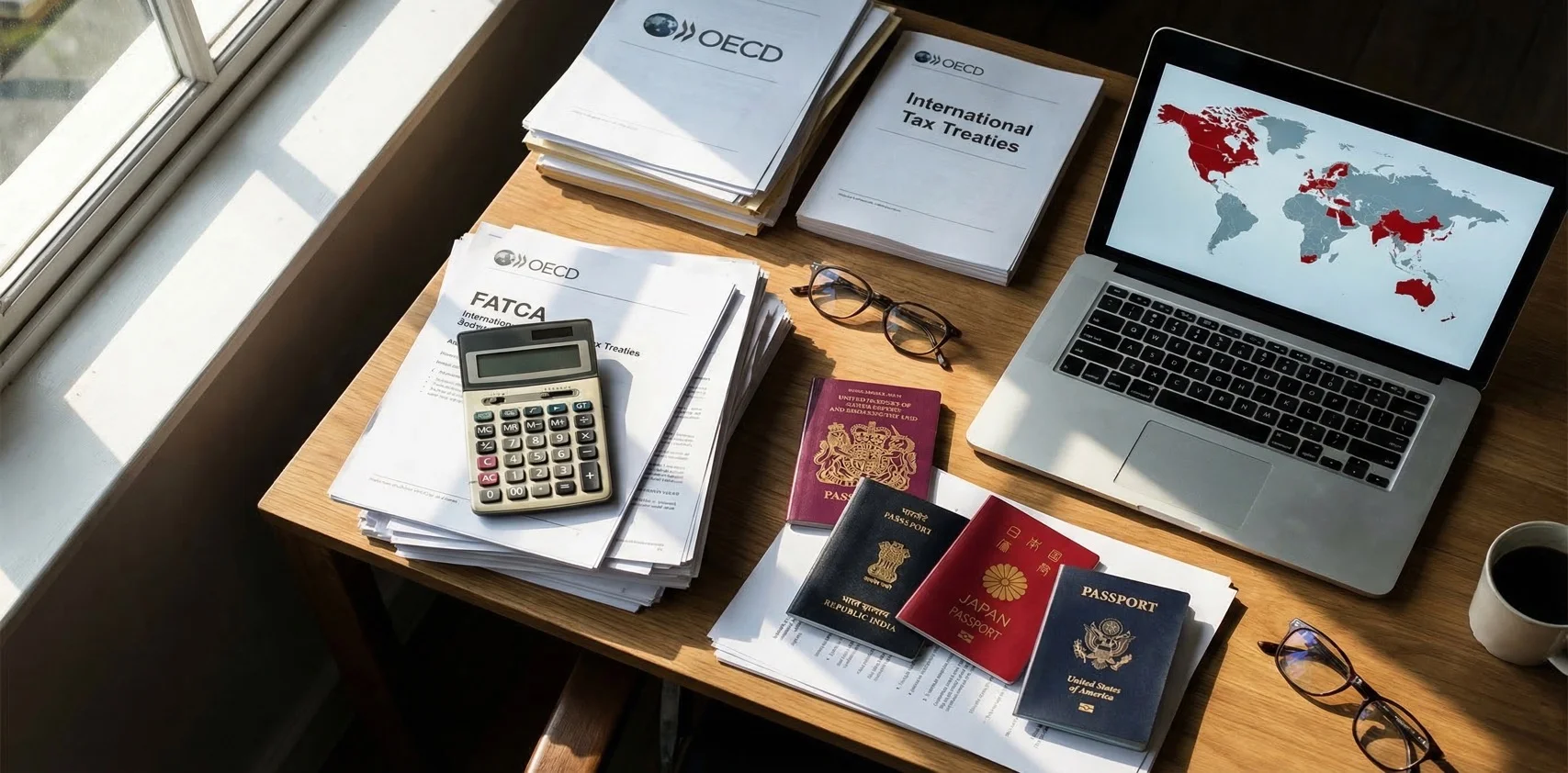
The Tax Traps Nobody Warns Digital Nomads About: The 183-Day Myth, Permanent Establishment Risks, and Cross-Border Landmines
In a co-working space in Lisbon's Bairro Alto district, a software engineer on a D7 visa has just wrapped up a standup call with his team in Silicon Valley. He's been in Portugal for nine months. His salary still hits his US bank account. He still files with the IRS. Everything seems fine—until a letter arrives from Portugal's tax authority, the Autoridade Tributária, demanding back taxes for two years at rates up to 48%. His mistake was a common one among digital nomads: assuming that once the visa was sorted, the legal work was done. A visa answers whether you're allowed to stay somewhere. Tax law answers who you owe money to. These are entirely different questions with entirely different logic—and confusing them can mean a six-figure tax bill. Sometimes, the consequences don't stop with the individual. The 183-Day Rule: A Line Far More Slippery Than It Looks Nearly every digital nomad has heard the "183-day rule": spend more than half the year in a country, and you become a tax resident subject to worldwide income taxation. The general idea is correct. The details are where it gets dangerous. Trap #1: It's not always a calendar year. Most people assume the 183-day count runs from January 1 to December 31. In some countries it does (the US has its own weighted formula under the Substantial Presence Test), but in popular nomad destinations like Greece, Portugal, and Spain, the threshold is calculated over any rolling 12-month period. A nomad could spend 120 days in 2025 and 100 days in 2026—safe by calendar-year math—but if those 220 days fall between July 2025 and June 2026, the threshold is triggered just the same. Trap #2: 183 days isn't the only criterion. Many countries apply a "tie-breaker test" that can establish tax residency even below the 183-day threshold. The factors typically include: Center of economic interest — Where is your primary income source? Where are your clients? Center of personal interest — Where does your spouse live? Your children? Your social network? Habitual abode — Where do you hold a long-term lease? Where is "home"? France is notoriously aggressive on this front. A person who spends only 140 days in France but whose spouse and children live in Paris may well be classified as a French tax resident. Trap #3: Once triggered, it's worldwide taxation. Being deemed a tax resident of Greece, for example, doesn't just mean paying tax on Greek-sourced income. Income from the US, Singapore, anywhere—salaries, investment gains, rental income—all falls within Greece's tax base at progressive rates of 9% to 44%. On top of that, you may owe Greek social insurance contributions (roughly 13.87% for the individual), and your employer could face an additional 22.29% in employer-side contributions. In 2023, a US tech company was hit with a €150,000 retroactive social insurance bill by Greek authorities after several of its employees had been working remotely from Greece for years without disclosure. Every one of those employees had assumed they were simply "Americans working abroad." Permanent Establishment: When Your Laptop Becomes a Corporate Tax Bomb The 183-day rule is a personal-level issue. Permanent Establishment (PE) is the corporate-level equivalent—and when it detonates, the numbers tend to be a hundred times larger. Under the OECD Model Tax Convention, a permanent establishment exists when a company carries on substantive business activity in a country through a fixed place or through a dependent agent. Traditionally, this meant offices, factories, branch locations—things with physical addresses. In the remote-work era, your apartment living room or a café table can potentially qualify as a "fixed place of business." The central question: when an employee works remotely from Country A for a company based in Country B, does that activity create a PE for the company in Country A? The answer typically depends on three dimensions: Nature of the role — Are you performing core commercial activities (negotiating, signing contracts, setting prices) or purely support work (writing code, designing interfaces)? Decision-making authority — Can you make binding commitments on the company's behalf? Duration and regularity — Is this a temporary business trip or an ongoing work arrangement? The Netflix India Case: A €2 Million Precedent In 2022, Netflix had no registered office in India but maintained employees there on a long-term basis who were involved in content acquisition and local partnership negotiations. India's tax authority determined these activities constituted "substantive operations"—even though the employees had no formal contract-signing authority. The result: Netflix was assessed approximately €2 million in corporate income tax for the period 2016–2020. Netflix argued that these employees were merely in "support roles" and that real decisions were made at US headquarters. India's position: your people are in India, doing work that serves the Indian market. That's operating in India. The case settled. But the precedent sent an unmistakable signal: in the remote-work era, "we don't have an office in that country" is no longer a shield. The Bosch Europe Case: From €1.4 Billion to €320 Million If the Netflix case was a warning bell, the Bosch case was an earthquake. In 2021, tax authorities across multiple EU countries launched a coordinated investigation into Bosch Group's cross-border employee work patterns. Senior employees had been working across several EU member states without the company declaring permanent establishments in those jurisdictions. The initial tax exposure estimate: €1.4 billion. After extensive negotiations and structural reorganization, the final figure came down to approximately €320 million. But the case made one thing abundantly clear: even a global corporation with €88 billion in annual revenue can face staggering tax liabilities from poorly managed cross-border work arrangements. For individual nomads, the takeaway matters: your remote work doesn't just affect your personal tax situation—it can drag your employer into a multinational tax dispute. This is precisely why a growing number of companies now explicitly restrict the countries where employees may work remotely. It's not about trust. It's that the moment you start typing in a café abroad, your company may have just created a tax obligation in a country it never intended to enter. The Risk Spectrum: Your Role Determines Your Danger Level Not all remote roles carry equal PE risk: Red zone (high risk): Sales directors (especially with contract-signing authority), business development leads, senior executives, anyone who negotiates on the company's behalf externally. Overseas activity in these roles almost inevitably triggers PE scrutiny. Yellow zone (moderate risk): Product managers, project leads, regional operations roles. Decision-making authority without direct external contract power—the widest gray area. Green zone (lower risk): Software engineers, designers, internal analysts, back-office staff. But "lower" doesn't mean "zero"—if you're the company's only employee in a given country, even writing code can be challenged in aggressive tax jurisdictions like India or Brazil. Double Social Security: One Paycheck, Two Bills Beyond income tax, social insurance is another money pit that catches nomads off guard. Social security operates on different logic than income tax. Income tax looks at where you're a tax resident; social security looks at where you physically work. These two answers frequently diverge—and when they do, two countries may simultaneously demand contributions. The worst scenario involves countries without bilateral agreements. The US has Totalization Agreements with approximately 31 countries, including the UK, Germany, France, Japan, South Korea, and Australia. With an agreement in place, you can obtain a Certificate of Coverage that exempts you from double contributions for up to five years. Without an agreement—the UAE, Thailand, Mexico, Brazil—you may owe both. US social security taxes run 12.4% (Social Security, capped at $168,600 in earnings) plus 2.9% (Medicare, uncapped), split between employer and employee. On a $120,000 salary, that's roughly $18,360. If the work country demands contributions on top of that, the combined burden can approach $30,000—more than a quarter of gross pay. Many nomads don't even know that Certificates of Coverage exist, and end up paying double for years. Worse, the application must be initiated by the employer, and many HR departments have little experience with cross-border social security. You may need to do the research yourself and push your company to act. Equity Compensation Across Borders: The Moment of Vesting Changes Everything For tech-industry nomads, RSUs (Restricted Stock Units) and stock options often represent a substantial portion of total compensation. And the cross-border taxation of equity awards is perhaps the most counterintuitive area in all of international tax. The key concept: RSUs are typically taxed at vesting, not at grant. But here's where it gets complicated—many countries assert taxing rights based on where you worked during the entire grant-to-vest period. Time apportionment is the standard approach. Suppose an RSU grant has a four-year vesting schedule. You worked in the US for the first two years, then moved to Portugal for the final two: The US may tax 50% of the vesting value (your two years on US soil) Portugal may also tax 50% (your two years as a Portuguese resident) If the bilateral tax treaty's credit mechanism doesn't align perfectly, you face double taxation A real case: a former Google engineer moved to Portugal and had approximately $300,000 in RSUs vest during his second year there. Portugal's tax authority classified him as a tax resident and applied the top marginal rate. The US also taxed the same income. Although foreign tax credits theoretically prevented double taxation, differences in calculation methods, recognition dates, and exchange rate conversions left him with roughly $40,000 more in actual tax than expected. Another trap: exit taxes. Certain countries—including the US (for those renouncing citizenship), Australia, and Norway—impose tax on unrealized capital gains when you leave. If you move to one of these countries holding substantial unvested equity, you may face an "early tax" upon departure. The smart move: before any cross-border relocation, review the vesting schedule for all equity compensation, assess each country's tax treatment, and negotiate timing adjustments with your employer if necessary. One Singapore-based engineer arranged to accelerate a large RSU vest before relocating to Europe, clearing the tax event in Singapore (which has no capital gains tax) and saving over $50,000. Labor Law Blind Spots: Your Contract May Not Mean What You Think Beyond taxes, labor law is a dimension that nomads routinely overlook. Most countries apply labor law on a territorial basis: regardless of which country's company you signed your contract with, if you're physically working in a given jurisdiction, local labor law may apply. What does this mean in practice? The "at-will employment" clause in your US contract—allowing either party to terminate the relationship at any time for any reason—may be effectively void in France. French labor law requires specific grounds for dismissal, lengthy notice periods, and statutory severance. If your company fires you under the terms of a US contract while you're working in France, a French labor court may rule the termination unlawful and order additional compensation. Similar gaps exist across Europe: Portugal: Termination requires 60 days' notice (increasing with tenure) and must be for "just cause" Spain: Unfair dismissal severance can reach 20 days' salary per year of service Germany: Dismissal protections for permanent employees are among the strictest in the world For nomads, this cuts both ways. On one hand, you may inadvertently gain stronger employment protections than your original contract provides. On the other, once your company realizes the legal exposure, it may prohibit you from working in that country—or worse, terminate your employment entirely. This is a key driver behind the rise of EOR (Employer of Record) services: a local EOR entity formally employs the worker, handles labor law compliance, social insurance, and payroll, while the parent company pays a service fee. For nomads, this is often the cleanest arrangement—provided the company is willing to bear the cost. A Practical Playbook: Seven Things You Can Do Today Enough about traps. Here's what to do about them. 1. Track your days The most basic, easiest, and most frequently neglected step. Use an app—TripIt, Nomad Tax Tracker, even a spreadsheet—to log your entry and exit dates for every country. Watch not just calendar years but rolling 12-month windows. When you approach any country's 183-day threshold, make a deliberate choice: stay and accept tax residency (if it's advantageous) or leave in time. 2. Be transparent with your employer Concealing your work location is the worst strategy. More companies now have formal cross-border remote work policies, and HR and legal teams can help assess risk. Early disclosure also gives the company time to arrange EOR services, apply for Certificates of Coverage, or adjust your work setup. 3. Know your equity timeline If you hold RSUs or options, review the vesting schedule before any international move. Consider whether key vests can be completed before relocation (especially when moving from a low-tax to a high-tax country), or whether plans need adjustment. 4. Check tax treaties Confirm whether your home country and destination country have a Double Taxation Agreement (DTA). A treaty doesn't eliminate tax obligations, but it typically defines priority taxing rights and credit mechanisms. The US has treaties with 60+ countries, the UK with 130+. 5. Keep every border-crossing record Passport scans, electronic boarding passes, lease agreements, utility bills, bank statements—all of these become critical evidence in a tax dispute. Build the habit of regular archiving. 6. Budget for professional advice Cross-border tax consultation typically runs $200–$500 per hour. That sounds expensive until you consider that a single tax dispute can involve tens or hundreds of thousands of dollars. Professional advice is strongly recommended if: your annual income exceeds $100,000, you have equity compensation, you plan to stay in a country for more than six months, or you've already received a notice from a tax authority. 7. Consider a short-stay rotation strategy If you'd rather not anchor to a single country, visa-free stays offer flexibility. Most countries allow 90-day visa-free visits; combined with a sensible rotation, you can maintain a nomadic lifestyle without triggering tax residency anywhere. But this requires discipline—and you need to maintain valid tax residency somewhere. Being a "tax ghost" (resident nowhere) is theoretically possible but practically high-risk: if challenged, multiple countries may simultaneously assert jurisdiction. The Price of Freedom Is Discipline Digital nomadism is an extraordinary way to work and live. But it doesn't exist in a legal vacuum. Your freedom of movement doesn't make tax authorities, labor regulators, or social insurance agencies disappear—if anything, it multiplies the number watching. The good news: as remote work becomes mainstream, the infrastructure is catching up. EOR services like Deel, Remote, and Papaya Global are making cross-border employment compliance more accessible. Tax advisors specializing in nomad clients are growing in number. Some countries—Portugal's former NHR regime, Greece's special tax programs—have even begun designing tax frameworks explicitly for mobile workers. But no tool, however good, removes your personal responsibility. Because when the tax notice arrives, it's addressed to you—not your visa agent, not your co-working space landlord, not the YouTuber who told you "just stay under 183 days." Do the homework. Ask the right questions. Get the right experts. Digital nomadism can be a brilliant adventure. It doesn't have to be a gamble on your tax bill.
April 10, 2026

Italy Is Using Digital Nomad Visas to Revive Its Ghost Towns — And It Might Actually Work
In Calabria, southern Italy, some villages have fewer than 200 permanent residents. Stone houses with half-collapsed roofs line empty piazzas. The only bar still open serves a handful of octogenarians. Italians have a word for these places: paese fantasma — ghost towns. There are thousands of them, scattered across the hills of Sicily, the valleys of Abruzzo, and the remote corners of Tuscany. Young people left decades ago for Rome, Milan, or further abroad. What remains are slowly dying communities and unclaimed properties. In February 2026, Italy launched a bold experiment: filling these voids with digital nomads. This isn't just another country jumping on the nomad visa bandwagon. It's a deliberate rural revitalization strategy — using the world's remote workforce to breathe life back into towns that are literally disappearing. The Visa: Visto per lavoratore da remoto Italy's digital nomad visa, officially called the "Visto per lavoratore da remoto" (remote worker visa), was legislated in late 2024 and began accepting applications in February 2026. The income threshold is surprisingly accessible: €2,500 per month. For context, Portugal's D8 visa requires four times the national minimum wage (roughly €3,400/month), and Spain's nomad visa demands 200% of the minimum wage (around €2,849). Italy sits in the middle — but given the dramatically lower cost of living in small Italian towns, the real purchasing power of that threshold is considerably higher than the numbers suggest. The visa is valid for one year and renewable. Holders must carry health insurance with at least €30,000 in coverage. Processing times are advertised at 30 to 60 days — ambitious by Italian bureaucratic standards. But the feature that truly distinguishes this visa from every other nomad permit in Europe is what happens when you choose to live somewhere small. The Rural Incentive: Population Density Below 160/km² Here's where Italy's approach diverges from the competition. Applicants who settle in municipalities with population density below 160 inhabitants per square kilometer receive two significant benefits: expedited processing and tax concessions. That 160-person threshold was carefully chosen. It excludes Rome, Milan, Florence, Naples, and their satellite cities. But it encompasses the vast majority of Italian towns facing depopulation — the very places that need new residents most. In other words, Italy isn't competing with Lisbon and Barcelona for the same pool of nomads who want nightlife, coworking spaces, and açaí bowls. It's targeting a completely different market segment: remote workers willing to trade urban convenience for stone farmhouses, olive groves, and a 5% flat tax rate. That tax rate deserves emphasis. Italy's standard income tax peaks at 43%, with even the lowest bracket at 23%. A 5% flat rate for new residents who choose low-density areas is an extraordinary incentive, particularly for nomads earning between €2,500 and €10,000 per month. Beyond the €1 House: A More Sophisticated Strategy Italy's €1 house programs made global headlines in recent years — municipalities in Sicily and Sardinia literally selling abandoned properties for a single euro, provided buyers committed to renovation within a set timeframe. The concept was viral, romantic, and mostly impractical. Renovation costs frequently exceeded €50,000, bureaucratic hurdles were significant, and many buyers discovered that a €1 house in a village with no grocery store and intermittent internet wasn't quite the dream they'd imagined. The digital nomad visa represents a more mature iteration of the same underlying goal. Rather than asking people to buy crumbling real estate sight unseen, it invites them to rent, to test, to experience. The barrier to entry is a monthly income and a laptop, not a renovation budget and a willingness to navigate Italian property law. It's also more sustainable. A €1 house buyer who completes renovation might visit twice a year. A digital nomad who falls in love with a village might stay for years — and spend locally every single day. The Competition Is Fierce Italy's visa doesn't exist in a vacuum. As of 2026, more than 65 countries offer some form of digital nomad permit, and the competition for remote workers has become a soft-power arms race. Portugal was an early leader, but its program has faced criticism for low retention rates. Many D8 visa holders use Lisbon as a base for Schengen access rather than genuinely integrating. The government has been tightening tax perks in response. Spain offers a three-year visa with the appealing Beckham Law (24% flat tax), but higher social security costs and recent income threshold increases have made it less attractive for mid-range earners. Croatia allows stays of up to 18 months and can be applied for online — appealing for simplicity, though the local infrastructure in smaller cities remains underdeveloped. Malta has raised its income bar, pricing out many independent freelancers. Italy's differentiation — the rural angle, the low threshold, the aggressive tax incentive for small-town settlement — is genuinely novel. No other country has so explicitly linked its nomad visa to regional development policy. What It Actually Looks Like on the Ground Imagine a UX designer from Toronto earning €4,000 per month from North American clients. In Lisbon, after rent, coworking, and daily expenses, she might save €500. In a village in Abruzzo — where a furnished apartment rents for €300-400 and a three-course lunch at the local trattoria costs €12 — she could save €2,000 while paying 5% income tax instead of Portugal's standard rates. She'd also have access to Italy's national healthcare system (with private top-up insurance), high-speed rail connections to Rome (Abruzzo is roughly 90 minutes east), and increasingly reliable fiber internet — Italy has been investing heavily in rural broadband as part of its National Recovery and Resilience Plan. The trade-offs are real: limited English-speaking social circles, fewer coworking options, and the adjustment to a pace of life that operates on its own timetable. But for nomads who've grown tired of the Bali-Lisbon-Medellín circuit, a stone house in a hilltop village with a view of the Adriatic might be exactly the reset they're looking for. The Bigger Picture: Nomad Visas as Population Policy Italy's approach signals a broader shift in how governments think about digital nomad programs. The first wave — Barbados, Estonia, Croatia — was about tourism revenue and international visibility. The second wave — Portugal, Spain, Greece — was about attracting tax-paying residents to bolster sluggish economies. Italy's is arguably the third wave: using nomad visas as targeted instruments of demographic policy. The country has one of the lowest birth rates in Europe (1.2 children per woman) and has been losing population since 2015. Rural depopulation is an existential crisis for hundreds of municipalities. Traditional immigration policy hasn't solved the problem — most immigrants, understandably, gravitate toward cities where jobs and services are concentrated. Digital nomads are different. They don't need local employment. They bring their own income. They need reliable internet, not a factory. And they're disproportionately drawn to exactly the qualities that small Italian towns have in abundance: authenticity, beauty, quiet, and affordability. Whether this experiment will succeed at scale remains to be seen. Italy's bureaucracy is legendary, and turning a visa policy into actual village revitalization requires more than tax incentives — it requires functioning schools, reliable healthcare, and local communities willing to welcome outsiders. But the concept is sound, the incentives are real, and for a certain type of digital nomad — one who's ready for slow travel, genuine integration, and the possibility of a €12 lunch that changes their life — Italy's ghost towns might just be the most compelling destination in the world right now. Key Details at a Glance Income threshold: €2,500/month (€30,000/year) Duration: 1 year, renewable Health insurance: €30,000 minimum coverage required Processing time: 30-60 days (advertised) Rural tax incentive: 5% flat rate for settlements in municipalities with population density < 160/km² Municipality registration: Within 8 days of entry Criminal record: Clean record required Competing visas: Portugal D8 (~€3,400/month), Spain DN (~€2,849/month), Croatia (18 months, online application), Estonia (1 year)
April 29, 2026

The EU's Entry/Exit System Is Live — The 90-Day Countdown Era for Digital Nomads
On April 10, 2026, the European Union's Entry/Exit System (EES) went fully operational across all Schengen Area borders. The familiar thud of a passport stamp — that ritual marking of arrival and departure — is now a relic. In its place: biometric data capture, facial recognition, and four-fingerprint scans feeding into a centralized database that tracks every non-EU traveler's movements with millisecond precision. For casual tourists, the change is procedural. For digital nomads who have spent years gaming the 90/180-day rule through strategic border hops, fuzzy passport stamps, and the general inconsistency of human border agents — it's a fundamental reset. The End of Analog Border Control The old system was charmingly low-tech. Border officers stamped passports on entry and exit. The stamps were often smudged, illegible, or inconsistently applied. Different countries had different standards. A traveler who spent 60 days in France and then crossed into Portugal faced a border agent who would need to manually flip through dozens of pages, identifying and tallying every Schengen entry and exit stamp — an exercise in futility during a busy shift. EES replaces all of this with a unified digital record. Upon first entry, the system captures a facial image and four fingerprints, creating a biometric profile. Every subsequent entry and exit is logged electronically and synchronized in real time across the entire Schengen zone. The system knows — precisely, automatically, unambiguously — how many days any given traveler has spent within Schengen during the rolling 180-day window. No more smudged stamps. No more human error. No more plausible deniability. 45 Million Crossings, 4,000+ Overstays: The Numbers Are In The system's effectiveness was evident almost immediately. EU officials reported that EES logged over 45 million border crossings in its initial period of operation and automatically flagged more than 4,000 overstay cases. Under the old regime, detecting overstays was essentially a manual process — and a deeply inconsistent one. Many overstayers simply walked through exit controls unchallenged. Even when caught, records often remained siloed within a single country's system. Now, overstay records are retained for five years and shared across the entire Schengen Area. A single overstay can trigger a multi-year entry ban. This isn't a gamble where you might get caught; it's a certainty. Airlines as the New Gatekeepers One of EES's most consequential changes is the shift of visa verification responsibility to airlines. Previously, a traveler's immigration status was primarily checked at the destination border. Under the new system, airlines must verify visa status and remaining days before boarding. If the system shows a traveler has exhausted their 90-day visa-free allowance, they won't be allowed on the plane. For digital nomads, this eliminates the "fly first, figure it out later" approach entirely. The system renders its verdict before takeoff. The Lisbon Nightmare: Five-Hour Queues and Summer Warnings The rollout has not been smooth. During EES pilot operations in December 2025, Lisbon airport experienced wait times exceeding five hours. Travelers were queued through the arrivals hall and out into the terminal corridors. Social media erupted with images of exhausted passengers sitting on floors, slumped against walls. The bottleneck was first-time registration. Every traveler new to EES needs to undergo full biometric enrollment — photo capture, fingerprint scanning, data verification. The process adds roughly one to two minutes per person, but multiplied across thousands of simultaneous arrivals, minutes became hours. Lisbon wasn't alone. Multiple major European airports reported similar delays. EU officials acknowledged the transition difficulties but argued that processing times would improve significantly as more travelers completed their initial registration — subsequent border crossings require only a quick biometric match rather than full enrollment. Industry analysts, however, warn that the approaching summer travel season could see a repeat performance. Peak-period wait times at some airports could reach five to six hours. For anyone planning European travel this summer, generous layover times are no longer optional — they're essential. The 90/180-Day Rule: No More Fuzzy Math For digital nomads, EES's most immediate impact is the iron-fisted enforcement of the Schengen Area's 90/180-day rule: a maximum of 90 days within any rolling 180-day period. The rule sounds simple but is notoriously difficult to calculate manually. The 180-day window is rolling, not calendar-based. Every single day, the system looks back 180 days and counts. Under the old system, this calculation was left to travelers and border agents — both frequently got it wrong. Nomads had developed an array of workarounds: The "border bounce" is dead. Some nomads would exit Schengen as their 90 days approached, spend a few days in a non-Schengen country, and re-enter hoping for a "reset." With human agents, this sometimes worked because officers didn't always scrutinize historical stamps. EES tracks every crossing with precision — there's nowhere to hide. Fuzzy dates are gone. Some travelers exploited inconsistent stamping at land borders, particularly at less rigorous checkpoints in Eastern Europe, to obscure their actual time in-country. Electronic records eliminate this entirely. The "lenient country" myth is over. Different Schengen states historically varied widely in their enforcement of overstay rules. Nomad forums buzzed with advice on which countries "didn't really check." EES creates a unified standard — an overstay is an overstay regardless of which border you cross. Digital Nomad Visas: From Nice-to-Have to Non-Negotiable EES may prove to be the tipping point that transforms digital nomad visas from an optional convenience into an absolute necessity. In recent years, countries across Europe have rushed to launch nomad visa programs — Portugal, Spain, Greece, Croatia, Italy, and more. But for many nomads, these visas felt redundant: why bother with paperwork and fees when 90 visa-free days were enough for a comfortable stint? EES changes the calculus entirely. When the 90-day limit is enforced with automated precision and overstays carry five-year records plus potential entry bans, a digital nomad visa becomes the only legal pathway for extended stays in Europe. The ripple effects are significant. Application volumes for nomad visas across Europe are expected to surge, potentially lengthening processing times. Countries with established programs (Portugal, Estonia) will likely see increased demand, while those still refining their processes (Greece) may face growing pressure. For nomads, planning horizons must extend dramatically. The "show up and figure it out" approach is obsolete. Visa applications require preparation — proof of income, health insurance, accommodation evidence — and these take time to assemble. Spontaneous nomadism in Europe is becoming a thing of the past. Rethinking Mobility Strategies EES forces a wholesale rethinking of how nomads structure their movements: Schengen/non-Schengen rotation. The most straightforward adaptation is alternating between Schengen and non-Schengen destinations. Approaching the 90-day limit? Move to Turkey, the UK, or the Western Balkans, wait for the 180-day window to refresh, then return. This pattern existed before EES, but it's now shifted from "best practice" to "only compliant option." The home-base approach. More nomads may pursue legal residency in a single Schengen country — whether through a nomad visa or another route — using it as a base for free movement throughout the zone. With legal residency, the 90/180-day restriction no longer applies, since movement occurs as a resident rather than a visa-free visitor. Rediscovering Eastern Europe and Central Asia. Higher barriers to Schengen access could accelerate exploration of alternative destinations. Georgia (one year visa-free for many nationalities), Turkey, Montenegro, Albania, and even Central Asian countries like Kazakhstan and Uzbekistan stand to benefit. Southeast Asia's continued appeal. For Asia-Pacific nomads in particular, destinations like Thailand, Indonesia (Bali), and Malaysia offer more relaxed terms through their own nomad visa programs. EES may prompt some nomads to reconsider whether the cost and effort of European compliance is worthwhile compared to more welcoming regions. The Privacy Question EES hasn't launched without controversy. European civil liberties organizations have raised persistent concerns about the mass collection of biometric data from millions of non-EU citizens. The system creates a vast database of facial images and fingerprints. The EU maintains that data is used strictly for border management, but history suggests that large-scale databases tend to find expanded purposes over time. For nomads, there's also a psychological dimension. Europe has long been romanticized as the ultimate nomad playground — culturally rich, well-connected, high quality of life. But the introduction of biometric tracking, combined with stricter stay enforcement, may leave some nomads feeling surveilled rather than welcomed. Whether this shifts Europe's desirability as a destination remains to be seen. ETIAS: The Next Wave Is Coming It's worth noting that EES is just the first phase of the EU's border digitization strategy. The European Travel Information and Authorisation System (ETIAS) — similar to the US ESTA — is expected to follow soon. ETIAS will require visa-exempt travelers to apply online before departure, pay a fee, and undergo a security background check. Even with a visa-free passport, the days of truly spontaneous European travel are numbered. Together, EES and ETIAS represent a fundamental shift in how Europe manages its borders. The message to nomads is clear: the barriers to entering Europe are rising systematically, and this trend will not reverse. A Practical Action List Facing the new EES reality, digital nomads should take concrete steps: Track days precisely. Use dedicated apps or tools to calculate the rolling 90/180-day window. Memory and rough estimates are no longer sufficient. Tools like Schengen calculators should be standard equipment. Plan visas early. If planning to stay in Europe beyond 90 days, start researching nomad visas immediately. Compare thresholds, costs, processing times, and benefits across countries. Allow generous airport time. Especially during summer peak season, allow at least three to four hours for immigration processing. Ensure layover times can absorb potential delays. Maintain personal travel records. While EES tracks automatically, keeping personal backups — flight tickets, accommodation confirmations, entry/exit records — provides valuable evidence in case of disputes. Consider the home-base strategy. Evaluate whether obtaining formal residency in a Schengen country makes sense as a foundation for long-term European life. The upfront investment is higher, but the long-term stability may be worth it. The End of an Era, the Start of Another The full activation of EES marks a subtle but significant turning point for European travel freedom. The era of wandering through Europe on little more than a visa-free passport and a sense of adventure is fading. But this isn't the end of digital nomadism in Europe. If anything, it may be the catalyst that pushes the nomad ecosystem toward maturity. When guerrilla-style stays become untenable, more people will pursue legitimate pathways — nomad visas, formal residency, bilateral agreements. This could ultimately drive countries to offer more comprehensive support systems for nomads, including clearer tax frameworks, easier banking access, and better-defined legal status. The 90-day countdown is now managed by machines, tracking every entry and exit with unfailing precision. For nomads, this isn't cause for panic — it's a call to take the rules seriously. Europe remains beautiful. Europe remains worth visiting. But from now on, staying requires smarter planning. The clock is ticking — and on the other side of the screen, EES is counting every single day.
April 28, 2026

The Financial Architecture of a One-Person Company: How Nomads Can Legally Optimize Taxes Without Stepping on Mines
Disclaimer: This article is for informational purposes only and does not constitute tax, legal, or financial advice. Individual tax situations vary based on nationality, residence, and income sources. Always consult a licensed tax advisor or accountant. Information verified as of March 2026; policies may change at any time. In digital nomad circles, "where is your company registered?" has replaced "where are you working from?" as the most common icebreaker. Not because everyone has an unusual passion for corporate law, but because for an independent worker with no fixed office and clients scattered across the globe, the choice of company jurisdiction directly determines how much of your income goes to the government each year. But there's a critical premise to establish first: legal tax optimization and tax evasion are two completely different things. Tax optimization means choosing the most advantageous structure within the law. Tax evasion means hiding income or fabricating expenses. The former is your right. The latter lands you in prison. This article deals exclusively with the former. Tax Residency: Where It All Begins Before discussing companies, you need to answer a more fundamental question: where are you a tax resident? The answer determines which country you must report your worldwide income to. Most countries use the "183-day rule"—if you spend more than 183 days in a country within a year, you're generally considered a tax resident there. For digital nomads, this rule is both a constraint and an opportunity. If you don't spend more than six months in any single country, you might technically not be a tax resident anywhere. But "technically not" doesn't mean "legally exempt"—your country of citizenship (especially if you hold a US or Eritrean passport) may tax worldwide income regardless of where you live. Even if you're not a citizen of these two countries, your home country may have extended tax residency rules that apply after departure. Bottom line: don't be your own tax lawyer. Hire an accountant who specializes in cross-border personal taxation and confirm your tax residency status. That consultation fee is the best investment you'll make. Estonia's e-Residency: The Lowest Barrier to an EU Company Estonia's e-Residency program is the most discussed option in nomad circles for a simple reason: it lets you establish an EU company without ever setting foot in Estonia. According to the official e-Residency website, since January 2025, the application fee for the e-Residency digital identity is a flat €150 (previously varied by pickup location). The application is completed entirely online and typically takes three to eight weeks. Once you receive your digital identity, you can establish an Estonian OÜ (private limited company) through authorized service providers. The minimum share capital is €2,500, which doesn't need to be paid in immediately but must be declared in the company's articles. The headline feature of Estonia's corporate tax system: retained profits are not taxed—only distributed profits are. According to PwC's Tax Summaries, since January 2025, the corporate income tax rate on distributed profits is 22/78 (approximately 22%), up from the previous 20/80. This means if you keep profits in the company for reinvestment, operational costs, or savings, your effective tax rate is zero. Tax only kicks in when you withdraw money as dividends. But e-Residency isn't a free lunch. Annual maintenance costs include: registered address service (€30-60/month), accounting services (€50-150/month depending on transaction volume), and annual report filing fees. All told, a low-volume Estonian company costs roughly €1,500-3,000 per year to maintain. One crucial point: e-Residency is not a residence permit and does not change your personal tax residency. It's a digital identity for remotely managing an Estonian company. Your personal tax obligations are still determined by where you actually live. (Sources: e-resident.gov.ee official website; PwC Tax Summaries - Estonia) Dubai Free Zones: Zero Personal Income Tax, but Not Cheap The UAE is another wildly popular option among nomads, and the biggest draw is straightforward: personal income tax is zero. No matter how much you earn, you personally pay no income tax. But it's not that simple. Since June 2023, the UAE has imposed corporate income tax. Per the Federal Tax Authority, corporate profits exceeding AED 375,000 (approximately USD 102,000) are taxed at 9%. However, if your company is registered in a qualifying free zone and your income qualifies as "Qualifying Income" (primarily meaning no transactions with UAE mainland entities), qualifying income remains at 0%. First-year total costs for a Dubai free zone company range from approximately AED 20,000 to 80,000 (roughly USD 5,500-22,000), depending on the zone, including trade license, registration fees, visa applications, medical tests, and office space. For freelancers, some free zones offer Freelancer Permits starting at AED 7,500-15,000 per year (approximately USD 2,000-4,100), a lower-cost entry point. Dubai's advantages are zero personal income tax and a relatively straightforward compliance environment. Its disadvantages are high living costs (rent, insurance, and daily expenses far exceed Southeast Asia) and the requirement to spend a certain number of days in the UAE annually to maintain your residence visa. (Sources: UAE Federal Tax Authority tax.gov.ae; SafeLedger 2026 Dubai Free Zone Cost Guide) Singapore: Asia's Business Hub for Those with Scale Ambitions If your clients are primarily in Asia-Pacific, or you expect your business to grow into something requiring a more formal corporate structure, Singapore deserves serious consideration. According to the Accounting and Corporate Regulatory Authority (ACRA), the official fee for registering a Singapore Private Limited Company (Pte Ltd) is S$315 (including S$15 for name application and S$300 for incorporation). Foreign individuals must use an ACRA-registered filing agent, appoint at least one Singapore-resident director, and designate a Singapore-resident company secretary within six months. If you're not in Singapore, you'll typically use a Nominee Director service at approximately S$2,000-4,000 per year. Including registered address, company secretary, and basic accounting services, first-year total setup and maintenance costs run approximately S$3,000-8,000 (roughly USD 2,200-6,000). Singapore's headline corporate tax rate is 17%, but new companies receive significant relief. Under the Start-Up Tax Exemption Scheme (SUTE) from the Inland Revenue Authority of Singapore (IRAS), qualifying new companies enjoy partial exemption for their first three assessment years: 75% exemption on the first S$100,000 of chargeable income and 50% on the next S$100,000. This means if your annual profit is under S$100,000, your effective tax rate is approximately 4.25%. Additionally, for the 2026 assessment year, Singapore is offering a 40% corporate income tax rebate. Singapore's advantages lie in its international reputation and banking infrastructure—opening a bank account for a Singapore company is relatively smooth, which is not always the case in other "tax-friendly" jurisdictions. Its disadvantages include higher compliance costs, and if you want to use it as a basis for an Employment Pass, the minimum qualifying salary for 2026 has increased to approximately S$5,600+. (Sources: ACRA BizFile+; IRAS official website; PilotoAsia 2026 Singapore Incorporation Guide) Banking Strategy: The Most Underrated Piece Many people spend extensive time researching where to register their company but overlook a more practical question: where does your money live? Opening cross-border bank accounts is notoriously difficult for digital nomads. Traditional banks are wary of clients with "no fixed address and global operations"—a high-risk indicator under anti-money laundering (AML) frameworks. The pragmatic approach is a three-tier account structure: Tier 1 is your company's bank account in the registration jurisdiction (e.g., LHV Bank for Estonia, a local bank for Singapore) for receiving client payments and covering operational expenses. Tier 2 is an international fintech platform (Wise Business, Mercury, Payoneer) for multi-currency transactions and exchange rate conversion. Tier 3 is your personal account in your home country for receiving dividends or salary. This three-tier structure ensures you can handle global payments smoothly while staying compliant. Cross-Border Invoicing and Contracts When your company is in Country A, your client is in Country B, and you're physically in Country C, invoicing and contracts require extra care. A few fundamentals: First, invoices must be issued under your company's name, not personally—this is the baseline requirement for maintaining separation between corporate and personal finances. Second, contracts should specify governing law and dispute resolution mechanisms—usually the law of your company's jurisdiction or a mutually agreed third-party arbitration. Third, maintain complete transaction records and payment documentation, not just for tax filing but to clearly demonstrate income sources and flows if audited. Quick Comparison Estonia suits nomads with lower revenue (USD 30,000-100,000 annually), European clients, and no need for residency rights. It has the lowest barrier to entry. Dubai suits higher earners willing to absorb higher living costs who want zero personal income tax, especially those serving Middle Eastern or global markets. Singapore suits nomads with medium-to-long-term growth plans, Asia-Pacific clients, or a need for a company entity with strong international credibility. There's no "best" option—only the one best suited to your current situation. And as your business grows and life circumstances change, your optimal choice may shift too. Starting with an Estonian company for a year, then migrating to Singapore once revenue stabilizes, is a perfectly reasonable path. A Final Reminder This article provides a framework, not a step-by-step manual. Tax law is among the most complex legal domains in the world, and every country's rules are in constant flux. What's accurate in March 2026 may be outdated by year-end. Before making any decisions, consult a professional cross-border tax advisor. That consultation fee of a few hundred to a few thousand dollars could save you tens of thousands in tax risk—or spare you an unpleasant letter from the tax authority.
April 6, 2026

Your VPN Is Not an Invisibility Cloak: The Labor Law Grey Zone of Remote Work
There is a belief circulating through digital nomad communities with the persistence of urban legend: "Keep your VPN connected to your employer's country, and legally, you're working there." It gets repeated on Reddit threads, in coworking space happy hours, and across Slack groups for remote workers as though it were a proven compliance strategy. It has never been one. A VPN encrypts network traffic and swaps the user's IP address for one belonging to the VPN server's location. What it does not—and cannot—alter is the physical coordinates of the person using it. Labor law, tax law, and social security law have never cared which node a data packet exits from. They care about which country the worker is sitting in. A software engineer writing code for a San Francisco startup from a coworking space in Bangkok is working in Thailand, regardless of whether the VPN endpoint is in Silicon Valley, Tokyo, or Reykjavik. That is the only fact that matters to the law. The reason this issue deserves serious attention is not moral. It is about the scale of consequences. An employee might receive an unexpected tax assessment from a country they never filed in. An employer might face a corporate income tax bill from a jurisdiction where they have never registered a single entity. And this grey zone is narrowing fast—governments around the world have started to act. What follows is the legal reality that a technical illusion has been obscuring. The Limits of What a VPN Can Do Start with the technical facts. A VPN (Virtual Private Network) performs two core functions: encrypting the network connection and replacing the user's IP address with one from the VPN server's location. This allows someone sitting in a Chiang Mai café to make their traffic appear as if it originates in New York, bypassing streaming geo-restrictions or securing sensitive communications on public Wi-Fi. These are legitimate uses. They are also the full extent of what a VPN was designed to do. The problem emerges when people extrapolate from "a VPN can change the geographic tag on an IP address" to "a VPN can change one's legal location." This leap fails on technical grounds and collapses entirely under legal scrutiny. Tax residency follows the person, not the packet. The vast majority of the world's tax systems determine tax residency based on physical presence—specifically, days spent within a country's borders. The OECD Model Tax Convention sets the threshold at 183 days: exceed that in a single tax year, and the country gains the right to tax global income. Whether an IP address appears to originate from the Arctic or the equator carries zero weight in any tax authority's assessment. Labor law applies where work physically occurs. When a person performs work within a country's borders, that country's minimum wage rules, overtime regulations, paid leave entitlements, and dismissal protections may all automatically come into effect. The trigger is not where the contract was signed or where the company is headquartered. It is where the keyboard is being pressed. An employer's compliance obligations are not waived by ignorance. Across the entire spectrum of cross-border remote work risks, this is the point most frequently underestimated and most severe in its consequences. Permanent Establishment: A Tax Bill from a Country You've Never Registered In International tax law contains a concept that keeps cross-border corporate legal teams awake at night: Permanent Establishment (PE). The logic is disarmingly straightforward. If a company's employee works in a given country on a sustained basis, the tax authority of that country may determine that the company has established a PE there—even if the company has no office, no registration, and no knowledge that its employee is physically present in that jurisdiction. The consequence: corporate income tax liability. The case law is accumulating rapidly. In 2024, Germany's Federal Fiscal Court (Bundesfinanzhof) issued a landmark ruling. A developer employed by a UK software company had been working remotely from Berlin for over 12 months. The court ruled that the company constituted a permanent establishment in Germany. The combined corporate income tax and late-payment penalties totaled approximately €420,000. The company argued that the employee had chosen to work from Berlin independently and that no such arrangement had been requested or approved. The court rejected this defense, noting that the company "knew or should have known" the employee's work location, and that the employee's output formed part of the company's core business activity. In 2025, the French tax authority (Direction générale des finances publiques) reached a similar conclusion regarding a US marketing firm. Three of its employees had been working remotely from Paris, Lyon, and Nice, accumulating over 500 combined work days in France. The authority determined that a permanent establishment existed and assessed corporate income tax and VAT totaling approximately €380,000. The message these cases send is unambiguous: wherever an employee opens a laptop, they may be creating a tax liability for their employer. A VPN changes the routing path of data packets. It does not change the boundaries of tax jurisdiction. Social Insurance: The Hidden Bill in Cross-Border Employment Permanent establishment risk primarily hits the employer. Social insurance obligations hit both sides—employer and employee alike. Most European countries explicitly require employers to pay social insurance contributions for employees who physically perform work within their borders, regardless of whether the employer is registered in the country. A US tech company with an employee actually working in France faces potential claims from French social security authorities for French social insurance contributions, even if the company has never had so much as a mailing address in France. A 2025 case put concrete numbers to this abstract risk. The Dutch Social Insurance Bank (SVB) issued a collection notice to an Irish tech company, demanding back payment of social insurance contributions for two employees who had been working remotely from Amsterdam for over a year. The amount: approximately €18,000 per employee per year. The Irish company had been entirely unaware of this obligation until the notice arrived. Within the EU, cross-border social insurance is governed by the EU Social Security Coordination Regulation (EC 883/2004). Its core principle: workers are covered by the social security system of the country where they work, provided at least 25% of their work occurs in their country of residence. This framework was designed to prevent double contributions, but it begins to break down when applied to digital nomads who change countries every few months and lack a fixed place of residence. Outside the EU, the situation grows murkier. Bilateral social security agreements have limited coverage, and many country pairs have no agreement at all. A German citizen working remotely from Thailand could theoretically be liable for social insurance in both countries, with no treaty mechanism to resolve the overlap. Governments Are Already Moving None of this is hypothetical. Multiple countries have moved from theoretical enforcement to systematic action. Portugal: auditing digital nomad visa holders. In 2024, Portuguese tax authorities launched a cross-referencing audit of digital nomad visa holders. The findings were striking: over 60% of foreign nationals holding nomad visas had never filed a single income declaration in Portugal. Hundreds of supplementary tax assessments followed, demanding payment at the Non-Habitual Resident (NHR) rate of 20%. That rate is far below Portugal's top marginal rate of 48%, but for nomads who believed they owed nothing, the bills still came as a shock. Spain: a dedicated program targeting undeclared remote workers. In 2025, Spain's tax authority (Agencia Tributaria) launched "Proyecto Nomada," a targeted enforcement initiative aimed at foreign remote workers who were physically residing in Spain and using public services without filing local tax returns. Tracking methods included social media geotags, coworking space membership records, and bank account transaction locations. By the end of 2025, over 1,200 supplementary tax notices had been issued, with total recoveries exceeding €20 million. Australia: the tax office explicitly debunks VPN compliance. In 2025, the Australian Taxation Office (ATO) updated its tax guidance with unusually direct language: "The country whose IP address you use to connect to the internet is irrelevant to your tax residency status. The ATO uses multiple methods to determine your actual place of residence, including but not limited to bank transactions, rental agreements, flight records, and social media activity." The statement reads as though it was written specifically to address the VPN compliance myth. Thailand: the legal framework is in place; enforcement is a matter of timing. Since 2024, Thailand has imposed income tax on foreign-sourced income remitted into the country for foreign nationals who stay more than 180 days. Enforcement remains relatively relaxed for now, but the legal architecture is fully operational. Nomads who remain in Thailand on tourist visas while performing remote work now face a tax mechanism that can be activated at any time. Indonesia: Bali tightens tax oversight on nomads. In late 2024, Bali introduced a digital nomad visa variant (B211A category) that requires holders to pay local income tax. By mid-2025, Indonesia's tax directorate began collaborating with immigration authorities to cross-reference visa records against tax filings, actively pursuing foreign remote workers on tourist visas who had never declared income. These cases share a structural characteristic: no country identified nomads through their VPN usage records. They relied on financial transaction data, visa entry-exit records, property lease agreements, and social media location footprints—information that is already highly digitized and easily cross-referenced. The single layer of IP address concealment that a VPN provides is virtually no barrier against these tracking methods. The trend is clear: tax enforcement against digital nomads has shifted from "theoretically possible" to "systematically implemented." EOR Platforms: How Much Protection Does the Umbrella Actually Provide? Faced with the legal labyrinth of cross-border employment, Employer of Record (EOR) platforms have become the default solution for many companies and remote workers. Deel, Remote, Oyster, and Papaya Global are names that have become nearly synonymous with "compliance" in nomad communities. An EOR operates by establishing local legal entities in target countries, hiring workers as the nominal employer, and handling payroll, tax withholding, and social insurance contributions. The worker still performs tasks for the original company but is legally employed by the EOR's local entity. The model works well under certain conditions. But its coverage is narrower than most users assume. Country coverage has gaps. An EOR's compliance capability depends on having legal entities in each country. Major platforms cover roughly 100 to 150 jurisdictions—not all of them. A remote worker who is compliantly employed through Deel in Portugal and then relocates to Croatia, where Deel has no local entity, sees their compliance status break immediately. Personal tax obligations are out of scope. EOR platforms handle employment-side taxes—payroll tax, social insurance—but an individual who qualifies as a tax resident in a given country may have separate obligations to report global income, including investment returns, rental income, and cryptocurrency gains. EOR services do not touch these. Frequent moves trigger steep switching costs. Each time a worker changes countries, the EOR typically needs to conduct a new compliance assessment and transition to a different local entity, at a cost of $2,000 to $5,000 per switch, with timelines stretching from weeks to months. For someone who changes countries every quarter, this becomes not just an administrative burden but a significant financial one. Some countries do not recognize the EOR legal framework at all. In 2025, a Brazilian labor court ruled that the relationship between an EOR platform and a foreign employee it had "hired" did not constitute genuine employment. The court found that all work instructions, performance evaluations, and daily management came from the actual employer—a US software company—while the EOR served as nothing more than a pass-through entity. The arrangement was classified as "fraudulent employment" (fraude trabalhista), and the actual employer was ordered to assume full labor law obligations. EOR platforms genuinely serve their purpose for remote workers who remain in one or two countries over extended periods. But for high-frequency movers who change time zones every three months, the protection on offer may be considerably thinner than expected. "Just Switch to Contractor Status": A Shortcut Full of Landmines Converting an employment relationship to an independent contractor arrangement is another widely circulated compliance shortcut in nomad circles. The reasoning sounds clean: if the worker is a contractor rather than an employee, the employer avoids permanent establishment risk and foreign social insurance obligations. The path looks open. In practice, it is lined with landmines on both sides. Globally, enforcement against misclassification—labeling employees as independent contractors to avoid employer obligations—is escalating rapidly. The core legal test is intuitive: if a person has fixed working hours, uses company-provided tools, and takes direction from a specific manager, they are an employee in the eyes of the law, regardless of what the contract says on its cover page. In 2024, the EU passed the Platform Workers Directive, establishing a legal presumption that platform workers are employees unless the hiring entity can prove otherwise. The directive primarily targets gig economy platforms like Uber and Deliveroo, but its legal reasoning applies directly to contractor arrangements in remote work contexts. Spain has gone further. The "Rider Law" (Ley Rider), passed in 2023, saw its presumption logic extended by the Labor Inspectorate in 2025 to non-platform settings, with investigations targeting foreign companies using contractor agreements to circumvent employment obligations. In the United States, California's AB5 law (effective 2020) applies a strict ABC test that has reclassified large numbers of previously independent contractors as employees. New York and Illinois introduced similar legislation in 2025. Independent contractor status is legitimate and appropriate in specific circumstances: workers who control their own schedules, use their own equipment, serve multiple clients simultaneously, and bear genuine business risk. But when the actual working relationship looks like employment in every dimension, a contract header reading "Independent Contractor" will not override what the law observes in practice. How Large Can the Bill Get? When things go wrong, the costs are worth laying out in full. For employees, the most immediate impact is tax recovery. Being classified as a tax resident in a country where no returns were ever filed results in back taxes, late fees, and penalties. In most European jurisdictions, penalties for tax fraud can reach 200% of the unpaid amount, with severe cases carrying criminal liability. For employers, the exposure is broader. A permanent establishment determination can trigger years of retroactive corporate income tax. Social insurance violations generate steep fines and back-payment demands. Labor law non-compliance can result in employment contracts being voided by courts, setting off a cascade of downstream legal liabilities. A 2025 case illustrates the scale: a mid-sized US SaaS company had 12 employees working remotely across 8 European countries. Germany, France, and the Netherlands initiated investigations almost simultaneously. The combined tax, social insurance, and penalty claims across the three countries exceeded €2 million. The company ultimately settled, but the process took over 18 months, and legal and compliance consulting fees consumed an additional €500,000. For smaller companies or individual workers, a financial hit of this magnitude can be existential. Even when the final settlement remains manageable, the time, energy, and reputational damage consumed by the process alone can be enough to cripple an otherwise healthy business. These risks are not confined to Europe. As tax authorities worldwide improve their digital auditing capabilities and cross-border information exchange mechanisms mature, enforcement cases in Asia, Latin America, and the Middle East are increasing year over year. The legal compliance risk facing remote workers is a global structural issue. No Perfect Solution, but Smarter Paths Exist An honest acknowledgment first: in 2026, this problem has no perfect answer. International tax and labor law were built on the foundational assumption that people live and work in fixed locations. Digital nomadism has broken that assumption, but the legal system's update cycle runs far slower than changes in how people choose to live and work. The result is a landscape of contradictory rules and inconsistent enforcement standards. Here are the currently viable paths forward, each carrying its own trade-offs. Path one: establish a home base and comply fully. Obtain tax residency in one country, pay local taxes and social insurance, and conduct cross-border movement within the legal framework of "business travel." This is the most conservative and most defensible approach. The cost is sacrificing most of the geographic flexibility that defines nomadic life. Path two: use an EOR to cover primary locations. If the movement pattern is predictable—say, rotating among three or four countries each year—establishing compliant employment through an EOR in those countries is a viable option. The trade-off is administrative complexity and the cost of each country switch. Path three: operate as a genuinely independent contractor. This requires that the work arrangement authentically meets the legal definition of contracting: control over working hours, use of personal equipment, multiple concurrent clients, and assumption of business risk. Both the contract language and the actual working relationship must support this classification. Personal tax filing obligations in the country of tax residence still apply. Path four: leverage digital nomad visas. As of 2026, more than 50 countries and territories offer visa programs specifically designed for remote workers, typically providing one to two years of residence permission with varying degrees of tax incentive. The limitation is that each program has its own qualifying conditions, and a single-country visa solves compliance for only that country—it does little to address the complexity of multi-country movement. No single path covers every scenario. But the most dangerous strategy of all is pretending these issues do not exist and placing one's trust in a VPN application. Four Forces Reshaping the Playing Field Some might argue that actual enforcement cases remain relatively rare. In statistical terms, this is currently true. But four forces are rapidly shifting that equation. First, cross-border financial information exchange has reached maturity. The OECD's Common Reporting Standard (CRS) has enabled automatic exchange of financial account information across more than 100 countries and territories. A bank account opened in Portugal by a nomad may already have its balance and transaction history sitting quietly in the tax authority database of the nomad's home country. Second, digital footprints are nearly impossible to erase completely. Instagram geotags, coworking space membership swipes, credit card transaction GPS coordinates, flight booking records, even LinkedIn location updates. Spain's "Proyecto Nomada" has already demonstrated how tax authorities can assemble these scattered digital fragments into a precise map of an individual's movements. Third, government fiscal pressure continues to mount. Post-pandemic public debt sits at historic highs, and identifying new revenue sources is a priority on every finance minister's desk. A population of high-income foreign workers who consume local services and infrastructure without contributing any tax revenue is among the most visible—and easiest to target. Fourth, the nomad population has grown too large to ignore. When a few thousand people live and work this way, governments have no economic incentive to invest administrative resources in tracking them down. When the number reaches millions, it becomes a systemic tax base erosion problem that every country's finance ministry must address head-on. The Risk Is on the Table This article is not intended to discourage anyone from pursuing the freedom that remote work offers. Nor does it constitute legal advice—individual tax planning and labor law decisions should involve qualified lawyers and tax advisors with cross-border expertise. What it aims to dismantle is a dangerous illusion spreading through nomad communities: that a technical tool can substitute for legal compliance. A VPN is an excellent privacy tool. It is not a legal invisibility cloak. The geographic freedom that digital nomadism provides is real and worth pursuing. But sustaining that freedom requires not technical evasion, but a clear-eyed understanding of the legal landscape and deliberate, calculated choices within the grey zones. Every person who opens a laptop to work in a foreign country simultaneously creates a specific set of legal obligations. Those obligations do not disappear when ignored. They surface at the least convenient moment. The risk is on the table. How to respond is each person's own judgment call.
April 30, 2026

Why Taiwan Is the Best-Kept Secret for Muslim Digital Nomads
When Muslim digital nomads scout for a base in the Asia-Pacific, the usual suspects dominate the conversation: Bali for its beaches and bargain living costs, Kuala Lumpur for its halal-everything convenience, Bangkok for its affordability and coworking scene. Taiwan rarely makes the shortlist. That may be a mistake. In the Mastercard-CrescentRating Global Muslim Travel Index (GMTI), Taiwan has ranked among the top three non-OIC (Organisation of Islamic Cooperation) destinations for several consecutive years. It placed second in 2022, third in 2023, and maintained a top-tier position in 2024, alongside Singapore and Hong Kong. In 2023, Taipei was awarded "Most Promising Muslim-Friendly City Destination of the Year (non-OIC)" at the Halal in Travel Global Summit organized by CrescentRating. For a place where Muslims account for less than one percent of the population, these rankings are not a fluke. They reflect a deliberate, policy-driven ecosystem that happens to address the exact pain points Muslim digital nomads face when settling in for months at a time: food, prayer, visas, and community. The Infrastructure: Prayer Rooms in Train Stations Taiwan's approach to Muslim-friendly infrastructure is remarkably systematic for a non-Muslim society. Prayer rooms with qibla (direction of Mecca) indicators are available at Taoyuan International Airport, Taipei Main Station, Kaohsiung Station, Hualien Station, and the Taichung High Speed Rail station. Thirteen national scenic areas and multiple highway rest stops across the island also offer prayer spaces. Major department stores in Taipei's Xinyi District provide prayer rooms and wudu (ablution) facilities. Over 30 tourist attractions island-wide have dedicated Muslim-friendly amenities. These are not improvised corners or temporary setups. They are permanent installations embedded in public infrastructure, maintained by local governments. For a nomad who plans to stay for months, the ability to pray at a train station before catching the high-speed rail south is not a luxury. It is daily life made functional. Halal Dining: Certified, Diverse, and Growing Food is the single biggest daily concern for Muslim travelers and residents. In most East Asian countries, maintaining a halal diet requires significant effort, advance planning, and repeated compromises. Taiwan stands apart. The Taiwan Tourism Administration oversees a multi-tiered halal certification system: MFT (Muslim Friendly Tourism), HK (Halal Kitchen), AH (All Halal), and HCI (Halal Counter Inside), among others. These certifications are issued by the Chinese Muslim Association or international halal certification bodies, with actual auditing and standards enforcement. Taipei alone has over 60 Muslim-friendly certified restaurants and hotels. The cuisine options span Taiwanese, Indonesian, Indian, Turkish, and Middle Eastern fare. This diversity matters for long-term residents. Eating the same cuisine every day for months is a fast track to burnout, and Taiwan's halal scene is varied enough to prevent it. Compare this to Tokyo, where halal-certified restaurants exist but are scattered and tourist-oriented, and where everyday Japanese cooking relies heavily on mirin (a rice wine) and non-halal meat. Or Seoul, where fewer than 20 halal-certified restaurants serve the entire city, concentrated almost entirely in the Itaewon district. The area around Taipei Grand Mosque in the Da'an District has organically developed into a small Muslim-friendly neighborhood, with halal restaurants, an Islamic cultural center, and gathering spots for the Indonesian and Malaysian Muslim communities. Accommodation: Rated and Ready CrescentRating has evaluated approximately 90 hotels in Taiwan, with 14 achieving ratings of 6 to 7 on a 7-point scale. Hotels at this level provide in-room qibla indicators, prayer mats, Ramadan-specific services, and halal dining options. For digital nomads, the practical value of this rating system is efficiency. Instead of researching each hotel from scratch, Muslim travelers can filter by CrescentRating score and know exactly what to expect. Options range from five-star properties to budget business hotels. Long-term rental costs offer a significant price advantage. A furnished studio apartment in Taipei runs approximately NT$15,000 to NT$25,000 per month (roughly USD 470 to 780), which is 40 to 60 percent cheaper than equivalent housing in Singapore, and meaningfully below Tokyo and Seoul prices. Moving to New Taipei City or Taichung drops costs by another 30 percent. The Visa Question: Legal Paths to Stay In January 2025, Taiwan launched a dedicated Digital Nomad Visitor Visa for nationals of visa-exempt countries. The visa allows stays of up to six months for the purpose of remote work, with applicants required to show proof of a remote employment contract or freelance income. The Employment Gold Card, which has been running for several years, provides an even more robust option. Targeted at professionals with expertise in technology, economics, education, culture, sports, finance, law, or architecture, the Gold Card grants an open work permit for up to three years. Holders need no employer sponsorship and can freelance, start businesses, or work for multiple clients. An income tax incentive sweetens the deal further. Together, these two pathways offer a clear legal framework for Muslim remote workers to reside in Taiwan. The Digital Nomad Visa suits those testing the waters for a few months. The Gold Card serves professionals ready to commit longer-term. By contrast, Bali's digital nomad visa options have been marked by shifting policies and inconsistent enforcement. Japan has no dedicated digital nomad visa. South Korea's equivalent remains in pilot phase. Malaysia's DE Rantau program exists but is known for slow processing and opaque criteria. Community and Religious Life A concern that Muslim nomads frequently raise about non-Muslim countries is isolation. Infrastructure is one thing. Feeling at home is another. Taiwan's Muslim community is smaller than those in Malaysia or Indonesia, but it is more established and accessible than many outsiders assume. Taipei Grand Mosque is one of the oldest in East Asia, and its weekly Friday prayers (Jumu'ah) draw hundreds of congregants. Additional mosques and Muslim community centers operate in Taichung, Kaohsiung, and Taoyuan. Islam Taiwan (islamtaiwan.com) provides multilingual resources in Arabic, English, Indonesian, and Chinese, covering prayer times, halal restaurant maps, Ramadan events, and community gatherings. It serves as a practical landing page for newly arrived Muslim nomads. Taiwan also has a substantial Indonesian and Malaysian Muslim community, primarily composed of migrant workers and students. Eid al-Fitr and Eid al-Adha celebrations in Taipei and Taoyuan regularly draw thousands of participants. These gatherings provide Muslim nomads with a social anchor and a sense of belonging that pure infrastructure cannot deliver. How Taiwan Compares: The Competitive Landscape To understand Taiwan's positioning, it helps to map it against the alternatives. Bali, Indonesia. Indonesia is the world's most populous Muslim-majority country, but Bali itself is predominantly Hindu. Halal food is available but not as ubiquitous as in Jakarta or KL. The real issue for nomads is infrastructure: unreliable internet (especially outside Ubud and Canggu), motorcycle-dependent transportation, and limited healthcare facilities. Bali's holiday atmosphere can also work against sustained productivity. Kuala Lumpur, Malaysia. KL offers unbeatable halal convenience as a Muslim-majority capital. But chronic traffic congestion, reliance on ride-hailing apps for transportation, street crime concerns (snatch theft), and seasonal haze from agricultural burning are persistent drawbacks for long-term residents. Seoul, South Korea. World-class digital infrastructure meets minimal halal resources. Fewer than 20 halal restaurants citywide, scarce prayer spaces, very few Muslim-friendly hotels, and a language barrier that can feel steeper than in other East Asian capitals. Tokyo, Japan. Japan has been investing in Muslim tourism, and halal restaurant numbers in Tokyo are growing. However, options remain scattered and tourism-focused. The pervasive use of alcohol-based seasonings in Japanese cooking makes daily halal compliance difficult. Tokyo's cost of living is also among the highest in the region. Singapore. Tops the GMTI non-OIC rankings for good reason: multicultural society, abundant halal dining, excellent infrastructure, English as an official language. The catch is cost. Monthly living expenses easily exceed USD 3,000, making it impractical as a long-term nomad base for most budgets. Taiwan's sweet spot. Taiwan is not a Muslim country, but it offers the most comprehensive halal-friendly infrastructure in non-Muslim East Asia. It is not as cheap as Bali, but it delivers far more reliable internet, better public transit, and superior healthcare. Its cost of living undercuts Singapore, Tokyo, and Seoul while providing more halal resources than any of the three. It occupies a rare intersection of Muslim-friendliness and digital nomad readiness that few cities in the region can match. The Numbers: Monthly Cost of Living A single digital nomad maintaining a moderate lifestyle can expect the following approximate monthly costs: Taipei. Housing (furnished studio): USD 470 to 780. Food (including dining out): USD 310 to 470. Transportation (metro pass plus occasional taxi): USD 60 to 95. Coworking space: USD 95 to 250. Total: approximately USD 940 to 1,560. Singapore. Total: approximately USD 3,000 to 4,500, with housing alone consuming USD 1,500 to 2,500. Tokyo. Total: approximately USD 2,200 to 3,500, with limited halal dining adding hidden time costs for self-catering. Kuala Lumpur. Total: approximately USD 1,000 to 1,800, the most budget-friendly option but with the trade-offs noted above. Bali. Total: approximately USD 800 to 1,500, though costs for reliable internet and comfortable housing are rising fast. Taipei lands in the middle of this range, offering a quality-of-life premium over the cheaper destinations without the sticker shock of Singapore or Tokyo. Connectivity and Work Environment Taiwan's average fixed broadband speed ranks in the global top ten. 4G and 5G mobile coverage is extensive, reaching even relatively remote areas like Hualien and Taitung. This stands in sharp contrast to Bali, where a tropical rainstorm can knock out internet for half a day. Taipei's coworking scene includes international brands like WeWork alongside local options such as CLBC and Impact Hub Taipei. Day passes and monthly memberships range from NT$3,000 to NT$8,000 per month. Taiwan's cafe culture is also notably nomad-friendly. Most cafes offer free Wi-Fi and power outlets, and staying for two or three hours with a single drink (typically NT$100 to 150) draws no disapproval. For many nomads, this informal work setup is as important as any formal coworking space. Safety, Healthcare, and Quality of Life Taiwan consistently ranks among the safest places on earth. Walking alone through Taipei at midnight carries virtually no personal safety risk, a factor that matters especially for female Muslim nomads whose sense of security directly affects quality of life and work output. Foreign residents holding an Alien Resident Certificate or Employment Gold Card are eligible for Taiwan's National Health Insurance, with monthly premiums of approximately NT$750 to NT$1,500. This provides comprehensive coverage including outpatient care, hospitalization, and prescription medications. Comparable healthcare access is rare among digital nomad visa programs in the Asia-Pacific. Public transportation in Taipei is clean, punctual, and inexpensive. The high-speed rail connects Taipei to Kaohsiung in about 90 minutes, making the entire western corridor easily accessible for nomads who want to explore different cities. The Honest Caveats No destination is perfect, and Muslim nomads considering Taiwan should be aware of several challenges. Language. Mandarin Chinese is the dominant language. English proficiency is lower than in Singapore or Hong Kong, and communication outside central Taipei can require patience. Translation apps and the general willingness of Taiwanese people to help bridge the gap, but the language barrier is real. Pork is everywhere. Pork is the most commonly used meat in Taiwanese cuisine. From braised pork rice to pork floss, pork products appear in unexpected places. Eating at non-certified restaurants carries a significant risk of inadvertent pork consumption. Muslim nomads need to develop the habit of checking certifications or sticking to known halal establishments, especially early on. Community scale. While Taiwan has an active Muslim community, its size cannot compare to Kuala Lumpur or Jakarta. Nomads seeking deep social integration may need to proactively join Facebook groups, WhatsApp communities, or attend mosque events. Visa nationality restrictions. Taiwan's Digital Nomad Visa is currently limited to nationals of visa-exempt countries. Citizens of some Southeast Asian and Middle Eastern nations are not on the visa-exempt list, meaning they would need to pursue alternative pathways such as the Employment Gold Card or standard work visas. The Bigger Picture What makes Taiwan's proposition distinctive is not any single feature but the sum of its parts. A systematic halal certification framework. Prayer rooms in transit hubs, malls, and tourist sites. Internationally recognized Muslim-friendly ratings. A legal digital nomad visa and a flexible Gold Card program. Reliable high-speed internet. Affordable coworking options. Living costs well below Singapore, Tokyo, and Seoul. World-class public safety and healthcare. An active Muslim community with multilingual information platforms. Taken together, this is not merely tourist-friendly hospitality. It is a functioning ecosystem that allows Muslim digital nomads to live, work, and practice their faith with minimal friction over extended periods. As global Muslim travel is projected to reach 230 million trips annually by 2028, and as the digital nomad population continues to grow within the Muslim world, Taiwan's systematic investment in Muslim-friendly infrastructure positions it as a forward-thinking destination. For Muslim digital nomads assembling their next shortlist, this island in the western Pacific deserves a serious look. Written by the Digital Nomad Press editorial team. Sources include the Mastercard-CrescentRating Global Muslim Travel Index (GMTI), Taiwan Tourism Administration, CrescentRating, Islam Taiwan, and The Traveler.
March 18, 2026

The RTO Backlash: The Real Cost of Forcing Everyone Back to the Office
2025 was the year companies went all-in on Return to Office. Amazon, Goldman Sachs, Disney, Dell — one after another, they announced mandatory or partial in-office attendance requirements. Management was confident: get people back in the building, and collaboration will improve, culture will heal, everything will click into place again. A year later, the data is in. It didn't quite work out that way. 80% of Companies Admit RTO Caused Talent Loss According to a late-2024 survey by ResumeBuilder, a staggering 80% of companies that implemented mandatory RTO policies acknowledged losing talent as a direct result. Not peripheral employees. Core contributors. An early-2026 analysis by HR Executive went further, finding that high-potential employees — the stars, the future leadership candidates — are the group most likely to leave under strict RTO mandates. The logic is straightforward: the most capable people have the most options. Force them back to a desk, and they don't just endure it quietly. They leave, because they actually have somewhere else to go. Ivanti's 2025 Technology at Work report showed that nearly half of all employees felt pressure from employers to return to the office, with the figure climbing to almost two-thirds among IT professionals. A significant portion of those employees were actively exploring new opportunities. Put these numbers together: companies spent considerable effort bringing people back to the office, and 80% found that people left instead. Not just anyone — the most valuable ones. Did Productivity Actually Go Up? The most common justification for mandatory RTO is that in-office work improves collaboration and productivity. The data isn't particularly kind to this claim. Gable's early-2026 research found that 37% of companies enforced office attendance in 2025, more than double the 17% in 2024. But during the same period, there was no corresponding improvement in productivity or profitability metrics. In other words, attendance went up, but performance didn't follow. There's a subtle reason for this. Employees who are forced back to the office don't automatically switch into "active collaboration" mode. Many of them do exactly what they did at home: headphones on, staring at screens, joining Zoom calls. Yes, Zoom calls from the office — because half the team is in a different office or a different country anyway. The only difference is an extra ninety minutes of commuting and ninety fewer minutes of actual productive work. Stanford economist Nick Bloom has been studying remote work for years. His team found that hybrid arrangements — two to three days in the office per week — outperformed full RTO mandates on employee satisfaction, retention, and productivity. The key factor wasn't "never going to the office." It was having the flexibility to choose. Companies That Got It Wrong — And Right Let's start with the cautionary tales. Dell announced a mandatory three-day office policy in early 2024, simultaneously eliminating promotion opportunities for remote employees. The backlash was immediate: nearly half of senior employees chose to stay remote, willingly forfeiting their promotion paths. Dell not only missed its attendance targets but damaged its employer brand in the external talent market. Amazon announced in September 2024 that employees would return to five-day office attendance starting January 2025. Within days, the rate of Amazon employees updating their LinkedIn profiles spiked by 40%. Internal anonymous surveys showed over 70% employee dissatisfaction with the policy, with roughly 30% actively considering leaving. Now the companies that took a different approach. Spotify has consistently maintained its "Work From Anywhere" policy. Founder Daniel Ek said it plainly: "You can't treat employees like children and then expect them to behave like adults." The result? Spotify's 2025 recruitment data showed application volume up over 30% year-on-year, with a notable influx of talent from companies that had imposed strict RTO policies. Airbnb adopted a similarly flexible approach. CEO Brian Chesky publicly stated that the policy enabled Airbnb to recruit from a vastly larger talent pool rather than being limited to a 50-kilometer radius around the Bay Area. Their 2024 attrition rate ran nearly 20% below the industry average. Side by side, the pattern is clear: companies enforcing RTO are pushing their best people directly toward competitors offering flexibility. What's Really Driving RTO? If the data so clearly shows that mandatory RTO does more harm than good, why do so many companies keep doing it? A few pragmatic reasons. First, sunk costs on commercial real estate. Many companies signed long-term office leases before the pandemic, paying millions in annual rent. Empty offices are pure financial loss. Getting employees back in the building at least makes the space look utilized. Second, management's need for control. Some leaders genuinely believe that "seeing people at desks equals productive work." This isn't malicious — it's a cognitive limitation. Their management style is built on oversight rather than trust, and remote work fundamentally challenges that model. Third, stealth layoffs. This one is darker but well-documented. Some companies use strict RTO policies to pressure certain employees into quitting voluntarily, avoiding the severance packages and PR fallout of formal layoffs. When employees "choose" to leave rather than comply, the company saves a fortune. Regardless of the motivation, the outcome is the same: companies save some visible short-term costs while hemorrhaging their most valuable talent and institutional knowledge over the long run. What to Do If You're Facing an RTO Mandate Enough about macro trends. Let's talk personal strategy. Assess your negotiating leverage. If you're indispensable to your team — you own key client relationships, possess critical technical knowledge, or hold scarce expertise — your bargaining position is stronger than you think. Don't argue emotionally. Come with data: "Here are my remote performance metrics over the past year. Let's discuss how I can maintain or improve on these." Build a location-independent career moat. Whether or not your current company is pushing RTO, this is sound strategy. Develop your professional brand, cultivate cross-company networks, and accumulate portable skills and a strong portfolio. When your value isn't tied to a specific desk, you have genuine optionality. Don't rage-quit. RTO policies are frustrating, but impulsive resignations rarely lead to optimal outcomes. Plan your next move first. Interview, secure an offer, and make sure the new company's remote policy is written into the employment contract — not just a verbal promise during the interview. Consider the contrarian opportunity. As talent floods out of RTO-mandated companies, those maintaining flexible policies are enjoying the richest talent pool in history. If you happen to be job hunting right now, this is an underappreciated window of opportunity. Where This Tug-of-War Is Heading The push and pull between RTO and remote work isn't ending anytime soon. But the data points increasingly in one direction: pure mandatory RTO is being punished by the market, and hybrid flexibility is the equilibrium point most knowledge workers and organizations will eventually converge on. Some of the companies that pushed hardest on RTO in 2025 are already quietly walking it back. Not with public announcements saying "we were wrong" — companies rarely do that. Instead, they're gradually adding "exceptions," "flex days," and "special request channels." The end state will likely look nothing like the full-office return they originally envisioned. For individuals, the most important takeaway is this: don't think of workplace flexibility as a perk. It's a component of your career strategy. In a world increasingly unconstrained by geography, your competitive advantage doesn't come from which chair you're sitting in. It comes from what you produce while sitting there.
March 26, 2026

The Complete Guide to Async Communication: Survival Rules for Cross-Timezone Remote Workers
My team spans three time zones: Taipei at UTC+8, Berlin at UTC+1, and New York at UTC-5. That's a 13-hour gap at its widest. When my Taipei colleagues are wrapping up for the day, the New York team is just finishing lunch. We tried the "let's find a time that works for everyone" approach early on. What that actually meant was someone was always on a call at 2 AM. It lasted three weeks before people started burning out. When we switched from real-time to fully asynchronous communication, our team's output actually improved. This is everything we learned along the way — the mistakes, the fixes, and the system we eventually built. Async Isn't "Slow Replies." It's a Designed Communication System. The most common misconception about async communication is that it means "you don't have to reply immediately." That's only half right. The real core of async communication isn't response speed — it's message quality. When you know the other person won't see your message for hours, you have to say everything clearly in one shot. You can't fire off "how's that thing going?" and wait for them to ask "which thing?" — because that back-and-forth just burned 16 hours (since your working hours don't overlap at all). Async communication actually demands higher communication quality, not lower. It took our team about two months to smooth out the system. Here are the core principles we distilled from that process. Principle 1: Every Message Must Be Self-Contained This is the most important rule. Every message you send should give the recipient enough information to take action without asking follow-up questions. We use a format called ACRE: A (Action): What do you need from them? "Please review." "Please decide." "FYI only." C (Context): What's the background? Don't assume they remember last week's discussion. R (Reference): Relevant document links, previous conversation threads, data sources. E (Expectation): When do you need a response? Is there a hard deadline? Here's the difference in practice. The old way: Hey, did you see the design for that project? The client seems to have some feedback. The async version: Action needed: Review V3 design and provide revision feedback Context: Client emailed yesterday (3/10) saying the homepage colors "feel too cold" and wants a warmer direction Reference: Design file in Figma [link], original client email in #client-feedback [link] Response by: End of your workday tomorrow (3/12 18:00 UTC+1) The second message takes maybe three extra minutes to write. But it saves an entire day of back-and-forth. In a cross-timezone team, the ROI on those three minutes is staggering. Principle 2: Separate "Urgent" from "Important" Async systems only work if not everything is treated as urgent. We split communication into four tiers, each with its own tool and response expectation: 🔴 Urgent (respond within 2 hours): Phone call or text message. Reserved for "the system is down" or "the client is terminating the contract" situations. Used maybe three times a month. 🟡 Same-day (respond within your workday): Specific Slack channels. Most work coordination lives here. The rule is simple: respond during your own working hours. 🟢 This week (respond within 3-5 days): Notion task comments. For questions requiring deep thought, or things that aren't urgent but need doing. ⚪ FYI (no response needed): Email or Notion weekly updates. Pure information sync. This tiering system looks simple, but it solves the biggest anxiety source in async communication: "I don't know how urgent this is." When every message carries a clear response expectation, you don't wake up at 3 AM wondering if you missed something critical. Principle 3: Use Text for Work, Use Meetings for Relationships Our team holds exactly two meetings per week: Monday's "alignment meeting," 30 minutes. All three time zones attend, and we rotate the time slot so no one is permanently sacrificed. This meeting doesn't discuss details — it does three things: confirm the week's priorities, flag blockers, and preview major decisions. Friday's "show and tell," also 30 minutes. Each person takes three to five minutes to share what they accomplished that week. This isn't about surveillance. It's about making sure everyone knows what others are working on, and creating some of the "team feeling" that easily erodes in async environments. Everything else — discussions, decisions, feedback — happens in writing. Some team members pushed back at first. "Wouldn't a meeting be faster?" they'd ask. My answer: meetings are "faster" in the moment, but finding a time that works across three time zones takes two days. More importantly, meeting content fades over time. Text stays. When you need to trace the reasoning behind a decision three months later, meeting notes are either lost or too brief. A Notion discussion thread gives you everything. Tool Recommendations: It's Not About Having More — It's About the Right Combination Our tool stack is straightforward: Slack: Daily communication workhorse. Channels are granular — one per project, one per client, plus a few cross-functional channels. The key is enforcing Thread replies so the main channel doesn't become chaos. Notion: Long-term documentation and project management. All decision records, project specs, and weekly reports live here. We maintain a "Decision Log" database where any directional decision must be recorded with context, options considered, final decision, and owner. Loom: For when you need to show or explain something. Screen recording plus narration is clearer than a thousand words of text, and the recipient can watch on their own schedule. Our designer swears by this for explaining design rationale. Linear: Task tracking. Much lighter than Jira, clean interface, integrates with both Slack and Notion. Every task has a clear status, owner, and deadline. Google Calendar: Timezone-overlaid view for managing the few meetings we do have. Everyone's calendar is annotated with their "core work hours" and "available for meetings" blocks. The tools matter less than the team's shared agreements about how to use them. When to use Slack, when to use Notion, what warrants a Loom video instead of a text explanation — all of this needs to be documented. We have a two-page "Communication Playbook" that every new team member reads on day one. Common Mistakes We Made Mistake 1: Marking everything as "urgent." When everything is urgent, nothing is. We had a stretch where the 🔴 tag in Slack appeared five or six times a day. We introduced a cap: each person gets three 🔴 tags per week. Once you've used them, you can only use 🟡. Abuse dropped by 90% overnight. Mistake 2: Going async without response deadlines. Early on, we'd say "reply when you can." The result? Some messages never got replies. We made it mandatory: every message requiring a response must include a deadline. Problem solved. Mistake 3: Neglecting informal social interaction. The first casualty in an async environment is team warmth. We eventually created a #random channel in Slack for non-work conversation. Restaurant recommendations, Netflix picks, pet photos. It looks trivial. It's actually the glue that holds the team together. Mistake 4: Information scattered everywhere. Decisions made in Slack, details in email, files in Google Drive, tasks in Linear. Early on, finding anything took ten minutes. The fix: Slack is for real-time communication only. Anything worth keeping — decisions, conclusions, specifications — must be synced to Notion. We call this "archiving," and we set a daily end-of-day reminder for it. Real Example: A Product Launch Across Three Time Zones Last November, we needed to ship a new feature within two weeks. The team was split across Taipei (engineers), Berlin (designer), and New York (PM and marketing). Here's how it played out: During Monday's alignment meeting, the PM spent five minutes verbally outlining the goal, then published a complete requirements document in Notion. The designer in Berlin saw it that afternoon and recorded a fifteen-minute Loom video walking through their design approach. Taipei's engineers watched the video and read the document the next morning, posted three technical questions in Notion, and provided a preliminary time estimate. The entire process required zero additional meetings. Everyone worked during their peak hours. The feature launched on time two weeks later, and the quality exceeded expectations. If we had insisted on synchronous workflows, just scheduling meetings and waiting for replies would have eaten half the timeline. For Teams Making the Transition If your team is shifting from synchronous to asynchronous communication, my biggest piece of advice is: don't try to do it all at once. Start with one small change: eliminate meetings that could just as easily be a written update. Observe for a week or two. Then gradually introduce the ACRE format, communication tiers, and tool conventions. Async communication isn't a silver bullet. Some things genuinely require face-to-face (or at least video) conversation — conflict resolution, emotional support, major directional shifts. Async handles the 80% of routine work communication. The remaining 20% deserves the richness of real-time dialogue. Once your team hits its stride, you'll notice something counterintuitive: async communication looks "slower" on the surface, but because every exchange is higher quality with less waste, it's actually the fastest approach over time.
March 23, 2026

Taiwan: Asia's Most Underrated Digital Nomad Base
Ask a digital nomad to name their top picks in Asia, and you'll hear the usual suspects: Bali for the vibes, Chiang Mai for the value, Bangkok for the energy, Tokyo for the aesthetics. These are fine choices. They've earned their reputations. But there's a place in Asia where the internet is faster than most of Europe, a doctor's visit costs less than a cocktail, the visa system actively welcomes freelancers, and you can walk alone at 3 AM without a second thought — and somehow, it barely registers on the nomad radar. That place is Taiwan. This isn't another "Taiwan digital nomad guide" with bullet points about SIM cards and MRT maps. Those exist already — digitalnomad.press alone has published city guides, visa breakdowns, and starter kits for Taiwan over the past two years. This piece is asking a different question: Why does Taiwan have every ingredient of a world-class nomad destination yet remain chronically overlooked? And what would you actually get if you gave it six months instead of six days? The Reason It's Overlooked Is Exactly Why It's Good Thailand has a mature digital nomad industry. In Chiang Mai or Bali, you step off the plane and immediately enter an ecosystem designed for you — coliving spaces, nomad meetups, visa consultants, Instagram-ready coworking cafés. The whole thing runs like a well-oiled machine. Taiwan doesn't have that. Not in the same polished, packaged way. And that's precisely the point. Taiwan is "underrated" not because it lacks the fundamentals, but because it hasn't commodified them. Its advantages are structural — baked into the fabric of the society itself, not bolted on to attract a specific demographic. What you experience isn't a curated bubble for nomads. It's an actual high-functioning society that happens to be an exceptional place to do remote work. Here's the difference: In Bali, your coliving space has blazing WiFi, but step outside and the connection might drop to nothing. In Taiwan, you walk into a random breakfast shop on a random corner, and the 4G on your phone pulls 50+ Mbps. That's not built for you. That's just what life here is. Visas: Taiwan Is Quietly Rolling Out the Red Carpet For nomads, visa logistics are always the first filter. Taiwan's progress here has been faster than most people realize. The Employment Gold Card might be the single most freelancer-friendly long-term residency document in Asia. It's a four-in-one card combining a work permit, resident visa, re-entry permit, and alien resident certificate. The critical detail: no employer sponsorship required. You don't need a job offer in Taiwan. You need to demonstrate professional qualifications in one of eight fields — science and technology, economics, education, culture and arts, sports, finance, law, or architecture. The card is valid for one to three years and renewable. Application fee: approximately NT$3,500, which works out to about US$110. Read that again. For the price of a moderately nice dinner, you get a card that lets you legally work, freely enter and exit, and enjoy resident-level access in Taiwan. The tax incentive deserves special attention. Gold Card holders earning above NT$3 million annually (roughly US$95,000) receive a 50% tax deduction on the portion exceeding that threshold — for the first five years. This isn't a grey-area tax hack. It's an explicit, codified policy designed to attract international talent. For remote workers with solid incomes, the math is extremely favorable. (For a detailed application walkthrough, see digitalnomad.press article #37, or head to goldcard.nat.gov.tw.) Beyond the Gold Card, Taiwan launched a new digital nomad visa category in February 2025. Compared to the Gold Card's professional bar, this nomad visa is positioned as a lower-threshold option — better suited to those who have stable remote income but may not yet meet the Gold Card's experience requirements. Two distinct pathways, covering different stages of the nomad career arc. What does this mean in practice? It means Taiwan isn't passively relying on 90-day tourist stamps. It's actively building institutional pathways for remote workers. In Asia, that's still rare. National Health Insurance: Taiwan's Hidden Ace If you had to pick one single reason to seriously consider Taiwan — not as a pit stop, but as a place to base yourself for six months — it should be healthcare. Taiwan's National Health Insurance (NHI) covers over 99% of the population. Foreign residents become eligible after six consecutive months of residence, at a monthly premium of approximately NT$800–1,500 — that's US$25–50 per month. Twenty-five to fifty dollars a month. Let that sit for a moment. In the United States, a basic health insurance plan runs $400–600/month with deductibles that can reach thousands. In Europe, even with public systems, foreigners often need supplementary private coverage. Most nomads rely on travel insurance products like SafetyWing or World Nomads — reasonable in price but limited in scope, with claims processes that range from tedious to adversarial. Taiwan's NHI is not travel insurance. It's real medical insurance. A standard outpatient visit costs NT$150–500 (US$5–16), including consultation and basic medication. Specialist visits, imaging, even minor procedures — the costs are so low they feel like errors. And the quality doesn't suffer. Taiwan's healthcare system consistently ranks among the world's best, with wait times so short you might see a doctor, get diagnosed, and pick up medication the same day you book the appointment. For nomads who've been on the road a while, this matters more than it might seem on paper. Health anxiety is one of the least-discussed but most persistent stressors of the nomad lifestyle. That background hum of "what happens if I actually get sick here?" — in Taiwan, it essentially disappears. You don't have to choose between seeing a doctor and watching your budget. Toothache? Go to the dentist. Feeling off? Walk into a clinic. No need to first research whether the local hospitals are trustworthy. The six-month residency requirement looks like a barrier, but flip the frame: if you're planning to stay half a year anyway, NHI enrollment becomes a massive bonus. And during those first six months, out-of-pocket costs for self-pay visits are still remarkably low — a routine consultation might run NT$600–1,000, less than a typical American copay. Cost of Living: Not the Cheapest — the Best Value Let's be upfront: Taiwan is not Southeast Asia. If your sole criterion is minimizing monthly burn, Chiang Mai, Hanoi, or Davao will stretch your dollar further. Taiwan's cost of living sits in Asia's middle tier — significantly cheaper than Japan or Korea, somewhat more expensive than most of Southeast Asia. But cost is never just a number. It's a ratio of what you spend to what you get. In Taipei, a nomad's monthly expenses typically fall between US$1,500 and $2,500, depending on housing and dining preferences. That covers rent (a decent studio runs US$500–800), food (US$300–500/month eating out, which is the default — Taiwan's street food culture makes cooking at home almost economically irrational), transport (MRT plus YouBike, under US$50/month), and incidentals. Take the same budget to Tokyo and you get a smaller room, pricier restaurants, and a more crushing commute. Tokyo's nomad range runs US$2,500–4,000/month, and hitting that lower bound requires meaningful sacrifices. Seoul is similar at US$2,000–3,500, with winter heating bills adding an unwelcome spike. Looking south, Bangkok runs comparable to Taiwan at US$1,000–2,000, but Taiwan pulls clearly ahead on safety, healthcare quality, and infrastructure reliability. Bali occupies a similar price band, but step outside the tourist corridor and gaps in internet stability and transport become the hidden surcharge on that cheap rent. Move beyond Taipei — Taichung or Kaohsiung — and your budget drops to US$1,000–1,800. Taichung has undergone a quality-of-life renaissance in recent years: pleasant climate, manageable pace, increasingly good food and cultural scene. Kaohsiung offers the expansive feel of a harbor city with steadily improving urban planning. Both deliver roughly 80% of Taipei's convenience at roughly 50% of Taipei's rent. Where Taiwan's value really shines is in the things you don't pay extra for. You don't need a water purifier. You don't need to worry about a baseline of food safety (Taiwan's standards are among Asia's strictest). You don't need to budget for living in "the safe neighborhood" — because the entire city is the safe neighborhood. Infrastructure: Things You'll Miss When You Leave Live in Taiwan long enough and you start taking certain things for granted. You only realize what you had when you land at your next destination and it's not there anymore. Internet. Taiwan's average fixed broadband speed exceeds 140 Mbps, ranking in Asia's top three. This isn't a hotel-lobby theoretical figure — it's what you actually get in your apartment, your café, your coworking space. Mobile coverage is equally robust, with 4G/5G reaching effectively everywhere. For remote workers who need reliable upload and download — especially those in video, design, or roles requiring frequent video calls — this is a hard requirement, not a nice-to-have. Convenience stores. This might sound like a strange infrastructure category, but anyone who's lived in Taiwan knows: convenience stores here transcend their label. Taiwan has one of the highest convenience store densities on the planet — 7-Elevens and FamilyMarts appear every block or two. You can pay bills, mail packages, print documents, grab decent coffee and hot meals, and handle minor administrative tasks, all at 3 AM if you want. For nomads, they function as an invisible life-support system. Public transit. The Taiwan High Speed Rail compresses the island's 350 km north-south span into roughly 90 minutes. Taipei's MRT is clean, punctual, cheap, and still expanding. YouBike (public bikeshare) blankets major cities at NT$5 for the first 30 minutes. Kaohsiung has metro and light rail; Taichung offers free bus rides within 10 km. You almost never need a car in Taiwan unless you're chasing mountain trails. Safety. This cannot be overstated. Taiwan consistently ranks among the world's safest countries. Walking alone at night, leaving your laptop on a café table while you use the restroom, riding the last train by yourself — things that require risk calculation in many countries are simply unremarkable here. For solo travelers and especially women nomads, this is foundational. Safety isn't a "nice bonus." It's the substrate on which quality of life is built. Coworking: No Hype, Genuinely Functional Honestly, Taiwan's coworking scene doesn't get the international press that Bali's or Lisbon's does. It doesn't have that Instagram-glow factor. But it has a more practical virtue: these spaces are designed for people who actually need to get work done, not for people who need a backdrop for content. Taipei has the most options. CLBC is a homegrown brand with multiple locations — practical, reasonably priced. Changee offers flexible plans well-suited to short-term nomads. Impact Hub Taipei is part of the global Impact Hub network, pairing workspace with community events and startup resources. WeWork has a Taipei presence for those who prefer global consistency. Taichung's coworking scene has grown rapidly. 好伴 (Howban) is a local institution with strong community ties. Blueprint and Monospace each have distinct character, with Monospace particularly popular among design and creative professionals. Kaohsiung's SpaceBar and Xinbin Station are the better-known options, the latter housed in a renovated historic building with a distinctive atmosphere. Even Hualien and Taitung on the east coast are seeing small independent spaces emerge — limited in selection, but compelling for anyone drawn to the idea of coding with the Pacific Ocean in view. A practical note: Taiwan's café culture is exceptionally developed, and most cafés are remarkably tolerant of laptop campers — far more so than Tokyo or Seoul. Many nomads in Taiwan work a hybrid pattern: café in the morning, coworking space in the afternoon, or cafés exclusively. A pour-over coffee runs NT$120–180 (US$4–6) and buys you hours of seating, air conditioning, and stable WiFi. Quality of Life: Beyond the Spreadsheet Numbers and policies are the skeleton. What actually makes people stay is the texture of daily life. Taiwan's food culture is a luxury for nomads — and a cheap one. Night markets aren't just tourist attractions; they're a living, breathing public dining system. A full night-market dinner runs NT$100–200 (US$3–7), with enough variety that you could eat something different every day for a month straight. Bento shops, street stalls, and breakfast joints form the backbone of daily sustenance for locals and nomads alike. But Taiwan isn't only cheap eats. The spectrum runs wide: specialty coffee roasters, creative fusion restaurants, Japanese-style izakayas, refined Taiwanese cuisine. You can spend NT$80 on a bowl of beef noodle soup that makes you reconsider your life choices, or NT$3,000 on a fine dining experience that redefines what Taiwanese food can be. Nature is another underappreciated dimension. Taiwan is small in area but vertically compressed — subtropical coastline to 3,000-meter peaks, all within a few hours' drive. On a weekend from Taipei, you can surf the north coast, soak in hot springs on Yangmingshan, or wander the hillside streets of Jiufen, all within an hour. With a full weekend, Taroko Gorge in Hualien, sunrise at Alishan, or Kenting's beaches are all within reach. For nomads who work hard during the week and need genuine recharging on weekends, Taiwan's geographic compression is an outsized advantage. Hot springs deserve a specific mention. Situated on the Pacific Ring of Fire, Taiwan has an almost absurd abundance of natural hot springs. Beitou, Wulai, Jiaoxi, Guguan — these aren't fly-to-reach resorts. They're weeknight-after-work destinations. The restorative value of regular hot spring access is something you don't fully appreciate until you have it, and then deeply miss when you don't. Cultural depth runs deeper than outsiders tend to assume. Taiwan is not a monoculture. Indigenous peoples comprise sixteen officially recognized groups, each with distinct languages, music, and festivals. Hakka culture is deeply rooted in certain regions. Hokkien (Minnan) culture is predominant but not the whole picture. Japanese colonial-era architecture and cultural traces are woven throughout the island. This layered cultural texture means you can live here for six months and discover a new dimension every few weeks. Language: An Honest Assessment No sugarcoating: language is Taiwan's most visible barrier for nomads. In Taipei, English functionality is reasonable. MRT signage, major attractions, and most restaurant menus include English. The younger generation's English proficiency is generally solid, and you can navigate daily life in English without major friction. But "manageable" and "comfortable" are different things — if you're accustomed to the near-total English immersion of European cities or Southeast Asian tourist hubs, Taipei will require a slight recalibration of expectations. Move south to Taichung or Kaohsiung and English utility drops noticeably. Young people's English is still decent, but in everyday contexts — traditional markets, local restaurants, government offices — Mandarin is effectively the only operating language. If you speak zero Chinese and plan to stay long-term outside Taipei, Google Translate becomes your constant companion, and you'll inevitably miss nuance. The good news: Taiwanese people are genuinely, disarmingly warm toward foreigners — and it's an earnest warmth, not a transactional one. Even with a complete language gap, most people will go out of their way to help — gesturing, pulling out phone translators, sometimes physically walking you to your destination. This social-level goodwill compensates, at least partially, for the linguistic gap. If you're planning three months or more, investing some time in basic Mandarin pays enormous dividends. You don't need fluency. But "hello," "thank you," "how much," and "no cilantro" will meaningfully upgrade your daily experience — especially the last one. "But What About the Geopolitics?" No article about Taiwan can avoid this question, so let's address it directly. Yes, cross-strait geopolitical tensions are a real and ongoing issue. Yes, international media periodically runs alarming headlines. Yes, if you tell friends you're moving to Taiwan for six months, someone will look concerned. But if you ask people who actually live in Taiwan — locals and expats alike — what percentage of their daily life is spent worrying about this, the answer approaches zero. Taiwanese society demonstrates a distinctive pragmatism on this topic: a clear-eyed acknowledgment that the risk exists, paired with a firm refusal to let it dictate the quality of daily life. On a practical level, Taiwan's political stability is high by Asian standards. Its democracy functions (loudly, sometimes chaotically, but it functions), its rule of law is predictable, and personal freedoms are robustly protected. Your internet isn't censored. You don't need a VPN. Freedom of speech is a default, not something you negotiate for. This article won't pretend the risk is zero — that would be dishonest. But it also won't let a low-probability hypothetical scenario negate a destination that excels on virtually every other dimension. Risk assessment is everyone's personal homework, but it should be informed by reality, not headlines. Why "Six Months"? This piece keeps emphasizing three to six months rather than "a quick visit" or "permanent relocation." That's intentional. Taiwan doesn't reveal its value on a short trip. Two weeks gives you the surface — night markets, Taipei 101, Jiufen — and you leave with a vague "that was nice" impression. Taiwan's real value lives in its deeper structures: NHI enrollment requires six months of residence. The Gold Card's tax benefits require tax residency. Coworking community connections take time to build. The actually-great hole-in-the-wall restaurants are found through word of mouth, not Google Maps. Three to six months is the sweet spot. Long enough to penetrate the tourist layer and start living like a resident. Short enough that you're not making a "moving to Taiwan" commitment. In that window, you can establish an efficient work rhythm, explore multiple cities, experience seasonal shifts (Taiwan's spring and autumn are particularly lovely), and gather enough firsthand data to decide what comes next. Many nomads who've spent six months in Taiwan end up putting it on their permanent rotation — one of those places they return to for a few months each year. That, in itself, is the strongest endorsement. Not the Flashiest. Possibly the Most Livable. The digital nomad community has a tendency to chase the next hot spot. Every few months, a new city gets thrust into the spotlight — maybe a viral YouTube video, maybe a prominent community's recommendation. These places usually have one or two standout strengths (incredibly cheap, incredibly beautiful, incredible community), but they also tend to have equally prominent weaknesses. Taiwan is not the kind of place that goes viral. It doesn't have Bali's visual drama, Lisbon's European romance, or Chiang Mai's "nomad paradise" brand equity. What it has is something rarer: comprehensiveness. Internet speed, healthcare, safety, transit, visa policy, cost of living, food quality, natural environment — Taiwan may not rank #1 in any single category. But add them all up, and it's extraordinarily hard to find another destination that scores this consistently high across this many dimensions. That's what "underrated" actually means. Not that nobody knows Taiwan is good, but that most people haven't grasped how comprehensively good it is. For nomads who've been at this long enough to value "baseline quality of life" over "cheapest and coolest," Taiwan deserves to be at the top of your next-destination list. Not because it's the most glamorous option. But because once you settle in, you'll find remarkably little to complain about. And in the world of digital nomadism, "remarkably little to complain about" might be the highest praise there is.
March 24, 2026