


News
20 posts
Sort by Latest

Digital Nomad Visas Are Multiplying, But Usable Destinations Are Getting Scarcer
Skim the immigration news from the first half of 2026 and it is easy to conclude that the world is competing to welcome remote workers. EY's Global Immigration Index update from March 2026 tracks a substantial jump in remote work and digital nomad programs compared with the pre-pandemic baseline. From the Caribbean to Central Europe, from Southeast Asia to East Asia, hardly a quarter goes by without a new scheme or a revision to an existing one. Switch the question from "does a program exist" to "can you actually live there on it," however, and the picture inverts. The set of realistically usable destinations is not expanding. It is contracting. From existence to usability For most of the last five years, the conversation about digital nomad visas was dominated by presence. Which countries have one? Which are next? Estonia, Portugal, Barbados, Croatia, and Dubai showed up in every listicle. By 2026 that question has lost its edge. EY counts dozens of jurisdictions running some flavor of remote worker or nomad permit. Taiwan launched its Digital Nomad Visitor Visa in 2025. Japan opened a short stay pathway with a high income floor. Thailand's Destination Thailand Visa offers a multi-entry route. The Philippines authorized a framework through Executive Order No. 86 in April 2025 for foreigners working remotely for overseas clients or employers, allowing stays of up to a year with possible renewal. The interesting question is now different. It is not where the programs exist. It is whether a given program is actually issued at scale, whether it can be renewed, and whether it is recognized by banks, tax offices, landlords, and insurers once you hold it. That is visa maturity, and it is a much shorter list than the one on immigration marketing pages. EY itself flags this gap in its report. Several programs are described as ambiguous in procedure, with rules that are not yet operational, and a handful have been suspended. For a nomad on the ground, that means a year of waiting, stacks of supporting documents, and unpredictable administrative costs sit between paper openness and lived usability. Paper programs: fast announcements, slow rules The first kind of "visible but unusable" visa is the paper program. The government press release is polished, the legal instrument is signed, but the operating regulations, the online system, and the consular training are still under construction. The Philippines Executive Order No. 86 is a textbook example. The order itself creates a full framework and sets the outer bounds of eligibility and duration. Turning that into a filing window with clear evidentiary standards, applicant queues, and trained overseas posts is another project entirely. Signing an order does not open a counter. Taiwan's program went live in 2025 with a specific design choice. Applicants must come from visa-exempt jurisdictions and must show income. This is a pragmatic and honest scheme: most of the entry logistics ride on the existing visa waiver system, while the nomad visa acts as a stay-extension instrument. For the target audience it is good news. For applicants who fall outside the waiver list, it is not really a new option at all. Paper programs share a common signature. Lots of press coverage. Few issued visas. Almost no public case studies from actual holders. Nomads who stake their planning on such programs often finish assembling a complete file only to be told to wait for further guidance. Income thresholds: the invisible filter The second usability gap is income. Japan's Ministry of Foreign Affairs page for its digital nomad route is refreshingly direct. The applicant must show a high annual income and hold private medical insurance. This is not a program for all remote workers. It is a short residency channel for the well paid. Several long-running European schemes have quietly raised their thresholds over the last two years, citing inflation and housing pressure. Dubai, various Caribbean islands, and Mediterranean states now sit at income levels that most freelancers cannot maintain consistently across a full application cycle. Layer on requirements for several months of bank statements, employer letters, or client contracts, and the population of viable applicants narrows again. MBO Partners estimated in its 2025 report that 18.5 million American workers identified as digital nomads in 2025, up 2.2 percent from 2024 and 153 percent from 2019, about 12 percent of the U.S. workforce. On the surface this looks like a giant addressable market. When the visa gate is calibrated to the top 10 percent of income earners, however, the number of people who can actually pass is a fraction of the number who identify with the lifestyle. Thresholds are not just numbers. They are national positioning statements. Is the scheme meant to attract high-earning technology workers, or is it a general-purpose channel for independent professionals? The answer determines the tax treatment, the residency benefits, and the renewal pathway that surround it. Renewals and residency: the break point in year two The third gap is the easiest to overlook and the most damaging for anyone planning a long stay. Renewal and residency pathways often break at year two. Many digital nomad visas run for an initial year. That sounds generous until you read the fine print. Whether the permit can be renewed, how many times, and whether it can convert into a longer term residence status is often left blank or described as case by case. The Philippines framework allows renewal, but the specific duration and conversion rules await implementing regulations. Thailand's DTV provides multiple entries and comfortably long single stays, but it is designed for defined activities and remote work rather than as a rung on a permanent residence ladder. In other words, many schemes are engineered for people who come, work, and leave. They are not engineered for people who want to stay. Nomads who evaluate a country only by its first-year comfort can find themselves pushed out just as they finish adapting, or forced to convert into a work visa or investment visa with much stricter requirements. A mature destination writes this pathway out explicitly. From nomad visa to long-term residence, to permanent residence, to citizenship, with clear timeframes, tax history requirements, and local ties. That kind of transparency is still the exception rather than the norm. Banking, tax, and insurance: three walls beyond the paper Holding the visa is one thing. Being able to live on it depends on whether a bank will open an account, how a tax authority classifies you, and whether an insurer will cover you. These three walls quietly decide the quality of daily life. Banking is noticeably harder than it was a decade ago. Anti-money-laundering rules and international tax information sharing have made banks cautious about foreigners on short-term status. Without a local account, rent, utilities, mobile plans, and coworking memberships all become clumsy. Digital banks fill some of the gap, but their acceptance varies widely by country. Tax status is the murkiest layer. Digital nomad visas rarely tell you directly whether you become a tax resident. Some countries decide by day count, some by center of vital interests, some by both. Meanwhile, your home country's rules do not disappear simply because you hold a foreign permit. What is actually needed is a side-by-side view of both jurisdictions, not the community folklore that says a particular visa magically exempts you from tax. Insurance is the most concrete gate. Japan, several European programs, and some Caribbean schemes explicitly require private medical insurance with meaningful coverage limits. Global travel insurance and proper medical insurance are not the same product. The first handles short-term accidents. The second handles long treatment and chronic conditions. Many applicants stall at this step, or discover only later that their policy does not cover costs outside the local public system. Documents and time: the underestimated cost The hidden cost of a visa application is documents and time. Police clearance, academic credentials, employer letters, client contracts, bank statements, health certificates, translations and notarizations, consular appointments. Each item takes days or weeks. If your country of residence and your target country lack streamlined mutual recognition, apostille or embassy legalization adds another layer. For nomads already on the road, the paper war is especially painful because the issuing authority is usually not where you currently sit. This is why experienced nomads often recommend spending six months in your home country before a major application to collect and legalize every document you might plausibly need. Trying to gather these while abroad turns a manageable process into a scavenger hunt across time zones. Administrative time is itself a cost. If an application sits with a consulate for three months, you need to know in advance whether you can keep working in your current location during that window, whether you can leave and reenter, and whether your passport will be held. Reading the map differently Stack these filters onto the same map and the truly usable set of destinations in 2026 is significantly smaller than the news implies. That is not bad news. It is an invitation to plan more concretely. A healthier decision framework starts with a few blunt questions. First, what is the program's actual issuance record? Not press releases, but issued volumes, average waiting times, and refusal rates. Second, does the income evidence requirement fit your actual income structure? Employees, freelancers, and business owners document income very differently. Third, is the renewal and residency path spelled out? If the goal is longer than a year, judge the program by its year-two rules, not its year-one incentives. Fourth, how do you plan to clear the banking, tax, and insurance walls? Is there a local accountant, lawyer, and insurance broker you can consult before applying? Fifth, where and when will you prepare documents? Do you need a trip home first? Sixth, what does exit look like if the plan fails? Deposits, leases, moving equipment, family logistics. A mature market asks for mature users The digital nomad visa market in 2026 is transitioning from a marketing phase to a usage phase. The prior phase rewarded whoever announced first and told the best story. The current phase rewards whoever can actually keep people housed, employed, taxed, and healthy. Gallup's May 2026 hybrid work indicator shows that among remote-capable U.S. employees, 26 percent are fully remote, 52 percent hybrid, and 22 percent on-site, with preferences still tilted heavily toward hybrid or remote arrangements. ActivTrak's 2026 State of the Workplace report finds remote-first companies well represented in its data. The demand is real and will not revert to pre-pandemic levels. Where it flows depends on which countries finish the plumbing. For individuals, maturity is not measured by how many nomad visas one has collected. It is measured by the clarity with which one can say: for this year, this stage of work, this family configuration, this specific destination has a visa that is usable, renewable, and affordable. Rather than chasing the newest announcement, ask a simpler question. If I fly there this month, will I still be able to stay three months from now? If the answer is clear, the visa is worth pursuing. If it is not, the paper is only paper.
September 15, 2026

The Philippines Enters the Digital Nomad Visa Game, and Southeast Asia's Map Just Shifted
When a country decides to formally issue visas to remote workers, the meaning rarely stops at "one more travel option." It functions as a signal. The country in question has accepted that remote work is no longer a pandemic-era improvisation, but a durable form of global talent movement worth writing into official immigration and foreign-exchange policy. The Philippines sent that signal in April 2025. On 24 April 2025, President Ferdinand R. Marcos Jr. signed Executive Order No. 86, authorizing the Department of Foreign Affairs (DFA) to issue a Digital Nomad Visa (DNV) to qualifying foreign remote workers. This is significant. The Philippines is Southeast Asia's most populous economy after Indonesia, and one of the very few in ASEAN that combines a widespread English-language environment with a mature outsourcing services base. It has now written the phrase "working for foreign clients while living here" into formal legal language for the first time. This deserves careful attention, not because the Philippines is cheap and not because the beaches are pretty. It deserves attention because this move raises the level of the regional competition. What was previously a race about who has the easiest tourist visa or the lowest cost of living is quietly becoming a race about which country is willing to institutionalize remote work in its formal statutes. What follows is a briefing from the Digital Nomad Editorial Team on the policy context, the practical calculus, and an honest checklist for anyone considering the Philippines as a base. 1. Where the Policy Actually Stands: Signed, Live, Still Being Refined The timeline matters. Otherwise it is easy to over-sell what is genuinely in place. Executive Order No. 86 was signed and published on 24 April 2025. The Order authorizes the DFA to issue a Digital Nomad Visa to non-immigrant foreigners who wish to reside temporarily in the Philippines, work remotely using digital technologies, and whose clients or employers are located outside the Philippines. The program is jointly administered by three agencies: the Department of Foreign Affairs (DFA), the Bureau of Immigration (BI), and the Department of Information and Communications Technology (DICT). The Order instructed agencies to issue implementing guidelines within thirty days and to conduct a pilot implementation within sixty days. In other words, by late June 2025, the Philippines had a clear legal basis and a pilot timeline. As of July 2026, the core framework is in place and the official e-visa portal (evisa.gov.ph) continues to operate, but whether a DNV application can be lodged smoothly from a specific country or through a specific Foreign Service Post still depends on current DFA, BI, and consular guidance. Some elements remain in flux. The final numerical income threshold, the definitive list of eligible countries, and the exact treatment of accompanying dependents are still being clarified through evolving Implementing Rules and Regulations (IRR). Filipino policymaking traditionally moves regulation-first, details-second. Readers should treat any foreign website that quotes an exact "USD 2,000 per month" figure as a working assumption rather than settled policy. The stable core, however, is worth laying out. Baseline eligibility. Applicants must be at least 18, not Filipino citizens, and able to demonstrate remote work performed via digital technology, whether under an employment contract, freelance agreements, or self-employed business documents, where the client or employer sits outside the Philippines. Applicants must show enough foreign-source income to fund their stay. The government has publicly referenced a benchmark of "approximately USD 24,000 per year," but this specific number is not fixed in the Order itself. The final threshold will be set by the IRR. Duration. The DNV is valid for up to one year and renewable once, giving a maximum legal stay of two years. It is a multiple-entry visa, so holders can leave and re-enter the country freely within the validity period. Health and background. Applicants must hold health insurance valid for the entire stay with coverage inside the Philippines, and provide a police clearance or criminal-record certificate from their country of residence, typically apostilled or authenticated by a Philippine Foreign Service Post. Reciprocity. This is the clause that most articles gloss over and that some readers should study first. The Order explicitly requires applicants to be nationals of countries that offer a reciprocal digital nomad visa to Filipinos. If your passport country has not opened a DNV or equivalent long-stay remote-work permit to Filipino citizens, the Philippine DNV is not available to you. This is a hard gate, not a discretionary one. Countries that have opened DNVs to Filipinos and are therefore candidates for early reciprocity include several European jurisdictions (Portugal, Spain, Croatia, Estonia, Hungary, Germany, Malta, Czechia), the United Arab Emirates, Indonesia, South Korea, Mauritius, and select Eastern European states (Albania, Georgia). The list is expected to expand as bilateral talks progress. For Taiwan and mainland Chinese passport holders, the gate is currently closed, since neither jurisdiction offers a Filipino-facing DNV. No local employment. DNV holders cannot be employed by any Philippine-based entity, nor engage in commercial activity where their clients are located inside the Philippines. The intent is clear: the country wants the foreign currency spending and the human capital adjacency, not labor imports. This is also why, at the tax layer, foreign-source income is in principle not subject to Philippine income tax. Tax treatment. Under existing Philippine tax law, non-citizens are taxed only on Philippine-source income, even if a stay exceeds 180 days and the person is classified as a resident alien. Because DNV holders' income by definition comes from foreign employers or clients, it should not attract local income tax. Two caveats belong here. First, this is a general principle, not a guarantee. It remains to be seen how the Bureau of Internal Revenue (BIR) interprets "in-country activity" for the DNV population. Second, host-country tax treatment does not erase home-country obligations. US citizens, tax residents of countries with worldwide taxation, and holders of tax-residence status in Japan or Korea should treat home-country compliance as a separate question. 2. Why the Philippines Wants This: Foreign Currency, Talent Adjacency, Industry Upgrade Reading a visa policy well requires asking not just what a country opens up, but what it is trying to receive in exchange. For the Philippines, three motives stack. The foreign-currency layer. The economy has long depended on remittances from overseas Filipino workers, roughly 8 to 10 percent of GDP. That dependence is both a structural strength and a structural fragility. The DNV inverts the flow. Rather than only sending Filipinos abroad to remit foreign currency home, the country also wants to bring foreigners in to spend foreign currency directly on the ground. DNV holders cannot work locally, but they will rent apartments, eat out, join gyms, pay for coworking, take domestic flights, and use Manila as a hub for onward travel. All of that is measurable service-sector output. The talent-adjacency layer. The second calculation is spillover. The Philippines hosts one of the world's largest Business Process Outsourcing industries, employing hundreds of thousands in Manila, Cebu, Davao, and Clark. This ecosystem serves North American and European clients in English, on Western business hours, in coworking-friendly infrastructure and 24-hour cafés. Foreign remote workers arriving through the DNV route slot naturally into that environment. The government hopes their skills, contacts, and eventual investment capital will feed the domestic BPO and emerging tech ecosystem over time. The industry-upgrade layer. Note that the Order explicitly names DICT as a co-administering agency. That is a deliberate choice. Tourism policy in the Philippines has historically been led by the Department of Tourism. Bringing DICT into a visa program signals that this is being treated as digital-economy policy, not merely tourism policy. That framing matters for the next decade of infrastructure investment: whether fiber build-out, 5G coverage, grid stability, and international flight capacity will be prioritized around remote-work-friendly cities. Put another way, the Philippines is bundling tourism revenue and digital-talent attraction under a single policy framework, following the pattern Thailand set with its 2022 LTR visa, Malaysia with DE Rantau, and Indonesia with the E33G Remote Worker Visa. With the Philippines now on the board, five of the six major ASEAN economies (Singapore excluded, and following its own high-skill visa logic) have some form of formalized digital nomad pathway. 3. What the Philippines Genuinely Offers Remote Workers Policy is only the entry ticket. The reason people actually come and stay is lived conditions. English. The Philippines is one of the few countries in Asia where English functions as an official language. In urban areas, service, healthcare, government administration, and business conversation can be conducted almost entirely in English. For many remote workers moving from North America or Europe, this dissolves the central tension of "Asian life is attractive but the language barrier is high." Time zone. Philippine Standard Time is UTC+8, aligned with Taipei, Singapore, Hong Kong, mainland China, and Malaysia. The position sits between Asian and Western working hours in a productive way. Serving European clients means the day is yours and evenings are for meetings. Serving American clients means mornings are for meetings and afternoons are yours. Serving Asia-Pacific clients means full time-zone overlap. That kind of flexibility is hard to replicate from a South American or African base. BPO spillover. There is a rarely-mentioned asset that follows from the outsourcing industry: because BPO firms operate to Western client standards, urban commercial infrastructure has been quietly built to that standard as well. Cebu IT Park, Manila's BGC, Ortigas, and Makati offer coworking, dining, banking, and logistics environments that are broadly comparable to Tokyo or Singapore, at roughly one-third to one-half the cost. Diversity of cities and islands. With over 7,000 islands, the Philippines allows a single visa cycle to cover several distinct lifestyles. Manila (BGC, Makati, Ortigas) offers the best infrastructure alongside significant traffic and urban pressure. Cebu, the second city, combines an IT Park work base with beach life on Mactan and diving further south. Davao on Mindanao is often described as the country's most orderly city and suits long-stay residents who want quiet. Palawan and Coron in the west are scenic but have weaker connectivity, better suited to weekend disconnection. Bataan and Baguio in the north offer cooler climates for those who dislike tropical heat. Siargao, the surfing hub that boomed in recent years, adds a distinct beach-town option. Cost of living. This is the country's obvious selling point, but it should be understood precisely. A furnished mid-to-upper-range apartment in Manila BGC runs roughly USD 800 to 1,500 per month, slightly below Bangkok's Sukhumvit corridor and comparable to Kuala Lumpur. Equivalents in Cebu run USD 500 to 900. Secondary cities and island towns go lower, but with real infrastructure trade-offs. Local food is significantly cheaper than the Southeast Asian average, though Western restaurant prices track the regional norm. Overall, the Philippines runs at roughly 30 percent of Singapore's cost, 40 percent of Tokyo's, and 60 percent of Taipei's. Flight connectivity. Manila and Cebu offer dense international schedules with direct routes to Taipei, Tokyo, Seoul, Singapore, Hong Kong, Bangkok, Kuala Lumpur, and Jakarta, plus fewer transit hops for onward Western travel than either Indonesia or Vietnam. For nomads who move frequently, this is a genuine advantage. 4. What the Philippines Actually Struggles With Honest reading requires listing the trade-offs. Uneven infrastructure. This is the most consistently underestimated variable. In urban core areas and newly developed districts, internet, power, and roads are reliable. Move a few blocks off those cores and reliability drops sharply. Within the same city, sometimes on the same street, fiber coverage, voltage stability, and mobile signal quality vary. Anyone accustomed to treating "a country" as a homogeneous evaluation unit will misjudge the Philippines. Experienced long-stay residents typically build a three-layer redundancy: a primary fiber connection (Converge, PLDT, or Globe), mobile hotspot backups (SIMs on both Smart and Globe), and Starlink for outlying islands like Siargao. Traffic. Manila traffic ranks among the world's worst. A five-kilometer trip at rush hour can consume ninety minutes. For work commitments that involve physical meetings, this is a real risk. Within cities, Grab (the regional Uber equivalent) and motorcycle taxis (Angkas) are essential but do not solve the underlying congestion. Between cities, flights usually beat road and ferry on time cost. Healthcare. Private hospitals in Manila, Cebu, and Davao operate at a high standard, often with US-trained physicians and modern equipment. But the market is dual-tracked. Public healthcare quality and service lag significantly, and the domestic health insurance scheme is not open to foreigners. The DNV requirement for Philippines-inclusive health insurance is not a formality but a genuine necessity. Applicants with chronic conditions, long-term medication needs, or plans to give birth in-country should study insurance claim boundaries and referral networks well in advance. Safety. Urban safety in most metro areas sits within the normal Southeast Asian range and mainly requires ordinary attention to personal belongings and nighttime awareness. What deserves specific attention is regional variation. Parts of southwestern Mindanao and the Sulu Archipelago still see occasional political and security incidents, and foreign-government travel advisories should be consulted seriously. Business districts, tourist zones, and coworking-adjacent neighborhoods in the major cities are, in practice, quite safe. Typhoons. The Philippines gets more than twenty typhoons per year, primarily between June and November, with some reaching super-typhoon strength. For residency choices this means: the northern and central regions (Luzon, the Visayas) will lose several weeks of normal rhythm annually to weather, while Mindanao (Davao, Cagayan de Oro) is comparatively spared. Small islands like Siargao, Bohol, and Palawan face heightened risk of connectivity and power outages during the season. Internet stability. Speed has improved dramatically in recent years, driven by fiber build-out and 5G rollout. Ookla data shows metro Manila fixed-line averages above 100 Mbps download, roughly comparable to Kuala Lumpur and Jakarta but behind Bangkok and Taipei. The real challenge is not peak speed but consistency. Outages driven by power dips, typhoons, earthquakes, and construction happen more frequently than in developed markets. This is precisely why seasoned remote workers insist on redundancy. Tax and compliance uncertainty. The DNV's current tax treatment is "foreign-source income is in principle not taxed locally." That principle needs time to become settled practice. The Philippine tax system is complex, and how BIR interprets in-country activity for DNV holders will only crystallize as real cases accumulate through 2026 and 2027. Applicants with high incomes, equity compensation, or crypto assets should consult a tax advisor familiar with both the Philippines and their home jurisdiction before committing. 5. Where the Philippines Sits Against Other Asian DNVs The Philippines' role only becomes clear when placed on the regional map. Thailand. The Destination Thailand Visa (DTV), launched in 2024, offers five years of multiple entry with each stay capped at 180 days. The application fee is low (around THB 10,000), and coverage is broad, but the ceiling on each visit is a hard constraint. It is not residency status. By contrast, the Philippine DNV provides continuous one-year residence renewable once. Positioning: Thailand suits nomads who prefer long-cycle rotations, the Philippines suits those who want to commit to one city for a year. Malaysia. The DE Rantau Nomad Pass, running since 2022, requires USD 24,000 annual income, offers 12 months of stay, and is renewable for another 12. The specifications are very close to the Philippine DNV. The real differentiator: Malaysia offers strong English and more stable infrastructure but lacks the archipelagic variety of the Philippines. Manila and Cebu are noisier urban environments than Kuala Lumpur, but slightly cheaper. The two countries now compete head-on for the same segment. Indonesia. The E33G Remote Worker Visa launched in 2024, valid one year and renewable once, with a USD 60,000 income threshold, higher than either the Philippines or Malaysia. Indonesia's core appeal is the polarized choice between Bali and Jakarta, but for anyone prioritizing long-stay life in a genuinely English-speaking environment, Indonesian cities do not match Manila or Cebu. Taiwan. Taiwan does not yet have a formal DNV. Its Employment Gold Card targets specific professional fields with income or achievement thresholds. This means Taiwan currently sits on the conservative side of the digital nomad visa contest, and by extension, Taiwan passport holders are blocked from the Philippine DNV under the reciprocity clause until bilateral arrangements are established. Japan. Japan's digital nomad visa launched in 2024 is valid for six months, non-renewable, with a JPY 10 million (approximately USD 65,000) annual income floor. Higher threshold, shorter duration, and the non-renewability is a hard limitation. Suits short-cycle high-earning nomads who want the "premium experience" rather than genuine long-term residence. South Korea. The Workation Visa (F-1-D), launched in 2024, sets the income floor at roughly KRW 84.96 million (about USD 63,000), with one-year stay and one renewal. Similar to Japan on the higher-threshold end. Attractive for budget-comfortable remote workers who want the Northeast Asian urban experience, but living costs are considerably higher than in the Philippines. Read this map together and the Philippine positioning becomes clear. The country is going after the "English + tropical + mid-range income threshold + reasonable stay duration" cluster. That combination competes directly with Malaysia, Thailand, and Indonesia, and stays clear of Japan and Korea's higher-threshold segment. The Philippines' comparative advantage is English penetration and BPO-adjacent commercial infrastructure. Its comparative weakness is infrastructure reliability. 6. Practical Guidance Before the Policy Fully Settles Between policy announcement and mature implementation, there is typically an 18-to-36-month settling period. Here is an honest playbook. Do the reciprocity check first. Before spending any research energy at all, confirm whether your passport country appears on the Philippine list of reciprocal DNV states. Check the DFA website, the nearest Philippine Foreign Service Post, and official press releases from the past three months. Taiwan and mainland Chinese passport holders are currently outside the list and must wait for bilateral progress. This gate has no workaround. No matter how high the income or how complete the paperwork, if reciprocity fails, the application does not proceed. Ground-truth with a tourist visa first. The Philippines offers 30-day visa-free or visa-on-arrival access to most Western passport holders. Use two to four weeks of on-the-ground time to test the specific district you are considering. Measure actual internet uptime over a full day, note power flicker frequency, time Grab response rates, check supermarket variety, and locate the nearest reliable hospital. These details are hard to verify online. A short scout run is worth more than a hundred blog posts. Start document prep early. Required documents include three months of bank statements, employment or freelance contracts, criminal-record certificates, health insurance proofs, passport, and photos. In most countries, obtaining a criminal-record certificate takes four to twelve weeks, plus another one to two months if apostille or embassy authentication is required. For health insurance, several international carriers cater specifically to nomads (World Nomads, SafetyWing, Cigna Global), and buyers should verify Philippine network coverage before committing. Evaluate cities on three axes. First, work base: does the city have stable, professionally-run coworking? Second, redundancy density: if the primary internet fails, are there at least two cafes or alternate spaces reliable enough for long-term use? Third, daily closed loop: can groceries, medical care, and banking be accessed within a 30-minute radius? A city that clears all three is viable for long stays. By this standard, Manila (BGC, Makati, Ortigas), Cebu (IT Park, Lahug), Davao (Ecoland, Matina), and Clark (Angeles) are currently the four most complete options. Avoid the cheap-country trap. This is the sharpest warning. Life in the Philippines costs less than in most of Asia, and for budget-constrained remote workers, that pull is strong. But cost of living is one variable among several, not the only one. Choosing a location primarily because it is inexpensive, when it has unstable internet, thin healthcare, and harsh weather patterns, tends to produce declining work quality, elevated health risk, and slow mental fatigue. The right calculation is total cost-effectiveness across living cost, output quality, and health maintenance, not a single-dimensional cheapness metric. Plan taxes early and with a specialist. This matters most for anyone with home-country worldwide-taxation obligations (US citizens especially, along with residents of Taiwan, Japan, Korea, and several European jurisdictions). The DNV nominally exempts foreign-source income from local tax, but if the stay exceeds 180 days, tax residency is triggered and home-country rules do not vanish. A cross-border tax advisor is worth the fee. Prepare for the timeline honestly. From decision to actual arrival, plan on four to eight months. Document assembly runs two to three months, consular processing another six to twelve weeks, and once the visa is granted, another one to two months typically covers ticketing, housing search, and closing affairs at home. The timeline is not procrastination. It is respect for a real administrative process. Anyone hoping to "fly out next month" is not a candidate for this route. 7. The Larger Question: What the Philippines Opening Means for Asia The Philippines' move will not remain a Philippine story. First, it completes ASEAN's digital nomad visa map. By the end of 2025, Thailand, Malaysia, Indonesia, and the Philippines, the four largest ASEAN economies, all have DNV frameworks in place. Vietnam is drafting one. Singapore takes a different path with its high-skill visas rather than a dedicated DNV. The region has, in effect, transitioned from being a place where remote workers passed through to being a set of officially sanctioned residence options for them. Second, it may accelerate broader visa reform conversations in Taiwan and Japan. When neighboring economies keep launching DNVs, and doing so with explicit goals of attracting English-capable talent, countries without a formal program face outside pressure. Taiwan in particular carries structural anxiety around talent attraction and demographic aging. Regional policy movement may push local debate forward faster than domestic politics alone would. Third, it reflects a global trend: governments are formalizing cross-border remote work inside official immigration and tax frameworks. This activity previously sat in a gray zone, with many nomads effectively long-staying on tourist visas, sailing close to the regulatory line. The arrival of DNVs converts that gray relationship into a legal one, allowing legitimate residence, tax compliance, and local economic participation. That is a structural push toward normalizing the entire remote work ecosystem. Fourth, the reciprocity clause makes DNV policy relevant to readers who never thought of it as their concern. Whether your passport country has opened a DNV to Filipinos will directly determine whether you can access the Philippine program. Immigration policy is no longer something that only happens in other countries. It becomes a domestic question of whether your own country is playing on this board. Closing: Cheap Is Not the Answer, Institutionalization Is The Philippine DNV deserves attention not because the country is cheap, and not because it is romantic. It deserves attention because it moves Southeast Asia's competition up one level, from a race about affordable places to live to a race about who can institutionalize a landing point for globally mobile talent. For nomads, this means options will keep expanding while decisions get harder. The old questions were: is this place fun, is it affordable, is the internet fast? The new questions are: what kind of legal status does this country offer me, what tax position, what family arrangements, what continuation path? Policy maturity will slowly replace pure cost or scenery as the core variable in long-stay decisions. The value of the Philippines' move is not that it is the perfect destination. Its value is that it formally opens the era of institutionalized remote-work competition in Asia. Over the next three years, watch how Thailand, Malaysia, and Indonesia respond, whether Japan and Korea revise thresholds, and whether Taiwan finally launches its own DNV. Those answers will shape the map of Asian remote work heading into 2030. Before that map settles, having documents ready, doing real homework, and clarifying the residency rhythm you actually want will matter more than chasing whichever option is currently trending. A visa is only the entry ticket. What determines the quality of a life abroad is always the daily trade-offs that come after the entry ticket has been used. (This piece is prepared by the Digital Nomad Editorial Team, based on information current as of July 2026. Implementing rules continue to evolve. Readers weighing a decision should consult the latest guidance from the Philippine Department of Foreign Affairs and their nearest Philippine Foreign Service Post.)
September 10, 2026

Japan's Nomad Visa at Two: What the High Bar Actually Filtered For
In March 2024, Japan launched its Digital Nomad Visa — officially a Designated Activities residence status — and became the last major Asian economy to offer a dedicated pathway for remote workers. Two years later, the program has quietly produced a result that few predicted: rather than attracting the broad community of location-independent workers, it has filtered for a narrow, high-earning slice of the global remote workforce. Whether that counts as success depends entirely on what Japan was trying to achieve. The Architecture of Exclusion Japan's income threshold of ¥10 million per year — roughly $65,000 to $68,000 at current exchange rates — is among the steepest in the world for a digital nomad visa. Portugal's D7 visa requires approximately €3,280 per month (about $43,000 annually). Thailand's Long-Term Resident visa demands $80,000 but offers up to ten years of stay. Malaysia's DE Rantau program sets the bar at just $24,000 for digital professionals. Japan chose a different path: quality over quantity, enforced through income. The remaining conditions reinforce the same philosophy. The visa permits a maximum stay of six months. It cannot be renewed. After departure, applicants must wait six months before reapplying. Private international health insurance with at least ¥10 million in medical coverage is mandatory. All employment must be with entities outside Japan — working for Japanese companies is explicitly prohibited. Perhaps most consequentially, the visa does not issue a Residence Card (Zairyu Card). In a society where this card serves as the primary identification for foreign residents, its absence creates friction at nearly every administrative touchpoint: banking, housing, mobile phone contracts, and even some medical services. Who Actually Showed Up Japan has not published official application statistics for the Digital Nomad Visa. But two years of community reports, immigration law firm observations, and nomad forum discussions paint a consistent picture of who holds these visas. Senior technology professionals form the largest cohort. For staff engineers and engineering managers at major tech companies — whether based in Silicon Valley, London, Singapore, or Berlin — the $68,000 threshold is comfortably below their compensation. The yen's sustained weakness has amplified their purchasing power in Japan by an estimated 30 to 40 percent compared to 2019 levels, making Tokyo and Kyoto surprisingly affordable relative to San Francisco or New York. Independent consultants and executives constitute the second major group. Management consultants, brand strategists, executive coaches, and similar high-rate knowledge workers can maintain their income while working remotely and easily clear the income bar. Cryptocurrency traders and high-earning freelancers make up a smaller but visible third category. The visa accepts self-employment income documentation, which has allowed some independent traders with consistent above-threshold earnings to qualify. Largely absent from the program are the people who populate coworking spaces in Chiang Mai, Lisbon, and Medellín — the freelance writers, designers, social media managers, and early-stage entrepreneurs earning $30,000 to $50,000 annually. Japan's visa was not designed for them, and it has worked exactly as designed. Living on a Visa Without a Card The day-to-day experience of holding Japan's Digital Nomad Visa is defined less by what it permits than by what it lacks. Housing is the most immediate challenge. Without a Residence Card, standard two-year apartment leases are essentially off the table. Most holders rely on Airbnb, monthly apartments, or foreigner-friendly short-term rental platforms. In Tokyo, neighborhoods like Shibuya, Nakameguro, and Shinjuku have adequate monthly rental supply, but prices run significantly above the standard rental market. Banking remains a persistent friction point. Local bank accounts require a Residence Card. Daily spending depends heavily on international credit cards and cash. Digital banking tools like Wise and Revolut help bridge the gap for yen-denominated expenses, but some merchants, smaller shops, and medical facilities still operate on a cash-only basis. Taxation is where the visa delivers its clearest advantage. Because holders stay less than one year and earn income from overseas sources, they are generally classified as non-residents for Japanese tax purposes. This means no Japanese income tax and no local inhabitant tax (approximately 10 percent). Japan's 10 percent consumption tax still applies to all daily spending, and holders remain subject to their home country's tax obligations. Workspace infrastructure has improved significantly. Tokyo's coworking density has grown over the past two years, with WeWork, LIFORK, and Fabbit offering day and weekly passes. Fukuoka has positioned itself as the most startup-friendly city in Japan. Café Wi-Fi quality and power outlet availability across the country generally surpass what is found in most Asian cities. The Asian Nomad Visa Landscape Japan's offering becomes clearer when placed alongside its regional competitors. Japan Digital Nomad Visa: Income threshold ~$68,000/year. Maximum stay 6 months, non-renewable. No Residence Card. No local tax obligation. 50+ eligible nationalities. Family members can accompany. South Korea F-1-D Visa: Income threshold ~$66,000–$70,000/year. Maximum stay 1 year, renewable. Launched late 2024. Can convert from tourist visa within Korea. Similar income bar to Japan but with double the stay duration. Taiwan Employment Gold Card: Targets specific professional fields (technology, economics, culture, education). Some categories require monthly salary of approximately $5,000. Valid up to 3 years. Includes open work permit — holders can work for local employers. Pathway to permanent residency. Thailand LTR Visa (Remote Worker category): Income threshold $80,000/year. Valid up to 10 years (5-year entries). Personal income tax reduced to 17 percent. Application process is more complex. Malaysia DE Rantau: Income threshold $24,000/year for digital/IT roles, $60,000 for other professionals. Maximum stay 1 year, renewable. Highly competitive cost of living. Relatively straightforward application. Japan's unique position is the combination of short duration, high threshold, and tax neutrality. It is not a visa for building a long-term base. It is a visa for spending a high-quality six months in one of the world's most distinctive countries. Structural Weaknesses Two years of operation have exposed several design limitations. The six-month cap with no renewal option draws the most criticism. For remote workers who want to develop deep cultural understanding or build local professional networks, six months is insufficient. The mandatory six-month gap before reapplication effectively limits usage to once per year. South Korea's one-year renewable model offers significantly more flexibility. The absence of a Residence Card creates more friction than the program's designers appear to have anticipated. Japanese society is structured around this card as the primary form of identification for non-citizens. Without it, visa holders exist in a persistent administrative gray zone for the duration of their stay. The flat income threshold makes no distinction between single applicants and families, or between Tokyo and smaller cities where living costs are dramatically lower. Immigration attorneys have suggested that a tiered approach could broaden the applicant pool without compromising the program's quality-filtering intent. No pathway to longer-term residency positions the visa as a pure consumption experience rather than a talent attraction tool. Taiwan's Gold Card, by contrast, can lead to permanent residency for those who choose to stay. What Comes Next The Japanese government has not signaled imminent changes to the Digital Nomad Visa's terms. But regional competitive pressure is building. South Korea's F-1-D visa offers comparable income requirements with double the stay duration. Taiwan continues refining its Gold Card program. Thailand's ten-year LTR visa remains an outlier in generosity. Possible adjustments worth watching include extending the stay period to one year, introducing a renewal mechanism, issuing a limited-function Residence Card, or — less likely — lowering the income threshold. There is, however, a credible argument that Japan's high-bar approach is working as intended. The visa ensures that incoming remote workers have high spending power, place minimal burden on social services, and do not compete with the local labor market. This aligns precisely with Japan's historically cautious approach to immigration policy. The Two-Year Verdict The real answer to Japan's Digital Nomad Visa at two years may not be found in application numbers. It is found in the composition of who applies. The high threshold effectively filtered out the looser end of the digital nomad spectrum — the $1,500-a-month freelancers living in Bali or Chiang Mai. What remained was a concentrated group of high-earning, self-disciplined professionals willing to pay a premium for the Japanese experience. Whether this is the right outcome depends on perspective. Japan never intended to compete on volume. It chose a quality play — trading high barriers for low risk, short stays for high control. For remote workers who meet the threshold, Japan's Digital Nomad Visa remains a compelling option. It is not the cheapest path, the longest stay, or the most convenient process. But it leads to one of the few places on earth that genuinely cannot be replicated elsewhere. And that, perhaps, is the one thing about this visa that needs no revision at all.
June 1, 2026

Italy Is Using Digital Nomad Visas to Revive Its Ghost Towns — And It Might Actually Work
In Calabria, southern Italy, some villages have fewer than 200 permanent residents. Stone houses with half-collapsed roofs line empty piazzas. The only bar still open serves a handful of octogenarians. Italians have a word for these places: paese fantasma — ghost towns. There are thousands of them, scattered across the hills of Sicily, the valleys of Abruzzo, and the remote corners of Tuscany. Young people left decades ago for Rome, Milan, or further abroad. What remains are slowly dying communities and unclaimed properties. In February 2026, Italy launched a bold experiment: filling these voids with digital nomads. This isn't just another country jumping on the nomad visa bandwagon. It's a deliberate rural revitalization strategy — using the world's remote workforce to breathe life back into towns that are literally disappearing. The Visa: Visto per lavoratore da remoto Italy's digital nomad visa, officially called the "Visto per lavoratore da remoto" (remote worker visa), was legislated in late 2024 and began accepting applications in February 2026. The income threshold is surprisingly accessible: €2,500 per month. For context, Portugal's D8 visa requires four times the national minimum wage (roughly €3,400/month), and Spain's nomad visa demands 200% of the minimum wage (around €2,849). Italy sits in the middle — but given the dramatically lower cost of living in small Italian towns, the real purchasing power of that threshold is considerably higher than the numbers suggest. The visa is valid for one year and renewable. Holders must carry health insurance with at least €30,000 in coverage. Processing times are advertised at 30 to 60 days — ambitious by Italian bureaucratic standards. But the feature that truly distinguishes this visa from every other nomad permit in Europe is what happens when you choose to live somewhere small. The Rural Incentive: Population Density Below 160/km² Here's where Italy's approach diverges from the competition. Applicants who settle in municipalities with population density below 160 inhabitants per square kilometer receive two significant benefits: expedited processing and tax concessions. That 160-person threshold was carefully chosen. It excludes Rome, Milan, Florence, Naples, and their satellite cities. But it encompasses the vast majority of Italian towns facing depopulation — the very places that need new residents most. In other words, Italy isn't competing with Lisbon and Barcelona for the same pool of nomads who want nightlife, coworking spaces, and açaí bowls. It's targeting a completely different market segment: remote workers willing to trade urban convenience for stone farmhouses, olive groves, and a 5% flat tax rate. That tax rate deserves emphasis. Italy's standard income tax peaks at 43%, with even the lowest bracket at 23%. A 5% flat rate for new residents who choose low-density areas is an extraordinary incentive, particularly for nomads earning between €2,500 and €10,000 per month. Beyond the €1 House: A More Sophisticated Strategy Italy's €1 house programs made global headlines in recent years — municipalities in Sicily and Sardinia literally selling abandoned properties for a single euro, provided buyers committed to renovation within a set timeframe. The concept was viral, romantic, and mostly impractical. Renovation costs frequently exceeded €50,000, bureaucratic hurdles were significant, and many buyers discovered that a €1 house in a village with no grocery store and intermittent internet wasn't quite the dream they'd imagined. The digital nomad visa represents a more mature iteration of the same underlying goal. Rather than asking people to buy crumbling real estate sight unseen, it invites them to rent, to test, to experience. The barrier to entry is a monthly income and a laptop, not a renovation budget and a willingness to navigate Italian property law. It's also more sustainable. A €1 house buyer who completes renovation might visit twice a year. A digital nomad who falls in love with a village might stay for years — and spend locally every single day. The Competition Is Fierce Italy's visa doesn't exist in a vacuum. As of 2026, more than 65 countries offer some form of digital nomad permit, and the competition for remote workers has become a soft-power arms race. Portugal was an early leader, but its program has faced criticism for low retention rates. Many D8 visa holders use Lisbon as a base for Schengen access rather than genuinely integrating. The government has been tightening tax perks in response. Spain offers a three-year visa with the appealing Beckham Law (24% flat tax), but higher social security costs and recent income threshold increases have made it less attractive for mid-range earners. Croatia allows stays of up to 18 months and can be applied for online — appealing for simplicity, though the local infrastructure in smaller cities remains underdeveloped. Malta has raised its income bar, pricing out many independent freelancers. Italy's differentiation — the rural angle, the low threshold, the aggressive tax incentive for small-town settlement — is genuinely novel. No other country has so explicitly linked its nomad visa to regional development policy. What It Actually Looks Like on the Ground Imagine a UX designer from Toronto earning €4,000 per month from North American clients. In Lisbon, after rent, coworking, and daily expenses, she might save €500. In a village in Abruzzo — where a furnished apartment rents for €300-400 and a three-course lunch at the local trattoria costs €12 — she could save €2,000 while paying 5% income tax instead of Portugal's standard rates. She'd also have access to Italy's national healthcare system (with private top-up insurance), high-speed rail connections to Rome (Abruzzo is roughly 90 minutes east), and increasingly reliable fiber internet — Italy has been investing heavily in rural broadband as part of its National Recovery and Resilience Plan. The trade-offs are real: limited English-speaking social circles, fewer coworking options, and the adjustment to a pace of life that operates on its own timetable. But for nomads who've grown tired of the Bali-Lisbon-Medellín circuit, a stone house in a hilltop village with a view of the Adriatic might be exactly the reset they're looking for. The Bigger Picture: Nomad Visas as Population Policy Italy's approach signals a broader shift in how governments think about digital nomad programs. The first wave — Barbados, Estonia, Croatia — was about tourism revenue and international visibility. The second wave — Portugal, Spain, Greece — was about attracting tax-paying residents to bolster sluggish economies. Italy's is arguably the third wave: using nomad visas as targeted instruments of demographic policy. The country has one of the lowest birth rates in Europe (1.2 children per woman) and has been losing population since 2015. Rural depopulation is an existential crisis for hundreds of municipalities. Traditional immigration policy hasn't solved the problem — most immigrants, understandably, gravitate toward cities where jobs and services are concentrated. Digital nomads are different. They don't need local employment. They bring their own income. They need reliable internet, not a factory. And they're disproportionately drawn to exactly the qualities that small Italian towns have in abundance: authenticity, beauty, quiet, and affordability. Whether this experiment will succeed at scale remains to be seen. Italy's bureaucracy is legendary, and turning a visa policy into actual village revitalization requires more than tax incentives — it requires functioning schools, reliable healthcare, and local communities willing to welcome outsiders. But the concept is sound, the incentives are real, and for a certain type of digital nomad — one who's ready for slow travel, genuine integration, and the possibility of a €12 lunch that changes their life — Italy's ghost towns might just be the most compelling destination in the world right now. Key Details at a Glance Income threshold: €2,500/month (€30,000/year) Duration: 1 year, renewable Health insurance: €30,000 minimum coverage required Processing time: 30-60 days (advertised) Rural tax incentive: 5% flat rate for settlements in municipalities with population density < 160/km² Municipality registration: Within 8 days of entry Criminal record: Clean record required Competing visas: Portugal D8 (~€3,400/month), Spain DN (~€2,849/month), Croatia (18 months, online application), Estonia (1 year)
April 29, 2026
The EU's Entry/Exit System Is Live — The 90-Day Countdown Era for Digital Nomads
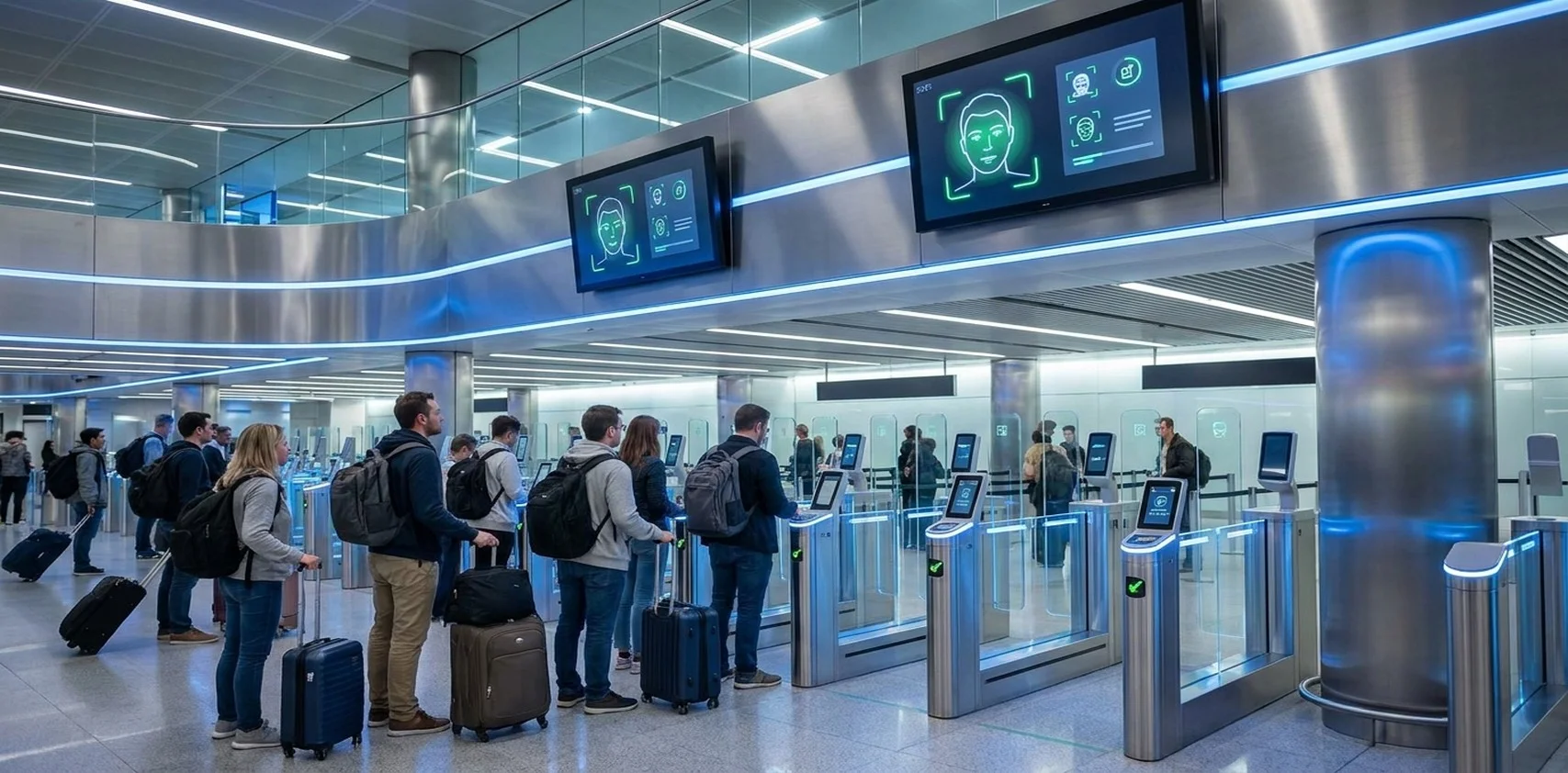
On April 10, 2026, the European Union's Entry/Exit System (EES) went fully operational across all Schengen Area borders. The familiar thud of a passport stamp — that ritual marking of arrival and departure — is now a relic. In its place: biometric data capture, facial recognition, and four-fingerprint scans feeding into a centralized database that tracks every non-EU traveler's movements with millisecond precision. For casual tourists, the change is procedural. For digital nomads who have spent years gaming the 90/180-day rule through strategic border hops, fuzzy passport stamps, and the general inconsistency of human border agents — it's a fundamental reset. The End of Analog Border Control The old system was charmingly low-tech. Border officers stamped passports on entry and exit. The stamps were often smudged, illegible, or inconsistently applied. Different countries had different standards. A traveler who spent 60 days in France and then crossed into Portugal faced a border agent who would need to manually flip through dozens of pages, identifying and tallying every Schengen entry and exit stamp — an exercise in futility during a busy shift. EES replaces all of this with a unified digital record. Upon first entry, the system captures a facial image and four fingerprints, creating a biometric profile. Every subsequent entry and exit is logged electronically and synchronized in real time across the entire Schengen zone. The system knows — precisely, automatically, unambiguously — how many days any given traveler has spent within Schengen during the rolling 180-day window. No more smudged stamps. No more human error. No more plausible deniability. 45 Million Crossings, 4,000+ Overstays: The Numbers Are In The system's effectiveness was evident almost immediately. EU officials reported that EES logged over 45 million border crossings in its initial period of operation and automatically flagged more than 4,000 overstay cases. Under the old regime, detecting overstays was essentially a manual process — and a deeply inconsistent one. Many overstayers simply walked through exit controls unchallenged. Even when caught, records often remained siloed within a single country's system. Now, overstay records are retained for five years and shared across the entire Schengen Area. A single overstay can trigger a multi-year entry ban. This isn't a gamble where you might get caught; it's a certainty. Airlines as the New Gatekeepers One of EES's most consequential changes is the shift of visa verification responsibility to airlines. Previously, a traveler's immigration status was primarily checked at the destination border. Under the new system, airlines must verify visa status and remaining days before boarding. If the system shows a traveler has exhausted their 90-day visa-free allowance, they won't be allowed on the plane. For digital nomads, this eliminates the "fly first, figure it out later" approach entirely. The system renders its verdict before takeoff. The Lisbon Nightmare: Five-Hour Queues and Summer Warnings The rollout has not been smooth. During EES pilot operations in December 2025, Lisbon airport experienced wait times exceeding five hours. Travelers were queued through the arrivals hall and out into the terminal corridors. Social media erupted with images of exhausted passengers sitting on floors, slumped against walls. The bottleneck was first-time registration. Every traveler new to EES needs to undergo full biometric enrollment — photo capture, fingerprint scanning, data verification. The process adds roughly one to two minutes per person, but multiplied across thousands of simultaneous arrivals, minutes became hours. Lisbon wasn't alone. Multiple major European airports reported similar delays. EU officials acknowledged the transition difficulties but argued that processing times would improve significantly as more travelers completed their initial registration — subsequent border crossings require only a quick biometric match rather than full enrollment. Industry analysts, however, warn that the approaching summer travel season could see a repeat performance. Peak-period wait times at some airports could reach five to six hours. For anyone planning European travel this summer, generous layover times are no longer optional — they're essential. The 90/180-Day Rule: No More Fuzzy Math For digital nomads, EES's most immediate impact is the iron-fisted enforcement of the Schengen Area's 90/180-day rule: a maximum of 90 days within any rolling 180-day period. The rule sounds simple but is notoriously difficult to calculate manually. The 180-day window is rolling, not calendar-based. Every single day, the system looks back 180 days and counts. Under the old system, this calculation was left to travelers and border agents — both frequently got it wrong. Nomads had developed an array of workarounds: The "border bounce" is dead. Some nomads would exit Schengen as their 90 days approached, spend a few days in a non-Schengen country, and re-enter hoping for a "reset." With human agents, this sometimes worked because officers didn't always scrutinize historical stamps. EES tracks every crossing with precision — there's nowhere to hide. Fuzzy dates are gone. Some travelers exploited inconsistent stamping at land borders, particularly at less rigorous checkpoints in Eastern Europe, to obscure their actual time in-country. Electronic records eliminate this entirely. The "lenient country" myth is over. Different Schengen states historically varied widely in their enforcement of overstay rules. Nomad forums buzzed with advice on which countries "didn't really check." EES creates a unified standard — an overstay is an overstay regardless of which border you cross. Digital Nomad Visas: From Nice-to-Have to Non-Negotiable EES may prove to be the tipping point that transforms digital nomad visas from an optional convenience into an absolute necessity. In recent years, countries across Europe have rushed to launch nomad visa programs — Portugal, Spain, Greece, Croatia, Italy, and more. But for many nomads, these visas felt redundant: why bother with paperwork and fees when 90 visa-free days were enough for a comfortable stint? EES changes the calculus entirely. When the 90-day limit is enforced with automated precision and overstays carry five-year records plus potential entry bans, a digital nomad visa becomes the only legal pathway for extended stays in Europe. The ripple effects are significant. Application volumes for nomad visas across Europe are expected to surge, potentially lengthening processing times. Countries with established programs (Portugal, Estonia) will likely see increased demand, while those still refining their processes (Greece) may face growing pressure. For nomads, planning horizons must extend dramatically. The "show up and figure it out" approach is obsolete. Visa applications require preparation — proof of income, health insurance, accommodation evidence — and these take time to assemble. Spontaneous nomadism in Europe is becoming a thing of the past. Rethinking Mobility Strategies EES forces a wholesale rethinking of how nomads structure their movements: Schengen/non-Schengen rotation. The most straightforward adaptation is alternating between Schengen and non-Schengen destinations. Approaching the 90-day limit? Move to Turkey, the UK, or the Western Balkans, wait for the 180-day window to refresh, then return. This pattern existed before EES, but it's now shifted from "best practice" to "only compliant option." The home-base approach. More nomads may pursue legal residency in a single Schengen country — whether through a nomad visa or another route — using it as a base for free movement throughout the zone. With legal residency, the 90/180-day restriction no longer applies, since movement occurs as a resident rather than a visa-free visitor. Rediscovering Eastern Europe and Central Asia. Higher barriers to Schengen access could accelerate exploration of alternative destinations. Georgia (one year visa-free for many nationalities), Turkey, Montenegro, Albania, and even Central Asian countries like Kazakhstan and Uzbekistan stand to benefit. Southeast Asia's continued appeal. For Asia-Pacific nomads in particular, destinations like Thailand, Indonesia (Bali), and Malaysia offer more relaxed terms through their own nomad visa programs. EES may prompt some nomads to reconsider whether the cost and effort of European compliance is worthwhile compared to more welcoming regions. The Privacy Question EES hasn't launched without controversy. European civil liberties organizations have raised persistent concerns about the mass collection of biometric data from millions of non-EU citizens. The system creates a vast database of facial images and fingerprints. The EU maintains that data is used strictly for border management, but history suggests that large-scale databases tend to find expanded purposes over time. For nomads, there's also a psychological dimension. Europe has long been romanticized as the ultimate nomad playground — culturally rich, well-connected, high quality of life. But the introduction of biometric tracking, combined with stricter stay enforcement, may leave some nomads feeling surveilled rather than welcomed. Whether this shifts Europe's desirability as a destination remains to be seen. ETIAS: The Next Wave Is Coming It's worth noting that EES is just the first phase of the EU's border digitization strategy. The European Travel Information and Authorisation System (ETIAS) — similar to the US ESTA — is expected to follow soon. ETIAS will require visa-exempt travelers to apply online before departure, pay a fee, and undergo a security background check. Even with a visa-free passport, the days of truly spontaneous European travel are numbered. Together, EES and ETIAS represent a fundamental shift in how Europe manages its borders. The message to nomads is clear: the barriers to entering Europe are rising systematically, and this trend will not reverse. A Practical Action List Facing the new EES reality, digital nomads should take concrete steps: Track days precisely. Use dedicated apps or tools to calculate the rolling 90/180-day window. Memory and rough estimates are no longer sufficient. Tools like Schengen calculators should be standard equipment. Plan visas early. If planning to stay in Europe beyond 90 days, start researching nomad visas immediately. Compare thresholds, costs, processing times, and benefits across countries. Allow generous airport time. Especially during summer peak season, allow at least three to four hours for immigration processing. Ensure layover times can absorb potential delays. Maintain personal travel records. While EES tracks automatically, keeping personal backups — flight tickets, accommodation confirmations, entry/exit records — provides valuable evidence in case of disputes. Consider the home-base strategy. Evaluate whether obtaining formal residency in a Schengen country makes sense as a foundation for long-term European life. The upfront investment is higher, but the long-term stability may be worth it. The End of an Era, the Start of Another The full activation of EES marks a subtle but significant turning point for European travel freedom. The era of wandering through Europe on little more than a visa-free passport and a sense of adventure is fading. But this isn't the end of digital nomadism in Europe. If anything, it may be the catalyst that pushes the nomad ecosystem toward maturity. When guerrilla-style stays become untenable, more people will pursue legitimate pathways — nomad visas, formal residency, bilateral agreements. This could ultimately drive countries to offer more comprehensive support systems for nomads, including clearer tax frameworks, easier banking access, and better-defined legal status. The 90-day countdown is now managed by machines, tracking every entry and exit with unfailing precision. For nomads, this isn't cause for panic — it's a call to take the rules seriously. Europe remains beautiful. Europe remains worth visiting. But from now on, staying requires smarter planning. The clock is ticking — and on the other side of the screen, EES is counting every single day.
April 28, 2026
Croatia Extended Its Digital Nomad Visa to 18 Months — But the Real Story Is Much Bigger
This small country on the Adriatic is playing a game of national survival — with visa policy as its opening move. In March 2025, Croatia quietly amended its Law on Foreigners, extending the maximum stay for digital nomad visa holders from 12 months to 18 months. The news rippled through digital nomad forums with modest enthusiasm — six more months of Dalmatian coastline, after all. But if all you see is "six more months," you're missing the most interesting part of the story. Because on March 25, 2026, the Croatian government dropped a much bigger bombshell: a comprehensive overhaul of its work visa system. Work permits extendable to three years. Foreign workers allowed to change employers after 12 months. A basic Croatian language test introduced as an integration mechanism. This isn't tourism marketing. This is a talent grab. And behind the talent grab is a country that's bleeding out. A Disappearing Nation Let's start with the numbers. When Croatia declared independence in 1991, its population stood at 4.7 million. By the 2021 census, that figure had dropped to 3.87 million — a loss of nearly 20%, or more than 800,000 people, in three decades. To put this in perspective, imagine the entire population of a major metropolitan area simply vanishing. This wasn't caused by war (though the 1990s independence conflict did contribute). The real hemorrhage began after Croatia joined the European Union in 2013. Once freedom of movement kicked in, young Croatians flooded toward Germany, Austria, and Ireland. Between 2011 and 2021, Croatia lost nearly 10% of its population — a rate of decline that actually exceeded the wartime 1990s. According to an analysis by OSW, a Central European think tank, the push factors go beyond economics. Young Croatians leave because of dissatisfaction with public services, disillusionment with the political environment, and the rational calculus of EU membership: if you hold an EU passport, why not go where the salaries are triple? A Croatian nurse earning €1,200 a month in Zagreb can make €3,600 in Munich. The math speaks for itself. Data from TheGlobalEconomy.com shows Croatia's Human Flight and Brain Drain Index at 5.8 in 2024, well above the global average of 4.98. The medical sector has been hit particularly hard — over 40% of medical students have considered emigrating after graduation, and the country faces projected shortages across multiple specialties. Birth rates? Persistently low. The UN projects Croatia's population could fall to 3.2 million by 2050 — meaning the country will lose another mid-sized city's worth of people every few years for the foreseeable future. This is the reality Croatia is confronting. It's not trying to "attract tourists." It's trying to prevent national hollowing-out. From Tourism Bonus to Talent Strategy With that context, the evolution of the digital nomad visa makes perfect sense. Croatia was one of the first European countries to launch a formal digital nomad visa, going live on January 1, 2021. The original design was straightforward — let remote workers stay legally for up to a year, enjoy the Adriatic sun, and spend money locally. For Croatia, these were ideal "consumer residents" who wouldn't compete for local jobs but would pay rent, eat at restaurants, and buy coffee. By 2025, the policy's tone began to shift. The amended Law on Foreigners, effective March 15, 2025, extended the digital nomad visa's maximum duration from 12 to 18 months. Simultaneously, the income threshold was raised to €3,295 per month (approximately 2.5 times Croatia's average net salary), and applicants now need six months of bank statements instead of the previous three. On the surface, this looks like a two-way adjustment: longer stays paired with higher barriers. But think about it — raising the threshold is a filter. Croatia doesn't want budget backpackers doing the digital nomad thing for a season. It wants people with stable, high incomes who will spend significantly in the local economy and might stick around. Then came the March 25, 2026 labor visa reform. The scope was dramatically larger: Work permits extended to three years. Croatia's previous short renewal cycles created administrative headaches for both employers and workers. The new system cuts friction costs in one stroke. Employer mobility after 12 months. This is the most critical change. The old system tied foreign workers to a single employer, limiting labor market efficiency and leaving workers vulnerable to exploitation. The new rule allows free job changes after one year — effectively upgrading Croatia's labor market from an "employer-sponsored visa" model to a "talent visa" model. Basic Croatian language test (A1 level). This looks like an added barrier, but it's actually an integration signal. The government's official framing: the test is "designed to encourage inclusion rather than create barriers." Translation: we don't just want you to work here. We want you to stay. Around the same time, Croatia launched a €2 million "Welcome Home" program targeting its diaspora — offering housing assistance, job matching, and integration support to encourage Croatians abroad to return. Put all these policies together and the picture is complete: the digital nomad visa extension is one piece, the labor visa liberalization is another, and the diaspora return program is a third. Croatia isn't making isolated policy tweaks. It's building a comprehensive talent acquisition system. Why Croatia? A Strong Hand Objectively, Croatia holds several strong cards in the European digital nomad competition. EU member + Schengen + Eurozone. This is the trump card. Croatia joined the EU in 2013 and simultaneously entered the Schengen Area and Eurozone in January 2023. This triple membership puts it on full institutional parity with Western European nations. Holders of a Croatian residence permit can travel freely throughout the Schengen Area — a massive convenience for frequently mobile digital nomads. Cost of living well below Western Europe. A one-bedroom apartment in Zagreb runs €500–700/month; in Split or Rijeka, potentially less. A proper lunch costs €8–12. According to Nomad List estimates, the average monthly cost of living for digital nomads in Croatia is roughly $1,960 — a figure that's impossible to match in any Western European capital. Croatia is more affordable than Italy, Greece, and even Portugal, which has gotten noticeably more expensive. Quality of life. This needs little explanation. 1,244 islands, 1,777 kilometers of coastline, UNESCO World Heritage sites everywhere — from the walls of Dubrovnik to the cascading lakes of Plitvice. Add Mediterranean climate, safe streets, and decent internet infrastructure (Zagreb averages over 100Mbps download speeds), and you have a mature remote work base. No local income tax. This is the sweetest perk of the digital nomad visa. Holders are completely exempt from Croatian income tax on foreign-sourced income. This isn't universal among European digital nomad visas — some countries trigger tax obligations after a certain number of days of residence. Croatia's system explicitly avoids this problem. Family-friendly. The visa allows spouses, unmarried partners, and minor children, with only a 10% income threshold increase (roughly €330/month) per additional family member. For unmarried partners, three years of cohabitation must be proven — unless there's a child in common, in which case the requirement is waived. This is more flexible than many competing programs. 18 Months, Non-Renewable: A Carefully Drawn Red Line Croatia's digital nomad visa has one hard constraint: after 18 months, it cannot be renewed, and the holder must leave Croatia for at least six months before reapplying. This looks like a drawback, but it's actually a deliberately calibrated red line. The reason is straightforward: tax residency. In most countries' tax codes, staying in a jurisdiction for more than 183 days (roughly six months) can trigger tax residency status. While Croatia exempts digital nomads from local income tax, extended stays create conflicts with the nomad's home country tax authority. If you've lived in Croatia for 18 months, your home country may consider you no longer their tax resident — but Croatia explicitly says you're not theirs either. This creates a "tax vacuum" — a gray zone where neither side taxes you. If this gray zone were exploited at scale, it would attract EU-level scrutiny. EU member states operate under strict tax coordination mechanisms, and no member can function as a de facto tax haven. The 18-month cap plus six-month cooling period is essentially telling the world: we welcome your spending, but don't use this as a tax avoidance tool. It's worth noting that international law firm Fragomen mentioned in an August 2025 update that Croatia's digital nomad visa "allows an initial stay of 18 months with a further renewal period of 18 months, for a potential stay of 36 months." This conflicts with most other sources and the Croatian Ministry of Interior's official guidance, which emphasizes the 18-month cap and six-month cooling period. This inconsistency may reflect evolving policy or gray areas between different permit categories. For anyone considering an application, the safest approach is to rely on official MUP guidance. European Digital Nomad Visas Compared: What Each Country Is Actually Selling When you place Croatia on the broader European digital nomad visa map, each country is selling something different. Spain: The Beckham Law's Sweet Spot and Its Traps Spain's digital nomad visa (officially the "international telework visa") launched in 2023, and its real killer feature is the Beckham Law — a tax regime literally named after footballer David Beckham, since it was originally designed to lure him to Real Madrid. The Beckham Law's core offer: Spanish-source income taxed at a flat 24% (up to €600,000), with excess at 47%. Foreign-source income is tax-exempt. The benefit lasts up to six years. Sounds great, but there are catches. The Beckham Law was originally designed for employees, and freelancers (autónomos) generally don't qualify. A 2025 court ruling confirmed that digital nomad visa holders can benefit, but this interpretation is new, and whether the tax authority will retroactively challenge it remains uncertain. More importantly, Spain's tax agency (Agencia Tributaria) is known for aggressively auditing Beckham Law beneficiaries — an "enforcement risk" that other countries' preferential regimes don't typically carry. And Spain's cost of living is significantly higher than Croatia's, especially in Barcelona and Madrid, where one-bedroom apartments run €1,200–1,800/month. Greece: The 50% Tax Reduction Math Problem Greece launched its digital nomad visa in 2021, paired with a 50% income tax reduction for foreign professionals who transfer their tax residency to Greece, valid for seven years. (There's also a separate 7% flat-rate scheme for retirees, which often gets confused with the nomad benefit.) A 50% reduction sounds impressive, but Greece's standard income tax is progressive (topping out at 44%), so the effective rate after reduction lands between roughly 10% and 22%, depending on income level. That's still considerably higher than Croatia's zero. Greece's advantages are climate, culture, and cuisine (none of which require a visa to enjoy), but its administrative efficiency is notoriously poor — lengthy application processes, unfriendly bureaucracy, and documentation requirements that change without warning. For efficiency-minded digital nomads, this may be a bigger obstacle than the tax rate. Portugal: The Rise and Complications of the D8 Portugal was once the undisputed top choice for European digital nomads — Lisbon and Porto had thriving coworking cultures, great weather, and high English proficiency. The D8 visa's (digital nomad visa) income threshold for 2026 is €3,480–3,680/month. But Portugal's problem is its own success. The flood of foreign remote workers drove up housing prices in Lisbon and Porto, pricing out locals and generating significant resentment. The government responded by tightening: in October 2025, Portugal's parliament passed a Nationality Law amendment extending the residency requirement for citizenship from 5 years to 10 years (7 for EU citizens and CPLP nationals). The signal is clear — Portugal is pumping the brakes on its foreign influx. For digital nomads, Portugal's appeal is fading: the citizenship pathway is now much longer, rents are no longer cheap, and the immigration agency (AIMA) has chronic efficiency problems. Croatia's Positioning: Quiet but Precise Line up all four countries: Spain sells "urban lifestyle + tax benefits, but understand the rules and accept audit risk" Greece sells "Mediterranean romance + tax discounts, but tolerate the bureaucracy" Portugal sells "mature nomad ecosystem, but it's getting expensive and less welcoming" Croatia sells "zero tax + EU membership + low cost + 18 months, but you must leave when time's up" Croatia's strategy is precise: no complex tax calculations, just "tax-free." No illusions of permanent residence, but a solid year and a half. EU and Schengen institutional advantages as the foundation, with a cost of living far below Western Europe as the hook. It's not an all-purpose ace. But for a specific type of digital nomad — one seeking medium-term stability, budget-conscious, who values EU freedom of movement — it's a highly compelling option. The Bigger Board: Digital Nomadism as Population Policy Back to the question from the beginning: what's really going on here? The answer is that Croatia is fighting three battles simultaneously. Battle one: Stop the bleeding. Prevent the continued outflow of young Croatians. The Welcome Home program, minimum wage increases, improved local public services — all aimed at bringing back those who left and keeping those who haven't. Battle two: Transfuse. Import foreign labor to fill vacancies. Three-year work permits, employer mobility, A1 language testing as integration design — these measures target gaps in construction, tourism, and hospitality. Battle three: Transform. This is the most ambitious front. Through the digital nomad visa and other preferential measures, attract high-income, high-skill foreign remote workers to reside long-term. These people don't compete for local jobs but contribute consumer spending, community vitality, and international visibility. More importantly, some of them may eventually evolve from "nomads" to "settlers" — transitioning from digital nomad permits to formal residence permits, perhaps even starting businesses or investing locally. This is why the 18-month digital nomad visa can't be viewed in isolation. It's the entry point for a comprehensive talent strategy — let you experience Croatian life first, hope you fall in love with it, then use other residency pathways to keep you there. Croatia's government even established the EU's first Ministry of Demography and Immigration specifically for this purpose. When a country creates an entire government ministry to deal with "not enough people," that alone tells you how serious the problem is. Practical Application Guide: What You Need to Know If the above analysis has piqued your interest in Croatia, here are the key details for applying in 2026. Who can apply? Non-EU/EEA nationals performing remote work for companies or clients outside Croatia. Freelancers, employees, and business owners all qualify. EU citizens don't need this visa — freedom of movement already covers them. Income requirements: Minimum €3,295/month, demonstrated through six months of payslips or bank statements. If using savings instead, you'll need €39,540 for 12 months or €59,310 for 18 months. Duration: Up to 18 months. You can initially apply for 6 or 12 months and extend to 18. After expiration, you must leave Croatia and wait at least six months before reapplying. Costs: Application fee approximately €60. Don't forget notarization, translation, and apostille costs — these can add €30–50 per document. Taxes: During your digital nomad residence, foreign-sourced income is exempt from Croatian income tax. However, verify your home country tax obligations — many countries (notably the US) tax worldwide income regardless of where you live. Required documents: Valid passport (expiring at least three months after your intended stay), biometric photos, proof of remote work (employment contract or freelance agreements), income proof, criminal background certificate (apostilled and translated into Croatian), health insurance, proof of accommodation, and the completed application form. Where to apply: At a police station within Croatia, or at a Croatian embassy/consulate in your home country. Non-Schengen nationals will also need to obtain a D-type long-stay visa after approval. Honest Advice for Digital Nomads Croatia's digital nomad visa isn't perfect. The 18-month hard cap and six-month cooling period mean you can't treat this as a permanent home. The €3,295/month income threshold isn't trivial for early-stage freelancers. Croatian is notoriously difficult to learn — English works fine in tourist areas, but deeper community integration requires language, and that's a real wall. And "tax-free" doesn't mean "tax-worry-free." Depending on your nationality and tax residency status, you may still owe taxes to your home country. If you stay the full 18 months, the tax residency determination between you and your home country could get complicated. Hiring an accountant who understands international tax law is a necessary investment. But if you accept these constraints, the package Croatia offers is genuinely competitive: EU institutional protections, Schengen freedom of movement, below-Western-Europe living costs, zero local income tax, and 18 months of legal residence. On the 2026 European digital nomad map, this combination still ranks near the top. More importantly, Croatia's attitude toward nomads is shifting from "welcome to spend" to "welcome to live." The labor visa liberalization, the language test introduction, the diaspora return program — these policy signals show a country that's seriously thinking about how to turn transients into residents. For digital nomads, this means you're not just picking a cheap beachside café to open your laptop. You're choosing a country that's redefining itself — one that's using policy tools to transform a "population crisis" into an "open opportunity." Whether this gambit will pay off remains to be seen. But at least Croatia is making moves, not waiting to fade away. For a country that has lost a fifth of its population in thirty years, that attitude alone is worth paying attention to.
April 20, 2026
When Countries Turn Nomads Into Tax Revenue, Jamaica's Proposal and the Caribbean's Digital Nomad Fiscal Playbook
On March 12, 2026, inside Jamaica's Gordon House, Opposition Spokesman on Finance Julian Robinson stood up during the annual budget debate and did something increasingly common in Caribbean politics — he wrote digital nomads into a national fiscal plan. Not as a tourism footnote. Not as a travel board gimmick. As a formal alternative revenue source, pitched directly against the ruling party's J$18 billion (approximately US$110 million) tax package. Robinson's proposal may not pass — opposition counterbudgets rarely do in Westminster-style parliaments. But the underlying shift it represents matters for anyone who is, or plans to become, a digital nomad: when a country starts counting you as a line item in its fiscal projections, you're no longer just a tourist. Inside the J$10 Billion Alternative The numbers first. Jamaica's ruling Jamaica Labour Party (JLP) proposed J$18 billion in new taxes for fiscal year 2026-2027, targeting sugary beverages, tobacco, alcohol, and tourism activities. Robinson called this "unconscionable" in the wake of Hurricane Melissa, which had devastated the island and left communities still rebuilding. His alternative: a J$10 billion revenue plan built on two pillars. Pillar One: Electronic Invoicing (approximately J$8.6 billion) An electronic invoicing system through Tax Administration Jamaica, automatically capturing sales transactions at the point of sale. Not new taxes — just collecting what's already owed but underreported. Robinson estimated J$8.6 billion in additional compliance-driven revenue. Pillar Two: Digital Nomad Programme (approximately J$1.5 billion) This is the part that concerns us. Robinson proposed a formal Digital Nomad Programme with the following structure: Special residence permit: A 12-month work permit allowing holders to work for overseas employers or clients while living in Jamaica Visa fee: US$2,000 per year Year-one target: 5,000 digital nomads Direct revenue: Approximately J$1.5 billion (US$9.4 million) from visa fees alone But Robinson made clear that visa fees were just the appetizer. "The real story," he told Parliament, "is when they come here, when they stay here — the restaurants, the Airbnbs, the hotels, the villas, the concerts, the food that they spend. That is the impact." He cited Barbados data showing that each digital nomad spends approximately US$55,000 during their stay. Robinson used a more conservative estimate for Jamaica — assuming an average six-month stay with spending of US$25,000 per person, 5,000 nomads could generate roughly US$125 million (approximately J$19.5 billion) in economic activity. "Barbados did it immediately after COVID and took first-mover advantage," Robinson said. "But we do have many advantages which other countries in the region don't have." He pointed to Jamaica's brand recognition from four million annual tourists, its climate, its culture, and — crucially — its existing connectivity infrastructure. Post-Hurricane Political Economics To understand why this proposal emerged now, you need to understand Jamaica's moment. Hurricane Melissa hit Jamaica hard. The full scale of damage is still being assessed. Against this backdrop, the ruling party chose the tax route — not uncommon in post-disaster reconstruction, but politically explosive. Robinson's argument rests on solid macroeconomic reasoning: raising taxes during an economic contraction is procyclical — it pressures the economy in the same direction the problem is already pushing. His countercyclical alternative: don't extract money from wounded domestic actors. Inject external spending instead. The digital nomad programme fits this framework elegantly. Nomads earn abroad but spend locally. For Jamaica's economy, it's nearly pure net inflow — no displacement of local workers (nomads don't compete for local jobs), but fresh demand for accommodation, food, transport, and services. The logic is compelling. Almost too compelling, which is why it warrants scrutiny. The Caribbean's Digital Nomad Wave: From Tourism to Fiscal Tool Jamaica is far from the first Caribbean nation to think of this. In fact, it's arriving late. Barbados Welcome Stamp (2020): The Textbook Case In July 2020, with COVID-19 crushing global tourism, Barbados launched the Welcome Stamp under Prime Minister Mia Mottley. The team moved fast — design began during the first wave of lockdowns. The Welcome Stamp's structure has become an industry template: US$2,000 annual fee, remote work permitted, no tax on overseas income, 12-month validity with renewal option, minimum annual income requirement of US$50,000. Barbados's results have been notable. While actual Welcome Stamp arrivals run in the hundreds annually (around 400 in 2023), these long-stay, high-spending residents contribute disproportionately compared to equivalent numbers of short-stay tourists. Robinson's "US$55,000 per person" figure cited in Jamaica's Parliament comes from Barbados's experience. More importantly, the Welcome Stamp catalyzed an ecosystem: coworking spaces, long-term rental markets, service industries targeting remote workers (from fiber internet installation to pet care). Barbados proved that digital nomads don't just bring spending — they bring an entire ecosystem of demand. Antigua and Barbuda Nomad Digital Residence (2020): The Fast Follower Almost simultaneously, Antigua and Barbuda launched the Nomad Digital Residence programme. Two-year validity, same US$2,000 annual fee. Antigua's strategy differed subtly — it emphasized "residence" over "work," aiming to attract not just laptop freelancers but remote entrepreneurs willing to put down longer roots. The two-year visa duration signals this intent: it's seeking people who might actually stay. Costa Rica Digital Nomad Visa (2022): Central America Joins In 2022, Costa Rica entered the field. Technically not a Caribbean island nation, but its entry marked the elevation of digital nomad visas from island-state experiments to a regional strategy spanning Central America and the Caribbean. Costa Rica requires a minimum monthly income of US$3,000, with a one-year visa. Its selling points differ from small islands — geographic diversity, a mature expat community, and the lifestyle brand built around "Pura Vida." The Broader Trend Beyond these, the Cayman Islands, Curaçao, Dominica, Bermuda, and others have rolled out their own variants. By late 2025, over 60 countries and territories globally offered some form of digital nomad visa, with the Caribbean having the highest concentration — virtually every island with tourism infrastructure has at least considered it. Jamaica's Robinson proposal pushes this trend into a new phase. From "Welcome, Visitors" to Fiscal Policy Tool: A Qualitative Shift The motivations driving Caribbean digital nomad programmes have evolved through distinct phases. Phase One (2020-2021): COVID Emergency Response Barbados and Antigua's programmes were born during the pandemic. The primary goal: find alternative visitors when borders were closed and tourism had collapsed. "Borders are shut, but remote workers can spend money without going anywhere" — this intuition drove first-wave design. Phase Two (2022-2024): Tourism Brand Differentiation As the pandemic receded, digital nomad visas repositioned from "emergency measure" to "brand differentiator." Countries began competing — faster internet, easier visa processes, friendlier tax treatment. The focus was tourism marketing: attract more people, keep them longer, have them spend more. Phase Three (2025-2026): Fiscal Policy Instrument Robinson's proposal at Jamaica's Parliament marks Phase Three. He wasn't at a tourism board press conference promoting a new visa. He was in a parliamentary budget debate, presenting digital nomads as a quantifiable fiscal source, directly compared against a tax package. The significance: digital nomads have shifted from "welcome guests who happen to spend money" to "a number in national fiscal planning." For small island economies, this shift has deep structural roots. Caribbean nations share several common predicaments: Scale constraints: Most island states have GDPs in the single-digit billions, with tiny domestic markets and near-total dependence on external demand Tourism over-reliance: Tourism accounts for 30-50% of GDP in many cases; any disruption (pandemic, hurricane, airline route cancellation) is existential Hurricane exposure: Climate change is intensifying hurricane frequency and severity, with reconstruction costs repeatedly draining limited fiscal resources — Jamaica's Hurricane Melissa is the latest example Brain drain: Educated young people emigrate to North America and Europe, shrinking both the talent pool and the tax base Under these structural constraints, digital nomads — long-term consumers who bring their own income — are nearly ideal. They don't compete for local jobs. They spend more than average tourists. They stay longer. Their infrastructure needs (primarily internet and accommodation) are concentrated and predictable. More fundamentally, they represent a "non-traditional tax base": no need for local employers to hire them, no complex industrial policy to develop them. Just a visa, reliable internet, and an environment worth staying in. Behind the Numbers: What the Proposal Doesn't Say Robinson's parliamentary presentation painted an attractive picture: 5,000 people, US$2,000 each in visa fees, US$25,000 in spending over six months, US$125 million in total economic activity. Clean numbers. Clean logic. Reality is never as clean as fiscal projections. The Attraction Problem: Where Do 5,000 Nomads Come From? Jamaica sees four million tourists annually — Robinson's foundational statistic. But tourists and digital nomads are fundamentally different populations. Tourists want all-inclusive resorts and beach cocktails. Nomads want stable internet, quiet workspaces, reasonable monthly rentals, and — the thing many won't say out loud but care deeply about — safety. Jamaica's performance on these dimensions is mixed. Internet infrastructure in Kingston and Montego Bay is improving, but it still lags behind Southeast Asian nomad hotspots like Bali, Chiang Mai, or Lisbon. More critically, Jamaica's security situation remains a significant concern for international visitors. Five thousand isn't impossible — Barbados's Welcome Stamp processes hundreds annually, and Jamaica's larger brand and tourism volume justify multiples of that. But hitting that target in year one requires more than a visa. It requires an ecosystem. The Spending Assumption: Conservative or Optimistic? Robinson deployed a smart rhetorical strategy: cite Barbados's US$55,000 figure first, then present his Jamaica estimate of US$25,000 as conservative by comparison. You see the ceiling, then the projection feels restrained. But US$25,000 over six months means roughly US$4,200 per month. That buys a comfortable life in Jamaica — provided stable monthly rental options and basic living infrastructure exist. If most nomads can only access expensive short-term rentals or resort accommodations, the actual spending structure may differ substantially — money spent, but not necessarily flowing into the local economy's capillaries. The Critical Question: Whose Pocket Does the Money Reach? The degree to which digital nomad spending actually benefits local communities is a global debate. In Bali, the nomad community has driven Canggu's boom but also pushed up rents and prices, displacing local residents from their own neighborhoods. In Lisbon, similar "nomad gentrification" has triggered fierce local backlash. Caribbean island economies are smaller and shift faster. When thousands of foreigners with monthly incomes far exceeding local averages arrive, rents, prices, and service costs all tend to rise — and the first people affected are typically low- and middle-income locals. This doesn't mean digital nomad programmes shouldn't exist. It means that when you write them into a fiscal plan, you need to simultaneously think about distribution. The Nomad's Perspective: From Guest to Tax Base Let's shift to the digital nomad's point of view. If you're a remote worker considering the Caribbean, what does Robinson's proposal mean for you? The Immediate Impact: One More Option Caribbean digital nomad visa choices are already abundant. Jamaica launching a programme would add another US$2,000-per-year option to an increasingly crowded market. For nomads, this is positive — more choices mean more leverage, and countries competing for residents will keep improving conditions. The Deeper Significance: Your Identity Is Being Redefined What's more worth noting is the identity shift. When Barbados launched the Welcome Stamp in 2020, the narrative was "come work from our beautiful island" — inviting, hospitable, an extension of tourism. When Robinson wrote digital nomads into Jamaica's 2026 budget debate, the narrative became "you can help us replace J$18 billion in taxes" — calculative, fiscal, your value measured as an economic unit. This shift isn't necessarily bad. But it changes the rules. As a "tourist," your relationship with a destination is a clean market transaction: I pay, you provide an experience. If it's not good, I leave. As a "tax base," the relationship gets complicated. The state develops expectations — stay long enough, spend enough, behave appropriately. And you may develop expectations in return — I paid US$2,000 for this visa plus thousands monthly in spending; what rights do I have? Who's responsible when the internet goes down? Can the healthcare system handle me? Do I get any voice in community matters? Over 60 countries currently offer digital nomad visas. The vast majority operate at the "you can come" level. Very few have seriously addressed the post-arrival rights-and-obligations framework. You're not a citizen, not a permanent resident, not even a traditional work visa holder — you're an entirely new, still poorly defined legal identity. Robinson's proposal follows this pattern. He spent extensive time on revenue (J$1.5 billion in visa fees, J$19.5 billion in economic activity) but barely mentioned what specific protections nomads would receive. This isn't Robinson's failing — it's a blind spot shared by digital nomad visa programmes worldwide. The Tax Grey Zone Another dimension nomads should watch: taxation. Barbados's Welcome Stamp explicitly promises no tax on overseas income — one of its biggest selling points. But as digital nomads graduate from "tourism add-on" to "fiscal policy pillar," the durability of that promise deserves scrutiny. If a country genuinely begins depending on nomad economic contributions as a significant revenue source, it will eventually face a temptation: should we start taxing these people? The current model — collect visa fees, don't tax income — is attractive to nomads but means the state foregoes its largest potential revenue stream. The moment Robinson wrote nomads into a budget proposal, Pandora's box, in some sense, was already open. The Bigger Picture: The Politicization of Nomad Economics Stepping back, Robinson's speech in Jamaica's Parliament represents a larger trend: digital nomadism is being politicized. Not pejoratively — but in the sense that it's moving from lifestyle choice and tourism niche into the core agenda of national policymaking. Globally, digital nomads number an estimated 40 to 60 million (definitions and methodologies vary widely), and the population is still growing rapidly. This group doesn't vote in their countries of residence, doesn't participate in local labor markets, but has significant spending power — they're an unprecedented economic phenomenon. For small Caribbean nations, capturing even a tiny fraction of 40 million nomads can generate meaningful economic impact. Robinson's 5,000-person target represents barely one-hundredth of one percent of the global nomad population. Viewed this way, it's not overly optimistic — it's a number that reveals how large the addressable market really is. But market size brings competition. Caribbean nations aren't just competing with each other. They're competing with Portugal, Thailand, Mexico, Colombia, and dozens of other destinations worldwide. In a world where nomads can go almost anywhere, a US$2,000 visa fee isn't the deciding factor — overall experience, cost of living, community, and safety are. Notes for Nomads If you're considering the Caribbean as your next base, some observations worth keeping in mind: One: Visa pricing is standardizing. Major Caribbean programmes cluster around the US$2,000 annual mark. This has become a market consensus — too high deters applicants, too low makes it not worth administering. But watch for hidden costs: health insurance requirements, income verification thresholds, and processing fees can add up. Two: "No tax" promises need ongoing monitoring. Most Caribbean digital nomad visas currently promise no tax on overseas income. These rules can change. Especially as nomad revenue becomes part of national fiscal conversations, policy winds could shift within a few years. Three: Infrastructure varies dramatically. Barbados and Costa Rica have relatively mature digital nomad infrastructure (coworking spaces, reliable internet, expat communities). Jamaica, if it launches a programme, may initially require more pioneer spirit — early movers may enjoy less competition and more authentic experiences, but also more friction. Four: Mind the gentrification effect. As a conscious nomad, consider your impact on local communities. Choosing local landlords over international platforms, eating at local spots instead of chains, learning about and respecting local culture — these aren't just ethical choices. They're the foundation that keeps digital nomad programmes politically viable long-term. If locals feel that nomads exploit rather than integrate, even the best policy will face backlash. Five: Your "being needed" is increasing. Perhaps the most important observation. From Barbados's tourism extension to Jamaica's budget alternative, Caribbean demand for digital nomads is structurally growing. This means expanding negotiating leverage — expect better terms, more infrastructure investment, and eventually, more robust rights protections. But "being needed" also means "being counted." Your spending, your length of stay, your economic contribution will be tracked and quantified with increasing precision. An Experiment Still in Progress Robinson's proposal faces an uncertain future in Jamaica's Parliament. As an opposition counterbudget, it's more likely to become debate material than immediate law. But the trend it reflects is clear — digital nomads are evolving from "transient visitors" to "budget line items." This is a Caribbean story, but it's also a global one. As more countries discover that "instead of taxing our own citizens harder, we could attract foreign remote workers to spend here," the nomad's standing will keep rising — accompanied by more regulation, more expectations, and more rights frameworks that nomads themselves will need to advocate for. In 2020, Barbados told nomads: "Welcome to our island." In 2026, Jamaica — or at least its opposition — told nomads: "You're worth J$1.5 billion." The next step is probably some country telling nomads: "You need to come." Until that day, this remains a game where nomads hold the advantage. Enjoy the window — but don't forget that once you shift from "guest" to "tax base," the rules have already started changing.
April 15, 2026

Portugal Spent Millions Attracting Remote Workers, then Forgot to Keep Them
In October 2022, Portugal launched the D8 digital nomad visa, throwing open its doors to the global remote workforce. The tech community collectively lost its mind. Lisbon's sunshine, Porto's wine country, the Algarve's beaches — all wrapped in a shiny new legal framework that said: come work here, we want you. Three years later, Portugal's digital nomad programme has become a case study. Not the kind anyone wanted. It's a masterclass in how a government can take every natural advantage — climate, culture, cost of living, brand recognition — and still fumble the execution so badly that the people it attracted are quietly leaving. The most damning part? Nobody knows exactly how many have left, because Portugal never bothered to track retention. The Man Who Built It Is Now Its Loudest Critic Gonçalo Hall isn't some armchair commentator taking shots at Portuguese policy from a beach in Bali. He's the founder of NomadX, the architect of the Digital Nomad Village in Madeira's Ponta do Sol, and a central figure in Portugal's remote work movement for nearly a decade. When Hall criticises Portugal's approach to digital nomads, he's criticising something he helped build. In March 2026, Hall published a widely circulated analysis that drew a devastating comparison. On one side: Tulsa, Oklahoma's remote worker programme, which invested roughly $10,000–$15,000 per person — not just as a cash grant, but as part of an integrated package including community events, pre-move city visits, and ongoing local support. The result: a 74% long-term retention rate, over 600 home purchases, and $622 million in direct employment income. According to the W.E. Upjohn Institute for Employment Research, every dollar Tulsa spent generated four dollars in benefits for existing residents. On the other side: Europe — and Portugal in particular — which spent millions on visa marketing while providing, in Hall's words, "zero integration infrastructure." "European governments optimise for vanity metrics — visa applications, press coverage — rather than actual outcomes: retention, property purchases, business creation," Hall wrote. That sentence should be tattooed on the wall of every government ministry running a digital nomad programme. The D8 Visa: Attractive on Paper, Painful in Practice Portugal's D8 visa looks good in a brochure. As of 2026, applicants need a monthly income of at least €3,680 (four times the Portuguese minimum wage of €920) and bank savings of at least €11,040. You can start with a temporary stay visa of up to one year, then convert to a two-year residence permit, with a pathway to permanent residency. The problems start the moment you try to actually use it. The AIMA backlog. Portugal's immigration agency, reorganised from the former SEF, has been drowning in case backlogs for years. Residence permit wait times stretch to months — some applicants report waiting over a year. For a country that markets itself as welcoming to remote workers, leaving people in legal limbo for six-plus months is a peculiar way of saying welcome. The tax regime whiplash. Portugal once held a trump card: the NHR (Non-Habitual Resident) tax regime, which offered qualifying foreign residents a 20% flat tax rate and exemptions on certain foreign income. Launched in 2009, it attracted a wave of high-income professionals and entrepreneurs. Then Portugal killed it in 2024. The replacement — IFICI (Tax Incentive for Scientific Research and Innovation), branded as "NHR 2.0" — preserves the 20% rate but dramatically narrows eligibility. Digital nomads are essentially excluded unless they fall into extremely narrow legacy provisions. As Hall told Euronews in 2024: "Portugal was attracting some of the brightest minds in the world with the NHR. Ending this talent attraction tool was the biggest mistake our previous government made." Translation: Portugal used tax breaks to lure people in, then pulled the rug before they'd finished unpacking. The residency paradox. To renew a D8 residence card, holders must spend at least 16 months in Portugal during the initial two-year validity period. Think about that for a moment. You've created a visa specifically for "digital nomads" — people whose defining characteristic is mobility — and then you require them to stay put for most of the year. That's not digital nomadism. That's relocation with extra paperwork. And in October 2025, Portugal's parliament raised the residency requirement for citizenship from 5 years to 10 (7 for CPLP nationals and EU citizens). Signal received: you're welcome to visit, but we're not sure we want you to stay forever. The Elephant in Lisbon's Living Room You cannot discuss Portugal's digital nomad policy without confronting the housing crisis. Or rather, you shouldn't — though Portugal's government has tried. Lisbon rents have surged dramatically. By mid-2025, the average rent in the Lisbon metropolitan area hit €19.6 per square metre. A decent one-bedroom in the city centre runs $1,500–$1,800 per month; something liveable in a desirable neighbourhood costs €2,100–€3,200. For remote workers earning American or Northern European salaries, this is manageable. For locals earning the Portuguese minimum wage of €920, it's a catastrophe. Digital nomads aren't solely responsible — Airbnb's expansion, golden visa-driven real estate investment, the tourism boom, and chronic underbuilding all play their parts. But nomads make convenient scapegoats. They're visible. They sit in cafés with MacBooks, paying rent in currencies that dwarf local wages, while their Portuguese neighbours queue for social housing. The Guardian reported in July 2025 on growing anti-nomad sentiment, quoting DiEM25 spokesperson Nadia Sales Grade: "There has to be more taxation for both the corporations and those not contributing to the economy other than driving up the rent." Anti-gentrification protesters have rallied at the gates of Web Summit, Lisbon's annual tech conference. "They put too much money in these things, and at the same time we can't live in the city anymore," a local teacher named Ana told reporters. Portugal's response has been to swerve. Promote D8 visas with one hand; restrict short-term rentals, tighten residency rules, and abolish tax breaks with the other. The result: neither nomads nor locals feel served. It's a policy that manages to alienate everyone simultaneously — a genuinely impressive achievement, if you think about it. Madeira: What Happens When You Build Community First Amid the chaos, one Portuguese experiment actually worked. Hall's Digital Nomad Village in Ponta do Sol, Madeira — launched in 2021 — wasn't a government marketing campaign. It was a community-building exercise: coworking spaces, social programming, connections between nomads and local businesses, practical help for newcomers trying to integrate into a small coastal town. The results went beyond vibes. Tech startup registrations in Madeira grew 81% — driven not by visa marketing but by community infrastructure. The lesson is counterintuitive but important: the most effective way to attract digital nomads isn't better visa terms. It's better living conditions. And "better living conditions" doesn't mean cheaper coffee or faster Wi-Fi. It means belonging. People stay in places where they have friends, collaborators, a café owner who knows their name, a neighbour who waves hello. You can't legislate belonging, but you can create the conditions for it. Countries That Got It (More) Right If Portugal is the cautionary tale, Estonia and Croatia offer more instructive models. Estonia's e-Residency is the gold standard of digital governance for nomads. Launched in 2014, it allows anyone — regardless of nationality — to register and run an EU-based company through a digital identity. By 2025, the programme had surpassed 100,000 users, with roughly 30% transitioning from nomad to entrepreneur. In 2025, e-Residency generated a record €125 million in tax revenue, as reported by Bloomberg and the European Business Magazine. Estonia's edge isn't the visa itself — the Estonian digital nomad visa and e-Residency are separate programmes. But combined, they create a multiplier effect. You're not just living in Estonia; you're operating there. You have a tax ID, a company, a bank account, obligations — and therefore reasons to stay. The model isn't perfect. An August 2025 VAT ID policy change rattled some e-Residents, with critics asking whether Estonia was quietly closing the door. But Estonia built something Portugal never did: a complete digital infrastructure — company registration, tax filing, banking — all accessible online. That's the real moat. Croatia took a different but equally smart approach. In 2025, it extended its digital nomad visa from 12 to 18 months. Six extra months might sound trivial, but it crosses a psychological threshold. At 12 months, you're still a visitor. At 18, you start thinking about language classes, favourite restaurants, and whether to sign a longer lease. Critically, Croatia's digital nomads pay zero Croatian income tax on foreign-sourced income. The rules are clear, stable, and predictable. Compare that to Portugal, where the tax framework reads like a document with track changes permanently enabled. Croatia is honest about its limits too: after 18 months, you must leave for at least 90 days before reapplying. It's not an immigration pathway, and Croatia doesn't pretend it is. That transparency, paradoxically, builds more trust than Portugal's ambiguous "welcome, but also maybe not" stance. The Ecosystem Problem Hall's critique resonated because it named something most governments still refuse to acknowledge: a digital nomad visa is a ticket, not an ecosystem. A functional nomad ecosystem requires at least five things: Visa clarity and stability. Transparent processes, predictable timelines, rules that don't change every fiscal cycle. When you invite someone to move to your country and then leave them in an administrative black hole for eight months, the message isn't "welcome" — it's "we weren't ready for you." Tax transparency. Nomads don't fear high taxes. They fear uncertainty. When a country overhauls its tax regime every two years in unpredictable ways, no rational person will make long-term plans based on current conditions. Estonia retains people partly because its rules are stable and legible. Housing accessibility. Not just price — supply. When a city's short-term rental market cannibalises its long-term stock, nomads and locals become adversaries in a zero-sum game. The smart play is directing nomads toward secondary cities and regions with lower housing pressure — exactly what Madeira demonstrated — rather than funnelling everyone into the capital. Coworking and community infrastructure. This sounds like a nice-to-have. It's actually the single strongest predictor of retention. When someone has a regular workspace, weekly friends, and active collaborations in a city, their switching cost skyrockets. Tulsa Remote's 74% retention wasn't bought with $10,000 grants. It was built through community cohesion. A pathway from nomadism to entrepreneurship. Thirty percent of Estonia's e-Residents converted from nomad to founder. That number tells the whole story. If you can help a nomad start a company in your country — hire locals, pay taxes, create jobs — they stop being a "consuming visitor" and become a "producing resident." That's where the real value lies. The SaaS Analogy Anyone who's built a SaaS product knows that customer acquisition cost (CAC) is only half the story. Customer lifetime value (LTV) is what matters. If your churn rate is too high, your growth engine is a leaky bucket — pouring in at the top, draining out at the bottom, never filling up. Portugal's digital nomad policy is a leaky bucket. The deeper problem is that many governments launched nomad visas not to genuinely attract remote workers, but to generate press coverage. A "Country X launches digital nomad visa" headline is nation-branding in its purest form. What happens to visa holders afterwards is someone else's department. This explains why more than 50 countries now offer some form of digital nomad visa, but the number that have built supporting ecosystems can be counted on one hand. The standard playbook: design a visa category → hold a press conference → build a pretty website → declare mission accomplished. What Comes Next Portugal still has nearly every natural advantage a country could want for the digital nomad economy: climate, culture, relative affordability (outside Lisbon), infrastructure, and powerful brand recognition in tech circles. But advantages don't automatically convert to retention. What Portugal needs isn't another round of visa marketing. It needs a fundamental strategic pivot: from attracting arrivals to preventing departures. That means stabilising the tax regime for at least five years. Accelerating AIMA processing times — or, failing that, building the kind of digital-first system Estonia proved is possible. Directing nomads toward Porto, Braga, the Algarve's smaller towns, and the Azores, where housing pressure is lower and community ties form more easily. Creating a simple, transparent pathway from nomad to entrepreneur. And above all, actually tracking retention — because you can't improve what you don't measure. Right now, Portugal counts visa applications the way an e-commerce site counts page views without looking at conversion rates. That's not strategy. That's self-deception. The Bottom Line Digital nomadism is no longer a fringe phenomenon. The global remote workforce has grown steadily since the pandemic, and competition between countries for high-skill, high-income, high-mobility talent will only intensify. In that competition, a visa is table stakes. The real differentiator is whether you can move someone from "visiting" to "staying" to "rooting." Portugal had that chance. In some ways, it still does. But the window won't stay open forever. When a nomad can't find housing in Lisbon, can't get a residence permit from AIMA, can't count on the tax rules remaining stable, and can't find a community that feels like home — they won't complain. They'll open their laptop and search "Croatia digital nomad visa." And then they'll be gone. Portugal will have one more beautiful visa application statistic, and one fewer person who might actually have stayed. Hall put it best: "The gap between selling a visa and building a community is where the real opportunity — and the real failure — lies." That sentence is brutal because it contains both the diagnosis and the prescription. The diagnosis: you only sold a ticket. The prescription: you need to build a home. Not a literal home. A place people choose to call one.
April 14, 2026
Forbes Names the 10 Best Countries for Digital Nomads in 2026: Visas, Income Thresholds, and Hidden Perks
On March 15, 2026, Forbes published its latest ranking of the world's most attractive digital nomad visa programs. The list of ten countries doesn't just reflect which governments are rolling out the welcome mat for remote workers. It reveals an accelerating global competition for a new class of high-value migrants: laptop-carrying professionals who bring foreign income, stay longer than tourists, and ask for nothing from local labor markets. From the sunlit coasts of Southern Europe to emerging hotspots in South America, governments are deploying visa policies, tax incentives, and infrastructure investments at unprecedented scale to attract this growing workforce. Here's what each country offers and what prospective nomads need to know. The Global Landscape As of March 2026, more than 60 countries and territories worldwide have introduced some form of digital nomad visa or remote work permit. In 2020, that number was fewer than ten. The explosion reflects three converging forces: the pandemic's permanent normalization of remote work, tourism-dependent economies discovering that nomads are premium visitors who inject foreign capital without competing for local jobs, and intensifying global talent competition that has made nomad visas a new tool for attracting high-skilled individuals. Forbes evaluated candidates across multiple dimensions: application ease, income threshold reasonableness, tax treatment, internet infrastructure, cost of living, safety, and community maturity. 1. Portugal Portugal has topped digital nomad rankings for years, and 2026 is no exception. Visa: The D8 visa (passive income/remote work) grants non-EU citizens residence in Portugal. It's valid for one year, renewable, and creates a pathway to permanent residency. Income threshold: Approximately €3,280 per month (four times Portugal's minimum wage). Mid-range by European standards. Tax treatment: Portugal's Non-Habitual Resident (NHR) regime once offered a flat 20% income tax rate for up to ten years. The original NHR was revised in 2024, but the 2026 version still provides tax benefits for specific industries and high-value activities under stricter conditions. Why it ranks: Lisbon and Porto host mature nomad ecosystems with abundant coworking spaces, international communities, reliable high-speed internet, and reasonable living costs. The climate, food, safety, and high English proficiency complete the package. Watch out for: Lisbon rents have surged over the past three years, approaching levels seen in major Western European cities. Consider secondary cities like Braga, Coimbra, or Faro. 2. Spain Since launching its digital nomad visa in 2023, Spain has rapidly become a top destination. In 2026, the country further streamlined its application process and expanded eligibility. Visa: Non-EU citizens can reside in Spain while working for overseas employers or clients. Initial validity is one year, extendable to five. Income threshold: Approximately €2,520 per month (double the Spanish minimum wage). One of the lowest among major European nomad visa countries. Tax treatment: The "Beckham Law" allows qualifying new tax residents to pay a flat 24% rate on Spanish-source income for six years, rather than progressive rates. However, freelancers may need to register as "Autónomo" (self-employed), which triggers additional social security contributions and quarterly VAT filings. Why it ranks: Barcelona, Madrid, Valencia, and Málaga all host thriving nomad communities. Spain's quality of life, food culture, social atmosphere, and climate are world-class. Living costs remain reasonable, especially outside tier-one cities. Watch out for: Spain's tax system is complex for freelancers. Autónomo social security fees and VAT obligations can become unexpected financial burdens. Consult a Spanish tax specialist before applying. 3. Greece Greece's digital nomad visa stands out for its unique 50% income tax reduction, and its 2026 completion of island-wide 5G coverage has dramatically increased its appeal. Visa: Valid for up to five years, with eligibility for permanent residency after five years. Applicants must commit to residing in Greece for at least two years. Income threshold: Approximately €3,500 per month, increasing for dependents. Tax treatment: The headline benefit is a 50% reduction on foreign-source income tax for those who commit to a two-year residency. Effective tax rates can drop to between 11% and 22% depending on income level, making Greece one of Europe's most competitive options. Why it ranks: Beyond tax incentives, Greece completed its "Island Mesh" 5G network project in 2026, extending high-speed mobile connectivity to remote islands that previously had unreliable internet. Working from Santorini, Mykonos, or Crete is no longer a bandwidth gamble. Athens living costs run roughly 40-50% of London's, with island locations even cheaper. Watch out for: Greek bureaucracy can be slow. Visa applications and tax registrations may take longer than expected. Budget extra processing time and consider hiring a local immigration lawyer. 4. Italy After launching its digital nomad visa in 2024, Italy spent time refining the supporting framework. By 2026, the program has matured into a compelling option backed by cultural magnetism and quality of life. Visa: Non-EU citizens can reside and work remotely in Italy. Initial validity is one year, renewable. Applicants must demonstrate high-skilled remote employment. Income threshold: Approximately €2,800 per month, plus adequate health insurance. Tax treatment: Italy's "Impatriate Regime" offers qualifying new tax residents up to 70% income tax reduction for the first five years. In designated southern regions, the reduction can reach 90%, making Italy one of Europe's most aggressive tax competitors for nomad talent. Why it ranks: Italy's cultural, culinary, and scenic assets need no introduction. In 2026, the government invested in coworking spaces and digital infrastructure across several southern cities (Bari, Catania, Lecce), actively steering nomads toward less-developed southern regions. Watch out for: Administrative processing can be slow by European standards. English proficiency is lower than in Northern Europe, potentially creating daily-life friction for non-Italian speakers. 5. Croatia One of Europe's earliest digital nomad visa adopters, Croatia upgraded its program in 2026 with enhanced family-friendly provisions. Visa: The digital nomad residence permit is valid for one year. After expiry, applicants must leave for at least 90 days before reapplying. Holders are exempt from Croatian income tax during their stay (provided they don't work for Croatian employers or clients). Income threshold: Approximately €2,540 per month. Tax treatment: The headline advantage is zero Croatian income tax during the residency period. Holders only owe tax in their country of tax residence, which can be extremely favorable for those based in low-tax or zero-tax jurisdictions. Why it ranks: Dubrovnik, Split, and Zagreb offer excellent living environments with growing nomad communities. Croatia joined the Eurozone and Schengen Area in 2023, simplifying financial and travel logistics. The Adriatic coastline and Mediterranean climate are powerful quality-of-life draws. Watch out for: The one-year limit plus 90-day cooling period constrains long-term settlement. Croatia works better as a rotation base than a permanent home. 6. Argentina South America's most enthusiastic adopter of the digital nomad trend, Argentina cracks Forbes' top ten for the first time. Visa: Launched in 2022, it allows remote workers to reside for up to six months, extendable for another six. Income threshold: No strict minimum, but applicants must demonstrate stable overseas income. Tax treatment: Visa holders are classified as non-tax residents and owe no Argentine income tax. Why it ranks: Argentina's primary draw is its extraordinary cost-of-living advantage driven by favorable exchange rates. Buenos Aires consistently ranks among the world's best cities for quality-of-life-to-cost ratio. Rich cultural life, world-class cuisine (especially steak and wine), vibrant nightlife, and numerous English-friendly coworking spaces make it a nomad paradise. Watch out for: Economic volatility and currency fluctuations are real risks. Persistent high inflation, while primarily affecting peso-denominated spending, means consumer prices can shift rapidly. 7. Estonia The global pioneer in digital governance, Estonia integrates its nomad visa with the broader e-Residency ecosystem for a uniquely digital experience. Visa: Available in short-term (Type C, up to 90 days) and long-term (Type D, up to one year) variants. Long-term visas are renewable. Income threshold: At least €4,500 average monthly income over the previous six months. One of the highest thresholds on this list. Tax treatment: Estonia's globally renowned corporate tax system charges zero tax on undistributed profits, paying only when dividends are distributed. This is especially advantageous for nomads who establish companies through e-Residency. Personal income tax is a flat 20%. Why it ranks: Estonia's digital infrastructure is world-leading. Nearly every administrative process, from banking to tax filing, can be completed online. Tallinn's tech startup ecosystem is thriving, and e-Residency allows nomads to establish and operate EU companies without physically residing in Estonia. Watch out for: Long, dark, cold winters. Limited options outside Tallinn. Living costs are lower than Western Europe but higher than most Eastern European countries. 8. Malta This Mediterranean island nation leverages English as an official language and EU membership to carve a unique niche in the nomad visa market. Visa: The Nomad Residence Permit allows non-EU remote workers to reside for up to three years. Applicants must work for employers or clients outside Malta. Income threshold: Approximately €2,700 per month (€32,400 annually). Tax treatment: Malta's tax system offers multiple favorable schemes for qualifying foreign residents. Nomad visa holders generally pay tax only on income remitted to Malta, starting at 15%. Why it ranks: English as an official language eliminates communication barriers. Mediterranean climate, high safety index, and EU/Schengen membership enabling easy European travel. Despite its small size, coworking spaces and the nomad community continue growing. Watch out for: Malta is tiny. Long-term residents may experience "island fatigue." Summer tourist season drives up prices and crowds. Housing options are limited and increasingly expensive. 9. Costa Rica Central America's digital nomad leader combines tropical living with infrastructure sophistication. Visa: The Rentista visa and dedicated digital nomad visa allow remote workers to reside for up to two years. Income threshold: Approximately $3,000 per month, or a one-time deposit of $60,000. Tax treatment: Costa Rica operates on a territorial tax system, taxing only income generated within its borders. Remote workers serving overseas clients typically owe zero Costa Rican income tax. Why it ranks: Stunning natural landscapes, political stability, a solid healthcare system, and Central America's best internet infrastructure. The country's "Pura Vida" (pure life) philosophy aligns naturally with nomad values. San José, Tamarindo, and Santa Teresa host active nomad communities. Watch out for: Living costs are high by Central American standards. Internet quality remains inconsistent in some areas. The rainy season (May through November) can disrupt outdoor activities and transportation in certain regions. 10. Thailand After years of policy debate, Thailand launched its digital nomad visa in 2025 and continued refining it through 2026, earning a spot on the Forbes list. Visa: The Long-Term Resident Visa (LTR) "Work-from-Thailand" category allows stays of up to ten years (in five-year increments). A shorter-term Digital Nomad Visa with one-year validity is also available. Income threshold: LTR requires at least $80,000 annual income over the past two years. The short-term nomad visa has a lower bar of approximately $2,500 per month. Tax treatment: LTR holders enjoy a flat 17% income tax rate (versus Thailand's standard progressive rates reaching 35%), with certain categories of overseas income exempt. Why it ranks: Thailand has been the unofficial capital of digital nomadism for over a decade. Bangkok, Chiang Mai, and Phuket host the world's most mature nomad infrastructure and communities. Ultra-low living costs, exceptional food, convenient transportation, warm climate, and welcoming local culture make Thailand competitive on every objective metric. The formal visa program finally resolves the gray-area immigration status that nomads in Thailand have navigated for years. Watch out for: Political volatility. The LTR income threshold excludes many nomads. Air quality is a serious health concern during burning season, particularly in Chiang Mai from February through April. Cross-Country Comparison Highlights Lowest barriers to entry: Argentina (no strict minimum) and Spain (€2,520/month). Best tax deals: Greece (50% income tax cut), Italy (up to 90% reduction in southern regions), Croatia (zero local tax). Longest stay options: Thailand LTR (10 years), Italy and Greece (5 years). Lowest living costs: Argentina and Thailand. Best for English speakers: Malta and Estonia. Clearest path to permanent residency: Portugal, Greece, and Italy. Emerging Trends for 2026 Forbes' report highlights several emerging patterns. Family-friendly provisions are proliferating as the nomad demographic shifts from solo backpackers to families. The "southward shift" is accelerating as South American and Southeast Asian countries chase European first-movers. Digital infrastructure has become a decisive competitive factor, exemplified by Greece's Island Mesh 5G project. And tax competition among nomad-friendly nations is intensifying with no end in sight. For anyone considering or already living the digital nomad lifestyle, 2026 offers more choices and better terms than any previous year. The question is no longer whether you can work from anywhere. It's which anywhere to choose.
April 7, 2026

Japan Tourism Agency Launches 2026 Digital Nomad Attraction Program: From Tourism to Investment & Co-Creation
Japan's Tourism Agency officially opened applications for its 2026 Digital Nomad Attraction Program on March 5, marking the third consecutive year of government-backed efforts to attract high-value remote workers. What's Different This Year? After two years of groundwork, the 2026 program shifts focus from exploration to "advanced, model-setting initiatives." Three key directions stand out: Cross-regional collaboration: Connecting major cities (Tokyo, Osaka) with rural areas to create multi-stop nomad itineraries within Japan Targeting high-income nomads: Designing attraction schemes for overseas companies with large remote workforces Ultra-long stays: Building infrastructure for stays exceeding 90 days using Japan's digital nomad visa 2025 Results Were Impressive The 2025 pilot program operated across four regions—Okinawa (Nago), Nagano (Hakuba), Nagasaki (Goto Islands), and Ishikawa (Noto)—attracting professionals from 27 countries and developing 30+ local experience programs. The standout figure: Over 50% of Okinawa participants expressed interest in ¥10-30 million in real estate or business investment. This is no longer about tourism spending—it's about investment and co-creation. What This Means for Nomads Participating regions must provide: English-speaking community managers, 24/7 high-speed Wi-Fi coworking spaces, kitchen-equipped long-term accommodations, and complete daily life infrastructure. Japan is seriously building the ecosystem for nomads to stay 3-6 months, not just visit for a week. Application Details Period: March 5 – April 14, 2026 Budget: ¥15M per project (4 projects nationwide) Selection criteria: Innovation, cross-regional ties, long-stay support, sustainability 📎 Official page: Japan Tourism Agency
April 2, 2026

Dubai Quietly Raises the Bar on Its Remote Work Visa — And the Free Ride Era for Digital Nomads Is Over
On January 27, 2026, the UAE's Federal Authority for Identity, Citizenship, Customs and Port Security (ICP) updated the application requirements for its Virtual Working Programme. The change: bank statements must now cover six consecutive months, up from three. No press conference. No transition period. Just a field updated in the system. It sounds administrative. It isn't. This is Dubai — and arguably the entire digital nomad visa market — shifting from "everyone's welcome" to "prove you belong." What Actually Changed (and Why It Matters More Than It Looks) The core framework of Dubai's remote work visa remains intact: $3,500/month minimum income, one-year validity with renewal option, no local sponsor required, and 0% personal income tax. By any measure, these are still among the most competitive terms globally. What changed is the depth of scrutiny. Three months of bank statements prove you currently have income. Six months prove your income is structurally sustainable. The gap between those two things is far wider than "three extra months of paperwork." The profiles most directly affected: Recent job changers. You might have landed a $120K remote position last month, but if you've been in the role for less than six months, your bank statements can't show a continuous record. Dubai doesn't care what your offer letter says — it wants to see the money hit your account six times. Freelancers still building momentum. A designer earning $5,000/month right now but making $1,200 three months ago will have that growth curve fully exposed in a six-month statement. Dubai isn't buying potential. It's buying proven stability. Early-stage founders and creators. SaaS bootstrappers, YouTubers, newsletter operators — early revenue is inherently lumpy. Even if current monthly revenue looks strong, six months of records will faithfully display every valley. And reviewers assess the full curve, not just the endpoint. People who just relocated internationally. Moving countries usually means changing banks. A new account with less than six months of history won't meet the requirement, regardless of how stable your income actually is. The logic is blunt: Dubai wants people who are stable, not people who are becoming stable. What Problem Is Dubai Actually Solving? Context matters. Rewind to 2020. When COVID collapsed global tourism and commercial real estate vacancy rates spiked, Dubai was among the first cities worldwide to launch a dedicated remote work visa. Low barriers, fast processing, zero income tax — it was an aggressive play to capture the nascent digital nomad market while traditional revenue sources dried up. It worked. Dubai climbed the rankings of every "best cities for digital nomads" list. High-speed infrastructure, modern coworking spaces, a time zone bridging Europe, Asia, and Africa, plus a deeply international English-speaking environment — the hardware was genuinely world-class. But growth in volume brought problems in quality. Rental pressure. Downtown Dubai and Dubai Marina saw rent increases of 20-30% annually between 2023 and 2025, driven partly by an influx of short-term tenants. Long-term expat workers and local residents bore the brunt. Asymmetric economic contribution. Not every visa holder was a high spender. Some chose Dubai purely for tax optimization or as a convenient hub for Middle East travel, contributing less to the local economy than the programme's architects had projected. Visa arbitrage. Reports emerged of applicants using the remote work visa primarily as a gateway to UAE financial infrastructure or to establish tax residency on paper — with no real intention of long-term residence. Extending the bank statement requirement from three to six months is a surgical response. It doesn't crudely raise the income threshold or add bureaucratic interviews. It simply stretches the time dimension — and lets time itself become the filter. Someone who can demonstrate six months of stable income typically has an established employment relationship or a mature client base. They're more likely to stay, spend, and not leave mid-visa because the money ran out. That's exactly the profile Dubai wants. The 0% Tax Myth: What the Marketing Doesn't Tell You Dubai's zero personal income tax is the headline feature. But it comes with serious fine print. US citizens can't actually go tax-free. The United States operates a citizenship-based taxation system. Regardless of where you live, you must file with the IRS on worldwide income. The 2026 Foreign Earned Income Exclusion (FEIE) is approximately $130,000 — anything above that remains taxable. For tech workers earning $150K+, Dubai's 0% rate reduces the burden but doesn't eliminate it. Tax residency is a gray zone. Many countries use the "183-day rule" or "center of vital interests" to determine tax residency. Holding a Dubai remote work visa doesn't automatically sever your tax obligations back home. If you maintain bank accounts, property, or primary social ties in your home country, its tax authority may still claim you as a resident — even while you're physically in Dubai. Social security double jeopardy. The UAE has Totalisation Agreements with relatively few countries (France, Belgium, Canada among them). Workers from most Asian countries — China, Japan, South Korea, Taiwan — may still owe social security contributions at home while living in Dubai. The corporate tax that arrived in 2023. The UAE introduced a 9% corporate tax on profits exceeding AED 375,000 (~$102,000) in June 2023. Personal income tax remains at 0%, but freelancers operating through a UAE-registered entity (some Freelance Permits are effectively company structures) may find their profits falling within the corporate tax net. The zero-tax halo is real but conditional. Anyone seriously considering Dubai's remote work visa should consult a cross-border tax specialist before making assumptions based on a headline number. The Bigger Picture: Digital Nomad Visas Are Tightening Globally Dubai isn't acting in isolation. Across 2025-2026, the global digital nomad visa landscape is undergoing a quiet structural shift. Wave one (2020-2023) was about acquisition. The pandemic devastated tourism and hospitality. Countries needed foreign spending power, fast. Estonia pioneered the digital nomad visa; Croatia, Portugal, Barbados, Thailand, and 50+ others followed. Low barriers, simple processes, minimal filtering — the goal was volume. Wave two (2024-2026) is about selection. After several years of operation, governments started running the numbers: what did these remote workers actually contribute? The findings weren't uniformly positive. Short-term residents pushed up housing costs without paying local taxes. Low-spending visa holders consumed administrative resources disproportionate to their economic contribution. Some visas became vehicles for tax arbitrage rather than genuine relocation. Policy responses are converging: Portugal overhauled its D7 visa and NHR (Non-Habitual Resident) tax regime in 2024, significantly curtailing the tax advantages that had drawn digital nomads. NHR 2.0 is far more restrictive. Greece introduced a 50% income tax reduction under Law 5246/2025 — attractive, but tied to a two-year minimum residency commitment. No more drop-in, drop-out. Spain's digital nomad visa (under the Beckham Law framework) requires €2,646/month minimum income with stricter documentation for non-EU applicants. Thailand split its approach: the premium LTR (Long-Term Resident) visa demands $80,000+ annual income, while the more accessible DTV (Destination Thailand Visa) comes with tighter restrictions, creating a two-tier system. Japan launched its digital nomad visa in late 2025 — but capped it at six months with no renewal option, explicitly positioning it as a short-term experience rather than a residency pathway. The pattern is unmistakable: countries are moving from volume expansion to quality filtering. Digital nomad visas are no longer tourism marketing tools. They're talent policy instruments. Who brings spending, tax revenue, skills transfer, or long-term settlement potential — that's what governments are actually evaluating now. What Should You Do? Practical Advice by Stage This tightening isn't the apocalypse, but it does change the playbook. If you're a senior remote worker with stable income: Minimal impact. Keep your primary bank account showing six-plus months of consistent deposits, have your employment or client contracts ready as supporting documents, and Dubai remains a top-tier option. If you recently changed jobs or just started freelancing: Don't rush the Dubai application. Stabilize for at least six months where you are, building a clean bank statement trail. In the meantime, consider lower-barrier alternatives — Thailand's DTV, Mexico's Residente Temporal (no explicit income threshold, but financial proof required), or Portugal's D7 visa. If you're relocating internationally: Before you move, ensure you keep at least one bank account with six-plus months of history. Don't close all your old accounts simultaneously during a move — that creates a documentation gap that will haunt your next visa application. Do your tax planning before your visa application. Not after. Dubai's 0% income tax is only half the equation. The other half is your home country's tax obligations. This requires professional advice, not Reddit threads. Think in visa portfolios. Don't stake everything on a single country. Research 2-3 options across different thresholds and regions, and stay flexible as your career stage and financial situation evolve. Thresholds change. Policies change. Maintaining optionality is the best risk management there is. The Signal Is Clear On a technical level, Dubai changed one field in a form. But the signal it sends matters far more than the change itself: the golden era of open-door digital nomad visas is over. This doesn't mean the remote work lifestyle is ending — quite the opposite. When more countries take this market seriously enough to implement quality controls, it confirms that digital nomadism has graduated from fringe experiment to mainstream policy concern. The rules have simply evolved: entry is no longer free, stability beats adventure, and tax planning matters more than passport stamp collecting. For established remote workers, this is good news — stricter screening means better policy environments and fewer system gamers. For those still in the early stages, it's a reality check: stabilize your income first, then plan your next destination. Digital nomadism isn't dead. It just grew up.
April 1, 2026
Sri Lanka Launches Digital Nomad Visa: $2,000 Monthly Income, Renewable Annually
Sri Lanka officially entered the global digital nomad visa race in February 2026, launching a dedicated visa program for remote workers serving clients or companies based outside the country. Key Requirements: Employed by a foreign company, freelancer, or own a non-Sri Lankan business Minimum monthly income of $2,000 (add $500 per dependent beyond two) Valid health insurance and accommodation arrangements Clean criminal record from home country Application fee: $500 per person What You Get: Visa holders can open personal bank accounts in Sri Lanka, enroll dependents in international or private schools, and participate in co-working spaces and government-organized events. The visa is renewable annually, though renewal requires proof of Sri Lankan tax registration. How Does It Compare? At $2,000/month, Sri Lanka's income threshold is among the most accessible globally. Japan requires ¥10 million annually (~$5,500/month), South Korea demands KRW 84.96 million, and Thailand's DTV requires THB 500,000 in savings. With its affordable cost of living, stunning coastline, surf culture, and cool tea country highlands, Sri Lanka offers a compelling alternative for nomads looking beyond the usual Southeast Asian hotspots. As of early 2026, over 50 countries and regions now offer digital nomad visas worldwide. 📎 Official info: Sri Lanka Department of Immigration and Emigration
March 10, 2026