


Taiwan: Asia's Most Underrated Digital Nomad Base
March 24, 2026
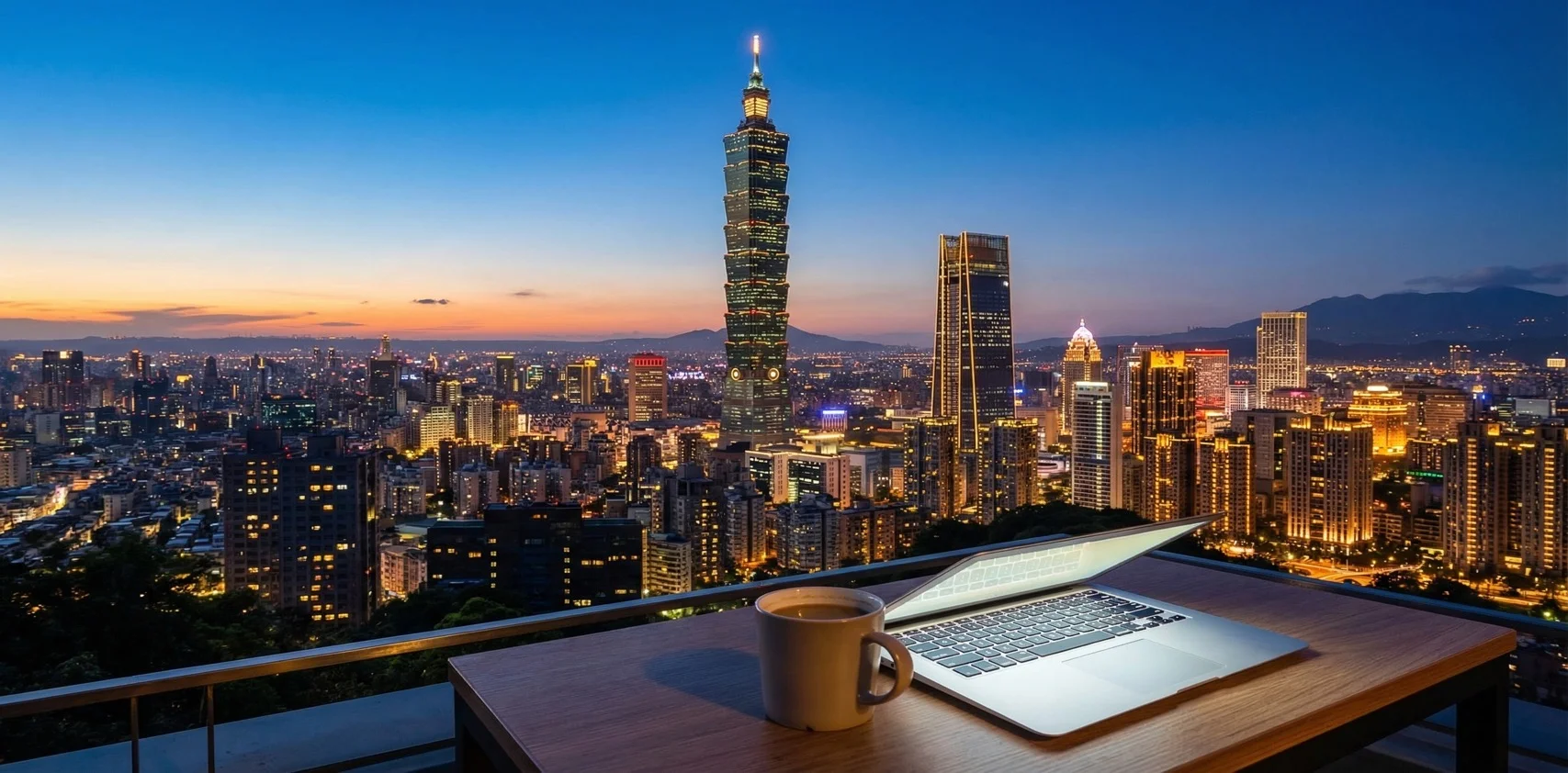
AI Generated - Editorial Use
A Gold Card visa with no employer sponsor needed, and the world's highest convenience store density. Taiwan has everything a digital nomad needs, yet it's still flying under most people's radar.
Ask a digital nomad to name their top picks in Asia, and you'll hear the usual suspects: Bali for the vibes, Chiang Mai for the value, Bangkok for the energy, Tokyo for the aesthetics. These are fine choices. They've earned their reputations. But there's a place in Asia where the internet is faster than most of Europe, a doctor's visit costs less than a cocktail, the visa system actively welcomes freelancers, and you can walk alone at 3 AM without a second thought — and somehow, it barely registers on the nomad radar.
That place is Taiwan.
This isn't another "Taiwan digital nomad guide" with bullet points about SIM cards and MRT maps. Those exist already — digitalnomad.press alone has published city guides, visa breakdowns, and starter kits for Taiwan over the past two years. This piece is asking a different question: Why does Taiwan have every ingredient of a world-class nomad destination yet remain chronically overlooked? And what would you actually get if you gave it six months instead of six days?
The Reason It's Overlooked Is Exactly Why It's Good
Thailand has a mature digital nomad industry. In Chiang Mai or Bali, you step off the plane and immediately enter an ecosystem designed for you — coliving spaces, nomad meetups, visa consultants, Instagram-ready coworking cafés. The whole thing runs like a well-oiled machine. Taiwan doesn't have that. Not in the same polished, packaged way.
And that's precisely the point.
Taiwan is "underrated" not because it lacks the fundamentals, but because it hasn't commodified them. Its advantages are structural — baked into the fabric of the society itself, not bolted on to attract a specific demographic. What you experience isn't a curated bubble for nomads. It's an actual high-functioning society that happens to be an exceptional place to do remote work.
Here's the difference: In Bali, your coliving space has blazing WiFi, but step outside and the connection might drop to nothing. In Taiwan, you walk into a random breakfast shop on a random corner, and the 4G on your phone pulls 50+ Mbps. That's not built for you. That's just what life here is.
Visas: Taiwan Is Quietly Rolling Out the Red Carpet
For nomads, visa logistics are always the first filter. Taiwan's progress here has been faster than most people realize.
The Employment Gold Card might be the single most freelancer-friendly long-term residency document in Asia. It's a four-in-one card combining a work permit, resident visa, re-entry permit, and alien resident certificate. The critical detail: no employer sponsorship required. You don't need a job offer in Taiwan. You need to demonstrate professional qualifications in one of eight fields — science and technology, economics, education, culture and arts, sports, finance, law, or architecture.
The card is valid for one to three years and renewable. Application fee: approximately NT$3,500, which works out to about US$110. Read that again. For the price of a moderately nice dinner, you get a card that lets you legally work, freely enter and exit, and enjoy resident-level access in Taiwan.
The tax incentive deserves special attention. Gold Card holders earning above NT$3 million annually (roughly US$95,000) receive a 50% tax deduction on the portion exceeding that threshold — for the first five years. This isn't a grey-area tax hack. It's an explicit, codified policy designed to attract international talent. For remote workers with solid incomes, the math is extremely favorable. (For a detailed application walkthrough, see digitalnomad.press article #37, or head to goldcard.nat.gov.tw.)
Beyond the Gold Card, Taiwan launched a new digital nomad visa category in February 2025. Compared to the Gold Card's professional bar, this nomad visa is positioned as a lower-threshold option — better suited to those who have stable remote income but may not yet meet the Gold Card's experience requirements. Two distinct pathways, covering different stages of the nomad career arc.
What does this mean in practice? It means Taiwan isn't passively relying on 90-day tourist stamps. It's actively building institutional pathways for remote workers. In Asia, that's still rare.
National Health Insurance: Taiwan's Hidden Ace
If you had to pick one single reason to seriously consider Taiwan — not as a pit stop, but as a place to base yourself for six months — it should be healthcare.
Taiwan's National Health Insurance (NHI) covers over 99% of the population. Foreign residents become eligible after six consecutive months of residence, at a monthly premium of approximately NT$800–1,500 — that's US$25–50 per month.
Twenty-five to fifty dollars a month.
Let that sit for a moment. In the United States, a basic health insurance plan runs $400–600/month with deductibles that can reach thousands. In Europe, even with public systems, foreigners often need supplementary private coverage. Most nomads rely on travel insurance products like SafetyWing or World Nomads — reasonable in price but limited in scope, with claims processes that range from tedious to adversarial.
Taiwan's NHI is not travel insurance. It's real medical insurance. A standard outpatient visit costs NT$150–500 (US$5–16), including consultation and basic medication. Specialist visits, imaging, even minor procedures — the costs are so low they feel like errors. And the quality doesn't suffer. Taiwan's healthcare system consistently ranks among the world's best, with wait times so short you might see a doctor, get diagnosed, and pick up medication the same day you book the appointment.
For nomads who've been on the road a while, this matters more than it might seem on paper. Health anxiety is one of the least-discussed but most persistent stressors of the nomad lifestyle. That background hum of "what happens if I actually get sick here?" — in Taiwan, it essentially disappears. You don't have to choose between seeing a doctor and watching your budget. Toothache? Go to the dentist. Feeling off? Walk into a clinic. No need to first research whether the local hospitals are trustworthy.
The six-month residency requirement looks like a barrier, but flip the frame: if you're planning to stay half a year anyway, NHI enrollment becomes a massive bonus. And during those first six months, out-of-pocket costs for self-pay visits are still remarkably low — a routine consultation might run NT$600–1,000, less than a typical American copay.
Cost of Living: Not the Cheapest — the Best Value
Let's be upfront: Taiwan is not Southeast Asia. If your sole criterion is minimizing monthly burn, Chiang Mai, Hanoi, or Davao will stretch your dollar further. Taiwan's cost of living sits in Asia's middle tier — significantly cheaper than Japan or Korea, somewhat more expensive than most of Southeast Asia.
But cost is never just a number. It's a ratio of what you spend to what you get.
In Taipei, a nomad's monthly expenses typically fall between US$1,500 and $2,500, depending on housing and dining preferences. That covers rent (a decent studio runs US$500–800), food (US$300–500/month eating out, which is the default — Taiwan's street food culture makes cooking at home almost economically irrational), transport (MRT plus YouBike, under US$50/month), and incidentals.
Take the same budget to Tokyo and you get a smaller room, pricier restaurants, and a more crushing commute. Tokyo's nomad range runs US$2,500–4,000/month, and hitting that lower bound requires meaningful sacrifices. Seoul is similar at US$2,000–3,500, with winter heating bills adding an unwelcome spike.
Looking south, Bangkok runs comparable to Taiwan at US$1,000–2,000, but Taiwan pulls clearly ahead on safety, healthcare quality, and infrastructure reliability. Bali occupies a similar price band, but step outside the tourist corridor and gaps in internet stability and transport become the hidden surcharge on that cheap rent.
Move beyond Taipei — Taichung or Kaohsiung — and your budget drops to US$1,000–1,800. Taichung has undergone a quality-of-life renaissance in recent years: pleasant climate, manageable pace, increasingly good food and cultural scene. Kaohsiung offers the expansive feel of a harbor city with steadily improving urban planning. Both deliver roughly 80% of Taipei's convenience at roughly 50% of Taipei's rent.
Where Taiwan's value really shines is in the things you don't pay extra for. You don't need a water purifier. You don't need to worry about a baseline of food safety (Taiwan's standards are among Asia's strictest). You don't need to budget for living in "the safe neighborhood" — because the entire city is the safe neighborhood.
Infrastructure: Things You'll Miss When You Leave
Live in Taiwan long enough and you start taking certain things for granted. You only realize what you had when you land at your next destination and it's not there anymore.
Internet. Taiwan's average fixed broadband speed exceeds 140 Mbps, ranking in Asia's top three. This isn't a hotel-lobby theoretical figure — it's what you actually get in your apartment, your café, your coworking space. Mobile coverage is equally robust, with 4G/5G reaching effectively everywhere. For remote workers who need reliable upload and download — especially those in video, design, or roles requiring frequent video calls — this is a hard requirement, not a nice-to-have.
Convenience stores. This might sound like a strange infrastructure category, but anyone who's lived in Taiwan knows: convenience stores here transcend their label. Taiwan has one of the highest convenience store densities on the planet — 7-Elevens and FamilyMarts appear every block or two. You can pay bills, mail packages, print documents, grab decent coffee and hot meals, and handle minor administrative tasks, all at 3 AM if you want. For nomads, they function as an invisible life-support system.
Public transit. The Taiwan High Speed Rail compresses the island's 350 km north-south span into roughly 90 minutes. Taipei's MRT is clean, punctual, cheap, and still expanding. YouBike (public bikeshare) blankets major cities at NT$5 for the first 30 minutes. Kaohsiung has metro and light rail; Taichung offers free bus rides within 10 km. You almost never need a car in Taiwan unless you're chasing mountain trails.
Safety. This cannot be overstated. Taiwan consistently ranks among the world's safest countries. Walking alone at night, leaving your laptop on a café table while you use the restroom, riding the last train by yourself — things that require risk calculation in many countries are simply unremarkable here. For solo travelers and especially women nomads, this is foundational. Safety isn't a "nice bonus." It's the substrate on which quality of life is built.
Coworking: No Hype, Genuinely Functional
Honestly, Taiwan's coworking scene doesn't get the international press that Bali's or Lisbon's does. It doesn't have that Instagram-glow factor. But it has a more practical virtue: these spaces are designed for people who actually need to get work done, not for people who need a backdrop for content.
Taipei has the most options. CLBC is a homegrown brand with multiple locations — practical, reasonably priced. Changee offers flexible plans well-suited to short-term nomads. Impact Hub Taipei is part of the global Impact Hub network, pairing workspace with community events and startup resources. WeWork has a Taipei presence for those who prefer global consistency.
Taichung's coworking scene has grown rapidly. 好伴 (Howban) is a local institution with strong community ties. Blueprint and Monospace each have distinct character, with Monospace particularly popular among design and creative professionals.
Kaohsiung's SpaceBar and Xinbin Station are the better-known options, the latter housed in a renovated historic building with a distinctive atmosphere. Even Hualien and Taitung on the east coast are seeing small independent spaces emerge — limited in selection, but compelling for anyone drawn to the idea of coding with the Pacific Ocean in view.
A practical note: Taiwan's café culture is exceptionally developed, and most cafés are remarkably tolerant of laptop campers — far more so than Tokyo or Seoul. Many nomads in Taiwan work a hybrid pattern: café in the morning, coworking space in the afternoon, or cafés exclusively. A pour-over coffee runs NT$120–180 (US$4–6) and buys you hours of seating, air conditioning, and stable WiFi.
Quality of Life: Beyond the Spreadsheet
Numbers and policies are the skeleton. What actually makes people stay is the texture of daily life.
Taiwan's food culture is a luxury for nomads — and a cheap one. Night markets aren't just tourist attractions; they're a living, breathing public dining system. A full night-market dinner runs NT$100–200 (US$3–7), with enough variety that you could eat something different every day for a month straight. Bento shops, street stalls, and breakfast joints form the backbone of daily sustenance for locals and nomads alike.
But Taiwan isn't only cheap eats. The spectrum runs wide: specialty coffee roasters, creative fusion restaurants, Japanese-style izakayas, refined Taiwanese cuisine. You can spend NT$80 on a bowl of beef noodle soup that makes you reconsider your life choices, or NT$3,000 on a fine dining experience that redefines what Taiwanese food can be.
Nature is another underappreciated dimension. Taiwan is small in area but vertically compressed — subtropical coastline to 3,000-meter peaks, all within a few hours' drive. On a weekend from Taipei, you can surf the north coast, soak in hot springs on Yangmingshan, or wander the hillside streets of Jiufen, all within an hour. With a full weekend, Taroko Gorge in Hualien, sunrise at Alishan, or Kenting's beaches are all within reach. For nomads who work hard during the week and need genuine recharging on weekends, Taiwan's geographic compression is an outsized advantage.
Hot springs deserve a specific mention. Situated on the Pacific Ring of Fire, Taiwan has an almost absurd abundance of natural hot springs. Beitou, Wulai, Jiaoxi, Guguan — these aren't fly-to-reach resorts. They're weeknight-after-work destinations. The restorative value of regular hot spring access is something you don't fully appreciate until you have it, and then deeply miss when you don't.
Cultural depth runs deeper than outsiders tend to assume. Taiwan is not a monoculture. Indigenous peoples comprise sixteen officially recognized groups, each with distinct languages, music, and festivals. Hakka culture is deeply rooted in certain regions. Hokkien (Minnan) culture is predominant but not the whole picture. Japanese colonial-era architecture and cultural traces are woven throughout the island. This layered cultural texture means you can live here for six months and discover a new dimension every few weeks.
Language: An Honest Assessment
No sugarcoating: language is Taiwan's most visible barrier for nomads.
In Taipei, English functionality is reasonable. MRT signage, major attractions, and most restaurant menus include English. The younger generation's English proficiency is generally solid, and you can navigate daily life in English without major friction. But "manageable" and "comfortable" are different things — if you're accustomed to the near-total English immersion of European cities or Southeast Asian tourist hubs, Taipei will require a slight recalibration of expectations.
Move south to Taichung or Kaohsiung and English utility drops noticeably. Young people's English is still decent, but in everyday contexts — traditional markets, local restaurants, government offices — Mandarin is effectively the only operating language. If you speak zero Chinese and plan to stay long-term outside Taipei, Google Translate becomes your constant companion, and you'll inevitably miss nuance.
The good news: Taiwanese people are genuinely, disarmingly warm toward foreigners — and it's an earnest warmth, not a transactional one. Even with a complete language gap, most people will go out of their way to help — gesturing, pulling out phone translators, sometimes physically walking you to your destination. This social-level goodwill compensates, at least partially, for the linguistic gap.
If you're planning three months or more, investing some time in basic Mandarin pays enormous dividends. You don't need fluency. But "hello," "thank you," "how much," and "no cilantro" will meaningfully upgrade your daily experience — especially the last one.
"But What About the Geopolitics?"
No article about Taiwan can avoid this question, so let's address it directly.
Yes, cross-strait geopolitical tensions are a real and ongoing issue. Yes, international media periodically runs alarming headlines. Yes, if you tell friends you're moving to Taiwan for six months, someone will look concerned.
But if you ask people who actually live in Taiwan — locals and expats alike — what percentage of their daily life is spent worrying about this, the answer approaches zero. Taiwanese society demonstrates a distinctive pragmatism on this topic: a clear-eyed acknowledgment that the risk exists, paired with a firm refusal to let it dictate the quality of daily life.
On a practical level, Taiwan's political stability is high by Asian standards. Its democracy functions (loudly, sometimes chaotically, but it functions), its rule of law is predictable, and personal freedoms are robustly protected. Your internet isn't censored. You don't need a VPN. Freedom of speech is a default, not something you negotiate for.
This article won't pretend the risk is zero — that would be dishonest. But it also won't let a low-probability hypothetical scenario negate a destination that excels on virtually every other dimension. Risk assessment is everyone's personal homework, but it should be informed by reality, not headlines.
Why "Six Months"?
This piece keeps emphasizing three to six months rather than "a quick visit" or "permanent relocation." That's intentional.
Taiwan doesn't reveal its value on a short trip. Two weeks gives you the surface — night markets, Taipei 101, Jiufen — and you leave with a vague "that was nice" impression. Taiwan's real value lives in its deeper structures: NHI enrollment requires six months of residence. The Gold Card's tax benefits require tax residency. Coworking community connections take time to build. The actually-great hole-in-the-wall restaurants are found through word of mouth, not Google Maps.
Three to six months is the sweet spot. Long enough to penetrate the tourist layer and start living like a resident. Short enough that you're not making a "moving to Taiwan" commitment. In that window, you can establish an efficient work rhythm, explore multiple cities, experience seasonal shifts (Taiwan's spring and autumn are particularly lovely), and gather enough firsthand data to decide what comes next.
Many nomads who've spent six months in Taiwan end up putting it on their permanent rotation — one of those places they return to for a few months each year. That, in itself, is the strongest endorsement.
Not the Flashiest. Possibly the Most Livable.
The digital nomad community has a tendency to chase the next hot spot. Every few months, a new city gets thrust into the spotlight — maybe a viral YouTube video, maybe a prominent community's recommendation. These places usually have one or two standout strengths (incredibly cheap, incredibly beautiful, incredible community), but they also tend to have equally prominent weaknesses.
Taiwan is not the kind of place that goes viral. It doesn't have Bali's visual drama, Lisbon's European romance, or Chiang Mai's "nomad paradise" brand equity.
What it has is something rarer: comprehensiveness.
Internet speed, healthcare, safety, transit, visa policy, cost of living, food quality, natural environment — Taiwan may not rank #1 in any single category. But add them all up, and it's extraordinarily hard to find another destination that scores this consistently high across this many dimensions.
That's what "underrated" actually means. Not that nobody knows Taiwan is good, but that most people haven't grasped how comprehensively good it is.
For nomads who've been at this long enough to value "baseline quality of life" over "cheapest and coolest," Taiwan deserves to be at the top of your next-destination list.
Not because it's the most glamorous option. But because once you settle in, you'll find remarkably little to complain about.
And in the world of digital nomadism, "remarkably little to complain about" might be the highest praise there is.
This content is protected by copyright. Please respect the author's work and do not copy or distribute without permission.
數位遊牧編輯群 Digital Nomad Editor Group
Digital Nomad is a knowledge sharing platform specially designed for “those who dream to become digital nomads.” We share the latest news and industry trends related to digital nomadism, as well as introduce essential skills and knowledge needed for freelancers, remote workers, etc. Our goal is to help you connect with fellow digital nomads!
