


Your Phone Made Work Borderless, but Your Paperwork Never Caught Up — The Administrative Hell of Digital Nomads
April 23, 2026
AI Generated - Editorial Use
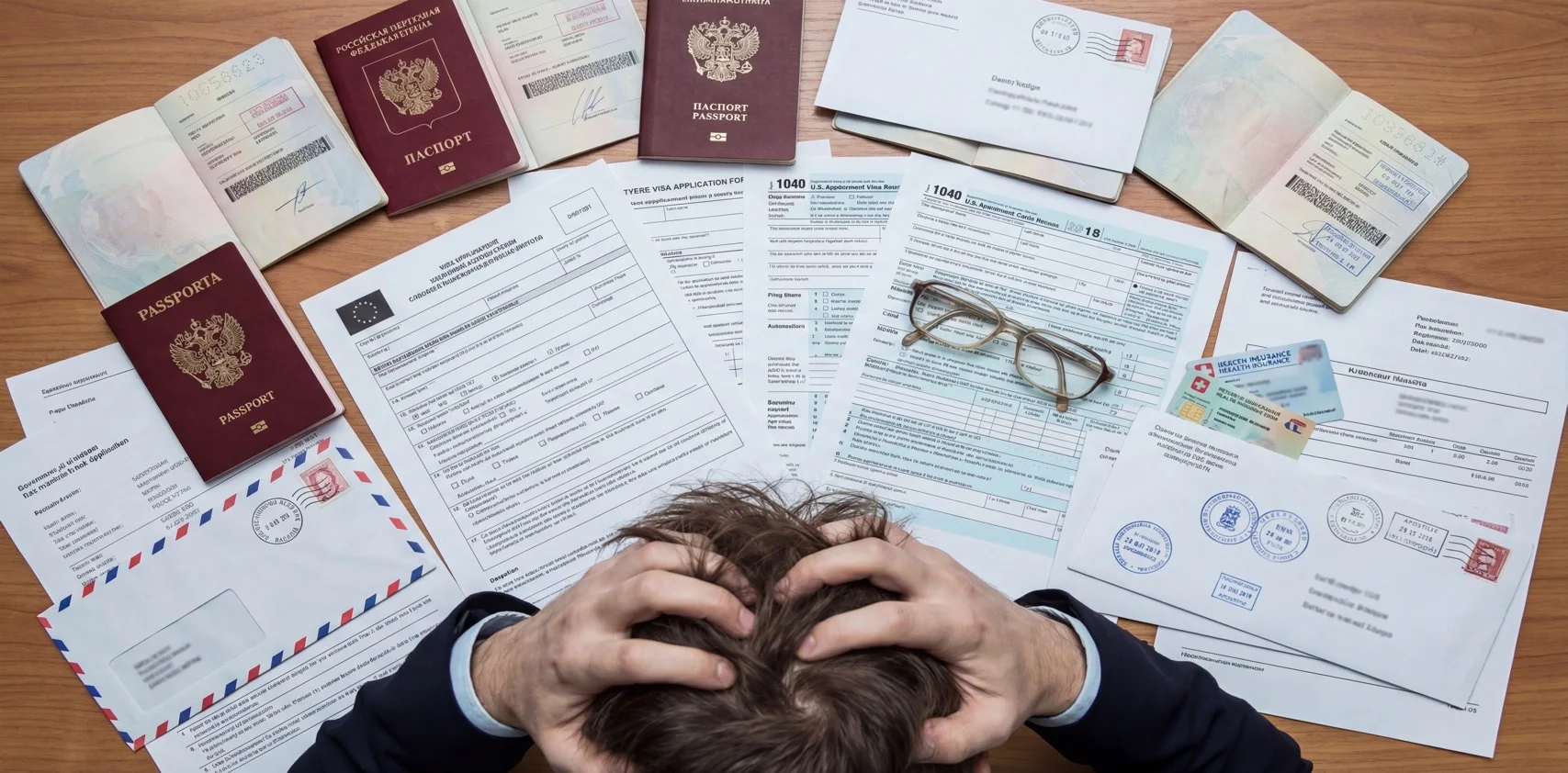
Smartphones made work borderless, but national administrative and tax systems are stuck in the past. From apostilles and banking to healthcare gaps, cross-border paperwork is the biggest hidden cost for digital nomads. This article outlines the five major administrative hells and practical strategies to navigate them.
In 2026, a single smartphone lets you take client calls from Bali, submit design files from Lisbon, and run data analysis from Chiang Mai. Technology has liberated "work" from the office — but there's one thing tech still hasn't figured out: the soul-crushing mountain of documents, certifications, tax forms, and insurance gaps that come with actually doing it legally.
On March 23, 2026, Tapscape published a piece with a title so blunt it hurts: "The Smartphone Made Work Borderless. Paperwork Never Caught Up." The article points out that while the technical barrier to remote work has dropped to near zero, administrative systems — visas, taxes, document authentication — remain stuck in last century's logic. You can work from any corner of the globe, but you can't legally work from any corner of the globe.
This isn't a minor inconvenience. It's the biggest hidden cost of the digital nomad lifestyle, and the real reason many people set out full of enthusiasm only to throw in the towel before their first year is up.
Here are five administrative pain points that every serious long-term nomad will encounter. Not "might" — will.
Cross-Border Document Authentication: You Thought a Stamp Would Do?
Digital nomads need to deal with far more official documents than most people realize. Applying for a digital nomad visa requires a criminal background check. Renting an apartment requires proof of income. Getting a residence permit requires a birth certificate. Starting a company requires authenticated academic credentials. The problem: all these documents were issued by your home country, and you need to use them in another.
Enter the Apostille.
What Is an Apostille?
The 1961 Hague Convention Abolishing the Requirement of Legalisation for Foreign Public Documents established a simplified system for cross-border document authentication. Between member countries, official documents only need a single "Apostille" — a standardized certification page — to be recognized, bypassing the lengthy embassy legalization process.
Sounds great. In practice, every country's requirements are different.
Problems You'll Actually Face
Requirements vary wildly between countries. Spain's digital nomad visa requires all documents to be apostilled and translated into Spanish by a sworn translator. Portugal's process is similar but different in detail. Thailand's LTR visa follows an entirely different authentication path because Thailand isn't a Hague Convention member — you'll need traditional embassy legalization instead.
You're not in your home country, but your documents need to go back there. Apostilles must be issued by designated authorities in the country that issued the document. If you're American, federal documents go through the State Department, while state-level documents go through the relevant Secretary of State's office — and yes, each state has different procedures and timelines.
Documents expire. Many countries require documents to be "no older than three months" or "no older than six months" at the time of application. You can't process everything once and use it forever. Every country change or visa renewal might mean starting over.
Translation requirements are minefields. Some countries accept English documents. Others only accept official translations into the local language. And "official translation" means different things in different places — sworn translators, court-certified translations, or translations with their own apostille attached.
Practical Advice
Prepare extras before you leave. Before departing your home country, get all potentially needed documents apostilled. Prepare at least two or three copies each of your criminal record check, birth certificate, academic credentials, and marriage certificate (if applicable).
Use expediting services. Companies like Three Hole Punch (US) and Apostille London (UK) specialize in apostille processing. When you're overseas, these services become your lifeline.
Digitize everything. Store high-resolution scans of all authenticated documents in the cloud. Most official processes still require paper originals, but digital backups buy you time in emergencies.
Research destination requirements early. Don't arrive only to discover you're missing a document. Every country's immigration website (or digital nomad visa page) lists required documents. Starting three to six months early isn't overkill.
EU A1 Telework Certificate: What Happens After the Transition Period?
If you're nomading through Europe, there's one document you may not have heard of but will inevitably encounter — the A1 Certificate.
What Is the A1 Certificate?
The A1 Certificate is a "Portable Document" under the EU's social security coordination system. It certifies which country's social security system a person is covered under. In plain terms, it tells governments: "This person's social security contributions are already being paid in Country X — don't charge them again."
This document was originally designed for traditional posted workers. But as remote work exploded, a new question arose: if you're employed by a French company but working remotely from Spain, who gets the social security contributions?
The Cross-Border Telework Framework Agreement
To address this, the EU introduced the Framework Agreement on Cross-Border Telework in 2023. The core rule: if remote work doesn't exceed 50% of total working time, employees can remain in their employer country's social security system — the employer just needs to apply for an A1 Certificate.
As of early 2026, 23 European countries have signed the Framework Agreement, with Estonia being the latest member (effective February 1, 2026).
The Transition Period Problem
Here's the catch. The Framework Agreement established a transition period during which retroactive A1 applications were allowed and procedures were simplified. According to EY's analysis, A1 telework applications submitted before the transition period ends are generally valid until June 30, 2026.
In other words, after June 30, 2026, the transition period perks disappear.
What does this mean for digital nomads?
Stricter application procedures. After the transition period, A1 Certificate applications will revert to formal processes — more documentation, longer wait times, and stricter review standards.
Employers may not cooperate. For European companies employing remote workers, applying for A1 Certificates is an administrative burden. The simplified transition procedures were a sweetener. Once that sweetener vanishes, some companies may reconsider whether hiring cross-border remote employees is worth the hassle.
A gray zone for the self-employed. The Framework Agreement primarily targets employed workers. If you're a freelancer, the situation is more complex — you may need to determine on your own which country you should be paying social security to, and the rules differ between countries.
Practical Advice
If you're working remotely in Europe, apply now. Before the transition period ends (June 30, 2026), have your employer submit an A1 Certificate application as soon as possible. BDO's analysis indicates that retroactive application opportunities will shrink dramatically after the transition period.
Communicate openly with your employer. Many European employers aren't fully aware of the Framework Agreement's details. Proactively providing information and helping your employer navigate the process benefits both parties.
Consider establishing a European entity. If you're self-employed and active in Europe long-term, consider setting up a legal entity in a country with favorable tax and social security regimes — Estonia's e-Residency program is a popular option that can simplify social security issues.
Stay on top of policy changes. EU member states are still adjusting their implementation of the Framework Agreement. KPMG and Vialto Partners regularly publish country-by-country updates worth following.
Opening a Bank Account: No Address, No Account
You might think that in 2026, opening a bank account should be as simple as downloading an app. For people with a fixed address, maybe. But for digital nomads? Good luck.
Traditional Banking Logic
Nearly every traditional bank worldwide is built on a fundamental assumption: the customer has a fixed residential address. This address isn't just for mailing statements — it's a core element of KYC (Know Your Customer) compliance. No local address means you don't make it past the first gate.
It gets worse. Many countries' banks also require you to appear in person, presenting proof of residence, a local tax number, or even an employer letter. If you're on a tourist visa or short-term digital nomad visa, many banks will flatly reject your application.
Digital Banks Arrived — But They're Not a Silver Bullet
The rise of digital banks like Wise, Revolut, and N26 has significantly improved the financial landscape for digital nomads. Wise offers multi-currency accounts with local bank details in multiple countries. Revolut supports exchanges in over 150 currencies. N26 provides full European IBAN accounts.
But they have their own issues.
Account freeze risk. Both Wise and Revolut have frozen user accounts due to compliance reviews. When your fund flow patterns don't match "normal" — frequent cross-border transfers, deposits from multiple countries — the system may trigger automatic reviews. SUISSE BANK's analysis notes that Wise users have reported accounts being frozen without warning, requiring days or even weeks to resolve.
Features limited by registration country. Despite marketing themselves as "borderless," many features are actually restricted based on the country of the address you used at registration. A Revolut account registered in the UK may have different features and limitations than one registered in Germany.
Not universally accepted. Some payment platforms, landlords, and government agencies won't accept digital bank account details. When renting in Europe, landlords may require traditional bank statements as proof of financial means.
Practical Advice
Keep your home country bank account. No matter what, don't close your home country bank account. Maintain at least one traditional bank account as an anchor for tax refunds and home-country financial affairs.
Multi-account strategy. Many experienced digital nomads use a combination: Wise for multi-currency receiving and low-cost conversions, Revolut for daily spending and travel, plus a traditional bank account as backup. GrabrFi is another newer option specifically designed to receive international payments from platforms like Payoneer and Deel.
Handle banking correspondence proactively. If your home country bank requires periodic address updates or KYC reviews, deal with them early. Many nomads discover their accounts have been "temporarily frozen" pending KYC updates while overseas, which becomes extremely difficult to resolve remotely.
Leverage digital nomad visa banking partnerships. Some countries' digital nomad visa programs include banking facilitation measures. Estonia's e-Residency paired with LHV or other partner banks, for example, provides a relatively straightforward path to opening a European account. Research banking tie-ins when applying for visas.
Health Insurance Gaps: The Day You Leave, Your Coverage Might End
This is the most overlooked issue — and the one with the most severe consequences.
The Basic Logic of National Health Systems
Almost every country's public health system is residence-based. You live here, you pay premiums (or taxes), you get coverage. Once you leave, gaps start appearing — or coverage drops off entirely.
Take Taiwan as an example: National Health Insurance allows short-term travelers to retain eligibility, but if you're abroad continuously for more than six months without paying premiums, your coverage gets suspended. European countries can be even stricter — many stop covering you once you confirm you're no longer a tax resident.
This means that from the day you truly begin digital nomading, you may enter a medical coverage vacuum.
A Digital Nomad Visa Doesn't Mean Health Coverage
Many people assume that getting a digital nomad visa automatically includes healthcare. Wrong. Most countries' digital nomad visas explicitly require you to "purchase adequate medical insurance" as an application requirement — meaning they're telling you from the start: you're not in our health system.
The Rise of Nomad-Specific Insurance
SafetyWing is currently the best-known digital nomad insurance brand, offering Nomad Insurance (travel medical insurance) and Nomad Insurance Complete (comprehensive health insurance). The latter attempts to bridge the gap between traditional travel insurance and formal health insurance — it's not an enhanced travel policy but rather a health insurance framework with travel protections layered on top.
Expatinsurance's analysis points out that traditional travel insurance and home-country health systems are "fundamentally mismatched" with the nomadic lifestyle. Only insurance specifically designed for digital nomads can effectively fill this gap.
Other options include World Nomads, Cigna Global, and Allianz Care. Their common feature: they're not tied to any single country and can be used in most places worldwide.
Practical Advice
Never have a coverage gap. BestTravelScout's advice is critical: make sure your policy has "no gap in coverage between destinations." One day of gap, and if something happens, it's a financial disaster.
Read the exclusion clauses carefully. Digital nomad insurance sounds great, but the exclusions can be brutal. Common exclusions include pre-existing conditions, specific high-risk countries, dental and vision, mental health, and pregnancy-related care. Read every word before buying.
Keep a path back to home-country health coverage. If your home country allows reinstatement after suspension (like Taiwan's NHI), understand the reinstatement conditions and waiting periods. This is your safety net — don't give it up lightly.
Budget adequately. A decent international health insurance plan costs roughly $80 to $300 per month, depending on age, coverage scope, and deductible. This is not where you cut corners. If your digital nomad financial plan doesn't include insurance, your budget is incomplete.
Learn local healthcare basics. When arriving in a new country, find the nearest hospitals, clinics, and emergency procedures. Save your insurance company's emergency contact number on your phone. These small steps are invaluable in a crisis.
Tax Filing: The Multi-Country Income Nightmare
If the previous four issues gave you headaches, wait until you hit taxes. You'll miss the days when things were merely "painful."
The Core Dilemma
The digital nomad tax dilemma can be summarized in one sentence: you may simultaneously owe taxes to multiple countries, and no country's tax system was designed for someone like you.
Here are common scenarios:
Your home country's tax obligations don't disappear when you leave. US citizens must file federal tax returns on worldwide income regardless of where they live. According to Greenback Tax Services, if your annual income exceeds $13,850 (2025 single filer threshold), you must file — no matter where on Earth you happen to be. Self-employment income over $400 also triggers approximately 15.3% in self-employment tax.
You may owe taxes in your destination country too. If you stay in a country beyond a certain number of days (typically 183, though standards vary), you may be considered a tax resident and required to file locally. Some digital nomad visas explicitly define tax treatment — some offer tax exemptions or reduced rates, others don't.
Double taxation risk. If two countries simultaneously consider you a tax resident, the same income could be taxed twice. While many countries have Double Taxation Agreements (DTAs), not all country pairs are covered, and actually applying a DTA is an administrative process in itself.
Challenges by Nationality
US Citizens: The most complex situation. The worldwide taxation principle, combined with FBAR (Foreign Bank Account Reporting) and FATCA (Foreign Account Tax Compliance Act) requirements, makes US digital nomads' compliance costs extremely high. The silver lining is the Foreign Earned Income Exclusion (FEIE), with a 2025 threshold of $126,500 — but you must pass either the Bona Fide Residence Test or the Physical Presence Test.
EU Citizens: Moving within the EU is relatively straightforward, but crossing EU borders requires attention to each country's tax treaties. The EU has no unified income tax system — each member state sets its own rules.
Citizens of other countries: Tax obligations vary widely. Some countries tax only domestic income for non-residents, while others apply worldwide taxation. Understanding your home country's rules and any applicable DTAs is essential.
Practical Advice
Hire a professional international tax advisor. This is not where you save money. Digital nomad tax compliance is extraordinarily complex. DIY mistakes are easy to make, and penalties for tax violations are typically steep. Firms like Brighttax and Greenback Tax Services specialize in serving overseas workers and are worth the investment.
Document everything. Meticulously record your days spent in each country, the source and currency of every income stream, and all expenses. These records aren't just for filing — they're your evidence if a tax authority ever comes asking questions.
Understand your destination's digital nomad visa tax provisions. Some countries offer tax advantages to digital nomad visa holders. According to Immigrantinvest's compilation, Barbados, Bermuda, and the Cayman Islands fully exempt nomads' foreign income from taxation. Portugal's NHR (Non-Habitual Resident) scheme was adjusted in 2024 but still offers certain tax benefits.
Leverage Double Taxation Agreements. If a DTA exists between your home country and your destination, understand its contents and application conditions. DTAs typically include a "tie-breaker rule" for determining primary tax residency, which can help you avoid being taxed by both sides simultaneously.
Plan your tax residency strategically. This isn't about tax evasion — it's about choosing the most favorable tax arrangement within legal frameworks. Some digital nomads deliberately establish tax residency in lower-tax jurisdictions. This is entirely legal but requires careful planning and professional guidance.
Administrative Infrastructure: The Biggest Hidden Cost of Digital Nomadism
When people talk about digital nomadism, social media shows beach laptops, café Zoom calls, and enviable landscape photos. Nobody posts their three-hour queue at the apostille office on Instagram. Nobody shares their 3 AM breakdown while researching cross-border tax treaties.
But that's the real digital nomad life.
Tapscape's report nails the core issue: "It's easy enough to grab a smartphone and send a business email no matter where you are… However, once visas, taxes, and licences get involved things tend to get messy and your location matters quite a bit."
Administrative infrastructure — document authentication, social security coordination, banking systems, health coverage, tax compliance — is the single biggest hidden cost for globally mobile workers. It doesn't appear in the first three pages of any "Digital Nomad Starter Guide," but the time, money, and energy it consumes often exceeds what you spend on coffee and coworking spaces.
International health insurance runs $100–300 per month. A single apostille plus official translation costs anywhere from tens to hundreds of dollars — and you may need to do it several times a year. International tax advisory fees start at several thousand dollars annually. Then there are the unquantifiable costs: time spent researching each country's regulations, anxiety while waiting for documents to process, the frustration of communicating with your home country bank across time zones.
A conservative estimate puts a compliance-conscious digital nomad's annual spending on "administrative infrastructure" at $3,000 to $8,000 minimum — not counting your own time.
Why Many Don't Make It Past Year One
Digital nomadism's high dropout rate is usually attributed to loneliness, culture shock, or income instability. These are real factors. But what rarely gets mentioned is the cumulative effect of administrative burden.
Month one, you think: "An apostille? No big deal." Month three, you realize: "Wait, I also need translations, notarization, and this country's requirements are totally different from the last one." Month six, it hits you: "My health insurance has a gap, my bank account has issues, and I have no idea how to file taxes." Month twelve, you're done: "I'm spending almost as much time on paperwork as on actual work."
That's administrative hell. It doesn't knock you out in one blow — it grinds you down. No single problem is fatal, but stacked together, they become the straw that breaks the camel's back.
Will It Get Better?
The good news: improvement is happening. The EU's cross-border telework Framework Agreement is progress, even if it's not fast enough. More countries are launching digital nomad visa programs, some with banking and tax facilitation built in. Digital banking is gradually filling the gaps traditional banks left behind.
The bad news: these improvements are fragmented. No international body is pushing for a unified "digital nomad administrative standard." Countries are going their own way — some moving fast, some not moving at all. For the foreseeable future, administrative infrastructure lag will remain an inherent feature of the digital nomad lifestyle.
For Those About to Set Out
If you still want to take the digital nomad path after reading this — good. It means you're serious.
But carry this awareness with you: your phone truly made work borderless, but the paperwork hasn't caught up. This isn't a complaint — it's a fact. And the value of facts is that once you acknowledge them, you can prepare.
Spend three to six months before departure handling documents and certifications. Line up an international tax advisor. Purchase health insurance. Set up a multi-account banking architecture. Track your days in every country.
Build these hidden costs into your budget and plans. They won't make your nomad journey less romantic — but they'll help your nomad journey survive year one.
And people who survive year one will usually tell you: those days wrestling with paperwork made the freedom that followed worth so much more.
This content is protected by copyright. Please respect the author's work and do not copy or distribute without permission.
