


The Fukuoka Colive Experiment: How 496 Nomads From 57 Countries Proved That Nomads Aren't Just Passing Through
April 9, 2026
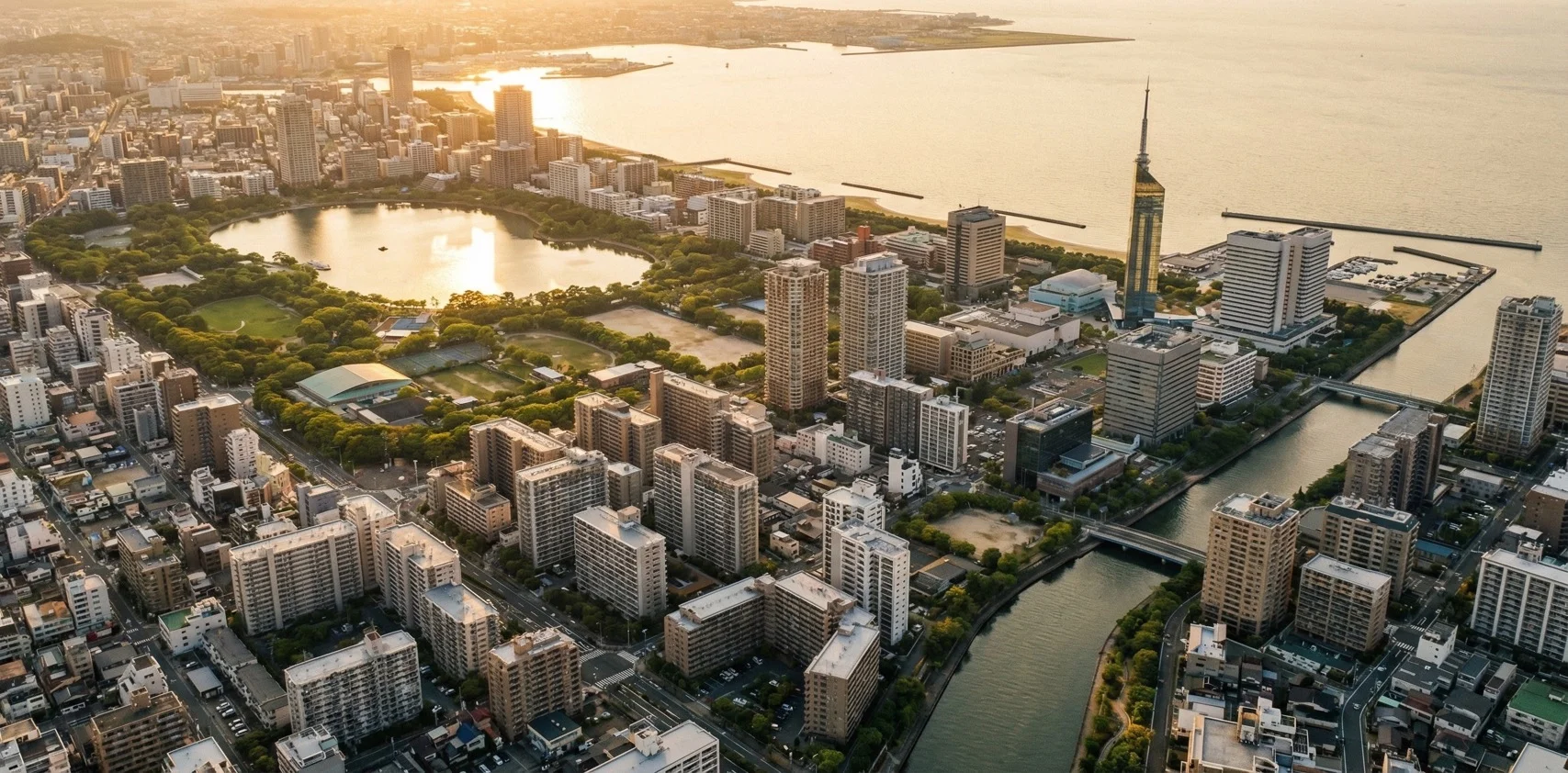
AI Generated — No Rights Reserved
In October 2025, 496 digital nomads from 57 countries gathered in Fukuoka and generated ¥140 million in economic impact in just one month. This wasn't just an event — it was a city redefining what nomads are worth.
On March 5, 2026, a quietly published report from Fukuoka dropped a set of numbers that deserve more attention than they've received: 496 digital nomads from 57 countries descended on Japan's sixth-largest city in October 2025, stayed an average of 23 days, and generated an estimated ¥140 million (roughly US$970,000) in local economic impact.
The program behind those numbers is called Colive Fukuoka, a joint initiative between Yugyo Inc. and the Fukuoka city government. And what it demonstrated goes far beyond what any tourism campaign has managed: a replicable model for how cities can attract high-value global talent—not with tax breaks or cheap rent, but with community.
What Colive Fukuoka Actually Is
The name says it. Not co-work. Not co-stay. Co-live.
Colive Fukuoka 2025 was a month-long program designed to embed international digital nomads into the city's fabric. Participants didn't just visit Fukuoka—they lived there. They worked from local coworking spaces, attended startup events, shared meals with local entrepreneurs, and built the kind of relationships that don't happen in two-night hotel stays.
The program's guiding philosophy is something Yugyo calls "Sight-Connecting"—a deliberate play on "sightseeing." The idea: the value for nomads isn't in seeing a city, it's in connecting with it. As Yugyo CEO Ryo Osera put it: "For nomads, the most meaningful value isn't tourism—it's genuinely connecting with the local community."
This sounds like a branding exercise until you look at what Fukuoka has built over the past decade to back it up.
A Decade of Infrastructure
Fukuoka wasn't improvising. The city has been laying groundwork for exactly this moment since 2015, when it became the first city in Japan to offer a Startup Visa—years before Tokyo got around to it.
Since then, the city has built out a coworking ecosystem that's unusually diverse for its size:
Engineer Cafe is a free, government-run coworking space housed in a historic building. Free. Government-run. In Japan. That alone is worth noting.
SALT offers ocean views and the kind of aesthetic that Instagram-native nomads gravitate toward.
CIC Fukuoka, which opened in April 2025, is the Cambridge Innovation Center's Asian outpost—3,500 square meters of space anchoring a corporate innovation and startup community.
Three spaces, three different vibes, all accessible to Colive participants. This isn't a city that bolted on nomad-friendly infrastructure as an afterthought. It's a city that spent a decade building the foundation, then designed a program to fill it with people.
Who Showed Up (And Why It Matters)
The numbers tell a story that challenges conventional wisdom about digital nomads.
From 1,020 global applications, 496 people actually showed up—a conversion rate that's remarkable for a first-edition program requiring international travel to Kyushu.
55% were international. The nationality breakdown was genuinely diverse: U.S. 7.6%, Taiwan 5.6%, Thailand 3.2%, with the remaining participants scattered across dozens of countries. This wasn't a program dominated by any single nationality—a critical factor for nomad communities, where diversity is the product.
37% were founders or investors. This is the number that should make other cities pay attention. More than a third of participants weren't freelancers scraping by on Upwork gigs—they were people building companies and deploying capital.
Average annual income: ¥12.5 million (approximately US$83,000). For context, the median income of nomads in Southeast Asian hubs like Bali and Chiang Mai typically falls between $30,000 and $50,000. Fukuoka attracted a fundamentally different demographic.
Average stay in Fukuoka: 23 days. Average stay in Japan: 42 days. The program was one month long, but participants used it as an anchor for extended time in the country.
This profile—high-income, entrepreneurial, internationally diverse, long-staying—is the exact opposite of what cities usually get from tourism campaigns. And it happened because Fukuoka wasn't running a tourism campaign. It was running a community experiment.
The End of the "Cheap Destination" Playbook
The digital nomad movement has been defined by cost arbitrage for over a decade. Bali, Chiang Mai, Medellín, Lisbon—the classic nomad destinations all shared one trait: they were cheap relative to where nomads came from.
That playbook had its era. But it's running into three problems simultaneously:
Rising costs. Success breeds inflation. Bali's Canggu neighborhood and Lisbon's historic center have both seen rents spike as nomad populations grew, eroding the cost advantage that attracted them in the first place.
Local backlash. From Lisbon's housing crisis to Bali's infrastructure strain, the "nomads as economic saviors" narrative has curdled in several major hubs. Gentrification anger is real and growing.
Demographic shift. The nomad population has stratified. The early wave was dominated by bootstrappers and budget travelers. The current wave increasingly includes senior professionals, funded founders, and corporate remote workers—people who don't need cheap. They need compelling.
Fukuoka's Colive model is built for this new reality. It doesn't compete on price. It competes on quality of life, community depth, and professional opportunity. The participants who came weren't looking for a bargain—they were looking for a reason to choose Fukuoka over everywhere else they could live.
And 94% of them said they'd come back.
Why 94% Retention Matters More Than ¥140 Million
That retention number is the most important data point in the entire report.
In tourism, "intent to return" surveys are notoriously unreliable. Tourists say they'll come back because it's the polite thing to say. They rarely do.
Nomads are different. Their lifestyle is built on choosing where to go next, every few months. When a nomad says "I want to come back," it's not pleasantry—it's a statement of future behavior with a realistic probability of happening.
94% intent to return means Fukuoka has a shot at becoming what the nomad community calls a "base city"—not where you live permanently, but where you keep coming back to. A recurring node in a mobile life.
This aligns with a broader shift in nomad culture that's been building for several years: slomadism.
Slomadism and the Third Wave
The evolution of digital nomadism maps roughly onto three phases:
Phase 1: Escape (2010–2018). The "4-Hour Workweek" era. Nomads were defined by what they were leaving—offices, commutes, expensive cities. Southeast Asia was the default destination. Cost was king.
Phase 2: Optimize (2018–2023). Remote work went mainstream. The nomad population exploded. Countries competed with digital nomad visas. Nomads optimized for internet speed, tax efficiency, and coworking density. The era of spreadsheets and "best cities for nomads" listicles.
Phase 3: Root (2023–present). Experienced nomads started admitting what perpetual motion costs: shallow relationships, community fatigue, the exhausting process of starting over every few weeks. Slomadism—slow nomadism—emerged as the counter-movement. Stay longer. Go deeper. Build real connections instead of collecting passport stamps.
Fukuoka is positioning itself as Asia's slomadism capital. And Colive Fukuoka is the proof of concept.
A month-long program. Deep community integration. Real connections with local industry through events like RAMEN TECH, western Japan's largest startup festival. The design is precisely calibrated for nomads who want more than a desk and a visa.
The 23-day average stay confirms the calibration worked.
The Replicable Model: City as Product
Strip Colive Fukuoka down to its structural logic, and a transferable framework emerges:
The problem: Cities want high-skill, high-spend international talent. Traditional tourism only delivers short stays and shallow spending. Traditional talent attraction requires tax incentives, immigration reform, and years of bureaucratic effort.
The target: High-income digital nomads—founders, investors, senior professionals. People who can live anywhere and choose based on quality, not necessity.
The value proposition: Not tourism, but connection. Come for the community, stay for the relationships, return because you belong.
The infrastructure layer: Diverse coworking options, visa accessibility (Startup Visa since 2015), high quality of life (Fukuoka consistently ranks among Japan's most livable cities—excellent food, efficient transit, low crime, compact walkability).
The community layer: Integration with local startup ecosystem (RAMEN TECH), intensive but voluntary social programming, organic mixing between international participants and local residents.
The retention loop: High satisfaction drives return visits. Return visits build ongoing relationships. Ongoing relationships create a year-round community that attracts new participants organically.
The critical insight: this model doesn't depend on cost advantage. It depends on community advantage. That makes it fundamentally more sustainable than the Bali/Chiang Mai playbook, and fundamentally more replicable for cities that can't (or don't want to) compete on price.
The ¥140 Million Question
Let's be honest about the economics. ¥140 million—roughly $970,000—is a rounding error in Fukuoka's annual tourism revenue. As a raw number, it's not going to move any municipal budget needle.
But raw numbers miss the point.
496 people. 23 days. ¥140 million. That's approximately ¥282,000 (about $1,870) per person in direct local economic contribution. And this calculates only direct spending—not the social media exposure, the business connections made, the future return visits, or the word-of-mouth recommendations to other nomads.
More importantly, consider the cost of acquiring these people through traditional channels. Corporate relocation packages, talent visa programs, investment promotion campaigns—all of these cost cities far more per person than what Fukuoka spent on Colive, and none of them achieve 94% retention intent.
Colive Fukuoka is almost certainly cash-flow positive even before accounting for indirect benefits. It's not a subsidy program. It's a self-funding talent magnet.
Fukuoka vs. the Field
Placing Colive Fukuoka against global competitors highlights what makes the model distinctive:
Lisbon built its nomad reputation on Western European quality at Eastern European prices. That arbitrage is closing fast, and political backlash against gentrification is reshaping the city's relationship with its nomad population.
Bali's Canggu remains the cultural heart of nomad life, but infrastructure problems (traffic, internet reliability) and over-tourism pressure have made it increasingly polarizing. It attracts volume, not necessarily value.
Dubai uses tax advantages and luxury infrastructure to attract high-income nomads, but the community layer is thin. People come for the deal, not the belonging.
Fukuoka offers something none of these can quite match: Japanese quality of life (safety, cleanliness, food culture, transit efficiency), a genuine startup ecosystem with government backing, and a deliberately designed community program that turns visitors into participants.
It's not the cheapest. It's not the flashiest. But it might be the most livable.
And for the slomadism generation, livable is the whole point.
October 2026: What Comes Next
Colive Fukuoka has announced its second edition: October 1–10, 2026.
The official program window has been compressed from a full month to ten days—likely reflecting an expectation that participants will extend their stays independently (as they overwhelmingly did in the first edition) and a desire for higher-density programming during the core period.
The questions that will determine whether Colive evolves from promising experiment to proven model:
Scale. How many participants can the program accommodate before community quality dilutes? The jump from 496 to, say, 1,500 would test whether the intimate, connection-first design can survive growth.
Actual return rate. 94% said they'd come back. How many actually do? This is the difference between novelty and loyalty, and it's the single most important metric for the second edition.
Year-round presence. An annual event, no matter how good, is still just an event. The real prize is building a permanent nomad community in Fukuoka—people cycling in and out throughout the year, with the social infrastructure to maintain continuity between visits.
Bidirectional value. The first edition proved nomads want to come. The second needs to demonstrate that their presence creates tangible value for Fukuoka's local community—not just spending, but knowledge exchange, business collaboration, and cultural enrichment.
The Bigger Picture
Colive Fukuoka matters beyond Fukuoka.
It represents a maturation point in the digital nomad industry—the moment where the conversation shifts from "where is cheapest" to "where do I belong." From tourism to sight-connecting to year-round community.
Behind that shift is a simple, almost embarrassingly human truth: people who chose not to settle down still want to feel settled.
That's not a contradiction. Nomadism was never about rejecting roots. It was about rejecting the absence of choice—being stuck in one place not because you love it, but because you can't leave. What nomads want is the freedom to choose where they stop, how long they stay, and who they share it with.
Colive Fukuoka's contribution is making Fukuoka a place worth choosing. Not through discounts or gimmicks, but through a genuine, well-designed community experience that delivers on the promise most nomad destinations only gesture at.
Ryo Osera's line deserves repeating: "For nomads, the most meaningful value isn't tourism—it's genuinely connecting with the local community."
That's not just advice for nomads. It's a blueprint for every city that wants to attract them.
496 people. 57 countries. 23 days. ¥140 million. 94% want to come back.
These numbers don't describe a successful event. They describe an emerging model—one where cities stop treating mobile talent as tourists to be processed and start treating them as community members to be welcomed.
Fukuoka spent ten years building the foundation. Colive was the moment it opened the door.
The question now is whether the people who walked through it will keep coming back. If the first edition is any indication, they will. And when enough nomads choose the same city often enough, something remarkable happens: the place they keep returning to stops being a destination.
It becomes home. Not the only home. But a real one.
And that's the whole point.
This content is protected by copyright. Please respect the author's work and do not copy or distribute without permission.

數位遊牧編輯群 Digital Nomad Editor Group
Digital Nomad is a knowledge sharing platform specially designed for “those who dream to become digital nomads.” We share the latest news and industry trends related to digital nomadism, as well as introduce essential skills and knowledge needed for freelancers, remote workers, etc. Our goal is to help you connect with fellow digital nomads!
