


Nomad Burnout Doesn't Look Like Office Burnout — It Disguises Itself as Freedom
April 27, 2026
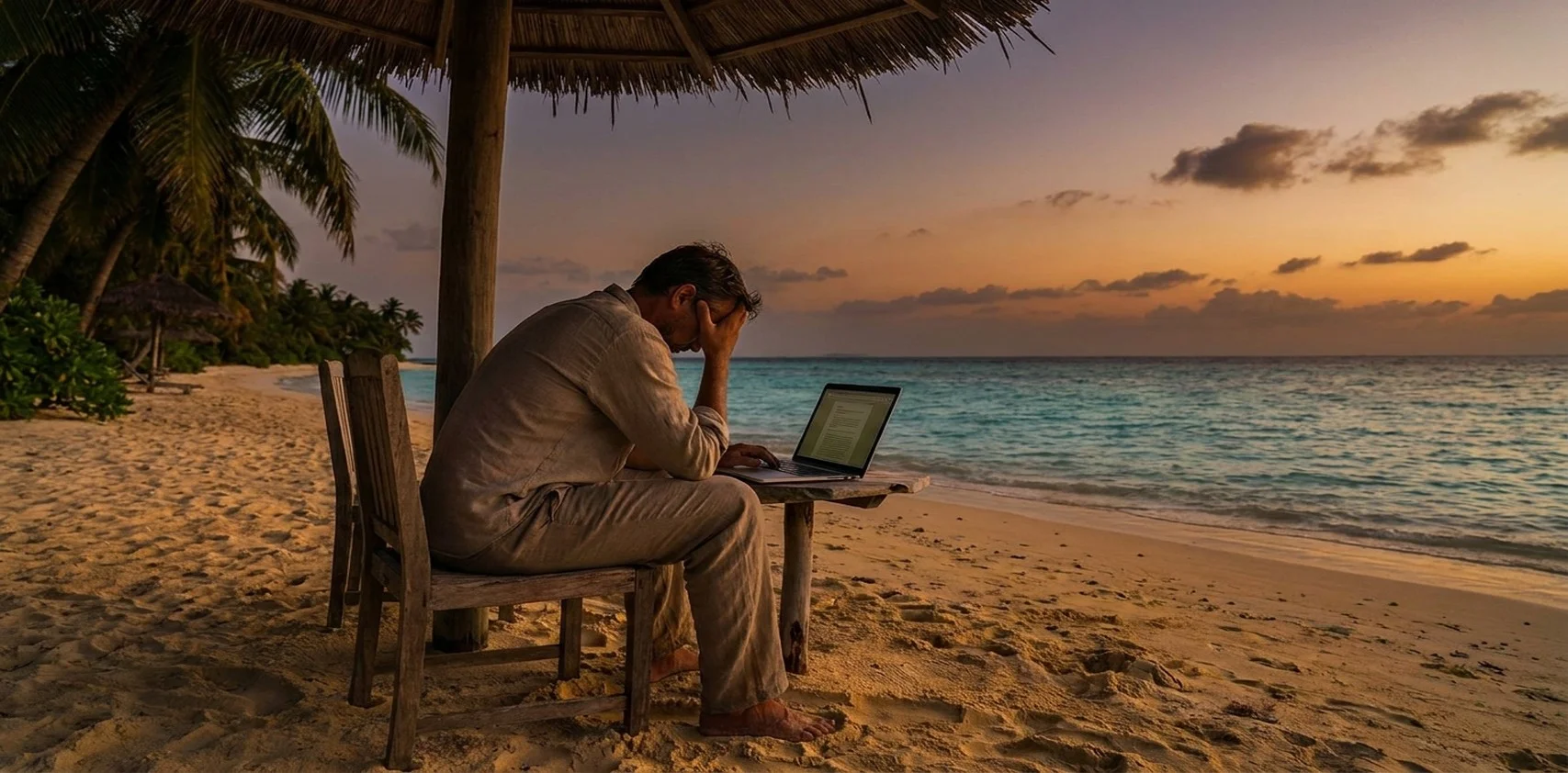
AI Generated - Editorial Use
Office burnout has a clear enemy — the commute, the meetings, the manager. Nomad burnout doesn't, because it disguises itself as freedom. 69% of remote workers report burnout from digital communication tools, 74% of Gen Z remote workers experience moderate to high burnout, and the average knowledge worker switches tasks every 47 seconds. When there's no commute to hate and no office to escape, the exit disappears — and 'just move to a new city' becomes avoidance in disguise. This article unpacks nomad burnout's unique costume and how to build sustainable freedom.
In a traditional office, burnout has recognizable symptoms: dreading the commute, counting the hours until Friday, fantasizing about quitting while staring at a fluorescent ceiling. The enemy is visible — the cubicle, the manager, the pointless meeting. When you burn out, you know exactly what you're burning out from.
Digital nomad burnout is different. It wears a costume. It disguises itself as freedom, adventure, and choice — which makes it far harder to diagnose and even harder to admit.
A 2025 Forbes survey found that 69% of remote workers reported burnout from digital communication tools alone. Among Gen Z remote workers, 74% reported moderate to high levels of burnout linked to persistent digital connectivity. Microsoft research found that the average knowledge worker switches tasks every 47 seconds.
These numbers don't distinguish between remote workers and nomads, but the nomad experience amplifies every factor: unstable routines, constant environmental change, and the complete dissolution of boundaries between work and life.
The Unique Shape of Nomad Burnout
Office burnout is about too much of something you don't want — too many meetings, too much commuting, too many hours in a space that drains you. The solution is obvious even if it's hard to execute: less of the bad thing.
Nomad burnout is about the absence of things you didn't know you needed.
No commute to hate. The commute is universally cited as the worst part of office life. Nomads don't have one — which sounds ideal until you realize the commute also served as a psychological boundary. Walking to the train station was when your brain switched from "home mode" to "work mode." Without it, the modes blur. You wake up, open your laptop, and realize four hours later that you haven't left your bed.
No office to escape from. When your apartment is your office, there's nowhere to go at 5 PM. The space you work in is the space you eat in, sleep in, and try to relax in. There's no physical act of "leaving work." The laptop is always right there, and the inbox never stops.
No colleagues to complain to. Watercooler venting is an underrated psychological safety valve. The ability to turn to someone and say "can you believe that email?" provides validation and stress release. Nomads process frustration alone, often in a language and culture that isn't their own.
No stable routine to anchor you. Every new city means a new grocery store, a new gym, a new coffee shop, a new morning walk. The cognitive load of constantly rebuilding basic routines — things that office workers do on autopilot — consumes bandwidth that should go toward creative work and rest.
The Costume: "I Just Need a New City"
Here's the most insidious part: when nomad burnout hits, the instinct isn't to rest. It's to move.
Feeling stuck in Lisbon? Must be time for Barcelona. Uninspired in Bali? Maybe Chiang Mai will fix it. The logic is seductive because it mirrors the original nomad promise: freedom of movement cures all ills.
But geographic change treats the symptom, not the cause. The exhaustion travels with you. The blurred boundaries follow you across every timezone. The loneliness doesn't care whether it's experienced in a Lisbon apartment or a Bangkok coworking space.
Experienced nomads call this "the carousel" — the compulsive rotation between cities that feels like progress but is actually avoidance. Each move provides a temporary dopamine hit of novelty, followed by the same flatness once the new city becomes familiar (usually around week three).
When "No Off Switch" Becomes the Default
In a traditional workplace, there are structural limits to work: the office closes, the lights go off, colleagues go home. Even in workaholic cultures, there are physical signals that the workday has ended.
For nomads, especially those working across multiple time zones, no such signals exist. A client in New York sends an "urgent" message at 2 AM your time. A collaborator in Sydney needs a review during your dinner. The Slack channel never sleeps.
The Forbes data on Gen Z burnout — 74% reporting moderate to high levels — is particularly relevant here because Gen Z is the cohort most likely to have entered the workforce fully remote. They've never experienced the structural boundaries that older workers take for granted. For them, "always on" isn't an aberration. It's the only mode they've ever known.
Add constant travel to that baseline, and the result is a generation of workers who are simultaneously the most location-free and the most boundary-less in history.
The Body Keeps Score (Even in Paradise)
Burnout isn't just a mental state. It manifests physically: disrupted sleep, chronic fatigue, digestive issues, weakened immunity. Nomads are particularly vulnerable because their lifestyle often involves:
- Irregular sleep patterns from timezone shifts and overnight travel
- Inconsistent diet from constantly eating out in unfamiliar cuisines
- Reduced exercise during transition periods between cities
- Limited healthcare access in many popular nomad destinations
The irony is sharp: the lifestyle that's supposed to optimize for wellbeing often systematically undermines it. The Instagram version shows yoga at sunrise. The reality is insomnia at 3 AM because a client email just landed.
Digital Wellness Day and the Rise of Intentional Disconnection
May 1st, 2026 marks Digital Wellness Day — an increasingly recognized reminder that our relationship with technology requires active management, not passive acceptance.
For nomads, digital wellness isn't a nice-to-have. It's a survival skill. Some practices that experienced nomads cite as essential:
Asynchronous communication boundaries. Not every Slack message needs a real-time response. Setting explicit response windows (e.g., "I check messages at 9 AM and 3 PM local time") is not unprofessional — it's a prerequisite for sustainable remote work.
The digital sabbath. One day per week completely offline. No email, no Slack, no social media. This is uncomfortable at first and revelatory after the third week. The world, it turns out, doesn't end when you're unreachable for 24 hours.
Minimum stay durations. The three-week threshold — the point at which a new city starts to feel familiar — is where many nomads instinctively bolt. Staying through it, building routine on the other side, is where the benefits of nomadism actually compound. Most burnout researchers and nomad communities recommend three months minimum per location.
Physical workspace separation. Even if it's just a dedicated corner of a rented apartment, having a space that is for work and only for work creates a psychological boundary that bedroom-to-laptop living destroys. Coworking spaces serve this function well, with the added benefit of casual social interaction.
Regular returns to a "base." Many experienced nomads maintain one location they return to every few months — a place with their own bedsheets, their preferred grocery store, a doctor who knows their history. This isn't abandoning nomadism. It's adding a root system to a mobile life.
The Hardest Part: Admitting It
Office burnout comes with cultural permission. Complaining about your job is socially acceptable, even expected. Friends sympathize, therapists validate, and "I need a break" is a recognized statement.
Nomad burnout comes with no such permission. You chose this. You're living the dream. How dare you be exhausted when you're in Bali and your friends are commuting in the rain?
This social dynamic — the inability to complain about a life that everyone else envies — creates a particular kind of isolation. Nomads experiencing burnout often double down on the performance of freedom: more Instagram posts, more city changes, more optimistic captions. The gap between the performed life and the experienced life widens until something breaks.
The first step is simply naming it. Nomad burnout is real, it's common, and it's not a personal failure. It's a structural consequence of a lifestyle that removes boundaries faster than most humans can rebuild them.
Freedom Needs Architecture
The ultimate paradox of nomad burnout is that genuine freedom requires structure. Not the imposed structure of an office — the chosen structure of intentional boundaries, stable routines, and regular disconnection.
The nomad who works from anywhere but has clear work hours, a minimum stay duration, a digital sabbath, and a place they call home base isn't less free than the one who changes cities every two weeks and answers Slack at midnight. They're more free — because their freedom is sustainable.
Burnout disguised as freedom is still burnout. The costume just makes it harder to see.
Take it off. Look at what's underneath. And then build the architecture that lets the freedom actually work.
Further Learning
If you find yourself constantly switching cities and time zones yet never shaking that nameless exhaustion — the problem might not be where you are, but how you're running your life.
The Darencademy course Manage Your Life Like a Business teaches you to systematically audit every dimension of your life — from energy allocation and goal-setting to risk management. When you stop relying on "a change of scenery" as a coping mechanism and start treating your own well-being with the rigor of a well-run company, burnout can finally be addressed at the root — instead of just being relocated to the next city.
This content is protected by copyright. Please respect the author's work and do not copy or distribute without permission.

數位遊牧編輯群 Digital Nomad Editor Group
Digital Nomad is a knowledge sharing platform specially designed for “those who dream to become digital nomads.” We share the latest news and industry trends related to digital nomadism, as well as introduce essential skills and knowledge needed for freelancers, remote workers, etc. Our goal is to help you connect with fellow digital nomads!
