


Croatia Extended Its Digital Nomad Visa to 18 Months — But the Real Story Is Much Bigger
April 20, 2026
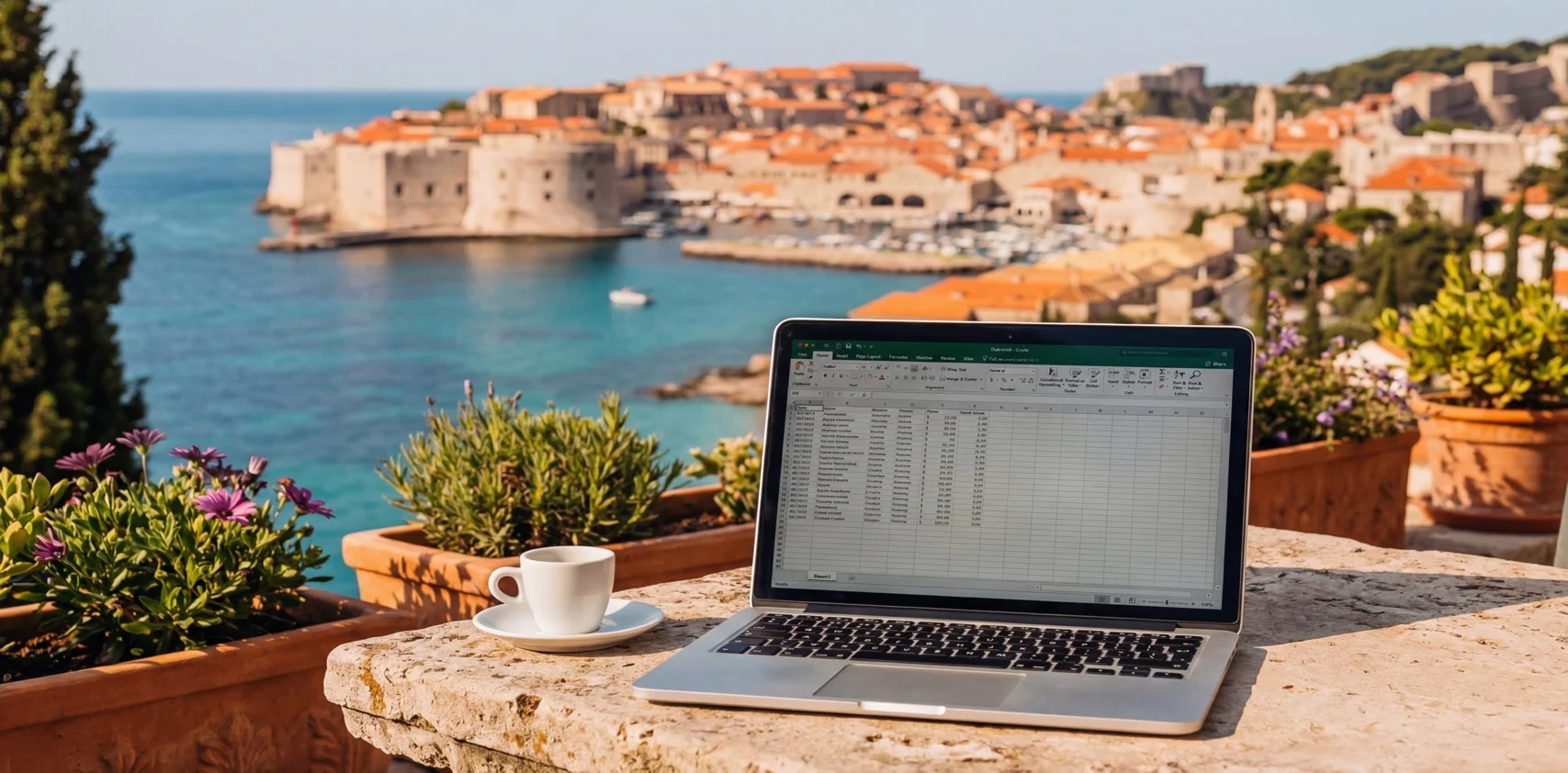
AI Generated - Editorial Use
Croatia has extended its digital nomad visa to 18 months, revealing a deeper crisis of population decline and labor shortages. Shifting from a tourism add-on to a talent strategy, how will this reform impact the European remote work landscape? This piece analyzes the strategic intent and visa limitations.
This small country on the Adriatic is playing a game of national survival — with visa policy as its opening move.
In March 2025, Croatia quietly amended its Law on Foreigners, extending the maximum stay for digital nomad visa holders from 12 months to 18 months. The news rippled through digital nomad forums with modest enthusiasm — six more months of Dalmatian coastline, after all. But if all you see is "six more months," you're missing the most interesting part of the story.
Because on March 25, 2026, the Croatian government dropped a much bigger bombshell: a comprehensive overhaul of its work visa system. Work permits extendable to three years. Foreign workers allowed to change employers after 12 months. A basic Croatian language test introduced as an integration mechanism. This isn't tourism marketing. This is a talent grab.
And behind the talent grab is a country that's bleeding out.
A Disappearing Nation
Let's start with the numbers.
When Croatia declared independence in 1991, its population stood at 4.7 million. By the 2021 census, that figure had dropped to 3.87 million — a loss of nearly 20%, or more than 800,000 people, in three decades. To put this in perspective, imagine the entire population of a major metropolitan area simply vanishing.
This wasn't caused by war (though the 1990s independence conflict did contribute). The real hemorrhage began after Croatia joined the European Union in 2013. Once freedom of movement kicked in, young Croatians flooded toward Germany, Austria, and Ireland. Between 2011 and 2021, Croatia lost nearly 10% of its population — a rate of decline that actually exceeded the wartime 1990s.
According to an analysis by OSW, a Central European think tank, the push factors go beyond economics. Young Croatians leave because of dissatisfaction with public services, disillusionment with the political environment, and the rational calculus of EU membership: if you hold an EU passport, why not go where the salaries are triple? A Croatian nurse earning €1,200 a month in Zagreb can make €3,600 in Munich. The math speaks for itself.
Data from TheGlobalEconomy.com shows Croatia's Human Flight and Brain Drain Index at 5.8 in 2024, well above the global average of 4.98. The medical sector has been hit particularly hard — over 40% of medical students have considered emigrating after graduation, and the country faces projected shortages across multiple specialties.
Birth rates? Persistently low. The UN projects Croatia's population could fall to 3.2 million by 2050 — meaning the country will lose another mid-sized city's worth of people every few years for the foreseeable future.
This is the reality Croatia is confronting. It's not trying to "attract tourists." It's trying to prevent national hollowing-out.
From Tourism Bonus to Talent Strategy
With that context, the evolution of the digital nomad visa makes perfect sense.
Croatia was one of the first European countries to launch a formal digital nomad visa, going live on January 1, 2021. The original design was straightforward — let remote workers stay legally for up to a year, enjoy the Adriatic sun, and spend money locally. For Croatia, these were ideal "consumer residents" who wouldn't compete for local jobs but would pay rent, eat at restaurants, and buy coffee.
By 2025, the policy's tone began to shift.
The amended Law on Foreigners, effective March 15, 2025, extended the digital nomad visa's maximum duration from 12 to 18 months. Simultaneously, the income threshold was raised to €3,295 per month (approximately 2.5 times Croatia's average net salary), and applicants now need six months of bank statements instead of the previous three.
On the surface, this looks like a two-way adjustment: longer stays paired with higher barriers. But think about it — raising the threshold is a filter. Croatia doesn't want budget backpackers doing the digital nomad thing for a season. It wants people with stable, high incomes who will spend significantly in the local economy and might stick around.
Then came the March 25, 2026 labor visa reform. The scope was dramatically larger:
Work permits extended to three years. Croatia's previous short renewal cycles created administrative headaches for both employers and workers. The new system cuts friction costs in one stroke.
Employer mobility after 12 months. This is the most critical change. The old system tied foreign workers to a single employer, limiting labor market efficiency and leaving workers vulnerable to exploitation. The new rule allows free job changes after one year — effectively upgrading Croatia's labor market from an "employer-sponsored visa" model to a "talent visa" model.
Basic Croatian language test (A1 level). This looks like an added barrier, but it's actually an integration signal. The government's official framing: the test is "designed to encourage inclusion rather than create barriers." Translation: we don't just want you to work here. We want you to stay.
Around the same time, Croatia launched a €2 million "Welcome Home" program targeting its diaspora — offering housing assistance, job matching, and integration support to encourage Croatians abroad to return.
Put all these policies together and the picture is complete: the digital nomad visa extension is one piece, the labor visa liberalization is another, and the diaspora return program is a third. Croatia isn't making isolated policy tweaks. It's building a comprehensive talent acquisition system.
Why Croatia? A Strong Hand
Objectively, Croatia holds several strong cards in the European digital nomad competition.
EU member + Schengen + Eurozone. This is the trump card. Croatia joined the EU in 2013 and simultaneously entered the Schengen Area and Eurozone in January 2023. This triple membership puts it on full institutional parity with Western European nations. Holders of a Croatian residence permit can travel freely throughout the Schengen Area — a massive convenience for frequently mobile digital nomads.
Cost of living well below Western Europe. A one-bedroom apartment in Zagreb runs €500–700/month; in Split or Rijeka, potentially less. A proper lunch costs €8–12. According to Nomad List estimates, the average monthly cost of living for digital nomads in Croatia is roughly $1,960 — a figure that's impossible to match in any Western European capital. Croatia is more affordable than Italy, Greece, and even Portugal, which has gotten noticeably more expensive.
Quality of life. This needs little explanation. 1,244 islands, 1,777 kilometers of coastline, UNESCO World Heritage sites everywhere — from the walls of Dubrovnik to the cascading lakes of Plitvice. Add Mediterranean climate, safe streets, and decent internet infrastructure (Zagreb averages over 100Mbps download speeds), and you have a mature remote work base.
No local income tax. This is the sweetest perk of the digital nomad visa. Holders are completely exempt from Croatian income tax on foreign-sourced income. This isn't universal among European digital nomad visas — some countries trigger tax obligations after a certain number of days of residence. Croatia's system explicitly avoids this problem.
Family-friendly. The visa allows spouses, unmarried partners, and minor children, with only a 10% income threshold increase (roughly €330/month) per additional family member. For unmarried partners, three years of cohabitation must be proven — unless there's a child in common, in which case the requirement is waived. This is more flexible than many competing programs.
18 Months, Non-Renewable: A Carefully Drawn Red Line
Croatia's digital nomad visa has one hard constraint: after 18 months, it cannot be renewed, and the holder must leave Croatia for at least six months before reapplying.
This looks like a drawback, but it's actually a deliberately calibrated red line.
The reason is straightforward: tax residency.
In most countries' tax codes, staying in a jurisdiction for more than 183 days (roughly six months) can trigger tax residency status. While Croatia exempts digital nomads from local income tax, extended stays create conflicts with the nomad's home country tax authority. If you've lived in Croatia for 18 months, your home country may consider you no longer their tax resident — but Croatia explicitly says you're not theirs either. This creates a "tax vacuum" — a gray zone where neither side taxes you.
If this gray zone were exploited at scale, it would attract EU-level scrutiny. EU member states operate under strict tax coordination mechanisms, and no member can function as a de facto tax haven. The 18-month cap plus six-month cooling period is essentially telling the world: we welcome your spending, but don't use this as a tax avoidance tool.
It's worth noting that international law firm Fragomen mentioned in an August 2025 update that Croatia's digital nomad visa "allows an initial stay of 18 months with a further renewal period of 18 months, for a potential stay of 36 months." This conflicts with most other sources and the Croatian Ministry of Interior's official guidance, which emphasizes the 18-month cap and six-month cooling period. This inconsistency may reflect evolving policy or gray areas between different permit categories. For anyone considering an application, the safest approach is to rely on official MUP guidance.
European Digital Nomad Visas Compared: What Each Country Is Actually Selling
When you place Croatia on the broader European digital nomad visa map, each country is selling something different.
Spain: The Beckham Law's Sweet Spot and Its Traps
Spain's digital nomad visa (officially the "international telework visa") launched in 2023, and its real killer feature is the Beckham Law — a tax regime literally named after footballer David Beckham, since it was originally designed to lure him to Real Madrid.
The Beckham Law's core offer: Spanish-source income taxed at a flat 24% (up to €600,000), with excess at 47%. Foreign-source income is tax-exempt. The benefit lasts up to six years.
Sounds great, but there are catches. The Beckham Law was originally designed for employees, and freelancers (autónomos) generally don't qualify. A 2025 court ruling confirmed that digital nomad visa holders can benefit, but this interpretation is new, and whether the tax authority will retroactively challenge it remains uncertain. More importantly, Spain's tax agency (Agencia Tributaria) is known for aggressively auditing Beckham Law beneficiaries — an "enforcement risk" that other countries' preferential regimes don't typically carry.
And Spain's cost of living is significantly higher than Croatia's, especially in Barcelona and Madrid, where one-bedroom apartments run €1,200–1,800/month.
Greece: The 50% Tax Reduction Math Problem
Greece launched its digital nomad visa in 2021, paired with a 50% income tax reduction for foreign professionals who transfer their tax residency to Greece, valid for seven years. (There's also a separate 7% flat-rate scheme for retirees, which often gets confused with the nomad benefit.)
A 50% reduction sounds impressive, but Greece's standard income tax is progressive (topping out at 44%), so the effective rate after reduction lands between roughly 10% and 22%, depending on income level. That's still considerably higher than Croatia's zero.
Greece's advantages are climate, culture, and cuisine (none of which require a visa to enjoy), but its administrative efficiency is notoriously poor — lengthy application processes, unfriendly bureaucracy, and documentation requirements that change without warning. For efficiency-minded digital nomads, this may be a bigger obstacle than the tax rate.
Portugal: The Rise and Complications of the D8
Portugal was once the undisputed top choice for European digital nomads — Lisbon and Porto had thriving coworking cultures, great weather, and high English proficiency. The D8 visa's (digital nomad visa) income threshold for 2026 is €3,480–3,680/month.
But Portugal's problem is its own success. The flood of foreign remote workers drove up housing prices in Lisbon and Porto, pricing out locals and generating significant resentment. The government responded by tightening: in October 2025, Portugal's parliament passed a Nationality Law amendment extending the residency requirement for citizenship from 5 years to 10 years (7 for EU citizens and CPLP nationals). The signal is clear — Portugal is pumping the brakes on its foreign influx.
For digital nomads, Portugal's appeal is fading: the citizenship pathway is now much longer, rents are no longer cheap, and the immigration agency (AIMA) has chronic efficiency problems.
Croatia's Positioning: Quiet but Precise
Line up all four countries:
- Spain sells "urban lifestyle + tax benefits, but understand the rules and accept audit risk"
- Greece sells "Mediterranean romance + tax discounts, but tolerate the bureaucracy"
- Portugal sells "mature nomad ecosystem, but it's getting expensive and less welcoming"
- Croatia sells "zero tax + EU membership + low cost + 18 months, but you must leave when time's up"
Croatia's strategy is precise: no complex tax calculations, just "tax-free." No illusions of permanent residence, but a solid year and a half. EU and Schengen institutional advantages as the foundation, with a cost of living far below Western Europe as the hook.
It's not an all-purpose ace. But for a specific type of digital nomad — one seeking medium-term stability, budget-conscious, who values EU freedom of movement — it's a highly compelling option.
The Bigger Board: Digital Nomadism as Population Policy
Back to the question from the beginning: what's really going on here?
The answer is that Croatia is fighting three battles simultaneously.
Battle one: Stop the bleeding. Prevent the continued outflow of young Croatians. The Welcome Home program, minimum wage increases, improved local public services — all aimed at bringing back those who left and keeping those who haven't.
Battle two: Transfuse. Import foreign labor to fill vacancies. Three-year work permits, employer mobility, A1 language testing as integration design — these measures target gaps in construction, tourism, and hospitality.
Battle three: Transform. This is the most ambitious front. Through the digital nomad visa and other preferential measures, attract high-income, high-skill foreign remote workers to reside long-term. These people don't compete for local jobs but contribute consumer spending, community vitality, and international visibility. More importantly, some of them may eventually evolve from "nomads" to "settlers" — transitioning from digital nomad permits to formal residence permits, perhaps even starting businesses or investing locally.
This is why the 18-month digital nomad visa can't be viewed in isolation. It's the entry point for a comprehensive talent strategy — let you experience Croatian life first, hope you fall in love with it, then use other residency pathways to keep you there.
Croatia's government even established the EU's first Ministry of Demography and Immigration specifically for this purpose. When a country creates an entire government ministry to deal with "not enough people," that alone tells you how serious the problem is.
Practical Application Guide: What You Need to Know
If the above analysis has piqued your interest in Croatia, here are the key details for applying in 2026.
Who can apply? Non-EU/EEA nationals performing remote work for companies or clients outside Croatia. Freelancers, employees, and business owners all qualify. EU citizens don't need this visa — freedom of movement already covers them.
Income requirements: Minimum €3,295/month, demonstrated through six months of payslips or bank statements. If using savings instead, you'll need €39,540 for 12 months or €59,310 for 18 months.
Duration: Up to 18 months. You can initially apply for 6 or 12 months and extend to 18. After expiration, you must leave Croatia and wait at least six months before reapplying.
Costs: Application fee approximately €60. Don't forget notarization, translation, and apostille costs — these can add €30–50 per document.
Taxes: During your digital nomad residence, foreign-sourced income is exempt from Croatian income tax. However, verify your home country tax obligations — many countries (notably the US) tax worldwide income regardless of where you live.
Required documents: Valid passport (expiring at least three months after your intended stay), biometric photos, proof of remote work (employment contract or freelance agreements), income proof, criminal background certificate (apostilled and translated into Croatian), health insurance, proof of accommodation, and the completed application form.
Where to apply: At a police station within Croatia, or at a Croatian embassy/consulate in your home country. Non-Schengen nationals will also need to obtain a D-type long-stay visa after approval.
Honest Advice for Digital Nomads
Croatia's digital nomad visa isn't perfect. The 18-month hard cap and six-month cooling period mean you can't treat this as a permanent home. The €3,295/month income threshold isn't trivial for early-stage freelancers. Croatian is notoriously difficult to learn — English works fine in tourist areas, but deeper community integration requires language, and that's a real wall.
And "tax-free" doesn't mean "tax-worry-free." Depending on your nationality and tax residency status, you may still owe taxes to your home country. If you stay the full 18 months, the tax residency determination between you and your home country could get complicated. Hiring an accountant who understands international tax law is a necessary investment.
But if you accept these constraints, the package Croatia offers is genuinely competitive: EU institutional protections, Schengen freedom of movement, below-Western-Europe living costs, zero local income tax, and 18 months of legal residence. On the 2026 European digital nomad map, this combination still ranks near the top.
More importantly, Croatia's attitude toward nomads is shifting from "welcome to spend" to "welcome to live." The labor visa liberalization, the language test introduction, the diaspora return program — these policy signals show a country that's seriously thinking about how to turn transients into residents.
For digital nomads, this means you're not just picking a cheap beachside café to open your laptop. You're choosing a country that's redefining itself — one that's using policy tools to transform a "population crisis" into an "open opportunity."
Whether this gambit will pay off remains to be seen. But at least Croatia is making moves, not waiting to fade away.
For a country that has lost a fifth of its population in thirty years, that attitude alone is worth paying attention to.
This content is protected by copyright. Please respect the author's work and do not copy or distribute without permission.
