


When Countries Turn Nomads Into Tax Revenue, Jamaica's Proposal and the Caribbean's Digital Nomad Fiscal Playbook
April 15, 2026
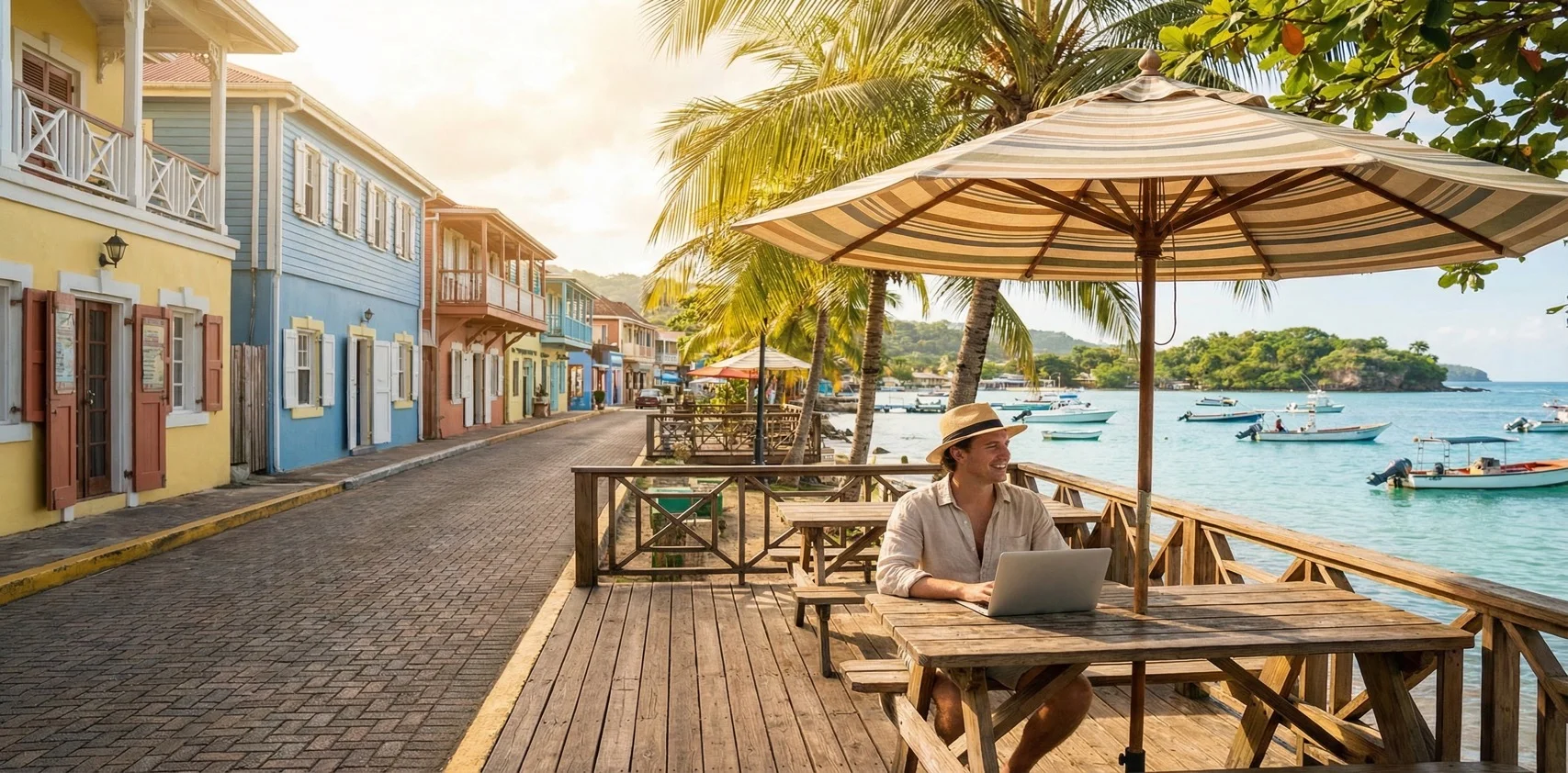
AI Generated - Editorial Use
Jamaica's opposition party proposed replacing tax hikes with a digital nomad programme targeting 5,000 remote workers in year one. When nomads become tax revenue, the Caribbean's playbook is being rewritten.
On March 12, 2026, inside Jamaica's Gordon House, Opposition Spokesman on Finance Julian Robinson stood up during the annual budget debate and did something increasingly common in Caribbean politics — he wrote digital nomads into a national fiscal plan.
Not as a tourism footnote. Not as a travel board gimmick. As a formal alternative revenue source, pitched directly against the ruling party's J$18 billion (approximately US$110 million) tax package.
Robinson's proposal may not pass — opposition counterbudgets rarely do in Westminster-style parliaments. But the underlying shift it represents matters for anyone who is, or plans to become, a digital nomad: when a country starts counting you as a line item in its fiscal projections, you're no longer just a tourist.
Inside the J$10 Billion Alternative
The numbers first.
Jamaica's ruling Jamaica Labour Party (JLP) proposed J$18 billion in new taxes for fiscal year 2026-2027, targeting sugary beverages, tobacco, alcohol, and tourism activities. Robinson called this "unconscionable" in the wake of Hurricane Melissa, which had devastated the island and left communities still rebuilding.
His alternative: a J$10 billion revenue plan built on two pillars.
Pillar One: Electronic Invoicing (approximately J$8.6 billion)
An electronic invoicing system through Tax Administration Jamaica, automatically capturing sales transactions at the point of sale. Not new taxes — just collecting what's already owed but underreported. Robinson estimated J$8.6 billion in additional compliance-driven revenue.
Pillar Two: Digital Nomad Programme (approximately J$1.5 billion)
This is the part that concerns us. Robinson proposed a formal Digital Nomad Programme with the following structure:
- Special residence permit: A 12-month work permit allowing holders to work for overseas employers or clients while living in Jamaica
- Visa fee: US$2,000 per year
- Year-one target: 5,000 digital nomads
- Direct revenue: Approximately J$1.5 billion (US$9.4 million) from visa fees alone
But Robinson made clear that visa fees were just the appetizer.
"The real story," he told Parliament, "is when they come here, when they stay here — the restaurants, the Airbnbs, the hotels, the villas, the concerts, the food that they spend. That is the impact."
He cited Barbados data showing that each digital nomad spends approximately US$55,000 during their stay. Robinson used a more conservative estimate for Jamaica — assuming an average six-month stay with spending of US$25,000 per person, 5,000 nomads could generate roughly US$125 million (approximately J$19.5 billion) in economic activity.
"Barbados did it immediately after COVID and took first-mover advantage," Robinson said. "But we do have many advantages which other countries in the region don't have."
He pointed to Jamaica's brand recognition from four million annual tourists, its climate, its culture, and — crucially — its existing connectivity infrastructure.
Post-Hurricane Political Economics
To understand why this proposal emerged now, you need to understand Jamaica's moment.
Hurricane Melissa hit Jamaica hard. The full scale of damage is still being assessed. Against this backdrop, the ruling party chose the tax route — not uncommon in post-disaster reconstruction, but politically explosive.
Robinson's argument rests on solid macroeconomic reasoning: raising taxes during an economic contraction is procyclical — it pressures the economy in the same direction the problem is already pushing. His countercyclical alternative: don't extract money from wounded domestic actors. Inject external spending instead.
The digital nomad programme fits this framework elegantly. Nomads earn abroad but spend locally. For Jamaica's economy, it's nearly pure net inflow — no displacement of local workers (nomads don't compete for local jobs), but fresh demand for accommodation, food, transport, and services.
The logic is compelling. Almost too compelling, which is why it warrants scrutiny.
The Caribbean's Digital Nomad Wave: From Tourism to Fiscal Tool
Jamaica is far from the first Caribbean nation to think of this. In fact, it's arriving late.
Barbados Welcome Stamp (2020): The Textbook Case
In July 2020, with COVID-19 crushing global tourism, Barbados launched the Welcome Stamp under Prime Minister Mia Mottley. The team moved fast — design began during the first wave of lockdowns.
The Welcome Stamp's structure has become an industry template: US$2,000 annual fee, remote work permitted, no tax on overseas income, 12-month validity with renewal option, minimum annual income requirement of US$50,000.
Barbados's results have been notable. While actual Welcome Stamp arrivals run in the hundreds annually (around 400 in 2023), these long-stay, high-spending residents contribute disproportionately compared to equivalent numbers of short-stay tourists. Robinson's "US$55,000 per person" figure cited in Jamaica's Parliament comes from Barbados's experience.
More importantly, the Welcome Stamp catalyzed an ecosystem: coworking spaces, long-term rental markets, service industries targeting remote workers (from fiber internet installation to pet care). Barbados proved that digital nomads don't just bring spending — they bring an entire ecosystem of demand.
Antigua and Barbuda Nomad Digital Residence (2020): The Fast Follower
Almost simultaneously, Antigua and Barbuda launched the Nomad Digital Residence programme. Two-year validity, same US$2,000 annual fee.
Antigua's strategy differed subtly — it emphasized "residence" over "work," aiming to attract not just laptop freelancers but remote entrepreneurs willing to put down longer roots. The two-year visa duration signals this intent: it's seeking people who might actually stay.
Costa Rica Digital Nomad Visa (2022): Central America Joins
In 2022, Costa Rica entered the field. Technically not a Caribbean island nation, but its entry marked the elevation of digital nomad visas from island-state experiments to a regional strategy spanning Central America and the Caribbean.
Costa Rica requires a minimum monthly income of US$3,000, with a one-year visa. Its selling points differ from small islands — geographic diversity, a mature expat community, and the lifestyle brand built around "Pura Vida."
The Broader Trend
Beyond these, the Cayman Islands, Curaçao, Dominica, Bermuda, and others have rolled out their own variants. By late 2025, over 60 countries and territories globally offered some form of digital nomad visa, with the Caribbean having the highest concentration — virtually every island with tourism infrastructure has at least considered it.
Jamaica's Robinson proposal pushes this trend into a new phase.
From "Welcome, Visitors" to Fiscal Policy Tool: A Qualitative Shift
The motivations driving Caribbean digital nomad programmes have evolved through distinct phases.
Phase One (2020-2021): COVID Emergency Response
Barbados and Antigua's programmes were born during the pandemic. The primary goal: find alternative visitors when borders were closed and tourism had collapsed. "Borders are shut, but remote workers can spend money without going anywhere" — this intuition drove first-wave design.
Phase Two (2022-2024): Tourism Brand Differentiation
As the pandemic receded, digital nomad visas repositioned from "emergency measure" to "brand differentiator." Countries began competing — faster internet, easier visa processes, friendlier tax treatment. The focus was tourism marketing: attract more people, keep them longer, have them spend more.
Phase Three (2025-2026): Fiscal Policy Instrument
Robinson's proposal at Jamaica's Parliament marks Phase Three. He wasn't at a tourism board press conference promoting a new visa. He was in a parliamentary budget debate, presenting digital nomads as a quantifiable fiscal source, directly compared against a tax package.
The significance: digital nomads have shifted from "welcome guests who happen to spend money" to "a number in national fiscal planning."
For small island economies, this shift has deep structural roots. Caribbean nations share several common predicaments:
- Scale constraints: Most island states have GDPs in the single-digit billions, with tiny domestic markets and near-total dependence on external demand
- Tourism over-reliance: Tourism accounts for 30-50% of GDP in many cases; any disruption (pandemic, hurricane, airline route cancellation) is existential
- Hurricane exposure: Climate change is intensifying hurricane frequency and severity, with reconstruction costs repeatedly draining limited fiscal resources — Jamaica's Hurricane Melissa is the latest example
- Brain drain: Educated young people emigrate to North America and Europe, shrinking both the talent pool and the tax base
Under these structural constraints, digital nomads — long-term consumers who bring their own income — are nearly ideal. They don't compete for local jobs. They spend more than average tourists. They stay longer. Their infrastructure needs (primarily internet and accommodation) are concentrated and predictable.
More fundamentally, they represent a "non-traditional tax base": no need for local employers to hire them, no complex industrial policy to develop them. Just a visa, reliable internet, and an environment worth staying in.
Behind the Numbers: What the Proposal Doesn't Say
Robinson's parliamentary presentation painted an attractive picture: 5,000 people, US$2,000 each in visa fees, US$25,000 in spending over six months, US$125 million in total economic activity. Clean numbers. Clean logic.
Reality is never as clean as fiscal projections.
The Attraction Problem: Where Do 5,000 Nomads Come From?
Jamaica sees four million tourists annually — Robinson's foundational statistic. But tourists and digital nomads are fundamentally different populations. Tourists want all-inclusive resorts and beach cocktails. Nomads want stable internet, quiet workspaces, reasonable monthly rentals, and — the thing many won't say out loud but care deeply about — safety.
Jamaica's performance on these dimensions is mixed. Internet infrastructure in Kingston and Montego Bay is improving, but it still lags behind Southeast Asian nomad hotspots like Bali, Chiang Mai, or Lisbon. More critically, Jamaica's security situation remains a significant concern for international visitors.
Five thousand isn't impossible — Barbados's Welcome Stamp processes hundreds annually, and Jamaica's larger brand and tourism volume justify multiples of that. But hitting that target in year one requires more than a visa. It requires an ecosystem.
The Spending Assumption: Conservative or Optimistic?
Robinson deployed a smart rhetorical strategy: cite Barbados's US$55,000 figure first, then present his Jamaica estimate of US$25,000 as conservative by comparison. You see the ceiling, then the projection feels restrained.
But US$25,000 over six months means roughly US$4,200 per month. That buys a comfortable life in Jamaica — provided stable monthly rental options and basic living infrastructure exist. If most nomads can only access expensive short-term rentals or resort accommodations, the actual spending structure may differ substantially — money spent, but not necessarily flowing into the local economy's capillaries.
The Critical Question: Whose Pocket Does the Money Reach?
The degree to which digital nomad spending actually benefits local communities is a global debate. In Bali, the nomad community has driven Canggu's boom but also pushed up rents and prices, displacing local residents from their own neighborhoods. In Lisbon, similar "nomad gentrification" has triggered fierce local backlash.
Caribbean island economies are smaller and shift faster. When thousands of foreigners with monthly incomes far exceeding local averages arrive, rents, prices, and service costs all tend to rise — and the first people affected are typically low- and middle-income locals.
This doesn't mean digital nomad programmes shouldn't exist. It means that when you write them into a fiscal plan, you need to simultaneously think about distribution.
The Nomad's Perspective: From Guest to Tax Base
Let's shift to the digital nomad's point of view.
If you're a remote worker considering the Caribbean, what does Robinson's proposal mean for you?
The Immediate Impact: One More Option
Caribbean digital nomad visa choices are already abundant. Jamaica launching a programme would add another US$2,000-per-year option to an increasingly crowded market. For nomads, this is positive — more choices mean more leverage, and countries competing for residents will keep improving conditions.
The Deeper Significance: Your Identity Is Being Redefined
What's more worth noting is the identity shift.
When Barbados launched the Welcome Stamp in 2020, the narrative was "come work from our beautiful island" — inviting, hospitable, an extension of tourism.
When Robinson wrote digital nomads into Jamaica's 2026 budget debate, the narrative became "you can help us replace J$18 billion in taxes" — calculative, fiscal, your value measured as an economic unit.
This shift isn't necessarily bad. But it changes the rules.
As a "tourist," your relationship with a destination is a clean market transaction: I pay, you provide an experience. If it's not good, I leave.
As a "tax base," the relationship gets complicated. The state develops expectations — stay long enough, spend enough, behave appropriately. And you may develop expectations in return — I paid US$2,000 for this visa plus thousands monthly in spending; what rights do I have? Who's responsible when the internet goes down? Can the healthcare system handle me? Do I get any voice in community matters?
Over 60 countries currently offer digital nomad visas. The vast majority operate at the "you can come" level. Very few have seriously addressed the post-arrival rights-and-obligations framework. You're not a citizen, not a permanent resident, not even a traditional work visa holder — you're an entirely new, still poorly defined legal identity.
Robinson's proposal follows this pattern. He spent extensive time on revenue (J$1.5 billion in visa fees, J$19.5 billion in economic activity) but barely mentioned what specific protections nomads would receive. This isn't Robinson's failing — it's a blind spot shared by digital nomad visa programmes worldwide.
The Tax Grey Zone
Another dimension nomads should watch: taxation. Barbados's Welcome Stamp explicitly promises no tax on overseas income — one of its biggest selling points. But as digital nomads graduate from "tourism add-on" to "fiscal policy pillar," the durability of that promise deserves scrutiny.
If a country genuinely begins depending on nomad economic contributions as a significant revenue source, it will eventually face a temptation: should we start taxing these people?
The current model — collect visa fees, don't tax income — is attractive to nomads but means the state foregoes its largest potential revenue stream. The moment Robinson wrote nomads into a budget proposal, Pandora's box, in some sense, was already open.
The Bigger Picture: The Politicization of Nomad Economics
Stepping back, Robinson's speech in Jamaica's Parliament represents a larger trend: digital nomadism is being politicized.
Not pejoratively — but in the sense that it's moving from lifestyle choice and tourism niche into the core agenda of national policymaking.
Globally, digital nomads number an estimated 40 to 60 million (definitions and methodologies vary widely), and the population is still growing rapidly. This group doesn't vote in their countries of residence, doesn't participate in local labor markets, but has significant spending power — they're an unprecedented economic phenomenon.
For small Caribbean nations, capturing even a tiny fraction of 40 million nomads can generate meaningful economic impact. Robinson's 5,000-person target represents barely one-hundredth of one percent of the global nomad population. Viewed this way, it's not overly optimistic — it's a number that reveals how large the addressable market really is.
But market size brings competition. Caribbean nations aren't just competing with each other. They're competing with Portugal, Thailand, Mexico, Colombia, and dozens of other destinations worldwide. In a world where nomads can go almost anywhere, a US$2,000 visa fee isn't the deciding factor — overall experience, cost of living, community, and safety are.
Notes for Nomads
If you're considering the Caribbean as your next base, some observations worth keeping in mind:
One: Visa pricing is standardizing. Major Caribbean programmes cluster around the US$2,000 annual mark. This has become a market consensus — too high deters applicants, too low makes it not worth administering. But watch for hidden costs: health insurance requirements, income verification thresholds, and processing fees can add up.
Two: "No tax" promises need ongoing monitoring. Most Caribbean digital nomad visas currently promise no tax on overseas income. These rules can change. Especially as nomad revenue becomes part of national fiscal conversations, policy winds could shift within a few years.
Three: Infrastructure varies dramatically. Barbados and Costa Rica have relatively mature digital nomad infrastructure (coworking spaces, reliable internet, expat communities). Jamaica, if it launches a programme, may initially require more pioneer spirit — early movers may enjoy less competition and more authentic experiences, but also more friction.
Four: Mind the gentrification effect. As a conscious nomad, consider your impact on local communities. Choosing local landlords over international platforms, eating at local spots instead of chains, learning about and respecting local culture — these aren't just ethical choices. They're the foundation that keeps digital nomad programmes politically viable long-term. If locals feel that nomads exploit rather than integrate, even the best policy will face backlash.
Five: Your "being needed" is increasing. Perhaps the most important observation. From Barbados's tourism extension to Jamaica's budget alternative, Caribbean demand for digital nomads is structurally growing. This means expanding negotiating leverage — expect better terms, more infrastructure investment, and eventually, more robust rights protections. But "being needed" also means "being counted." Your spending, your length of stay, your economic contribution will be tracked and quantified with increasing precision.
An Experiment Still in Progress
Robinson's proposal faces an uncertain future in Jamaica's Parliament. As an opposition counterbudget, it's more likely to become debate material than immediate law. But the trend it reflects is clear — digital nomads are evolving from "transient visitors" to "budget line items."
This is a Caribbean story, but it's also a global one. As more countries discover that "instead of taxing our own citizens harder, we could attract foreign remote workers to spend here," the nomad's standing will keep rising — accompanied by more regulation, more expectations, and more rights frameworks that nomads themselves will need to advocate for.
In 2020, Barbados told nomads: "Welcome to our island." In 2026, Jamaica — or at least its opposition — told nomads: "You're worth J$1.5 billion."
The next step is probably some country telling nomads: "You need to come."
Until that day, this remains a game where nomads hold the advantage. Enjoy the window — but don't forget that once you shift from "guest" to "tax base," the rules have already started changing.
This content is protected by copyright. Please respect the author's work and do not copy or distribute without permission.

數位遊牧編輯群 Digital Nomad Editor Group
Digital Nomad is a knowledge sharing platform specially designed for “those who dream to become digital nomads.” We share the latest news and industry trends related to digital nomadism, as well as introduce essential skills and knowledge needed for freelancers, remote workers, etc. Our goal is to help you connect with fellow digital nomads!
