


All Posts
123 posts
Sort by Latest

AI Will Not Make Nomad Work Effortless. It Turns You Into a One-Person Project Manager
Around 2024, most conversations about AI tools revolved around fairly narrow use cases: draft this email, summarize this meeting, generate a rough image. By 2026, the frame has shifted. Generative models keep improving, but the more interesting movement is on the agentic side. Systems can now take a goal, plan sub-tasks, call multiple tools, read and write files, verify intermediate outputs, and report back to a human. For solo operators, freelancers, and digital nomads, this looks like an obvious win: one person can now do the work that used to require a small team. Talk to people actually running AI-augmented practices in 2026, however, and a different picture emerges. AI has not made them lighter on their feet. It has turned them into full-time project managers who happen to also do the delivery work. They now ship faster, but they also spend more time designing workflows, verifying outputs, managing permissions, tracing errors, reassuring clients, and absorbing accountability when something goes wrong. This piece tries to describe that shift honestly. It is not another take on whether AI will replace anyone. It is about a more practical question: for a digital nomad, AI does not deliver free time. It delivers a new layer of management work. Whether you can carry that layer will decide whether you become one of the operators whose output truly doubled in 2026, or one of the operators who ended up more tethered to their laptop than before. From Tools to Agents: What Actually Changed The most consequential change of the last two years is not raw model intelligence. It is the shift from single-turn tools to persistent, tool-using agents. Recent research on generative AI in IT project management and software project management frames these systems as assistant-level or junior project manager roles: they handle scheduling, status roll-ups, risk flags, document syncing, and other repetitive but time-consuming work. Humans stay accountable for orchestration, judgment, trust, and governance. For a solo remote worker, this means two things happen at once. First, you can take on work you previously could not, because parts of the process that used to require outsourcing or overnight effort can now be delegated to an agent. Second, you have to start thinking like a real project manager: how to break down goals, assign execution, verify results, monitor risks, and track schedules. The difference is that the executors are often AI agents, and the project manager is always you. Productivity Gains Are Real, But Not Free A lot of AI marketing frames productivity gains as switch-flip easy. In practice, they are not. Getting real leverage from AI typically comes with three hidden costs. The first is process design. You have to decompose your own work into pieces small and clean enough that an agent can act on them. That forces you to understand your own workflow in a way many freelancers never had to. If you cannot describe how you do the work, you cannot delegate it to anything, human or otherwise. The second is prompt and context maintenance. An agent that operates across multiple clients needs different reference material, style examples, preferences, and terminology per client. None of that maintains itself. Someone has to keep it current, and that someone is you. The third is verification. AI output must be checked, especially when it touches client data, financial figures, legal language, or code behavior. A single hallucinated citation or a wrong number can end a client relationship. The higher your leverage, the more disciplined your verification must be. In other words, AI gives you access to more capacity, but it also drops a new role on your desk: workflow manager. If you refuse the role, you find yourself firefighting through every AI-augmented deliverable and losing the time savings you thought you had. The Layer Nomads Most Often Miss: Judgment and Accountability Agentic systems can do a lot of things, but they cannot absorb responsibility on your behalf. That matters especially for remote independents. When you are working from Lisbon, Chiang Mai, or Tokyo, and your client sits in New York, Taipei, or Berlin, the client does not have a conversation with your AI when something breaks. They come to you. That means your workflow must include explicit judgment points: which steps an agent can run end to end, and which steps require a human eye before anything leaves your machine. Recent academic work on agentic systems keeps returning to the same idea: the human role moves from execution to orchestration, trust, and governance. Orchestration decides who does what and when. Trust judges whether an output is releasable. Governance defines what happens when something goes wrong. For a nomad, all three layers are harder than in an office. You are moving. Your time zone shifts. Your bandwidth varies. You may be juggling clients across three time zones on the same day. That environment demands a stricter, not looser, approach to process design, because when things break you might be on a flight or in a valley with no signal. The Job Portfolio of a One-Person PM Break down a typical day for a 2026 nomad running AI-augmented delivery and you find several overlapping roles. There is still an executor role, doing content, code, design, or analytical work. That role now has AI assistance, so execution time is shorter but verification time is longer. There is a process designer role, deciding which tasks flow through which tools and agents. This role never rests, because models change, APIs update, and client requirements evolve. There is a quality auditor role, checking factual accuracy, style consistency, correct citations, absence of hallucinations, and absence of accidental data leakage. There is a client communication and expectation management role. This one is easy to underestimate. When AI dramatically shortens your delivery time, clients quickly recalibrate. Yesterday's fast turnaround becomes today's baseline. You have to actively manage that baseline or you get eaten by the efficiency you created. There is also a risk and security role, which deserves its own separate discussion. Each role is small individually. Combined, they add up to a serious ongoing management load that most freelancers underestimate when they first bolt AI onto their practice. Why "Passive Income from AI" Is Mostly Misleading A large part of the online conversation still pushes the fantasy of stacking AI-generated assets and collecting money while you travel. In any serious, client-bearing, quality-sensitive line of work, this is not how AI actually behaves. AI does not make good work passive. It makes it more active. The reason is simple. When the marginal cost of production drops, market supply of content and services surges. Clients, drowning in options, spend more effort filtering for people they can trust to catch mistakes and stand behind the output. Cheap output becomes commoditized. Judgment becomes more valuable, not less. That is good news and bad news for nomads. Good news, because your judgment, taste, contextual understanding of the client, and risk instincts become your primary income drivers. Bad news, because none of those can be handed to an agent while you nap on a beach. Serious AI-augmented work rewards presence of mind, not absence. Time Zones, Networks, Moods: The Real Working Conditions Most agentic AI research happens in stable, well-connected settings. Nomad conditions are messier. Network stability is the first variable. Agents that maintain long connections and call external APIs frequently will fail more often on flaky bandwidth. You have to design retries, resumable steps, and offline-safe fallbacks. The nicer the coworking space in your city, the fewer of these problems bite you, but eventually one of them will. Time zones are the second variable. When an agent runs in the cloud while you sleep half a world away, deciding when to wake you up becomes an engineering problem. Every agent needs escalation rules: which events can wait, which events must ping you immediately, and which events must halt the workflow and wait for human input. Mood and energy are the third variable, and the one people rarely admit. Sustained cross-time-zone work, frequent relocation, and unstable social ties erode judgment. AI output verification specifically requires stable human judgment. There is a structural tension here: the more you rely on AI, the more your personal stability matters, because the entire quality chain runs through your attention. A tired human plus a confident agent is a bad combination. How to Upgrade Yourself Into an Orchestrator If you want to make AI actually work for you in 2026, a few practical moves matter. First, write down your workflow. Documents, checklists, and templates for how you take on work, how you deliver, and how you track progress form the base layer of any automation. Without this step, AI can only help you in fragments; it cannot systematically scale you. Second, separate tasks that can go end to end from tasks that require your own eyes. Formatting, first drafts, aggregation, initial translation, boilerplate replies can often run without you. Final decisions, client commitments, legal or financial calls, and anything touching sensitive data should not. Every operator draws this line differently, but every operator has to draw one. Third, embed verification into the workflow rather than treating it as cleanup. Bake checkpoints into the process, each producing a concrete artifact: a checklist, a diff, a test result. This way, even from a train or a cafe, you can quickly judge whether to release the output. Fourth, budget slack for errors. Any AI-augmented pipeline will occasionally fail, and your schedule must have room to respond. Overpacking your calendar is the classic mistake of early AI adopters, because the tools tempt you to promise more. Fifth, keep investing in domain judgment. The more AI can do, the more the human premium concentrates in taste, context, relationships, and the ability to see what actually matters. None of that grows on its own when the tools improve. It requires deliberate practice, reading, feedback, and reflection. A Healthier Relationship With the Machine Return to the original question: does AI make life easier for digital nomads. The honest answer is that for operators who accept the role of project manager, AI raises the income ceiling while also making the work heavier, the responsibility larger, and the complexity to manage greater. For operators who refuse to take on that layer, AI slowly reroutes their work to competitors who orchestrate better, leaving them competing on price. The healthier mental model is not to treat AI as something that works instead of you. It is to treat it as a junior colleague who never tires but never carries responsibility either. You can hand off large volumes of repetitive work, but you must design the rules, the verification, the escalation paths, and you must own the final quality. For nomads, this transition is actually a fit. If you chose this life, you already opted out of clocking hours in a fixed office. You have been building a portable professional identity. In 2026, a portable professional who can also orchestrate AI agents responsibly and stay accountable to clients is a rare combination in the market. Seen this way, AI does not make the nomad life easier. It makes serious nomads more valuable. Whether you become one of them will shape your career over the next several years at least as much as your choice of the next city.
September 21, 2026
Want to Work While Traveling? In 2026, You Need to Negotiate the Rules First
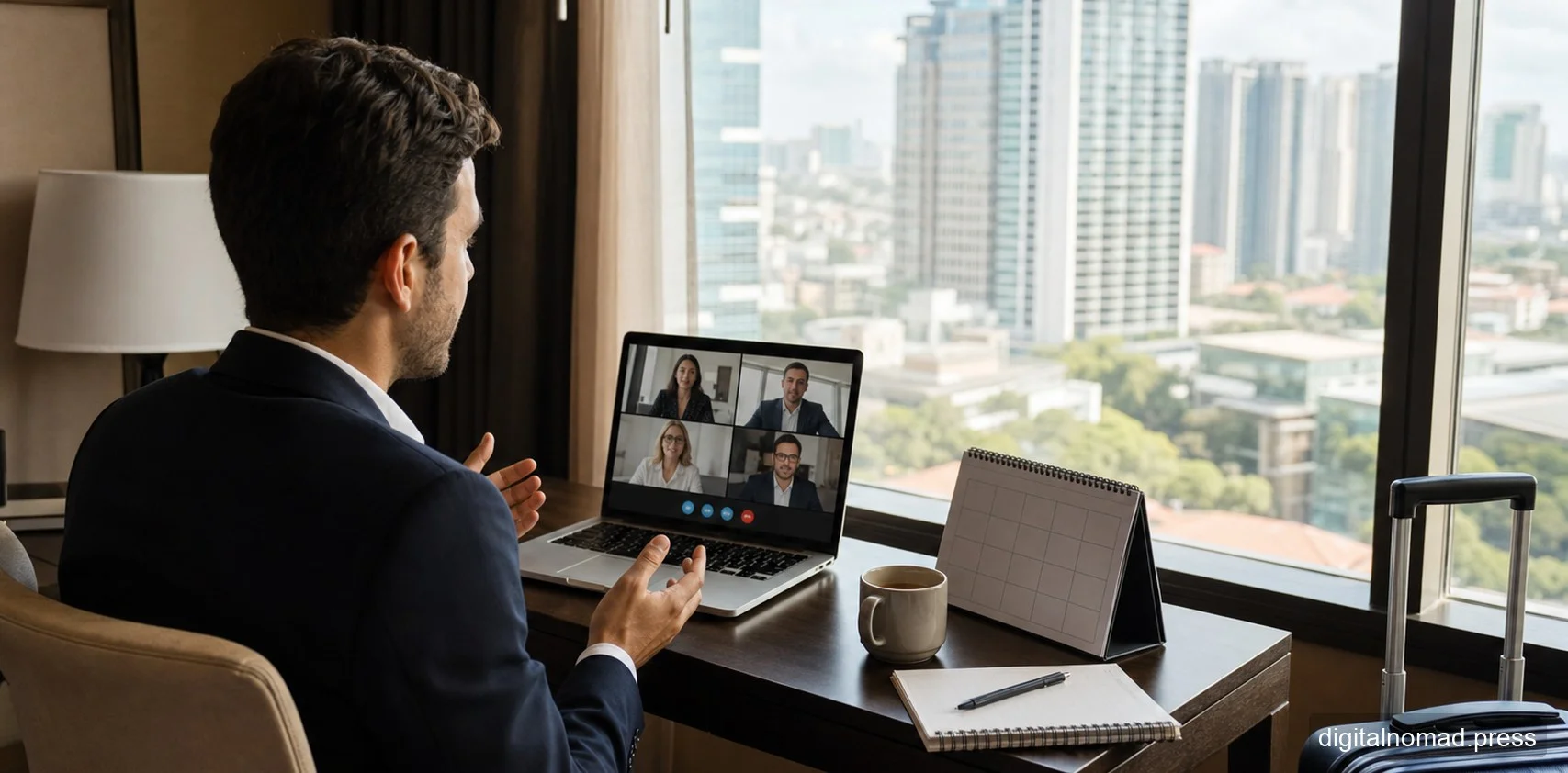
The 2026 workplace is defined by an apparent contradiction. On one side, large American employers have been rolling out return-to-office mandates since 2024, and headlines keep announcing that remote work is dead. On the other, Gallup's May 2026 hybrid work indicator shows that among U.S. remote-capable employees, 52% work hybrid, 26% work fully remote, and only 22% work fully on-site. Employee preferences still lean strongly toward hybrid and remote. MBO Partners' 2025 report estimates that 18.5 million Americans identified as digital nomads in 2025, up 153% from 2019, roughly 12% of the workforce. In short, executives want control back, and workers still hold the flexibility. That tension is the actual starting point for workcation in 2026. The difference is that the people who genuinely manage to work abroad while traveling are less often the ones sneaking out of the country. They are the ones who negotiated the rules with their employer, put them in writing, and operate under predictable terms. Remote Work Did Not Die. It Got Rules. For three years the narrative has swung between extremes. From 2020 to 2022, the story was work from anywhere, and many people boarded flights to Chiang Mai, Lisbon, or Bali with a laptop for the first time. From 2023 to 2025, the pendulum swung back with RTO announcements from Amazon, Google, JPMorgan, and other bellwethers. Many employees concluded that leaving the country to work was over. The operational reality is more nuanced. ActivTrak's 2026 State of the Workplace report shows that remote-first companies are common in its dataset. Fully remote workers log high productive time, while hybrid split-day workers stretch long hours but show lower focus and productivity. Companies have not abandoned remote work. They have stopped allowing it to be unbounded. The more accurate label for 2026 is conditional remote. Employers will let you go abroad for a period. They will let you spend weeks in another city. But they want prior approval, disclosed locations, signed addenda, and defined availability windows. For anyone serious about long-term workcation, this is actually good news. Once you learn how to negotiate, the path becomes more stable. Break Workcation Into Six Negotiable Terms Most employees walk into a manager's office with a vague ask: I want to work from Japan for a month, is that okay? In the manager's head, that single sentence forks into a stack of questions. Does this count as an assignment? What about taxes? What about data compliance? How will we run meetings across time zones? Who is accountable if something goes wrong? That information gap is the main reason proposals get rejected. A more mature approach is to split workcation into six negotiable dimensions: location, duration, data handling, time zone and availability, performance measurement, and emergency return. Each can be negotiated separately or bundled. When the ask is specific, the cost of saying no rises, because the employer now has to explain which particular clause is unacceptable rather than dismiss a fuzzy request. Take location as an example. Saying Southeast Asia is weaker than saying Bangkok or Chiang Mai. Since Thailand opened the Destination Thailand Visa in 2024, the multi-entry path for remote workers has become clearer, and corporate legal teams can find the relevant tax and residency rules more easily. Japan's MOFA digital nomad visa has high income and insurance thresholds, so it fits fewer employees, but for well-paid engineers and consultants it is workable. The more specific you are, the more the employer can actually assess. Location: Not Where You Want, But Where the Company Already Is Even when your employer accepts remote work in principle, location choice still hinges on three things: whether the company or its clients have an entity in that country, whether your stay triggers permanent establishment risk, and whether local data protection rules complicate access to systems. These three items decide whether corporate legal signs off. If the company has a subsidiary in the destination, life is simple, because payroll and tax already have a compliance path. If not, employees who stay beyond certain day thresholds can create a permanent establishment for the employer, which nobody in legal wants to explain to the finance team. Many mature remote policies therefore include an allowed country list, usually mapped to existing entities or clear tax treaties. When drafting your proposal, do the homework first. Read the destination's digital nomad visa page. Understand tax residency definitions and the 183-day rule. Offer a shortlist rather than an open request. This is not flattery; it is a way to lower the decision cost for your manager and legal. Duration: Short Is Easier Than Long, Recurring Is Easier Than One-Off Asking for a year is hard. Asking for two weeks is easy. Workcation duration follows a simple principle: short is easier to approve than long, and recurring cadence is easier to approve than a single long trip. Short typically means under 30 days per trip. That threshold matters because many countries' short-stay rules, corporate travel policies, and health insurance coverage windows quietly assume that boundary. Beyond 30 days, tax, visa, and insurance risk all rise at once. If you can keep each trip between 21 and 28 days, resistance drops noticeably. Recurring means something like once per quarter, two to three weeks each time. This is easier to accept than three consecutive months in Portugal, because it forms a predictable pattern. Managers can plan meetings, deliveries, and coverage around it. For the employee, a cadence also protects home relationships, since long absences erode the local network you eventually return to. Data Handling: The Term Most Likely to Kill Your Proposal Of the six terms, data handling is the one most likely to stall a request. GDPR in the EU, CPRA in California, and tightening personal data rules in Singapore, Japan, and Korea have made companies much more cautious about employees taking devices and access credentials across borders. Client contracts in finance, healthcare, legal, and public sector work often prohibit data leaving specific jurisdictions. Handle three things proactively in your proposal. First, describe the device. Is it a company-issued laptop with full-disk encryption and MDM enrollment? Second, describe the connection. Will you use the corporate VPN, avoid public Wi-Fi, and route through a personal hotspot when needed? Third, describe the data. Will you avoid the most sensitive client work during the trip, or arrange coverage for it? That proactive framing is much stronger than waiting for legal to interrogate you. It shows that you understand yourself as part of the data chain, not just as an employee wanting a change of scenery. A 2025 ScienceDirect study on the VPN security landscape noted that VPN-targeted attacks rose meaningfully between 2020 and 2022 as remote work expanded. Referencing that context briefly in your proposal signals that you take the risk seriously. Time Zones and Availability: Write Down the Window Time zones are the most romanticized and most easily botched variable in remote work. When an employee says I will do my best to be available, the manager hears you can reach me anytime. When the employee actually lands in a location 12 hours off and stops responding at 3 a.m., the manager feels misled. The mature move is to specify the availability window. For example: while I am in Lisbon, I will be online Monday through Friday from 2 p.m. to 8 p.m. local time, which overlaps our headquarters afternoon by six hours; I will keep Wednesday evenings free for the New York morning standup. A written window turns a vague promise into a verifiable clause. Also declare the periods you will not cover and who your backup is. For instance, no responses after 11 p.m. local, non-urgent items handled the next morning, and named colleagues authorized to make judgment calls on urgent issues. These details sound trivial, but they are exactly what your manager needs when asked in a meeting who covers when you are away. Performance: Talk About Deliverables, Not Effort The most fragile point in remote work is a manager's intuitive anxiety about whether the employee is actually doing anything. A large share of the RTO push comes from that anxiety, not from data proving remote lowers output. ActivTrak's numbers actually show fully remote employees are not less productive than office workers, but data rarely overrides a manager's instinct for visibility. What you can do is shift the measurement from input to output. Instead of promising to be online on time, work with your manager to define three to five measurable deliverables for the period. For example, ship the first version of a specific feature, submit two client proposals, complete and publish a process document with internal review sign-off. Once outputs are clear, location matters less. Propose the deliverables yourself. Do not wait to be handed a list. Write a draft, let your manager edit, and land on a written agreement. That artifact becomes the arbiter later if disagreements arise, replacing the subjective dispute over whether you seemed engaged enough. Emergency Return and Insurance: Discuss It Cold, So You Do Not Panic Hot Nobody enjoys talking about what happens when things go wrong, but a serious workcation proposal cannot skip it. Cover at least three scenarios: personal illness or injury, a family emergency at home, and a major incident on the company side. Each needs its own plan. For personal medical events abroad, you need international health coverage or travel medical insurance with limits high enough to cover typical treatment and, if necessary, medical evacuation from that country. Prepare this yourself, and ask HR whether existing employee insurance covers overseas events. For family emergencies, consider whether you can be home in 24 or 48 hours. Flight connectivity therefore feeds back into location choice. Remote islands are appealing but expensive to leave in a hurry. For company incidents, ask yourself whether you could handle a production outage, an urgent client meeting, or a sudden team departure while abroad. Draft a three-tier list before you leave: items I can handle immediately from anywhere, items I will handle with some delay, and items I will hand off to a named colleague. Giving that list to your manager visibly raises their trust. Write It As a One-Page Memo, Not an Improvised Conversation Once the six terms are worked through, the most effective step is not walking into your manager's office to improvise. It is writing a one-page memo covering purpose, location and duration, availability window, data handling, deliverables, emergency return, and any additional responsibilities you voluntarily accept, such as paying your own supplementary insurance, waiving a portion of travel allowance, or committing to check-in milestones. The value of a one-pager is that it converts spoken commitments into written terms your manager can bring to HR, legal, and finance. Without that document, even a supportive manager cannot advocate for you inside the organization, because there is nothing concrete to circulate. With it, even a rejection produces the basis for revision rather than a return to zero. The memo does not need to be long. One A4 page and five to eight tight paragraphs is enough. The point is not polish. The point is specificity, verifiability, and traceability. Once one memo is approved inside a company, the second and third become easier. That is how workcation goes from being a handful of individual exceptions to a documented internal process in companies with mature remote policies. Negotiation Is Not About More Vacation. It Is About Career Infrastructure. One last thing worth stating clearly: this kind of negotiation is not a trick to smuggle in a few weeks of travel. It is a way to build repeatable, predictable, and cumulative remote capability into your career. The people who will retain real flexibility after 2026 are not the ones sneaking abroad hoping no one notices. They are the ones who wrote the rules down and helped their employer grow the system around them. The first group loses everything the moment they get caught. The second group carries a mature negotiation playbook into every future role and can set the terms on day one at the next company. MBO Partners' data shows a 153% rise in the American digital nomad population between 2019 and 2025. That number is unlikely to reverse, because it reflects a structural shift in how work is organized rather than a pandemic-era anomaly. But it also means workcation is no longer a privilege. It is a skill: the ability to manage where you live and how you perform at the same time. Learning to negotiate the terms is where that skill begins.
September 18, 2026

Digital Nomad Visas Are Multiplying, But Usable Destinations Are Getting Scarcer
Skim the immigration news from the first half of 2026 and it is easy to conclude that the world is competing to welcome remote workers. EY's Global Immigration Index update from March 2026 tracks a substantial jump in remote work and digital nomad programs compared with the pre-pandemic baseline. From the Caribbean to Central Europe, from Southeast Asia to East Asia, hardly a quarter goes by without a new scheme or a revision to an existing one. Switch the question from "does a program exist" to "can you actually live there on it," however, and the picture inverts. The set of realistically usable destinations is not expanding. It is contracting. From existence to usability For most of the last five years, the conversation about digital nomad visas was dominated by presence. Which countries have one? Which are next? Estonia, Portugal, Barbados, Croatia, and Dubai showed up in every listicle. By 2026 that question has lost its edge. EY counts dozens of jurisdictions running some flavor of remote worker or nomad permit. Taiwan launched its Digital Nomad Visitor Visa in 2025. Japan opened a short stay pathway with a high income floor. Thailand's Destination Thailand Visa offers a multi-entry route. The Philippines authorized a framework through Executive Order No. 86 in April 2025 for foreigners working remotely for overseas clients or employers, allowing stays of up to a year with possible renewal. The interesting question is now different. It is not where the programs exist. It is whether a given program is actually issued at scale, whether it can be renewed, and whether it is recognized by banks, tax offices, landlords, and insurers once you hold it. That is visa maturity, and it is a much shorter list than the one on immigration marketing pages. EY itself flags this gap in its report. Several programs are described as ambiguous in procedure, with rules that are not yet operational, and a handful have been suspended. For a nomad on the ground, that means a year of waiting, stacks of supporting documents, and unpredictable administrative costs sit between paper openness and lived usability. Paper programs: fast announcements, slow rules The first kind of "visible but unusable" visa is the paper program. The government press release is polished, the legal instrument is signed, but the operating regulations, the online system, and the consular training are still under construction. The Philippines Executive Order No. 86 is a textbook example. The order itself creates a full framework and sets the outer bounds of eligibility and duration. Turning that into a filing window with clear evidentiary standards, applicant queues, and trained overseas posts is another project entirely. Signing an order does not open a counter. Taiwan's program went live in 2025 with a specific design choice. Applicants must come from visa-exempt jurisdictions and must show income. This is a pragmatic and honest scheme: most of the entry logistics ride on the existing visa waiver system, while the nomad visa acts as a stay-extension instrument. For the target audience it is good news. For applicants who fall outside the waiver list, it is not really a new option at all. Paper programs share a common signature. Lots of press coverage. Few issued visas. Almost no public case studies from actual holders. Nomads who stake their planning on such programs often finish assembling a complete file only to be told to wait for further guidance. Income thresholds: the invisible filter The second usability gap is income. Japan's Ministry of Foreign Affairs page for its digital nomad route is refreshingly direct. The applicant must show a high annual income and hold private medical insurance. This is not a program for all remote workers. It is a short residency channel for the well paid. Several long-running European schemes have quietly raised their thresholds over the last two years, citing inflation and housing pressure. Dubai, various Caribbean islands, and Mediterranean states now sit at income levels that most freelancers cannot maintain consistently across a full application cycle. Layer on requirements for several months of bank statements, employer letters, or client contracts, and the population of viable applicants narrows again. MBO Partners estimated in its 2025 report that 18.5 million American workers identified as digital nomads in 2025, up 2.2 percent from 2024 and 153 percent from 2019, about 12 percent of the U.S. workforce. On the surface this looks like a giant addressable market. When the visa gate is calibrated to the top 10 percent of income earners, however, the number of people who can actually pass is a fraction of the number who identify with the lifestyle. Thresholds are not just numbers. They are national positioning statements. Is the scheme meant to attract high-earning technology workers, or is it a general-purpose channel for independent professionals? The answer determines the tax treatment, the residency benefits, and the renewal pathway that surround it. Renewals and residency: the break point in year two The third gap is the easiest to overlook and the most damaging for anyone planning a long stay. Renewal and residency pathways often break at year two. Many digital nomad visas run for an initial year. That sounds generous until you read the fine print. Whether the permit can be renewed, how many times, and whether it can convert into a longer term residence status is often left blank or described as case by case. The Philippines framework allows renewal, but the specific duration and conversion rules await implementing regulations. Thailand's DTV provides multiple entries and comfortably long single stays, but it is designed for defined activities and remote work rather than as a rung on a permanent residence ladder. In other words, many schemes are engineered for people who come, work, and leave. They are not engineered for people who want to stay. Nomads who evaluate a country only by its first-year comfort can find themselves pushed out just as they finish adapting, or forced to convert into a work visa or investment visa with much stricter requirements. A mature destination writes this pathway out explicitly. From nomad visa to long-term residence, to permanent residence, to citizenship, with clear timeframes, tax history requirements, and local ties. That kind of transparency is still the exception rather than the norm. Banking, tax, and insurance: three walls beyond the paper Holding the visa is one thing. Being able to live on it depends on whether a bank will open an account, how a tax authority classifies you, and whether an insurer will cover you. These three walls quietly decide the quality of daily life. Banking is noticeably harder than it was a decade ago. Anti-money-laundering rules and international tax information sharing have made banks cautious about foreigners on short-term status. Without a local account, rent, utilities, mobile plans, and coworking memberships all become clumsy. Digital banks fill some of the gap, but their acceptance varies widely by country. Tax status is the murkiest layer. Digital nomad visas rarely tell you directly whether you become a tax resident. Some countries decide by day count, some by center of vital interests, some by both. Meanwhile, your home country's rules do not disappear simply because you hold a foreign permit. What is actually needed is a side-by-side view of both jurisdictions, not the community folklore that says a particular visa magically exempts you from tax. Insurance is the most concrete gate. Japan, several European programs, and some Caribbean schemes explicitly require private medical insurance with meaningful coverage limits. Global travel insurance and proper medical insurance are not the same product. The first handles short-term accidents. The second handles long treatment and chronic conditions. Many applicants stall at this step, or discover only later that their policy does not cover costs outside the local public system. Documents and time: the underestimated cost The hidden cost of a visa application is documents and time. Police clearance, academic credentials, employer letters, client contracts, bank statements, health certificates, translations and notarizations, consular appointments. Each item takes days or weeks. If your country of residence and your target country lack streamlined mutual recognition, apostille or embassy legalization adds another layer. For nomads already on the road, the paper war is especially painful because the issuing authority is usually not where you currently sit. This is why experienced nomads often recommend spending six months in your home country before a major application to collect and legalize every document you might plausibly need. Trying to gather these while abroad turns a manageable process into a scavenger hunt across time zones. Administrative time is itself a cost. If an application sits with a consulate for three months, you need to know in advance whether you can keep working in your current location during that window, whether you can leave and reenter, and whether your passport will be held. Reading the map differently Stack these filters onto the same map and the truly usable set of destinations in 2026 is significantly smaller than the news implies. That is not bad news. It is an invitation to plan more concretely. A healthier decision framework starts with a few blunt questions. First, what is the program's actual issuance record? Not press releases, but issued volumes, average waiting times, and refusal rates. Second, does the income evidence requirement fit your actual income structure? Employees, freelancers, and business owners document income very differently. Third, is the renewal and residency path spelled out? If the goal is longer than a year, judge the program by its year-two rules, not its year-one incentives. Fourth, how do you plan to clear the banking, tax, and insurance walls? Is there a local accountant, lawyer, and insurance broker you can consult before applying? Fifth, where and when will you prepare documents? Do you need a trip home first? Sixth, what does exit look like if the plan fails? Deposits, leases, moving equipment, family logistics. A mature market asks for mature users The digital nomad visa market in 2026 is transitioning from a marketing phase to a usage phase. The prior phase rewarded whoever announced first and told the best story. The current phase rewards whoever can actually keep people housed, employed, taxed, and healthy. Gallup's May 2026 hybrid work indicator shows that among remote-capable U.S. employees, 26 percent are fully remote, 52 percent hybrid, and 22 percent on-site, with preferences still tilted heavily toward hybrid or remote arrangements. ActivTrak's 2026 State of the Workplace report finds remote-first companies well represented in its data. The demand is real and will not revert to pre-pandemic levels. Where it flows depends on which countries finish the plumbing. For individuals, maturity is not measured by how many nomad visas one has collected. It is measured by the clarity with which one can say: for this year, this stage of work, this family configuration, this specific destination has a visa that is usable, renewable, and affordable. Rather than chasing the newest announcement, ask a simpler question. If I fly there this month, will I still be able to stay three months from now? If the answer is clear, the visa is worth pursuing. If it is not, the paper is only paper.
September 15, 2026

The Philippines Enters the Digital Nomad Visa Game, and Southeast Asia's Map Just Shifted
When a country decides to formally issue visas to remote workers, the meaning rarely stops at "one more travel option." It functions as a signal. The country in question has accepted that remote work is no longer a pandemic-era improvisation, but a durable form of global talent movement worth writing into official immigration and foreign-exchange policy. The Philippines sent that signal in April 2025. On 24 April 2025, President Ferdinand R. Marcos Jr. signed Executive Order No. 86, authorizing the Department of Foreign Affairs (DFA) to issue a Digital Nomad Visa (DNV) to qualifying foreign remote workers. This is significant. The Philippines is Southeast Asia's most populous economy after Indonesia, and one of the very few in ASEAN that combines a widespread English-language environment with a mature outsourcing services base. It has now written the phrase "working for foreign clients while living here" into formal legal language for the first time. This deserves careful attention, not because the Philippines is cheap and not because the beaches are pretty. It deserves attention because this move raises the level of the regional competition. What was previously a race about who has the easiest tourist visa or the lowest cost of living is quietly becoming a race about which country is willing to institutionalize remote work in its formal statutes. What follows is a briefing from the Digital Nomad Editorial Team on the policy context, the practical calculus, and an honest checklist for anyone considering the Philippines as a base. 1. Where the Policy Actually Stands: Signed, Live, Still Being Refined The timeline matters. Otherwise it is easy to over-sell what is genuinely in place. Executive Order No. 86 was signed and published on 24 April 2025. The Order authorizes the DFA to issue a Digital Nomad Visa to non-immigrant foreigners who wish to reside temporarily in the Philippines, work remotely using digital technologies, and whose clients or employers are located outside the Philippines. The program is jointly administered by three agencies: the Department of Foreign Affairs (DFA), the Bureau of Immigration (BI), and the Department of Information and Communications Technology (DICT). The Order instructed agencies to issue implementing guidelines within thirty days and to conduct a pilot implementation within sixty days. In other words, by late June 2025, the Philippines had a clear legal basis and a pilot timeline. As of July 2026, the core framework is in place and the official e-visa portal (evisa.gov.ph) continues to operate, but whether a DNV application can be lodged smoothly from a specific country or through a specific Foreign Service Post still depends on current DFA, BI, and consular guidance. Some elements remain in flux. The final numerical income threshold, the definitive list of eligible countries, and the exact treatment of accompanying dependents are still being clarified through evolving Implementing Rules and Regulations (IRR). Filipino policymaking traditionally moves regulation-first, details-second. Readers should treat any foreign website that quotes an exact "USD 2,000 per month" figure as a working assumption rather than settled policy. The stable core, however, is worth laying out. Baseline eligibility. Applicants must be at least 18, not Filipino citizens, and able to demonstrate remote work performed via digital technology, whether under an employment contract, freelance agreements, or self-employed business documents, where the client or employer sits outside the Philippines. Applicants must show enough foreign-source income to fund their stay. The government has publicly referenced a benchmark of "approximately USD 24,000 per year," but this specific number is not fixed in the Order itself. The final threshold will be set by the IRR. Duration. The DNV is valid for up to one year and renewable once, giving a maximum legal stay of two years. It is a multiple-entry visa, so holders can leave and re-enter the country freely within the validity period. Health and background. Applicants must hold health insurance valid for the entire stay with coverage inside the Philippines, and provide a police clearance or criminal-record certificate from their country of residence, typically apostilled or authenticated by a Philippine Foreign Service Post. Reciprocity. This is the clause that most articles gloss over and that some readers should study first. The Order explicitly requires applicants to be nationals of countries that offer a reciprocal digital nomad visa to Filipinos. If your passport country has not opened a DNV or equivalent long-stay remote-work permit to Filipino citizens, the Philippine DNV is not available to you. This is a hard gate, not a discretionary one. Countries that have opened DNVs to Filipinos and are therefore candidates for early reciprocity include several European jurisdictions (Portugal, Spain, Croatia, Estonia, Hungary, Germany, Malta, Czechia), the United Arab Emirates, Indonesia, South Korea, Mauritius, and select Eastern European states (Albania, Georgia). The list is expected to expand as bilateral talks progress. For Taiwan and mainland Chinese passport holders, the gate is currently closed, since neither jurisdiction offers a Filipino-facing DNV. No local employment. DNV holders cannot be employed by any Philippine-based entity, nor engage in commercial activity where their clients are located inside the Philippines. The intent is clear: the country wants the foreign currency spending and the human capital adjacency, not labor imports. This is also why, at the tax layer, foreign-source income is in principle not subject to Philippine income tax. Tax treatment. Under existing Philippine tax law, non-citizens are taxed only on Philippine-source income, even if a stay exceeds 180 days and the person is classified as a resident alien. Because DNV holders' income by definition comes from foreign employers or clients, it should not attract local income tax. Two caveats belong here. First, this is a general principle, not a guarantee. It remains to be seen how the Bureau of Internal Revenue (BIR) interprets "in-country activity" for the DNV population. Second, host-country tax treatment does not erase home-country obligations. US citizens, tax residents of countries with worldwide taxation, and holders of tax-residence status in Japan or Korea should treat home-country compliance as a separate question. 2. Why the Philippines Wants This: Foreign Currency, Talent Adjacency, Industry Upgrade Reading a visa policy well requires asking not just what a country opens up, but what it is trying to receive in exchange. For the Philippines, three motives stack. The foreign-currency layer. The economy has long depended on remittances from overseas Filipino workers, roughly 8 to 10 percent of GDP. That dependence is both a structural strength and a structural fragility. The DNV inverts the flow. Rather than only sending Filipinos abroad to remit foreign currency home, the country also wants to bring foreigners in to spend foreign currency directly on the ground. DNV holders cannot work locally, but they will rent apartments, eat out, join gyms, pay for coworking, take domestic flights, and use Manila as a hub for onward travel. All of that is measurable service-sector output. The talent-adjacency layer. The second calculation is spillover. The Philippines hosts one of the world's largest Business Process Outsourcing industries, employing hundreds of thousands in Manila, Cebu, Davao, and Clark. This ecosystem serves North American and European clients in English, on Western business hours, in coworking-friendly infrastructure and 24-hour cafés. Foreign remote workers arriving through the DNV route slot naturally into that environment. The government hopes their skills, contacts, and eventual investment capital will feed the domestic BPO and emerging tech ecosystem over time. The industry-upgrade layer. Note that the Order explicitly names DICT as a co-administering agency. That is a deliberate choice. Tourism policy in the Philippines has historically been led by the Department of Tourism. Bringing DICT into a visa program signals that this is being treated as digital-economy policy, not merely tourism policy. That framing matters for the next decade of infrastructure investment: whether fiber build-out, 5G coverage, grid stability, and international flight capacity will be prioritized around remote-work-friendly cities. Put another way, the Philippines is bundling tourism revenue and digital-talent attraction under a single policy framework, following the pattern Thailand set with its 2022 LTR visa, Malaysia with DE Rantau, and Indonesia with the E33G Remote Worker Visa. With the Philippines now on the board, five of the six major ASEAN economies (Singapore excluded, and following its own high-skill visa logic) have some form of formalized digital nomad pathway. 3. What the Philippines Genuinely Offers Remote Workers Policy is only the entry ticket. The reason people actually come and stay is lived conditions. English. The Philippines is one of the few countries in Asia where English functions as an official language. In urban areas, service, healthcare, government administration, and business conversation can be conducted almost entirely in English. For many remote workers moving from North America or Europe, this dissolves the central tension of "Asian life is attractive but the language barrier is high." Time zone. Philippine Standard Time is UTC+8, aligned with Taipei, Singapore, Hong Kong, mainland China, and Malaysia. The position sits between Asian and Western working hours in a productive way. Serving European clients means the day is yours and evenings are for meetings. Serving American clients means mornings are for meetings and afternoons are yours. Serving Asia-Pacific clients means full time-zone overlap. That kind of flexibility is hard to replicate from a South American or African base. BPO spillover. There is a rarely-mentioned asset that follows from the outsourcing industry: because BPO firms operate to Western client standards, urban commercial infrastructure has been quietly built to that standard as well. Cebu IT Park, Manila's BGC, Ortigas, and Makati offer coworking, dining, banking, and logistics environments that are broadly comparable to Tokyo or Singapore, at roughly one-third to one-half the cost. Diversity of cities and islands. With over 7,000 islands, the Philippines allows a single visa cycle to cover several distinct lifestyles. Manila (BGC, Makati, Ortigas) offers the best infrastructure alongside significant traffic and urban pressure. Cebu, the second city, combines an IT Park work base with beach life on Mactan and diving further south. Davao on Mindanao is often described as the country's most orderly city and suits long-stay residents who want quiet. Palawan and Coron in the west are scenic but have weaker connectivity, better suited to weekend disconnection. Bataan and Baguio in the north offer cooler climates for those who dislike tropical heat. Siargao, the surfing hub that boomed in recent years, adds a distinct beach-town option. Cost of living. This is the country's obvious selling point, but it should be understood precisely. A furnished mid-to-upper-range apartment in Manila BGC runs roughly USD 800 to 1,500 per month, slightly below Bangkok's Sukhumvit corridor and comparable to Kuala Lumpur. Equivalents in Cebu run USD 500 to 900. Secondary cities and island towns go lower, but with real infrastructure trade-offs. Local food is significantly cheaper than the Southeast Asian average, though Western restaurant prices track the regional norm. Overall, the Philippines runs at roughly 30 percent of Singapore's cost, 40 percent of Tokyo's, and 60 percent of Taipei's. Flight connectivity. Manila and Cebu offer dense international schedules with direct routes to Taipei, Tokyo, Seoul, Singapore, Hong Kong, Bangkok, Kuala Lumpur, and Jakarta, plus fewer transit hops for onward Western travel than either Indonesia or Vietnam. For nomads who move frequently, this is a genuine advantage. 4. What the Philippines Actually Struggles With Honest reading requires listing the trade-offs. Uneven infrastructure. This is the most consistently underestimated variable. In urban core areas and newly developed districts, internet, power, and roads are reliable. Move a few blocks off those cores and reliability drops sharply. Within the same city, sometimes on the same street, fiber coverage, voltage stability, and mobile signal quality vary. Anyone accustomed to treating "a country" as a homogeneous evaluation unit will misjudge the Philippines. Experienced long-stay residents typically build a three-layer redundancy: a primary fiber connection (Converge, PLDT, or Globe), mobile hotspot backups (SIMs on both Smart and Globe), and Starlink for outlying islands like Siargao. Traffic. Manila traffic ranks among the world's worst. A five-kilometer trip at rush hour can consume ninety minutes. For work commitments that involve physical meetings, this is a real risk. Within cities, Grab (the regional Uber equivalent) and motorcycle taxis (Angkas) are essential but do not solve the underlying congestion. Between cities, flights usually beat road and ferry on time cost. Healthcare. Private hospitals in Manila, Cebu, and Davao operate at a high standard, often with US-trained physicians and modern equipment. But the market is dual-tracked. Public healthcare quality and service lag significantly, and the domestic health insurance scheme is not open to foreigners. The DNV requirement for Philippines-inclusive health insurance is not a formality but a genuine necessity. Applicants with chronic conditions, long-term medication needs, or plans to give birth in-country should study insurance claim boundaries and referral networks well in advance. Safety. Urban safety in most metro areas sits within the normal Southeast Asian range and mainly requires ordinary attention to personal belongings and nighttime awareness. What deserves specific attention is regional variation. Parts of southwestern Mindanao and the Sulu Archipelago still see occasional political and security incidents, and foreign-government travel advisories should be consulted seriously. Business districts, tourist zones, and coworking-adjacent neighborhoods in the major cities are, in practice, quite safe. Typhoons. The Philippines gets more than twenty typhoons per year, primarily between June and November, with some reaching super-typhoon strength. For residency choices this means: the northern and central regions (Luzon, the Visayas) will lose several weeks of normal rhythm annually to weather, while Mindanao (Davao, Cagayan de Oro) is comparatively spared. Small islands like Siargao, Bohol, and Palawan face heightened risk of connectivity and power outages during the season. Internet stability. Speed has improved dramatically in recent years, driven by fiber build-out and 5G rollout. Ookla data shows metro Manila fixed-line averages above 100 Mbps download, roughly comparable to Kuala Lumpur and Jakarta but behind Bangkok and Taipei. The real challenge is not peak speed but consistency. Outages driven by power dips, typhoons, earthquakes, and construction happen more frequently than in developed markets. This is precisely why seasoned remote workers insist on redundancy. Tax and compliance uncertainty. The DNV's current tax treatment is "foreign-source income is in principle not taxed locally." That principle needs time to become settled practice. The Philippine tax system is complex, and how BIR interprets in-country activity for DNV holders will only crystallize as real cases accumulate through 2026 and 2027. Applicants with high incomes, equity compensation, or crypto assets should consult a tax advisor familiar with both the Philippines and their home jurisdiction before committing. 5. Where the Philippines Sits Against Other Asian DNVs The Philippines' role only becomes clear when placed on the regional map. Thailand. The Destination Thailand Visa (DTV), launched in 2024, offers five years of multiple entry with each stay capped at 180 days. The application fee is low (around THB 10,000), and coverage is broad, but the ceiling on each visit is a hard constraint. It is not residency status. By contrast, the Philippine DNV provides continuous one-year residence renewable once. Positioning: Thailand suits nomads who prefer long-cycle rotations, the Philippines suits those who want to commit to one city for a year. Malaysia. The DE Rantau Nomad Pass, running since 2022, requires USD 24,000 annual income, offers 12 months of stay, and is renewable for another 12. The specifications are very close to the Philippine DNV. The real differentiator: Malaysia offers strong English and more stable infrastructure but lacks the archipelagic variety of the Philippines. Manila and Cebu are noisier urban environments than Kuala Lumpur, but slightly cheaper. The two countries now compete head-on for the same segment. Indonesia. The E33G Remote Worker Visa launched in 2024, valid one year and renewable once, with a USD 60,000 income threshold, higher than either the Philippines or Malaysia. Indonesia's core appeal is the polarized choice between Bali and Jakarta, but for anyone prioritizing long-stay life in a genuinely English-speaking environment, Indonesian cities do not match Manila or Cebu. Taiwan. Taiwan does not yet have a formal DNV. Its Employment Gold Card targets specific professional fields with income or achievement thresholds. This means Taiwan currently sits on the conservative side of the digital nomad visa contest, and by extension, Taiwan passport holders are blocked from the Philippine DNV under the reciprocity clause until bilateral arrangements are established. Japan. Japan's digital nomad visa launched in 2024 is valid for six months, non-renewable, with a JPY 10 million (approximately USD 65,000) annual income floor. Higher threshold, shorter duration, and the non-renewability is a hard limitation. Suits short-cycle high-earning nomads who want the "premium experience" rather than genuine long-term residence. South Korea. The Workation Visa (F-1-D), launched in 2024, sets the income floor at roughly KRW 84.96 million (about USD 63,000), with one-year stay and one renewal. Similar to Japan on the higher-threshold end. Attractive for budget-comfortable remote workers who want the Northeast Asian urban experience, but living costs are considerably higher than in the Philippines. Read this map together and the Philippine positioning becomes clear. The country is going after the "English + tropical + mid-range income threshold + reasonable stay duration" cluster. That combination competes directly with Malaysia, Thailand, and Indonesia, and stays clear of Japan and Korea's higher-threshold segment. The Philippines' comparative advantage is English penetration and BPO-adjacent commercial infrastructure. Its comparative weakness is infrastructure reliability. 6. Practical Guidance Before the Policy Fully Settles Between policy announcement and mature implementation, there is typically an 18-to-36-month settling period. Here is an honest playbook. Do the reciprocity check first. Before spending any research energy at all, confirm whether your passport country appears on the Philippine list of reciprocal DNV states. Check the DFA website, the nearest Philippine Foreign Service Post, and official press releases from the past three months. Taiwan and mainland Chinese passport holders are currently outside the list and must wait for bilateral progress. This gate has no workaround. No matter how high the income or how complete the paperwork, if reciprocity fails, the application does not proceed. Ground-truth with a tourist visa first. The Philippines offers 30-day visa-free or visa-on-arrival access to most Western passport holders. Use two to four weeks of on-the-ground time to test the specific district you are considering. Measure actual internet uptime over a full day, note power flicker frequency, time Grab response rates, check supermarket variety, and locate the nearest reliable hospital. These details are hard to verify online. A short scout run is worth more than a hundred blog posts. Start document prep early. Required documents include three months of bank statements, employment or freelance contracts, criminal-record certificates, health insurance proofs, passport, and photos. In most countries, obtaining a criminal-record certificate takes four to twelve weeks, plus another one to two months if apostille or embassy authentication is required. For health insurance, several international carriers cater specifically to nomads (World Nomads, SafetyWing, Cigna Global), and buyers should verify Philippine network coverage before committing. Evaluate cities on three axes. First, work base: does the city have stable, professionally-run coworking? Second, redundancy density: if the primary internet fails, are there at least two cafes or alternate spaces reliable enough for long-term use? Third, daily closed loop: can groceries, medical care, and banking be accessed within a 30-minute radius? A city that clears all three is viable for long stays. By this standard, Manila (BGC, Makati, Ortigas), Cebu (IT Park, Lahug), Davao (Ecoland, Matina), and Clark (Angeles) are currently the four most complete options. Avoid the cheap-country trap. This is the sharpest warning. Life in the Philippines costs less than in most of Asia, and for budget-constrained remote workers, that pull is strong. But cost of living is one variable among several, not the only one. Choosing a location primarily because it is inexpensive, when it has unstable internet, thin healthcare, and harsh weather patterns, tends to produce declining work quality, elevated health risk, and slow mental fatigue. The right calculation is total cost-effectiveness across living cost, output quality, and health maintenance, not a single-dimensional cheapness metric. Plan taxes early and with a specialist. This matters most for anyone with home-country worldwide-taxation obligations (US citizens especially, along with residents of Taiwan, Japan, Korea, and several European jurisdictions). The DNV nominally exempts foreign-source income from local tax, but if the stay exceeds 180 days, tax residency is triggered and home-country rules do not vanish. A cross-border tax advisor is worth the fee. Prepare for the timeline honestly. From decision to actual arrival, plan on four to eight months. Document assembly runs two to three months, consular processing another six to twelve weeks, and once the visa is granted, another one to two months typically covers ticketing, housing search, and closing affairs at home. The timeline is not procrastination. It is respect for a real administrative process. Anyone hoping to "fly out next month" is not a candidate for this route. 7. The Larger Question: What the Philippines Opening Means for Asia The Philippines' move will not remain a Philippine story. First, it completes ASEAN's digital nomad visa map. By the end of 2025, Thailand, Malaysia, Indonesia, and the Philippines, the four largest ASEAN economies, all have DNV frameworks in place. Vietnam is drafting one. Singapore takes a different path with its high-skill visas rather than a dedicated DNV. The region has, in effect, transitioned from being a place where remote workers passed through to being a set of officially sanctioned residence options for them. Second, it may accelerate broader visa reform conversations in Taiwan and Japan. When neighboring economies keep launching DNVs, and doing so with explicit goals of attracting English-capable talent, countries without a formal program face outside pressure. Taiwan in particular carries structural anxiety around talent attraction and demographic aging. Regional policy movement may push local debate forward faster than domestic politics alone would. Third, it reflects a global trend: governments are formalizing cross-border remote work inside official immigration and tax frameworks. This activity previously sat in a gray zone, with many nomads effectively long-staying on tourist visas, sailing close to the regulatory line. The arrival of DNVs converts that gray relationship into a legal one, allowing legitimate residence, tax compliance, and local economic participation. That is a structural push toward normalizing the entire remote work ecosystem. Fourth, the reciprocity clause makes DNV policy relevant to readers who never thought of it as their concern. Whether your passport country has opened a DNV to Filipinos will directly determine whether you can access the Philippine program. Immigration policy is no longer something that only happens in other countries. It becomes a domestic question of whether your own country is playing on this board. Closing: Cheap Is Not the Answer, Institutionalization Is The Philippine DNV deserves attention not because the country is cheap, and not because it is romantic. It deserves attention because it moves Southeast Asia's competition up one level, from a race about affordable places to live to a race about who can institutionalize a landing point for globally mobile talent. For nomads, this means options will keep expanding while decisions get harder. The old questions were: is this place fun, is it affordable, is the internet fast? The new questions are: what kind of legal status does this country offer me, what tax position, what family arrangements, what continuation path? Policy maturity will slowly replace pure cost or scenery as the core variable in long-stay decisions. The value of the Philippines' move is not that it is the perfect destination. Its value is that it formally opens the era of institutionalized remote-work competition in Asia. Over the next three years, watch how Thailand, Malaysia, and Indonesia respond, whether Japan and Korea revise thresholds, and whether Taiwan finally launches its own DNV. Those answers will shape the map of Asian remote work heading into 2030. Before that map settles, having documents ready, doing real homework, and clarifying the residency rhythm you actually want will matter more than chasing whichever option is currently trending. A visa is only the entry ticket. What determines the quality of a life abroad is always the daily trade-offs that come after the entry ticket has been used. (This piece is prepared by the Digital Nomad Editorial Team, based on information current as of July 2026. Implementing rules continue to evolve. Readers weighing a decision should consult the latest guidance from the Philippine Department of Foreign Affairs and their nearest Philippine Foreign Service Post.)
September 10, 2026

Timezone Collaboration Is Not a Time Problem. It's a Trust Problem.
A distributed team spread across three continents held a retrospective after their first year of fully remote operation. The word that appeared most often in the meeting notes was not "timezone," not "tools," not "documentation." It was "waiting." Waiting for a reply. Waiting for a confirmation. Waiting for someone in another hemisphere to wake up. Waiting for a decision. Waiting for a code merge. Waiting for the point of contact to say "you can move now." Two hours of retrospective, and most sentences began with "I was waiting on..." or ended with "...they're waiting on me." Near the end, one of the leads made a quiet observation. He said the biggest waste of that year had not been the timezone spread itself. It was the fact that nobody could reliably predict whether the other person would come through on time. So everyone kept two kinds of buffer: one for the actual clock difference, and one for the uncertainty about whether the person on the other end would deliver. This article is about that second buffer. Most teams, when they first adopt distributed work across timezones, reach for tools and process. They switch to Slack. They set up Notion. They record Loom videos. They write SOPs. They agree on core hours. They standardize timezone displays. These moves are correct, but they are not root causes. Once a team is actually running, the friction that hurts is rarely "the tool is not good enough." It is almost always "we do not share the same expectations about each other's behavior." Timezone collaboration, when you push into it, keeps circling back to a single question: does this team have a clear trust contract? The Clock Is a Magnifier, Not the Real Problem A common misconception is that cross-timezone work is hard because the clocks don't line up. The clocks not lining up is a fact, but that is only the visible symptom. What actually breaks the team is that when the clocks don't line up, people cannot tell what state their colleagues are in. Did that teammate not reply because she's asleep, in a meeting, or actively ignoring the thread? Did the manager not approve the request because he's on vacation, thinking it over, or he simply hasn't seen it? Did the engineer not push code because he's stuck, thinks it isn't urgent, or is deliberately waiting on somebody else to move first? When a team sits in the same room, none of these questions get asked out loud. A glance across the office is enough. When the team is scattered across three timezones, every single question requires an explicit check, and every check has to wait for the next handoff window. A doubt that would have taken thirty seconds to resolve now takes a day and a half. By the time the answer arrives, the person who asked has often forgotten why the question mattered. After this pattern repeats a few times, teams tend to react in one of two ways. The first reaction is "tighten the leash." The manager starts demanding that everyone be online, that replies come in real time, that more meetings get scheduled, that every task come with more granular status. This looks like a fix for ambiguity, but what it actually does is force a distributed team back into a synchronous mold. Nothing gets faster. The people in inconvenient timezones end up working strange hours, their sleep gets damaged, their deep work gets shredded, and some quietly start updating their résumés. The second reaction is "let everyone self-govern." The manager announces that people are grown-ups and can figure it out. This looks respectful, but in practice it dumps the entire burden of setting boundaries onto individual contributors. The reliable people get overloaded. The less reliable ones hide behind the timezone gap. Over months, trust corrodes. The common flaw in both reactions is that neither of them addresses trust as the actual problem. They just move the cost of distrust from one place to another. What a Trust Contract Actually Is The phrase "trust contract" sounds abstract, but it can be broken down into something very concrete. It refers to whether every member of the team has a shared, actionable answer to the following questions. First, when is synchronous conversation required? Which decisions actually need real-time discussion, and which are better served by writing something down and letting people think? Without an explicit agreement, two failure modes appear. Small items get pulled into meetings, eating everyone's deep work window. Big items get buried in message threads because no one wants to take responsibility for calling a meeting. Second, who has decision rights? Who is the owner of this project? When that person is offline, who can decide on her behalf? If the decision turns out to be wrong, who takes the hit? When this is unclear, a peculiar kind of paralysis appears in distributed teams. Everyone waits for a specific person to come online, but when that person does come online and reads the thread, they cannot tell whether they were expected to decide, so they punt the question back into the void. Third, what response time counts as abnormal? Is four hours slow? Eight hours? A full day? In a shared office, this question never surfaces because you can see the person at their desk. Across timezones, "no reply" could mean "asleep," or it could mean "read and ignoring." The team has to agree in advance which delays are normal and which silences require intervention. Fourth, when does something need to be escalated? Some problems will resolve themselves if left alone. Others will explode if not addressed within hours. The first category belongs in an async channel. The second category may require an actual phone call, a text message, or waking someone up in another timezone. If the team lacks a shared standard, members either fail to escalate when they should, or wake people up over things that could have waited. Fifth, what evidence needs to remain when work changes hands? When work moves from person A to person B, what must A leave behind? Just conclusions? The reasoning? Failed attempts? The next planned step? Without a shared standard, every handoff becomes a puzzle. The next person has to reverse-engineer the thinking of the previous one, which often costs more than the original work. A trust contract is not a poster on the wall listing company values. It is the specific set of answers to these five questions, held in common by every team member and honored in daily practice. When the contract is clear, timezones become an advantage. When it is fuzzy, no amount of tooling can save the team. Why "Let Everyone Self-Govern" Doesn't Scale Across Timezones In a single-timezone office, managers do not need to design many collaboration rules, because social pressure fills the gaps. Someone who ships late gets a raised eyebrow from a colleague. Someone who drags a meeting past dinner hears complaints in the hallway. Someone who decides too slowly gets cornered next to the coffee machine. These informal signals substitute for rules. Distributed work switches off almost all of these signals. You cannot see anyone's raised eyebrow. You cannot hear anyone in the hallway. Every expectation that used to be transmitted through body language now has to be spoken out loud, in writing. Many managers underestimate this. They carry over habits from the physical office and assume that "these are adults, they'll figure it out." But the distributed team members are not failing to understand. They are simply not receiving the signal. In an office, an offhand "I'd like this wrapped up by end of day" is an unambiguous deadline. Across three timezones, "end of day" resolves to three different points in time, and each person interprets it independently. There is a deeper reason self-governance struggles across timezones. Self-governance requires a reference point. When everyone is on the same rhythm, self-governance means "keep pace with the group." When each person is on a different rhythm, "keep pace with what?" becomes a philosophical question. Some people align with the manager's timezone and burn themselves out. Others align with their own local hours and get labeled hard to work with. A third group tries to split the difference and ends up doing both badly. A mature distributed team does not bet the quality of collaboration on the assumption that everyone will be perfectly self-disciplined. It builds a set of rules that shifts the burden of discipline from the individual to the system. The individual just has to follow the rules. They no longer have to guess, every day, whether they're doing the right thing. The More Global You Get, the More Explicit You Need to Be There is a paradox worth sitting with. The teams that most emphasize flexibility, decentralization, and flat structures are the ones that most need clear working agreements. At first that sounds backwards. Isn't flexibility supposed to be about not needing agreements? Isn't flatness about not needing rules? But look closer. Flexibility and flatness both assume that every member of the team can, in the absence of explicit direction, make choices that align with everyone else's choices. That kind of alignment is not achieved through supervision. It is achieved through a shared mental model. Distributed teams cannot rely on supervision, because there is no one supervising. A shared mental model becomes the only remaining coordination mechanism. Shared mental models do not appear on their own. They emerge through repeated conversation, repeated mistakes, and repeated correction, slowly hardening into team consensus. That hardening process is what building a working agreement actually looks like. A cross-timezone working agreement usually contains several layers. The first layer is a response time SLA. Not a rigid "you must reply in five minutes," but a classification of messages by urgency. A general question gets a reply within twenty-four hours. A decision request gets an answer within forty-eight. A true emergency gets an actual phone call. The benefit of this layer is not compliance. It is that every person knows how their message will be treated, and knows how to signal urgency when it is real. The second layer is core hours. Everyone in the team has some block of time each day where they should be reachable. It might be as little as two hours. Its importance is out of proportion to its length. It is the team's heartbeat. Outside of core hours, people work when they want. Inside of core hours, synchronous work is allowed. This design respects individual rhythm and preserves collective rhythm at the same time. The third layer is a handoff protocol. When work passes from one timezone to the next, what needs to travel with it? A minimum viable handoff includes current state, known risks, next action, blockers, and the point of contact. Writing those five items rarely takes more than fifteen minutes, but they save the receiving person hours of guesswork. The fourth layer is a decision log. Important decisions cannot live only in one meeting, one message, or one person's head. They need to be captured, along with the decision itself, the person who made it, the reasoning, the alternatives considered, and the expected impact. New hires can then understand how the team got to where it is. Decisions stop getting relitigated every few months because the rationale is written down and searchable. The fifth layer is an escalation path. When can a member bypass a normal point of contact and reach someone more senior? When can they page an on-call? When is a phone call appropriate instead of a message? If these boundaries are unclear, people make two kinds of mistakes. They interrupt people they shouldn't, and they hesitate to reach out when they really should. Add the five layers together and you have a concrete trust contract. It looks like a lot to set up, but once it exists, the ongoing cost of collaboration drops sharply. The Manager's Real Job Is Design, Not Surveillance Everything above implies that the manager of a distributed team does a very different job from the manager of a co-located one. Co-located managers can, at least partially, manage through presence. Distributed managers must manage through design. A good distributed manager does not demand that everyone shift to their timezone. They do not check who came online at what time. They do the following things instead. First, they name a Directly Responsible Individual for every meaningful piece of work. The DRI is the person you look for when the thing goes wrong. The DRI does not necessarily do all the work. What they hold is the authority to decide and the accountability for outcomes. When every workstream in a distributed team has a DRI, people stop getting stuck on "I don't know who owns this." Second, they design defaults. What happens when nobody makes an explicit choice? Is the default to proceed, or to wait? Is the default that the manager decides, or that the proposer decides? These defaults must be set in advance. A distributed team cannot resolve default situations through real-time discussion, because in a real-time sense, there is no one to talk to. Third, they reduce the cost of chasing people and guessing intent. A good manager asks: how much time is this team spending on locating someone and interpreting their probable meaning? If that fraction is high, the problem is not the people, it is the system. Better calendars, better status indicators, better documents, and clearer ownership all reduce chasing cost. Fourth, and most under-appreciated, they model reliability themselves. Trust in a distributed team gets seeded by the manager. If the manager makes casual commitments and misses them, the team learns that commitments are elastic. If the manager promises a Thursday response and delivers on Thursday, week after week, the team gradually raises its own bar. The slogan version of this section is: a good manager does not demand that everyone be online, but designs a mechanism where mutual trust is predictable. The slogan sounds fluffy. Broken down into daily behavior, it is the four items above. The Remote Worker's Own Job: Being Predictable The trust contract is not the manager's problem alone. Every member of a distributed team owes something back. This section is for the individual contributor. A somewhat harsh fact worth accepting: in a distributed team, your professional skill accounts for only half of how you are evaluated. The other half is reliability. Reliability is not a question of whether you cheat on hours. It is a question of whether your colleagues, when they cannot see you, can predict your behavior. A handful of habits raise personal reliability sharply. First, write down what you promised. Whatever you said you would do, do not keep it in your head. Put it in a shared place. The point is not to prevent forgetting. The point is that a colleague who sees the record does not need to chase you. Visibility replaces pestering. Second, update proactively when the plan slips. If you know something will be late, tell the other person before the original deadline arrives, not after. Many people fail this. They tell themselves "I might still make it," and then don't, and the person on the other side of the world waits an entire day for a status that never comes. Proactive updates cost ten seconds. Silent slippage costs your colleague's trust in you. Third, write down the reasoning, not just the conclusion. When you hand work off to the next timezone, "done with A, hit B, stuck on C" is worth vastly more than "done." The receiving person needs context, not just outcomes. Five minutes of context saves them thirty minutes of reconstruction. Fourth, publish your available hours clearly. You do not have to be on call twenty-four hours a day. You do have to make it easy for colleagues to know when you are reachable. A shared calendar, an explicit status, a short personal SOP: any of these makes you predictable. Being predictable matters more than being present. Fifth, before you go offline, leave behind "the first thing to look at tomorrow." Write it in a shared document or thread. It helps the night timezone see where you left off, and it saves your morning self from spending twenty minutes remembering. Small habit, outsized effect on handoff quality. Sixth, treat "read" and "handled" as different states. In a distributed context, a colleague who sees you read a message may assume you will act on it. If you cannot act on it soon, a single line of "got it, will handle tomorrow morning" beats silence by a hundred to one. This is basic collaborative courtesy. Seventh, build reliability slowly and do not spend it in one go. Distributed teams evaluate you on a longer cycle, because they cannot see your day-to-day process. One broken commitment often takes several kept ones to repair. Under-promise is a better long-term strategy than aggressive promise-and-miss. It looks conservative, but it compounds. The Rhythm You're Aiming For When a team has a real trust contract, when the manager designs well, and when individuals show up reliably, a distinctive rhythm emerges. This rhythm does not exist in single-timezone offices. It resembles a relay race, but it is not quite one. In a relay, each runner knows who receives the baton and how to pass it. In a distributed team, each person, at the end of their working day, hands their unfinished work over cleanly, rather than throwing it. Clean handover means the next person can continue seamlessly. Thrown handover means the next person has to spend time reconstructing before they can start. Once this rhythm is established, the manager notices something. They no longer chase. Every person, before going offline, has already made their work legible. Nobody needs a morning roll call, because the document already says. Nobody needs an emergency evening meeting, because decisions are already routed through their DRIs. The manager can even take a vacation and leave the team to itself, because escalation paths, decision rights, and ownership are all defined. Team members feel it too. They stop worrying whether the manager thinks they're slacking off, because their output speaks. They stop working till midnight because of the timezone spread, because the working agreement protects their sleep. They can actually go offline, because on-call and escalation are not silently pooled onto one person. It sounds idealized. Some teams actually get there. What they have in common is not smarter people or fancier tools. It is that they spent real time writing the trust contract down, and then they actually used it. A Checklist You Can Take Home To make this article useful in practice, here is a distilled checklist to review with your own team. At the team level: Do you have an explicit set of core hours that everyone knows and respects? Do you have response time tiers for general, decision-related, and emergency messages? Does every active workstream have a named DRI? Do you have a written escalation path for genuinely urgent moments? Are important decisions captured in a decision log? Do handoffs follow a common format covering state, risks, next steps, blockers, and points of contact? At the manager level: Are you implicitly asking people to work in your timezone? If so, redesign. Are your own promised response times stable? Do you extend the same trust and opportunity to members regardless of their timezone? Is your calendar transparent to the team? Have you thought through how a cross-timezone emergency will actually be handled? At the individual level: Are your commitments written where others can see them? Do you update proactively before a deadline slips? Do handoffs from you include reasoning, not just outcomes? Do your colleagues know when you are reachable? Do you understand that one broken commitment takes several kept ones to repair, and act accordingly? Keep this checklist on your desk. Review it once a quarter. Distributed collaboration quality will shift, slowly but perceptibly. Closing: Trust Is an Asset, and Also an Infrastructure Return to the lead's observation from the opening. The biggest waste of that first year was not the timezones themselves. It was the fact that nobody could reliably predict whether the other side would come through on time. Everyone carried two kinds of buffer. That extra buffer has a name. It is trust debt. Trust debt behaves like financial debt. You can defer it, but it compounds. The longer you defer, the harder it is to repay. A distributed team that does not repay its trust debt develops a strange condition. The workload has not increased, but every person feels exhausted. They are doing their job and also constantly hedging against uncertainty. The cost of hedging is often larger than the cost of the job. Conversely, a team with a clear trust contract can span ten timezones and still move fluidly. They do not achieve this through more meetings, more messages, or more tracking. They achieve it through a shared understanding that everyone actually holds and respects. If your distributed team has been endlessly debating "how to schedule meetings," "how to write docs," or "which tool to use," consider pausing to ask a deeper question. Do we share consistent expectations about how each of us will behave? If the answer is no, then no combination of tools is a shortcut. It's a detour. Trust is an asset that takes time to accumulate. It is also an infrastructure that has to be deliberately designed. The real difficulty of cross-timezone collaboration was never the clock. It was the people. And people, as always, are more complicated than clocks. They are also more worth investing in. (Digital Nomad editorial team)
September 7, 2026

The Salary Geography of Remote Work: Should the Same Job Pay Less Just Because You Moved?
A senior backend engineer in the San Francisco Bay Area receives an offer letter from a tech company. Total compensation sits around a hundred and seventy thousand dollars a year. He is pleased. Then the recruiter asks a question that changes the tone of the conversation: "Where do you plan to be based?" He assumes this is routine paperwork. Remote work, he thought, meant he could choose his own city. But the recruiter continues. If he stays in the Bay Area, the offer stands. If he relocates to Austin, the salary drops by roughly eight percent. If he decides to work from Lisbon or Taipei, the salary could fall to somewhere near sixty-five percent of the original figure. Same title, same tech stack, same weekly hours, only a different set of coordinates on a map. The delta is close to sixty thousand dollars a year. He is confused. His output does not change based on where he sleeps. The code he ships, the reviews he does, the bugs he closes, none of these have anything to do with which apartment he happens to live in. Yet his paycheck does. The company calls this "geo-adjusted pay," a policy meant to preserve "internal equity" and "market competitiveness." What he hears is: the same work, priced by geography rather than by contribution. And he wonders, quietly, whose equity is being protected here. He is not alone. Since 2020, remote work has forcibly separated the location of the worker from the location of the employer. Compensation systems, however, have not fully caught up. Millions of remote workers around the world now face a single, awkward question: should pay follow the value of the work, or the cost of the address? This piece is not about individual salary negotiation tactics. It is about how remote work is quietly rewriting what "equal pay for equal work" actually means. When the job can be done from anywhere but the salary is still tied to a zip code, ideas that once felt stable, ideas like fairness, market rate, and value, begin to fracture. 1. Salary Was Never Just a Price for Value Before diving into geo-adjusted pay, it helps to step back and ask a simpler question. What is a salary actually the price of? Classical economic textbooks would say a salary reflects a worker's marginal productivity, the incremental value they create for the firm. Anyone who has worked in an actual company for more than a year knows the reality is messier. A salary is the outcome of at least five overlapping forces. First, the employer's ability to pay. A backend engineer at a billion-dollar unicorn and a backend engineer at a pre-seed startup can differ by three times, even for identical work. Second, market substitutability. If qualified candidates are rare, wages climb. If a single job post attracts five hundred applications overnight, wages sag. Third, internal reference points. What other people in similar positions at the same company earn creates a gravitational field. New hires get pulled toward it. Fourth, negotiation skill. Two candidates with identical qualifications can end up twenty percent apart in starting salary purely because of how they conduct the conversation. Fifth, local market rates. This is where geo-adjusted pay lives. Traditionally, if a company opened an office in a city, it referenced local salary benchmarks. Bay Area engineers cost more than Austin engineers. London marketers cost more than Lisbon marketers. In the office era, this felt natural because the company operated in that city and had to hire at that city's price. Remote work disturbs the fifth force. When an engineer no longer needs to walk into any particular building, the labor they provide has already detached from any particular geographic market. Their output flows through the internet, their customers may be scattered across continents, their colleagues may be spread across ten time zones. The logic of pricing them by where their bed happens to be becomes very fragile. A compensation strategy consultant who has worked with several multinationals put it bluntly at an industry roundtable: "Geo-adjusted pay is not a fairness policy. It is a cost management policy dressed up as a market policy. It talks about local markets, but what it is really talking about is the budget." 2. Why Companies Still Ask Where You Live Even with fragile logic, most companies that support remote or hybrid work still practice some form of geo-adjusted pay. Multiple industry surveys between 2022 and 2025 report that more than sixty percent of US companies have implemented geographic pay policies for their remote workforce. In practice, three models dominate. The first model is fully localized pricing. The company references the local salary median in each employee's city and pays close to that. This is common in international hiring. A US company hiring a senior engineer in Manila will often pay against the Philippine market, not the US market. The second model is a headquarters baseline with geographic multipliers. The company sets a benchmark for its headquarters city and applies a percentage to other locations. Austin might be ninety-two percent of San Francisco. Chicago might be ninety-five. Taipei might be sixty-five. Manila might be fifty. The employee's job does not change. Only their city does. And the paycheck follows the coefficient. The third model is tiered geography. All possible locations get grouped into a few tiers. Tier 1 might include ultra-high-cost cities like San Francisco, New York, Zurich, and London. Tier 2 covers major cities. Tier 3 captures everywhere else. Employees within a tier earn the same. Between tiers there is a clear gap. Buffer, when they published their salary formula publicly, used a version of this by grouping locations through Numbeo's Cost of Living Index, distinguishing high-cost from non-high-cost areas with a ninety percent multiplier applied to the latter. From the company's perspective, there are reasons that are hard to dismiss. The first is cost control. When a Bay Area company can hire equally capable talent for sixty percent of local salary, the impact on the P&L is significant. Multiply this across thousands of employees and the annual savings can reach hundreds of millions of dollars. During the era of loose venture funding this hardly mattered. After the recent years of funding contraction and repeated tech layoffs, cost control has returned to the top of board-level conversations. The second is internal political fairness. Inside the same company, an engineer in San Francisco pays four thousand dollars a month in rent. An engineer in Lisbon pays perhaps eight hundred euros. If both earn the same, the San Francisco employee feels punished. "Why am I working just as hard while they live so comfortably?" This is exactly the kind of relative deprivation that pushes people toward the exit or fuels demands for company-wide raises. Geo-adjusted pay is, in part, a way to manufacture the illusion of comparable living standards, keeping internal politics quieter. The third is cross-border compliance. Employing workers globally means dealing with local minimum wage laws, mandatory social contributions, tax structures, and labor codes. In some countries, employer costs on top of gross salary can be substantial. Anchoring salary to local benchmarks makes it easier for finance and HR teams to model total cost. Uniform global pay creates the additional headache of translating one gross number into wildly different net figures across jurisdictions. Most HR departments prefer not to inherit that complexity. The fourth is the inertia of global talent pricing. For three decades, offshore and nearshore outsourcing have already carved global work into visible tiers. North America and Western Europe formed the top tier. Eastern Europe, Latin America, and East Asia formed the second. Southeast Asia, South Asia, and much of Africa formed the third. Remote work did not invent this hierarchy. It merely allowed the hierarchy to enter the world of full-time employment rather than staying confined to contractor relationships. Viewed this way, the persistence of geo-adjusted pay is not simple corporate greed. It is a systemic choice reinforced by finance, politics, regulation, and long-standing market convention. To dismantle it, all four supports would need to shift at once. 3. The Worker's Side: The Sweetness and the Trap of Geographic Arbitrage From the remote worker's angle, geo-adjusted pay is not always the enemy. Much of the reason so many people embraced the digital nomad lifestyle over the past five years came from the appeal of geographic arbitrage. Geographic arbitrage means earning at the wages of a high-cost country while living at the prices of a low-cost country. A software engineer at a US tech firm, if they can keep their full US salary, might relocate to Chiang Mai, Bali, Lisbon, or Medellin, and effectively convert the same job into a much greater purchasing power. A four-thousand-dollar Bay Area apartment becomes a five-hundred-dollar apartment with a pool and a doorman. Monthly savings can jump from one thousand dollars to more than five thousand. This arbitrage peaked between 2020 and 2022. Many tech companies during that period took an "open remote first, formalize policy later" approach. Employees simply notified their employer about the move and salary continued unchanged. A cohort of workers exploited this window and accumulated in two years the kind of savings that used to take eight. Some of them will look back on that period as the single most financially productive stretch of their careers. The honeymoon ended fast. Starting in the second half of 2022, remote work became institutionalized, and with it came formal geographic pay policies. Some companies grandfathered existing employees while applying the new formula to new hires. Others gave existing employees an ultimatum: return to headquarters within a defined window or accept a pay cut. By 2025, the geo-adjusted pay regime is largely settled in most large enterprises. The old "Bay Area salary while living in Chiang Mai" arrangement has become rare inside formal employment structures. Remote workers now confront three deeper questions. The first question is whether relocation to a low-cost country still makes sense once salary is trimmed to match. In pure purchasing-power terms, often yes. A Bay Area salary cut to sixty-five percent is still three times or more the local median in many Asian and Latin American cities. Even when geo-adjusted, remote work remains an unusually strong economic position relative to local peers. But there is a subtler question hidden inside this. Does the purchasing-power advantage still convert into long-term capital? This is what actually matters. Some workers enjoy a comfortable lifestyle on a geo-adjusted salary yet find that their absolute monthly savings (in US dollars, not local currency) do not rise significantly. The salary cut nearly matches the cost-of-living drop. What was supposed to accelerate financial independence quietly downgrades into merely sustaining a comfortable life. If the goal is genuine financial freedom, this difference is the whole game. The second question is whether the label of "worker from a low-cost location" quietly compresses long-term career ceilings. This is what many senior remote workers are starting to think about. Once a person is classified in the company's system as a "Manila tier salary employee," two things happen over time. Promotions reference that pay band, and moving up multiple tiers is structurally difficult because the system was designed to keep tiers separate. And internal mobility becomes narrower. When leadership considers who might step into a stretch role, they rarely think of the Manila-based engineer first. This is not overt discrimination. It is a career ceiling that emerges naturally from the salary architecture. The third question is what happens when the low-cost destination itself becomes expensive. Over the past five years, the influx of remote workers has driven up rents and living costs in Lisbon, Mexico City, Bali, Chiang Mai, and Medellin. A worker who arrived in Lisbon five years ago and paid less than ten percent of their salary in rent may now be paying close to thirty percent. Local salaries have not risen at the same rate, so both locals and remote workers begin to feel squeezed. Countries like Portugal and Spain are already revisiting their digital nomad visa regimes in response. 4. Same Work, Different Pay: Market Pricing or Hidden Discrimination? Return to the engineer at the start. The same job pays thirty-five percent less if he lives in Taipei rather than San Francisco. Is that reasonable? Supporters of geo-adjusted pay usually argue: this is market pricing, not discrimination. The logic is that if the engineer lives in Taipei, the other jobs he could realistically obtain (his outside options) are priced by the Taipei market. Since his alternatives sit at local market rates, the company only needs to pay slightly above local market to retain him. In economic terms, this is rational pricing. The argument holds when labor markets are truly local. It holds less well as a genuinely global remote labor market takes shape. When remote work becomes routine, the senior engineer in Taipei is not limited to Taiwanese employers. His real outside options include every company in the world that hires remotely. His "market" is not Taipei anymore. His market is the internet. In other words, when a company prices him at "local market," it is exploiting an information asymmetry. Global employers have already entered the global talent market. Individual workers, however, often still think in terms of their local market. The gap is narrowing, but it currently benefits employers more than workers. This is why an entirely different approach exists too: location-agnostic pay. Companies like GitLab, Automattic, and Doist, all fully remote for years, at times paid the same salary for the same role and level regardless of geography, emphasizing simplicity and fairness. In practice, this approach hits its own walls. If a unified rate is set at one hundred and fifty thousand dollars, it feels underpaid to Bay Area employees and generously overpaid to someone based in Manila. Bay Area attrition rises while low-cost-region applications surge. Over time, the "location-agnostic" salary tends to drift toward a middle number that satisfies neither end. So location-agnostic pay in practice is not the average of the highest global salaries. It is a compromise median. To some employees it feels like a luxury. To others it feels like a settlement. True universal fairness is much harder to design than to declare. There is a further dimension that gets less airtime. Geographic pay policies can intersect with gender, ethnicity, and country of origin in statistically uncomfortable ways. Some geographies attract more women remote workers because local culture encourages remote flexibility for women. Some geographies house particular ethnic groups. Some are simply developing countries with historically lower salaries. Over time, geo-adjusted pay can quietly overlap with existing pay gaps along gender and race lines. This is why some labor lawyers in the United States now warn that heavy reliance on geographic adjustments could create latent discrimination risk under existing employment law. At its core, this is a philosophical question. Should a salary reflect the value of the work, or the worker's outside options? The first is a moral kind of fairness. The second is a market-efficient one. When these diverge for a long time, every choice carries a cost. 5. Three Company Strategies and Their Long-Term Effects Companies facing this contradiction typically end up in one of three postures, each with distinct long-term consequences. The first is full geographic pricing. All salaries follow local markets and get recalculated when employees move. Short-term cost is lowest, but two structural issues follow. Internal mobility is constrained, and employees in low-pay bands hit systemic resistance when trying to move up. And the company's reputation in the global talent market suffers, making senior executive-level hires harder because top-tier talent avoids employers seen as squeezing pay. The second is tiered geographic pricing. Locations are grouped into a few large tiers, with equality within a tier and clear gaps across tiers. This is currently the mainstream approach. It balances cost control with a rough sense of fairness. Yet over time the tier boundaries themselves become political flashpoints. Should Taipei sit in the same tier as Bangkok? Should Lisbon sit in a different tier from Berlin? Employees will contest these lines again and again. The third is location-agnostic pricing. Global uniform pay, or salary bands determined only by role and performance. This is the most attractive proposition for employees, and the most administratively simple. Companies bear higher total labor costs, and their hiring strategy loses flexibility. The companies still practicing this tend to be smaller, fully remote, and unusually sensitive to cultural and philosophical values. Between 2023 and 2025, an interesting drift has emerged. Some companies that once championed location-agnostic pay have quietly shifted toward tiered geography because the funding environment made global salary costs unsustainable. Meanwhile, some previously strict geo-adjusted companies now break their own rules for exceptional talent, paying global-rate salaries for specific roles because those candidates refuse to be discounted. The takeaway: salary strategy is not a one-time policy decision. It is a moving equilibrium shaped by talent markets, capital markets, and labor regulation. Remote workers who treat their employer's current policy as permanent may be underestimating how quickly the environment shifts. 6. A Practical Framework for Remote Workers Individual workers cannot flip the system with a single negotiation. But they can approach their situation with clearer eyes and make better long-term choices. Three angles for judging whether an offer is reasonable. The first angle: compared to employees at the same company and level in other geographies, is the geographic coefficient in this offer defensible? This information used to be nearly impossible to obtain. With pay transparency legislation spreading across the US and the EU, more job listings now disclose salary ranges, and third-party platforms like Levels.fyi, Glassdoor, and Ravio provide cross-geography comparisons. Spending an evening on research beats guessing. The second angle: compared to what other companies pay employees of the same level in the same region, is this offer competitive within the global remote market? If the offer sits noticeably below what other global remote employers pay in that region, this is not "geographic reasonableness." It is simply underpayment. The third angle: measured against your own long-term capital-building goals, does this offer let you accumulate meaningful real capital within a few years? If it funds a comfortable life but does not accumulate, its strategic value deserves scrutiny. Three ways to avoid being priced purely by location. First, maintain scarcity. Geo-adjusted pay works because the company assumes replaceable talent exists in your region. If you hold a scarce skill in a high-demand domain, the company hesitates to compress your pay to local band, fearing you will be poached. Accumulating scarce, hard-to-replace expertise remains the strongest moat. Second, maintain external options. A remote worker who interacts only with their own company gradually loses touch with the outside market and becomes easy to convince, through internal narrative, that "this is what your region pays." Interviewing at other companies periodically, even without intent to leave, keeps a live sense of market reality. Third, maintain diverse income streams. If all income comes from one employer, that employer defines your pay ceiling. If side work, consulting, investments, and writing contribute meaningfully to income, geo-adjusted primary pay hurts less because total earnings stay high. This is why many digital nomads gradually shift from full-time employment toward a mix of one anchor contract plus several smaller projects. Build career capital that does not depend on cheap living. Low cost of living is a temporary advantage, not an asset. It disappears with local price inflation and evaporates with visa policy changes. The real assets are portable capabilities: cross-cultural communication, cross-time-zone collaboration, cross-market observation, deep specialized expertise, personal brand, and professional networks. Once accumulated, these do not vanish when you change cities. A remote worker who has lived in Lisbon for seven years shared a reflection at a small community gathering: "When I first moved, I thought my competitive edge came from being cheap. By year seven I realized what actually keeps me in this position is the professional trust and cross-border network I have built. That has nothing to do with Lisbon itself." 7. What Remote Work Is Really Reshaping Is Not Salary. It Is Values. Looping back, the deeper question is not "how much should the salary be." It is "how should the value of work be measured at all." The industrial-era answer was simple. The worker showed up at the factory. The factory paid them wages tied to the local labor market. That logic worked because output was bound to place. Wherever the factory sat, the economy sat. In the knowledge economy, that binding loosens. Software written by one engineer can be used in New York, Tokyo, and Mumbai at the same time. Their output has already detached from any single local market. Compensation systems, however, continue to apply industrial-era logic. They price the worker by "which factory neighborhood they live near." Once remote work arrives, this misalignment gets stretched to the point of absurdity. A software engineer whose output radiates globally still has their salary pinned to their front door. Over the coming decade, several forces will keep pushing on this misalignment. First, global pay transparency. More jurisdictions require employers to disclose salary ranges. Once ranges become visible, cross-geography comparison becomes trivial, and worker leverage grows. Second, the maturing of the global talent market. Cross-border hiring used to require complex entity setup, tax handling, and compliance work. With Employer of Record services like Deel, Remote, and Oyster reaching maturity, the cost of hiring across borders has dropped dramatically. Companies can hire anywhere; workers can apply anywhere. Third, the rising self-awareness of talent in emerging markets. Engineers in India, the Philippines, and Vietnam used to be framed as "cheap alternatives" and were expected to feel fortunate accepting local rates. As the top tier of talent in these regions gets hired by international companies at increasingly global rates, the narrative that "you should be cheap because you live there" loses its persuasive power. Fourth, regulatory involvement. The EU is already discussing pay fairness for cross-border remote workers. Some US states have passed related legislation. Once the law begins requiring that pay not discriminate based on residence in observable ways, corporate policy flexibility narrows. None of these forces will land everywhere simultaneously, and each region will move at a different pace. But the overall direction is clear. The binding between salary and address is loosening. Remote workers' geographic pricing will move, slowly, toward "the value of the work itself" rather than "the price of where the worker sleeps." In this transition, every remote worker is a participant rather than a passive recipient. When more people refuse compressed geographic pay, insist on pricing that matches their actual work, and openly compare global salary data, the collective force accelerates the shift in market logic. Should the same job pay less just because you moved? There is no clean answer. What is certain is that pretending the question does not exist will not make it disappear. It will keep resurfacing, in more complex forms, in every remote worker's next offer letter, waiting to be answered. The real change may not come from a single large employer suddenly rewriting its policy. It may come from many workers, one by one, starting to answer the previously self-evident question differently. "Where do you live?" A growing number of them are beginning to reply: "That has nothing to do with what I am worth."
August 21, 2026

Your Manager Is Watching Your Screen: The Trust Crisis Behind Remote Monitoring Software
One engineer described his first week at a new company like this. The onboarding email included a technical document instructing him to install a "productivity assistance tool" on his laptop. Once installed, a small icon appeared in the corner of his screen, usually easy to ignore. When he asked IT what the tool actually did, the answer was crisp. Every ten minutes it captured a desktop screenshot, logged which applications he opened, calculated the ratio of keyboard and mouse activity, and rolled everything into a daily "productivity score" that landed on his manager's dashboard. Sitting at his own desk in his own home, staring at that quiet little icon, he felt the room shrink. His story is not unusual. Industry data from late 2025 suggests that roughly seven out of ten large employers now use some form of employee monitoring, and adoption is even higher at fully remote companies. The products come with a variety of tasteful names: productivity analytics platform, workforce intelligence suite, engagement analytics. But in the English-speaking tech community they share a blunter nickname, bossware. Software for bosses. Over the past few years, remote work has evolved from an emergency workaround into a permanent option, and the relationship between companies and workers has shifted along with it. Some organizations have genuinely embraced the change, redesigning performance systems and collaboration workflows to fit distributed teams. Others have taken a different route, layering on more screenshots, more logs, more cameras, trying to reproduce the "visibility" of a physical office inside people's homes. The question worth asking is not whether these tools should exist, but something more fundamental. When a company chooses surveillance over management, what does remote work actually become? Why Monitoring Software Exploded in the Remote Era To understand the current landscape, it helps to rewind to 2020. That March, countless organizations were forced to move an entire office into their employees' homes within weeks. Many managers had never led a remote team before. Their previous method of evaluating people was mostly ambient. Walking past a desk and seeing someone typing, noticing whose camera was on in a meeting, observing who was still around after five. These signals were crude, but inside a shared physical space, a manager's brain automatically stitched them into a kind of impression score. Once those signals disappeared, many managers found themselves in the dark. They could see that tasks were progressing, deliverables were arriving, meetings were happening, and yet a vague anxiety remained. One product vice president at a tech company once admitted in an interview that even though team output had not dropped, he still felt his people might be "goofing off at home." The important part of that sentence is not what the employees were doing. It was that he could no longer be sure. Monitoring software slid neatly into that psychological gap. In January 2022, purchases of employee monitoring tools jumped by seventy-five percent, the largest single-month increase since the pandemic began. The wave never really receded. As remote and hybrid arrangements became normalized, it slowly seeped into more industries. By 2026, the global market for employee monitoring software is projected to reach roughly 4.59 billion dollars, and the product landscape is evolving quickly. Simple time tracking has expanded into live screen viewing, keystroke logging, application usage analytics, mouse-movement heatmaps, occasional webcam snapshots, and increasingly, AI-driven "focus scores" and "sentiment analysis." It is worth noting that this trend is not driven purely by bad bosses. Some companies adopt monitoring for genuine security reasons, particularly in finance and heavily regulated industries where auditable activity logs are a compliance requirement. Others adopt it to satisfy client demands, especially agencies whose clients want proof that billable hours were spent on the correct project. Some do it for insurance and legal cover. The motives are rarely single-issue. But a tool's actual use tends to drift well past the reasons it was purchased. Once a company has spent budget on a system, it becomes very hard for managers not to open the dashboard. Once the dashboard is open, it generates new questions, new suspicions, new comparisons. Monitoring software is not a passive recorder. It reshapes what its users can see, gradually training managers to notice the things that are measurable while missing the things that actually determine outcomes. A Critical Perception Gap A widely cited industry survey has revealed a striking asymmetry. Around sixty-eight percent of employers believe that monitoring genuinely improves productivity. At the same time, roughly seventy-two percent of employees say that monitoring either has no positive effect on their work or actively hurts it. This is a deep crack. It is not a disagreement over numbers. It is a collision of two very different definitions of what work is. From the employer's angle, monitoring systems deliver unprecedented visibility. The dashboard produces neat reports every day. Who typed how many words, who kept the IDE open for how many hours, whose mouse activity is below the team average, whose screenshots contain windows unrelated to work. This data feels objective, precise, and comparable. For senior leaders who are used to managing by numbers, it has an almost irresistible appeal. The problem is that what these systems measure is not output. It is activity. Between those two, there is a very deep canyon. A senior engineer might spend two hours staring at a screen without touching the keyboard, mentally simulating how a system architecture would behave under various failure modes. From the monitoring software's perspective, no keys pressed, no mouse moved, no window switches. The system flags him as "not focused." But those two hours might be the most valuable output of his entire week, because during them he made a technical decision that will save the team six months of development. Meanwhile, another employee might spend the day flipping between browser tabs, generating dense keyboard activity that shows up as "highly engaged," while actually doing little more than repeatedly copy-pasting the same data or wandering through search results without progress. When companies start using activity metrics to drive performance evaluations, compensation, and promotions, employees learn the rules of the new game very quickly. This is what has come to be called productivity theater. How Productivity Theater Eats Away at the Value of Remote Work The term productivity theater began circulating in English-language management media around 2023. It refers not to fraud, but to something subtler. Employees investing energy in looking busy rather than producing real results. In remote environments, this theater takes many forms. Some people run mouse jigglers so the monitoring software keeps registering activity. Some prop an old phone next to the keyboard with a rubber band to keep the screen glowing. Some develop the habit of tapping the Enter key every few minutes to prevent their focus score from sagging. Some make a point of posting in Slack at specific hours to leave a trail of "active presence." Some leave documents scrolling overnight so their screenshots still show work happening after hours. These behaviors sound absurd, but the pattern they expose is serious. When a monitoring system focuses on activity rather than output, employee attention follows. A person who might have spent eight hours thinking about how to improve a product now spends six of them thinking about how to look like they are improving the product, and two actually improving it. Those missing two hours are not laziness. They are the rational response to a system that trained the person to invest time in impression management. Research has found that employees in monitored environments report engaging in performative work at significantly higher rates than their unmonitored peers. These are not bad employees. On the contrary, they are often the ones who most want to keep their jobs and earn recognition. They are simply responding rationally to the signal their company keeps sending them. If activity is what you measure, activity is what I will give you. The cost of productivity theater is that the most precious part of remote work quietly evaporates. The original promise of remote arrangements was that people could produce their best work at whatever rhythm suited them. That deep thinking would no longer be shredded by meetings. That the time saved from commuting could become focus time. Once monitoring dashboards enter the picture, an employee's rhythm has to conform to the software's sampling frequency, not the shape of their own energy curve. The space for deep work is chopped into ten-minute screenshot intervals. The margin for reflection is compressed into a set of activity metrics that must be maintained. Remote work stops being freedom and becomes a more fragmented digital factory. How Surveillance Precisely Drives Away the People You Most Want to Keep There is a common assumption in the labor market that surveillance may make employees uncomfortable, but at least it lifts overall output, presenting a trade-off between morale and efficiency. Recent data suggests this assumption may not hold up. One study tracked the intent to leave among monitored and unmonitored employees. The result was striking. Forty-two percent of monitored employees said they planned to leave their job within a year, compared with just twenty-three percent of their unmonitored counterparts. The gap is nearly double. Another case analysis of a large technology firm found that after monitoring systems were rolled out, average daily working hours rose by about two hours per employee, while overall productivity dropped by eight to nineteen percent. The reason was that teams had to spend more time in meetings, more time writing reports, more time explaining anomalies flagged by the monitoring system. Actual creative work was squeezed to the margins. There is a rarely discussed mechanism here. The psychological impact of monitoring software is not evenly distributed across the workforce. For less capable employees who need external pressure to maintain their pace, monitoring may indeed raise activity levels, if only by discouraging obvious gaming during work hours. But that group is generally not the core the company wants to retain. For high-trust, high-autonomy employees who take pride in what they produce, the signal from monitoring is very different. What they read is not "the company is protecting its assets." What they read is "the company does not believe I will do my job unless it watches me." This triggers a very deep psychological reaction. Their professional self-respect is being challenged. These employees are often the technical spine of the team, the senior experts, the people who give a product its soul. They are the ones who might quietly work through two weekends to fix a bug no one else noticed, or spend extra hours mentoring newcomers. These behaviors flow from intrinsic motivation, and once intrinsic motivation is diluted by external surveillance, it rarely returns. The absurd outcome is that a company spends money installing a system in the hope of raising overall output, and that system ends up filtering out the people who were never a great fit, while precisely pushing away the people who mattered most. What remains is a middle layer of employees who have learned to invest their time in the dashboard. The activity metrics look better than ever. The real output quietly thins. One venture partner in the tech industry once put it vividly. You can look at how a company treats trust with its remote workforce, he said, and roughly predict whether that company will lose its top technical talent over the next three years. It is not that monitoring itself is uniquely terrifying. It is that monitoring reveals the company's definition of work. Top performers rarely coexist for long with an organization that defines work as screen activity time. Surveillance Is a Substitute for Failed Management, Not a Solution Zoom out a bit, and it becomes clear that what monitoring software is really filling in for is something else entirely. Management capability. A good remote manager does a handful of specific things. First, they slice work into tasks with clear, verifiable outputs, rather than fuzzy responsibilities. Second, they set reasonable rhythms and check-ins so that progress and blockers surface early. Third, they build communication channels of enough trust that people will voluntarily say "I'm stuck" instead of hiding the problem. Fourth, they pay attention to their people's growth and wellbeing, not just at review time. These practices take time, practice, and a certain amount of emotional energy. The honest truth is that many managers never developed these skills in the physical office either. They relied on the ambient sensing that shared space provided, not on real management technique. When the space disappeared, their management gaps were exposed. At that moment, monitoring software offered an extremely tempting alternative. No need to learn new skills, no need to change mindsets, just open the dashboard and feel a sense of control. But a sense of control is not the same as actual control. The activity metrics on a dashboard will not tell a manager what real difficulty their team is facing, which opportunities are being missed, or which employee is at a career inflection point that needs support. A manager staring at the dashboard thinks they are managing, but in truth the dashboard is managing them, redirecting their attention toward the signals that are measurable but not particularly important. There is a sharp but fair way to describe this dynamic. When a company substitutes surveillance for management, it is essentially outsourcing its failure to manage to a software vendor. And the vendor is happy to take the order, because selling dashboards is much easier than selling management consulting. It is a business, not a solution. Actual answers to the remote management challenge tend to point in the same direction. Outcome orientation. Outcome orientation does not mean "we ignore how employees work and only look at results." It means defining outputs precisely enough that employees and managers can discuss them against a shared standard. It includes several concrete practices. Tasks have clear acceptance criteria. Progress is tracked in a way that is visible to everyone. Blockers have low-friction paths to surface. Performance evaluation logic is agreed in advance. All of this is harder than installing a monitoring system, but it is the only path that lets remote work reach its actual potential. A Field Guide for Remote Workers For anyone job hunting for remote roles or already working in one, understanding surveillance is not just an ethical concern. It is a practical career question. Here are a few methods for evaluating a company before, during, and after joining. Before applying, do a little public research. Search the company on Glassdoor, Blind, Reddit's career forums, and similar platforms. Useful keywords include monitoring, surveillance, screenshots, productivity tracking, bossware. If many employees mention pressure from monitoring, or refer to specific tools by name (Hubstaff, Time Doctor, Teramind, ActivTrak, among others), that is a meaningful signal. It does not automatically mean the company is bad, but it is worth probing during interviews. During interviews, ask specific questions rather than fishing for abstract "culture" statements. Try questions like: How do you measure the performance of remote employees, and what tools do you use? How does my manager typically know I am working? When I hit a blocker, how are you hoping I communicate that to my manager? These sound simple, but a genuinely healthy company will have clear answers that lean toward outcomes and communication. If the interviewer stumbles or falls back on phrases like "we have a system that..." or "the dashboard shows...", that itself is a signal. Another direct question is worth asking. If at three in the afternoon I feel mentally exhausted and want to take a one-hour walk before continuing, would that be a problem here? A healthy remote company will treat this as an unremarkable and even desirable rhythm adjustment. An unhealthy one will immediately start explaining "our active hours policy" or "how we define working time." Around the time of joining, read the employment contract and information security policy carefully, paying attention to monitoring clauses. Many companies leave themselves broad authority, such as "the company may access any activity records on company devices." Sometimes these clauses exist purely for compliance and are not actively used, but you should know what you are signing. If the contract permits practices that make you deeply uncomfortable, and the company will not adjust the wording, take that seriously. After joining, watch how performance is discussed inside the team. A healthy remote company describes performance in terms of output and impact. Reviews focus on what you delivered, what you changed for the company, and what you want to develop next. An unhealthy company slides toward activity metrics almost unconsciously. Your online hours last quarter were ten percent below average. Your screenshots frequently contain such-and-such application. These details will tell you what this company really thinks you are: a person who brings a brain to work, or an activity-generating machine that requires oversight. A Short Note for Remote Managers Most of this piece has been written from the employee's angle, but many readers manage teams. The advice for managers is shorter but no less important. First, ask yourself honestly what problem you are trying to solve with monitoring software. If the answer is "I don't know whether my people are actually working," then the real problem is not visibility. It is task definition. Investing time in slicing tasks well and writing clear acceptance criteria solves about eighty percent of that anxiety. Second, if compliance or security reasons genuinely require some form of logging, prefer non-invasive approaches. Some tools produce activity statistics without capturing screenshots, or only trigger recording in specific situations. More transparent tools cause less psychological damage to teams, and employees are more likely to understand and accept them. Whatever you choose, disclose it fully in advance, and clearly specify the purpose, retention period, and access rights of the data. Third, do not use dashboard data directly for personnel decisions. Monitoring data can be a nudge. If you notice an employee whose activity has been unusual for two weeks, you can reach out to see if they are struggling. But do not jump straight to the conclusion that they are not committed. Real judgment still requires one-on-one conversations, review of actual deliverables, and cross-functional feedback. Fourth, periodically ask yourself whether you could still manage this team if all monitoring systems were switched off. If the answer is no, the gap you need to close is not more surveillance. It is management. Closing Thoughts: Trust Is Not a Piece of Management Poetry Some people treat trust as a nice-sounding but impractical word, arguing that in real business environments trust has to be enforced by systems, checks, and tools. There is truth in that view, but only half of it. Trust does need institutional support. But the direction of the institution determines whether trust gets cultivated or consumed. An outcome-oriented system, with clear goals and feedback loops, verifies and reinforces trust with every delivery. A system built around activity tracking and screenshots grinds trust down with every dashboard refresh. The problem with monitoring software is not that it violates some abstract right to privacy. It is that it quietly rewrites the contract between company and employee. From "we are pursuing this outcome together" to "I am watching you work, prove yourself to me." The next decade of remote work will be the main battlefield of this trust crisis. Some companies will double down on surveillance and turn remote arrangements into more refined activity prisons. Others will go through the painful process of learning genuine remote management and transform themselves into organizations fit for a new era. That choice, which today may feel like a small purchasing decision, will show up five years from now in talent structures, product quality, and organizational reputation. For those currently doing remote work, you do not always have the freedom to choose which company to join, but you can choose to ask questions, choose to observe, and choose to make the next call within the range of what is available to you. At the very least, when you notice that quiet icon in the corner of your screen, you will recognize that it is telling a story about this company, and that you are part of that story too. The Digital Nomad editorial team believes that the real freedom of remote work is not the freedom to leave the office. It is the freedom to produce meaningful work while being trusted. That path is not easy, not for employees and even less so for managers, but it is the only path that lets remote work grow into its full shape. Your manager can choose to watch your screen. Your manager can also choose to watch your outcomes. That choice determines more than a management style. It determines who they can hire, who they can keep, and what their team will look like five years from now.
August 17, 2026

The Remote Worker's Promotion Ceiling: If Nobody Sees You in the Office, Nobody Sees You on the Promotion List Either
There's something a lot of remote workers don't quite want to admit, even though they know it's true: sometime after the pandemic ended, their career quietly slipped into a strange kind of stasis. The work still gets done. Deliverables still ship on time. Performance reviews still come back with solid marks, and the manager still says the reassuring things in one-on-ones. And yet, when the promotion list comes out for the third or fourth cycle in a row, the name is not on it. The people moving up are the ones who happen to be in the office every Tuesday and Thursday, the ones who share elevator rides with the VP, the ones who get pulled into the impromptu whiteboard session on the way back from lunch. It is possible, at first, to explain this away as timing, or seniority, or bad luck. But after enough cycles, any reasonably self-aware person starts to wonder something more uncomfortable: is it possible that simply not being physically present has already lost the game? That is the question this article wants to sit with. 1. This Is Not a Feeling. It Is a Repeatedly Documented Pattern. Start with a number that a lot of people find uncomfortable. Back in 2015, Stanford economist Nicholas Bloom ran a nine-month randomized controlled trial at a large publicly listed travel company. The results, later published in the Quarterly Journal of Economics, were counterintuitive. Remote workers were about 13 percent more productive than their in-office peers. But their promotion rate was roughly half. More productive, less promoted. That was the tradeoff, sitting in plain sight, almost a decade before the world had a mainstream conversation about remote work. Not many people paid attention at the time, because full-time remote work was still a fringe arrangement. After 2020, it became mainstream, and the research caught up. In 2024, a follow-up study by Bloom's team, published in Nature, tracked over 1,600 employees for two years. The finding was more nuanced but no less striking: hybrid workers who came into the office two days a week were promoted at essentially the same rate as full-time office workers. But fully remote employees were promoted about 31 percent less often than their peers, controlling for performance. The pattern has not softened in 2025 or 2026. A 2025 joint survey by Paycor and the HR Policy Association found that fully remote employees were still less likely to receive promotions and raises even when performance was matched. A March 2026 survey covering more than 3,000 companies found that nearly 40 percent of managers admitted, on the record, to weighting "how often I see this person" heavily in promotion decisions. The academic name for this is proximity bias, and it comes with a very simple mechanism. Human brains are wired to build trust, familiarity, and emotional connection with the people they see most often. Those subjective feelings are what flow into a manager's judgment about who "seems ready" for the next level. The uncomfortable implication is that the problem is not remote workers being worse. The problem is that even when remote workers are better, they struggle to enter the cognitive field of the decision-maker. 2. Performance Weighs Far Less in Promotions Than You Think If you take the corporate handbook seriously, promotions look like a reasonably objective process. Goals are set at the start of the year. Achievement is scored. Contribution and leadership potential are weighed. A committee reviews the case, and the best candidate wins. Anyone who has spent enough time inside a real company knows the actual process looks nothing like this. Real promotion decisions happen in less structured places. In private conversations between a manager and their skip-level. Over lunch, when department heads swap impressions of "who's stepping up lately." In the year-end calibration meeting, where senior leaders piece together whatever they happen to remember about each candidate. The candidate who can be named, remembered for a specific contribution, and described in a sentence that sticks is almost always the one who wins. Put another way, promotion is not scoring. It is memory. It is whether the decision-makers in the room can vividly recall you when your name comes up. And memory works on completely different rules than performance. It weights recency, frequency, and ease of retrieval. In cognitive psychology this is called the availability heuristic, and it is one of the most reliable biases in human judgment. What comes to mind first tends to be judged as more important. An employee who shows up every day, attends meetings in person, and passes colleagues in the hallway naturally occupies more mental bandwidth in the decision-maker's head. A high-performing remote worker who appears only as a small black rectangle in video calls, whose name lives mostly in Slack threads and email signatures, sits in a much dimmer corner of the same brain, even if the contribution is objectively larger. Nobody is doing anything wrong here. This is just how memory works. But it is deeply unfair to remote workers. The situation gets worse when you consider that a large share of promotion-relevant conversations happen in venues where remote workers cannot be present. When directors go out for a drink on Friday evening and start sketching next year's org chart, the remote employee in another city is not in the room. When a VP passes another VP in the hallway and mentions "that engineer has been on fire lately," the tip does not travel to someone who is not there. For a remote worker, promotion becomes a debate they are not part of. And in debates you are not part of, logic rarely saves you. 3. The 2025 to 2026 RTO Wave and What Is Actually Driving It Once you understand proximity bias, the wave of return-to-office mandates over the past two years suddenly makes more sense. Amazon announced in September 2024 that starting January 2025, all corporate employees would return five days a week. JPMorgan Chase announced in January 2025 that its full workforce would come back five days starting in March. Google did not go all the way to five, but tightened its hybrid rules to at least three days for most employees and started clawing back previously approved remote arrangements. Those policies have carried through 2026 with no meaningful softening. The public reasoning from CEOs is remarkably uniform. Culture. Collaboration. Innovation. Mentorship. Client relationships. The talking points are so consistent across companies that they read like they came from the same slide deck. Look at the less public data and a different picture emerges. A 2025 anonymous survey of US executives found that roughly one in four admitted a primary goal of the RTO mandate was to trigger voluntary attrition. Layoffs are expensive: severance, legal risk, PR damage, morale hits. Making the job less attractive so people leave on their own is, from a cost accounting standpoint, almost free. It also lets the company avoid the appearance of downsizing. A second, less discussed motivation is commercial real estate. Many large companies signed ten and fifteen year leases before the pandemic. Empty offices still cost the same as full ones. Bringing people back is one of the few ways to justify the sunk cost inside a quarterly earnings call. A third motivation, which connects directly to the theme of this piece, is that management as a class has a deep, mostly unspoken discomfort with employees they cannot see. There is a well-documented "face time" culture in traditional management. A manager's sense of authority, of control, of confidence in judging performance, is built substantially on visual presence. When employees are not in the visual field, managers cannot observe them the old way, cannot evaluate them the old way, and cannot exert influence through the informal social channels they are used to. Forced return to office, in that reading, is not primarily about productivity or innovation or culture. It is about restoring managerial authority. It is a reclamation of visibility. The problem for the individual remote worker is that this restoration is not going away, but neither is remote work. As of February 2026, roughly 30 to 40 percent of professional job postings on major platforms are still remote or highly remote-friendly, according to FlexJobs. The question is not whether remote work will vanish. It is whether a specific person, in a specific company, is willing to give up the life they have built in order to be seen. And that question does not have a clean yes or no answer. 4. Is Remote Work Actually Worse? What the Data Says Before deciding what to do about all this, it is worth pausing on a prior question: is remote work itself actually worse? The honest answer is, it depends on what you mean by "worse." On individual productivity, the evidence between 2023 and 2026 is fairly consistent. Fully remote workers complete individual tasks roughly 5 to 15 percent faster than fully in-office workers, especially for deep work. This is not really controversial. Nobody at home has hallway interruptions, spontaneous meetings, or ambient noise from neighbors. On team collaboration, the picture gets more complicated. A 2026 MIT tracking study found that fully remote teams did worse than hybrid teams on fast-iteration projects, cross-functional projects, and projects with high ambiguity. The gap was around 10 percent. The cause was not raw talent. It was that these types of work depend on real-time back-and-forth, quick failure and recovery, and nonverbal cues. Those are exactly the signals that video calls fail to transmit well. On mentorship and career development, the gap becomes a chasm. A 2025 Gartner report found that fully remote new hires received about 60 percent less informal senior mentorship than in-office new hires. This is not about managers being intentionally cold. It is about the fact that informal mentorship happens in informal moments. Walking to the elevator. A five minute chat by the coffee machine. Grabbing a beer after work. Remote workers are simply not present in these moments. Put the three dimensions together and a fair summary looks like this. For task-heavy work, remote is often better. For collaboration-heavy work, hybrid tends to win. For long-term career development, remote workers pay a real penalty unless they design around it. It is worth being precise about the cause. The penalty is not because remote workers are worse. It is because they are seen less, fed less informal information, and included in fewer of the ad hoc conversations where decisions actually get made. If that is the real problem, then "come back to the office" is a blunt instrument for a very specific pain. The subtler response is to redesign visibility itself. 5. Visibility Is Not a Virtue. It Is a Resource That Has to Be Cultivated. In the world of remote work, visibility does not happen on its own. This is the single thing many smart, hardworking, capable people fail to grasp for years. In an office, visibility is a free byproduct. You show up, and visibility accrues automatically. Your existence is a continuous form of self-marketing. Even when you walk to the coffee machine, you are being seen, remembered, and mentally attached to a project. You do not have to try. In a remote environment, visibility becomes a scarce resource that has to be actively cultivated. Every time you want to be seen, you need a specific action. Every time you want to be remembered, you need a specific touch point. Do nothing and you become a small black square in a video call, a Slack avatar, a name in an email footer. This is not fair. But it is the situation. One common response is cynicism. "I do my job well. I refuse to play politics." This attitude is understandable, and it will keep you stuck for years. Because being seen is not politics. It is communication. Work that gets done but is not seen, for organizational purposes, might as well not have been done. This is not a values debate. It is a physics of information problem. The opposite response, panicked overcompensation, backfires just as badly. "Okay, I will be online eight hours a day and post something in every channel." That reads as insecure, performative, and thin. Effective visibility is not about volume. It is about quality. Quality visibility can be broken down into three layers. The first layer is work visibility. This is the most basic. Not telling people where you are or what you did, but making the work itself automatically legible. It means learning to repackage your output in different mediums. A concise weekly summary. A results deck with clear charts. A two-minute screen recording that walks through a decision. These sound trivial. They are actually the remote worker's desk. An office worker does not need to build a digital desk because they have a physical one. You do not, so you have to build one that other people can walk past. The second layer is thinking visibility. This is harder and more important. It means letting decision-makers see how you think, not just what you produce. Ways to do this include asking structured questions in meetings, sharing a considered take on an industry trend in Slack, writing an informal strategy memo to your manager. The point is not to show off. The point is to lodge a label in the decision-maker's head that reads "this person thinks well." When promotion discussions happen, that label is what decides whether you get remembered. The third layer is relationship visibility. This is the subtlest. It is not about sucking up to executives. It is about building a network of people inside the organization who know what you are working on and are willing to say your name out loud when it matters. In an office, this network forms passively through shared lunches and late nights. Remotely, it has to be designed on purpose. Regular one-on-ones. Cross-team collaborations. Occasional informal video calls that are not about status updates. The three layers together form what could be called visibility capital. Promotion, in the end, is nothing more than the conversion of that capital into position. 6. Seven Concrete Things You Can Start Doing This Week The framework above is abstract. Here are seven concrete moves any remote worker can begin immediately. First, keep a wins file. Every Friday afternoon, spend twenty minutes writing down three to five specific accomplishments from the week, quantified wherever possible. Not "I did a lot today," but "Shipped phase two of Project X, brought error rate down from 3 percent to 1.2 percent." These notes are not for your manager. They are for your future self, during year-end reviews, cross-team introductions, or the next interview. Office coworkers do not need to do this because their contributions are witnessed. You need to witness your own. Second, install a rhythm of upward communication. Book a recurring 30-minute one-on-one with your direct manager, biweekly, whether or not there is anything urgent to discuss. The purpose is not to report. It is to give the manager a scheduled excuse to refresh their mental image of you. Bring recent challenges, thoughts on team direction, a question about future opportunities. This ritual is one of the most important things a remote worker can build. Third, turn the camera on. Many people resist this, but the data is clear. A 2026 Zoom study found that employees who kept their cameras on regularly received about 40 percent more inbound outreach from colleagues than those who kept them off. You do not need to do it every meeting. But when you are speaking, in one-on-ones, or meeting a cross-functional collaborator for the first time, keep the camera on. Human memory is far stronger for faces than for voices. Fourth, actively volunteer for high-visibility cross-functional projects. These typically share a few features: a hard deadline, participants from multiple teams, and a reporting chain that goes upward. The projects may not connect directly to your current job. That is fine. They are the fastest way to get introduced to more decision-makers. In your next one-on-one, simply say, "I'd like more cross-team exposure. If a project like that comes up, I'm happy to help." Most managers will not turn that down. Fifth, visit the office on purpose, on a schedule. This sounds like a betrayal of the remote premise, but the logic is different. If you can travel to the office or HQ once a quarter for three to five days, and stack the visit with one-on-ones, key meetings, and lunches with decision-makers, you get the maximum visibility payoff for the minimum lifestyle cost. This is not compromise. It is leverage. Sixth, build external visibility. This is slower but has the deepest long-term impact. Post considered observations about your industry on LinkedIn. Speak at online events. Answer questions in professional communities. Write short pieces about your field. External exposure has a strange internal effect. Company insiders often pay more attention to someone whose name is being talked about outside the company than to the same person from inside it. It also lays the foundation for the next job or the independent career, if it ever comes to that. Seventh, find an office ally. Not necessarily your manager, but someone who is regularly on-site, has real influence with the people who make decisions, and is willing to mention your name when you are not in the room. Share your progress with them periodically. Ask them to describe the political weather. Ask them to drop your name into conversations where you cannot be present. This role, in English, is called a sponsor, and it matters more than a mentor. A good office ally patches the single largest hole in remote work: the conversation you were not in. 7. The Deeper Question: Is Remote Work Worth It? After all this, a question tends to surface: is doing this much work, just to be considered for promotion, actually worth it? The honest answer is that there is no universal one. It depends entirely on how you define "worth it." If your career goal is to reach a senior executive position inside a traditional large company, the truth has to be faced squarely. Fully remote work in most traditional large companies remains a systematically discounted path. The seven actions above can shrink the discount. They cannot eliminate it. The question then becomes: what quality of life am I willing to trade for what level of title? If your career goal has already shifted away from a linear climb toward a longer-term state of balance, optionality, and location independence, remote work is not a problem to solve. It is already part of the answer. In that case, "promotion" quietly loses its central weight in the overall design. It is not that promotion becomes unimportant. It stops being the only measurement stick. Among the remote workers the Digital Nomad editorial team has spoken with over the past few years, one pattern shows up repeatedly. The people who are both thriving in remote work and not anxious about promotion tend to have done two specific things. The first is that they have redefined "career" as a portfolio, not a ladder. Not one job, one employer, one promotion track, but a primary income plus one or two side ventures plus one long-term personal project. This portfolio structure sharply reduces dependence on any single employer. When promotion does not happen at the day job, they are not devastated, because it was never their primary source of growth. The second is that they invest disproportionately in what could be called portable capital. Portable capital is anything that walks with you when you leave the company: a personal professional brand, a public body of work, industry relationships, transferable skills. None of this appears on any promotion list. All of it decides how much real choice you have across the arc of a career. Perhaps, for remote workers, the recalibration required is not "how do I win inside the current system," but "what is the thing I actually want to win?" 8. Closing: If They Do Not See You in the Office, It Does Not Automatically Mean They Cannot See You on the Promotion List The data says remote workers have it worse when it comes to promotions. Proximity bias is real, and it does not vanish because we pretend not to notice it. The return-to-office wave is real, and the motivations behind it include commercial, managerial, and political ones. None of these are structures any single individual can change. But individuals still have choices. You can choose to fight the system by cultivating your visibility so deliberately that promotion stops being a debate you are not part of and becomes a presentation you are prepared for. You can choose to step outside the system by defining your career as a broader portfolio rather than a rung on someone else's ladder. You can choose a hybrid strategy: show up in person when it counts, and focus on longer-term capital the rest of the time. There is no universally correct choice. But one thing is certain: doing nothing will not make it better. In the world of remote work, every unit of visibility is actively cultivated. If you do not cultivate yours, someone else will do it for you, and the version they cultivate will rarely be the one that serves you best. If they cannot see you in the office, it does not automatically mean they cannot see you on the promotion list. But the bridge from one to the other has to be built by you. Nobody else is going to do it. That is both the freedom and the price of remote work. And seeing that clearly is probably the first honest step forward.
August 12, 2026

Should Freelancers Productize Their Services? First, Ask if You Sell Deliverables or a Methodology
Many freelancers eventually have this thought: should I productize my services? This thought rarely appears at the beginning. When you first start freelancing, getting projects is the priority. If someone is willing to pay, you take the job. You try your best to do whatever the client wants. Every collaboration feels like a new adventure. It is hard work, but it is fresh and exciting. However, over time, the novelty wears off and exhaustion sets in. You find yourself answering the same questions repeatedly. Constantly drafting new quotes. Repeatedly explaining your process. Always dealing with half-baked client requirements. Endlessly doing things from scratch that you have already done before. This is when you start wondering: is it possible to avoid starting every project from zero? This is why productizing services is so appealing to freelancers. But there is a very common misunderstanding here. Many people think productizing a service means packaging it into a fixed plan, slapping a price tag on it, and selling it on a website. It is as if a custom service has been turned into a set menu. What used to be negotiable is now split into three tiers: basic, advanced, and premium. This is certainly one form of productization, but it is not the core. The true essence of productizing a service is not about having three pricing tiers or a beautiful sales page. What really matters is whether you can turn the methodology in your head into a collaboration model that others can understand and buy, and that you can deliver reliably. In other words, productization does not mean making your service cheaper. Productization means making your methodology clear. If You Start From Scratch Every Time, It Is Hard to Accumulate Value The easiest thing to accumulate as a freelancer is a portfolio. Build ten websites, and you have ten portfolio pieces. Write twenty copy pieces, and you have twenty case studies. Serve fifteen clients, and you have fifteen collaborative experiences. These are certainly valuable. But if every collaboration is completely different, you might only be accumulating experiences rather than a system. Experience makes you skilled, but a system makes you stable. What is the difference? If you only accumulate experience, you rely on improvising to solve problems every time. You communicate one way with this client and quote differently for another. You use one process for this project and switch to another on the fly for the next. You will gain experience, but you will also become increasingly dependent on your energy levels and physical state. If you start accumulating a system, you will gradually form a consistent way of making decisions. Which clients are a good fit? What questions must you ask before starting a project? What scope must you clarify before quoting? How many phases are in the delivery process? What must the client provide at each phase? How do you define revisions and final approval? Under what circumstances do you need to issue a new quote? Once these things are clear, your service has the foundation for productization. This is because you are no longer just selling "I will do a task for you." You are selling "I will use a specific methodology to solve a specific type of problem for you." There is a massive difference between the two. The former is easily subjected to price comparison. The latter more easily builds trust. Productization Does Not Mean Rejecting Customization. It Means Knowing What Can Be Customized Many professional service providers reject productization because they believe every client is different. This is absolutely true. Every client has a different industry, different resources, different teams, different budgets, different personalities, and different decision-making processes. You cannot solve everyone's problems with the exact same approach. But this does not mean every single step must be customized. Mature service productization usually does not force every client into the same mold. Instead, it separates stable processes from professional judgment. Processes can be standardized. For example, project kickoff interviews, data collection, problem diagnosis, solution design, delivery milestones, feedback methods, and approval rules. These do not need to be reinvented every time. However, judgment can be customized. Every client's core problem is different, and you still need to make choices based on their context. You might use the same set of interview questions, but you will get different answers. You might use the same diagnostic framework, but provide different recommendations. You might use the same delivery process, but the actual solution will vary. This is the real point of productizing professional services. It is not about turning people into an assembly line. It is about fixing the repeatable parts so you have more mental energy to handle the parts that truly require your judgment. Many freelancers are exhausted because they treat everything as a custom job. They rethink everything every single time: what to ask before a meeting, how to write a quote, how to collect client data, and how to reply to revision requests. This is not being professional. This is a waste of cognitive bandwidth. Are You Selling Deliverables, or the Methodology to Reach Them? The most critical question in productizing a service is this: what exactly is the client buying? If you are a designer, is the client buying a single image, or a visual methodology to help their brand be understood? If you are a copywriter, is the client buying an article, or a communication methodology that clearly articulates their product's value? If you are a consultant, is the client buying a few hours of meetings, or a framework to help them clarify problems and make decisions? If you are a web developer, is the client buying a few webpages, or an information architecture that gets visitors to understand, trust, and take action? How you answer this question determines how you design your service. If you sell deliverables, you will constantly be asked about price. How much for this image? How much for this article? How much for this website? How much for this presentation? But if you sell a methodology, you have the opportunity to elevate the collaboration to a much more comprehensive level. You can tell the client that the service includes preliminary diagnosis, audience analysis, messaging architecture, content design, final deliverables, and a revision process. You are not just handing over a file. You are guiding them through a journey from problem to result. Of course, the client will still receive concrete deliverables in the end. But deliverables are merely the result. They are not your total value. Many freelancers struggle with pricing because they view their value entirely as that final file. However, what clients truly need is often the value you provide along the way: the mistakes you help them avoid, the time you save them, the confusion you clear up, and the risks you reduce. If these elements are not built into your service design, they are hard to see and hard to charge for. The First Step in Productization Is Not Building a Sales Page. It Is Organizing Your Recurring Problems If you want to start productizing your service, do not rush to build a website or design three pricing tiers. A better first step is to organize the recurring problems from your past collaborations. What questions do clients keep asking? Where do things get stuck every single time? Which requests most frequently lead to scope creep? Which clients are actually a bad fit for you? Which outcomes do you deliver most reliably? Which collaborations most easily turn into long-term referrals? These questions will tell you what the market does not truly need, and they will also reveal what you are not genuinely good at. Next, you can organize these recurring problems into a service process. For example, if you find that clients often do not know how to provide information, you can design a project kickoff questionnaire. If you find that clients often do not know how to give revision feedback, you can design a standard feedback format. If you find that clients often change directions midway, you can put strategy confirmation in the first phase and clearly define how directional changes will be handled. If you find that many clients do not actually need a massive project but just a single diagnostic session, you can design an initial consultation or health check service. All of these are forms of productization. Not because they look like products, but because they ensure your service no longer starts from chaos every single time. Replicable Does Not Mean You Are Unnecessary. It Means Not Relying Solely on Yourself Every Time The most common bottleneck for freelancers is relying entirely on themselves for everything. Client communication relies on you. Strategic judgment relies on you. Execution and delivery rely on you. Managing revisions relies on you. Invoicing and following up on payments rely on you. If every project is highly dependent on your current physical and mental state, it is very hard to be truly free. When you get busy, quality fluctuates. When you get tired, communication slows down. When you get sick, the entire project stalls. When you want to rest, your income drops with it. Productization is not about removing you entirely from the service. For professional services, many decisions still require your expertise. But productization allows you to stop carrying the entire burden by yourself every time. Fixed processes can reduce chaos. Fixed instructions can reduce repetitive communication. Fixed delivery phases let the client know exactly where the project stands. Fixed scopes and revision rules can reduce disputes. Fixed case studies and FAQs allow clients to understand your service before they even ask. As these elements are gradually built, your work is no longer just trading time for money. It begins to have a structure that can accumulate value. This is the key for a freelancer transitioning from single transactions to a small business. Finally, Not Every Service Should Be Productized Immediately Productization is great, but do not treat it as a silver bullet. If you still do not know which type of client you are best suited to serve, productizing too early might lock you into a corner. If your service is still highly exploratory, such as high-level strategic consulting, complex organizational change, or deeply customized system design, it is not suitable to be packaged into an overly simplified menu. If you just want to save effort and force all clients into the same fixed plan, you might ultimately lower your service quality. Therefore, a more mature sequence is as follows: First, take on projects to understand the market. Next, organize recurring problems to form a methodology. Then, turn your methodology into a process. Finally, package that process into a purchasable service product. Productization is not the first step. It is the organized result of having a sufficient understanding of the market. If you are still in the early stages of freelancing, do not rush to build a comprehensive looking sales page. What you should do instead is record the problems in every collaboration. Organize the ambiguities from every communication. Condense the experience of every quote and delivery into rules that can be reused next time. Over time, you will gradually realize one thing: You are not truly selling a single deliverable. You are selling an increasingly mature methodology. When your methodology can be understood, trusted, and repeatedly delivered, your freelancing is no longer just taking on gigs. It will begin to take the shape of a true business.
August 10, 2026

Freelancers in the AI Era: Stop Selling Skills and Start Selling Judgment
Over the past two years, many freelancers have felt a growing sense of unease. Clients used to hire you to write copy, create presentations, design graphics, edit short videos, organize data, or build websites. They understood these tasks required a professional. Now, those same clients are using AI. They use ChatGPT to write first drafts, Canva to design graphics, and Notion AI to organize information. They use various generative tools to create the initial versions themselves. The skills you thought were your professional moat have suddenly become things clients can try on their own. This leaves many freelancers anxious and wondering if they are about to be replaced. This question cannot be answered with empty comfort. The reality is that AI will drive down prices for certain freelance jobs or eliminate them entirely. If you are selling the ability to polish a paragraph, AI can do that. If you are selling the ability to format data into a table, AI can do that. If you are selling the ability to make a passable social media graphic, AI can do that too. However, this does not mean freelancers have no future. The ones who will truly be squeezed out are those who position themselves merely as execution tools. The most important question in the AI era is not whether tools will replace you. Instead, you should ask why clients still need you when tools can do the execution. The answer usually lies not in technical skills, but in judgment. Skills Will Get Cheaper, But Bad Decisions Will Not Historically, the value of many freelancers was built on doing things the client could not do. Clients hired you because you knew how to write copy, design, edit videos, or build websites. This logic worked well when the barrier to entry for tools was high. Clients had to hire someone just to get the work done. AI has significantly lowered that execution barrier. Clients might not do the job perfectly, but they can at least produce something decent. This gives them the impression that they can do it themselves, leading them to question why they should pay you a premium. This is where freelancers start getting undercut on price. Telling the client that you do it better is often ineffective. In their eyes, AI might score a 70 out of 100 while you score a 90. They just might not understand where that 20-point difference actually lies. The bigger issue is that many clients do not actually need the deliverable itself. They do not just need copy; they need their product to be understood. They do not just need an image; they need their brand to look credible. They do not just need a website; they need cold visitors to leave their contact info or place an order. They do not just need a slide deck; they need to persuade their boss, investors, clients, or internal team. AI can help make things, but it does not automatically know what business problem those things are supposed to solve in the client's specific context. This is where judgment comes in. Can you help the client identify the real bottleneck? What needs to be addressed first? Which requirements seem important but are actually not urgent? Which approaches look good in the short term but will cause problems later? Which options seem cheap upfront but carry high long-term costs? These judgments will never lose their importance just because tools have improved. On the contrary, the more tools we have, the more valuable judgment becomes. AI Makes It Easy for Clients to Produce "Passable" Work The biggest illusion AI creates is the feeling of having completed a task. Enter a prompt, and you get an article in seconds. Upload reference images, and you have visual assets in minutes. Feed data into a system, and summaries, tables, analysis, and proposals appear instantly. All of these look like finished results. However, looking like a finished result does not mean it is actually usable. Fluent copy does not mean it addresses the customer's objections. A beautiful image does not mean it fits the brand identity. A comprehensive proposal does not mean it will convince decision-makers to invest resources. A modern website does not mean its information architecture helps users find answers. AI is great at generating things that are structurally complete. But there is a huge gap between structural completeness and business effectiveness. That gap is exactly what professional service providers are responsible for bridging. You can no longer just say you know how to use AI. Using AI is no longer a major advantage. Your real edge is knowing which AI outputs are usable, which are not, what needs to be redone, where strategy is missing, and what is just superficial fluff. In other words, AI speeds up execution, but it also enables the mass production of mediocre execution. When the market is flooded with generic content, designs, decks, websites, and proposals, clients actually need someone to help them figure out what is right. This role is simply no longer meant for someone who only takes orders. It is more like a hybrid of a consultant, editor, product manager, strategic partner, and quality gatekeeper. Shift from "Doing It for You" to "Thinking It Through with You" Many freelancers will say that their clients only want them to execute. It is true that many clients will start with this exact request. They will ask if you can design a deck, write an article, create an image, or edit a video. But you must understand that the request a client initially voices is not necessarily their real need. They might simply be describing the problem using the only language they know. They ask for copy because the product is not selling well. They ask for a video because social media reach has dropped. They ask for a website because sales reps keep getting asked the same questions. They ask for a presentation because internal proposals keep getting rejected. If you only address surface-level requests, you place yourself in the role of an executor. The clearer the client's specifications are, the more you look like a vendor. Vendors are easily subjected to price comparisons because clients assume anyone can do the same job. If you can dig deeper by asking a few more questions, your positioning changes completely. You can ask who the final audience is for this deliverable. Why have they not been persuaded yet? Do they care most about risk, cost, time, or trust? In what context will this asset be used? If this project fails to hit the mark, where is the problem most likely to occur? Asking these questions might look like you are delaying the actual work, but they are actually establishing your professional authority. You are not stalling; you are preventing them from making a mistake. Freelancers in the AI era desperately need this ability to diagnose problems early. Execution is just too easy now, which means executing the wrong thing is equally easy. Your value lies in helping clients avoid taking the wrong path from the very beginning. The Value of V014: Redesigning Trust This is exactly why this topic connects so well with the course V014, "Systematic Approaches to Selling Professional Services." Many freelancers instinctively resist the word "sales." They feel they are professionals, not salespeople. They do not want to promote themselves or learn sales scripts. For freelancers, however, selling is not about scripts. It is about helping the market understand your value. This is even more crucial in the AI era. Clients already have the tools. They do not need someone who is just slightly better at operating software. They need someone who can assure them that you know what to do and why. They need to know where they cannot cut corners, where it is not worth spending money, and how to turn deliverables into genuinely effective solutions. V014 addresses this exact challenge. How do you design your services so clients know they are not just buying a block of your time? How do you write proposals that show you are reducing their decision-making risk instead of just handing over a file? How do you present your pricing so clients do not compare you to the monthly subscription fee of an AI tool or a budget freelancer? How do you build a portfolio that proves your true expertise lies in structuring problems into solvable plans rather than just making things? Professional service providers in the AI era must rethink all of these areas. As tools become more powerful, professional services can no longer rely solely on them. Your Judgment Must Be Seen, Not Hidden Many freelancers actually possess great judgment, but the market never sees it. You know internally why a design approach is wrong, why a copy angle misses the mark, why a client should hold off on running ads, or why a website structure will confuse users. But if you do not write these thoughts down, voice them, or organize them into case studies, clients will only see the final deliverable. And final deliverables are the easiest things to price-shop. Therefore, freelancers in the AI era need to aggressively showcase their thought processes. You can write case studies explaining the judgments you made from the initial request to the final solution. You can compile lists of common mistakes to show potential clients the hidden risks behind seemingly logical approaches. You can clearly outline in your proposals why you suggest starting with Step A instead of Step B, why avoiding feature bloat is smart right now, and why certain needs should be postponed. You can also clearly document your service process. Show clients that you do not just start working the moment you receive a request, but that you diagnose, clarify, and prioritize before executing. These steps will elevate your professional image from simply being skilled to being a safe pair of hands. Being a safe pair of hands is what truly allows professional services to command higher prices. Finally, Do Not Compete with AI on Speed Freelancers will suffer if they try to compete with AI on speed. You will never produce a first draft faster than an AI. You will never be cheaper than AI either. What you really need to compete on is understanding. Who understands the problem better? Who makes better trade-offs? Who can translate vague client expectations into actionable plans? Who spots project risks early and handles them proactively? These abilities do not automatically show up on a resume. The market will not notice them just because you use a few software tools. You need to intentionally design your services, proposals, and communication style, while actively accumulating case studies and trust. AI will make standard execution cheap. However, it will also make people with true judgment much rarer. So if you are a freelancer, stop asking which AI tool you should learn next. Instead, ask yourself: Can I identify the client's real problem? Can I clearly articulate my judgment? Can I design a service process that clients trust? Can I show the market that I am not selling execution, but rather the ability to mitigate bad decisions? When you can answer these questions, you will no longer be a freelancer running from tools in the AI era. You will become someone capable of guiding clients through the chaos.
August 6, 2026

What Freelancers Really Need to Manage is Not Clients, but Uncertainty
Many freelancers dread dealing with difficult clients. Requirements keep changing, replies are slow, deadlines are tight, and budgets are low. You try your best to accommodate them, yet they always feel something is missing. You hand over the work, and the client says it is not what they want. You ask what they want, and they say they cannot explain it, but it just feels wrong. After experiencing this a few times, many freelancers come to a conclusion: the most painful part of freelancing is managing clients. But this statement is only half right. Because the real trouble is usually not the client themselves. It is the unmanaged uncertainty during the collaboration process. Uncertain requirements make every discussion feel like starting from scratch. Uncertain scope turns a minor tweak into a complete redo. Uncertain responsibilities mean anyone on the client's side can give feedback, yet no one takes responsibility for the final decision. Uncertain acceptance criteria make you think the job is done, while the client feels it has just begun. If freelancers fail to see this, they will keep thinking the problem is a difficult client. From a business perspective, many difficult clients are actually created by a poor collaboration process. Not every client naturally knows how to work with freelancers. They do not all know how to clarify requirements, bring in decision makers, or consolidate feedback. Often, the client is just as confused. If you simply follow their confusion, you will end up absorbing the cost of all that uncertainty. Good Clients Are Designed, Not Found In the early days of freelancing, many rely on luck for the quality of collaboration. If they meet a client who communicates clearly, pays on time, and makes crisp decisions, they feel lucky. If they encounter a client who constantly asks for revisions, adds last-minute tasks, and has conflicting internal opinions, they feel unlucky. Of course, client maturity does vary. Some clients are great at collaborating, while others are disorganized. But if you rely on luck for every project, your freelance career will be exhausting. A more mature approach is to break down a good collaboration into several designable steps. First, clarify goals before starting. Many freelancers rush to quote as soon as they hear a request. The client asks for a website, and you ask how many pages. The client asks for branding, and you ask how many proposals they need. The client asks for copywriting, and you ask for the article count. However, these are specifications, not goals. The real questions to ask are: What problem do you hope this project solves? What is your biggest challenge right now? If you consider this collaboration successful three months from now, what exactly will have happened? These questions seem slow, but they actually save time later. If goals are not aligned from the start, all subsequent specification discussions turn into a guessing game. Second, clearly define the scope. The scope should not just be building a website or designing a presentation. This description is too vague and practically useless. You need to detail what is included, what is excluded, how many rounds of revision are allowed, the definition of each revision round, scenarios that require a new quote, materials the client must provide, and how deadlines adjust if the client delays. Many hesitate to write these down out of fear the client will find them petty. Yet the real relationship breaker is rarely setting clear rules upfront. It is arguing halfway through the project about whether something was included in the original quote. Third, bring decision makers in early. Freelancers often face a scenario where their initial contact approves everything. Then, at the final stage, the boss, manager, partner, spouse, or investor suddenly steps in and dislikes it. This is frustrating because you have already done multiple revisions based on the contact's feedback. From the client's perspective, the real decision maker is seeing the work for the first time, so they naturally give feedback from scratch. Therefore, ask upfront: Who makes the final decision? Who needs to be involved along the way? At what milestones should the decision maker review the work? If multiple people provide feedback, who is responsible for consolidating the final response? This is not bureaucracy. It is protecting the quality of the collaboration. Remote Freelancing Requires Explicit Agreements In an office, much collaboration relies on unspoken understandings. A colleague asks a quick question, a manager adds a comment during a meeting, or people pick up background information in the break room. Many things are simply understood this way. Remote freelancing lacks this natural flow of information. You are in Taipei, the client is in Singapore, the designer is in Bangkok, and the developer is in Kuala Lumpur. People are not necessarily online at the same time, nor do they always understand problems in the same language. What you think is obvious might be completely missed by the other party. What you think is a minor tweak might look like a total change of direction to them. This is why managing collaboration for digital nomads and remote freelancers cannot just rely on everyone being nice. Being nice only lowers the emotional cost of conflict. It cannot replace a process. What truly reduces risk is documenting key collaboration details. Start with a project brief that outlines goals, scope, deliverables, timeline, and roles. Follow every meeting with short notes confirming decisions, action items, owners, and deadlines. Include an explanation with each delivery round. Tell the client what problems this version solves, what areas need their approval, and which types of feedback might affect the future timeline or budget. Do not let feedback scatter across chat apps, emails, shared documents, presentation comments, and verbal messages. Centralize it when possible, number the items, and ask the client to consolidate feedback instead of sending it in five separate pieces. These tasks do not look like creative work or professional skills. Yet for a freelancer, they often determine whether you can finish a project smoothly. Many highly capable freelancers fail at collaboration management. They can produce great work, but the results are drained away by unclear requirements, incomplete decisions, and constant changes. Changes Are Not the Enemy, Unmanaged Changes Are Freelancers often fear clients changing their requirements. Frankly, changing requirements is normal. Clients might not have a clear vision initially. Market conditions can shift. Internal company opinions might emerge. The client might only realize their original idea was wrong after seeing a draft halfway through. These are all common scenarios. The problem is not the change itself. The problem is when the change goes unmanaged. If every change is treated as a free service, the client will not realize that changes have costs. If changes are not recorded, no one will be able to explain what was altered by the end of the project. If you do not reconfirm the timeline and budget for every change, you will be forced to absorb all the uncertainty with your own time. Therefore, freelancers need to establish a simple rule for changes. This is not to make things difficult for the client. It is to ensure both sides know how to handle situations when the direction shifts. For example, minor text edits are included in the original revision rounds. Adding pages, changing strategic directions, creating different audience versions, or requesting extra interviews requires a new time estimate and quote. It is best to include these rules in the contract. If there is no contract, at least put them in the quote or collaboration overview. Do not wait until a conflict happens to introduce rules, because it is usually too late by then. Some worry that stating this clearly will make them seem difficult to work with. My view is the exact opposite. Truly mature clients usually appreciate it when you establish clear rules. It shows you are not just taking projects blindly, but actually know how to steer a collaboration to success. Clients who get upset because you clarify boundaries upfront are likely the ones you need to be careful with. Freelancing is Also a Form of Small-Scale Project Management Many freelancers dislike the term project management. They feel it is something used by large corporations, engineering teams, project managers, and executives, and has nothing to do with solo freelancing. But if you look closely, a freelance gig is actually a small project. It has goals, timelines, scopes, resource limits, stakeholders, risks, changes, deliverables, and acceptance criteria. The only difference is that a large company project might have a dozen people sharing the load. A freelancer often acts as sales, project manager, executor, customer service, finance, and legal contact all at once. So you actually have a greater need to understand basic project management. You do not have to learn a bunch of jargon or get a certification. But you should at least know how to define scope, break down deliverables, set milestones, manage changes, involve decision makers at the right time, and highlight risks early. If we relate this back to the ProjectUp courses, the 101 Project Management One-Day Bootcamp or 102 Process Design and Cross-Departmental Communication can actually provide freelancers with very practical foundational skills. This is not because freelancers need to become corporate project managers. It is because you need to start using mature methods to manage the variables that cause projects to derail. Especially when you hope to freelance remotely, collaborate internationally, or even work while traveling, these skills will be more important than you think. Because distance amplifies chaos. Something you cannot explain clearly in the same office will only become more confusing in a cross-timezone remote collaboration. Finally, Do Not Treat Smooth Collaboration as the Client's Responsibility Freelancers who want a long career cannot just hope to meet good clients. Good clients are certainly important. But you also need the ability to guide average clients into better collaboration methods. Ask about goals clearly from the very beginning. Write the scope clearly when quoting. Explain roles and decision processes clearly when starting the project. Record progress and changes clearly throughout the process. State the acceptance criteria clearly upon delivery. Doing these things is not romantic. They will not make you look like some amazing superstar freelancer. But they will save you a lot of pointless exhaustion. The freedom of freelancing is not just about choosing where you work. More importantly, it is about whether you can stop work from constantly eroding you in chaotic ways. When you start managing the uncertainty in collaboration, you are no longer someone just dragged along by client demands. You will gradually become a professional service provider who can clarify vague matters and turn chaotic collaborations into an executable state. This is the true capability worth building as a freelancer.
August 3, 2026

The Hybrid Nomad: Why the Future of Freedom Is Not Constant Movement, but Moving from a Base
There is a familiar image that has dominated the digital nomad imagination for most of the past decade. A laptop open on a café table in Lisbon in the morning. Two weeks later, a beachside guesthouse in Bali. A month after that, a rooftop apartment in Mexico City. A suitcase permanently unpacked. A passport thick with stamps. Between 2018 and 2022, this picture defined what freedom meant for a whole generation of remote workers. That image is quietly fading. Not because the movement has died, but because the people who actually walked that path for three, five, seven years have begun admitting something out loud: constant movement is exhausting, and it does not scale. Enter the Hybrid Nomad. This is a person who keeps a long-term base in one city, handles the boring but necessary parts of adult life there (visa, taxes, insurance, friendships), and then structures a few one-to-three-month remote work trips into each year. They have more than a full-time nomad, since they have a home. They have more than a typical office worker, since they still get to live in multiple countries every year. It is a shape that acknowledges two truths at once: humans need roots, and humans crave motion. According to MBO Partners' 2025 Digital Nomads Trends Report, roughly 18.5 million Americans now identify as digital nomads, a 147% increase from 2019. But the more interesting signal is buried underneath that headline. The growth is not driven by people selling all their possessions and hitting the road. It is driven by people who still own houses, still have partners, sometimes have children, but carve out one to three months a year to work remotely from somewhere else. The pure "rootless nomad" has become a minority within the movement. This piece is about why that shift happened, and what it means for anyone considering stepping onto the remote-work path. The Golden Age of Extreme Nomadism and What It Cost To understand why hybrid nomadism is rising, it helps to look at what it is replacing. Between 2018 and 2022, the "new country every two weeks" version of nomad life dominated Instagram and YouTube. Creators produced beautiful timelapses of café sunrises, infinity pools, and coworking spaces with floor-to-ceiling windows, all set to the promise: you can have all of this. The narrative was enormously effective at pulling a generation of restless remote workers out of their offices. What the beautiful footage did not show, though, was where most of the actual cost lived. The first cost is physical fatigue. Every new city means relearning basic logistics: where the supermarket is, which SIM card to buy, where the reliable internet lives, which café has chairs that will not destroy your back. These small tasks look trivial in isolation, but they consume a large chunk of cognitive bandwidth. Attention that should be spent on work or creative output gets shredded across a thousand micro-adaptations. The second cost is emotional isolation. If a person leaves every two weeks, they are saying goodbye every two weeks to people they just started to know. Over time, many nomads notice themselves becoming socially shallow, less willing to invest in new friendships, because "I am leaving next month anyway." In the short term, this looks like a rich, colorful social life. In the long term, it produces a peculiar kind of loneliness that no amount of Instagram engagement can fill. The third cost is professional. Frequent movement means unstable internet, shifting time zones, meeting slots that constantly need renegotiation, and clients or employers who start quietly wondering whether this person is reliable. Some nomads compensate by chasing more short-term gigs, avoiding long-term commitments, which then traps them in a cycle of always hunting the next project. The lifestyle stops feeding the career. The fourth cost is administrative and health-related, and it is often invisible until it hits hard. Visas need renewal every 30 or 90 days. Insurance policies exist on paper but no one is sure how to use them in an unfamiliar country. Tax status is murky year after year. Bank accounts get frozen because the account holder is not physically present in the home country. Any one of these things is manageable. All of them together produce a slow suspicion that maybe this whole thing was just an elegant way to avoid becoming a functioning adult. Out of this comes a term the community has started using: Nomad Burnout. It is different from ordinary career burnout. The people affected do not hate their work. Many of them love it, and love the lifestyle in principle. They have simply discovered that the fuel cost of this life is much higher than the brochure promised. What Hybrid Nomadism Actually Is The core idea of hybrid nomadism is not complicated. A person picks one or two base cities, rents or buys a long-term home there, and handles the parts of life that reward stability (visa status, taxes, healthcare, deep social ties). Then each year, they arrange several remote work trips of one to three months, either to explore new places or to escape unfriendly seasons at the base (winter in Southeast Asia, summer back in Europe, that kind of pattern). Trend reports coming out of 2025 and 2026 keep pointing at the same thing: the "three to six months abroad, the rest of the year at base" cadence is quickly replacing the sprint-style nomad life. A related term is Slomad, short for slow nomad, referring to someone who stays three to twelve months in a single place. Some observers estimate the global Slomad population reached around 18 million by mid-2026, up from roughly four million just three years earlier. That growth rate outpaces the growth of full-time nomadism itself. Hybrid Nomad and Slomad overlap, but the emphasis differs. Slomad emphasizes staying longer in one place. Hybrid Nomad emphasizes holding both a base and mobility. The first is a change in tempo. The second is a change in structure. In practice, they often happen together: once someone starts staying longer, that place tends to become a base almost by accident. A third adjacent term worth knowing is Part-Time Digital Nomad. These are people with a full remote job and a fixed home, who spend one to three months a year working from somewhere else. This is possibly the fastest-growing segment of the whole movement, because the barrier to entry is close to zero. No quitting. No selling furniture. No breaking up with a partner. It turns "digital nomad" from an identity into a lifestyle option. Together, these three flavors (Hybrid, Slomad, Part-Time) form the mainstream of remote work culture in 2025 to 2026. The boundaries between them are blurry, but the shared spirit is clear: freedom is no longer equated with rootlessness, and stability is no longer equated with being trapped. Why the Shift Happened The forces driving this change are more layered than a simple "people got tired and slowed down." Several structural pressures are acting at once. Visas and Taxes Grew Up Most tourist visas cap out at 30 or 90 days. That window is long enough to acclimate but too short to build depth. Extending the stay legally means dealing with visa paperwork, and the rules differ everywhere. Spain's digital nomad visa asks for proof of income and company documentation. Portugal's D8 requires an established residence in Portugal. Thailand's long-term options require substantial savings. Taxes are messier. Staying more than 183 days in a country often triggers tax residency, which means owing income tax there. Not properly severing tax ties in the home country can then produce double taxation. The old trick, "just keep moving so no country ever claims me," has become fragile since the OECD's Common Reporting Standard and other cross-border tax information exchanges matured in the past few years. Having a clearly defined tax base has flipped from being a constraint to being a strategy. This is why so many experienced nomads gravitate toward Portugal, Spain, Georgia, the UAE, or Mexico as long-term bases. These jurisdictions either offer favorable regimes for foreign residents or provide dedicated nomad visa tracks, letting someone hold a real base legally without inviting a tax disaster. Healthcare Started to Matter At 25, cheap travel insurance feels sufficient because most people rarely need it. At 35 or 40, or once a chronic condition appears, or once a family member needs accompanying to a doctor, the calculation shifts. Living in one country long-term means enrolling in the local health system, finding a family doctor, and building a continuous medical record. These things become non-negotiable in real emergencies. Many veteran nomads only accepted the need for a base after one genuinely serious medical event. A common line: "I can accept work being interrupted. I cannot accept sitting in an unfamiliar hospital in an unfamiliar language listening to an unfamiliar doctor tell me something I did not want to hear." Belonging Started to Matter Humans being social animals is a truth nomad life tests repeatedly. Short stays can produce plenty of introductions, but real social networks require repetition. Getting to know the neighbor well enough to receive their package. Getting to know the café owner well enough that they start your usual coffee before you order. Getting to know a friend well enough to call them for last-minute dinner. These relationships are not built in a week. They require staying in one place, showing up over and over, until something crosses a threshold. Hybrid nomadism preserves the possibility of this depth. A base city gives someone a set of people who have actually known them for years. The annual trips then become chosen variety, not passive drift. There is an often-repeated observation: on Instagram, anyone can look like they lead a rich life. In the actual moments of loneliness, the number of people who could reasonably answer a phone call is what tells the truth about quality of life. Hybrid nomadism takes that observation seriously and builds a life structure around it. Fighting Nomad Burnout The Nomad Burnout mentioned earlier is the most immediate driver of this shift. Constant movement drains something psychologists sometimes call decision fatigue. Every day requires choosing where to eat, where to work, where to go next, how to handle the next visa, whether the exchange rate is favorable this week. These small decisions act like a low-grade tax on attention. With a base, most of those decisions get automated. No debating the morning café, because it is the one downstairs. No worry about this month's rent, because the bank pulls it automatically. No question about which gym, because the membership already exists. The feeling of "not needing to decide again" gives the brain space for what actually matters: work, creative output, relationships, health. One long-time remote worker put it well: "Freedom is not being able to choose every day. Freedom is not having to choose everything." Careers Started Thinking Long-Term Sprint nomadism suits solo freelancers or people early in their remote-work journey. But someone building a serious career eventually runs into needs that fight the nomad logic: long-term clients who want in-person meetings, a stable address to receive samples, consistent working hours in a specific time zone, sometimes a team to build and manage. These needs collide with constant movement. Clients hesitate to hand a long project to someone whose location keeps changing. Teams struggle when their lead's time zone drifts. A base solves this by providing the predictability a career benefits from, letting a person hold "career growth" and "life freedom" in the same hand rather than choosing between them. One number from the MBO Partners report is worth sitting with: 51% of American digital nomads are traditional employees using a hybrid work model. They did not quit. Their employers simply agreed to remote arrangements for parts of the week or year. This segment has been the fastest-growing group in the whole nomad population over the past three years, faster than pure freelancers. It contradicts the older story that digital nomadism means fleeing corporate life. Increasingly, nomads are people who stayed inside companies and quietly redefined where the office lives. What Hybrid Nomadism Looks Like in Practice The shape this life takes varies wildly. Here are some of the common rhythms that show up. Base plus seasonal migration. The classic version. A long-term apartment in Lisbon or Mexico City, then two or three months in Bali, Chiang Mai, or Colombia when the base gets too cold or too hot. The rhythm follows the seasons, which is actually how humans lived for most of history. Base plus event travel. Better for people whose movement is driven by specific interests or gatherings. The base sits in Taipei or Tokyo, but each year gets shaped by particular music festivals, industry conferences, or family events, producing trips ranging from two weeks to two months. The point is intentional movement, not movement for its own sake. Two bases. Some people run parallel homes, summer in Lisbon, winter in Bangkok. This tends to work when the finances allow it or when short-term coworking membership makes duplicate infrastructure cheap. The upside is total climate control. The downside is maintaining two social networks, which is more tiring than it sounds. Seasonal return home. Common among people whose families still form the emotional center of life. Base abroad, but two or three months a year back in the home country, aligned with major holidays and family responsibilities. Many Asian remote workers use this pattern because family maintenance is culturally non-negotiable. Base plus wild card. A stable work and social life at base, but each year leaves one stretch open for somewhere completely unfamiliar. The purpose is not remote work per se but pure exploration and learning. This suits creators, researchers, and anyone whose work benefits from wide inputs. None of these are rigid categories, and one person's shape often changes across life stages. The point is not to copy a formula, but to notice that "base" and "movement" are two independent variables that can be tuned separately, and then find the ratio that fits the current season. How to Choose a Base City If hybrid nomadism is appealing, the next question is practical: where should the base actually be? There is no single answer, but there is a useful checklist. Long-term visa viability. Can a person legally stay for two, three, or ten years? Relying on endless tourist-visa renewals produces chronic stress. Countries with real digital nomad visa tracks or investment residency paths (Portugal, Spain, Georgia, UAE, Mexico) offer far more runway. Tax structure. Foreign resident tax regimes, bilateral tax treaties, capital gains rules, inheritance rules. This is the one area where consulting a cross-border tax specialist early is worth more than any listicle. Handling this after the fact is always more expensive than setting it up correctly. Healthcare access and quality. Hospital standards, whether family doctor systems exist, whether public healthcare is open to foreigners, and what private insurance actually costs. Easy to ignore in your twenties, central by your forties. Community density. Are there enough people in this city who share your interests, profession, or worldview? Not just other nomads, but local professional communities, cultural scenes, hobby groups. The more shared context available, the easier deep friendships get to build. Infrastructure. Internet speed, power stability, transit, delivery systems. Individually small, but used daily, and the compounding effect on quality of life is significant. Climate and geography. Can a person live happily in this weather for many years? Extreme summers or brutal winters wear on mood and health over time. Also, how well positioned is the city for the trips a person actually takes? A Lisbon base makes South America and Africa easy. A Taipei base makes Southeast Asia and Northeast Asia trivial. Geography compounds. Cultural fit. Language, food, social norms, tempo, attitudes toward foreigners. Some places score brilliantly on objective criteria but never feel like home. This is subjective and should be tested with an actual three-month stay before committing, not judged from a two-week vacation. Cost and net worth math. Long-term rent, groceries, healthcare, tax. If these add up to an unreasonable share of income, no other virtue can compensate for that over time. Practical advice: do not sign a two-year lease immediately, and do not rush to buy property. Start with a six-month to one-year medium-term rental, experience the seasons, the holidays, the small daily annoyances, and only then decide whether to sink roots deeper. Many people choose bases based on tourist-mode impressions and discover the shadow side of a city only after actually living there. Hybrid Nomadism Is Not a Compromise, It Is a Maturation Some purists frame hybrid nomadism as a compromise, a giving-in to reality, a less authentic version of "true" nomad life. That framing carries a certain early-culture romanticism: the more rootless, the freer; the more mobile, the more alive. Zoomed out, though, hybrid nomadism is not a compromise. It is a more mature version of freedom. The extreme nomad model often equated freedom with refusal of commitment. Refuse to commit to a city, to a relationship, to a long-term job, to anything that might reduce mobility. After three or five years in that mode, many people realize they have not actually accumulated anything. The friendships stay shallow. The work stays scattered. Health gets deferred. The weight of a life gets diluted by the speed of the movement. Hybrid nomadism acknowledges one thing: depth requires stillness. Deep friendships, deep expertise, deep community, deep self-knowledge. None of these emerge from two-week stops. They require being in the same place, with the same people, doing the same thing, repeated long enough to cross some invisible threshold. At the same time, hybrid nomadism acknowledges the opposite: humans also need new inputs and new horizons. Staying only in one place too long produces narrowness. Habits ossify. Assumptions calcify. Regular movement keeps curiosity alive, exposes a person to other cultures, and forces them to question what they used to take for granted. These two truths do not contradict each other. They just run on different rhythms. Depth is slow. Breadth is fast. The elegance of hybrid nomadism is that it weaves both rhythms into one life structure: the base handles depth, the trips handle breadth. The definition of freedom shifts accordingly. From "I can leave anytime" to "I have somewhere worth returning to, and I know I can leave whenever I choose." The second version is sturdier and rarer. The first only requires having no attachments. The second requires building attachments and preserving the ability to move at the same time. For Anyone Considering This Path If you currently sit in an office and are wondering whether to try remote-work travel, hybrid nomadism is a much lower-risk entry point than the full jump. You do not need to quit. You do not need to sell furniture. You do not need to leave your partner. Combine annual leave with a remote-work window and test one to two weeks of "workation." If it feels right, next year stretch it to two or three months. This gradual approach lets you probe whether the lifestyle suits you without cutting off your safety net. If you have been a full-time nomad for two or three years and are starting to feel worn down, hybrid nomadism is likely the next stage, not a defeat. Reframe it as evolution, not surrender. Pick a city you keep enjoying more than expected, stay longer, rent a place large enough for actual furniture, and start investing in a local community. You will likely find your energy returning faster, your work quality improving, and your ambition sharpening. If you are a freelancer whose career is still growing, the biggest gift a base offers is not stability, it is predictability. A predictable address, tax status, and time zone allow you to accept longer, more valuable engagements. A base does not restrict your freedom. It gives your freedom leverage. If you have a partner or children, hybrid nomadism is probably the only viable long-term shape. Children need schools, friends, and a rhythm. Partners often have career considerations. A base city provides all of that while the annual trips let the whole family keep exploring the world together. Regardless of the starting point, the important idea to internalize is this: freedom is not a destination, it is a continuously-tuned capacity. This year's ideal ratio between base and travel is not next year's. Career stage, family status, health, and inner needs all shift. The beauty of hybrid nomadism is that it has enough flex to absorb those shifts. Closing: Movement from a Base Is the Only Sustainable Freedom The early digital nomad culture taught an entire generation that work does not have to be tied to an office. That was a real contribution. It broke a spatial constraint that had existed since the Industrial Revolution and forced a rethink of how work and life relate. But the next question is no longer "can I leave." It is "once I have left, how do I sustain this." The answer to sustainability is not found in moving faster. It is found somewhere between deeper anchoring and more intentional movement. Hybrid nomadism is not the end of the nomad story. It is the version of the story that grew up. When the dream shifts from "everywhere all the time" to "somewhere by choice, elsewhere by design," it represents an upgrade in the very idea of freedom: from escaping a place to being able to live well in any place, from refusing commitment to being willing to invest in a few places while keeping the option to leave. This version of freedom is less photogenic. It does not need airport-heroic shots of dragging luggage into arrivals. It only needs a bed that sleeps well, a group of friends who know you, and a calendar that already knows where you are going next. For many who have been through extreme nomadism, this kind of equilibrium is what arriving actually feels like. They finally understand that freedom was never really about fleeing anything. It was about the capacity to choose. And that capacity, it turns out, needs a base to fully express itself. The future of freedom is not moving constantly. It is moving from a base. The sentence sounds anticlimactic, but for this generation of remote workers, it may be the most important shift in perspective they will make. Written by the Digital Nomad editorial team.
July 30, 2026