


Digital Ghosts: You Check In Everywhere, But You Don't Exist Anywhere
May 13, 2026
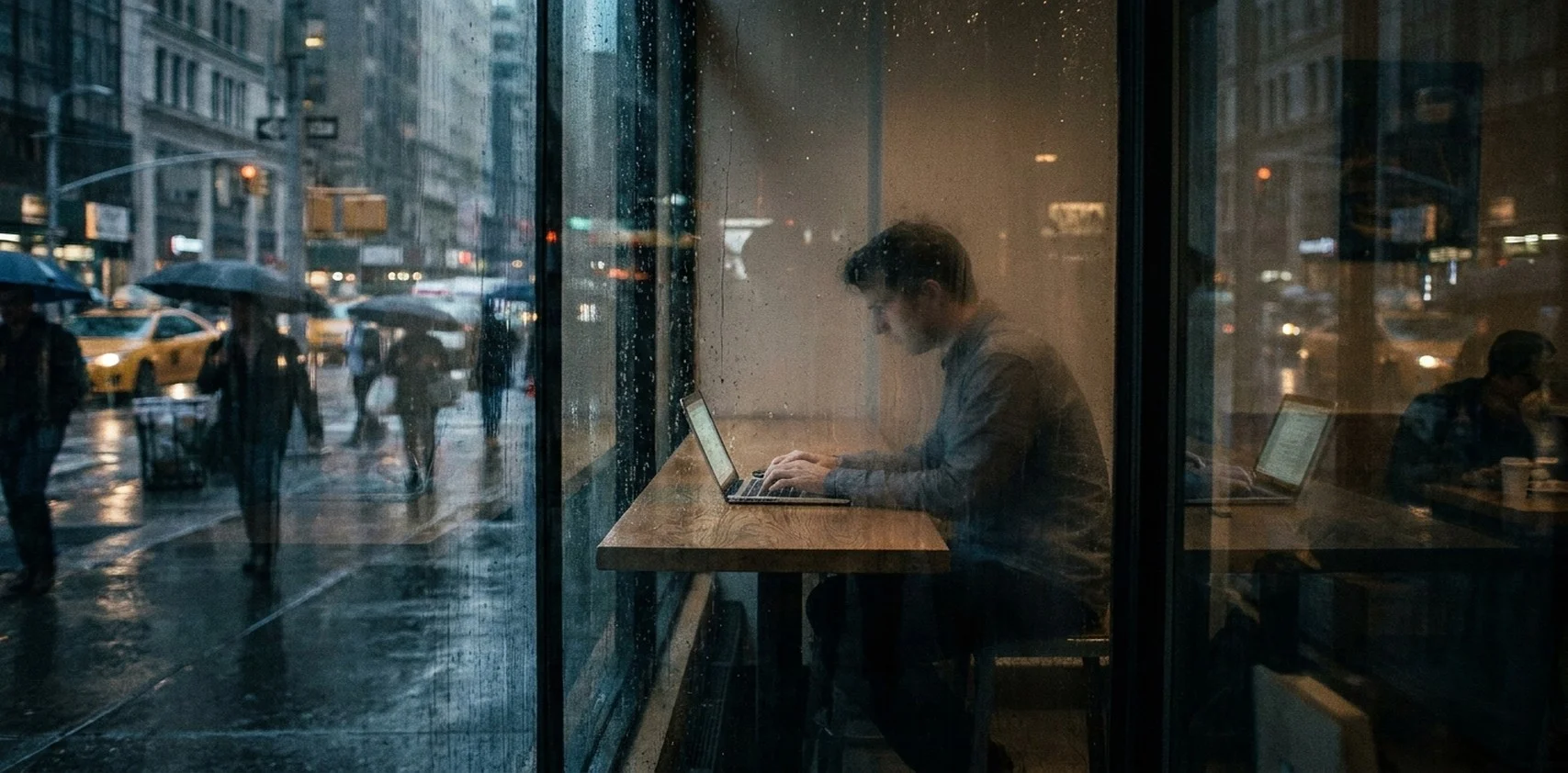
AI Generated - Editorial Use
Twenty thousand followers online, zero people who know your name on the street where you live. Welcome to life as a digital ghost. In 2026, as nomadism industrializes, an uncomfortable truth is emerging: proximity bias makes remote workers invisible in promotions, AI makes absent humans more replaceable, and surface-level living turns cultural experience into a backdrop with Wi-Fi. This article examines the hidden costs — and how to become present again.
In late 2025, an anonymous post circulated through digital nomad forums that struck a nerve: "I have 20,000 followers across three platforms. On the street where I live, nobody knows my name. I am a digital ghost."
It wasn't an isolated sentiment. As digital nomadism has evolved from lifestyle experiment to full-blown industry — with its own visa categories, insurance products, and influencer economy — an uncomfortable question is surfacing: Are the people who check in everywhere actually present nowhere?
Globally Visible, Locally Invisible
The digital footprint of a typical nomad is enormous. Bali sunsets on Instagram, timezone complaints on X, Notion boards spanning three continents. From the digital world's perspective, these people are active, productive, omnipresent.
Switch to the physical world, and the picture inverts.
In a Chiang Mai coliving space, a nomad might stay three months without ever walking into the market next door. In a Lisbon apartment, the neighbor's name remains a mystery. In a Medellín café, interactions with the local community rarely extend beyond ordering in broken Spanish.
This isn't because nomads are cold or selfish. It's structural. When you know you're leaving in three months, the instinct to invest in local relationships diminishes. When your work, social life, and entertainment all happen on a screen, physical space degrades into "a backdrop with Wi-Fi."
The Indian tech publication The News Mill coined a term for this in April 2026: the "displacement factor" — nomads who occupy space and drive up local rents without participating in the community. They're tourists with long-term leases.
Proximity Bias Is Real — And It's Getting Worse
The career cost of being a ghost is concrete.
When a high-stakes project lands or a promotion opens up, leadership tends to look at the person they just had lunch with — not the profile picture three time zones away. Research on proximity bias consistently shows that physical presence disproportionately influences performance evaluations, trust-building, and opportunity allocation.
For nomads, this creates a paradox. The freedom to work from anywhere comes with the penalty of being nowhere in particular. You might be the most capable person on the team, but if you lack "office presence," you're essentially a high-performing subscription service — easy to keep, easier to overlook.
The feedback vacuum compounds the problem. Think about the best career advice you've ever received. Was it in a scheduled Zoom call? Probably not. It was a casual remark during a coffee break, a shared frustration in the elevator, an offhand observation from a senior colleague who happened to be walking past your desk. Digital nomads live outside these informal learning ecosystems. They become efficient, but they stop becoming wise.
AI Makes the Ghost More Replaceable
Here's where the ghost metaphor takes a darker turn.
As AI tools increasingly handle data analysis, code generation, content drafting, and research — the very tasks that many nomads perform — the value proposition of the remote human shifts. If you're not physically present to advocate for your strategic vision, to read the room in a meeting, to build the kind of trust that comes from shared physical space, you risk becoming interchangeable with an algorithm.
The nomad who works efficiently from a beach in Bali and the AI agent that works efficiently from a server rack in Virginia start to look uncomfortably similar from a manager's perspective. Both deliver outputs. Neither is in the room.
This isn't an argument against remote work. It's an argument for being intentional about what remote work costs you — and actively compensating for those costs.
Surface-Level Living: 8K Views, Zero Real Connections
Then there's the social cost, which compounds over years in ways that are hard to see in real time.
The Instagram reel of a Himalayan vista with a laptop in the foreground is aspirational content — but the reality behind that image is often ten hours of screen time with a five-minute glance at the view during lunch. It's surface-level living. You're physically in a stunning culture but mentally in a spreadsheet.
The communities that nomads pass through feel this too. In many second and third-tier cities — from Canggu to Tbilisi to Oaxaca — digital nomads have become a specific kind of economic actor: they earn high salaries, spend most of it on global platforms or isolated Airbnb stays, and drive up local rents without contributing to local civic life. They don't attend town halls. They don't know their neighbors' names. They don't send their kids to local schools.
This creates a peculiar form of gentrification: one without participation. The nomad presence raises costs for locals while adding nothing to the social fabric.
The Loneliness Data Is Damning
Surveys consistently paint a challenging picture. A 2025 study by the MBO Partners found that 52% of digital nomads reported feelings of loneliness as their primary challenge — ahead of unreliable internet, visa complications, and time zone difficulties.
Coworking spaces and nomad meetups provide a partial solution, but they're inherently transient communities. The person you bonded with over coffee last week is in a different country this week. The emotional pattern is one of constant shallow connection and repeated loss — not traumatic individually, but cumulatively exhausting.
Psychologists studying this pattern call it "relational groundlessness" — the feeling of never being fully rooted in any single community, relationship network, or sense of place. Over time, it can manifest as anxiety, decision fatigue, and a persistent sense that something important is missing, even as every measurable metric of freedom and flexibility looks great on paper.
The Antidote: Intentional Presence
None of this means digital nomadism is broken. It means the naive version — hopping cities every two weeks, optimizing for novelty, treating each location as content — has a hidden cost that compounds over time.
The emerging alternative goes by various names: slow nomadism, base-building, the "two-base" model. The principles are consistent:
Stay longer. Three months minimum per location. Six is better. Enough time to learn someone's name, to have a regular order at a coffee shop, to be recognized.
Join something local. A sports league, a language class, a volunteer project, a neighborhood association. Something that creates obligation and routine — the very things nomadism was supposed to liberate you from, but which turn out to be the architecture of belonging.
Build a "second home." Many experienced nomads eventually settle on one or two locations they return to regularly — a place where they have a dentist, a landlord who remembers them, friends who aren't leaving next week. This isn't giving up on nomadism. It's adding roots to a rootless lifestyle.
Separate work and life physically. When your apartment is your office, the boundary between work-self and personal-self dissolves. Use a coworking space, a library, a café with a dedicated work corner. The commute might be three minutes, but the psychological separation matters.
Go offline intentionally. A "digital sabbath" — one day per week without Slack, email, or social media — forces engagement with the physical world. It's uncomfortable at first, then revelatory.
Presence Is a Skill, Not a Location
The deepest irony of the digital ghost phenomenon is that the people who've optimized most aggressively for freedom often end up with the least meaningful version of it. Freedom to work from anywhere becomes freedom from attachment, from community, from the messy, inconvenient, irreplaceable experience of being known.
The question isn't whether to be a nomad. It's whether to be a ghost.
The difference is intentionality. A nomad who stays three months, learns thirty words of the local language, shops at the neighborhood market, and shows up to the same café often enough to be greeted by name — that person is present. They exist in a place, not just a timezone.
A ghost has Wi-Fi. A person has neighbors.
The choice, as always, is yours.
Further Learning
Stopping is the first step. But after you stop, what you need is the ability to build relationships — and that's precisely the skill that atrophies fastest for people who've been on the road too long.
Darencademy's Workplace Relationships & Strategic Advantage is ostensibly about the office, but at its core it teaches how to forge meaningful human connections in any environment. From reading what others need to finding your place within a community — these skills aren't just for cubicle life. For a nomad who wants to stop being a ghost and start being a neighbor, they might matter even more.
This content is protected by copyright. Please respect the author's work and do not copy or distribute without permission.
