


Managing Up as a Remote Worker: Out of Sight Doesn't Mean Out of the Game
May 7, 2026
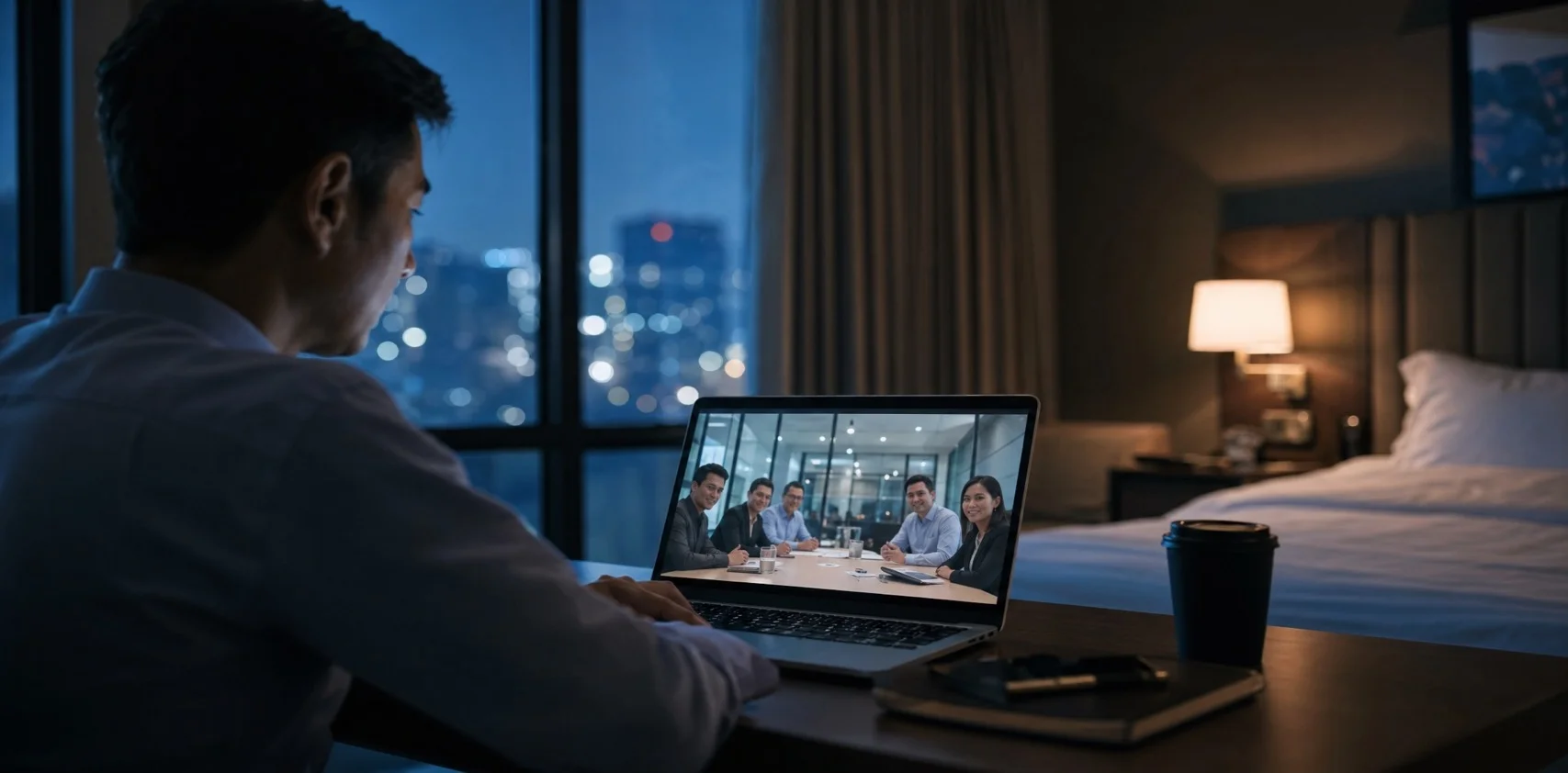
AI Generated - Editorial Use
Remote workers often face a paradox: strong performance paired with weak recognition. Harvard Business Review research shows 85% of managers doubt remote employees' productivity, while Stanford professor Nick Bloom found remote workers' promotion rates are nearly 50% lower. This article examines the psychology of proximity bias and the triple bind facing digital nomads — time zone invisibility, environmental image gaps, and corridor politics vacuums — then offers four actionable strategies.
A software engineer spent an entire year working remotely from Chiang Mai. During that time, he was consistently the fastest to deliver on his team. His bug rate was the lowest in the group. The CTO publicly praised his code review quality twice in all-hands meetings. When his annual performance review came back, the rating was a B.
His manager's explanation was polite but pointed: "Your output is fine, but the team feels you're not fully engaged."
A person who worked over ten hours a day and never missed a single deadline had been labeled "not fully engaged." Looking back on that moment, he said the strongest emotion wasn't anger. It was confusion. He genuinely had no idea what he'd done wrong.
That confusion points directly at the most dangerous blind spot in remote work: performance and visibility are two entirely different things.
Proximity Bias: The Default Setting in the Human Brain
This engineer's experience isn't an outlier. Behind it lies a psychological mechanism validated by extensive research, known in academic literature as Proximity Bias. The concept is straightforward: humans are naturally inclined to give higher evaluations, greater trust, and more collaboration opportunities to people who are physically closer to them.
This isn't a character flaw in any particular manager. It's a cognitive shortcut left behind by evolution.
A 2023 Harvard Business Review feature on hybrid work found that even when remote employees matched their in-office counterparts in objective output, managers still tended to perceive the people they could physically see as more hardworking and more dependable. The researchers called this the "visibility premium": the mere act of showing up at the office adds points to a person's evaluation, independent of actual performance.
Microsoft's 2022 Work Trend Index put it more bluntly: 85% of managers said that under hybrid or remote arrangements, they struggled to feel confident their employees were truly productive. Microsoft coined a term for this: "Productivity Paranoia."
Not 15%. Not half. Eighty-five percent.
In other words, even if someone delivers on time, maintains consistent quality, and never misses a beat, their manager may still harbor a persistent, nagging question: "Is this person actually working hard?"
It sounds absurd. And it is. But absurdity doesn't equal nonexistence. The bias is there, and it won't disappear just because it's irrational.
Even more sobering evidence comes from Stanford economics professor Nick Bloom's longitudinal research. He found that remote workers' probability of receiving a promotion was nearly 50% lower than that of their in-office colleagues. Not because of any gap in ability, but purely because managers didn't "see" them putting in the effort.
Faced with this structural disadvantage, there are two possible responses: spend energy proving the system is unfair, or spend that same energy designing strategies to navigate it. Both have merit, but this article focuses on the latter, because the latter can change outcomes in the near term.
The Triple Bind of Digital Nomads
If proximity bias were the only issue, working from home would already be challenging enough. But digital nomads face not just one variable called "remote" — they contend with three interlocking structural disadvantages operating simultaneously.
Layer One: Time Zone Misalignment Creates Systematic Invisibility
It's 9 AM in Chiang Mai. The nomad opens their laptop, energized and ready to work. At that exact moment, their manager back in Taipei has already been in the office for hours, currently in their third meeting of the day. By the time the nomad finishes their most critical deliverable and wants to sync up, the manager has already left for the evening.
The nomad's most productive hours register as dead silence in the manager's awareness.
The absence of real-time responsiveness compounds the problem. When a manager asks during a morning standup, "Who can pick this up right now?" the nomad in a different time zone may still be asleep. By the time they see the message, the task has already been claimed by whoever in the office raised their hand first.
A 2023 Gartner survey found that over 70% of managers, when assigning critical tasks, default to whoever can respond immediately. This isn't deliberate exclusion of remote colleagues — it's the path of least resistance under pressure. Time zone differences don't merely create inconvenience. They systematically exclude nomads from the real-time moments that signal eagerness and availability.
Layer Two: The Gap Between Environmental Signals and Professional Image
A remote engineer once joined a client video call from a café on Nimmanhaemin Road in Chiang Mai. Halfway through the meeting, backpackers at the next table broke into loud conversation. The sound of tuk-tuk horns from the street punched through his noise-canceling headphones. On screen, the client's expression stiffened almost imperceptibly.
After the meeting, his manager messaged: "For important calls, could you find somewhere quieter?" The tone was friendly. The signal was unmistakable.
This is the awkward position digital nomads regularly find themselves in. One reason they chose this lifestyle was precisely to escape the confines of a fixed office. Yet in the "professional imagination" of most managers and clients, a serious worker should be sitting in a quiet, organized, formal-looking space.
"Shouldn't results be all that matter?" In theory, yes. In practice, human judgment never relies on results alone. UCLA professor Albert Mehrabian's research in the 1970s established that up to 55% of interpersonal communication is conveyed through visual cues. In a video call, the background, lighting, and audio quality all silently broadcast signals about whether someone is "professional enough." What the nomad considers charming ambiance may register as carelessness to the person on the other end.
Layer Three: The Vacuum of Corridor Politics
Inside every office exists an invisible information network sometimes called corridor politics. It refers to informal interactions that happen outside official meetings: chitchat at the water cooler, exchanged glances by the elevator, hushed conversations over lunch.
"Apparently the boss isn't happy with Q3 numbers." "That proposal got shot down — word is finance had objections." "The new VP seems to care a lot about X direction."
None of this appears in any Slack channel, meeting minutes, or official documentation. Yet it constitutes some of the most valuable intelligence in an office ecosystem. Colleagues who are physically present absorb these signals passively every day. They don't need to actively seek information — being there is the antenna.
Remote workers are entirely excluded from this intelligence network. By the time a key decision is finalized, they discover after the fact that the winds shifted long ago, and nobody thought to send them a memo.
A 2022 study in MIT Sloan Management Review found that over 60% of critical organizational decisions are influenced by informal communication channels. Being absent from corridor politics doesn't just mean missing gossip — it means losing the ability to participate in and influence how decisions are shaped.
Stack all three layers together, and you have the real structural landscape digital nomads operate in. It's not an ability problem. It's not an effort problem. It's that the operating logic of most organizations inherently disadvantages people who aren't physically present.
Understanding this matters because it fundamentally reframes the question. When remote workers receive unfair evaluations, their first instinct is often self-doubt: "Am I not performing well enough?" The answer is usually no — performance may be excellent. But performance that isn't seen is, in most organizational cultures, performance that doesn't exist.
The real question, then, is not "How do I perform better?" but "How do I ensure that what I've already done well reaches the right people at the right time?" This is a communication design challenge, not a capability gap.
Making Performance Visible: From "What I Did" to "What They See"
With the structural challenge mapped out, the next step is building a system to actively counter it. The four strategies below share a common logic: convert invisible work into visible signals.
Strategy One: The Weekly Dispatch — Establishing a Stable Cognitive Anchor
Rather than waiting for the manager to ask "What have you been up to?", make sure they receive the answer at a predictable cadence.
The practice: every Monday morning (in the manager's time zone), send a concise weekly update. Three sections are sufficient:
- What was completed last week (describe outcomes, not hours logged)
- What's planned for this week (demonstrate direction and priorities)
- Anything that needs support (if nothing, write "All on track, no blockers")
A few details matter. The send time must be fixed — not whenever you remember, not when you get around to it, but the same day, same window, every single week without exception. This rhythm alone builds an impression of stability in the manager's mind. Align the send time to the manager's time zone; even if it means scheduling delivery at 3 AM from Chiang Mai, the manager's experience is "the update was already there Monday morning." Keep the tone informational, not self-congratulatory. "Completed the X module refactor; performance improved approximately 30%" is sufficient. No need to mention overtime or personal sacrifice.
The core logic of the weekly dispatch: a manager's greatest anxiety isn't that an employee is underperforming — it's not knowing what the employee is doing. Eliminate that uncertainty consistently, and trust follows naturally.
Some may object: "Isn't this just putting on a show?" Quite the opposite. The weekly dispatch isn't performance theater — it's information asymmetry reduction. With time zones and distance separating you from your manager, the absence of proactive signals leaves the manager with only one option: guessing. And when people guess under uncertainty, they tend to guess negatively. The weekly update isn't about impressing anyone. It's about compressing the space available for speculation.
Buffer's 2023 State of Remote Work report found that remote workers who provided regular structured updates received manager satisfaction scores 43% higher than those who updated sporadically. A consistent communication rhythm is, in itself, a powerful trust signal.
There's also a frequently overlooked side benefit: every weekly dispatch doubles as a running performance record. When it's time for a self-assessment in three months, a raise negotiation in six, or a résumé update in a year, those accumulated dispatches make every accomplishment instantly retrievable. This isn't just a tool for managing up — it's a tool for managing a career.
Strategy Two: Visibility Design — Default to Async, Go Sync When It Counts
Remote workers tend to default to asynchronous communication: Slack messages, emails, comments in project management tools. These channels work well for routine updates, but in certain situations, synchronous interaction should be a deliberate choice.
Which situations? When the goal is to demonstrate judgment, not just execution.
Suppose a potential risk is identified in the project's technical direction and an alternative approach is worth proposing. An email detailing the analysis might prompt the manager to think "that makes sense" before moving on to the next item. But a fifteen-minute video call that walks through the reasoning, allowing the manager to ask questions and receive real-time answers, creates an interaction of entirely different memorability.
The Generation Effect in cognitive psychology explains why: people retain significantly deeper memories of conversations they actively participated in compared to text they passively read. The objective of managing up isn't merely for the manager to "know" about an idea — it's for the manager to "remember" the idea and who proposed it.
Not everything warrants a video call, of course. The key is choosing the right moments. Synchronous communication is particularly valuable when:
- Proposing a significant recommendation or alternative approach
- A project hits trouble and a fast decision is needed
- Gauging the manager's genuine stance on something (written communication is too easily polished and hedged)
- Immediately before or after quarterly reviews or annual planning cycles
For routine progress updates? Async is fine. Respect everyone's time.
Strategy Three: Alliance Building — Installing a Proxy in the Office
Of the four strategies, this one is the least intuitive and possibly the most effective.
The nomad needs to identify an ally within the office. Not a political faction — a colleague with a solid working relationship and mutual goodwill. The two establish a reciprocal understanding: the nomad handles tasks that can be done remotely (compiling technical documentation, reviewing reports, running data analyses), while the ally performs actions in the office that the nomad physically cannot.
For example, when the manager discusses a project's progress in a meeting, the ally can naturally mention: "That part was primarily handled by XX — it was wrapped up last week." Just one sentence, delivered casually, without fanfare. But for someone who isn't in the room, having another person ensure they're "seen" at a critical moment is enormously valuable.
The reciprocity works in reverse too. The ally urgently needs a document — the nomad, leveraging the time difference, prepares it overnight so it's ready when the ally walks into the office the next morning. The ally's report needs data support — the nomad runs the analysis. Once this mutual support stabilizes, it's more persuasive than any form of self-promotion.
Some might worry this resembles forming cliques. The distinction is fundamental. Cliques operate by excluding others. Alliance building operates by finding partners whose gaps complement each other. What the nomad lacks is physical presence. What the office colleague may lack is spare bandwidth or a specific technical skill. This is a mutually beneficial collaboration — normal and healthy in any organization.
Strategy Four: Timing — Appear When the Manager Most Needs Reassurance
Managing up isn't the platitude "communicate more with your boss." Frequency matters far less than timing.
When does a manager most need a remote worker to show up? Not when everything is running smoothly. When they're feeling anxious.
Four key moments remote workers should make a point of being present:
Project kickoff. At the start of a new project, a manager's primary anxiety is "Does everyone understand the direction?" Proactively scheduling a brief call to confirm understanding of objectives and priorities creates the impression: "This person may not be in the office, but they're clearly locked in."
Crisis moments. When things go wrong, the absent are the first to be forgotten. While office colleagues huddle tensely to discuss solutions, a remote worker who simply types "Anything I can help with?" on Slack barely registers. A more effective approach: quickly analyze the problem, volunteer for a specific piece of the response, and deliver results in the shortest possible timeframe. Decisive action during a crisis leaves a lasting impression.
End-of-quarter periods. Managers typically use this time to compile team performance summaries, report upward, and plan the next quarter's direction. Proactively organizing personal accomplishments into a clear document saves the manager the effort of digging through records. Ostensibly it's helping them; the practical effect is that when they're assembling performance data, the nomad's name and contributions are the clearest, most complete entry in the file.
Personnel transitions. When someone resigns, someone gets promoted, or the organization restructures, managerial attention is being redistributed. This is a prime window for refreshing one's presence. Nothing dramatic is required — just being slightly more proactive and slightly more visible than usual during this period.
The shared logic across all four moments: these are the times when managers most need reassurance, and showing up proactively is how reassurance is delivered.
Asynchronous Trust: The Foundation Beneath Remote Work Relationships
The four strategies above address the visibility problem. The deeper challenge is trust.
In an office, trust has a remarkably low entry threshold. Seeing someone show up on time each day, sit at their desk, attend meetings, and interact with colleagues — these mundane behaviors automatically accumulate into a baseline of trust. Even without knowing what the person specifically accomplished, simply "seeing them there" produces a vague but effective judgment: "They're probably reliable."
Remote workers have no such automatic mechanism. Every unit of trust must be deliberately constructed.
How? Three core principles.
Principle One: Absolute consistency in commitments. Say Wednesday delivery, deliver Wednesday. Say 2 PM call, be online at 2 PM sharp. Not ninety percent of the time — one hundred percent. It sounds severe, but this is the real cost of remote trust. An office colleague who's five minutes late is spotted hurrying down the hallway, and nobody thinks twice. A remote worker who's five minutes late produces a single sensation on the other end: "I have no idea whether this person is even there." The absence of visibility amplifies every minor lapse.
Principle Two: Oversupply transparency. In the office, colleagues can see someone working late, frowning in concentration, or meeting with another department. For remote workers, all of these process signals are invisible. Critical milestones must therefore be surfaced proactively. Not exhaustive play-by-play reporting, but making key process waypoints visible. "Currently comparing approaches A and B; expect a conclusion tomorrow." "This task turned out more complex than anticipated; I've adjusted the timeline, with the new delivery date at X." The message to convey: work is continuously in progress, not materializing from thin air.
Principle Three: Anticipating problems matters more than solving them. In an office, noticing the manager's expression darken prompts a quick check-in. Remote workers don't have access to these real-time facial cues. The habit to cultivate: think of the problem before it's formally raised. "I've noticed that X's timeline might cascade into Y's schedule — wanted to check whether priorities need adjusting."
The impression created by anticipatory communication far exceeds that of after-the-fact damage control. The signal it sends isn't just "this person is working" — it's "this person is thinking about the bigger picture." For a manager, a remote employee who can foresee problems may actually be more dependable than an in-office colleague who simply waits for instructions.
This is one of the rare areas where remote workers can flip the structural disadvantage: being away from the office noise provides a quieter environment for deep thinking. Leveraging this unique advantage and converting it into a habit of proactive communication turns what was a liability into irreplaceable value.
Intuition Versus System
People in the office enjoy one advantage that nomads cannot replicate: the luxury of intuition.
Sharing physical space with a manager every day means passively absorbing a constant stream of nonverbal signals. The manager's mood today. Which topics are getting attention lately. Who they're spending time with. What they seem hesitant about. None of this requires deliberate intelligence gathering — simply being present is the antenna.
Nomads don't have that luxury.
Without the raw signal data that fuels intuition, nomads cannot afford to operate on gut feeling. What they need instead is a systematic methodology: a way to read situations that become invisible across distance, and to make the most effective possible use of limited interaction opportunities.
The strategies in this article are a starting point: the weekly dispatch addresses information asymmetry, visibility design ensures critical moments leave a mark, alliance building compensates for the absence of physical presence, and timing selection maximizes the impact of every interaction. These methods are not isolated tactics — they form an interlocking system that allows remote workers to be correctly understood even within a structure designed to overlook them.
If these strategies resonate with you but you want a more comprehensive framework for navigating workplace dynamics, consider A101 Office Politics Masterclass by DarenCademy. This two-day workshop, taught by Bryan Yao, uses tools like interpersonal network mapping and empathy maps to help you decode office power structures — from reading the room to building alliances to choosing your battles. It's particularly valuable for remote workers who need to navigate politics without the advantage of physical presence.
What Happened Next
The engineer in Chiang Mai spent roughly three months adjusting his approach. He began sending consistent weekly updates, proactively scheduling calls at key moments, and found a reliable ally in the office.
Six months later, his manager's attitude had visibly shifted. The most concrete evidence: when a cross-departmental project opportunity emerged, the manager's first thought was him. "You may not be in the office," the manager said, "but I've always known you have the full picture."
He later offered a concise summary that may be worth ending on:
"I used to think doing good work was enough. Then I realized that good work is the baseline. Making sure the right people know about it at the right time — that's what completes the picture of professionalism."
That insight holds true whether someone is sitting in a Chiang Mai café, a Tokyo coworking space, or a Lisbon coliving apartment.
Remote work grants spatial freedom, but it doesn't exempt anyone from the responsibility of building presence within a professional ecosystem. Freedom and visibility were never an either-or choice. The truly mature nomad understands that both must be cultivated in tandem.
This content is protected by copyright. Please respect the author's work and do not copy or distribute without permission.

數位遊牧編輯群 Digital Nomad Editor Group
Digital Nomad is a knowledge sharing platform specially designed for “those who dream to become digital nomads.” We share the latest news and industry trends related to digital nomadism, as well as introduce essential skills and knowledge needed for freelancers, remote workers, etc. Our goal is to help you connect with fellow digital nomads!
