


Italy Is Using Digital Nomad Visas to Revive Its Ghost Towns — And It Might Actually Work
April 29, 2026
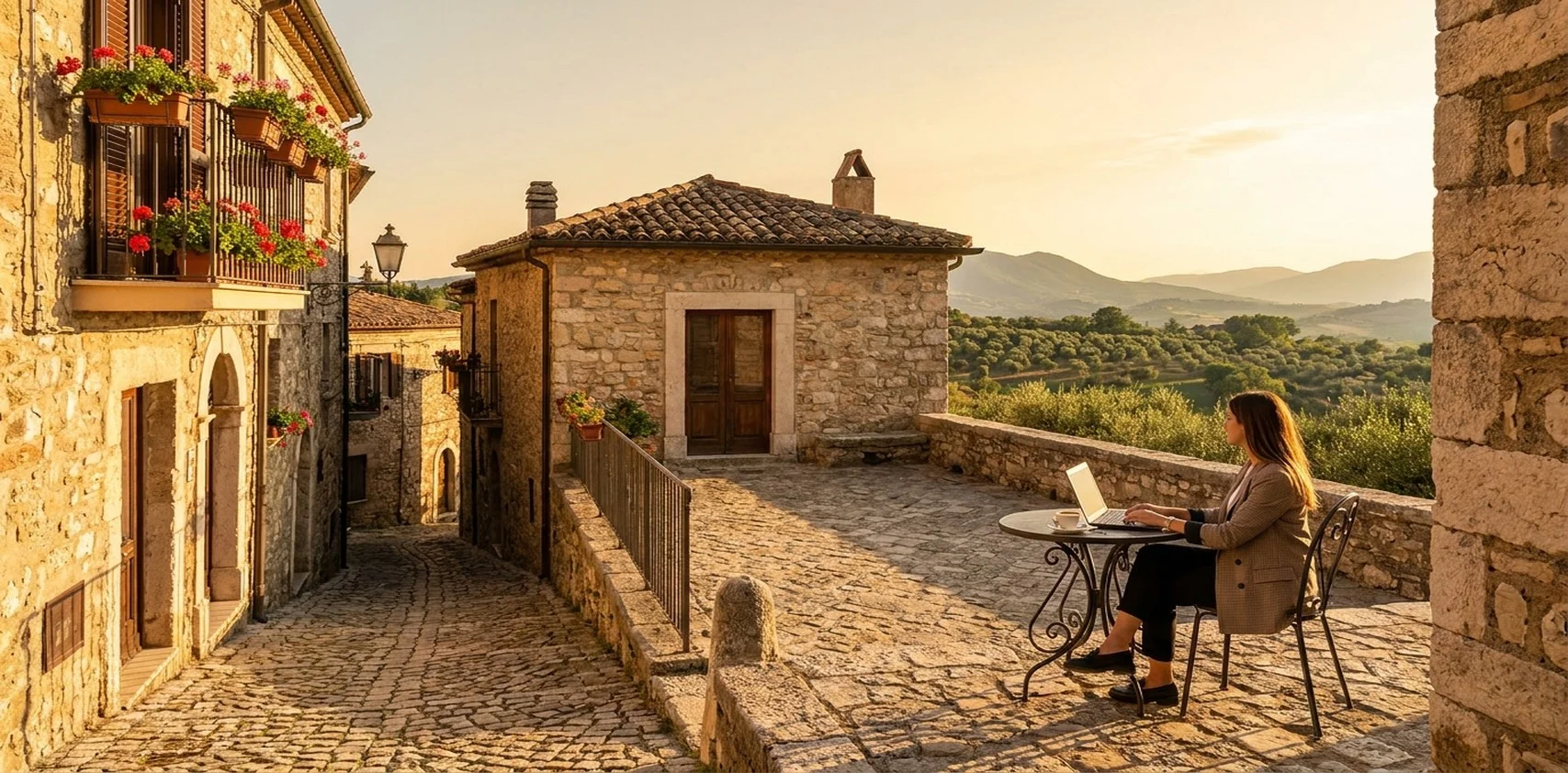
AI Generated - Editorial Use
In February 2026, Italy launched its digital nomad visa — but this isn't just another country jumping on the bandwagon. It's a deliberate rural revitalization strategy. With a €2,500/month threshold and a 5% flat tax for nomads who settle in low-density municipalities, Italy is channeling remote workers into its dying ghost towns rather than competing for the Lisbon-Barcelona crowd. Here's how it works and why it might actually succeed.
In Calabria, southern Italy, some villages have fewer than 200 permanent residents. Stone houses with half-collapsed roofs line empty piazzas. The only bar still open serves a handful of octogenarians. Italians have a word for these places: paese fantasma — ghost towns.
There are thousands of them, scattered across the hills of Sicily, the valleys of Abruzzo, and the remote corners of Tuscany. Young people left decades ago for Rome, Milan, or further abroad. What remains are slowly dying communities and unclaimed properties.
In February 2026, Italy launched a bold experiment: filling these voids with digital nomads. This isn't just another country jumping on the nomad visa bandwagon. It's a deliberate rural revitalization strategy — using the world's remote workforce to breathe life back into towns that are literally disappearing.
The Visa: Visto per lavoratore da remoto
Italy's digital nomad visa, officially called the "Visto per lavoratore da remoto" (remote worker visa), was legislated in late 2024 and began accepting applications in February 2026.
The income threshold is surprisingly accessible: €2,500 per month. For context, Portugal's D8 visa requires four times the national minimum wage (roughly €3,400/month), and Spain's nomad visa demands 200% of the minimum wage (around €2,849). Italy sits in the middle — but given the dramatically lower cost of living in small Italian towns, the real purchasing power of that threshold is considerably higher than the numbers suggest.
The visa is valid for one year and renewable. Holders must carry health insurance with at least €30,000 in coverage. Processing times are advertised at 30 to 60 days — ambitious by Italian bureaucratic standards.
But the feature that truly distinguishes this visa from every other nomad permit in Europe is what happens when you choose to live somewhere small.
The Rural Incentive: Population Density Below 160/km²
Here's where Italy's approach diverges from the competition.
Applicants who settle in municipalities with population density below 160 inhabitants per square kilometer receive two significant benefits: expedited processing and tax concessions.
That 160-person threshold was carefully chosen. It excludes Rome, Milan, Florence, Naples, and their satellite cities. But it encompasses the vast majority of Italian towns facing depopulation — the very places that need new residents most.
In other words, Italy isn't competing with Lisbon and Barcelona for the same pool of nomads who want nightlife, coworking spaces, and açaí bowls. It's targeting a completely different market segment: remote workers willing to trade urban convenience for stone farmhouses, olive groves, and a 5% flat tax rate.
That tax rate deserves emphasis. Italy's standard income tax peaks at 43%, with even the lowest bracket at 23%. A 5% flat rate for new residents who choose low-density areas is an extraordinary incentive, particularly for nomads earning between €2,500 and €10,000 per month.
Beyond the €1 House: A More Sophisticated Strategy
Italy's €1 house programs made global headlines in recent years — municipalities in Sicily and Sardinia literally selling abandoned properties for a single euro, provided buyers committed to renovation within a set timeframe. The concept was viral, romantic, and mostly impractical. Renovation costs frequently exceeded €50,000, bureaucratic hurdles were significant, and many buyers discovered that a €1 house in a village with no grocery store and intermittent internet wasn't quite the dream they'd imagined.
The digital nomad visa represents a more mature iteration of the same underlying goal. Rather than asking people to buy crumbling real estate sight unseen, it invites them to rent, to test, to experience. The barrier to entry is a monthly income and a laptop, not a renovation budget and a willingness to navigate Italian property law.
It's also more sustainable. A €1 house buyer who completes renovation might visit twice a year. A digital nomad who falls in love with a village might stay for years — and spend locally every single day.
The Competition Is Fierce
Italy's visa doesn't exist in a vacuum. As of 2026, more than 65 countries offer some form of digital nomad permit, and the competition for remote workers has become a soft-power arms race.
Portugal was an early leader, but its program has faced criticism for low retention rates. Many D8 visa holders use Lisbon as a base for Schengen access rather than genuinely integrating. The government has been tightening tax perks in response.
Spain offers a three-year visa with the appealing Beckham Law (24% flat tax), but higher social security costs and recent income threshold increases have made it less attractive for mid-range earners.
Croatia allows stays of up to 18 months and can be applied for online — appealing for simplicity, though the local infrastructure in smaller cities remains underdeveloped.
Malta has raised its income bar, pricing out many independent freelancers.
Italy's differentiation — the rural angle, the low threshold, the aggressive tax incentive for small-town settlement — is genuinely novel. No other country has so explicitly linked its nomad visa to regional development policy.
What It Actually Looks Like on the Ground
Imagine a UX designer from Toronto earning €4,000 per month from North American clients. In Lisbon, after rent, coworking, and daily expenses, she might save €500. In a village in Abruzzo — where a furnished apartment rents for €300-400 and a three-course lunch at the local trattoria costs €12 — she could save €2,000 while paying 5% income tax instead of Portugal's standard rates.
She'd also have access to Italy's national healthcare system (with private top-up insurance), high-speed rail connections to Rome (Abruzzo is roughly 90 minutes east), and increasingly reliable fiber internet — Italy has been investing heavily in rural broadband as part of its National Recovery and Resilience Plan.
The trade-offs are real: limited English-speaking social circles, fewer coworking options, and the adjustment to a pace of life that operates on its own timetable. But for nomads who've grown tired of the Bali-Lisbon-Medellín circuit, a stone house in a hilltop village with a view of the Adriatic might be exactly the reset they're looking for.
The Bigger Picture: Nomad Visas as Population Policy
Italy's approach signals a broader shift in how governments think about digital nomad programs. The first wave — Barbados, Estonia, Croatia — was about tourism revenue and international visibility. The second wave — Portugal, Spain, Greece — was about attracting tax-paying residents to bolster sluggish economies.
Italy's is arguably the third wave: using nomad visas as targeted instruments of demographic policy. The country has one of the lowest birth rates in Europe (1.2 children per woman) and has been losing population since 2015. Rural depopulation is an existential crisis for hundreds of municipalities. Traditional immigration policy hasn't solved the problem — most immigrants, understandably, gravitate toward cities where jobs and services are concentrated.
Digital nomads are different. They don't need local employment. They bring their own income. They need reliable internet, not a factory. And they're disproportionately drawn to exactly the qualities that small Italian towns have in abundance: authenticity, beauty, quiet, and affordability.
Whether this experiment will succeed at scale remains to be seen. Italy's bureaucracy is legendary, and turning a visa policy into actual village revitalization requires more than tax incentives — it requires functioning schools, reliable healthcare, and local communities willing to welcome outsiders.
But the concept is sound, the incentives are real, and for a certain type of digital nomad — one who's ready for slow travel, genuine integration, and the possibility of a €12 lunch that changes their life — Italy's ghost towns might just be the most compelling destination in the world right now.
Key Details at a Glance
- Income threshold: €2,500/month (€30,000/year)
- Duration: 1 year, renewable
- Health insurance: €30,000 minimum coverage required
- Processing time: 30-60 days (advertised)
- Rural tax incentive: 5% flat rate for settlements in municipalities with population density < 160/km²
- Municipality registration: Within 8 days of entry
- Criminal record: Clean record required
- Competing visas: Portugal D8 (~€3,400/month), Spain DN (~€2,849/month), Croatia (18 months, online application), Estonia (1 year)
This content is protected by copyright. Please respect the author's work and do not copy or distribute without permission.
