


The Coworking Bubble Burst: WeWork Fell, but the Nomad's Office Problem Remains
May 11, 2026
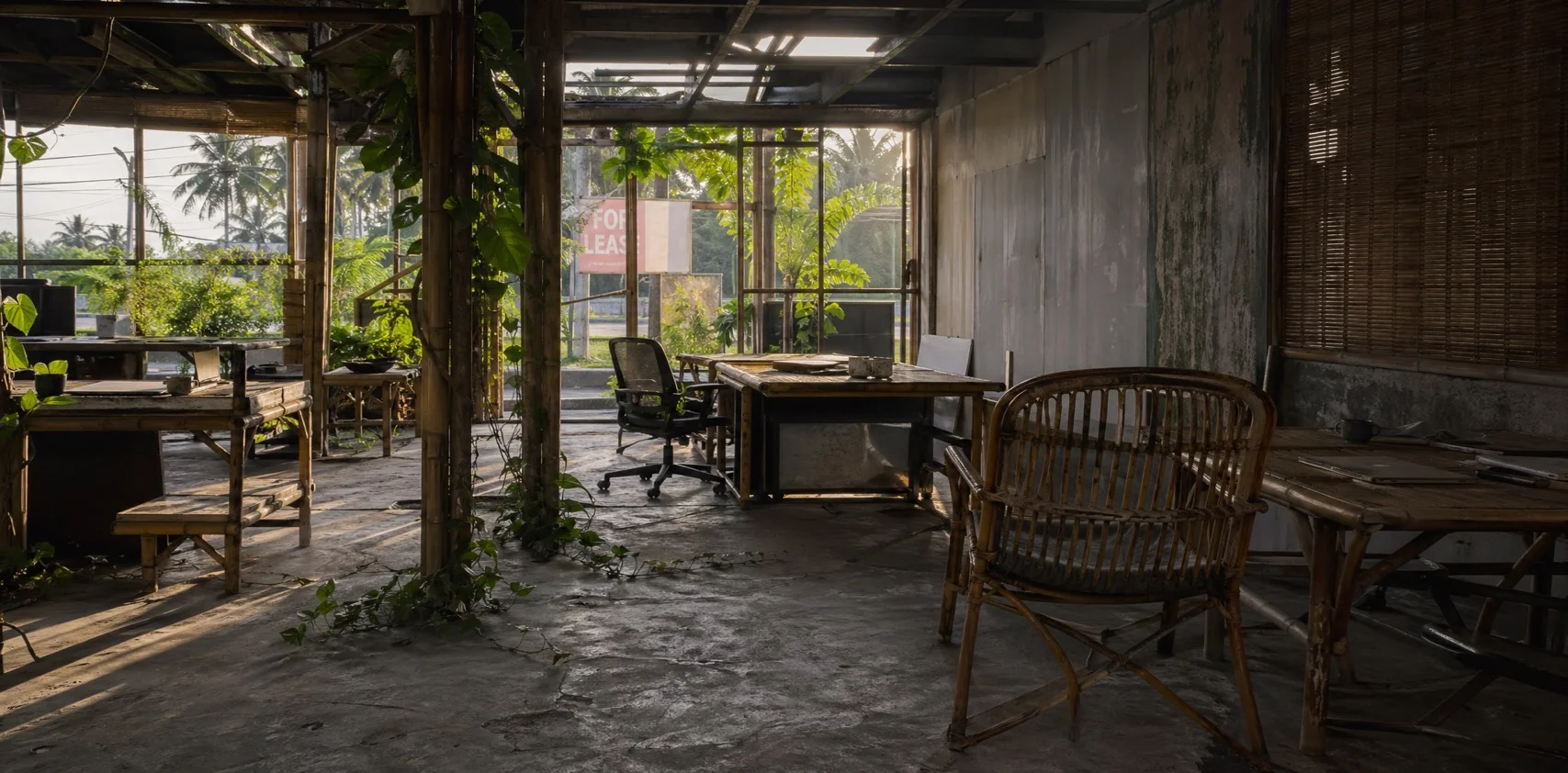
AI Generated - Editorial Use
WeWork's 2023 bankruptcy sent shockwaves far beyond Silicon Valley. Across Southeast Asia, dozens of coworking spaces in Chiang Mai, Bali, and Bangkok quietly shut down between 2023 and 2025 as a long-brewing bubble finally burst. Oversupply, dependence on short-term nomad tourists, and the fatal mistake of selling desks instead of community drove most closures. Yet survivors like Hubud, PunSpace, and Outpost thrived by building genuine communities, integrating lifestyle services, and balancing local and international memberships.
In November 2023, WeWork filed for bankruptcy protection. The company once valued at $47 billion collapsed under more than $10 billion in debt. Global media fixated on Silicon Valley's reckless valuations and founder Adam Neumann's extravagant antics. Few noticed the chain reaction it triggered on the other side of the world.
From Chiang Mai to Bali, Bangkok to Ho Chi Minh City, dozens of coworking spaces across Southeast Asia quietly disappeared between 2023 and 2025. This wasn't coincidence. It was a bubble that had been inflating for years, finally popping.
The twist? The spaces that survived are now healthier than ever.
A Simple Math Problem
Understanding any bubble starts with supply and demand.
Chiang Mai ranks among the world's most popular digital nomad hubs. According to Coworker.com, the city had roughly 35 coworking spaces in 2019. By late 2022, that number had ballooned past 80, an increase of over 120%.
During the same period, Chiang Mai's nomad population was also growing, but nowhere near fast enough. Nomad List data suggests the city's active nomad count grew by about 40% between 2019 and 2022. Supply surging 120% while demand grows 40% is a math problem that doesn't require an economics degree to solve.
Bali's situation was even more extreme. Canggu, a coastal area of less than 10 square kilometers, crammed in over 30 coworking spaces at its peak. That's roughly one "Coworking" sign every 300 meters. According to Deskmag's Global Coworking Survey, Canggu's coworking supply grew at approximately 40% per year between 2021 and 2023, while demand increased by only about 15%.
Bangkok presented a slightly different picture. As Southeast Asia's commercial capital, its coworking market was primarily driven by local startup ecosystems and multinational corporate demand, with less dependence on nomads. But WeWork's global collapse still delivered a significant psychological blow. When the world's most recognized coworking brand went bankrupt, investor confidence in the entire sector plummeted, and fundraising conditions for Southeast Asian operators tightened accordingly.
The ingredients for a bubble were all in place: oversupply, limited demand, and a global confidence shock.
The WeWork Hangover
WeWork's direct footprint in Southeast Asia was limited, concentrated mainly in Singapore and Bangkok. But its business model spread like a virus, shaping the thinking of countless small operators across the region.
WeWork's core logic was straightforward: sign long-term leases on large commercial spaces, renovate them, then sublet to individuals and teams on flexible short-term agreements, pocketing the spread. In markets like New York and London, where per-square-meter rents run into five figures, the margin math can work. Transplanted to Southeast Asia, the entire model collapses.
The reason is blunt: base rents in Southeast Asia are too low, so low that coworking spaces can barely find a viable margin.
In Chiang Mai, a café with air conditioning and Wi-Fi costs nothing more than a latte to sit in all day. In Bali, many Airbnb living rooms come equipped with decent work desks and stable internet. When free or near-free alternatives are everywhere, how does a coworking space justify charging $100 to $250 per month for a desk and a password?
Yet the wave of new spaces that opened between 2019 and 2022 did exactly that. They copied the WeWork playbook: invest heavily in renovations, purchase designer furniture, install industrial-style pendant lights and neon slogans, then shoot a series of polished photos for Instagram. They were selling the visual appeal of a space, not what actually happened inside it.
This was WeWork's real legacy in Southeast Asia: the widespread belief that a beautiful space would automatically attract paying customers.
Four Fatal Mistakes
Looking back at the coworking spaces that closed across Southeast Asia between 2023 and 2025, the same errors appear again and again.
First, they got stuck in no-man's land. These spaces weren't the cheapest option (cafés are essentially free), nor the most professional (enterprise-grade offices offer better equipment and services), nor did they provide any distinctive community value. Their only selling point was "quieter than a café but cheaper than an office," a positioning with zero defensibility in a saturated market.
Second, they bet their revenue on the least reliable customer segment. Many spaces built their business model around day passes and weekly passes, targeting nomads staying one or two weeks. This group spends little, has near-zero loyalty, and fluctuates dramatically with the seasons. The packed house of peak season evaporates the moment the low season arrives.
Chiang Mai's Mana Coworking offers a cautionary tale. It leased roughly 660 square meters of premium space on Nimman Road, pricing day passes at 250 Thai baht (about $7) and monthly passes at 4,500 baht. During peak season, occupancy hit 70-80%, and the numbers looked reassuring. But during the annual low season from April to September, usage plunged below 20%, and cash flow couldn't cover fixed costs. Mana shut down in mid-2024.
Third, they ignored the local market entirely. Too many spaces focused exclusively on foreign nomads, building their entire business model around customers who might fly away at any moment. Local freelancers, small tech teams, language teachers, and independent creators don't vanish with the seasons. They're the most stable revenue base available. Spaces that survived the shakeout almost universally had a significant proportion of local members.
Fourth, they never did the math. This sounds unbelievable, but it's accurate. Many founders were nomads themselves who figured, "I need a good workspace, so others must too," then leased a space and launched. The full cost structure of rent, staffing, utilities, maintenance, and marketing? Never properly calculated. Some spaces couldn't even state how many paying members they needed to break even. In Southeast Asia's low-margin environment, this kind of seat-of-the-pants entrepreneurship is practically a death sentence.
What the Survivors Got Right
The spaces that stood firm through the shakeout, and in some cases expanded, share one defining trait: they sell belonging, not desks.
Hubud: Bali's Evergreen in Ubud
Founded in 2013, Hubud is one of Southeast Asia's earliest nomad coworking spaces. While competitors in Canggu fell one by one, Hubud in Ubud not only survived but grew steadily year after year.
The choice of location planted the seeds of success. Unlike tourist-saturated Canggu, Ubud attracts nomads who typically stay three to six months, far longer than Canggu's one-to-two-week average. Longer stays mean people are more willing to invest in community and build relationships.
But location was just the foundation. Hubud's real moat is that it placed community at the core of its operations from day one. Weekly entrepreneur showcases, skill-swap workshops, and local volunteer programs are fixtures. Joining Hubud means gaining access not just to a workspace, but to a network.
The smartest move was building an alumni network that extends beyond the physical space. Members who leave Bali remain active in online communities and reconnect at alumni gatherings in cities worldwide. Hubud's value doesn't reset to zero when someone leaves Ubud, which dramatically amplifies brand advocacy and lifetime value.
Hubud's monthly membership runs about $200, more expensive than many spaces that have already closed. Members pay willingly because they're not buying desk access. They're buying a community that generates collaboration opportunities, cross-border friendships, and professional growth.
PunSpace: Chiang Mai's Local-International Hybrid
Also founded in 2013, PunSpace navigated the 2023-2024 wave of Chiang Mai closures without a scratch and even opened a second location.
Its core strategy is a deceptively simple positioning that proves extraordinarily difficult to execute: serving locals and foreigners simultaneously. PunSpace's membership mix is roughly 60% Thai locals (freelancers, small tech teams, language teachers) and 40% foreign nomads. This ratio means that even when foreign nomads thin out during the low season, local members sustain baseline revenue.
The pricing architecture is equally deliberate. From day passes (200 baht) to monthly memberships and from open desks to dedicated offices (starting at 15,000 baht per month), a complete ladder ensures short-term visitors contribute foot traffic and energy, while long-term members and team rentals provide steady cash flow. The two segments complement rather than cannibalize each other.
On the community front, PunSpace's monthly "Chiang Mai Startup Meetup" has run for over eight consecutive years. The event has become a key node in Chiang Mai's startup ecosystem, creating brand equity that competitors simply cannot replicate.
Outpost: Expanding Against the Tide in Canggu
As Canggu coworking spaces fell like dominoes, Outpost was one of the few that not only survived but kept expanding. It operates locations in both Canggu and Ubud and opened a third space in 2025.
Outpost's differentiation lies in lifestyle integration. Beyond workspace, it bundles coliving accommodation, fitness facilities, yoga classes, and community events. Members can rent a desk alone or opt for packages that include housing. This integrated model significantly extends average stay duration and increases total spend per member.
The critical decision was hiring a full-time community manager. This role handles onboarding new members, organizing regular social events, and proactively connecting members who might benefit from collaboration. The presence of a dedicated community manager is the clearest line between "having a community" and "having a bunch of people who happen to occupy the same building."
Four Traits of Second-Generation Coworking
Distilling the common logic of survivors, Southeast Asia's coworking industry has officially entered a new era. Second-generation spaces differ from their predecessors in several fundamental ways.
From selling seats to selling memberships. The first generation traded in desks and hours. The second generation trades in identity: you're a member of this community, with bundled access to space, events, and multi-location privileges. The underlying logic resembles a gym. You're not paying per treadmill session. You're paying for membership in an ecosystem.
From standalone space to lifestyle ecosystem. Second-generation spaces tend to integrate accommodation, dining, fitness, and education, becoming a gateway to a way of living rather than merely a place to work. This isn't just about additional revenue streams. More importantly, it raises switching costs. When housing, office, gym, and social circle are all within one ecosystem, few people will leave over a modest price difference at a competitor.
From chasing turnover to chasing retention. The first generation measured success by how many people came through the door. The second measures how many stayed. The operational center of gravity shifts from marketing acquisition to community building and member experience.
From homogeneity to sharp positioning. First-generation spaces uniformly featured industrial-style interiors with plant walls, nearly indistinguishable from one another. The second generation is developing distinct brand identities: some focus on specific industries (Tribal Bali targets the creative sector), others align with particular values (environmentalism, social enterprise), and still others serve specific demographics (women nomads, remote-working families). Differentiation is no longer about décor. It's about fundamentally different audiences and value propositions.
An Emerging Model: Community as a Service
A new business logic is quietly taking shape in the coworking world, captured in a single phrase: community as a service.
The Bulgarian mountain town of Bansko offers a compelling case study. Coworking Bansko transformed an obscure ski town into one of Europe's most vibrant nomad communities. Its physical workspace is, frankly, unremarkable — standard equipment, modest décor. But community manager Matthias Zeitler built an elaborate community operations system: welcome dinners for newcomers, weekly skill-sharing sessions, weekend hikes, language exchange nights. The space is merely the physical container for community gathering, not the core product.
In Southeast Asia, similar thinking is emerging at Yellow Coworking in Chiang Mai and Livit Hub in Bali. Their founders increasingly identify as "community builders" rather than "space operators." Yellow Coworking's founder has stated publicly: "If we ever find a better way to bring people together, we'd drop the physical space without hesitation."
Behind this shift lies a cold economic reality: in Southeast Asia's low-rent environment, renting out desks alone is nearly impossible as a sustainable business. But the value community provides — professional networks, collaboration opportunities, a sense of belonging, career development — cannot be replicated by any café or Airbnb living room. That's the real, unreplicable moat.
Ho Chi Minh City: The Next Battleground
As coworking markets in Chiang Mai and Bali approach saturation, Ho Chi Minh City is rapidly emerging as the new focal point of Southeast Asia's coworking map.
Vietnam presents a uniquely attractive combination of conditions: GDP growth consistently above 6% has fueled a thriving local startup ecosystem; the e-Visa program launched in August 2023 allows travelers from over 80 countries to stay up to 90 days; the cost of living remains below Bangkok and Bali; and the city's sheer energy and cultural diversity hold strong appeal for younger nomad workers.
But operators in Ho Chi Minh City face a pivotal choice: repeat Chiang Mai's trajectory of flooding the market with homogeneous spaces and waiting for the next shakeout, or build differentiated community models from the start.
The current answer is that both paths coexist. Some new entrants are visibly following the old playbook, pouring budgets into interior design and photography while community programming remains an afterthought. But others have genuinely absorbed the painful lessons from Chiang Mai and Bali.
Dreamplex, one of Ho Chi Minh City's most successful coworking brands, has taken a notably shrewd approach. Its strategy serves both multinational corporate teams stationed in Vietnam and local entrepreneurs, using stable long-term corporate contracts to subsidize community programming and space operations. Corporate clients provide a solid financial foundation; community activities inject vitality and word-of-mouth. This dual-engine model is far more commercially robust than single-track dependence on nomads.
A Nomad's Guide to Choosing Coworking Spaces
After this shakeout, the criteria nomads use to pick coworking spaces deserve an upgrade too. The following principles are distilled from the successes and failures of dozens of spaces.
Look at the people before the décor. When you arrive in a new city, don't let polished Google Maps photos and five-star ratings do your thinking. Search Facebook groups, Reddit's r/digitalnomad, and Nomad List for authentic feedback from local nomads. The right question isn't "How fast is the Wi-Fi?" or "Do they have standing desks?" It's "Is the community active? Do members actually interact and collaborate?"
Try before you commit. Nearly every quality space that survived the shakeout offers day passes or free trials. Spend a day or two inside and read the atmosphere with your own senses. In a healthy coworking space, you'll see people chatting naturally in the kitchen area, grouping up for lunch, and gathering for a drink after work. If everyone is wearing noise-canceling headphones and staring silently at their screens, you can get the exact same experience at a street-corner café for a fraction of the price.
Ask whether they have a community manager. This is a simple but remarkably effective filter. Spaces with a dedicated community manager are usually serious about building community. If a space employs only a receptionist and cleaning staff, it's fundamentally a desk rental business, not a community.
Observe the proportion of long-term members. If most people in the space are day-pass visitors, it signals low stickiness and potential financial fragility. If you walk in on day one and still see many of the same faces two weeks later, the space is probably running well.
Check the level of localization. A coworking space populated exclusively by foreigners lacks cultural diversity and is entirely dependent on seasonal nomad traffic. Spaces with a meaningful share of local members are more stable, more interesting, and better at facilitating genuine local connections. After all, you didn't fly to Southeast Asia just to hang out with other Westerners.
Don't make price the deciding factor. The cheapest spaces are typically the first to disappear. Paying an extra $30-60 per month buys you a more stable community, richer programming, and a lower risk of your office evaporating overnight. Given what you've already spent on flights, visas, and accommodation, the monthly coworking fee difference is the least significant expense in the entire journey.
A Market Lesson in Value
Southeast Asia's coworking shakeout was, at its core, a brutal market lesson in what actually constitutes value.
The first wave of operators believed value resided in the space itself: a well-crafted desk, high-speed Wi-Fi, unlimited coffee. They were wrong. These things are too easily substituted in Southeast Asia. Any decent café, any Airbnb, even a hotel lobby can provide a functional desk and internet. When your core product is ubiquitous, you have no pricing power.
The surviving second generation proved through action that the truly irreplaceable value lies in human connection. A community where you meet future collaborators in a foreign land. A network that makes you feel you belong in an unfamiliar city. A setting that transforms nomad life from "working alone in a strange place" to "working among kindred spirits."
Building such a community is extraordinarily difficult. It demands time, expertise, patience, and a deep understanding of human nature. No amount of renovation spending or discount promotions can substitute. And that's precisely what makes it valuable as a moat: because it's hard, it's hard to copy.
In 2025, when generative AI can write code and virtual meeting rooms can replace face-to-face gatherings, real human connection has paradoxically become the scarcest resource. The coworking spaces that deeply understand this are doing something that may matter far more than it appears on the surface.
The next time you walk into a coworking space in Southeast Asia, skip the décor. Look at the people first.
Are they genuinely talking to each other? Is there conversation and laughter flowing between desks? If so, that's a place worth staying. If not, no matter how exquisite the interior, you're just sitting in an overpriced café. And a café, at least, doesn't charge a monthly fee.
This content is protected by copyright. Please respect the author's work and do not copy or distribute without permission.
