


All Posts
133 posts
Sort by Latest

The Rise of the Slomad: Why 2026's Nomads Are Staying Put
Three years ago, the quintessential digital nomad image looked something like this: a laptop, a carry-on, a new city every three weeks, and an Instagram feed perpetually refreshed with unfamiliar coffee shops and golden-hour sunsets. Movement was the point. The number of countries you'd visited was a proxy for how fully you were living. In 2026, that narrative is being quietly rewritten. A growing share of the world's remote workers aren't chasing the next boarding pass — they're settling into apartments for three months, six months, a year or more. They have a name: slomads. Short for slow nomads. And they're reshaping what it means to live a location-independent life. This isn't the death of digital nomadism. It's its maturation. What the Data Shows MBO Partners' 2025 Digital Nomad Trends Report found that 18.5 million American workers currently identify as digital nomads — a 153% increase since 2019. But the more telling shift isn't in total numbers. It's in how long people are staying. The report explicitly notes that nomads are "opting to stay longer at fewer destinations," a pattern it calls "slomading." A 2025 academic conference paper puts finer numbers on the trend: 58.4% of digital nomads surveyed reported staying in a single destination for one to three months. The remainder — the slomad cohort — opt for significantly longer stays. In February 2026, Drift Travel declared it outright: "2026 is the year of the slow-travel digital nomad." The piece describes nomads who no longer hop cities every few days but instead settle into 30-to-90-day "slowmad residencies" that allow the brain to enter the flow state required for deep, complex work. By April 2026, Euronews reported that approximately 165,000 UK professionals had relocated abroad to work remotely, with the "slomad trend" — favoring longer stays and a slower pace of life — identified as a primary driver. The pattern is unmistakable. Slomading isn't a fringe preference. It's a structural shift in how mainstream nomadism is practiced. Why They're Staying Burnout Is Real The hidden cost of constant relocation is enormous. Every move involves finding accommodation, verifying internet quality, adjusting to a new time zone, rebuilding daily routines, and handling the inevitable logistics failures. When this cycle repeats every three weeks, the cumulative cognitive load erodes both productivity and creative capacity. A Business Insider profile from October 2025 documented one nomad's transition: rather than quitting the lifestyle entirely, she learned to slow down. The article identified one of the most commonly cited contributors to nomad burnout as "the constant challenge of finding reliable internet" — a problem that largely vanishes under the slomad model. When you know you'll be in the same place for three months, you don't spend every Monday morning testing a new Wi-Fi password. Visa Policies Are Catching Up The slomad trend has coincided with a structural upgrade in global digital nomad visa offerings. In the past, most countries offered 90-day visa-free entry or short-term tourist visas, forcing nomads into periodic "visa runs." Now, an increasing number of nations are rolling out year-long or longer permits specifically designed for remote workers. Croatia extended its digital nomad permit to 18 months in 2025 and exempts holders from local income tax, with a minimum monthly income threshold of approximately €3,295. Spain's digital nomad visa enables long-term stays with a €2,700 monthly income requirement and access to a favorable non-resident tax regime. Portugal's D8 visa requires €3,480 per month and grants residence in hubs like Lisbon and Madeira. Estonia offers its e-Residency program with a 22% tax rate and nearly all government services available online. These visas aren't just legal documents. They're signals: these countries are serious about attracting remote workers for the long haul, not just transient tourism spending. Community Can't Be Built in Three Weeks Nomads who move constantly face a paradox: they crave connection but never give themselves enough time to form it. Every new city means finding a coworking space, meeting people, navigating local norms — only to leave before any of it deepens into genuine relationship. MBO Partners' report notes that slomading "fosters a more active social life, deeper learning about local cultures, and reduces the loneliness that is common among digital nomads." This isn't just a psychological benefit. For freelancers and entrepreneurs, local community means potential collaborators, clients, and the kind of trust that can't be replicated over Zoom. Cities like Barcelona, Chiang Mai, and Lisbon became nomad hubs not just because of their weather or cost of living — but because they developed multi-year community ecosystems. You have to stay long enough to become part of the ecosystem, rather than just passing through it. What Slomad Life Actually Looks Like The daily reality of a slomad differs fundamentally from the classic nomad experience. Home isn't a hotel. Slomads typically rent apartments on three-month to one-year leases, not nightly Airbnbs. This means a real kitchen, a dedicated workspace, and the kind of routines — greeting neighbors, knowing the mail carrier — that come with actual residency. Monthly costs are often a third to half of what short-term rentals command. Work rhythms resemble those of settled professionals. Without the need to re-adapt to a new environment every few weeks, continuity and depth of work improve markedly. Many slomads report that their longest, most ambitious projects were completed during extended stays — work they couldn't have sustained while constantly on the move. Travel becomes a weekend activity, not a lifestyle. This is a subtle but important distinction. Slomads still travel — but travel is exploration radiating outward from a fixed base, not an endless migration. A weekend trip to a nearby town, a holiday in a neighboring country — but home is somewhere specific. Local integration goes deeper. After six months in one place, you know which market opens on Wednesdays, which café has the best seats after 3 PM, and the name of the barber three blocks away. These details seem trivial, but they're the difference between inhabiting a place and merely passing through it. Pushing Back on the Instagram Nomad The slomad trend is, in part, a reckoning with the aesthetic that dominated nomad culture for the past decade. Social media constructed an image of the ideal digital nomad as perpetually in motion — always somewhere new, always documenting, always radiating the effortless cool of location independence. That narrative drew millions of young professionals into the lifestyle. It also left many of them feeling hollow after three to six months. The reality is that constant movement doesn't create meaning by itself. The novelty of a new city fades. And the problems you carry with you — career plateaus, relationship difficulties, questions of identity — don't resolve themselves just because you changed time zones. The slomad model proposes a different value equation: freedom isn't measured by how far you can go, but by your ability to build a quality life wherever you are. It's a more mature, more sustainable philosophy of nomadism. How to Transition from Fast to Slow For nomads considering a deceleration, some practical guidance: Start with a one-to-three-month trial stay. There's no need to commit to six months immediately. Pick a city that interests you, find an apartment with reliable internet, and give yourself a month to feel the rhythm. If it clicks, extend. Choose cities with established nomad infrastructure. For a first slomad experience, existing community scaffolding — coworking spaces, regular meetups, online groups — significantly lowers the barrier to integration. Lisbon, Barcelona, Chiang Mai, Medellín, and Budapest are all proven options. Research visa and tax implications. Longer stays introduce more complex regulatory considerations. Understand whether your target country offers a digital nomad visa, whether staying beyond 183 days triggers tax residency, and how your home country treats foreign-sourced income. Systematize your relocation process. Build a reusable moving checklist: accommodation preferences, essential gear packing list, first-three-days task list for each new location. When relocation becomes systematic, transitions are smoother even when they happen less frequently. Leave room for the unplanned. The core of slomad life isn't about doing nothing — it's about having enough slack in your schedule to accommodate the unexpected. A new friend's invitation. A local class you stumble into. A creative idea that needs three consecutive days of focus. Fast-paced nomad life rarely has room for these. Not Stopping — Redefining Movement The deeper significance of the slomad trend isn't that nomads have lost their appetite for travel. It's that their definition of freedom is evolving. The first generation of digital nomads proved their freedom through geographic movement. The second generation — the slomads — is discovering that a more fundamental expression of freedom is the ability to choose to stay, rather than being compelled to move. When a growing share of 18.5 million American nomads opt for slower rhythms, when governments roll out 18-month visas, when academic research and industry reports converge on the same conclusion — this isn't a passing fad. It's digital nomadism growing up. The coolest nomad of 2026 might be the one who's lived in the same apartment for eight months, knows every shopkeeper on the corner, and spends weekends hiking with local friends. Not because they couldn't keep moving. Because they finally found a reason to stay.
May 22, 2026

Your Instagram Check-Ins Are Being Used as Tax Residency Evidence
In the spring of 2026, a U.S.-based freelance designer received an unexpected attachment during a tax audit. The IRS examiner had compiled a series of her geotagged Instagram posts—a co-working space selfie in Lisbon, a sunset dinner Story in Porto, a Christmas market Reel in Prague—to challenge her claim of year-round foreign residency. The casual check-ins she'd posted without a second thought had become the raw material for reconstructing her actual location timeline. This is not an isolated case. According to multiple tax advisory reports published between 2025 and 2026, major tax authorities worldwide are deploying digital footprint analysis with unprecedented sophistication to verify taxpayer residency claims. HMRC in the United Kingdom, the IRS in the United States, and tax agencies across the European Union are all expanding their digital evidence collection capabilities. For digital nomads who move frequently across borders, the implication is stark: everyday digital behavior is now a source of tax risk. The Seven Digital Traces Being Monitored The scope of digital footprints that tax authorities can access or reference is far broader than most people realize. Here are the data categories currently known to be in active use: Social media geolocation. Check-ins, geotagged photos, and location data embedded in Stories on Instagram, Facebook, and TikTok. Even when a post doesn't explicitly tag a location, EXIF metadata in the image file may contain GPS coordinates. Tax authorities don't need real-time account access—public posts are discoverable evidence on their own. Credit card and financial transaction locations. Every card swipe carries merchant location data. When someone claims year-round residency in Portugal but their credit card records show four months of transactions concentrated in New York, the inconsistency surfaces. Under FATCA and CRS frameworks, banks automatically exchange account information with relevant tax authorities across jurisdictions. IP login records. The IP addresses used to log into bank accounts, email services, and cloud platforms reveal actual physical location. These records carry significant evidentiary weight in audits because they're passively generated—unlike social media posts, they can't be retroactively deleted or location-edited. Ride-hailing history. Usage records from Uber, Grab, Bolt, and similar platforms include precise pickup and dropoff coordinates with timestamps. This data can accurately reconstruct someone's activity patterns in a specific city. Flight and hotel bookings. Airline and accommodation platform records provide entry and exit timestamps. Combined with visa stamps and immigration records, tax authorities can calculate exact day counts in specific countries—and the "183-day rule" remains the key threshold for tax residency determination in many jurisdictions. Messaging app location data. Some messaging platforms include geographic information in read receipts or login records. While this data carries less standalone evidentiary weight, it serves a corroborating function when cross-referenced with other sources. Online shopping and subscription billing addresses. Records from Amazon, Netflix, Spotify, and similar services—including billing addresses and IP sources—can be used as supplementary evidence in audits. The power of these seven data categories lies not in what any single one can prove, but in the residency timeline they produce when cross-referenced. When social media check-ins place someone in Bali, but IP logins originate from London and credit card transactions occur in Tokyo, tax authorities don't need a conviction—they need an inconsistency signal sufficient to trigger a deeper investigation. Permanent Establishment Risk: Beyond Personal Tax For nomads running businesses, digital footprint exposure extends well beyond personal income tax. The OECD's November 2025 update to the Model Tax Convention introduced a 50-percent working-time benchmark and a "commercial reason" test: if a founder spends more than half their working time in a foreign country, and their presence is deemed to serve a genuine commercial purpose rather than personal convenience, the host country's tax authority may determine that the business has a permanent establishment (PE) there. The consequences are substantial. PE designation can trigger corporate income tax, VAT obligations, and payroll withholding requirements in the host country. A 2026 Forbes Business Council analysis noted that PE-triggered corporate tax rates range from 15 to 35 percent, with noncompliance penalties that compound quickly. A founder working from a Lisbon co-working space for six months while closing deals and managing revenue presents a very different risk profile to tax authorities than a freelance developer coding from the same location. Digital footprints—co-working space check-ins, calendar entries for local business meetings, IP addresses on client communications—can all serve as evidence in PE determinations. The VPN Misconception "Just use a VPN" is one of the most common responses in nomad communities when tax location concerns come up. The idea has three fundamental flaws. VPNs don't alter financial transaction geography. Credit card swipe locations, bank account logins (banks typically use their own geolocation mechanisms independent of VPN routing), and SWIFT transfer records don't pass through VPN encryption tunnels. VPN usage itself can constitute evidence of concealment intent. In a tax audit, deliberately masking location information can be interpreted as intent to evade, escalating a case from "negligent filing" to "willful evasion"—categories with very different penalty structures and legal consequences. VPN coverage is inherently limited. Even if all internet traffic routes through a VPN, the phone's GPS data, photo EXIF metadata, physical credit card swipe records, and airline boarding records all fall outside VPN protection. Trying to solve a tax residency problem with a VPN is like holding an umbrella against one direction of a storm. The "Sticky State" Trap For U.S. citizen nomads, an additional layer of complexity exists at the state level. States including California, New York, New Mexico, South Carolina, and Virginia are known for aggressively pursuing former residents' income taxes. California's Franchise Tax Board is among the most assertive agencies. Simply moving abroad and filing federal returns with a foreign address does not sever California's claim to tax your income. A retained driver's license, voter registration, mailing address, property ownership, or bank account—any lingering connection can be used to argue continued California tax residency. For a founder earning $200,000 or more annually, a failed California residency audit can produce a six-figure liability spanning multiple tax years. And the evidence tax authorities use to build the argument that "you never really left" draws heavily on the digital footprints outlined above. FBAR and FATCA: The Reporting Minefield Nomads who open bank accounts abroad frequently underestimate the severity of U.S. foreign financial account reporting requirements. FBAR (Report of Foreign Bank and Financial Accounts) requires disclosure of any foreign accounts with an aggregate balance exceeding $10,000 at any point during the year. FATCA (Form 8938) applies to foreign financial assets exceeding $200,000 on the last day of the year, or $300,000 at any point during the year, for single filers living abroad. The penalty structure is disproportionate to the underlying tax liability. Non-willful FBAR violations carry penalties of up to $12,500 per account per year. Willful violations can reach 50 percent of the account balance or $100,000, whichever is greater. These penalties frequently dwarf the actual tax owed on the accounts themselves. An observation from RemoteTribe captures the predicament precisely: "The most common reason remote workers fail a tax audit isn't lack of honesty—it's lack of evidence." Many nomads genuinely qualify for foreign residency claims but lack the systematic documentation to prove it when audited. Building a Bulletproof Residency File If digital footprints can be used to challenge residency claims, the same logic works in reverse: systematically building digital evidence to support a residency position. Tax professionals recommend the following defensive documentation strategies: Automate day counting. Don't rely on manual tracking. Dedicated residency tracking apps (TaxBird, Domicile365, and similar tools) use GPS to automatically log daily country presence and generate reports aligned with 183-day rules and other tax thresholds. Preserve complete entry and exit records. Passport stamp page photos, e-visa confirmation emails, boarding passes (paper and digital), and immigration authority records should all be archived. Some countries' electronic immigration systems allow online retrieval of historical records—download and back these up periodically. Build a "residency intent" evidence portfolio. Local rental agreements, utility bills, bank statements, health insurance documentation, and records of local social engagement (co-working memberships, local organization registrations) all contribute. Tax authorities evaluating "tax home" determinations consider the depth of a person's economic and social ties to a specific location. Sever ties to prior jurisdictions. Especially critical for U.S. nomads leaving sticky states: switch driver's licenses to a no-income-tax state, update voter registration, close or transfer local bank accounts, and resolve property ownership or rental arrangements. Document every step in writing. Manage social media geography consciously. This doesn't mean stopping social media activity. It means ensuring the geographic narrative presented on social platforms is consistent with stated residency claims. If the declared tax home is Portugal, but 80 percent of Instagram check-ins are in the United States, that inconsistency becomes an issue under audit. Conscious management of digital footprint geography is now part of the 2026 nomad tax playbook. Not Alarmism—Reality To be clear: the use of digital footprints in tax enforcement is neither illegal nor unethical. It's the natural evolution of enforcement capability in the digital age. The problem isn't that tax authorities shouldn't do this. The problem is that most nomads are completely unprepared for it. In an era when dozens of apps continuously log a person's geographic location, "keeping a low profile" is no longer a viable strategy. Every ride hailed, every transaction made, every Story posted leaves a timestamped, geocoordinated record on some server somewhere. These records used to be scattered across platforms, difficult to aggregate. But as cross-border information exchange mechanisms (CRS, FATCA) mature and data analytics capabilities advance, tax authorities' ability to assemble these fragments is improving rapidly. The most pragmatic response for digital nomads isn't panic, and it certainly isn't attempting to hide their tracks. It's flipping the same logic around: proactively building a residency evidence file that's more complete and more systematic than anything a tax authority could assemble. When the audit arrives, prepared nomads won't be defeated by their own Instagram check-ins—because those check-ins will confirm exactly the residency position they've claimed. The most common reason tax audits fail isn't deception. It's the failure to document. In 2026, one of the costs of digital nomad freedom is the discipline to manage a tax file with the same rigor as running a business.
May 20, 2026

How Do Freelancers Handle Labor and Health Insurance? Your Options When No Company Has Your Back
How Do Freelancers Handle Labor and Health Insurance? Your Options When No Company Has Your Back Leaving a company to freelance, run your own media, or work independently is a dream for many. But the day you actually hand in your employee badge, one issue hits you immediately: social insurance. When you worked at a company, everything related to labor insurance and national health insurance (NHI) was handled by HR. Premiums were automatically deducted from your paycheck, and most people barely knew how much they were paying each month. Once you leave that employed status, none of these obligations disappear. They simply shift from "your company takes care of it" to "you figure it out yourself." This article walks through the most common labor and health insurance options for freelancers in Taiwan, helping you understand your social insurance landscape before or right after leaving a company. First Things First: Labor Insurance and Health Insurance Are Two Different Systems Many people in Taiwan use the phrase "labor and health insurance" as if it were a single thing, but labor insurance and national health insurance are actually two separate systems with different governing agencies, premium rates, benefit structures, and enrollment methods. National Health Insurance (NHI) is straightforward in concept: it is a mandatory, universal medical insurance program. Regardless of whether you are employed or what your work status is, you must be enrolled. The NHI card you use at clinics and hospitals is backed by this system. The core logic is simple: everyone must be covered, and the only variables are which enrollment category you fall under, where you enroll, and how your premiums are calculated. Labor insurance works differently. It is an occupational insurance program designed primarily for people who are actively working. Its benefits cover maternity, injury and illness, disability, old age (i.e., the labor insurance pension), and death. Labor insurance is directly tied to how much pension you can receive after retirement, and any gaps in enrollment may affect your accumulated seniority and future benefit amounts. In short: NHI is your medical safety net, while labor insurance is your occupational risk and retirement protection. Both matter, but they are managed differently, and your options after leaving a company are not the same. What Happens to Your Insurance After You Leave a Company? While you are employed, both your labor insurance and NHI are registered under your company's insurance unit. On your last day, the company processes your withdrawal from both programs. For NHI, you do not immediately lose your ability to seek medical care after withdrawal, but you must find a new enrollment status within a certain period. Otherwise, you may accumulate unpaid premiums. These premiums continue to accrue regardless of whether you actually see a doctor. It is not a "no coverage, no charge" situation. For labor insurance, withdrawal means your coverage is interrupted. If you do not re-enroll through another channel, this gap does not count toward your labor insurance seniority. If you suffer a work-related injury or illness during this period, you cannot claim labor insurance benefits. This is why freelancers need to take proactive steps. Nobody will come knocking on your door to remind you. By the time you realize there is a problem, it is usually because you need the coverage and do not have it. Four Paths at a Glance Freelancers often compare labor insurance, National Health Insurance, and National Pension Insurance as though they were interchangeable. They are not. National Health Insurance covers medical care, while Labor Insurance and National Pension Insurance are separate social insurance systems. National Pension Insurance does not replace health insurance. The key point is that these are not four freely interchangeable products. The correct route depends on whether you are actually working, employed, eligible for the relevant occupational union, or operating a registered business. NHI: What Are Your Enrollment Options? NHI is mandatory, so "not enrolling" is not an option. After leaving a company, the most common enrollment methods include: 1. Enroll as a Dependent Dependent enrollment is intended for people who currently have no occupation and legally qualify as a dependent, such as a non-working spouse or an eligible direct relative. If you are already taking regular freelance assignments and are genuinely working, the statutory NHI enrollment priority determines whether you should enroll through an occupational union, company, or registered business. You cannot simply choose dependent status because it costs less. Best for: someone who has just left a job, is temporarily not working, has not begun freelancing, and has an employed relative through whom dependent enrollment is legally available. Dependent enrollment is subject to kinship, occupational status, and enrollment-priority rules. It does not apply to every relative or every freelancer, so confirm your individual eligibility with the National Health Insurance Administration. 2. Enroll at Your Local District Office If you have no insurance unit and cannot enroll as a dependent, you can register as a "regional population" enrollee at the district office (township or city office) where your household registration is located. This is the NHI system's catch-all mechanism to ensure everyone is covered. Premiums are calculated based on government-announced benchmarks and are usually higher than what you would pay out of pocket while employed, since there is no employer sharing the cost. 3. Enroll Through a Professional Union If your occupation has a corresponding professional union, you can enroll in NHI through the union. The premium calculation method is similar to employer-based enrollment but with different cost-sharing ratios. Keep in mind that enrolling in NHI through a union and enrolling in labor insurance through a union are typically handled together. More on this below. 4. Enroll After Establishing a Company or Business If you have already set up your own studio, sole proprietorship, or limited company, you have an insurance unit and can enroll in NHI as an employer or employee. Premiums under this method depend on the salary bracket you report. Labor Insurance: Freelancers Have Fewer Options Compared to NHI's "everyone must enroll" principle, labor insurance has a higher enrollment threshold because it was originally designed for people in employment relationships or specific occupations. For freelancers who are not employed by someone else, the common channels are: 1. Join a Professional Union This is the most popular choice for freelancers without a fixed employer. Taiwan has professional unions across many fields, including design, writing, photography, IT, and food services. After joining a union, you can enroll in labor insurance (and usually NHI as well) through the union. Key points to keep in mind: You must join a union that matches your actual line of work. The Bureau of Labor Insurance conducts audits, and if your occupation clearly does not match the union's category, it may affect future benefit claims. The cost-sharing ratios for union-based enrollment differ from employer-based enrollment. When enrolled through a company, the employer bears a larger share. Through a union, your personal share increases, the government subsidizes a portion, but there is no employer contribution. You choose your own insured salary bracket (within the range the union allows). This directly affects your monthly premiums and your future benefit amounts. A higher bracket means higher premiums but also higher future payouts. Each union charges membership fees and administrative fees that vary. Ask about these before joining. 2. Enroll as an Employer After Establishing a Company or Business After a company or registered business is established, it must handle Labor Insurance, Employment Insurance, and Occupational Accident Insurance for employees as required by law. A responsible person is not a mandatory Labor Insurance enrollee, but someone who actually performs work may voluntarily enroll as a working employer under the applicable rules. This should not be simplified as “hiring yourself,” and benefits such as unemployment insurance do not apply to employer status. A formal business entity may support invoicing, corporate contracts, and future hiring. It also creates registration, bookkeeping, tax, and administrative costs, so it should not be established solely to obtain Labor Insurance. 3. National Pension Insurance (When You Are Not Enrolled in Labor Insurance) If you leave your company and do not enroll in labor insurance through either a union or a company, the system automatically places you under the National Pension Insurance program. This program primarily provides old-age pension, maternity benefits, funeral benefits, and disability pension. National Pension premiums are lower than labor insurance premiums, but the benefit amounts are also significantly lower. Many people think "National Pension is good enough," but if you plan to freelance long-term, relying solely on National Pension for retirement may not be sufficient. An important note: labor insurance and National Pension cannot be held simultaneously. When you have labor insurance, National Pension is suspended. When you do not have labor insurance, you are automatically enrolled in National Pension. Which Route Fits Your Current Situation? You have just left a job and are not currently working: First check whether you legally qualify for dependent NHI coverage. If not, enroll as a local resident through your household registration office. Eligible people are automatically enrolled in National Pension Insurance based on government records. You regularly freelance, have no company, and employ no one: If you qualify as a worker without a fixed employer or a self-employed worker, look for an occupational union that genuinely matches your work. Do not join an unrelated union merely for convenience. Your revenue is stable and you need invoices, staff, or corporate contracts: Evaluate a company or registered business together with tax, liability, client, and hiring needs. Insurance should be one factor, not the sole reason. You have a full-time job and only freelance occasionally: Your primary employer generally remains your insurance unit. Business registration and tax treatment for side income are separate questions, and occasional freelancing does not automatically mean you should join a union. Rules change over time. Before applying, review the Bureau of Labor Insurance rules for occupational union enrollment, National Pension eligibility, and the National Health Insurance enrollment guide, or confirm your individual circumstances directly with the responsible agency. Common Misconceptions Among Freelancers In practice, many newly independent freelancers hold incorrect assumptions about labor and health insurance. Here are the most common ones: Misconception 1: "I'm not employed, so I probably don't need insurance." NHI is mandatory regardless of your employment status. Labor insurance is not mandatory, but if you are taking on projects and earning income, you are working. You should enroll through an appropriate channel to protect your rights. Misconception 2: "I'll skip it for now and sign up when I need it." NHI arrears continue to accumulate, and you owe them whether or not you see a doctor. For labor insurance, gaps in enrollment do not count as seniority, and you have no coverage if an accident happens. By the time you realize you need it, it is often too late. Misconception 3: "I'll just join any union. They're all the same." Joining a union that does not match your actual occupation may lead to rejected benefit claims and could even be classified as fraudulent enrollment. When choosing a union, confirm that its occupational categories align with what you actually do. Misconception 4: "I have National Pension, so retirement should be covered." The benefit levels of National Pension and labor insurance pension are significantly different. If you plan to freelance as your primary income source long-term, seriously evaluate whether you should enroll in labor insurance through a union or company rather than relying on National Pension alone. Misconception 5: "Setting up a company is too much hassle just for insurance." Starting a company does involve additional costs and administrative work. But if your freelance income is already stable, incorporating does not just solve the insurance issue; it may also open up better tax planning opportunities. This is not an all-or-nothing decision. It depends on your income scale and long-term plans. When Should You Seek Professional Help? The details of labor and health insurance are extensive, and rates and regulations are periodically adjusted. In the following situations, consider consulting an accountant, labor consultant, or contacting the Bureau of Labor Insurance or NHI Administration directly: Your income is stable, but you are unsure whether to set up a company or continue as an individual. This involves tax planning, insured salary brackets, and future pension considerations. It is worth getting professional advice. You have both employed income and freelance income. The enrollment rules for dual status are more complex. Make sure you understand them to avoid double enrollment or gaps. You plan to work remotely overseas long-term. If your household registration is still in Taiwan but you are abroad for extended periods, pay special attention to NHI suspension and reinstatement rules and labor insurance seniority continuity. You are considering switching from union enrollment to company enrollment, or vice versa. The transition process involves timing gaps and bracket changes. Consult before you act. You are confused about which insured salary bracket to choose. This bracket directly affects your premiums and future benefits. It is not a decision to make casually. Both the Bureau of Labor Insurance and the NHI Administration have toll-free hotlines and in-person services. Do not feel that your questions are too small to ask. Understanding the system is how you protect yourself. Freedom Does Not Mean No Systems; It Means Designing Your Own Choosing to freelance means reclaiming control over your time and how you work. But the flip side of that freedom is that everything your company used to handle now falls on you. Labor and health insurance are just one piece. Tax filing, retirement planning, commercial insurance, and contract management together form the "life infrastructure" of a freelancer. These are not as exciting as portfolio pieces or client-facing skills, but they are the foundation that allows you to sustain a freelance career over the long term. Rather than viewing these tasks as burdens, think of it this way: you are designing your own system. Your company used to design it for you. Now you do it yourself. That ability, in itself, is one of the most important competencies a freelancer can have. Start figuring out your insurance enrollment before you leave your company, or at least in the early days of freelancing. You do not need to get everything perfect on day one, but you should at least know your current status, what options you have, and the general impact of each choice. After all, the biggest risk in freelancing is not running out of clients. It is discovering you have no safety net precisely when you need one.
May 19, 2026

CARF Is Live: Your Crypto Trades Are Now Visible to 50 Countries' Tax Authorities
On January 1, 2026, a new era began for cryptocurrency taxation — and most people holding crypto didn't even notice. That's the day the OECD's Crypto-Asset Reporting Framework, known as CARF, went live across more than 50 jurisdictions worldwide. From Tokyo to London to Singapore, regulated crypto exchanges started systematically collecting and preparing user transaction data for automatic reporting to national tax authorities. For digital nomads who've long treated crypto as a borderless, lightly regulated asset class, this is a wake-up call. The jurisdictional ambiguity that once shielded cross-border crypto holdings from scrutiny is dissolving — fast. How CARF Works Think of CARF as the crypto equivalent of CRS, the Common Reporting Standard that's been forcing banks to share account holder information across borders since 2017. The mechanics are nearly identical, just applied to a different asset class. Under CARF, the reporting obligation falls not on individual users but on Reporting Crypto-Asset Service Providers (RCASPs) — exchanges, brokers, and custodial wallet providers. These entities must collect standardized information about their users and report it to the tax authority in each user's country of tax residence. The data flows in one direction: from the platform to the government. Users don't need to opt in. There's no consent form. If you trade on a regulated exchange in a CARF-participating country, your data is being collected right now. What Gets Reported CARF casts a wide net. The information exchanges must report includes: Personal identification data: Full name, residential address, date of birth, nationality, and tax identification number (TIN). Transaction data: Crypto-to-fiat trades (e.g., selling Bitcoin for euros), crypto-to-crypto swaps (e.g., exchanging ETH for USDT), and deposits and withdrawals — including transfers to external wallets. Wallet classification: When assets are moved off-platform, exchanges must note whether the destination is a self-hosted wallet or a third-party wallet. Staking income isn't yet universally required under CARF, but individual countries can expand the scope. The framework is designed to grow. Which Countries Are In As of February 2026, over 75 jurisdictions have committed to implementing CARF. The first wave — those that began data collection on January 1, 2026 — includes: All EU member states (implemented via DAC8, the EU's own directive mirroring CARF) United Kingdom Japan Singapore Australia Canada Cayman Islands, Jersey, and other offshore financial centers Brazil and the UAE New Zealand joins in April 2026. The United States is expected to begin in 2027. The first cross-border data exchange is scheduled for 2027. That means transaction data collected throughout 2026 will land on the desks of tax authorities in users' home countries next year. Why This Matters for Digital Nomads For years, a subset of the nomad community has operated in a gray area: moving frequently across borders, not establishing clear tax residency in any single country, and holding assets primarily in crypto to avoid triggering traditional financial reporting mechanisms. The underlying assumption was simple — if no single government could see the full picture, enforcement was practically impossible. CARF demolishes that assumption. Exchanges determine your tax residence from your KYC data. The passport, address, and tax ID you provided when you opened your account are what the exchange uses to decide where to report your activity. It doesn't matter if you're trading from a beach bar in Bali — Binance reports to the country where you told them you live. "I have no tax residence" is no longer a viable position. Under CARF, exchanges are obligated to verify users' tax status. If you can't provide a clear tax residence, platforms may restrict your account functionality or suspend your access entirely. Cross-platform data can now be cross-referenced. When dozens of countries simultaneously receive standardized transaction reports, they gain the ability to track fund flows across platforms and borders. This level of transparency is unprecedented in the crypto space. Retroactive exposure is real. While CARF formally covers transactions from 2026 onward, tax authorities retain the power to request historical data from exchanges through collective information requests. Germany's tax office did exactly this in 2023, obtaining user records from Bitcoin.de dating back to 2015. What About DeFi and Self-Custody? The obvious question: does CARF apply to decentralized exchanges and self-hosted wallets? In the short term, no. CARF directly targets centralized, regulated service providers. But the trajectory is clear. Most crypto holders eventually need to convert to fiat currency — a step that almost always involves a regulated platform. The OECD has explicitly stated that CARF was designed with "forward-looking" scope, meaning DeFi protocols and NFT marketplaces could be brought under its umbrella in future iterations. And governments are rapidly advancing their on-chain analytics capabilities, making it increasingly possible to trace DEX activity back to centralized entry and exit points. Pure self-custody and peer-to-peer trading remain outside CARF's immediate reach. But the operational space for truly anonymous crypto activity is shrinking by the month. A Compliance Checklist for Nomads Digital nomads holding crypto should treat CARF as a prompt to get their tax house in order: Establish your tax residence — definitively. Constant movement doesn't mean you have no tax home. Most countries use the 183-day rule or a "center of vital interests" test. If you're unsure where you're tax resident, consult an international tax professional. This is not optional anymore. Update your KYC information on every exchange. Make sure the address and tax ID on file match your actual country of tax residence. Outdated or incorrect information won't protect you — it will complicate your situation when questions arise. Build a complete transaction history. Don't start from 2026. Go back as far as you can. If a tax authority comes knocking with a retroactive inquiry, having clean records is the difference between a manageable process and a nightmare. Reassess "zero-tax" residency strategies. Establishing tax residence in the UAE, Panama, or similar jurisdictions to minimize tax remains legal. But CARF means you need to genuinely be a tax resident there — not just hold a mailing address. Countries are tightening enforcement against sham residencies. Make tax compliance part of your nomad planning. Just as you research visa policies and cost of living before choosing a base, tax implications now deserve the same level of attention. The cost of ignoring them may far exceed whatever you'd save. The End of Ambiguity CARF doesn't make crypto hostile to nomads. It makes crypto legible to governments. For those who've always reported honestly, very little changes. For those who relied on information asymmetry between jurisdictions, 2026 marks a clear before-and-after. Smart tax planning still offers plenty of legitimate room to optimize — choosing tax-friendly residences, utilizing exemption thresholds, timing transactions strategically. But all of it now happens in the open, under the assumption that your tax authority can see what you're doing. Fifty countries' tax offices are watching. The question is no longer whether they'll find out — it's whether you're ready.
May 18, 2026

Digital Ghosts: You Check In Everywhere, But You Don't Exist Anywhere
In late 2025, an anonymous post circulated through digital nomad forums that struck a nerve: "I have 20,000 followers across three platforms. On the street where I live, nobody knows my name. I am a digital ghost." It wasn't an isolated sentiment. As digital nomadism has evolved from lifestyle experiment to full-blown industry — with its own visa categories, insurance products, and influencer economy — an uncomfortable question is surfacing: Are the people who check in everywhere actually present nowhere? Globally Visible, Locally Invisible The digital footprint of a typical nomad is enormous. Bali sunsets on Instagram, timezone complaints on X, Notion boards spanning three continents. From the digital world's perspective, these people are active, productive, omnipresent. Switch to the physical world, and the picture inverts. In a Chiang Mai coliving space, a nomad might stay three months without ever walking into the market next door. In a Lisbon apartment, the neighbor's name remains a mystery. In a Medellín café, interactions with the local community rarely extend beyond ordering in broken Spanish. This isn't because nomads are cold or selfish. It's structural. When you know you're leaving in three months, the instinct to invest in local relationships diminishes. When your work, social life, and entertainment all happen on a screen, physical space degrades into "a backdrop with Wi-Fi." The Indian tech publication The News Mill coined a term for this in April 2026: the "displacement factor" — nomads who occupy space and drive up local rents without participating in the community. They're tourists with long-term leases. Proximity Bias Is Real — And It's Getting Worse The career cost of being a ghost is concrete. When a high-stakes project lands or a promotion opens up, leadership tends to look at the person they just had lunch with — not the profile picture three time zones away. Research on proximity bias consistently shows that physical presence disproportionately influences performance evaluations, trust-building, and opportunity allocation. For nomads, this creates a paradox. The freedom to work from anywhere comes with the penalty of being nowhere in particular. You might be the most capable person on the team, but if you lack "office presence," you're essentially a high-performing subscription service — easy to keep, easier to overlook. The feedback vacuum compounds the problem. Think about the best career advice you've ever received. Was it in a scheduled Zoom call? Probably not. It was a casual remark during a coffee break, a shared frustration in the elevator, an offhand observation from a senior colleague who happened to be walking past your desk. Digital nomads live outside these informal learning ecosystems. They become efficient, but they stop becoming wise. AI Makes the Ghost More Replaceable Here's where the ghost metaphor takes a darker turn. As AI tools increasingly handle data analysis, code generation, content drafting, and research — the very tasks that many nomads perform — the value proposition of the remote human shifts. If you're not physically present to advocate for your strategic vision, to read the room in a meeting, to build the kind of trust that comes from shared physical space, you risk becoming interchangeable with an algorithm. The nomad who works efficiently from a beach in Bali and the AI agent that works efficiently from a server rack in Virginia start to look uncomfortably similar from a manager's perspective. Both deliver outputs. Neither is in the room. This isn't an argument against remote work. It's an argument for being intentional about what remote work costs you — and actively compensating for those costs. Surface-Level Living: 8K Views, Zero Real Connections Then there's the social cost, which compounds over years in ways that are hard to see in real time. The Instagram reel of a Himalayan vista with a laptop in the foreground is aspirational content — but the reality behind that image is often ten hours of screen time with a five-minute glance at the view during lunch. It's surface-level living. You're physically in a stunning culture but mentally in a spreadsheet. The communities that nomads pass through feel this too. In many second and third-tier cities — from Canggu to Tbilisi to Oaxaca — digital nomads have become a specific kind of economic actor: they earn high salaries, spend most of it on global platforms or isolated Airbnb stays, and drive up local rents without contributing to local civic life. They don't attend town halls. They don't know their neighbors' names. They don't send their kids to local schools. This creates a peculiar form of gentrification: one without participation. The nomad presence raises costs for locals while adding nothing to the social fabric. The Loneliness Data Is Damning Surveys consistently paint a challenging picture. A 2025 study by the MBO Partners found that 52% of digital nomads reported feelings of loneliness as their primary challenge — ahead of unreliable internet, visa complications, and time zone difficulties. Coworking spaces and nomad meetups provide a partial solution, but they're inherently transient communities. The person you bonded with over coffee last week is in a different country this week. The emotional pattern is one of constant shallow connection and repeated loss — not traumatic individually, but cumulatively exhausting. Psychologists studying this pattern call it "relational groundlessness" — the feeling of never being fully rooted in any single community, relationship network, or sense of place. Over time, it can manifest as anxiety, decision fatigue, and a persistent sense that something important is missing, even as every measurable metric of freedom and flexibility looks great on paper. The Antidote: Intentional Presence None of this means digital nomadism is broken. It means the naive version — hopping cities every two weeks, optimizing for novelty, treating each location as content — has a hidden cost that compounds over time. The emerging alternative goes by various names: slow nomadism, base-building, the "two-base" model. The principles are consistent: Stay longer. Three months minimum per location. Six is better. Enough time to learn someone's name, to have a regular order at a coffee shop, to be recognized. Join something local. A sports league, a language class, a volunteer project, a neighborhood association. Something that creates obligation and routine — the very things nomadism was supposed to liberate you from, but which turn out to be the architecture of belonging. Build a "second home." Many experienced nomads eventually settle on one or two locations they return to regularly — a place where they have a dentist, a landlord who remembers them, friends who aren't leaving next week. This isn't giving up on nomadism. It's adding roots to a rootless lifestyle. Separate work and life physically. When your apartment is your office, the boundary between work-self and personal-self dissolves. Use a coworking space, a library, a café with a dedicated work corner. The commute might be three minutes, but the psychological separation matters. Go offline intentionally. A "digital sabbath" — one day per week without Slack, email, or social media — forces engagement with the physical world. It's uncomfortable at first, then revelatory. Presence Is a Skill, Not a Location The deepest irony of the digital ghost phenomenon is that the people who've optimized most aggressively for freedom often end up with the least meaningful version of it. Freedom to work from anywhere becomes freedom from attachment, from community, from the messy, inconvenient, irreplaceable experience of being known. The question isn't whether to be a nomad. It's whether to be a ghost. The difference is intentionality. A nomad who stays three months, learns thirty words of the local language, shops at the neighborhood market, and shows up to the same café often enough to be greeted by name — that person is present. They exist in a place, not just a timezone. A ghost has Wi-Fi. A person has neighbors. The choice, as always, is yours. Further Learning Stopping is the first step. But after you stop, what you need is the ability to build relationships — and that's precisely the skill that atrophies fastest for people who've been on the road too long. Darencademy's Workplace Relationships & Strategic Advantage is ostensibly about the office, but at its core it teaches how to forge meaningful human connections in any environment. From reading what others need to finding your place within a community — these skills aren't just for cubicle life. For a nomad who wants to stop being a ghost and start being a neighbor, they might matter even more.
May 13, 2026

Spain's Beckham Law + Digital Nomad Visa Update: The Numbers Behind the 24% Flat Tax
Spain's digital nomad visa has been one of Europe's most talked-about immigration products since its launch. The combination of a dedicated remote worker permit with the Beckham Law's 24% flat tax rate sounds almost too good to be true — and for many nomads, the fine print reveals exactly why. In 2026, Spain updated the income threshold for its digital nomad visa to €2,849 per month, reflecting 200% of the national minimum wage. Combined with mandatory social security contributions, registration requirements, and a wealth tax that many applicants don't discover until they're already committed, the real cost of Spain's nomad-friendly tax regime is considerably more complex than the headline numbers suggest. The Beckham Law: What It Actually Offers Spain's Régimen Especial de Trabajadores Desplazados — colloquially known as the Beckham Law after the footballer whose 2003 Real Madrid transfer first highlighted its benefits — allows qualifying foreign residents to pay a flat 24% tax on Spanish-source income up to €600,000 per year, for a period of six years. For digital nomads, this means income earned from foreign clients while residing in Spain is taxed at 24% rather than Spain's progressive rates, which range from 19% to 47%. On an annual income of €60,000, the difference is significant: roughly €14,400 under the Beckham Law versus approximately €18,000-20,000 under standard progressive rates, depending on regional supplements. The Beckham Law also exempts holders from Spain's wealth tax on assets outside the country — a crucial benefit for nomads with diversified portfolios or property in other jurisdictions. But there's a catch that many guides gloss over: the Beckham Law is not automatic. You must actively opt in within six months of obtaining your residence permit, and the election is irrevocable for its duration. Choose it, and you're locked into the flat rate — even if your circumstances change in ways that would make progressive taxation more favorable. The 2026 Threshold: €2,849/Month The updated income requirement of €2,849 per month (€34,188 annually) represents a notable increase from earlier thresholds. It's calculated as 200% of Spain's Salario Mínimo Interprofesional (SMI), which rose to €1,424.50 per month in 2026. For family applications, the threshold increases by 75% of the SMI for a spouse (roughly €1,068) and 25% per child (roughly €356). A family of four — two adults, two children — would need to demonstrate monthly income of approximately €4,629. The income must come from foreign sources. You must prove employment or self-employment with entities outside Spain, with no more than 20% of your total revenue coming from Spanish clients. This is verified through contracts, tax returns, or bank statements covering the preceding three months. The Hidden Cost: Autónomo Social Security Here's where Spain's real financial picture diverges sharply from the marketing. If you're self-employed — which most digital nomads are — you must register as autónomo (self-employed) with Spain's social security system. The monthly contribution in 2026 ranges from €350 to €400 minimum, scaled to income brackets. That's €4,200-4,800 per year, regardless of whether you use a single Spanish public service. For a nomad earning €40,000 annually, social security alone consumes roughly 10-12% of gross income — before the 24% Beckham Law tax rate is even applied. Combined, a self-employed nomad earning €50,000 could face: Beckham Law tax: €12,000 (24%) Social security: ~€4,800 (autónomo minimum) Total government take: ~€16,800 (33.6%) That 24% headline rate suddenly looks more like 34%. The 8-Day Registration Trap Within eight days of entering Spain, nomad visa holders must register with the local municipal office (empadronamiento). This isn't just a formality — it triggers tax residency implications and is required for accessing public services, signing contracts, and eventually renewing your residence permit. Miss the eight-day window, and you face administrative complications that can cascade. Your local police station may require an appointment booked weeks in advance. Your landlord may not cooperate with the registration process. And without empadronamiento, your bank account application, phone contract, and even gym membership can stall. Experienced nomads in Spain recommend scheduling the municipal registration appointment before you even book your flight. Wealth Tax: The Surprise for Crypto and Portfolio Holders While the Beckham Law shields foreign assets from Spain's wealth tax, there's a critical nuance: the exemption only applies while you're under the Beckham regime. If your circumstances change — say you take on a Spanish client that pushes you above the 20% domestic revenue limit, disqualifying you from the regime — you retroactively become subject to Spain's wealth tax on worldwide assets. Spain's wealth tax varies by region but typically applies to net assets above €700,000 at rates from 0.2% to 3.5%. For nomads with significant cryptocurrency holdings, investment portfolios, or property in other countries, the exposure can be substantial. Several regions (Madrid, Andalusia) have historically offered wealth tax exemptions, but the national Impuesto Temporal de Solidaridad de las Grandes Fortunas (solidarity tax) creates a floor that applies regardless of regional policy. How Spain Compares Spain's advantage isn't tax efficiency — Croatia and Italy beat it handily on that metric. Spain's advantage is the total package: world-class infrastructure, reliable healthcare, a three-year visa term, a deep coworking ecosystem, and the quality of life that keeps nomads coming back even after the tax incentives expire. Who Spain's Visa Is Actually For The sweet spot: Mid-career nomads earning €50,000-€150,000. At this income level, the Beckham Law delivers meaningful savings over progressive rates, the social security contributions are proportionally manageable, and the lifestyle benefits of Spanish cities (Barcelona, Valencia, Málaga, Seville) justify the premium over cheaper destinations. Not ideal for: Low-income freelancers (under €40,000). The fixed social security costs consume too large a percentage of income. A freelance writer earning €30,000 would pay roughly €4,800 in social security plus €7,200 in Beckham tax — a 40% effective rate, which is worse than many alternatives. Not ideal for: High-net-worth individuals. The wealth tax exposure, particularly for crypto holders and portfolio investors, creates risks that more favorable jurisdictions (Portugal's NHR, UAE, or certain Caribbean islands) simply don't have. The Bottom Line Spain's digital nomad visa with the Beckham Law is a genuinely competitive product for the right profile: an employed or self-employed professional earning solid mid-range income from international clients, who values lifestyle quality and European access over pure tax optimization. But the 24% number that appears in every headline is, at best, incomplete. Factor in social security, regional taxes, wealth tax exposure, and administrative costs, and the real picture is more nuanced. Spain is selling a life, not just a tax rate. For many nomads, that life is worth the premium. For others, the numbers simply don't add up. The key, as with most nomad visa decisions, is to run the full calculation before you commit — not after you've already signed a lease in Barcelona.
May 12, 2026

The Coworking Bubble Burst: WeWork Fell, but the Nomad's Office Problem Remains
In November 2023, WeWork filed for bankruptcy protection. The company once valued at $47 billion collapsed under more than $10 billion in debt. Global media fixated on Silicon Valley's reckless valuations and founder Adam Neumann's extravagant antics. Few noticed the chain reaction it triggered on the other side of the world. From Chiang Mai to Bali, Bangkok to Ho Chi Minh City, dozens of coworking spaces across Southeast Asia quietly disappeared between 2023 and 2025. This wasn't coincidence. It was a bubble that had been inflating for years, finally popping. The twist? The spaces that survived are now healthier than ever. A Simple Math Problem Understanding any bubble starts with supply and demand. Chiang Mai ranks among the world's most popular digital nomad hubs. According to Coworker.com, the city had roughly 35 coworking spaces in 2019. By late 2022, that number had ballooned past 80, an increase of over 120%. During the same period, Chiang Mai's nomad population was also growing, but nowhere near fast enough. Nomad List data suggests the city's active nomad count grew by about 40% between 2019 and 2022. Supply surging 120% while demand grows 40% is a math problem that doesn't require an economics degree to solve. Bali's situation was even more extreme. Canggu, a coastal area of less than 10 square kilometers, crammed in over 30 coworking spaces at its peak. That's roughly one "Coworking" sign every 300 meters. According to Deskmag's Global Coworking Survey, Canggu's coworking supply grew at approximately 40% per year between 2021 and 2023, while demand increased by only about 15%. Bangkok presented a slightly different picture. As Southeast Asia's commercial capital, its coworking market was primarily driven by local startup ecosystems and multinational corporate demand, with less dependence on nomads. But WeWork's global collapse still delivered a significant psychological blow. When the world's most recognized coworking brand went bankrupt, investor confidence in the entire sector plummeted, and fundraising conditions for Southeast Asian operators tightened accordingly. The ingredients for a bubble were all in place: oversupply, limited demand, and a global confidence shock. The WeWork Hangover WeWork's direct footprint in Southeast Asia was limited, concentrated mainly in Singapore and Bangkok. But its business model spread like a virus, shaping the thinking of countless small operators across the region. WeWork's core logic was straightforward: sign long-term leases on large commercial spaces, renovate them, then sublet to individuals and teams on flexible short-term agreements, pocketing the spread. In markets like New York and London, where per-square-meter rents run into five figures, the margin math can work. Transplanted to Southeast Asia, the entire model collapses. The reason is blunt: base rents in Southeast Asia are too low, so low that coworking spaces can barely find a viable margin. In Chiang Mai, a café with air conditioning and Wi-Fi costs nothing more than a latte to sit in all day. In Bali, many Airbnb living rooms come equipped with decent work desks and stable internet. When free or near-free alternatives are everywhere, how does a coworking space justify charging $100 to $250 per month for a desk and a password? Yet the wave of new spaces that opened between 2019 and 2022 did exactly that. They copied the WeWork playbook: invest heavily in renovations, purchase designer furniture, install industrial-style pendant lights and neon slogans, then shoot a series of polished photos for Instagram. They were selling the visual appeal of a space, not what actually happened inside it. This was WeWork's real legacy in Southeast Asia: the widespread belief that a beautiful space would automatically attract paying customers. Four Fatal Mistakes Looking back at the coworking spaces that closed across Southeast Asia between 2023 and 2025, the same errors appear again and again. First, they got stuck in no-man's land. These spaces weren't the cheapest option (cafés are essentially free), nor the most professional (enterprise-grade offices offer better equipment and services), nor did they provide any distinctive community value. Their only selling point was "quieter than a café but cheaper than an office," a positioning with zero defensibility in a saturated market. Second, they bet their revenue on the least reliable customer segment. Many spaces built their business model around day passes and weekly passes, targeting nomads staying one or two weeks. This group spends little, has near-zero loyalty, and fluctuates dramatically with the seasons. The packed house of peak season evaporates the moment the low season arrives. Chiang Mai's Mana Coworking offers a cautionary tale. It leased roughly 660 square meters of premium space on Nimman Road, pricing day passes at 250 Thai baht (about $7) and monthly passes at 4,500 baht. During peak season, occupancy hit 70-80%, and the numbers looked reassuring. But during the annual low season from April to September, usage plunged below 20%, and cash flow couldn't cover fixed costs. Mana shut down in mid-2024. Third, they ignored the local market entirely. Too many spaces focused exclusively on foreign nomads, building their entire business model around customers who might fly away at any moment. Local freelancers, small tech teams, language teachers, and independent creators don't vanish with the seasons. They're the most stable revenue base available. Spaces that survived the shakeout almost universally had a significant proportion of local members. Fourth, they never did the math. This sounds unbelievable, but it's accurate. Many founders were nomads themselves who figured, "I need a good workspace, so others must too," then leased a space and launched. The full cost structure of rent, staffing, utilities, maintenance, and marketing? Never properly calculated. Some spaces couldn't even state how many paying members they needed to break even. In Southeast Asia's low-margin environment, this kind of seat-of-the-pants entrepreneurship is practically a death sentence. What the Survivors Got Right The spaces that stood firm through the shakeout, and in some cases expanded, share one defining trait: they sell belonging, not desks. Hubud: Bali's Evergreen in Ubud Founded in 2013, Hubud is one of Southeast Asia's earliest nomad coworking spaces. While competitors in Canggu fell one by one, Hubud in Ubud not only survived but grew steadily year after year. The choice of location planted the seeds of success. Unlike tourist-saturated Canggu, Ubud attracts nomads who typically stay three to six months, far longer than Canggu's one-to-two-week average. Longer stays mean people are more willing to invest in community and build relationships. But location was just the foundation. Hubud's real moat is that it placed community at the core of its operations from day one. Weekly entrepreneur showcases, skill-swap workshops, and local volunteer programs are fixtures. Joining Hubud means gaining access not just to a workspace, but to a network. The smartest move was building an alumni network that extends beyond the physical space. Members who leave Bali remain active in online communities and reconnect at alumni gatherings in cities worldwide. Hubud's value doesn't reset to zero when someone leaves Ubud, which dramatically amplifies brand advocacy and lifetime value. Hubud's monthly membership runs about $200, more expensive than many spaces that have already closed. Members pay willingly because they're not buying desk access. They're buying a community that generates collaboration opportunities, cross-border friendships, and professional growth. PunSpace: Chiang Mai's Local-International Hybrid Also founded in 2013, PunSpace navigated the 2023-2024 wave of Chiang Mai closures without a scratch and even opened a second location. Its core strategy is a deceptively simple positioning that proves extraordinarily difficult to execute: serving locals and foreigners simultaneously. PunSpace's membership mix is roughly 60% Thai locals (freelancers, small tech teams, language teachers) and 40% foreign nomads. This ratio means that even when foreign nomads thin out during the low season, local members sustain baseline revenue. The pricing architecture is equally deliberate. From day passes (200 baht) to monthly memberships and from open desks to dedicated offices (starting at 15,000 baht per month), a complete ladder ensures short-term visitors contribute foot traffic and energy, while long-term members and team rentals provide steady cash flow. The two segments complement rather than cannibalize each other. On the community front, PunSpace's monthly "Chiang Mai Startup Meetup" has run for over eight consecutive years. The event has become a key node in Chiang Mai's startup ecosystem, creating brand equity that competitors simply cannot replicate. Outpost: Expanding Against the Tide in Canggu As Canggu coworking spaces fell like dominoes, Outpost was one of the few that not only survived but kept expanding. It operates locations in both Canggu and Ubud and opened a third space in 2025. Outpost's differentiation lies in lifestyle integration. Beyond workspace, it bundles coliving accommodation, fitness facilities, yoga classes, and community events. Members can rent a desk alone or opt for packages that include housing. This integrated model significantly extends average stay duration and increases total spend per member. The critical decision was hiring a full-time community manager. This role handles onboarding new members, organizing regular social events, and proactively connecting members who might benefit from collaboration. The presence of a dedicated community manager is the clearest line between "having a community" and "having a bunch of people who happen to occupy the same building." Four Traits of Second-Generation Coworking Distilling the common logic of survivors, Southeast Asia's coworking industry has officially entered a new era. Second-generation spaces differ from their predecessors in several fundamental ways. From selling seats to selling memberships. The first generation traded in desks and hours. The second generation trades in identity: you're a member of this community, with bundled access to space, events, and multi-location privileges. The underlying logic resembles a gym. You're not paying per treadmill session. You're paying for membership in an ecosystem. From standalone space to lifestyle ecosystem. Second-generation spaces tend to integrate accommodation, dining, fitness, and education, becoming a gateway to a way of living rather than merely a place to work. This isn't just about additional revenue streams. More importantly, it raises switching costs. When housing, office, gym, and social circle are all within one ecosystem, few people will leave over a modest price difference at a competitor. From chasing turnover to chasing retention. The first generation measured success by how many people came through the door. The second measures how many stayed. The operational center of gravity shifts from marketing acquisition to community building and member experience. From homogeneity to sharp positioning. First-generation spaces uniformly featured industrial-style interiors with plant walls, nearly indistinguishable from one another. The second generation is developing distinct brand identities: some focus on specific industries (Tribal Bali targets the creative sector), others align with particular values (environmentalism, social enterprise), and still others serve specific demographics (women nomads, remote-working families). Differentiation is no longer about décor. It's about fundamentally different audiences and value propositions. An Emerging Model: Community as a Service A new business logic is quietly taking shape in the coworking world, captured in a single phrase: community as a service. The Bulgarian mountain town of Bansko offers a compelling case study. Coworking Bansko transformed an obscure ski town into one of Europe's most vibrant nomad communities. Its physical workspace is, frankly, unremarkable — standard equipment, modest décor. But community manager Matthias Zeitler built an elaborate community operations system: welcome dinners for newcomers, weekly skill-sharing sessions, weekend hikes, language exchange nights. The space is merely the physical container for community gathering, not the core product. In Southeast Asia, similar thinking is emerging at Yellow Coworking in Chiang Mai and Livit Hub in Bali. Their founders increasingly identify as "community builders" rather than "space operators." Yellow Coworking's founder has stated publicly: "If we ever find a better way to bring people together, we'd drop the physical space without hesitation." Behind this shift lies a cold economic reality: in Southeast Asia's low-rent environment, renting out desks alone is nearly impossible as a sustainable business. But the value community provides — professional networks, collaboration opportunities, a sense of belonging, career development — cannot be replicated by any café or Airbnb living room. That's the real, unreplicable moat. Ho Chi Minh City: The Next Battleground As coworking markets in Chiang Mai and Bali approach saturation, Ho Chi Minh City is rapidly emerging as the new focal point of Southeast Asia's coworking map. Vietnam presents a uniquely attractive combination of conditions: GDP growth consistently above 6% has fueled a thriving local startup ecosystem; the e-Visa program launched in August 2023 allows travelers from over 80 countries to stay up to 90 days; the cost of living remains below Bangkok and Bali; and the city's sheer energy and cultural diversity hold strong appeal for younger nomad workers. But operators in Ho Chi Minh City face a pivotal choice: repeat Chiang Mai's trajectory of flooding the market with homogeneous spaces and waiting for the next shakeout, or build differentiated community models from the start. The current answer is that both paths coexist. Some new entrants are visibly following the old playbook, pouring budgets into interior design and photography while community programming remains an afterthought. But others have genuinely absorbed the painful lessons from Chiang Mai and Bali. Dreamplex, one of Ho Chi Minh City's most successful coworking brands, has taken a notably shrewd approach. Its strategy serves both multinational corporate teams stationed in Vietnam and local entrepreneurs, using stable long-term corporate contracts to subsidize community programming and space operations. Corporate clients provide a solid financial foundation; community activities inject vitality and word-of-mouth. This dual-engine model is far more commercially robust than single-track dependence on nomads. A Nomad's Guide to Choosing Coworking Spaces After this shakeout, the criteria nomads use to pick coworking spaces deserve an upgrade too. The following principles are distilled from the successes and failures of dozens of spaces. Look at the people before the décor. When you arrive in a new city, don't let polished Google Maps photos and five-star ratings do your thinking. Search Facebook groups, Reddit's r/digitalnomad, and Nomad List for authentic feedback from local nomads. The right question isn't "How fast is the Wi-Fi?" or "Do they have standing desks?" It's "Is the community active? Do members actually interact and collaborate?" Try before you commit. Nearly every quality space that survived the shakeout offers day passes or free trials. Spend a day or two inside and read the atmosphere with your own senses. In a healthy coworking space, you'll see people chatting naturally in the kitchen area, grouping up for lunch, and gathering for a drink after work. If everyone is wearing noise-canceling headphones and staring silently at their screens, you can get the exact same experience at a street-corner café for a fraction of the price. Ask whether they have a community manager. This is a simple but remarkably effective filter. Spaces with a dedicated community manager are usually serious about building community. If a space employs only a receptionist and cleaning staff, it's fundamentally a desk rental business, not a community. Observe the proportion of long-term members. If most people in the space are day-pass visitors, it signals low stickiness and potential financial fragility. If you walk in on day one and still see many of the same faces two weeks later, the space is probably running well. Check the level of localization. A coworking space populated exclusively by foreigners lacks cultural diversity and is entirely dependent on seasonal nomad traffic. Spaces with a meaningful share of local members are more stable, more interesting, and better at facilitating genuine local connections. After all, you didn't fly to Southeast Asia just to hang out with other Westerners. Don't make price the deciding factor. The cheapest spaces are typically the first to disappear. Paying an extra $30-60 per month buys you a more stable community, richer programming, and a lower risk of your office evaporating overnight. Given what you've already spent on flights, visas, and accommodation, the monthly coworking fee difference is the least significant expense in the entire journey. A Market Lesson in Value Southeast Asia's coworking shakeout was, at its core, a brutal market lesson in what actually constitutes value. The first wave of operators believed value resided in the space itself: a well-crafted desk, high-speed Wi-Fi, unlimited coffee. They were wrong. These things are too easily substituted in Southeast Asia. Any decent café, any Airbnb, even a hotel lobby can provide a functional desk and internet. When your core product is ubiquitous, you have no pricing power. The surviving second generation proved through action that the truly irreplaceable value lies in human connection. A community where you meet future collaborators in a foreign land. A network that makes you feel you belong in an unfamiliar city. A setting that transforms nomad life from "working alone in a strange place" to "working among kindred spirits." Building such a community is extraordinarily difficult. It demands time, expertise, patience, and a deep understanding of human nature. No amount of renovation spending or discount promotions can substitute. And that's precisely what makes it valuable as a moat: because it's hard, it's hard to copy. In 2025, when generative AI can write code and virtual meeting rooms can replace face-to-face gatherings, real human connection has paradoxically become the scarcest resource. The coworking spaces that deeply understand this are doing something that may matter far more than it appears on the surface. The next time you walk into a coworking space in Southeast Asia, skip the décor. Look at the people first. Are they genuinely talking to each other? Is there conversation and laughter flowing between desks? If so, that's a place worth staying. If not, no matter how exquisite the interior, you're just sitting in an overpriced café. And a café, at least, doesn't charge a monthly fee.
May 11, 2026

Managing Up as a Remote Worker: Out of Sight Doesn't Mean Out of the Game
A software engineer spent an entire year working remotely from Chiang Mai. During that time, he was consistently the fastest to deliver on his team. His bug rate was the lowest in the group. The CTO publicly praised his code review quality twice in all-hands meetings. When his annual performance review came back, the rating was a B. His manager's explanation was polite but pointed: "Your output is fine, but the team feels you're not fully engaged." A person who worked over ten hours a day and never missed a single deadline had been labeled "not fully engaged." Looking back on that moment, he said the strongest emotion wasn't anger. It was confusion. He genuinely had no idea what he'd done wrong. That confusion points directly at the most dangerous blind spot in remote work: performance and visibility are two entirely different things. Proximity Bias: The Default Setting in the Human Brain This engineer's experience isn't an outlier. Behind it lies a psychological mechanism validated by extensive research, known in academic literature as Proximity Bias. The concept is straightforward: humans are naturally inclined to give higher evaluations, greater trust, and more collaboration opportunities to people who are physically closer to them. This isn't a character flaw in any particular manager. It's a cognitive shortcut left behind by evolution. A 2023 Harvard Business Review feature on hybrid work found that even when remote employees matched their in-office counterparts in objective output, managers still tended to perceive the people they could physically see as more hardworking and more dependable. The researchers called this the "visibility premium": the mere act of showing up at the office adds points to a person's evaluation, independent of actual performance. Microsoft's 2022 Work Trend Index put it more bluntly: 85% of managers said that under hybrid or remote arrangements, they struggled to feel confident their employees were truly productive. Microsoft coined a term for this: "Productivity Paranoia." Not 15%. Not half. Eighty-five percent. In other words, even if someone delivers on time, maintains consistent quality, and never misses a beat, their manager may still harbor a persistent, nagging question: "Is this person actually working hard?" It sounds absurd. And it is. But absurdity doesn't equal nonexistence. The bias is there, and it won't disappear just because it's irrational. Even more sobering evidence comes from Stanford economics professor Nick Bloom's longitudinal research. He found that remote workers' probability of receiving a promotion was nearly 50% lower than that of their in-office colleagues. Not because of any gap in ability, but purely because managers didn't "see" them putting in the effort. Faced with this structural disadvantage, there are two possible responses: spend energy proving the system is unfair, or spend that same energy designing strategies to navigate it. Both have merit, but this article focuses on the latter, because the latter can change outcomes in the near term. The Triple Bind of Digital Nomads If proximity bias were the only issue, working from home would already be challenging enough. But digital nomads face not just one variable called "remote" — they contend with three interlocking structural disadvantages operating simultaneously. Layer One: Time Zone Misalignment Creates Systematic Invisibility It's 9 AM in Chiang Mai. The nomad opens their laptop, energized and ready to work. At that exact moment, their manager back in Taipei has already been in the office for hours, currently in their third meeting of the day. By the time the nomad finishes their most critical deliverable and wants to sync up, the manager has already left for the evening. The nomad's most productive hours register as dead silence in the manager's awareness. The absence of real-time responsiveness compounds the problem. When a manager asks during a morning standup, "Who can pick this up right now?" the nomad in a different time zone may still be asleep. By the time they see the message, the task has already been claimed by whoever in the office raised their hand first. A 2023 Gartner survey found that over 70% of managers, when assigning critical tasks, default to whoever can respond immediately. This isn't deliberate exclusion of remote colleagues — it's the path of least resistance under pressure. Time zone differences don't merely create inconvenience. They systematically exclude nomads from the real-time moments that signal eagerness and availability. Layer Two: The Gap Between Environmental Signals and Professional Image A remote engineer once joined a client video call from a café on Nimmanhaemin Road in Chiang Mai. Halfway through the meeting, backpackers at the next table broke into loud conversation. The sound of tuk-tuk horns from the street punched through his noise-canceling headphones. On screen, the client's expression stiffened almost imperceptibly. After the meeting, his manager messaged: "For important calls, could you find somewhere quieter?" The tone was friendly. The signal was unmistakable. This is the awkward position digital nomads regularly find themselves in. One reason they chose this lifestyle was precisely to escape the confines of a fixed office. Yet in the "professional imagination" of most managers and clients, a serious worker should be sitting in a quiet, organized, formal-looking space. "Shouldn't results be all that matter?" In theory, yes. In practice, human judgment never relies on results alone. UCLA professor Albert Mehrabian's research in the 1970s established that up to 55% of interpersonal communication is conveyed through visual cues. In a video call, the background, lighting, and audio quality all silently broadcast signals about whether someone is "professional enough." What the nomad considers charming ambiance may register as carelessness to the person on the other end. Layer Three: The Vacuum of Corridor Politics Inside every office exists an invisible information network sometimes called corridor politics. It refers to informal interactions that happen outside official meetings: chitchat at the water cooler, exchanged glances by the elevator, hushed conversations over lunch. "Apparently the boss isn't happy with Q3 numbers." "That proposal got shot down — word is finance had objections." "The new VP seems to care a lot about X direction." None of this appears in any Slack channel, meeting minutes, or official documentation. Yet it constitutes some of the most valuable intelligence in an office ecosystem. Colleagues who are physically present absorb these signals passively every day. They don't need to actively seek information — being there is the antenna. Remote workers are entirely excluded from this intelligence network. By the time a key decision is finalized, they discover after the fact that the winds shifted long ago, and nobody thought to send them a memo. A 2022 study in MIT Sloan Management Review found that over 60% of critical organizational decisions are influenced by informal communication channels. Being absent from corridor politics doesn't just mean missing gossip — it means losing the ability to participate in and influence how decisions are shaped. Stack all three layers together, and you have the real structural landscape digital nomads operate in. It's not an ability problem. It's not an effort problem. It's that the operating logic of most organizations inherently disadvantages people who aren't physically present. Understanding this matters because it fundamentally reframes the question. When remote workers receive unfair evaluations, their first instinct is often self-doubt: "Am I not performing well enough?" The answer is usually no — performance may be excellent. But performance that isn't seen is, in most organizational cultures, performance that doesn't exist. The real question, then, is not "How do I perform better?" but "How do I ensure that what I've already done well reaches the right people at the right time?" This is a communication design challenge, not a capability gap. Making Performance Visible: From "What I Did" to "What They See" With the structural challenge mapped out, the next step is building a system to actively counter it. The four strategies below share a common logic: convert invisible work into visible signals. Strategy One: The Weekly Dispatch — Establishing a Stable Cognitive Anchor Rather than waiting for the manager to ask "What have you been up to?", make sure they receive the answer at a predictable cadence. The practice: every Monday morning (in the manager's time zone), send a concise weekly update. Three sections are sufficient: What was completed last week (describe outcomes, not hours logged) What's planned for this week (demonstrate direction and priorities) Anything that needs support (if nothing, write "All on track, no blockers") A few details matter. The send time must be fixed — not whenever you remember, not when you get around to it, but the same day, same window, every single week without exception. This rhythm alone builds an impression of stability in the manager's mind. Align the send time to the manager's time zone; even if it means scheduling delivery at 3 AM from Chiang Mai, the manager's experience is "the update was already there Monday morning." Keep the tone informational, not self-congratulatory. "Completed the X module refactor; performance improved approximately 30%" is sufficient. No need to mention overtime or personal sacrifice. The core logic of the weekly dispatch: a manager's greatest anxiety isn't that an employee is underperforming — it's not knowing what the employee is doing. Eliminate that uncertainty consistently, and trust follows naturally. Some may object: "Isn't this just putting on a show?" Quite the opposite. The weekly dispatch isn't performance theater — it's information asymmetry reduction. With time zones and distance separating you from your manager, the absence of proactive signals leaves the manager with only one option: guessing. And when people guess under uncertainty, they tend to guess negatively. The weekly update isn't about impressing anyone. It's about compressing the space available for speculation. Buffer's 2023 State of Remote Work report found that remote workers who provided regular structured updates received manager satisfaction scores 43% higher than those who updated sporadically. A consistent communication rhythm is, in itself, a powerful trust signal. There's also a frequently overlooked side benefit: every weekly dispatch doubles as a running performance record. When it's time for a self-assessment in three months, a raise negotiation in six, or a résumé update in a year, those accumulated dispatches make every accomplishment instantly retrievable. This isn't just a tool for managing up — it's a tool for managing a career. Strategy Two: Visibility Design — Default to Async, Go Sync When It Counts Remote workers tend to default to asynchronous communication: Slack messages, emails, comments in project management tools. These channels work well for routine updates, but in certain situations, synchronous interaction should be a deliberate choice. Which situations? When the goal is to demonstrate judgment, not just execution. Suppose a potential risk is identified in the project's technical direction and an alternative approach is worth proposing. An email detailing the analysis might prompt the manager to think "that makes sense" before moving on to the next item. But a fifteen-minute video call that walks through the reasoning, allowing the manager to ask questions and receive real-time answers, creates an interaction of entirely different memorability. The Generation Effect in cognitive psychology explains why: people retain significantly deeper memories of conversations they actively participated in compared to text they passively read. The objective of managing up isn't merely for the manager to "know" about an idea — it's for the manager to "remember" the idea and who proposed it. Not everything warrants a video call, of course. The key is choosing the right moments. Synchronous communication is particularly valuable when: Proposing a significant recommendation or alternative approach A project hits trouble and a fast decision is needed Gauging the manager's genuine stance on something (written communication is too easily polished and hedged) Immediately before or after quarterly reviews or annual planning cycles For routine progress updates? Async is fine. Respect everyone's time. Strategy Three: Alliance Building — Installing a Proxy in the Office Of the four strategies, this one is the least intuitive and possibly the most effective. The nomad needs to identify an ally within the office. Not a political faction — a colleague with a solid working relationship and mutual goodwill. The two establish a reciprocal understanding: the nomad handles tasks that can be done remotely (compiling technical documentation, reviewing reports, running data analyses), while the ally performs actions in the office that the nomad physically cannot. For example, when the manager discusses a project's progress in a meeting, the ally can naturally mention: "That part was primarily handled by XX — it was wrapped up last week." Just one sentence, delivered casually, without fanfare. But for someone who isn't in the room, having another person ensure they're "seen" at a critical moment is enormously valuable. The reciprocity works in reverse too. The ally urgently needs a document — the nomad, leveraging the time difference, prepares it overnight so it's ready when the ally walks into the office the next morning. The ally's report needs data support — the nomad runs the analysis. Once this mutual support stabilizes, it's more persuasive than any form of self-promotion. Some might worry this resembles forming cliques. The distinction is fundamental. Cliques operate by excluding others. Alliance building operates by finding partners whose gaps complement each other. What the nomad lacks is physical presence. What the office colleague may lack is spare bandwidth or a specific technical skill. This is a mutually beneficial collaboration — normal and healthy in any organization. Strategy Four: Timing — Appear When the Manager Most Needs Reassurance Managing up isn't the platitude "communicate more with your boss." Frequency matters far less than timing. When does a manager most need a remote worker to show up? Not when everything is running smoothly. When they're feeling anxious. Four key moments remote workers should make a point of being present: Project kickoff. At the start of a new project, a manager's primary anxiety is "Does everyone understand the direction?" Proactively scheduling a brief call to confirm understanding of objectives and priorities creates the impression: "This person may not be in the office, but they're clearly locked in." Crisis moments. When things go wrong, the absent are the first to be forgotten. While office colleagues huddle tensely to discuss solutions, a remote worker who simply types "Anything I can help with?" on Slack barely registers. A more effective approach: quickly analyze the problem, volunteer for a specific piece of the response, and deliver results in the shortest possible timeframe. Decisive action during a crisis leaves a lasting impression. End-of-quarter periods. Managers typically use this time to compile team performance summaries, report upward, and plan the next quarter's direction. Proactively organizing personal accomplishments into a clear document saves the manager the effort of digging through records. Ostensibly it's helping them; the practical effect is that when they're assembling performance data, the nomad's name and contributions are the clearest, most complete entry in the file. Personnel transitions. When someone resigns, someone gets promoted, or the organization restructures, managerial attention is being redistributed. This is a prime window for refreshing one's presence. Nothing dramatic is required — just being slightly more proactive and slightly more visible than usual during this period. The shared logic across all four moments: these are the times when managers most need reassurance, and showing up proactively is how reassurance is delivered. Asynchronous Trust: The Foundation Beneath Remote Work Relationships The four strategies above address the visibility problem. The deeper challenge is trust. In an office, trust has a remarkably low entry threshold. Seeing someone show up on time each day, sit at their desk, attend meetings, and interact with colleagues — these mundane behaviors automatically accumulate into a baseline of trust. Even without knowing what the person specifically accomplished, simply "seeing them there" produces a vague but effective judgment: "They're probably reliable." Remote workers have no such automatic mechanism. Every unit of trust must be deliberately constructed. How? Three core principles. Principle One: Absolute consistency in commitments. Say Wednesday delivery, deliver Wednesday. Say 2 PM call, be online at 2 PM sharp. Not ninety percent of the time — one hundred percent. It sounds severe, but this is the real cost of remote trust. An office colleague who's five minutes late is spotted hurrying down the hallway, and nobody thinks twice. A remote worker who's five minutes late produces a single sensation on the other end: "I have no idea whether this person is even there." The absence of visibility amplifies every minor lapse. Principle Two: Oversupply transparency. In the office, colleagues can see someone working late, frowning in concentration, or meeting with another department. For remote workers, all of these process signals are invisible. Critical milestones must therefore be surfaced proactively. Not exhaustive play-by-play reporting, but making key process waypoints visible. "Currently comparing approaches A and B; expect a conclusion tomorrow." "This task turned out more complex than anticipated; I've adjusted the timeline, with the new delivery date at X." The message to convey: work is continuously in progress, not materializing from thin air. Principle Three: Anticipating problems matters more than solving them. In an office, noticing the manager's expression darken prompts a quick check-in. Remote workers don't have access to these real-time facial cues. The habit to cultivate: think of the problem before it's formally raised. "I've noticed that X's timeline might cascade into Y's schedule — wanted to check whether priorities need adjusting." The impression created by anticipatory communication far exceeds that of after-the-fact damage control. The signal it sends isn't just "this person is working" — it's "this person is thinking about the bigger picture." For a manager, a remote employee who can foresee problems may actually be more dependable than an in-office colleague who simply waits for instructions. This is one of the rare areas where remote workers can flip the structural disadvantage: being away from the office noise provides a quieter environment for deep thinking. Leveraging this unique advantage and converting it into a habit of proactive communication turns what was a liability into irreplaceable value. Intuition Versus System People in the office enjoy one advantage that nomads cannot replicate: the luxury of intuition. Sharing physical space with a manager every day means passively absorbing a constant stream of nonverbal signals. The manager's mood today. Which topics are getting attention lately. Who they're spending time with. What they seem hesitant about. None of this requires deliberate intelligence gathering — simply being present is the antenna. Nomads don't have that luxury. Without the raw signal data that fuels intuition, nomads cannot afford to operate on gut feeling. What they need instead is a systematic methodology: a way to read situations that become invisible across distance, and to make the most effective possible use of limited interaction opportunities. The strategies in this article are a starting point: the weekly dispatch addresses information asymmetry, visibility design ensures critical moments leave a mark, alliance building compensates for the absence of physical presence, and timing selection maximizes the impact of every interaction. These methods are not isolated tactics — they form an interlocking system that allows remote workers to be correctly understood even within a structure designed to overlook them. If these strategies resonate with you but you want a more comprehensive framework for navigating workplace dynamics, consider A101 Office Politics Masterclass by DarenCademy. This two-day workshop, taught by Bryan Yao, uses tools like interpersonal network mapping and empathy maps to help you decode office power structures — from reading the room to building alliances to choosing your battles. It's particularly valuable for remote workers who need to navigate politics without the advantage of physical presence. What Happened Next The engineer in Chiang Mai spent roughly three months adjusting his approach. He began sending consistent weekly updates, proactively scheduling calls at key moments, and found a reliable ally in the office. Six months later, his manager's attitude had visibly shifted. The most concrete evidence: when a cross-departmental project opportunity emerged, the manager's first thought was him. "You may not be in the office," the manager said, "but I've always known you have the full picture." He later offered a concise summary that may be worth ending on: "I used to think doing good work was enough. Then I realized that good work is the baseline. Making sure the right people know about it at the right time — that's what completes the picture of professionalism." That insight holds true whether someone is sitting in a Chiang Mai café, a Tokyo coworking space, or a Lisbon coliving apartment. Remote work grants spatial freedom, but it doesn't exempt anyone from the responsibility of building presence within a professional ecosystem. Freedom and visibility were never an either-or choice. The truly mature nomad understands that both must be cultivated in tandem.
May 7, 2026

When AI Replaces Your Coworkers: Remote Teams Are Becoming "One Human + A Squad of AIs"
Your job is still there. Your coworker isn't. In March 2026, Atlassian announced it would lay off 1,600 employees—10% of its global workforce. Reuters reported that CEO Mike Cannon-Brookes attributed the cuts to the "AI era." Almost simultaneously, The Guardian's follow-up coverage revealed a telling detail: before the layoffs, Atlassian had already begun introducing AI "teammates" to help existing employees "do more." First came the AI teammates. Then came the pink slips. This isn't an isolated case. Block (Square's parent company), HP, Amazon—one tech giant after another carried out AI-driven workforce reductions between 2025 and 2026. But this wave of layoffs is different from past ones. Previously, companies cut "redundant headcount." This time, they're cutting "roles AI can handle." And many of those roles belong to remote workers. For digital nomads, the implication is brutally specific: AI isn't coming for your job—it's coming for your coworker's job. When your teammates become AI agents, your team structure, work model, and even your market value are all being redefined. The Quiet Downsizing If you joined a five-person remote team in 2024—a project manager, two engineers, a designer, and a marketer—by 2026, that team might be down to three people. Maybe two. Not because the company is struggling, but because the same output no longer requires that many humans. According to McKinsey's State of AI survey, released in late 2025 after polling 1,993 business leaders across 105 countries: 32% of companies expect AI to reduce their workforce by at least 3% within the next year. Only 13% expect AI to increase headcount. Companies planning to downsize outnumber those planning to expand by 2.5 to 1. The more telling figure: among business units that have already adopted AI, 17% of respondents reported workforce reductions in the past year. Looking ahead, that number jumps to 30%—nearly double. Forbes, citing Deloitte, offers an even bolder prediction: by 2026, U.S. companies will shift toward a model where one human supervises 30 AI agents, scaling to 1:100 by 2030. This isn't science fiction. In the context of remote work, it means that tasks that once required a full team can now be handled by one person and a suite of AI tools. HR Dive reported in September 2025 that 37% of companies expect to replace some positions with AI by the end of 2026. Ten percent say they've already done it. This isn't "maybe someday." It's happening now. Who Gets Replaced? Not You—The Person Next to You Let's be clear: AI can't yet fully replace a senior strategist, a marketing director with market intuition, or a technical lead who makes architectural decisions. But AI is exceptionally good at replacing the "support roles" on a team—the people who execute, not ideate. Stanford's 2026 Remote Work Economic Analysis produced a striking statistic: of entry-level remote positions eliminated in 2025, 41% were replaced by AI tools, not by other humans. Specifically, which remote roles are disappearing? Customer service representatives: AI chatbots and voice agents can now handle 70–80% of common queries. A remote support team that once needed 10 people on rotation now requires 2 humans plus AI to cover the same volume. ALM Corp's data confirms customer service as the sector where AI displacement has advanced the fastest. Translators and localization specialists: DeepL, GPT-4, and similar tools have reached near-professional translation quality. A project that once needed three translators and one proofreader can now be handled by a single language specialist who knows how to operate AI translation tools. Entry-level designers: Banners, social media graphics, simple UI changes—Midjourney, DALL-E, and Figma's AI features have turned these tasks from "hire a junior designer" to "someone who knows prompting can do this in 15 minutes." Data entry and administrative support: Nearly fully automated. Legal secretaries face 75% AI exposure, medical secretaries 63%, general office clerks 50%. Junior developers: GitHub Copilot and various AI coding agents have dramatically amplified the output of senior engineers. Work that once required two junior developers can now be handled by one senior with AI assistance. The World Data's compilation notes that in the first half of 2025 alone, 77,999 tech job cuts in the U.S. were attributed to AI adoption, with software engineer employment declining 20% in some markets. The story behind these numbers: companies aren't eliminating work—they're compressing teams. Same output, fewer people, more AI. Fractional Workers: The New Team Composition When companies no longer need five full-time employees to complete a project, they're embracing a new staffing model: Fractional Workers (part-time specialists) + AI. Forbes predicted in a late-2025 column that companies in 2026 and beyond would maintain "fractional benches" of recurring experts across functions. We're now seeing fractional AI officers, fractional cybersecurity leads, fractional ESG directors—roles that were once exclusive to large corporations now exist part-time within small and mid-sized companies. TechBullion painted a vivid picture in a February 2026 deep dive: "In 2026, a 'Senior Digital Marketing Strategist' or a 'Chief AI Officer' might work for three different companies simultaneously. This fractional leadership allows SMBs to access tier-one talent they could never afford full-time." The article further noted: "In this fractional era, a human worker's value is no longer measured by output, but by orchestration ability." What is orchestration ability? It's the ability to direct AI to do work. The same article offered a concrete example: a fractional copywriter doesn't just "write"—they manage a team of 10 AI agents that generate drafts, perform SEO research, and run A/B tests. The result: one person's output in 2026 equals a 20-person agency's output in 2022. For businesses, the cost of expertise has plummeted while execution quality has actually risen. This is why remote teams are shifting from "a group of full-time employees" to "a handful of fractional experts + AI tool suites." Companies aren't buying your time anymore—they're buying your ability to orchestrate AI into delivering results. A Double-Edged Sword for Digital Nomads This transformation presents digital nomads with both unprecedented opportunity and unprecedented threat. The Upside: One Person, One Army If you're an experienced digital nomad—say, a senior content strategist, brand consultant, or full-stack engineer—2026 might be the best year yet. Previously, your ceiling as a solo freelancer was obvious: limited time, limited clients, limited bandwidth. But now you have an AI team behind you. You can delegate research, first drafts, data analysis, design assets, and client reports to AI, while focusing on what only humans can do: strategic judgment, client communication, creative direction. Upwork's 2026 In-Demand Skills report shows demand for AI-related freelance skills grew 109% year-over-year in 2025—more than doubling. But demand for "human expertise" remains robust, especially in coaching, strategy, and high-level consulting. In other words, the market is polarizing: what AI can do approaches zero cost; what AI can't do commands premium pricing. If you're on the premium side, your bargaining power is rising. This echoes an increasingly visible trend: the "Human Premium." As AI grows more capable, a freelancer who communicates clearly, understands client business context, and makes sound strategic calls becomes more valuable than ever. Because companies have eliminated the middle layer, they need someone reliable at the top even more. For nomads, this means upgrading from "one person taking small gigs" to "one person landing major contracts." Your client doesn't need to know how many AI agents are working behind you—they just need to know the deliverables are excellent. The Downside: The Bottom Rung Is Disappearing But if you're a digital nomad surviving on mid-to-low-level remote skills, 2026 looks grim. The "entry ticket" to digital nomadism used to be affordable: basic graphic design, English content writing, data entry, remote customer service—these skills were enough to sustain a decent nomadic life in Southeast Asia or Latin America. Those jobs are vanishing at visible speed. Stanford's data makes it plain: 40% of entry-level remote position eliminations were caused by AI, not offshoring. TechCrunch, citing multiple enterprise VCs in late 2025, noted that as companies more meaningfully adopt AI, they'll "take a closer look at how many employees they really need." On platforms like Fiverr and Upwork, the change is even more tangible. According to a 2025 Freelancer Trends Report, clients using AI-assisted features completed projects 29% faster with 24% higher satisfaction. Same projects, fewer humans needed, faster delivery. Low-end "manual execution" is being replaced by "AI execution + human oversight." The nomad profiles hit hardest: Execution-only translators: Those without language strategy or cultural adaptation skills are being replaced by machine translation + human review workflows. Template designers: People who only create Canva designs from templates have lost their reason to exist—AI does it faster and for free. Basic content writers: Writing 500-word SEO articles, product descriptions, social media posts? ChatGPT and similar tools can handle 80%+ of this workload. Administrative virtual assistants: Scheduling, email management, basic research—once the classic nomad entry job, now nearly fully automated by AI. These jobs aren't completely gone, but their volume is shrinking rapidly and pay is declining. When AI can deliver 80-point quality, the price companies will pay for a human covers only the last 20 points—and often, those 20 points don't justify hiring anyone, full-time or fractional. Your Value Redefined: From "Can Do" to "Can Direct" IDC predicts that by 2026, 40% of job roles at Global 2000 companies will involve direct interaction with AI systems. This doesn't mean 40% will be replaced—it means 40% will see their core competency shift from "performing tasks" to "directing AI to perform tasks." This leads to a point we must confront: Prompt engineering isn't a skill—it's the new literacy. In the 1990s, "knowing how to use a computer" was a resume bonus. By the 2000s, it was a baseline requirement. In the 2010s, "knowing Excel" went from advantage to assumed. In 2026, "knowing how to direct AI" is traveling the same path. It's not a specialty you can show off—it's a foundational ability you'll be screened out without. Just as no one says "I'm proficient in typing" anymore, within a few years no one will say "I'm proficient in AI prompting"—because it will be the default. But during this transition, the truly valuable capabilities aren't "writing prompts"—they're three deeper skills: 1. Problem decomposition: Breaking a vague business need into a step-by-step task flow that AI can execute. This requires business understanding, awareness of AI's capability boundaries, and systematic thinking. 2. Quality judgment: AI output always looks decent, but the gap between "looks fine" and "is actually good" is enormous. Being able to assess AI output quality, catch hidden errors, and elevate the final 20%—that's the irreplaceable human contribution. 3. Cross-domain integration: AI agents each handle their piece, but who ensures the fragments assemble into a meaningful whole? This "orchestrator" role is the most valuable capability of 2026. McKinsey's survey corroborates this: leaders estimated only 4% of employees use AI for 30%+ of their tasks, but the actual figure is closer to 13%. Meanwhile, 20% of leaders expected heavy AI adoption within a year, while 47% of employees were already doing it. In other words, frontline AI usage far exceeds management's awareness. Those quietly using AI to multiply their output are pulling ahead of their peers—and management hasn't even noticed. What's Happening on the Enterprise Side: Fundamental Team Restructuring Let's zoom out and look at the structural changes happening within organizations. The old remote team looked like this: 1 project manager 2–3 executors (engineers, designers, writers) 1 admin support 1 QA person The 2026 remote team increasingly looks like this: 1 strategy lead (often fractional) 1 technical lead (managing AI agent clusters) N AI agents (each handling a specific function) 0–1 human executors (handling long-tail tasks AI can't complete) CIO Magazine, in a piece titled "Taming AI Agents: The Autonomous Workforce of 2026," noted: "By 2026, AI agents will run complete workflows—but only if we stop chasing 'super agents' and design them to stay in their lanes." This describes a new team architecture: not one omnipotent AI replacing everyone, but a cluster of specialized AI agents each handling one link in the chain, coordinated by one or two humans making decisions on top. For businesses, the appeal is cost and flexibility. Five full-time remote employees used to cost $300,000–$500,000 annually (including benefits and management overhead). Two fractional specialists plus an AI tool suite can now achieve the same output for under $150,000—with quality that often exceeds the original. More importantly, flexibility: fractional workers scale on demand, AI tools scale instantly. When not needed, the cost drops to zero. For cash-conscious startups and SMBs, this is the organizational model they've been dreaming of. How Nomads Can Position Themselves in This Restructuring Whether you're at the top, middle, or bottom of the skill spectrum, now is the time to rethink your positioning. Senior Nomads: Become the "Human Interface" for AI Teams Your biggest advantage: companies are looking for people who can "show up with an AI team ready to go." Previously, you sold your time and skills. Now, you sell the combined output of "you + your AI tool suite." A strategy consultant who simultaneously manages content production AI, data analysis AI, and design AI represents a small team in one hire. Positioning tactics: Build your own AI workflow (not occasional ChatGPT use—a complete production pipeline) Demonstrate your "AI-augmented" capacity to clients, showing what one person can deliver Position yourself as a fractional expert serving 2–3 clients simultaneously Mid-Level Nomads: Move Up or Move Sideways If your current skills sit in the "AI can do 70% of this" zone, you have two paths: Move up: Deepen your expertise into areas AI still struggles with. If you're a designer, stop doing banners—do brand strategy. If you're a writer, stop writing SEO articles—do content strategy. Move sideways: Learn to manage and direct AI, becoming an AI workflow architect. Companies don't need another person who "knows ChatGPT"—they need someone who can integrate AI into business processes. Entry-Level Nomads: The Threshold Has Changed For newcomers aspiring to the nomad life, the harshest reality is this: the old entry paths are closing. "Start with basic remote work and gradually move up" is an increasingly narrow path. New entry paths might look like: Becoming an AI power user in a specific vertical (not generically "using AI," but mastering AI applications in one niche) Starting with AI tool education and implementation consulting (many companies know they should use AI but don't know how) Finding "humanized" work that AI still can't do well: community management, client relationship management, cross-cultural communication This Isn't a Sequel to #287 "The AI One-Person Company" If you've read our earlier article, "The AI One-Person Company: One Person with the Output of an Entire Firm," you might think this piece covers similar ground. The perspectives are fundamentally different. That article focused on personal productivity: how one person uses AI tools to become a company. The spotlight was on you—your toolbox, your workflow, your output. This article focuses on structural change on the enterprise side: it's not about you choosing to use AI—it's about your employer, your clients, and your entire work ecosystem restructuring because of AI. Teams are shrinking, roles are vanishing, organizational models are shifting from "full-time employee" to "fractional + AI." The difference: a one-person company is your choice. Team restructuring is not. Whether you want it or not, this shift is happening. The only choice you have is which side you're on—the side being replaced, or the side doing the replacing. What to Watch in the Second Half of 2026 Several signals worth monitoring: Enterprise "AI-first" restructuring: Atlassian won't be the last. Over the next six months, expect more tech companies to use "AI transformation" as justification for organizational downsizing. With each layoff announcement, look at which roles are affected—that's the direction you need to avoid or upgrade away from. Skill demand shifts on Upwork/Fiverr: Upwork's 2026 report already shows AI skill demand doubling. Continuously tracking demand data on these platforms is like watching the weather vane for the entire freelance market. AI agent platform maturity: When AI agents go from "cool demos" to "stable production tools," enterprises will accelerate team downsizing. Watch developments from OpenAI, Google, Anthropic, and others on their agent platforms. Government regulation: The EU AI Act is already in effect. Will labor laws worldwide keep pace with AI's impact on employment? This will affect how fast and how aggressively companies replace human roles with AI. Conclusion: This Isn't the Apocalypse, but It's Not a Party Either Let's review the numbers: 37% of companies plan to replace positions with AI by the end of 2026. McKinsey says 32% expect AI-driven workforce reductions within a year. Stanford says 41% of entry-level remote job eliminations are due to AI. Upwork says AI skill demand grew 109%. These figures don't paint an "AI takes all jobs" doomsday scenario—WEF's report also projects AI creating 170 million new jobs by 2030. But they do paint a picture of massive reshuffling. For digital nomads, the core message of this reshuffling is simple: Your competitor is no longer just another nomad sitting in a Chiang Mai café. Your competitor is another nomad backed by an AI army. If you're still wielding a 2022 skill set in a 2026 market, you won't be eliminated by AI—you'll be eliminated by peers who learned to command it. The good news: this game is still early. McKinsey's survey shows nearly two-thirds of companies haven't scaled AI enterprise-wide yet. Management's perception of employee AI usage is off by a factor of three. This means if you start building your AI workflow now, you still have time to position yourself on the winning side before the reshuffling ends. But the window is closing. More people are waking up. More companies are making moves. Remote teams in 2026 are shifting from "a group of people collaborating" to "one or two people directing a group of AIs." Are you ready to be the one directing? Further Learning As AI takes on more and more tasks, the question is no longer "Will I be replaced?" but "Can I make my irreplaceability obvious at a glance?" Darencademy's Resume Optimization & Personal Brand Rebuild shows you how to reposition your professional value in the AI era — turning what you've done into a compelling reason for people to work with you. And if you'd rather master the tools directly and become the one directing AI, the AI Hands-On Workshop will take you from user to operator — so you're already in position while everyone else is still watching from the sidelines.
May 5, 2026

Your VPN Is Not an Invisibility Cloak: The Labor Law Grey Zone of Remote Work
There is a belief circulating through digital nomad communities with the persistence of urban legend: "Keep your VPN connected to your employer's country, and legally, you're working there." It gets repeated on Reddit threads, in coworking space happy hours, and across Slack groups for remote workers as though it were a proven compliance strategy. It has never been one. A VPN encrypts network traffic and swaps the user's IP address for one belonging to the VPN server's location. What it does not—and cannot—alter is the physical coordinates of the person using it. Labor law, tax law, and social security law have never cared which node a data packet exits from. They care about which country the worker is sitting in. A software engineer writing code for a San Francisco startup from a coworking space in Bangkok is working in Thailand, regardless of whether the VPN endpoint is in Silicon Valley, Tokyo, or Reykjavik. That is the only fact that matters to the law. The reason this issue deserves serious attention is not moral. It is about the scale of consequences. An employee might receive an unexpected tax assessment from a country they never filed in. An employer might face a corporate income tax bill from a jurisdiction where they have never registered a single entity. And this grey zone is narrowing fast—governments around the world have started to act. What follows is the legal reality that a technical illusion has been obscuring. The Limits of What a VPN Can Do Start with the technical facts. A VPN (Virtual Private Network) performs two core functions: encrypting the network connection and replacing the user's IP address with one from the VPN server's location. This allows someone sitting in a Chiang Mai café to make their traffic appear as if it originates in New York, bypassing streaming geo-restrictions or securing sensitive communications on public Wi-Fi. These are legitimate uses. They are also the full extent of what a VPN was designed to do. The problem emerges when people extrapolate from "a VPN can change the geographic tag on an IP address" to "a VPN can change one's legal location." This leap fails on technical grounds and collapses entirely under legal scrutiny. Tax residency follows the person, not the packet. The vast majority of the world's tax systems determine tax residency based on physical presence—specifically, days spent within a country's borders. The OECD Model Tax Convention sets the threshold at 183 days: exceed that in a single tax year, and the country gains the right to tax global income. Whether an IP address appears to originate from the Arctic or the equator carries zero weight in any tax authority's assessment. Labor law applies where work physically occurs. When a person performs work within a country's borders, that country's minimum wage rules, overtime regulations, paid leave entitlements, and dismissal protections may all automatically come into effect. The trigger is not where the contract was signed or where the company is headquartered. It is where the keyboard is being pressed. An employer's compliance obligations are not waived by ignorance. Across the entire spectrum of cross-border remote work risks, this is the point most frequently underestimated and most severe in its consequences. Permanent Establishment: A Tax Bill from a Country You've Never Registered In International tax law contains a concept that keeps cross-border corporate legal teams awake at night: Permanent Establishment (PE). The logic is disarmingly straightforward. If a company's employee works in a given country on a sustained basis, the tax authority of that country may determine that the company has established a PE there—even if the company has no office, no registration, and no knowledge that its employee is physically present in that jurisdiction. The consequence: corporate income tax liability. The case law is accumulating rapidly. In 2024, Germany's Federal Fiscal Court (Bundesfinanzhof) issued a landmark ruling. A developer employed by a UK software company had been working remotely from Berlin for over 12 months. The court ruled that the company constituted a permanent establishment in Germany. The combined corporate income tax and late-payment penalties totaled approximately €420,000. The company argued that the employee had chosen to work from Berlin independently and that no such arrangement had been requested or approved. The court rejected this defense, noting that the company "knew or should have known" the employee's work location, and that the employee's output formed part of the company's core business activity. In 2025, the French tax authority (Direction générale des finances publiques) reached a similar conclusion regarding a US marketing firm. Three of its employees had been working remotely from Paris, Lyon, and Nice, accumulating over 500 combined work days in France. The authority determined that a permanent establishment existed and assessed corporate income tax and VAT totaling approximately €380,000. The message these cases send is unambiguous: wherever an employee opens a laptop, they may be creating a tax liability for their employer. A VPN changes the routing path of data packets. It does not change the boundaries of tax jurisdiction. Social Insurance: The Hidden Bill in Cross-Border Employment Permanent establishment risk primarily hits the employer. Social insurance obligations hit both sides—employer and employee alike. Most European countries explicitly require employers to pay social insurance contributions for employees who physically perform work within their borders, regardless of whether the employer is registered in the country. A US tech company with an employee actually working in France faces potential claims from French social security authorities for French social insurance contributions, even if the company has never had so much as a mailing address in France. A 2025 case put concrete numbers to this abstract risk. The Dutch Social Insurance Bank (SVB) issued a collection notice to an Irish tech company, demanding back payment of social insurance contributions for two employees who had been working remotely from Amsterdam for over a year. The amount: approximately €18,000 per employee per year. The Irish company had been entirely unaware of this obligation until the notice arrived. Within the EU, cross-border social insurance is governed by the EU Social Security Coordination Regulation (EC 883/2004). Its core principle: workers are covered by the social security system of the country where they work, provided at least 25% of their work occurs in their country of residence. This framework was designed to prevent double contributions, but it begins to break down when applied to digital nomads who change countries every few months and lack a fixed place of residence. Outside the EU, the situation grows murkier. Bilateral social security agreements have limited coverage, and many country pairs have no agreement at all. A German citizen working remotely from Thailand could theoretically be liable for social insurance in both countries, with no treaty mechanism to resolve the overlap. Governments Are Already Moving None of this is hypothetical. Multiple countries have moved from theoretical enforcement to systematic action. Portugal: auditing digital nomad visa holders. In 2024, Portuguese tax authorities launched a cross-referencing audit of digital nomad visa holders. The findings were striking: over 60% of foreign nationals holding nomad visas had never filed a single income declaration in Portugal. Hundreds of supplementary tax assessments followed, demanding payment at the Non-Habitual Resident (NHR) rate of 20%. That rate is far below Portugal's top marginal rate of 48%, but for nomads who believed they owed nothing, the bills still came as a shock. Spain: a dedicated program targeting undeclared remote workers. In 2025, Spain's tax authority (Agencia Tributaria) launched "Proyecto Nomada," a targeted enforcement initiative aimed at foreign remote workers who were physically residing in Spain and using public services without filing local tax returns. Tracking methods included social media geotags, coworking space membership records, and bank account transaction locations. By the end of 2025, over 1,200 supplementary tax notices had been issued, with total recoveries exceeding €20 million. Australia: the tax office explicitly debunks VPN compliance. In 2025, the Australian Taxation Office (ATO) updated its tax guidance with unusually direct language: "The country whose IP address you use to connect to the internet is irrelevant to your tax residency status. The ATO uses multiple methods to determine your actual place of residence, including but not limited to bank transactions, rental agreements, flight records, and social media activity." The statement reads as though it was written specifically to address the VPN compliance myth. Thailand: the legal framework is in place; enforcement is a matter of timing. Since 2024, Thailand has imposed income tax on foreign-sourced income remitted into the country for foreign nationals who stay more than 180 days. Enforcement remains relatively relaxed for now, but the legal architecture is fully operational. Nomads who remain in Thailand on tourist visas while performing remote work now face a tax mechanism that can be activated at any time. Indonesia: Bali tightens tax oversight on nomads. In late 2024, Bali introduced a digital nomad visa variant (B211A category) that requires holders to pay local income tax. By mid-2025, Indonesia's tax directorate began collaborating with immigration authorities to cross-reference visa records against tax filings, actively pursuing foreign remote workers on tourist visas who had never declared income. These cases share a structural characteristic: no country identified nomads through their VPN usage records. They relied on financial transaction data, visa entry-exit records, property lease agreements, and social media location footprints—information that is already highly digitized and easily cross-referenced. The single layer of IP address concealment that a VPN provides is virtually no barrier against these tracking methods. The trend is clear: tax enforcement against digital nomads has shifted from "theoretically possible" to "systematically implemented." EOR Platforms: How Much Protection Does the Umbrella Actually Provide? Faced with the legal labyrinth of cross-border employment, Employer of Record (EOR) platforms have become the default solution for many companies and remote workers. Deel, Remote, Oyster, and Papaya Global are names that have become nearly synonymous with "compliance" in nomad communities. An EOR operates by establishing local legal entities in target countries, hiring workers as the nominal employer, and handling payroll, tax withholding, and social insurance contributions. The worker still performs tasks for the original company but is legally employed by the EOR's local entity. The model works well under certain conditions. But its coverage is narrower than most users assume. Country coverage has gaps. An EOR's compliance capability depends on having legal entities in each country. Major platforms cover roughly 100 to 150 jurisdictions—not all of them. A remote worker who is compliantly employed through Deel in Portugal and then relocates to Croatia, where Deel has no local entity, sees their compliance status break immediately. Personal tax obligations are out of scope. EOR platforms handle employment-side taxes—payroll tax, social insurance—but an individual who qualifies as a tax resident in a given country may have separate obligations to report global income, including investment returns, rental income, and cryptocurrency gains. EOR services do not touch these. Frequent moves trigger steep switching costs. Each time a worker changes countries, the EOR typically needs to conduct a new compliance assessment and transition to a different local entity, at a cost of $2,000 to $5,000 per switch, with timelines stretching from weeks to months. For someone who changes countries every quarter, this becomes not just an administrative burden but a significant financial one. Some countries do not recognize the EOR legal framework at all. In 2025, a Brazilian labor court ruled that the relationship between an EOR platform and a foreign employee it had "hired" did not constitute genuine employment. The court found that all work instructions, performance evaluations, and daily management came from the actual employer—a US software company—while the EOR served as nothing more than a pass-through entity. The arrangement was classified as "fraudulent employment" (fraude trabalhista), and the actual employer was ordered to assume full labor law obligations. EOR platforms genuinely serve their purpose for remote workers who remain in one or two countries over extended periods. But for high-frequency movers who change time zones every three months, the protection on offer may be considerably thinner than expected. "Just Switch to Contractor Status": A Shortcut Full of Landmines Converting an employment relationship to an independent contractor arrangement is another widely circulated compliance shortcut in nomad circles. The reasoning sounds clean: if the worker is a contractor rather than an employee, the employer avoids permanent establishment risk and foreign social insurance obligations. The path looks open. In practice, it is lined with landmines on both sides. Globally, enforcement against misclassification—labeling employees as independent contractors to avoid employer obligations—is escalating rapidly. The core legal test is intuitive: if a person has fixed working hours, uses company-provided tools, and takes direction from a specific manager, they are an employee in the eyes of the law, regardless of what the contract says on its cover page. In 2024, the EU passed the Platform Workers Directive, establishing a legal presumption that platform workers are employees unless the hiring entity can prove otherwise. The directive primarily targets gig economy platforms like Uber and Deliveroo, but its legal reasoning applies directly to contractor arrangements in remote work contexts. Spain has gone further. The "Rider Law" (Ley Rider), passed in 2023, saw its presumption logic extended by the Labor Inspectorate in 2025 to non-platform settings, with investigations targeting foreign companies using contractor agreements to circumvent employment obligations. In the United States, California's AB5 law (effective 2020) applies a strict ABC test that has reclassified large numbers of previously independent contractors as employees. New York and Illinois introduced similar legislation in 2025. Independent contractor status is legitimate and appropriate in specific circumstances: workers who control their own schedules, use their own equipment, serve multiple clients simultaneously, and bear genuine business risk. But when the actual working relationship looks like employment in every dimension, a contract header reading "Independent Contractor" will not override what the law observes in practice. How Large Can the Bill Get? When things go wrong, the costs are worth laying out in full. For employees, the most immediate impact is tax recovery. Being classified as a tax resident in a country where no returns were ever filed results in back taxes, late fees, and penalties. In most European jurisdictions, penalties for tax fraud can reach 200% of the unpaid amount, with severe cases carrying criminal liability. For employers, the exposure is broader. A permanent establishment determination can trigger years of retroactive corporate income tax. Social insurance violations generate steep fines and back-payment demands. Labor law non-compliance can result in employment contracts being voided by courts, setting off a cascade of downstream legal liabilities. A 2025 case illustrates the scale: a mid-sized US SaaS company had 12 employees working remotely across 8 European countries. Germany, France, and the Netherlands initiated investigations almost simultaneously. The combined tax, social insurance, and penalty claims across the three countries exceeded €2 million. The company ultimately settled, but the process took over 18 months, and legal and compliance consulting fees consumed an additional €500,000. For smaller companies or individual workers, a financial hit of this magnitude can be existential. Even when the final settlement remains manageable, the time, energy, and reputational damage consumed by the process alone can be enough to cripple an otherwise healthy business. These risks are not confined to Europe. As tax authorities worldwide improve their digital auditing capabilities and cross-border information exchange mechanisms mature, enforcement cases in Asia, Latin America, and the Middle East are increasing year over year. The legal compliance risk facing remote workers is a global structural issue. No Perfect Solution, but Smarter Paths Exist An honest acknowledgment first: in 2026, this problem has no perfect answer. International tax and labor law were built on the foundational assumption that people live and work in fixed locations. Digital nomadism has broken that assumption, but the legal system's update cycle runs far slower than changes in how people choose to live and work. The result is a landscape of contradictory rules and inconsistent enforcement standards. Here are the currently viable paths forward, each carrying its own trade-offs. Path one: establish a home base and comply fully. Obtain tax residency in one country, pay local taxes and social insurance, and conduct cross-border movement within the legal framework of "business travel." This is the most conservative and most defensible approach. The cost is sacrificing most of the geographic flexibility that defines nomadic life. Path two: use an EOR to cover primary locations. If the movement pattern is predictable—say, rotating among three or four countries each year—establishing compliant employment through an EOR in those countries is a viable option. The trade-off is administrative complexity and the cost of each country switch. Path three: operate as a genuinely independent contractor. This requires that the work arrangement authentically meets the legal definition of contracting: control over working hours, use of personal equipment, multiple concurrent clients, and assumption of business risk. Both the contract language and the actual working relationship must support this classification. Personal tax filing obligations in the country of tax residence still apply. Path four: leverage digital nomad visas. As of 2026, more than 50 countries and territories offer visa programs specifically designed for remote workers, typically providing one to two years of residence permission with varying degrees of tax incentive. The limitation is that each program has its own qualifying conditions, and a single-country visa solves compliance for only that country—it does little to address the complexity of multi-country movement. No single path covers every scenario. But the most dangerous strategy of all is pretending these issues do not exist and placing one's trust in a VPN application. Four Forces Reshaping the Playing Field Some might argue that actual enforcement cases remain relatively rare. In statistical terms, this is currently true. But four forces are rapidly shifting that equation. First, cross-border financial information exchange has reached maturity. The OECD's Common Reporting Standard (CRS) has enabled automatic exchange of financial account information across more than 100 countries and territories. A bank account opened in Portugal by a nomad may already have its balance and transaction history sitting quietly in the tax authority database of the nomad's home country. Second, digital footprints are nearly impossible to erase completely. Instagram geotags, coworking space membership swipes, credit card transaction GPS coordinates, flight booking records, even LinkedIn location updates. Spain's "Proyecto Nomada" has already demonstrated how tax authorities can assemble these scattered digital fragments into a precise map of an individual's movements. Third, government fiscal pressure continues to mount. Post-pandemic public debt sits at historic highs, and identifying new revenue sources is a priority on every finance minister's desk. A population of high-income foreign workers who consume local services and infrastructure without contributing any tax revenue is among the most visible—and easiest to target. Fourth, the nomad population has grown too large to ignore. When a few thousand people live and work this way, governments have no economic incentive to invest administrative resources in tracking them down. When the number reaches millions, it becomes a systemic tax base erosion problem that every country's finance ministry must address head-on. The Risk Is on the Table This article is not intended to discourage anyone from pursuing the freedom that remote work offers. Nor does it constitute legal advice—individual tax planning and labor law decisions should involve qualified lawyers and tax advisors with cross-border expertise. What it aims to dismantle is a dangerous illusion spreading through nomad communities: that a technical tool can substitute for legal compliance. A VPN is an excellent privacy tool. It is not a legal invisibility cloak. The geographic freedom that digital nomadism provides is real and worth pursuing. But sustaining that freedom requires not technical evasion, but a clear-eyed understanding of the legal landscape and deliberate, calculated choices within the grey zones. Every person who opens a laptop to work in a foreign country simultaneously creates a specific set of legal obligations. Those obligations do not disappear when ignored. They surface at the least convenient moment. The risk is on the table. How to respond is each person's own judgment call.
April 30, 2026

Italy Is Using Digital Nomad Visas to Revive Its Ghost Towns — And It Might Actually Work
In Calabria, southern Italy, some villages have fewer than 200 permanent residents. Stone houses with half-collapsed roofs line empty piazzas. The only bar still open serves a handful of octogenarians. Italians have a word for these places: paese fantasma — ghost towns. There are thousands of them, scattered across the hills of Sicily, the valleys of Abruzzo, and the remote corners of Tuscany. Young people left decades ago for Rome, Milan, or further abroad. What remains are slowly dying communities and unclaimed properties. In February 2026, Italy launched a bold experiment: filling these voids with digital nomads. This isn't just another country jumping on the nomad visa bandwagon. It's a deliberate rural revitalization strategy — using the world's remote workforce to breathe life back into towns that are literally disappearing. The Visa: Visto per lavoratore da remoto Italy's digital nomad visa, officially called the "Visto per lavoratore da remoto" (remote worker visa), was legislated in late 2024 and began accepting applications in February 2026. The income threshold is surprisingly accessible: €2,500 per month. For context, Portugal's D8 visa requires four times the national minimum wage (roughly €3,400/month), and Spain's nomad visa demands 200% of the minimum wage (around €2,849). Italy sits in the middle — but given the dramatically lower cost of living in small Italian towns, the real purchasing power of that threshold is considerably higher than the numbers suggest. The visa is valid for one year and renewable. Holders must carry health insurance with at least €30,000 in coverage. Processing times are advertised at 30 to 60 days — ambitious by Italian bureaucratic standards. But the feature that truly distinguishes this visa from every other nomad permit in Europe is what happens when you choose to live somewhere small. The Rural Incentive: Population Density Below 160/km² Here's where Italy's approach diverges from the competition. Applicants who settle in municipalities with population density below 160 inhabitants per square kilometer receive two significant benefits: expedited processing and tax concessions. That 160-person threshold was carefully chosen. It excludes Rome, Milan, Florence, Naples, and their satellite cities. But it encompasses the vast majority of Italian towns facing depopulation — the very places that need new residents most. In other words, Italy isn't competing with Lisbon and Barcelona for the same pool of nomads who want nightlife, coworking spaces, and açaí bowls. It's targeting a completely different market segment: remote workers willing to trade urban convenience for stone farmhouses, olive groves, and a 5% flat tax rate. That tax rate deserves emphasis. Italy's standard income tax peaks at 43%, with even the lowest bracket at 23%. A 5% flat rate for new residents who choose low-density areas is an extraordinary incentive, particularly for nomads earning between €2,500 and €10,000 per month. Beyond the €1 House: A More Sophisticated Strategy Italy's €1 house programs made global headlines in recent years — municipalities in Sicily and Sardinia literally selling abandoned properties for a single euro, provided buyers committed to renovation within a set timeframe. The concept was viral, romantic, and mostly impractical. Renovation costs frequently exceeded €50,000, bureaucratic hurdles were significant, and many buyers discovered that a €1 house in a village with no grocery store and intermittent internet wasn't quite the dream they'd imagined. The digital nomad visa represents a more mature iteration of the same underlying goal. Rather than asking people to buy crumbling real estate sight unseen, it invites them to rent, to test, to experience. The barrier to entry is a monthly income and a laptop, not a renovation budget and a willingness to navigate Italian property law. It's also more sustainable. A €1 house buyer who completes renovation might visit twice a year. A digital nomad who falls in love with a village might stay for years — and spend locally every single day. The Competition Is Fierce Italy's visa doesn't exist in a vacuum. As of 2026, more than 65 countries offer some form of digital nomad permit, and the competition for remote workers has become a soft-power arms race. Portugal was an early leader, but its program has faced criticism for low retention rates. Many D8 visa holders use Lisbon as a base for Schengen access rather than genuinely integrating. The government has been tightening tax perks in response. Spain offers a three-year visa with the appealing Beckham Law (24% flat tax), but higher social security costs and recent income threshold increases have made it less attractive for mid-range earners. Croatia allows stays of up to 18 months and can be applied for online — appealing for simplicity, though the local infrastructure in smaller cities remains underdeveloped. Malta has raised its income bar, pricing out many independent freelancers. Italy's differentiation — the rural angle, the low threshold, the aggressive tax incentive for small-town settlement — is genuinely novel. No other country has so explicitly linked its nomad visa to regional development policy. What It Actually Looks Like on the Ground Imagine a UX designer from Toronto earning €4,000 per month from North American clients. In Lisbon, after rent, coworking, and daily expenses, she might save €500. In a village in Abruzzo — where a furnished apartment rents for €300-400 and a three-course lunch at the local trattoria costs €12 — she could save €2,000 while paying 5% income tax instead of Portugal's standard rates. She'd also have access to Italy's national healthcare system (with private top-up insurance), high-speed rail connections to Rome (Abruzzo is roughly 90 minutes east), and increasingly reliable fiber internet — Italy has been investing heavily in rural broadband as part of its National Recovery and Resilience Plan. The trade-offs are real: limited English-speaking social circles, fewer coworking options, and the adjustment to a pace of life that operates on its own timetable. But for nomads who've grown tired of the Bali-Lisbon-Medellín circuit, a stone house in a hilltop village with a view of the Adriatic might be exactly the reset they're looking for. The Bigger Picture: Nomad Visas as Population Policy Italy's approach signals a broader shift in how governments think about digital nomad programs. The first wave — Barbados, Estonia, Croatia — was about tourism revenue and international visibility. The second wave — Portugal, Spain, Greece — was about attracting tax-paying residents to bolster sluggish economies. Italy's is arguably the third wave: using nomad visas as targeted instruments of demographic policy. The country has one of the lowest birth rates in Europe (1.2 children per woman) and has been losing population since 2015. Rural depopulation is an existential crisis for hundreds of municipalities. Traditional immigration policy hasn't solved the problem — most immigrants, understandably, gravitate toward cities where jobs and services are concentrated. Digital nomads are different. They don't need local employment. They bring their own income. They need reliable internet, not a factory. And they're disproportionately drawn to exactly the qualities that small Italian towns have in abundance: authenticity, beauty, quiet, and affordability. Whether this experiment will succeed at scale remains to be seen. Italy's bureaucracy is legendary, and turning a visa policy into actual village revitalization requires more than tax incentives — it requires functioning schools, reliable healthcare, and local communities willing to welcome outsiders. But the concept is sound, the incentives are real, and for a certain type of digital nomad — one who's ready for slow travel, genuine integration, and the possibility of a €12 lunch that changes their life — Italy's ghost towns might just be the most compelling destination in the world right now. Key Details at a Glance Income threshold: €2,500/month (€30,000/year) Duration: 1 year, renewable Health insurance: €30,000 minimum coverage required Processing time: 30-60 days (advertised) Rural tax incentive: 5% flat rate for settlements in municipalities with population density < 160/km² Municipality registration: Within 8 days of entry Criminal record: Clean record required Competing visas: Portugal D8 (~€3,400/month), Spain DN (~€2,849/month), Croatia (18 months, online application), Estonia (1 year)
April 29, 2026
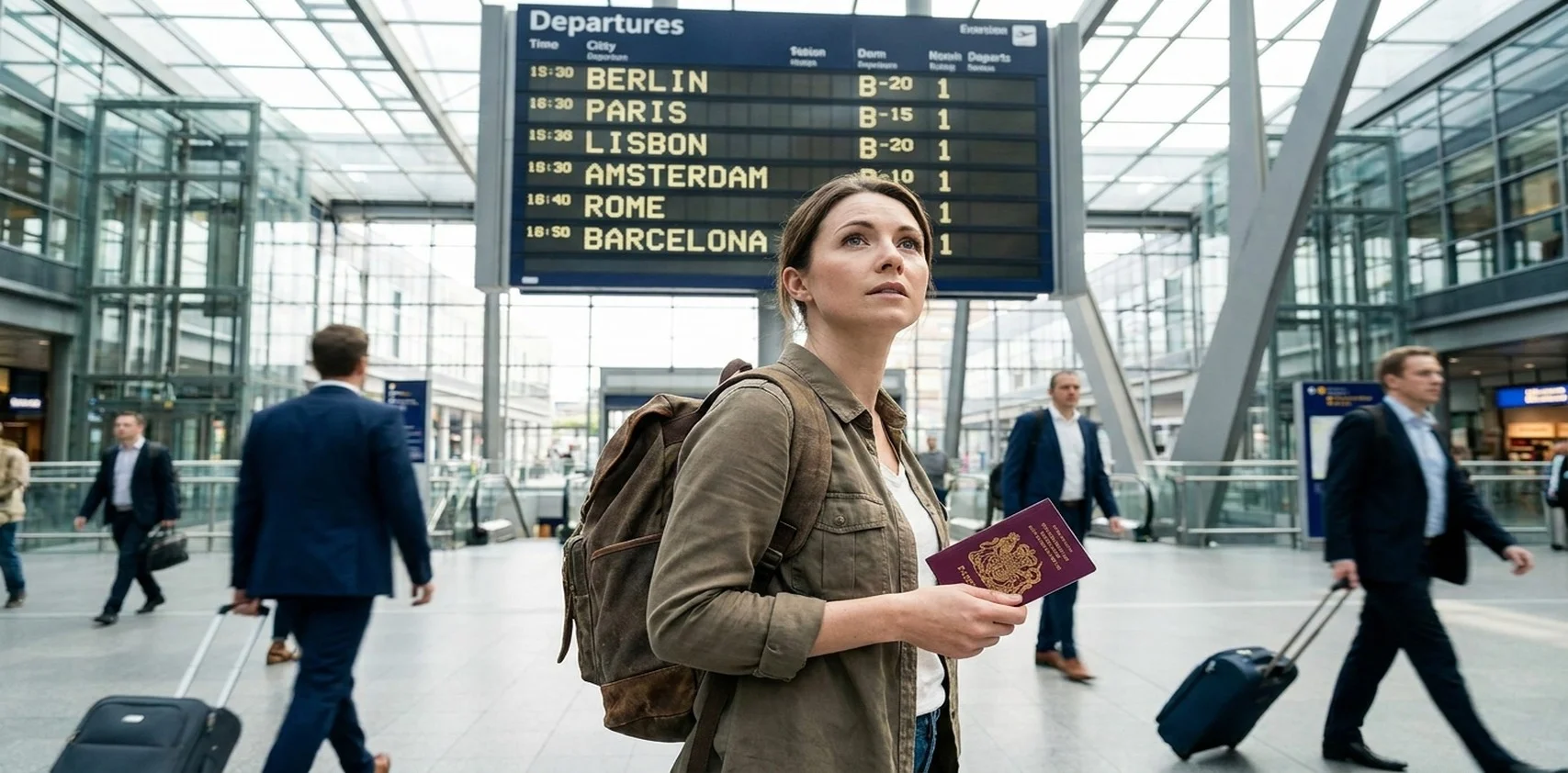
165,000 UK Nomads Flocked to Europe — Then Hit a Legal Wall
On April 8, 2026, UK job platform LiveCareer UK published a report that sent ripples through the digital nomad community: approximately 165,000 British citizens are currently living abroad as digital nomads, with the overwhelming majority based in Europe. Spain and Portugal top the list. The headline sounds like a freedom story — Brits escaping London's sky-high rents and grey skies, trading their cramped flats for sun-soaked terraces overlooking the Mediterranean, laptop in hand. But dig deeper, and this is really a story about law, taxes, and the vanishing grey zones that made this lifestyle possible in the first place. Because a significant portion of those 165,000 people are operating in legal limbo — and that limbo is disappearing fast. The Brexit Price Tag: From "Going Home" to "Entering a Foreign Country" To understand why British digital nomads face unique challenges in Europe, you have to go back to 2020. That year, the UK formally left the European Union, ending 47 years of membership. For most Brits, the most immediate impact of Brexit wasn't trade tariffs or fishing quotas — it was the loss of their right to live and work freely anywhere in the EU. Before Brexit, any British citizen could pack a bag, move to Barcelona, Lisbon, or Berlin, and start working — no visa needed. This was a fundamental EU right: Freedom of Movement. After Brexit, Brits were instantly reclassified as "third-country nationals" in the Schengen Area, subject to the 90/180-day rule: within any rolling 180-day window, they can stay for a maximum of 90 days. Overstay, and you're illegal. For tourists, 90 days is plenty. For someone trying to build a life while working remotely from a Lisbon apartment, it's a wall. EES Goes Live: The End of Grey Zones For the past few years, many British nomads played the system — hopping between Schengen and non-Schengen countries, flying to Turkey or back to the UK for a few days to "reset the clock." Technically illegal, but with entry and exit tracked through manual passport stamps, enforcement was inconsistent at best. That era ended on April 10, 2026. The EU's Entry/Exit System (EES) went live on that date. EES is a fully automated electronic border control system that replaces passport stamps with biometric data — fingerprints and facial scans — to precisely track every non-EU citizen's entry and exit. The system automatically calculates days stayed and alerts border agents when someone approaches or exceeds the 90-day limit. What this means: the old excuses — smudged stamps, disconnected databases between countries, border agents who didn't check — are gone. EES creates a single, shared database across all 29 Schengen states. Every day is counted. There's nowhere to hide. For British nomads who've been "long-term short-staying" in Europe, EES is a wake-up call: get legal, or get out. Digital Nomad Visas: Solution or New Labyrinth? In response to demand from Brits and other non-EU citizens, multiple European countries have rolled out Digital Nomad Visas (DNVs) over the past few years. These visas allow holders to legally reside and work remotely, provided their employer or clients are based outside the host country. Sounds like the perfect fix. But the devil is in the details. Spain: The Sunny Coast with a Steep Entry Fee Spain's DNV (officially the "International Remote Work Visa"), launched in 2023, requires applicants to earn at least 200% of Spain's minimum wage. In 2026, that means roughly €2,520 per month (about $2,750 USD) in provable income. Applicants also need an employment or freelance contract with a non-Spanish company, a clean criminal record, private health insurance, and proof of at least one year of remote work experience. The process typically takes 2-4 months and must be initiated from a Spanish consulate in the UK before entering Spain. The visa is valid for up to one year, renewable for up to three. But each renewal requires fresh proof of income eligibility. Portugal: An Even Higher Bar Portugal's DNV (the D8 visa) sets the bar higher — requiring monthly income of at least four times Portugal's minimum wage. With the 2026 minimum at €870, that's €3,480 per month (about $3,800 USD). For freelancers or early-stage startup employees, that's a tough threshold. Portugal demands "stable and provable" income — sporadic project fees or investment returns typically don't qualify. It's worth noting that Portugal once attracted droves of remote workers with its Non-Habitual Resident (NHR) tax regime, offering up to ten years of tax breaks. But NHR stopped accepting new applications in 2024, replaced by a much more restrictive "NHR 2.0" aimed primarily at academic researchers and high-skilled workers in specific industries. For the average digital nomad, Portugal's tax appeal has faded considerably. Croatia: The 18-Month Long Stay Croatia offers one of the EU's longest DNV durations — up to 18 months. The income threshold is relatively moderate at approximately €2,540 per month, and visa holders are exempt from Croatian income tax during their stay. The catch: the 18-month term is non-renewable. After it expires, you must leave Croatia for at least six months before reapplying. This makes it better suited for extended stays than permanent relocation. Estonia: The Digital Pioneer's One-Year Deal Estonia, the birthplace of e-Residency and a global leader in digital governance, offers a DNV with a maximum one-year stay. The income threshold is €4,500 per month (about $4,900 USD), placing it at the higher end among European countries. Estonia's advantage lies in its fully digital administrative infrastructure — visa applications, tax filings, and company registration can all be handled online. But one year still means this isn't a long-term solution. The Bigger Picture Greece, Malta, Hungary, Romania, Latvia, Iceland, Norway, and others have also launched their own DNV programs with varying terms. But the core problem is the same: every country has its own income thresholds, duration limits, renewal rules, and tax obligations — and these rules keep changing. For British digital nomads, this isn't as simple as "pick a country and apply." It's navigating a legal jigsaw puzzle made up of 30-plus countries, where the pieces get reshuffled every few months. The Tax Trap: Leaving the UK Doesn't Mean Leaving UK Taxes If visas are the visible obstacle, taxes are the hidden trap. Many British nomads naively assume that being physically outside the UK means they owe no UK taxes. This is a dangerous misconception. HM Revenue & Customs (HMRC) uses a complex framework called the Statutory Residence Test (SRT) to determine whether someone remains a UK tax resident. The SRT doesn't just count days in the UK — it also considers work patterns, family ties, property ownership, bank accounts, and social connections. The SRT works roughly as follows: Automatic Overseas Tests: If you spend no more than 15 days in the UK during a tax year (April 6 to April 5) while having been UK-resident for the previous three years — or no more than 45 days if you were non-resident for all three prior years — you're automatically non-resident. Automatic UK Tests: If you spend more than 183 days in the UK, or have a sole home in the UK that you use for more than 30 days, you're automatically resident. Sufficient Ties Test: If neither automatic test applies, HMRC examines your "tie factors" — family (spouse or minor children in the UK), accommodation (accessible UK housing), work (substantive UK employment), the 90-day rule (spending 90+ days in the UK in either of the two preceding tax years), and country tie (more days in the UK than in any other single country). The more ties you have, the fewer days it takes to be classified as UK-resident. In practice, this means a Brit working remotely from Lisbon who still owns a London flat, whose spouse lives in Manchester, and who occasionally flies back for client meetings — even if they spend only 60 days a year in the UK — could still be deemed a UK tax resident by HMRC. Then there's the double taxation risk. If you hold a Portuguese DNV and live there for more than 183 days, Portugal will also consider you a tax resident. You could simultaneously be a tax resident in both countries. While the UK has Double Taxation Agreements with most European nations to prevent the same income from being taxed twice, these treaties are complex and typically require professional tax advice to navigate properly. And cross-border tax consultation isn't cheap — often an unaffordable luxury for freelance nomads. A Counterintuitive Conclusion: Brexit Fueled the Nomad Boom While Making It Harder The LiveCareer UK report reveals a profound irony: Brexit, in many ways, created the British digital nomad boom. After losing the right to work freely in the EU, many Brits became more aggressive about pursuing remote work opportunities. The logic was simple — if you can't legally work in a Barcelona office, why not work remotely from a Barcelona café? COVID-19 accelerated the trend. Remote work shifted from exception to norm, making more Brits realize: if the job doesn't require an office, why live in one of Europe's most expensive cities? But the legal foundation of this nomad wave is fragile. Brexit stripped Brits of automatic EU work rights. The 90/180-day rule caps their stays. EES eliminates the grey zones. And while DNVs offer legal pathways, each comes with its own thresholds and complications. In other words, Brexit made more Brits want to be digital nomads while simultaneously making it harder to be one legally. The Real Spectrum Behind 165,000 The 165,000 figure in the LiveCareer UK report encompasses a diverse range of situations: Fully compliant: Holding a proper DNV or work visa, correctly filing taxes, carrying local health insurance. Typically higher-earning tech workers or seasoned freelancers. Semi-compliant: Entering on tourist status and working remotely within the 90-day window. Technically, most Schengen tourist entries don't permit "work" — but if you're working for a UK employer without generating local income, this grey area has been tolerated to varying degrees. Non-compliant: Overstaying, failing to report taxes, or both. Risks include entry bans, fines, back taxes, and — post-EES — automatic flagging by the system. Retired or semi-retired: Living on pensions in lower-cost European countries. Visa issues are simpler, but tax complications remain. The report doesn't break down the proportions. But community observation suggests the "semi-compliant" category is the largest — and these are the people most disrupted by EES. Europe's Calculus: Using Visas to Attract Talent From the European perspective, British digital nomads are ideal economic contributors — they bring foreign spending, don't compete for local jobs, are typically well-educated, and have strong purchasing power. This is precisely why more countries keep launching DNV programs. Spain's calculation is particularly shrewd. As the top destination for British nomads, it benefits directly: these people rent apartments, dine at restaurants, shop at supermarkets, hire cleaners. Their spending flows straight into the local economy without taking a single Spanish job. In Southern European countries grappling with aging populations and high youth unemployment, this is a remarkably good deal. Portugal has shifted strategy. After ending the NHR tax break, it appears to be moving from quantity to quality — using higher income thresholds to select for higher-spending nomads. Rising rent backlash from Lisbon locals is part of the context behind this policy shift. Smaller countries like Croatia and Estonia use DNVs more aggressively as nation-branding tools. Croatia's Adriatic coastline and Estonia's tech ecosystem have both gained international visibility through their nomad visa programs. The trend is clear: more European countries will launch or refine DNV programs, and Brits — as Europe's largest pool of non-EU English-speaking talent — will be a primary target audience. The Price of Freedom The story of 165,000 Brits working remotely across Europe exposes a core contradiction of modern digital nomadism: technology allows work to happen anywhere, but the law still ties people to borders. Visa systems assume people belong to one country. Tax systems assume income is earned in one place. Social security systems assume people settle somewhere. The digital nomad lifestyle challenges every one of these assumptions. Post-Brexit Brits experience this contradiction more acutely than perhaps any other group. They once had the right to move freely across Europe, lost it, and then tried to reclaim a version of that freedom through technology and remote work — only to discover that legal walls are harder to cross than geographic distances. This isn't a problem that technology will solve on its own. It requires a fundamental update to international legal frameworks — recognizing that digital nomads are neither tourists nor immigrants, but an entirely new category of cross-border workers who need entirely new legal structures. Until that day comes, 165,000 British nomads — and millions of others worldwide in similar positions — will continue walking the tightrope between freedom and compliance. Some will find legal paths. Some will retreat home. Some will keep operating in the grey zones until the EES red light flashes. That is the price of freedom.
April 28, 2026