


The Rise of the Slomad: Why 2026's Nomads Are Staying Put
May 22, 2026
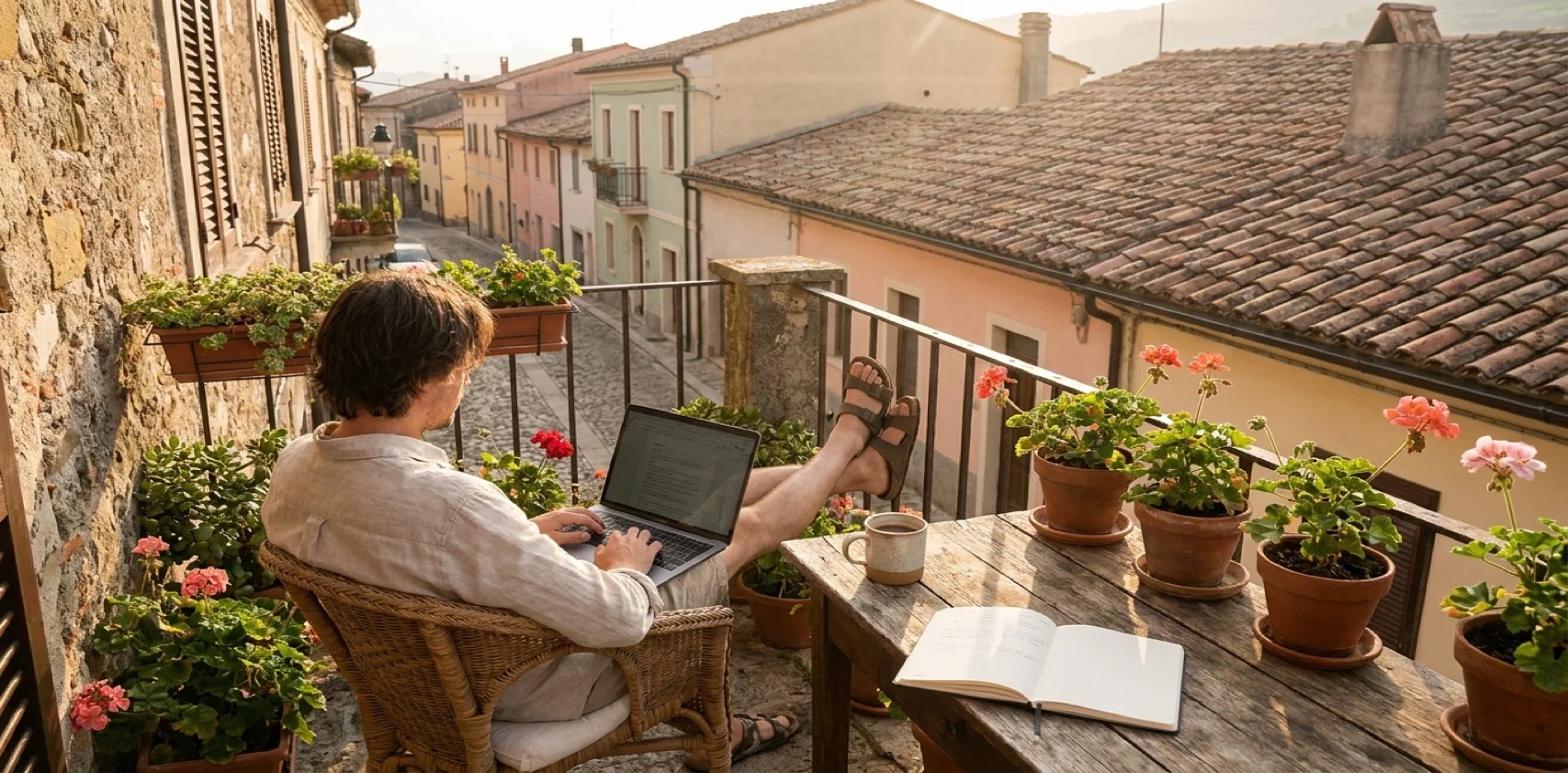
AI Generated - Editorial Use
Slomads — slow nomads — are replacing the backpacker-style, city-hopping lifestyle as the dominant mode of remote work abroad. 2026 data shows average stays extending from 3 weeks to 3+ months, driven by burnout backlash, loosening visa policies, and a collective realization that nomadism is growing up. Euronews calls it 'structured wandering': proper visas, local healthcare, even community involvement. This article examines the data behind the trend and why visiting three countries a year beats twelve.
Three years ago, the quintessential digital nomad image looked something like this: a laptop, a carry-on, a new city every three weeks, and an Instagram feed perpetually refreshed with unfamiliar coffee shops and golden-hour sunsets. Movement was the point. The number of countries you'd visited was a proxy for how fully you were living.
In 2026, that narrative is being quietly rewritten. A growing share of the world's remote workers aren't chasing the next boarding pass — they're settling into apartments for three months, six months, a year or more. They have a name: slomads. Short for slow nomads. And they're reshaping what it means to live a location-independent life.
This isn't the death of digital nomadism. It's its maturation.
What the Data Shows
MBO Partners' 2025 Digital Nomad Trends Report found that 18.5 million American workers currently identify as digital nomads — a 153% increase since 2019. But the more telling shift isn't in total numbers. It's in how long people are staying. The report explicitly notes that nomads are "opting to stay longer at fewer destinations," a pattern it calls "slomading."
A 2025 academic conference paper puts finer numbers on the trend: 58.4% of digital nomads surveyed reported staying in a single destination for one to three months. The remainder — the slomad cohort — opt for significantly longer stays.
In February 2026, Drift Travel declared it outright: "2026 is the year of the slow-travel digital nomad." The piece describes nomads who no longer hop cities every few days but instead settle into 30-to-90-day "slowmad residencies" that allow the brain to enter the flow state required for deep, complex work.
By April 2026, Euronews reported that approximately 165,000 UK professionals had relocated abroad to work remotely, with the "slomad trend" — favoring longer stays and a slower pace of life — identified as a primary driver.
The pattern is unmistakable. Slomading isn't a fringe preference. It's a structural shift in how mainstream nomadism is practiced.
Why They're Staying
Burnout Is Real
The hidden cost of constant relocation is enormous. Every move involves finding accommodation, verifying internet quality, adjusting to a new time zone, rebuilding daily routines, and handling the inevitable logistics failures. When this cycle repeats every three weeks, the cumulative cognitive load erodes both productivity and creative capacity.
A Business Insider profile from October 2025 documented one nomad's transition: rather than quitting the lifestyle entirely, she learned to slow down. The article identified one of the most commonly cited contributors to nomad burnout as "the constant challenge of finding reliable internet" — a problem that largely vanishes under the slomad model.
When you know you'll be in the same place for three months, you don't spend every Monday morning testing a new Wi-Fi password.
Visa Policies Are Catching Up
The slomad trend has coincided with a structural upgrade in global digital nomad visa offerings. In the past, most countries offered 90-day visa-free entry or short-term tourist visas, forcing nomads into periodic "visa runs." Now, an increasing number of nations are rolling out year-long or longer permits specifically designed for remote workers.
Croatia extended its digital nomad permit to 18 months in 2025 and exempts holders from local income tax, with a minimum monthly income threshold of approximately €3,295. Spain's digital nomad visa enables long-term stays with a €2,700 monthly income requirement and access to a favorable non-resident tax regime. Portugal's D8 visa requires €3,480 per month and grants residence in hubs like Lisbon and Madeira. Estonia offers its e-Residency program with a 22% tax rate and nearly all government services available online.
These visas aren't just legal documents. They're signals: these countries are serious about attracting remote workers for the long haul, not just transient tourism spending.
Community Can't Be Built in Three Weeks
Nomads who move constantly face a paradox: they crave connection but never give themselves enough time to form it. Every new city means finding a coworking space, meeting people, navigating local norms — only to leave before any of it deepens into genuine relationship.
MBO Partners' report notes that slomading "fosters a more active social life, deeper learning about local cultures, and reduces the loneliness that is common among digital nomads."
This isn't just a psychological benefit. For freelancers and entrepreneurs, local community means potential collaborators, clients, and the kind of trust that can't be replicated over Zoom. Cities like Barcelona, Chiang Mai, and Lisbon became nomad hubs not just because of their weather or cost of living — but because they developed multi-year community ecosystems.
You have to stay long enough to become part of the ecosystem, rather than just passing through it.
What Slomad Life Actually Looks Like
The daily reality of a slomad differs fundamentally from the classic nomad experience.
Home isn't a hotel. Slomads typically rent apartments on three-month to one-year leases, not nightly Airbnbs. This means a real kitchen, a dedicated workspace, and the kind of routines — greeting neighbors, knowing the mail carrier — that come with actual residency. Monthly costs are often a third to half of what short-term rentals command.
Work rhythms resemble those of settled professionals. Without the need to re-adapt to a new environment every few weeks, continuity and depth of work improve markedly. Many slomads report that their longest, most ambitious projects were completed during extended stays — work they couldn't have sustained while constantly on the move.
Travel becomes a weekend activity, not a lifestyle. This is a subtle but important distinction. Slomads still travel — but travel is exploration radiating outward from a fixed base, not an endless migration. A weekend trip to a nearby town, a holiday in a neighboring country — but home is somewhere specific.
Local integration goes deeper. After six months in one place, you know which market opens on Wednesdays, which café has the best seats after 3 PM, and the name of the barber three blocks away. These details seem trivial, but they're the difference between inhabiting a place and merely passing through it.
Pushing Back on the Instagram Nomad
The slomad trend is, in part, a reckoning with the aesthetic that dominated nomad culture for the past decade.
Social media constructed an image of the ideal digital nomad as perpetually in motion — always somewhere new, always documenting, always radiating the effortless cool of location independence. That narrative drew millions of young professionals into the lifestyle. It also left many of them feeling hollow after three to six months.
The reality is that constant movement doesn't create meaning by itself. The novelty of a new city fades. And the problems you carry with you — career plateaus, relationship difficulties, questions of identity — don't resolve themselves just because you changed time zones.
The slomad model proposes a different value equation: freedom isn't measured by how far you can go, but by your ability to build a quality life wherever you are. It's a more mature, more sustainable philosophy of nomadism.
How to Transition from Fast to Slow
For nomads considering a deceleration, some practical guidance:
Start with a one-to-three-month trial stay. There's no need to commit to six months immediately. Pick a city that interests you, find an apartment with reliable internet, and give yourself a month to feel the rhythm. If it clicks, extend.
Choose cities with established nomad infrastructure. For a first slomad experience, existing community scaffolding — coworking spaces, regular meetups, online groups — significantly lowers the barrier to integration. Lisbon, Barcelona, Chiang Mai, Medellín, and Budapest are all proven options.
Research visa and tax implications. Longer stays introduce more complex regulatory considerations. Understand whether your target country offers a digital nomad visa, whether staying beyond 183 days triggers tax residency, and how your home country treats foreign-sourced income.
Systematize your relocation process. Build a reusable moving checklist: accommodation preferences, essential gear packing list, first-three-days task list for each new location. When relocation becomes systematic, transitions are smoother even when they happen less frequently.
Leave room for the unplanned. The core of slomad life isn't about doing nothing — it's about having enough slack in your schedule to accommodate the unexpected. A new friend's invitation. A local class you stumble into. A creative idea that needs three consecutive days of focus. Fast-paced nomad life rarely has room for these.
Not Stopping — Redefining Movement
The deeper significance of the slomad trend isn't that nomads have lost their appetite for travel. It's that their definition of freedom is evolving.
The first generation of digital nomads proved their freedom through geographic movement. The second generation — the slomads — is discovering that a more fundamental expression of freedom is the ability to choose to stay, rather than being compelled to move.
When a growing share of 18.5 million American nomads opt for slower rhythms, when governments roll out 18-month visas, when academic research and industry reports converge on the same conclusion — this isn't a passing fad. It's digital nomadism growing up.
The coolest nomad of 2026 might be the one who's lived in the same apartment for eight months, knows every shopkeeper on the corner, and spends weekends hiking with local friends.
Not because they couldn't keep moving. Because they finally found a reason to stay.
This content is protected by copyright. Please respect the author's work and do not copy or distribute without permission.

數位遊牧編輯群 Digital Nomad Editor Group
Digital Nomad is a knowledge sharing platform specially designed for “those who dream to become digital nomads.” We share the latest news and industry trends related to digital nomadism, as well as introduce essential skills and knowledge needed for freelancers, remote workers, etc. Our goal is to help you connect with fellow digital nomads!
