


All Posts
127 posts
Sort by Most Viewed
165,000 UK Nomads Flocked to Europe — Then Hit a Legal Wall
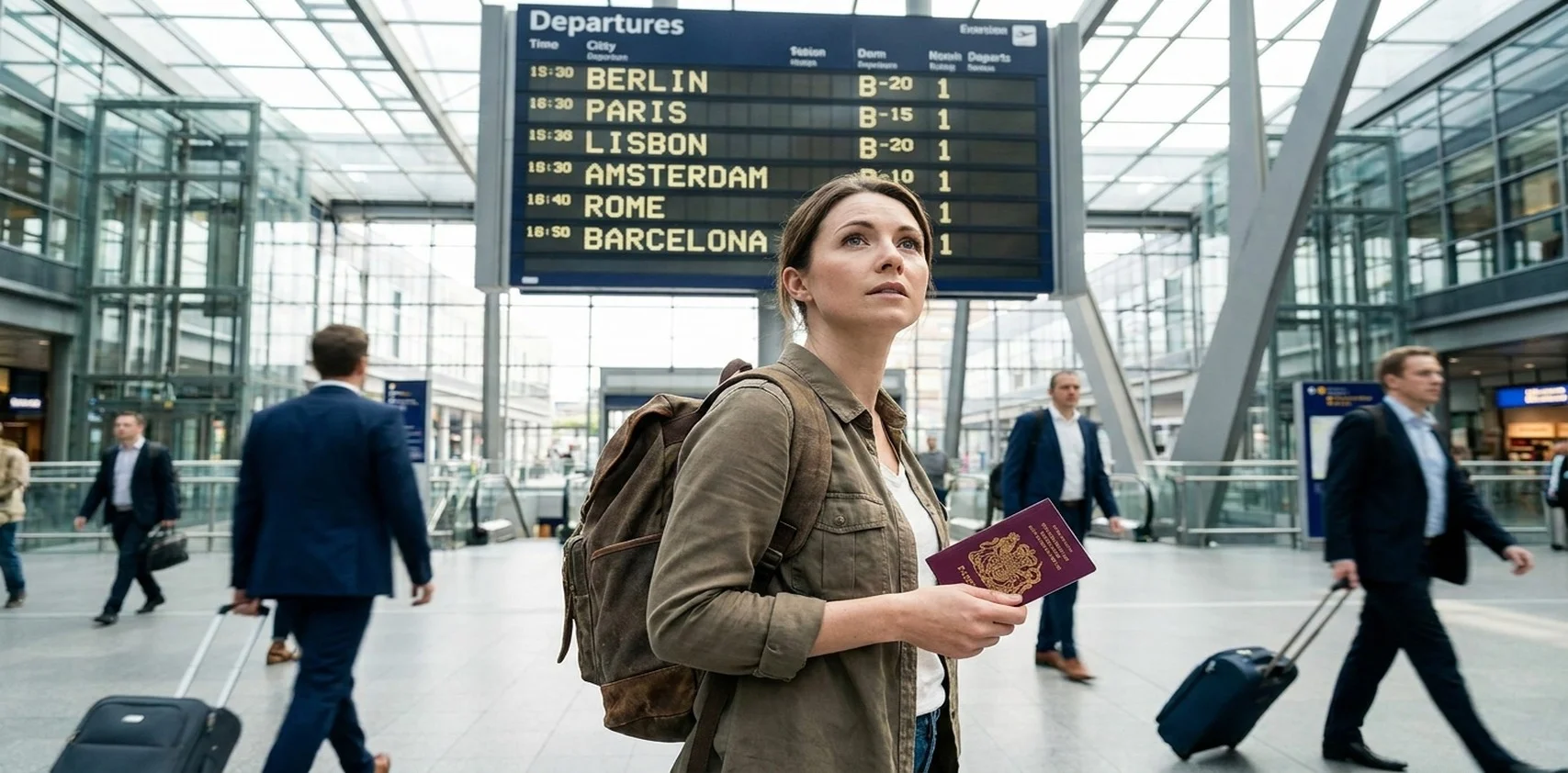
On April 8, 2026, UK job platform LiveCareer UK published a report that sent ripples through the digital nomad community: approximately 165,000 British citizens are currently living abroad as digital nomads, with the overwhelming majority based in Europe. Spain and Portugal top the list. The headline sounds like a freedom story — Brits escaping London's sky-high rents and grey skies, trading their cramped flats for sun-soaked terraces overlooking the Mediterranean, laptop in hand. But dig deeper, and this is really a story about law, taxes, and the vanishing grey zones that made this lifestyle possible in the first place. Because a significant portion of those 165,000 people are operating in legal limbo — and that limbo is disappearing fast. The Brexit Price Tag: From "Going Home" to "Entering a Foreign Country" To understand why British digital nomads face unique challenges in Europe, you have to go back to 2020. That year, the UK formally left the European Union, ending 47 years of membership. For most Brits, the most immediate impact of Brexit wasn't trade tariffs or fishing quotas — it was the loss of their right to live and work freely anywhere in the EU. Before Brexit, any British citizen could pack a bag, move to Barcelona, Lisbon, or Berlin, and start working — no visa needed. This was a fundamental EU right: Freedom of Movement. After Brexit, Brits were instantly reclassified as "third-country nationals" in the Schengen Area, subject to the 90/180-day rule: within any rolling 180-day window, they can stay for a maximum of 90 days. Overstay, and you're illegal. For tourists, 90 days is plenty. For someone trying to build a life while working remotely from a Lisbon apartment, it's a wall. EES Goes Live: The End of Grey Zones For the past few years, many British nomads played the system — hopping between Schengen and non-Schengen countries, flying to Turkey or back to the UK for a few days to "reset the clock." Technically illegal, but with entry and exit tracked through manual passport stamps, enforcement was inconsistent at best. That era ended on April 10, 2026. The EU's Entry/Exit System (EES) went live on that date. EES is a fully automated electronic border control system that replaces passport stamps with biometric data — fingerprints and facial scans — to precisely track every non-EU citizen's entry and exit. The system automatically calculates days stayed and alerts border agents when someone approaches or exceeds the 90-day limit. What this means: the old excuses — smudged stamps, disconnected databases between countries, border agents who didn't check — are gone. EES creates a single, shared database across all 29 Schengen states. Every day is counted. There's nowhere to hide. For British nomads who've been "long-term short-staying" in Europe, EES is a wake-up call: get legal, or get out. Digital Nomad Visas: Solution or New Labyrinth? In response to demand from Brits and other non-EU citizens, multiple European countries have rolled out Digital Nomad Visas (DNVs) over the past few years. These visas allow holders to legally reside and work remotely, provided their employer or clients are based outside the host country. Sounds like the perfect fix. But the devil is in the details. Spain: The Sunny Coast with a Steep Entry Fee Spain's DNV (officially the "International Remote Work Visa"), launched in 2023, requires applicants to earn at least 200% of Spain's minimum wage. In 2026, that means roughly €2,520 per month (about $2,750 USD) in provable income. Applicants also need an employment or freelance contract with a non-Spanish company, a clean criminal record, private health insurance, and proof of at least one year of remote work experience. The process typically takes 2-4 months and must be initiated from a Spanish consulate in the UK before entering Spain. The visa is valid for up to one year, renewable for up to three. But each renewal requires fresh proof of income eligibility. Portugal: An Even Higher Bar Portugal's DNV (the D8 visa) sets the bar higher — requiring monthly income of at least four times Portugal's minimum wage. With the 2026 minimum at €870, that's €3,480 per month (about $3,800 USD). For freelancers or early-stage startup employees, that's a tough threshold. Portugal demands "stable and provable" income — sporadic project fees or investment returns typically don't qualify. It's worth noting that Portugal once attracted droves of remote workers with its Non-Habitual Resident (NHR) tax regime, offering up to ten years of tax breaks. But NHR stopped accepting new applications in 2024, replaced by a much more restrictive "NHR 2.0" aimed primarily at academic researchers and high-skilled workers in specific industries. For the average digital nomad, Portugal's tax appeal has faded considerably. Croatia: The 18-Month Long Stay Croatia offers one of the EU's longest DNV durations — up to 18 months. The income threshold is relatively moderate at approximately €2,540 per month, and visa holders are exempt from Croatian income tax during their stay. The catch: the 18-month term is non-renewable. After it expires, you must leave Croatia for at least six months before reapplying. This makes it better suited for extended stays than permanent relocation. Estonia: The Digital Pioneer's One-Year Deal Estonia, the birthplace of e-Residency and a global leader in digital governance, offers a DNV with a maximum one-year stay. The income threshold is €4,500 per month (about $4,900 USD), placing it at the higher end among European countries. Estonia's advantage lies in its fully digital administrative infrastructure — visa applications, tax filings, and company registration can all be handled online. But one year still means this isn't a long-term solution. The Bigger Picture Greece, Malta, Hungary, Romania, Latvia, Iceland, Norway, and others have also launched their own DNV programs with varying terms. But the core problem is the same: every country has its own income thresholds, duration limits, renewal rules, and tax obligations — and these rules keep changing. For British digital nomads, this isn't as simple as "pick a country and apply." It's navigating a legal jigsaw puzzle made up of 30-plus countries, where the pieces get reshuffled every few months. The Tax Trap: Leaving the UK Doesn't Mean Leaving UK Taxes If visas are the visible obstacle, taxes are the hidden trap. Many British nomads naively assume that being physically outside the UK means they owe no UK taxes. This is a dangerous misconception. HM Revenue & Customs (HMRC) uses a complex framework called the Statutory Residence Test (SRT) to determine whether someone remains a UK tax resident. The SRT doesn't just count days in the UK — it also considers work patterns, family ties, property ownership, bank accounts, and social connections. The SRT works roughly as follows: Automatic Overseas Tests: If you spend no more than 15 days in the UK during a tax year (April 6 to April 5) while having been UK-resident for the previous three years — or no more than 45 days if you were non-resident for all three prior years — you're automatically non-resident. Automatic UK Tests: If you spend more than 183 days in the UK, or have a sole home in the UK that you use for more than 30 days, you're automatically resident. Sufficient Ties Test: If neither automatic test applies, HMRC examines your "tie factors" — family (spouse or minor children in the UK), accommodation (accessible UK housing), work (substantive UK employment), the 90-day rule (spending 90+ days in the UK in either of the two preceding tax years), and country tie (more days in the UK than in any other single country). The more ties you have, the fewer days it takes to be classified as UK-resident. In practice, this means a Brit working remotely from Lisbon who still owns a London flat, whose spouse lives in Manchester, and who occasionally flies back for client meetings — even if they spend only 60 days a year in the UK — could still be deemed a UK tax resident by HMRC. Then there's the double taxation risk. If you hold a Portuguese DNV and live there for more than 183 days, Portugal will also consider you a tax resident. You could simultaneously be a tax resident in both countries. While the UK has Double Taxation Agreements with most European nations to prevent the same income from being taxed twice, these treaties are complex and typically require professional tax advice to navigate properly. And cross-border tax consultation isn't cheap — often an unaffordable luxury for freelance nomads. A Counterintuitive Conclusion: Brexit Fueled the Nomad Boom While Making It Harder The LiveCareer UK report reveals a profound irony: Brexit, in many ways, created the British digital nomad boom. After losing the right to work freely in the EU, many Brits became more aggressive about pursuing remote work opportunities. The logic was simple — if you can't legally work in a Barcelona office, why not work remotely from a Barcelona café? COVID-19 accelerated the trend. Remote work shifted from exception to norm, making more Brits realize: if the job doesn't require an office, why live in one of Europe's most expensive cities? But the legal foundation of this nomad wave is fragile. Brexit stripped Brits of automatic EU work rights. The 90/180-day rule caps their stays. EES eliminates the grey zones. And while DNVs offer legal pathways, each comes with its own thresholds and complications. In other words, Brexit made more Brits want to be digital nomads while simultaneously making it harder to be one legally. The Real Spectrum Behind 165,000 The 165,000 figure in the LiveCareer UK report encompasses a diverse range of situations: Fully compliant: Holding a proper DNV or work visa, correctly filing taxes, carrying local health insurance. Typically higher-earning tech workers or seasoned freelancers. Semi-compliant: Entering on tourist status and working remotely within the 90-day window. Technically, most Schengen tourist entries don't permit "work" — but if you're working for a UK employer without generating local income, this grey area has been tolerated to varying degrees. Non-compliant: Overstaying, failing to report taxes, or both. Risks include entry bans, fines, back taxes, and — post-EES — automatic flagging by the system. Retired or semi-retired: Living on pensions in lower-cost European countries. Visa issues are simpler, but tax complications remain. The report doesn't break down the proportions. But community observation suggests the "semi-compliant" category is the largest — and these are the people most disrupted by EES. Europe's Calculus: Using Visas to Attract Talent From the European perspective, British digital nomads are ideal economic contributors — they bring foreign spending, don't compete for local jobs, are typically well-educated, and have strong purchasing power. This is precisely why more countries keep launching DNV programs. Spain's calculation is particularly shrewd. As the top destination for British nomads, it benefits directly: these people rent apartments, dine at restaurants, shop at supermarkets, hire cleaners. Their spending flows straight into the local economy without taking a single Spanish job. In Southern European countries grappling with aging populations and high youth unemployment, this is a remarkably good deal. Portugal has shifted strategy. After ending the NHR tax break, it appears to be moving from quantity to quality — using higher income thresholds to select for higher-spending nomads. Rising rent backlash from Lisbon locals is part of the context behind this policy shift. Smaller countries like Croatia and Estonia use DNVs more aggressively as nation-branding tools. Croatia's Adriatic coastline and Estonia's tech ecosystem have both gained international visibility through their nomad visa programs. The trend is clear: more European countries will launch or refine DNV programs, and Brits — as Europe's largest pool of non-EU English-speaking talent — will be a primary target audience. The Price of Freedom The story of 165,000 Brits working remotely across Europe exposes a core contradiction of modern digital nomadism: technology allows work to happen anywhere, but the law still ties people to borders. Visa systems assume people belong to one country. Tax systems assume income is earned in one place. Social security systems assume people settle somewhere. The digital nomad lifestyle challenges every one of these assumptions. Post-Brexit Brits experience this contradiction more acutely than perhaps any other group. They once had the right to move freely across Europe, lost it, and then tried to reclaim a version of that freedom through technology and remote work — only to discover that legal walls are harder to cross than geographic distances. This isn't a problem that technology will solve on its own. It requires a fundamental update to international legal frameworks — recognizing that digital nomads are neither tourists nor immigrants, but an entirely new category of cross-border workers who need entirely new legal structures. Until that day comes, 165,000 British nomads — and millions of others worldwide in similar positions — will continue walking the tightrope between freedom and compliance. Some will find legal paths. Some will retreat home. Some will keep operating in the grey zones until the EES red light flashes. That is the price of freedom.
April 28, 2026

"I Want to Quit My Job and Go Nomad": A Decision Checklist for the Clear-Headed
Jess is 32, a product manager at a mid-size tech company, five years in. Her savings could cover a full year without work. Her boyfriend is supportive. Her project management skills translate perfectly to remote freelancing. On paper, she is the ideal candidate. She has been following digital nomad accounts for months, even building a spreadsheet that breaks her projected monthly expenses down to the dollar. Southeast Asia route, roughly $1,200 a month. It all adds up. And yet, eight months later, she still has not handed in her resignation. When asked what was holding her back, she thought for a long time before answering: "I can't explain where I'd be going. Not geographically. Directionally. I know I want to leave where I am, but I'm not sure if nomading is the answer or just a photogenic way to run away." That single sentence captures a problem most aspiring nomads never articulate: the question "Should I quit my job to go nomad?" is not one question. It is at least six, crammed together and disguised as a binary choice. Answering them all at once is like trying to unlock six different doors with one key. You Are Not Asking One Question. You Are Asking Six. Pull the question apart, and here is what falls out: First: Do I want to leave this specific job? That is a satisfaction question. Second: Am I willing to give up a stable income? That is a financial risk-tolerance question. Third: Do I want to change my lifestyle? That is a preference question. Fourth: Am I ready to leave my current social circle? That is an interpersonal-dependency question. Fifth: Can I handle my family's skepticism? That is a relationship-management question. Sixth: Can I maintain work output while moving? That is a question about how much professional performance depends on environment. Each of these has its own answer and its own evaluation method. A person might be deeply unhappy at work (question one says "leave") yet genuinely need the social structure of an office (question four says "stay"). Finances might be rock-solid (question two, no issue) while work skills depend heavily on in-person team dynamics (question six, big issue). When the six answers contradict each other, the brain translates the conflict into "I'm not ready" or "I'm not brave enough." But the real problem is not courage. It is a framework too blunt for a question this nuanced. The rest of this article will break the mega-question into pieces that can be evaluated separately. By the end, the answer may not be "quit" or "stay" but a third path that was not visible before. One-Way Door or Two-Way Door? Know Which One You Are Pushing In his 1997 letter to Amazon shareholders, Jeff Bezos introduced a framework that is still widely cited: every decision is either a one-way door or a two-way door. One-way doors lock behind you. Selling a home, forfeiting a position that cannot be reclaimed, signing an irrevocable contract. These demand caution because the cost of error is enormous. Two-way doors let you walk back through. Try it, look around, and return if it does not work. These should be made quickly and boldly because the cost of hesitation exceeds the cost of a mistake. Most people classify "quitting to go nomad" as a one-way door: once you leave, there is no going back. But is that really the case? Look closer. "Leaving a specific role" can indeed be close to a one-way door, especially in a company where promotion slots are fiercely contested. Leave for a year and the seat may be occupied. But "experiencing the nomad lifestyle" is entirely a two-way door. Try it for two months; if it does not work, come home. The trouble is that people treat a hybrid decision as a pure one-way door and freeze. And freezing has its own cost. Psychologist Barry Schwartz argued in The Paradox of Choice (2004) that prolonged decision anxiety drains cognitive resources, degrading performance across every other area of life. Spending an hour a day agonizing over resignation does not just waste an hour. It drags down everything outside that hour as well. The first step, then, is not to decide. It is to separate the hybrid decision into its one-way and two-way components. Evaluate the one-way parts carefully (the next section uses opportunity-cost analysis). Test the two-way parts quickly (that is the MVN concept covered later). The Full Opportunity-Cost Calculation: You Are Giving Up More Than a Salary When most people consider quitting, the math in their head is simple: monthly salary times months equals savings needed. But that equation omits more than it captures. Consider a concrete scenario. Kai, 30, software engineer at a mid-size startup, three years of tenure. His explicit compensation: a monthly salary of roughly $5,800 (pre-tax), a year-end bonus of two months' pay, and a performance bonus bringing annual cash compensation to about $88,000. Most people stop here. "I'd lose $88K a year, but I have $100K in savings. I'm fine." What about the invisible costs? Promotion trajectory disruption. Kai is two years away from a potential promotion to Tech Lead, which would push his compensation above $105,000. Leave for a year, and someone else may fill the slot. Promotion is not a queue. It depends on an opening appearing at the right moment, the candidate being present, and the manager remembering their work. According to LinkedIn's 2024 Workforce Report, job seekers with a career gap of more than six months need an average of 7.3 months after returning to match their pre-departure salary; gaps exceeding one year stretch that recovery period to 14 months. Retirement savings gap. In many countries, employer-matched retirement contributions stop the moment employment ends. Even a single year of missed contributions, compounded at 5% annually over 30 years, can grow into a significant shortfall. Loss of group insurance. Company-provided life, accident, and health insurance typically ends upon resignation. Purchasing equivalent individual coverage costs substantially more, and adding international health insurance (a non-negotiable for nomads) pushes annual premiums higher still. Social-network dilution. Three years of colleague relationships, cross-departmental connections, and client trust do not vanish overnight, but they fade. A year later, project names are unfamiliar, meeting references go over the head, lunch regulars have rotated twice. Internal referrals are among the most effective job-search channels. As networks cool, that channel narrows. Industry knowledge shelf-life. In software, the technology stack shifts visibly every 18 months. A year away means catching up on toolchains, frameworks, and best practices, and the ramp-up period itself represents reduced productivity. Add it all up, and Kai's real cost of one year away is not $88,000. It is closer to $130,000, possibly more. This exercise is not meant to scare anyone into staying. Its purpose is clarity. A number calculated on impulse breeds anxiety by month three of nomading. A number calculated with precision breeds calm at the same moment, because the decision was made with eyes open. The Reversibility Spectrum: It Is Not Leave or Stay. It Is How Many Doors You Open. Even the near-one-way-door components of this decision vary in their degree of irreversibility. Between "fully reversible" and "fully irreversible" lies an entire spectrum. Most people see only two options: stay (take the elevator) or quit cold (jump). But between those extremes are several intermediate stations, each with a different risk profile. Tier One: Unpaid Leave Lowest risk, highest reversibility. The position is held; in some companies, seniority continues to accrue. Not every employer offers this formally, but many will consider it if the request is framed as a business proposition. One creative director at an advertising agency spent three months negotiating a six-month leave by offering to return with an insight report on the Southeast Asian market. The company saw it as an investment, not a vacation. The point is not that every negotiation succeeds. It is that many people skip straight to "I have to quit" without ever asking. And without asking, there is no way to know how much flexibility exists. Tier Two: Contract or Part-Time Conversion Converting from full-time to a contractor or part-time arrangement preserves the company relationship and some income, though benefits typically shrink and renewal power shifts to the employer. One UI/UX designer negotiated a contract for 80 hours per month at 60% of her salary, location-independent. She used the remaining time to build a freelance client base. After six months of overlap, she confirmed she could sustain output without an office and then went fully independent. The beauty of this approach is its gradualism. It is not a one-night transformation from employee to freelancer but a transition period that keeps anxiety low and decisions rational. Tier Three: Negotiate a Boomerang Clause A boomerang clause is not a legal term but a mutual understanding: if the departing employee wants to return within a defined period, the company will prioritize them. According to Workday's 2024 workforce-trends report, roughly 28% of new hires globally are boomerang employees, nearly double the figure from five years earlier. Whether that door stays ajar depends on how one leaves. A thorough handover, no public criticism, occasional help for former colleagues, and a holiday greeting now and then all add up. The manner of departure often matters more than the decision to depart. Tier Four: Quitting Cold All safety nets removed. Straight off the edge. This is not inherently wrong. Some people need to burn the bridge behind them to summon full effort. But it is the highest-risk option on the spectrum, with the highest cost of return and the greatest uncertainty. If this is the chosen path, at least verify one thing: the motivation is running toward something, not running from something. A simple test: if the current job suddenly improved (better manager, better pay, better role), would the desire to go nomad remain? If yes, the pull is probably toward nomading. If no, it is probably away from the job. Escape-driven cold quits rarely survive the three-month honeymoon. Psychologist Tal Ben-Shahar noted in Happier (2007) that the happiness boost from environmental change typically lasts three to six months before people revert to their emotional baseline. If the baseline was low before departure, it will be low again in Bali by month four. Most people treat quitting as all-or-nothing. But the spectrum offers several intermediate options worth testing first. Not charging headlong (impulsive quit), not surrendering (enduring silently), but finding a third way. MVN: Minimum Viable Nomad. Test the Water Before Diving In. The startup world has MVP: Minimum Viable Product. Build the cheapest version that can test the market. No company spends millions on a factory before validating demand. By the same logic, no one needs to quit, book a one-way ticket, and cancel a lease before discovering whether nomad life is a fit. Run an MVN (Minimum Viable Nomad) first. Element one: a two-to-four-week field test. Use annual leave to spend two to four weeks in a target city with a laptop. Not a vacation. A simulation. Work normal hours, attend normal meetings, deliver normal output. Nine a.m. at a café, laptop open. Six p.m., laptop closed, dinner. Identical to life at home, except the geography. Why at least two weeks? Because travel novelty lasts roughly 10 to 14 days. Research from Breda University of Applied Sciences in the Netherlands found that vacation happiness peaks around day eight, then begins to decline. The first two weeks are all discovery. By week three, novelty fades and real daily life appears: finding a reliable workspace, memorizing which supermarket is cheaper, handling laundry and cleaning. If week three still feels fine, nomading fits. If it feels boring and triggers an itch to move again, the attraction may be travel rather than nomading. Those are very different things. Travel is consumption. Nomading is daily life. Element two: pre-building a side income or freelance pipeline. The MVN period tests more than lifestyle. It tests revenue. If the plan involves freelancing after quitting, start landing the first gig while still employed. It does not need to be large. The point is to run the full cycle from client acquisition to payment and discover where friction hides. The imagined freelance workflow is: build a portfolio, clients appear, do the work, get paid. The real one is closer to: spend two weeks on a proposal, client ghosts, switch platforms, finally land a gig, complete it, wait three months for payment. Experiencing that gap while still drawing a salary is fundamentally different from experiencing it with only six months of savings left. Element three: the 70% threshold. Before formally resigning, side or remote income should reach at least 70% of current base pay. Why not 100%? Because nomad living costs are typically lower than a home-city baseline (especially on a Southeast Asian route), and commuting, wardrobe, and social-obligation expenses disappear. But below 70%, the margin for surprises and income volatility gets dangerously thin. Together, these three elements form an extremely low-risk test. No resignation, no lease termination, no public announcement. Just a slightly longer vacation that happens to validate several critical assumptions. The Financial Safety Net: Three Non-Negotiables "Save enough and you can leave" is the most common advice. But "enough" is almost always higher than people think. Behavioral economist Daniel Kahneman called this the planning fallacy: humans systematically underestimate future expenses and overestimate future income. The mental image is "I can live on $1,200 a month in Chiang Mai." The reality includes first-month setup costs, a sudden rent increase in month two, and a client who pays late in month three. A reliable financial safety net requires three components. All three. Not two. One: Six Months of Living Expenses (Not Survival Expenses) Nomading is not asceticism. If every coffee purchase triggers a cost-benefit analysis, productive work becomes impossible. Financial anxiety devours cognitive bandwidth and leaves no room to enjoy the lifestyle's benefits. Monthly expenses in popular Southeast Asian nomad hubs (Chiang Mai, Bali, Ho Chi Minh City) typically run $1,000 to $1,800 including several frequently overlooked items: coworking-space fees ($100 to $250 per month; Hubud in Bali charges around $180, Punspace in Chiang Mai around $120); the short-stay premium (monthly rentals cost 30 to 50 percent more than annual leases and rarely include utilities); relocation costs each time cities change (flights, transitional accommodation); visa expenses (Thailand's DTV visa requires proof of remote work; Malaysia's DE Rantau visa demands monthly income of at least $3,500); and contingencies (laptop repairs, theft, medical visits). A six-month buffer therefore lands at roughly $6,000 to $11,000 for Southeast Asia, $13,000 to $18,000 for Europe. Pre-departure costs (lease-break penalties, gear purchases) are extra. Two: A Ticket Home Not just the literal airfare. A psychological safety net. An untouchable "emergency repatriation fund" that stays in the account no matter how tight daily spending gets. Around $250 to $500 from Southeast Asia, $800 to $1,300 from Europe or the Americas. Having that return ticket on hand makes every other decision calmer. The worst-case scenario is going home, not being stranded. That assurance tangibly improves daily decision quality. Knowing retreat is always available paradoxically creates more room for risk-taking. Three: International Health Insurance The most commonly skipped item, and the one that must not be skipped. People accustomed to strong national health systems tend to forget that coverage evaporates abroad. An emergency-room visit in Thailand can cost $150 to $600. A hospital stay runs $250 per day and up. In the U.S. or Western Europe, an injury bill can easily reach five figures. One nomad who crashed a motorbike in Bangkok received a medical bill exceeding $10,000. Without insurance, that is half a year's budget gone in a single afternoon. International medical insurance runs roughly $500 to $1,500 per year. SafetyWing's basic plan costs about $45 per month and covers hospitalization, emergency care, and medical evacuation. World Nomads is pricier but broader, including sports and adventure activities. All three items. No exceptions. This is not conservatism. It is basic risk management. Take risks with life choices, not with safety nets. The Honest Psychological Checklist: What Nobody Mentions Finances and career sorted. One gate remains: psychology. Nomad life on social media looks perpetually sun-drenched. Laptop open, coconut water beside it, infinity pool or tropical garden in the background. But the reality beyond those frames rarely gets posted. Not because anyone is lying, but because the mundane bits are too boring and too unPhotogenic to share. And yet it is precisely those mundane bits that determine long-term sustainability. Loneliness arrives faster and cuts deeper than expected. In an office, it is possible to turn to a colleague at any moment and say, "Can you believe that feature request?" Lunch has company. After-work drinks happen on autopilot. These micro-interactions are pillars of emotional stability, invisible only because they are constant. Like air, noticed only when submerged. After going nomad, entire days can pass without a single face-to-face conversation. Coworking spaces are full of people wearing headphones behind invisible "do not disturb" barriers. Community meetups exist, but conversation often stays shallow: where are you from, what do you do, where are you headed. The same self-introduction repeated dozens of times, rarely reaching anything resembling genuine connection. A 2023 survey by Lonely Planet and Remote Year of 2,800 digital nomads found that 62% cited loneliness as the biggest challenge of nomad life, ahead of visa issues (48%) and unreliable internet (51%). Lunch without someone to complain to is harder than it sounds. Complaining is a social adhesive. Venting about a client or a boss with colleagues is not about solving the problem. It is about confirming that the frustration is shared. That ritual of collective venting is the most underrated psychological support in office life. After going nomad, work frustrations can only be processed alone or typed out to a distant friend. But the emotional-release gap between typing and talking face to face is enormous. A long message describing a terrible day, met with a thumbs-up emoji. The hollowness of that exchange is familiar to anyone who has lived it. Family worry is a low-grade, continuous drain. Parents may never say "don't go" outright, but they will ask: "What about your pension contributions?" "What if you get sick over there?" "When are you coming back?" Every question carries worry underneath, and every answer requires re-convincing oneself. More subtle are the unspoken concerns: an occasional message ("It's cold today, dress warm"), an unexpected call ("Is it safe where you are?"). These do not require deep replies, but they constantly remind that someone is uneasy because of a choice made. The guilt is low-dosage but perpetual, like a dripping faucet that never floods the room and never stops. Rebuilding a social circle every three months is exhausting. There is an unspoken rule in nomad communities: most friendships last only as long as the stay in a given city. Finally meet a few people worth knowing, discover a café everyone frequents, build a small daily routine. Then leave, or they leave. Three months later, a new city, back to zero. Some people thrive on this lightweight social model; constant new connections energize them. But for those who need depth, the cycle slowly drains the social battery. None of this is meant to dissuade. It is meant to ensure awareness before departure. Expected difficulties are always more manageable than surprises. When loneliness hits on a random Wednesday afternoon, someone who knew it was coming thinks, "Right on schedule," and executes a pre-planned response (attend a meetup, make a video call, sit in the communal area of a coworking space for the afternoon). Someone who did not know it was coming panics and starts questioning the entire decision. Take the Dilemma Apart. The Answer Lives in the Middle. Back to the original question. "Should I quit my job to go nomad?" Once disassembled, it is no longer a yes-or-no proposition. It becomes several independently answerable sub-questions whose combined answers often point toward a direction that was not previously visible. For example: after calculating opportunity costs, the real fear turns out to be not income loss but promotion-track derailment. The question then shifts from "Should I quit?" to "Is there an arrangement that gets me out of the office without taking me off the promotion track?" A contract conversion, a remote-work agreement, an overseas assignment, or even a cross-border project proposal all become potential solutions. Or: after completing an MVN, the realization is that full-time nomading is not the goal. The goal is simply "not being trapped at the same desk every day." The solution might not be quitting but finding a company with a remote policy and scheduling two or three month-long workations per year. Or: after working through the psychological checklist, the deepest concern turns out to be family reaction. The first step might not be preparing to quit but taking a parent on a short trip to the target city, letting them see firsthand that it is not the dangerous wilderness they imagined. When facing major decisions, emotion compresses options down to two: charge or endure, leave or stay, all in or all out. Seeing the vast middle ground between those extremes requires not just information but a systematic method of decomposition. Break the dilemma apart, address each piece on its own terms, and assemble a third path that requires neither reckless leaping nor resigned surrender. So What Happened to Jess? News of Jess surfaced about a year after her initial hesitation. She did not quit. At least not in the way she had originally envisioned. She spent two weeks working through the sub-questions one by one. The result surprised her. What she actually resented was not the job itself but the form it took: commuting every day and sitting through endless in-person meetings. She liked her team. She liked the product. She just could not stand the daily grind of getting there. With that clarity, she proposed a one-month remote-work trial to her company. She did not frame it as "I want to go nomad" (knowing that would raise eyebrows). Instead, she pitched it as "I want to test the team's asynchronous-collaboration capacity and see whether we can build a workflow that doesn't depend on face-to-face meetings." The company saw it as solving a team problem, not indulging a personal whim, and agreed. She flew to Chiang Mai and spent four weeks rotating between CAMP and Punspace with her laptop. Four weeks later, she had two findings. First, remote output was not just sustainable but higher, thanks to eliminated commuting and unnecessary meetings. She proved it with data: project delivery timelines, code-review response times, and client satisfaction scores all held steady or improved. Second, what she truly wanted was not to quit but to have flexibility over where she worked. Back home, she brought the four weeks of data to her manager with a new proposal: one month per quarter of location-independent remote work. The manager reviewed the data, deliberated for two weeks, and approved. Jess now spends one month every quarter in a different city. Chiang Mai, Seoul, Bangkok, Fukuoka. Not full-time nomading, but her own version of it. Is this ending perfect? Not quite. She sometimes feels a month is too short, just long enough to settle in before having to leave. She occasionally envies full-time nomads who can move whenever they want. But she does not regret it, because the decision was not born of impulse. It was the product of testing, negotiating, and adjusting, one step at a time. And she knows this is not the final version. Perhaps in two years, her circumstances will have changed enough to slide further along the spectrum. But that is a question for two years from now. For today, this version is the best arrangement she can make. If you find yourself swinging between "should I stay or should I go" — or facing any major life decision where the answer won't come — consider checking out S012: Systematic Thinking for Life's Toughest Decisions by DarenCademy. Instructor Joe Chang uses six real-life stories and 30 keywords to help you build a framework for breaking down seemingly impossible dilemmas. The core insight is simple: most hard problems aren't "unsolvable" — you just haven't found the right question to ask yet. That spirit aligns perfectly with what this article is about: not choosing between quitting and staying, but learning to decompose the problem first. The decisions people regret least are rarely the most dramatic. They are the ones they thought through most clearly.
May 25, 2026

Remote Work Isn't a Perk—It's a Selection Mechanism: Why the Strongest Companies Are Embracing Async Collaboration
In 2023, while most tech companies were busy herding employees back into offices, GitLab CEO Sid Sijbrandij said something in an interview that cut through the noise: "We're not remote-first. We're all-remote. And we're never going to have an office." This wasn't a marketing slogan. GitLab has team members in over 65 countries, and the company's entire operating system is built on a publicly available handbook that exceeds two thousand pages. No headquarters, no physical offices, no weekly all-hands meetings. What they do have is a work culture built on written communication, asynchronous collaboration, and the relentless measurement of output. This isn't a Silicon Valley anomaly. Automattic, the company behind WordPress, has been fully distributed since its founding in 2005, spanning more than 90 countries. Basecamp (now 37signals) has practiced remote work since the late 1990s—its founders Jason Fried and David Heinemeier Hansson wrote an entire book, Remote, arguing that offices are the enemy of productivity. Zapier, Buffer, Doist (the company behind Todoist)—these companies share a common trait that goes beyond "allowing employees to work from home." Their organizational DNA was designed from the ground up for asynchronous collaboration. Understanding this distinction is critical. "Allowing remote" and "built for remote" are two fundamentally different organizational models. The former patches remote capability onto a traditional company framework—you can work from home, but the meetings are the same meetings, just migrated from conference rooms to Zoom. The latter rebuilds from the foundation—synchronous meetings are not the default, all decision-making processes are documented in writing, and the default mode of communication is text, not voice. Why Async Collaboration Is a Superior Way to Work Synchronous communication—real-time conversations and meetings that require everyone to be online simultaneously—has a fatal flaw: it assumes everyone's time has equal value in that moment. A one-hour meeting with eight people doesn't cost one hour. It costs eight. And of those eight hours, the actual information exchange that required everyone's simultaneous presence might account for fifteen minutes. The rest is people listening to discussions irrelevant to them, waiting for their turn to speak, or mentally drifting. GitLab's handbook captures this precisely: "If a decision can be communicated through a document, it should not be communicated through a meeting. Meetings are the most expensive form of synchronous communication." Their approach: all proposals are first written as Issues or Merge Requests. Relevant stakeholders read and provide feedback at their convenience. The responsible person makes the decision and records it in the document. The entire process requires no one to be online at the same time. Basecamp's Shape Up methodology goes further. Work is divided into six-week cycles. At the start of each cycle, teams receive a "pitch"—a thoroughly argued proposal document, not a presentation meeting. Team members read it on their own, plan their own approach to delivering within six weeks, and in between there are no daily standups, no progress check-in meetings. At the end of six weeks, you either shipped or you didn't. Results talk. Automattic's internal communication runs primarily through a tool called P2—essentially an internal blog platform. Every team and every project has its own P2, and all discussions happen in long-form text. CEO Matt Mullenweg once said: "If you can't write down your idea, you probably haven't fully thought it through." This isn't a motivational poster quote. It's the core logic by which Automattic filters talent: if you can't clearly articulate your thinking process in writing, you won't survive at this company. The Brutal Side of Async: An Output-Only Game Here's something that isn't entirely politically correct: async remote work is paradise for some people and hell for others. It's paradise for those who can self-manage, excel at written communication, and sustain output without external pressure. It's hell for those who depend on office structure and atmosphere for motivation, who communicate better face-to-face, or whose work habits require real-time feedback. In a traditional office, you can create the illusion of value by "looking busy." Arriving early, leaving late, speaking up actively in meetings, frequently walking within the boss's line of sight—these behaviors all signal "effort" in a physical office. In an all-remote company, every one of these signals becomes invisible. Nobody sees what time you start working. Nobody knows whether you're paying attention in a call. The only thing visible is your output: the documents you wrote, the code you committed, the designs you delivered, the projects you moved forward. GitLab's performance evaluation system directly reflects this logic. Their handbook states explicitly: "We measure results, not input. We don't care when you work or how long you work. We care about what you deliver." This sounds liberating, and it is—but the flip side is unforgiving: if you don't deliver, no excuse is valid. You can't say "I was in six meetings today, I was busy," because in an async culture, meetings aren't work. The output of meetings is work. This "output-only" culture demands enormously from workers. You need strong time management, because no one will schedule your day for you. You need excellent written communication skills, because more than 80% of collaboration happens through text. You need discipline, because your manager won't—and shouldn't—micromanage you. You need initiative, because in an async environment, people who wait to be told what to do get culled quickly. What This Means for Job Seekers If you're considering joining an all-remote company, the first thing you need to do isn't updating your technical résumé. It's asking yourself honestly: are you built for this? All-remote companies often interview differently from traditional ones. GitLab's process involves substantial asynchronous written communication—you may be asked to complete a written assignment rather than (or in addition to) a live video interview. This isn't to save the interviewer's time. It's because written communication ability is itself the core skill being evaluated. If you can't express your ideas clearly in writing during the interview, you won't perform any better in daily work. Automattic's interview process is famously distinctive—they have a "trial project" phase, typically lasting three to eight weeks, during which you actually participate in company projects. You get paid, but it's a mutual evaluation. They want to see not just your skills, but whether you can consistently produce high-quality work when nobody's watching you. Some concrete advice for job seekers. First, before applying, spend a few days working in a completely async mode—turn off instant messaging, conduct all communication via email or documents, batch-process messages at fixed times instead of responding instantly. See if you can tolerate this rhythm. Second, start building a "written portfolio"—technical documentation, project proposals, decision memos. These artifacts are more useful in all-remote interviews than any verbal presentation. Third, if possible, gain actual async collaboration experience through freelancing or part-time remote work first. Fourth, carefully read the target company's public handbook—GitLab's handbook is public, Basecamp's Shape Up documentation is public. Reading and understanding these documents is more valuable than any job-search guide. The Truth About Remote Work: It's Not a Benefit, It's an Organizational Philosophy Many people treat remote work as an employee benefit—a fancier version of free lunch or flexible hours. But in the context of GitLab, Automattic, and Basecamp, remote work isn't a perk. It's a fundamental organizational design choice. It changes communication patterns, decision-making processes, performance evaluation criteria, and even how company culture is defined. These companies chose all-remote not because it's better for employees (though for some employees it certainly is), but because they believe this way of working produces better outcomes. When you force all communication through writing, you force people to think more deeply. When you eliminate most meetings, you return time to the deep work that actually creates value. When you stop measuring performance by attendance, you select for people who can autonomously deliver. That's why the title calls remote work a "selection mechanism." It doesn't just select for employees who are suited to remote work. It selects for a way of thinking, communicating, and maintaining work discipline that is suited to remote work. Not everyone fits this system, just as not everyone fits a clock-in-clock-out office. But if you're the kind of person who can sustain output without external structure, who thinks more clearly in writing than in speech, who thrives on autonomy over your own work rhythm—then an all-remote company isn't just a job option. It might be the best environment you'll ever work in. The strongest companies are embracing async not because it's trendy, but because in a globalized talent market, whoever removes the constraint of "everyone must be in the same place at the same time" first gets to hire the best people from everywhere on Earth. The office isn't the source of productivity. Talent is. And asynchronous collaboration is the key that unlocks the global talent pool.
March 13, 2026

The Midlife Crisis of Digital Nomadism: When Freedom Becomes Its Own Trap
You remember the first time you opened your laptop in a Chiang Mai café, don't you? Sunshine pouring in, a latte for less than two dollars, your project on screen, and a single thought in your head: "I'm never going back to an office." That feeling was real. The problem is, three years later you find yourself in a Lisbon café doing roughly the same thing, drinking roughly the same coffee—except the latte now costs three euros and the questions running through your mind are completely different. The first two years of digital nomadism are a honeymoon. You learn to manage meetings across time zones, to fit your life into a carry-on, to compare cities on Nomad List like a sommelier comparing vintages. These skills make you feel like you've cracked a code that cubicle workers haven't. But by year three, four, five, an uncomfortable thought creeps in: you're free, but you're not moving forward. According to MBO Partners' 2025 Digital Nomad Trends Report, the top challenges nomads face are burnout (23%), time zone friction (21%), and loneliness (19%). A 2023 survey by Passport Photo Online is even blunter—77% of digital nomads have experienced professional burnout at least once, with the figure climbing to 80% among entrepreneurs. These aren't outliers. They're structural. Structural problem one: your career has no "up." In a traditional job, you have titles, promotions, and salary negotiations that serve as benchmarks. You might hate the game, but at least it gives you coordinates for measuring growth. Digital nomads don't have this. You might go from a freelancer charging $40 an hour to one charging $80, but fundamentally you're still one person selling time. Nobody's going to write "Congratulations on your promotion to Senior Digital Nomad" on LinkedIn, because that title doesn't exist. Your income may have grown, but your operating model, client relationships, and daily routine are virtually unchanged. You're not climbing a ladder. You're sliding across a flat surface. Structural problem two: your social connections reset constantly. The friends you made at a co-working space in Bali scatter within three months. You follow each other on Instagram, exchange occasional likes, but meaningful conversations go from daily to monthly to annual. Human intimacy requires time and repeated contact, and the essence of nomadism is constant movement. By year five, you know people everywhere but nobody is waiting for you to come home anywhere. Structural problem three: you have no safety net. No employer-sponsored health insurance, no pension contributions, no HR department to call when things go sideways. You might have international health coverage, but that's the bare minimum. A major illness, a client pulling the plug, a political crisis in the country you're staying in—you handle it all yourself. You are your own HR, CFO, and therapist. At twenty-eight, that sounds empowering. At thirty-five, it starts to feel like a liability. These problems aren't bugs in the nomadic lifestyle. They're side effects of its best feature. You chose freedom, and freedom's price is the absence of structure. The question isn't whether to keep nomading—it's whether you're conscious of the cost and willing to build your own scaffolding. The nomads I've seen navigate the "midlife crisis" successfully tend to take one of three paths. Path one: base-camp nomadism. It sounds like an oxymoron, but it's the most pragmatic solution. You pick a home base—your favorite city, the most tax-friendly jurisdiction, or wherever your partner and family are—and orbit around it. You stop being "a person with no home" and become "a person whose home is somewhere, but who's often not there." The subtle difference solves the social reset problem: you build a stable friend circle, a regular café, a family doctor in your base city. You travel three to four months a year and return to your anchor the rest of the time. This isn't abandoning nomadism. It's nomadism's second act. Lisbon, Chiang Mai, Medellín, Taipei—different nomads pick different bases for different reasons, but the logic is the same: you need somewhere to come back to. Path two: from solo operator to partnership. After five years alone, you hit a ceiling that no hourly rate increase can break through. There are only so many hours in a day. The way past this ceiling is finding complementary partners and turning your one-person shop into a two-or-three-person micro-agency. One codes, one sells, one designs—suddenly you can take on bigger projects, serve longer-term clients, and build a brand instead of just selling your personal skills. The bonus is genuine companionship. Not the nodding-acquaintance kind you get in co-working spaces, but someone who shares your risk and your profit. The depth of that bond is entirely different. Path three: from selling time to building assets. This is the hardest path but offers the highest return. You convert years of accumulated expertise and connections into assets that generate income without requiring your real-time involvement—online courses, SaaS products, paid newsletters, automated services in a niche market. The transition from "selling time" to "selling assets" typically takes one to two years of overlap, during which you maintain freelance income while developing new revenue streams. But once the assets start generating, you shift from "free but anxious freelancer" to "genuinely passive-income business owner." Your income decouples from your hours, and your anxiety drops with it. These three paths aren't mutually exclusive. You can absolutely live in Lisbon, run a micro design studio with two remote partners, and publish a paid newsletter on the side. The point isn't which path to pick—it's recognizing that "keep doing the same thing indefinitely" isn't a sustainable option. The digital nomad midlife crisis isn't an ending. It's a turning point. It forces you to redefine yourself from "someone who escaped the office" to "someone who actively designed their life structure." The former runs on negation—no commute, no boss, no cubicle. The latter runs on affirmation—I want this kind of relationship, this income structure, this rhythm. The shift from negation to affirmation is the real rite of passage in a nomadic career. Those who survive the midlife crisis often end up living better than their office-bound peers. Because they were forced, at thirty-five, to confront a question most people don't face until forty-five or fifty: what kind of life do I actually want? That's not a misfortune. It's a privilege—provided you're willing to stop, think, and not just book a flight to the next city pretending the question doesn't exist.
March 16, 2026
The Rise of Nomad Forex Traders: From Meme to Market Force
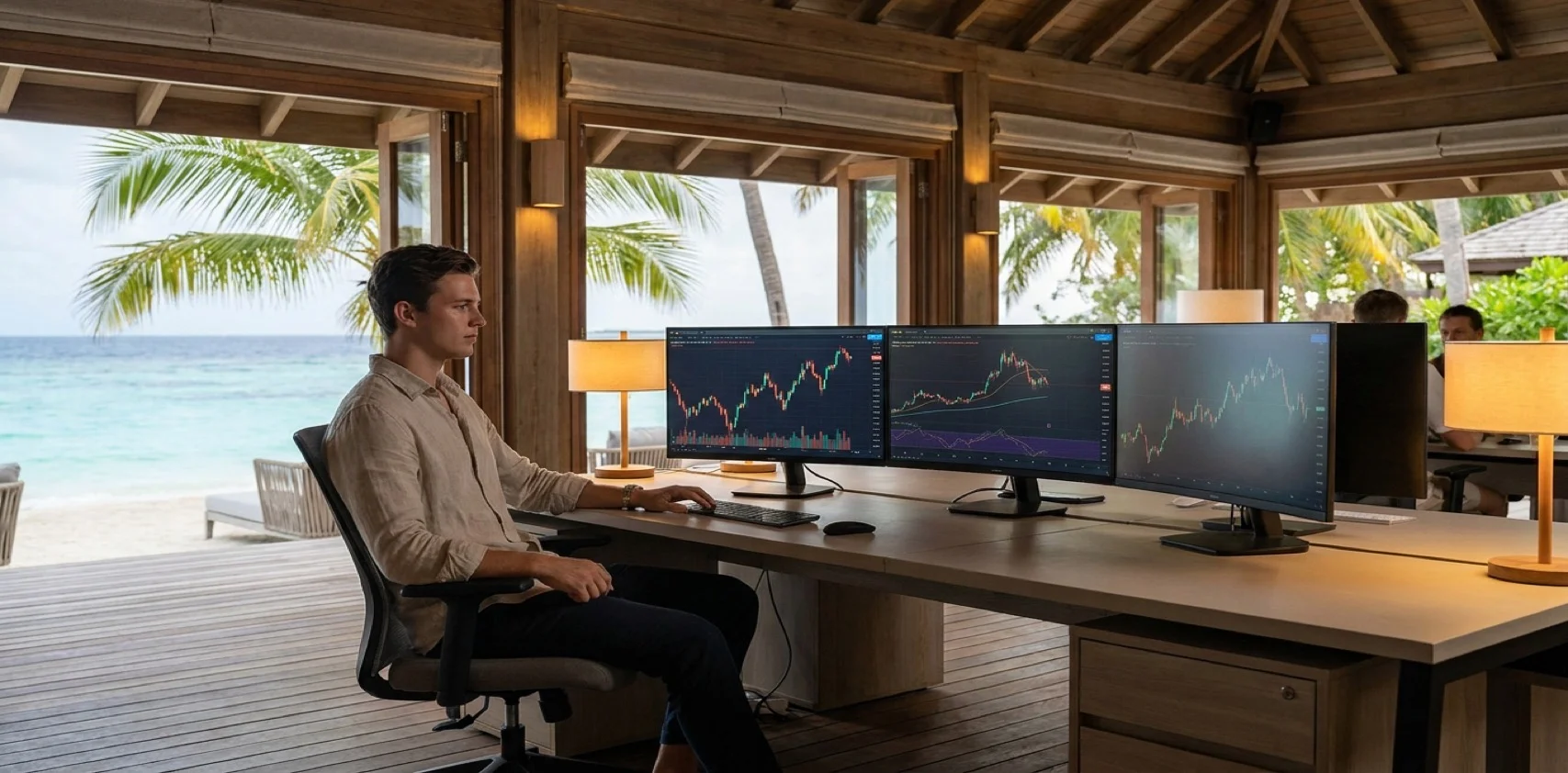
In a coworking space in Chiang Mai, a 27-year-old trader watches a MetaTrader 5 chart on his phone, waiting for the London session to open. His laptop displays a multi-pane TradingView layout beside a Telegram channel where 3,000 members are dissecting the day's cable setup. He has no finance degree and has never worked at a bank. But he manages a $200,000 account funded by a proprietary trading firm. This scene barely existed in 2020. By 2026, it has become one of the most visible — and most contested — new archetypes in the digital nomad world. From Joke to Job The "laptop trader" image circulated on social media for years, mostly as a punchline: beachside screenshots, exaggerated profit displays, "freedom lifestyle" captions. Over the past three years, several converging forces turned the meme into something real. The first force was the explosive growth of proprietary trading firms — prop firms — operating on a challenge-based model. Platforms like FTMO fundamentally rewired how retail traders access capital. Instead of risking personal savings, a trader pays a challenge fee (typically $100 to $500), passes a performance evaluation on a simulated account, and receives a funded account ranging from $10,000 to $400,000. Profits are split between the trader and the firm, usually at ratios of 70/30 to 90/10 in the trader's favor. In 2025, the prop firm industry crossed a threshold of institutional legitimacy. FTMO acquired OANDA, one of the world's most recognized retail forex brokers, backed by a $250 million credit facility from a consortium of Czech banks. By March 2026, OANDA had formally migrated its prop trading clients to FTMO's infrastructure. Traditional brokers began launching their own prop brands at an accelerating pace, and the line between prop firm and broker started to blur. The second force was the maturation of mobile trading technology. TradingView's mobile app now delivers near-desktop-grade charting. MetaTrader 5's mobile client has significantly improved in stability and execution speed. Combined with expanding global 4G and 5G coverage, executing trades from a café in Bali or a coworking desk in Lisbon is no longer a technical compromise — it is functionally equivalent to trading from a home office. The third force was the normalization of nomadic work itself. As remote employment shifted from fringe to mainstream, the idea of earning a living from a laptop anywhere in the world became culturally unremarkable. Forex — a 24-hour, fully digital, location-agnostic market — was a natural fit. Portrait of the Nomad Trader The reality of nomad forex traders diverges substantially from the social media stereotype. They tend to cluster between ages 25 and 35. Many hold university degrees, though not necessarily in finance — former software engineers, data analysts, and even teachers-turned-traders are common profiles. Most are not full-time traders, at least not initially. A significant proportion maintain parallel income streams: freelance development, online teaching, content creation. Forex trading functions as an additional revenue layer built on top of an existing nomad lifestyle, rather than the sole source of income. FTMO remains the dominant platform, but The5ers, FundedNext, and TopStep (focused on futures) hold meaningful market share. Challenge fees range from tens to hundreds of dollars. The pass rate — the critical number in the entire model — is estimated at roughly 10 to 15 percent across platforms based on available public and private data. The percentage of traders who sustain consistent payouts after passing is lower still. Geographically, Southeast Asia remains the preferred base. Chiang Mai, Canggu in Bali, Bangkok, and Kuala Lumpur offer the optimal combination of low living costs, reliable internet, and time zone coverage spanning the Asian and European sessions. Lisbon, Tenerife, and Mexico City host growing nomad trader communities as well. Time Zone Arbitrage: The Structural Edge The forex market operates across three major sessions — Asian, European, and American — each with distinct liquidity and volatility characteristics. The nomad's geographic flexibility provides an advantage that office-bound traders cannot easily replicate: time zone arbitrage. A trader based in Europe can trade Asian-session yen pairs in the early morning hours (lower volatility, suited to range strategies), then shift to European-session euro and sterling trades during the highest-liquidity window of the day. The same trader, relocated to Southeast Asia, can trade the New York session in the evening — positioning around U.S. economic data releases and their associated volatility spikes. This ability to align biological rhythm with market rhythm by choosing where to live is a genuine structural advantage. The nomadic lifestyle minimizes the mismatch between the trader's waking hours and the market's most productive hours. Prop Firm Economics: Can You Actually Make Money? The business model at the heart of prop firms is not primarily about the profits generated by successful traders. It is about challenge fees. A typical scenario: a trader pays $300 to enter a challenge requiring 8 to 10 percent profit within 30 days on a simulated account, with a maximum drawdown limit of 5 to 10 percent. Upon passing, the trader receives a $100,000 funded account — still simulated, but with real payouts based on performance — and profits are split 80/20. In the ideal case, a trader generating a consistent 3 percent monthly return on a $100,000 account earns $3,000 per month in gross profit. At an 80 percent split, that is $2,400 in take-home income. In Chiang Mai or Canggu, this is a comfortable monthly income. Reality is considerably less forgiving. Data mandated by the European Securities and Markets Authority (ESMA) shows that 75 to 80 percent of retail forex traders lose money. Within the prop firm model, the picture may be worse. Traders who fail challenges lose not only their fee but often retry multiple times, compounding their total expenditure. Industry estimates suggest that most traders spend well beyond their initial challenge fee before eventually quitting. For prop firms, challenge fees are a significant component of revenue. Failed traders' fees subsidize the payouts to successful traders. The economic structure is analogous to a poker tournament — a small number of winners funded by a large pool of entry fees. The Tax Optimization Motive Beyond lifestyle appeal, tax considerations are a powerful and often understated driver of the nomad trading phenomenon. Tax treatment of forex profits varies enormously by jurisdiction. In the United States, forex income may be taxed at ordinary income rates up to 37 percent. In the United Kingdom, CFD trading profits are classified as gambling income and are tax-free — provided trading is not the individual's primary income source. Under Portugal's Non-Habitual Resident (NHR) regime, foreign-source investment income can qualify for exemption or reduced rates under specific conditions. By selecting their country of residence, nomad traders can legally optimize their tax burden. Holding Portuguese NHR status, establishing Dubai tax residency, or using jurisdictions that do not tax foreign-source income (Panama, Georgia) are widely discussed strategies in trading communities. However, the boundary between tax optimization and tax evasion is not always sharp. Many countries have complex rules for determining tax residency, and the nomadic lifestyle's frequent relocations can trigger simultaneous tax obligations in multiple jurisdictions. Without professional cross-border tax planning, what begins as "optimization" can become legal exposure. Survivorship Bias on Display Search "forex trader lifestyle" on Instagram or TikTok. The results are uniformly aspirational: luxury apartments, profit screenshots, laptops on beaches. This picture suffers from acute survivorship bias. The traders who consistently produce social media content are, by definition, the small minority who have succeeded. Those who lost money do not film their failures. Those who quit do not return to share lessons. The result is a profoundly distorted representation of actual success rates. More concerning is the revenue model behind many high-visibility "traders." Their real income often derives not from trading itself but from selling courses, signal services, or earning prop firm referral commissions. This creates a self-reinforcing cycle: the image of success attracts students and followers, and the tuition and referral income far exceeds actual trading profits. Not all trading education is fraudulent — genuinely skilled educators exist. But consumers should understand that the correlation between a trader's social media influence and their actual trading performance is far weaker than intuition suggests. Why Most Will Fail The high failure rate in forex trading is not accidental. It is structural. Leverage is a force multiplier in both directions. Retail forex typically employs leverage of 10:1 to 100:1. A 1 percent price movement at 100:1 leverage equals a 100 percent swing on capital. Leverage amplifies profits but amplifies losses far more lethally — especially for traders without rigorous risk management discipline. Market efficiency does not favor retail participants. The major players in forex — central banks, investment banks, and large hedge funds — possess informational advantages, execution speeds, and analytical resources that retail traders cannot match. In this ecosystem, the retail trader is the weakest participant. Psychological destruction is underestimated. The greatest enemy in trading is often not the market but the trader's own emotions. Fear triggers premature profit-taking. Greed prevents timely loss-cutting. The isolation and lack of structured social support inherent in nomadic life can amplify these psychological traps. Prop firm rules are themselves a stress factor. Maximum drawdown limits, time constraints, and profit targets force decision-making under pressure — and pressure is the primary catalyst for irrational trading behavior. What Comes Next Despite the risks, nomad forex traders as a cohort are moving from the periphery toward the mainstream. FTMO's acquisition of OANDA signals that the prop firm model has earned a measure of institutional acceptance. Advances in mobile trading technology continue to lower infrastructure barriers. The emergence of AI-assisted trading tools — from automated technical analysis to sentiment-parsing algorithms — is creating new possibilities for technically skilled nomad traders. But the core reality will not change: forex trading is a negative-sum game after spreads and commissions, and the majority of participants will lose money. The geographic freedom and tax flexibility that nomadic life provides are genuine advantages, but they cannot substitute for trading skill itself. For digital nomads considering this path, the most honest advice may be this: validate your edge with minimal capital over the longest possible time horizon before treating trading as an income pillar. Until then, maintain other stable income sources. Because in the world of nomad forex trading, the vast majority of those enviable profit screenshots on social media are missing the most important image of all — the cumulative loss statement that preceded them.
June 8, 2026

Japan's Nomad Visa at Two: What the High Bar Actually Filtered For
In March 2024, Japan launched its Digital Nomad Visa — officially a Designated Activities residence status — and became the last major Asian economy to offer a dedicated pathway for remote workers. Two years later, the program has quietly produced a result that few predicted: rather than attracting the broad community of location-independent workers, it has filtered for a narrow, high-earning slice of the global remote workforce. Whether that counts as success depends entirely on what Japan was trying to achieve. The Architecture of Exclusion Japan's income threshold of ¥10 million per year — roughly $65,000 to $68,000 at current exchange rates — is among the steepest in the world for a digital nomad visa. Portugal's D7 visa requires approximately €3,280 per month (about $43,000 annually). Thailand's Long-Term Resident visa demands $80,000 but offers up to ten years of stay. Malaysia's DE Rantau program sets the bar at just $24,000 for digital professionals. Japan chose a different path: quality over quantity, enforced through income. The remaining conditions reinforce the same philosophy. The visa permits a maximum stay of six months. It cannot be renewed. After departure, applicants must wait six months before reapplying. Private international health insurance with at least ¥10 million in medical coverage is mandatory. All employment must be with entities outside Japan — working for Japanese companies is explicitly prohibited. Perhaps most consequentially, the visa does not issue a Residence Card (Zairyu Card). In a society where this card serves as the primary identification for foreign residents, its absence creates friction at nearly every administrative touchpoint: banking, housing, mobile phone contracts, and even some medical services. Who Actually Showed Up Japan has not published official application statistics for the Digital Nomad Visa. But two years of community reports, immigration law firm observations, and nomad forum discussions paint a consistent picture of who holds these visas. Senior technology professionals form the largest cohort. For staff engineers and engineering managers at major tech companies — whether based in Silicon Valley, London, Singapore, or Berlin — the $68,000 threshold is comfortably below their compensation. The yen's sustained weakness has amplified their purchasing power in Japan by an estimated 30 to 40 percent compared to 2019 levels, making Tokyo and Kyoto surprisingly affordable relative to San Francisco or New York. Independent consultants and executives constitute the second major group. Management consultants, brand strategists, executive coaches, and similar high-rate knowledge workers can maintain their income while working remotely and easily clear the income bar. Cryptocurrency traders and high-earning freelancers make up a smaller but visible third category. The visa accepts self-employment income documentation, which has allowed some independent traders with consistent above-threshold earnings to qualify. Largely absent from the program are the people who populate coworking spaces in Chiang Mai, Lisbon, and Medellín — the freelance writers, designers, social media managers, and early-stage entrepreneurs earning $30,000 to $50,000 annually. Japan's visa was not designed for them, and it has worked exactly as designed. Living on a Visa Without a Card The day-to-day experience of holding Japan's Digital Nomad Visa is defined less by what it permits than by what it lacks. Housing is the most immediate challenge. Without a Residence Card, standard two-year apartment leases are essentially off the table. Most holders rely on Airbnb, monthly apartments, or foreigner-friendly short-term rental platforms. In Tokyo, neighborhoods like Shibuya, Nakameguro, and Shinjuku have adequate monthly rental supply, but prices run significantly above the standard rental market. Banking remains a persistent friction point. Local bank accounts require a Residence Card. Daily spending depends heavily on international credit cards and cash. Digital banking tools like Wise and Revolut help bridge the gap for yen-denominated expenses, but some merchants, smaller shops, and medical facilities still operate on a cash-only basis. Taxation is where the visa delivers its clearest advantage. Because holders stay less than one year and earn income from overseas sources, they are generally classified as non-residents for Japanese tax purposes. This means no Japanese income tax and no local inhabitant tax (approximately 10 percent). Japan's 10 percent consumption tax still applies to all daily spending, and holders remain subject to their home country's tax obligations. Workspace infrastructure has improved significantly. Tokyo's coworking density has grown over the past two years, with WeWork, LIFORK, and Fabbit offering day and weekly passes. Fukuoka has positioned itself as the most startup-friendly city in Japan. Café Wi-Fi quality and power outlet availability across the country generally surpass what is found in most Asian cities. The Asian Nomad Visa Landscape Japan's offering becomes clearer when placed alongside its regional competitors. Japan Digital Nomad Visa: Income threshold ~$68,000/year. Maximum stay 6 months, non-renewable. No Residence Card. No local tax obligation. 50+ eligible nationalities. Family members can accompany. South Korea F-1-D Visa: Income threshold ~$66,000–$70,000/year. Maximum stay 1 year, renewable. Launched late 2024. Can convert from tourist visa within Korea. Similar income bar to Japan but with double the stay duration. Taiwan Employment Gold Card: Targets specific professional fields (technology, economics, culture, education). Some categories require monthly salary of approximately $5,000. Valid up to 3 years. Includes open work permit — holders can work for local employers. Pathway to permanent residency. Thailand LTR Visa (Remote Worker category): Income threshold $80,000/year. Valid up to 10 years (5-year entries). Personal income tax reduced to 17 percent. Application process is more complex. Malaysia DE Rantau: Income threshold $24,000/year for digital/IT roles, $60,000 for other professionals. Maximum stay 1 year, renewable. Highly competitive cost of living. Relatively straightforward application. Japan's unique position is the combination of short duration, high threshold, and tax neutrality. It is not a visa for building a long-term base. It is a visa for spending a high-quality six months in one of the world's most distinctive countries. Structural Weaknesses Two years of operation have exposed several design limitations. The six-month cap with no renewal option draws the most criticism. For remote workers who want to develop deep cultural understanding or build local professional networks, six months is insufficient. The mandatory six-month gap before reapplication effectively limits usage to once per year. South Korea's one-year renewable model offers significantly more flexibility. The absence of a Residence Card creates more friction than the program's designers appear to have anticipated. Japanese society is structured around this card as the primary form of identification for non-citizens. Without it, visa holders exist in a persistent administrative gray zone for the duration of their stay. The flat income threshold makes no distinction between single applicants and families, or between Tokyo and smaller cities where living costs are dramatically lower. Immigration attorneys have suggested that a tiered approach could broaden the applicant pool without compromising the program's quality-filtering intent. No pathway to longer-term residency positions the visa as a pure consumption experience rather than a talent attraction tool. Taiwan's Gold Card, by contrast, can lead to permanent residency for those who choose to stay. What Comes Next The Japanese government has not signaled imminent changes to the Digital Nomad Visa's terms. But regional competitive pressure is building. South Korea's F-1-D visa offers comparable income requirements with double the stay duration. Taiwan continues refining its Gold Card program. Thailand's ten-year LTR visa remains an outlier in generosity. Possible adjustments worth watching include extending the stay period to one year, introducing a renewal mechanism, issuing a limited-function Residence Card, or — less likely — lowering the income threshold. There is, however, a credible argument that Japan's high-bar approach is working as intended. The visa ensures that incoming remote workers have high spending power, place minimal burden on social services, and do not compete with the local labor market. This aligns precisely with Japan's historically cautious approach to immigration policy. The Two-Year Verdict The real answer to Japan's Digital Nomad Visa at two years may not be found in application numbers. It is found in the composition of who applies. The high threshold effectively filtered out the looser end of the digital nomad spectrum — the $1,500-a-month freelancers living in Bali or Chiang Mai. What remained was a concentrated group of high-earning, self-disciplined professionals willing to pay a premium for the Japanese experience. Whether this is the right outcome depends on perspective. Japan never intended to compete on volume. It chose a quality play — trading high barriers for low risk, short stays for high control. For remote workers who meet the threshold, Japan's Digital Nomad Visa remains a compelling option. It is not the cheapest path, the longest stay, or the most convenient process. But it leads to one of the few places on earth that genuinely cannot be replicated elsewhere. And that, perhaps, is the one thing about this visa that needs no revision at all.
June 1, 2026

Digital Nomad Visas Are Splitting Into Two Types: One for Travelers, One for Talent
When Estonia launched the world's first digital nomad visa in 2018, the concept was refreshingly simple: give remote workers a legal way to stay in the country without pretending to be tourists. At the time, only a handful of nations were experimenting with the idea, and most policymakers treated it as a niche curiosity. Seven years later, more than seventy countries and territories have rolled out some form of digital nomad visa. From Caribbean island nations to core EU member states, from Southeast Asian tourism hubs to emerging tech cities in the Middle East, "welcoming remote workers" has gone from novelty to standard operating procedure in the global competition for talent. But if you start digging into these programs, you'll notice something: they all carry the label "digital nomad visa," yet they are fundamentally two different things. One type lets you stay for a while, experience the local lifestyle, and leave your existing tax situation untouched. Call it the Traveler Visa. The other asks you to put down roots, pay taxes, and participate in the local social system. Call it the Talent Visa. The logic behind each is entirely different, and choosing the wrong one can be more expensive than most people realize. Same Name, Different Game Start with a basic question: why would a country issue a visa to someone who works remotely for a foreign employer? The most intuitive answer is consumer spending. Nomads rent apartments, eat out, shop, and generally inject foreign-earned income into the local economy. For many countries, this is the cleanest revenue source imaginable: no jobs displaced, no employer obligations, just spending power flowing in from abroad. This logic gave birth to the first wave of digital nomad visas: the Traveler Visa. But as remote work became mainstream, some countries started thinking bigger. They didn't just want your spending; they wanted your skills, your tax contributions, and your long-term economic participation. These countries grafted the digital nomad concept onto their existing talent attraction frameworks, creating programs that don't just let you "try living here" but ask you to commit: become a tax resident, join the social insurance system, and genuinely integrate into the national economy. That's the Talent Visa logic. Both types allow you to work remotely from a foreign country. But what they ask from you, what they give back, and what happens legally when you leave are completely different stories. The Traveler Visa: An Upgraded Tourist Stay The Traveler Visa is designed for simplicity: legally extend your stay beyond the typical tourist visa duration while continuing to work remotely. Classic examples include Barbados's Welcome Stamp, Bermuda's Work from Bermuda certificate, Croatia's digital nomad residence permit, and similar programs across the Caribbean and Southeast Asia. These visas typically share several features. Duration ranges from six months to one year. Most traveler visas are valid for six to twelve months, with some offering a single renewal. Long enough for a deep experience, short enough to avoid serious legal entanglement. No local tax residency triggered. This is the defining feature and the sharpest line between traveler and talent visas. Most traveler visa programs explicitly exclude holders from becoming local tax residents. You continue filing taxes in your home country; the host nation does not tax your foreign income. The Barbados Welcome Stamp, for instance, explicitly states that holders are not considered Barbadian tax residents. Moderate income thresholds. Typical requirements hover around $2,000 to $3,500 per month, mainly to confirm you have stable remote income and won't become a financial burden. Streamlined applications. Most traveler visas can be applied for online, with basic documentation: proof of income, health insurance, and a clean criminal record. Processing times range from days to weeks. The barrier is intentionally low because every applicant means more consumer spending. No path to permanent residency or citizenship. When the visa expires, it expires. Time spent under a traveler visa typically doesn't count toward permanent residency or citizenship requirements. Think of it as a day pass to a coworking space. You can use the facilities, but you're not a member. Your name won't be on the mailbox, and you leave nothing behind when you walk out. Hidden Risks of the Traveler Visa Traveler visas aren't risk-free. The most common pitfalls involve tax gray zones. While the host country doesn't tax you, your home country may have a different perspective. Many jurisdictions apply worldwide taxation: as long as you're a tax resident, all income is reportable regardless of where you earn or spend it. If you spend eight months outside your home country, your tax residency status there may come into question. And if you're simultaneously not a tax resident anywhere, some authorities will default to claiming you based on citizenship or last known residence. Healthcare is another concern. Traveler visas typically require international health insurance, but these policies often have coverage gaps compared to national social insurance systems, especially for chronic conditions, mental health, and long-term care. Banking access can also become complicated. Extended absence from your home country may trigger account restrictions, while the host country generally won't let you open local accounts since you're not a resident. The Talent Visa: A Weapon in the Global Talent War The Talent Visa operates on fundamentally different logic. The starting point isn't "come spend money here" but "come stay here." Countries issuing talent visas value not just your monthly spending but your skills, the economic value you create, the taxes you pay, and the businesses you might build locally. They're willing to offer more (long-term residency, social benefits, education access) but also demand more: tax obligations, social insurance contributions, and genuine economic participation. Portugal's D8 Visa: From Paradise to Reality Portugal was once a tax haven for digital nomads. Before 2024, D8 visa holders could leverage the Non-Habitual Resident (NHR) regime to enjoy tax-free or low-tax treatment on foreign-sourced income. This made Portugal wildly popular in nomad circles, turning Lisbon and Porto into some of Europe's hottest remote work hubs. But the NHR regime was formally terminated in early 2024. The 2026 reality: if you stay in Portugal on a D8 visa for more than 183 days, you become a Portuguese tax resident subject to progressive rates up to 48%. No special treatment, no transition provisions (unless you were grandfathered in before the NHR ended). The D8's income threshold has also risen. In 2026, you need at least €3,680 per month (four times Portugal's minimum wage), and applicants must obtain a Social Security identification number (NISS) as part of the process, which means you're pulled into the social security system from day one. This is textbook talent visa logic: welcome to Portugal, but you participate as a resident. You pay taxes and social contributions; in return, you access Portugal's public healthcare, education system, and the freedom to move anywhere within the EU. The D8 can be renewed into a long-term residence permit, eventually leading to permanent residency and citizenship. Spain's Digital Nomad Visa and the Beckham Law Spain's digital nomad visa, launched in 2023, is a particularly clever specimen, combining talent visa obligations with powerful incentives. The income threshold is €2,849 per month (200% of Spain's 2026 minimum wage), with at least 80% of income derived from non-Spanish sources. So far, this sounds like a traveler visa. But Spain added a headline attraction: the Beckham Law. Qualifying remote workers can opt into a special tax regime that caps Spanish-sourced income at a flat 24% rate for up to six years, while foreign-sourced income is taxed at 0%. The design is shrewd. It uses tax incentives to attract high-earning remote workers to settle, while requiring full residency: social insurance registration, a physical address in Spain, and access to public schools for your children. The visa pathway is clear: the first-year permit converts to a three-year residence permit, then a five-year long-term permit, then permanent residency. Spain isn't selling a ticket to visit. It's selling a one-way ticket to European life. Germany's Freelancer Visa Germany has never used the term "digital nomad visa," but its Freelancer Visa (Freiberufler Visa) functions as a talent visa in practice. Applicants must work in a recognized "free profession" (engineers, designers, software developers, consultants, journalists, among others), provide client contracts or letters of intent, and demonstrate health insurance coverage in Germany. There's no explicit minimum income requirement, but you must submit a business plan showing financial viability. Once approved, you become a German tax resident. Income tax rates range from 14% to 45%, plus monthly health insurance contributions (roughly €200 to €900 for self-employed individuals, depending on income). The overall burden is significant. But so are the returns: Germany's healthcare system ranks among the world's best, the residence permit can be renewed toward permanent residency, and a German residence card grants nearly unrestricted movement across the Schengen Area. For anyone serious about building a long-term life in Europe, this may be one of the most pragmatic paths available. Other Notable Talent Visa Programs Greece's 2024 digital nomad visa allows stays of up to two years and may trigger tax obligations on locally generated income. Its distinctive selling point: a 50% income tax reduction for new tax residents, valid for seven years. Estonia's one-year digital nomad visa, combined with its pioneering e-Residency program, lets holders register a company in Estonia and benefit from 0% tax on undistributed profits. This creates a hybrid model where your physical presence may be elsewhere, but your business "lives" in Estonia. Dubai's Virtual Working Programme offers a one-year visa with no personal income tax (the UAE has none), though living costs are steep. It falls somewhere between a traveler and talent visa: no tax residency requirements, but far more legal standing than a tourist visa. In Asia, Taiwan's Employment Gold Card is a textbook talent visa. It bundles a work permit, residence visa, and re-entry permit into a single card, offers up to three years of initial validity without requiring a local employer, and provides specific tax incentives for qualifying professionals in its first three years. (We explored the Gold Card's application process and practical experience in detail in our previous article.) Decision Framework: Which One Do You Need? The choice between traveler and talent visas isn't about which is "better." It's about where you are in your nomad journey and where you want to be in three to five years. Question 1: How long will you stay in one place? If your answer is "six months at most, then I move on," the traveler visa is almost certainly the right fit. Low barrier, light administrative burden, clean exit. If your answer is "I want to settle somewhere for one to two years, maybe longer," you need to seriously evaluate talent visas. Many countries' tax codes use the 183-day threshold: once you exceed it, the host nation may claim you as a tax resident regardless of your visa type. Rather than falling into a gray zone, proactively choosing a talent visa with a clear legal and tax framework is the smarter play. Question 2: What's your income structure? If you're a salaried remote employee of a foreign company, your income source is clear and your tax structure relatively simple. A traveler visa may suffice. If you're a freelancer juggling clients across multiple countries, things get complicated fast. A well-designed talent visa (Spain's Beckham Law, Estonia's e-Residency with company registration) can consolidate your chaotic multi-country tax situation into a single clear framework. If you run your own business or earn from diversified sources like investments, intellectual property, or platform revenue, tax planning becomes critical. You need more than a visa; you need a comprehensive tax residency strategy, and a talent visa is often the centerpiece. Question 3: Do you care about a social safety net? Under a traveler visa, your safety net relies entirely on commercial insurance and personal savings. International health plans cover emergencies and hospitalization, but chronic disease management, mental health support, unemployment protection, and pension accumulation usually aren't included. At thirty, healthy, and unattached, this may not matter. As life circumstances evolve, the gap becomes harder to ignore. Talent visas typically integrate you into the local social security system. You pay contributions, but you also gain access to public healthcare, pensions, and sometimes unemployment benefits. For anyone planning to spend three or more years abroad, this isn't an extra cost; it's risk diversification for your life. Question 4: Do you want a residency pathway? If the answer is "no, I want to keep moving," traveler visa flexibility is exactly what you need. If the answer is "maybe, I'd like to keep my options open," the talent visa's value compounds over time. Portugal's D8 leads to permanent residency after five years and citizenship after six. Spain offers a complete short-to-permanent pathway. Germany's freelancer visa converts to permanent residency (Niederlassungserlaubnis) after five years of continuous residence. EU permanent residency or citizenship means freedom to live and work across 27 member states, access to local education for your children, and social security support in retirement. A traveler visa can never offer that. Taxes: The Most Underestimated Variable Regardless of visa type, tax planning is the most commonly overlooked and most consequential factor. Many nomads assume "if I'm not there, I don't owe taxes there." Under a traveler visa, this is broadly true, but only if you maintain valid tax residency somewhere. If you're not a tax resident anywhere, you're not "tax-free"; you're a "tax orphan," and any country's tax authority that takes an interest in you will find you have no legal basis to dispute their jurisdiction claim. Talent visas actually offer clearer protection. When you're a Portuguese tax resident, your obligations are explicit, your filing basis is transparent, and if another country tries to tax you, you can invoke bilateral tax treaties to avoid double taxation. The "clear obligation" that seems like a burden is, in practice, a shield. Common Tax Traps The 183-day myth. Many people believe "under 183 days means no tax," but this is just a rough rule of thumb. Different countries use different criteria, and some focus on your "centre of vital interests" (where your family lives, where your bank accounts are, where your social ties are strongest) rather than day counts. CRS automatic information exchange. Over 100 countries participate in the Common Reporting Standard, under which financial institutions automatically report account information to your country of tax residence. The era of "don't report it and no one will know" is over. Leaving your home country doesn't mean leaving its tax system. The United States taxes citizens and green card holders on worldwide income regardless of residence. Other countries have their own "post-departure tax obligations." Understanding how to legally exit your home country's tax system is just as important as understanding the tax rate in your new one. Future Trends: The Split Will Deepen Based on developments over the past two years, the divergence between traveler and talent visas will only accelerate. On the traveler side, more countries are launching programs, but they're increasingly homogeneous. Income thresholds cluster around $2,000 to $3,500 per month, durations hover at six to twelve months, and applications are fully digital. For nomads, the deciding factors are increasingly practical: cost of living, internet speed, timezone alignment, rather than visa terms. On the talent side, competition is intensifying. Spain plays the Beckham Law card at 24%. Greece counters with a seven-year 50% tax reduction. Thailand's LTR visa offers a flat 17%. Expect more countries to roll out bespoke tax incentives for high-income remote workers in the coming years. Hybrid models will multiply. Some countries may introduce "graduated" visas: year one operates under traveler visa conditions (low barrier, no tax obligations), year two transitions to talent visa terms (integrated into tax and social security systems). This design serves both the "try before you commit" crowd and the "attract long-term talent" objective. Multilateral coordination pressure is building. The OECD and EU have begun examining the tax implications of digital nomadism, particularly the base erosion risks of "work in country A, file taxes in country B, reside in country C" arrangements. International rules on nomad tax attribution are likely to become more explicit, shrinking the gray zones. Practical Advice: Before You Go First, establish a "tax home base." Whether you choose a traveler or talent visa, make sure you maintain clear tax residency in at least one country. It can be your home country or the country where you settle via a talent visa. The point is having an unambiguous "home," not in the emotional sense, but in the tax law sense. Second, calculate the true cost. Talent visa tax burdens look heavy, but factor in the benefits. If you're spending $300 a month on international health insurance under a traveler visa, with no pension accumulation and no unemployment safety net, the "net cost" of a talent visa may be lower than you think once you account for these hidden expenses. Third, understand your exit costs. Entering a country's tax system isn't hard; leaving is the real test. Some countries impose exit taxes. Others require continued filing for several years after departure. Before committing, find out what it will cost to leave later. Fourth, don't treat visa type as a tax strategy. A visa is permission to enter and reside. Taxation is a separate legal framework. Holding a traveler visa doesn't automatically make you tax-exempt, and holding a talent visa doesn't mean you'll pay the maximum local rate. Real tax planning considers your nationality, income sources, asset allocation, family situation, and applicable bilateral tax treaties. If your income exceeds $50,000 annually, consulting a cross-border tax professional is almost certainly money well spent. Fifth, stay flexible. The digital nomad visa landscape is evolving rapidly. This year's best option may be revised next year. An option that doesn't exist today may appear tomorrow. Keep tracking policy changes across countries, and maintain the ability to switch between traveler and talent visas as your circumstances evolve. Conclusion The global split in digital nomad visas reflects a more fundamental question: in an era when where you work and where you live can be entirely separate, which country do you actually "belong" to? The traveler visa says: "You don't belong anywhere, so everywhere welcomes you for a while." The talent visa says: "You can choose to belong here, and we'll give you corresponding rights and obligations." Neither logic is superior. Some people spend their entire nomad careers happily moving from one traveler visa to the next. Others find the right place and decisively commit through a talent visa. Many will switch between the two modes at different life stages. What matters is understanding what you need right now, and the true cost behind each choice. A visa is just a door. The path you walk through it is always your own.
June 10, 2026

Taiwan Has Everything Digital Nomads Want. It Just Hasn't Figured Out How to Say It.
Open any digital nomad forum and the same destinations cycle through like a greatest-hits playlist: Bali, Chiang Mai, Lisbon, Medellín, Mexico City. Each comes with a fully formed narrative, a mental postcard that lets prospective nomads picture their life there before booking a flight. Bali is rice paddies and surf breaks between Zoom calls. Lisbon is European sunshine at a fraction of London prices. Chiang Mai is the place where a thousand dollars a month buys a surprisingly comfortable life. Taiwan? Most nomads couldn't tell you what life there looks like. Not because the experience is lacking, but because almost nobody has bothered to describe it. Search "Taiwan" on r/digitalnomad and you'll find scattered threads, a handful of people noting that Taipei is "underrated," a few replies agreeing, and then silence. No sustained community discussion, no comprehensive city guides updated season after season, no critical mass of experience reports feeding the algorithm. For a place that checks nearly every box on the nomad wish list, Taiwan's absence from the conversation is genuinely strange. Because the fundamentals are not just adequate. They are, on many dimensions, best-in-class. The Product Is There. The Pitch Isn't. Think of Taiwan as a kitchen stocked with premium ingredients, professional-grade equipment, and plenty of counter space. What's missing is a menu that the people walking past can read. In digital nomad terms, a "menu" is a coherent information package: what daily life looks like, how much it costs, what the visa situation is, what problems you'll run into, and what your routine will feel like after three months, six months, a year. Bali has had this package for nearly a decade, refined through waves of blogger testimonials, coworking brand marketing, NomadList reviews, and YouTube vlogs. The information pipeline is mature and self-sustaining. Taiwan has almost none of it. The tourism bureau promotes Sun Moon Lake, night markets, and Jiufen. Investment promotion targets semiconductor supply chains and corporate relocation. The Employment Gold Card program speaks to high-end professionals in the language of talent recruitment, not lifestyle design. And the recently introduced digital nomad visa, while a welcome policy signal, hasn't yet been wrapped in the kind of storytelling that makes someone actually want to apply. Nobody is telling international nomads: "Here's what six months in Taiwan actually looks like, and here's why it might be exactly what you need." Safety You Stop Thinking About People who live in Taiwan rarely mention personal safety as a selling point. It's too obvious, like praising oxygen for being breathable. But for nomads who have spent years rotating through destinations where situational awareness is a constant background process, Taiwan's safety is not obvious at all. It is extraordinary. The nomad community has an unspoken understanding that many popular destinations come with real security trade-offs. Mexico City has pickpocketing and mugging risks in certain neighborhoods after dark. Medellín, though far safer than its reputation suggests, still requires knowing which streets to avoid. Lisbon has seen a rise in tourist-targeted theft. Bali's motorbike bag-snatching is a perennial complaint. None of this makes those cities unlivable. But when you stay somewhere long enough, safety stops being an abstract statistic and starts shaping your daily behavior. You route-plan around sketchy blocks, keep valuables hidden, maintain awareness of your surroundings in a way that drains mental energy even when nothing happens. In Taiwan, that calculation essentially disappears. Walking home alone at two in the morning is unremarkable. Leaving a laptop on a café table while visiting the restroom is routine. A phone left on a restaurant counter stays exactly where you put it. These sound like small things, and they are, individually. But accumulated over weeks and months, the absence of low-grade vigilance produces a quality of life that nomads who have experienced it consistently describe as one of Taiwan's most compelling features. Taiwan's safety isn't fragile or accidental. It rests on structural factors: dense networks of convenience stores and street lighting creating natural surveillance, high social trust, and relatively equitable income distribution that reduces the economic desperation driving street crime in many other countries. These conditions won't evaporate because more foreigners show up. Healthcare That Removes Fear If safety means nomads don't have to watch their backs, Taiwan's healthcare system means they don't have to dread getting sick. Most long-term nomads carry travel insurance from providers like SafetyWing or World Nomads. These policies handle basic doctor visits and emergencies, but anything moderately complex becomes a bureaucratic ordeal, and the claims process can be genuinely maddening. In many popular nomad cities, language barriers turn a routine medical visit into a guessing game. Taiwan's clinic and hospital density is remarkably high. In Taipei, Taichung, and Kaohsiung, a clinic is almost always within a fifteen-minute walk. The system moves fast: same-day registration, same-day consultation, same-day medication pickup. The entire process often takes under an hour. For anyone accustomed to European or North American wait times (weeks for a specialist appointment is normal in many countries), the speed is startling. Costs are low even without National Health Insurance enrollment (which requires six months of continuous residence). A standard outpatient visit including medication runs roughly NT$600 to 1,500 (about US$20 to 50). Dental cleanings, eye exams, dermatology consultations: all fall in the same range. After NHI enrollment, the monthly premium is around NT$800 to 1,500 (US$25 to 50), and copays drop to near-negligible levels. Language is manageable. Taiwanese physicians generally communicate in English, particularly at larger hospitals. Not every nurse or receptionist will be fluent, but the clinical core of a medical visit, diagnosis and treatment explanation, usually works in English. Compared to seeking medical care in Thailand or Indonesia, where translation apps or interpreters are frequently necessary, Taiwan is significantly more accessible. What this adds up to: illness in Taiwan is an inconvenience, not a crisis. You walk to the nearest clinic, see a doctor, pick up medication, go home. No frantic Googling of hospital reviews, no anxiety about the bill, no phone battles with insurance adjusters. For nomads who have spent years treating every health issue as a logistical emergency, this kind of normalcy is almost disorienting. A City That Fits City scale matters more than most nomads realize when choosing a base. Mega-cities like Tokyo, New York, or London make even casual errands feel like expeditions. Small towns like Ubud or suburban Chiang Mai offer calm at the cost of limited options. The sweet spot is a city large enough to keep things interesting but compact enough that getting anywhere feels effortless. Taipei sits squarely in that sweet spot. It has the full inventory of a major international city: diverse dining, cultural programming, nightlife, retail. But it's small enough that the MRT can get you virtually anywhere within thirty minutes. More importantly, Taipei's districts each carry distinct personalities. Da'an is quiet and bookish. Xinyi is glossy and commercial. Wanhua is loud and local. Tianmu has an expat-neighborhood ease. Minsheng feels like a small town hiding inside a metropolis. You can shift your daily scenery without changing your address. This compression of diversity into a walkable, transit-friendly footprint is genuinely rare among nomad-popular cities. Bangkok is diverse but sprawling and traffic-choked. Lisbon is compact but limited in neighborhood variety. Chiang Mai is pleasant but small. Taipei's balance is hard to match. And Taiwan offers more than Taipei. Taichung has emerged as a high-quality, lower-cost alternative with its own café culture, arts districts, and a sunnier climate. Tainan delivers slow-paced living, extraordinary food, and deep history. Kaohsiung, once dismissed as an industrial port city, is mid-transformation with major public architecture (the National Kaohsiung Center for the Arts, the Kaohsiung Music Center), a growing light rail network, and living costs roughly 60 to 70 percent of Taipei's. Four distinct cities on one island, all connected by a high-speed rail network that puts any two of them within two hours of each other. This means you can change your environment without leaving the country, a powerful antidote to the restlessness that eventually hits every long-term nomad. The Café Layer For digital nomads, cafés aren't just places to drink coffee. They are alternative offices, social anchors, and daily rhythm-setters. A city's café culture directly determines nomad quality of life. Taipei's independent café density rivals any city in Asia. These aren't cookie-cutter chain outlets but individually designed spaces with distinct identities: some focused on specialty beans and pour-over technique, others on atmosphere and interior design, still others deliberately optimized for long working sessions with ample outlets and stable Wi-Fi. The cultural attitude matters as much as the physical space. Taiwanese café culture has an implicit tolerance for lingering. During off-peak hours, ordering a single latte and working for three hours draws no dirty looks from staff. Contrast this with Paris (many cafés don't offer Wi-Fi) or Amsterdam (where "no laptops" signs are increasingly common), and the difference is palpable. Coworking spaces exist too. Taipei's CLBC, Impact Hub Taipei, and Changee have operated for years with stable facilities. Pricing runs around NT$5,000 to 8,000 per month (roughly US$160 to 260) for a fixed desk, significantly cheaper than international brands like WeWork. But here's where the narrative gap reappears. Bali's Dojo Bali and Outpost became famous not just for their spaces but for their community-building: nomad meetups, visa assistance, consistent social media content, positioning themselves as the first stop for anyone arriving on the island. Taiwan's coworking spaces serve their existing members well but rarely speak outward to the international nomad community. Good product, quiet marketing. Infrastructure That Just Works Taiwan's public transportation deserves mention not because it rivals Japan's rail network (it doesn't, in scale or punctuality obsession) but because it hits a pragmatic sweet spot of simplicity and coverage. A single EasyCard handles the MRT, buses, YouBike (the ubiquitous public bike-share), trains, and convenience store payments. No juggling multiple fare systems. Taipei's MRT map is clean and intuitive, station signage includes English, announcements are multilingual, and transfer navigation is clear enough that getting lost requires genuine effort. The high-speed rail compresses Taiwan's west coast into a single corridor: Taipei to Taichung in 47 minutes, Taipei to Kaohsiung in about 90. Day trips between cities are trivially easy. The entire island functionally operates as one extended metro area. Taxis start at NT$85 (about US$2.70), and short urban trips rarely exceed NT$200. Uber operates but many residents (and nomads who've been around a while) find that flagging a street taxi is faster and simpler. Ride costs that would barely cover the base fare in New York or London get you across town in Taipei. Internet connectivity barely warrants discussion because there's nothing to complain about. Taiwan consistently ranks in the global top ten for fixed broadband speed. Mobile coverage exceeds 99 percent for 4G, with 5G expanding rapidly. A prepaid SIM card runs NT$500 to 1,000 per month (US$16 to 32) for reliable high-speed data. Free Wi-Fi in convenience stores, cafés, and MRT stations is standard. Food as Daily Infrastructure Few places on earth can compete with Taiwan on food, and this isn't a subjective claim about taste. It's an observation about the food ecosystem's objective characteristics. Diversity: within a five-kilometer radius of central Taipei, you can find virtually every major cuisine. Taiwanese staples, Japanese, Italian, Indian, Korean, Thai, Mexican, Middle Eastern. Many international kitchens operate at genuinely high levels, supported by Taiwan's sizable expat population and notoriously discerning local palate. Price range: a roadside bowl of dry noodles costs NT$50. A Michelin-recommended dinner runs NT$3,000. Between those poles, in the NT$100 to 300 range (roughly US$3 to 10), the quality and variety available is difficult for most countries to match at equivalent price points. Accessibility: small eateries, lunch-box shops, and breakfast joints operate in virtually every neighborhood from early morning to late night. Convenience stores supplement with fresh-food options, microwaveable meals, and ready-to-eat selections. Running out of food options in Taiwan requires extraordinary effort. For nomads, food is not a minor quality-of-life detail. It is one of daily life's greatest pleasures and the most immediate gateway to local culture. In Taiwan, you don't schedule a special outing to "experience local food." Every single meal is the experience. The Convenience Store Civilization If one symbol captures Taiwan's daily convenience, it is the convenience store. Taiwan has the world's second-highest convenience store density (behind South Korea), roughly one per two thousand residents. And Taiwanese convenience stores do far more than sell snacks: utility bill payments, package pickup and drop-off, document printing, high-speed rail ticket purchases, transit card top-ups, even certain government service reservations. For nomads, many errands that require dedicated trips and queue-waiting in other countries can be handled at the nearest 7-Eleven, typically within a three-minute walk. This ultra-low friction daily experience becomes almost addictive. Foreigners who leave Taiwan frequently cite convenience stores, not night markets or scenery, as what they miss most. Combined with mature food delivery (Uber Eats and foodpanda operate extensively) and efficient e-commerce logistics (next-day delivery is standard on many platforms), daily life in Taiwan can approach zero friction. Language: A Real But Manageable Barrier Mandarin is Taiwan's primary language, and that's a genuine consideration for nomads who don't speak it. But the barrier is lower than it might appear. In Taipei, most daily interactions (ordering food, navigating transit, shopping, medical visits) can be managed with basic English, gesture, and translation apps. Younger Taiwanese generally have functional English skills, not at the level of Singapore or Hong Kong where English is an official language, but sufficient for daily life. Google Maps, MRT signage, and major road signs include English. Complete linguistic helplessness is unlikely. For nomads interested in learning Mandarin, Taiwan offers near-ideal conditions: world-renowned language programs (National Taiwan Normal University's Mandarin Training Center is globally recognized), abundant real-world practice opportunities, and a cultural attitude that encourages rather than mocks foreign attempts at Chinese. For nomads who already speak Mandarin, particularly those with Chinese heritage, Taiwan's advantages become overwhelming. It is one of the few places worldwide that uses traditional Chinese characters, combines Chinese cultural foundations with a distinct local identity, and operates within a democratic, open society. For anyone seeking deep Chinese-language cultural immersion without certain political frameworks, Taiwan is essentially the only option. The Tech Undercurrent Taiwan is the global epicenter of semiconductor manufacturing. TSMC alone produces more than half of the world's advanced-process chips. What does this mean for digital nomads? The direct implication is that Taiwanese society is fluent in technology, digital tools, and remote work as concepts. This is not a place where you need to explain that your job happens on a laptop and doesn't require an office. Taipei's tech and startup ecosystem, while smaller than Silicon Valley's, is dense. Meetups, tech communities, and hackathons are active, many conducted bilingually in Mandarin and English. This gives Taiwan a distinctive character. Unlike pure lifestyle destinations where the nomad population skews toward content creators, coaches, and wellness practitioners, Taiwan naturally attracts (or has the potential to attract) engineers, designers, product managers, and other technically oriented remote workers. Different population, different needs, and Taiwan happens to serve the latter particularly well. Island Rhythms Taiwan is an island, and islands have a particular quality of life. Their boundedness creates a sense of containment that can feel surprisingly grounding. Everything is within reach. From Taipei, a three-hour drive reaches Taroko Gorge's marble cliffs. Two hours gets you to the coast. One hour puts you in a mountain hot spring. Weekend escapes don't require flights; they require an early alarm and a train ticket. Taiwan's landscape diversity consistently surprises first-time visitors. Many assume the island is essentially urban with some hot springs attached. In reality, it contains more peaks above 3,000 meters than Switzerland, plus subtropical rainforest, coral-reef coastline, temperate conifer forest, and volcanic terrain. The geographic density of distinct landscapes packed into 36,000 square kilometers is globally unusual. For nomads, this means Taiwan simultaneously serves weekday productivity needs and weekend recharging needs. Work from a Taipei café Monday through Friday, take the train to Yilan's hot springs or Nantou's mountains on Saturday, return Sunday evening. This rhythm is sustainable in a way that pure-urban bases are not. The city's edge always offers nature within arm's reach. The Honest Downsides Any serious analysis of a destination that lists only positives is advertising, not assessment. Taiwan presents several genuine challenges for nomads. Summer climate. June through September is hot and humid, with perceived temperatures frequently exceeding 38°C (100°F). Typhoon season brings heavy rain and occasional disruption. Nomads from temperate countries may find their first Taiwanese summer punishing. Many experienced Taiwan-based nomads time their stays for October through April, or retreat to higher elevations (Cingjing, Alishan) during the worst months. Housing. Taiwan's rental market is not foreigner-friendly, not primarily due to discrimination but because the system is opaque. No credible English-language rental platform exists. Most listings appear on 591.com.tw in Chinese only. Lease terms and deposit conventions differ from international norms. Compared to Lisbon (Flatio), Bangkok (abundant English-friendly serviced apartments), or Bali (villa culture that caters effortlessly to foreigners), Taiwan's housing discovery process is a real friction point. Air quality. Western Taiwan occasionally experiences elevated pollution levels during autumn and winter, driven by cross-border pollutant transport. Taichung and Kaohsiung see more affected days than Taipei. Not a daily issue, but worth monitoring for those with respiratory sensitivities. International flight connectivity. Taoyuan International Airport's route network and frequency don't match Bangkok, Singapore, or Tokyo. Direct flights to Europe and the Americas are limited. Nomads who fly frequently may find Taiwan's geographic position (eastern edge of Asia) and routing options less convenient than major hub cities. These are real limitations, but they fall in the "inconvenient" category rather than "deal-breaking." Every nomad destination has a drawback list; Taiwan's is comparatively mild. What's Missing Isn't a Feature. It's a Story. Adding everything up, the conclusion is hard to avoid: Taiwan has nearly all the hardware required to function as a top-tier global nomad destination. Safety, healthcare, internet, transit, food, daily convenience: high marks across the board. Add gradually liberalizing visa policy (the Employment Gold Card plus the new digital nomad visa), and institutional barriers are shrinking. Yet Taiwan remains a fuzzy dot on the global nomad's mental map. The reason isn't a missing amenity or policy gap. It's a missing narrative. Consider the stories other destinations have built. Bali: "Code between rice paddies and surf breaks." Lisbon: "Europe's sunniest city at a third of London's price." Chiang Mai: "A thousand dollars buys a king's life." These framings are oversimplified, but they work because they hand prospective nomads a vivid, immediate mental image. What is Taiwan's story? "Asia's most underrated…" and then what? The framing itself reveals the problem: it defines Taiwan by negation ("underrated" means "you don't know it's good") rather than by an affirmative, image-rich narrative. Taiwan needs a sentence, or a paragraph, that puts a picture in a nomad's head instantly. Maybe: "A city safe enough for 2 AM walks, with world-class healthcare and a bowl of braised pork rice for a dollar fifty." Maybe: "Asia's tech heartland with an island's pace of life." Maybe: "Close your laptop, and you're standing on a three-thousand-meter peak an hour later." The exact wording matters less than the act of starting. Who Tells It? The government has invested in Gold Card and nomad visa promotion, but government communication defaults to policy explanation, not lifestyle storytelling. An official website listing eligibility requirements and required documents is necessary groundwork, but it won't make a nomad scrolling through their phone in a Chiang Mai café suddenly think, "I should go to Taiwan." The tourism bureau targets tourists, but nomads are not tourists. The information nomads need (rental channels, coworking reviews, visa nuances, tax implications, community events) barely overlaps with what tourists need (attractions, restaurants, souvenirs). Tourist-framed messaging aimed at nomads is a language mismatch. Foreign nomads already in Taiwan are arguably the most credible voices, but their numbers are still small and their output is scattered across platforms without forming a coherent narrative current. Local coworking brands may be the most overlooked leverage point. If Taiwan's spaces learned from Bali's Dojo or Lisbon's Second Home, positioning themselves not just as workspaces but as the international nomad community's gateway to the island, actively producing English-language content, hosting internationally oriented events, building online communities, the narrative could begin to crystallize. Or perhaps no single institution needs to lead. The most effective nomad-destination narratives have never been top-down campaigns. They emerge organically from people living somewhere, sharing their experience, and drawing others in through genuine word of mouth. What Taiwan needs isn't a "plan." It needs a critical mass of early adopters willing to describe their Taiwanese nomad life consistently, specifically, and honestly. An Invitation, Not an Advertisement This article is not trying to convince you to book a flight to Taiwan tomorrow. Needs differ, preferences differ, budgets differ, life stages differ. Taiwan is not for everyone, and pretending otherwise would be dishonest. But if you are considering an Asian base, or if you've spent enough time in Southeast Asia that the Chiang Mai and Bali nomad bubbles have started to feel like a loop, Taiwan deserves a place on your shortlist. Not because it's the cheapest, the most exotic, or the most Instagram-friendly option, but because it offers a qualitatively different kind of nomad experience: a genuinely high-functioning, high-convenience, high-safety society where you can live a normal life while doing your work. Taiwan doesn't need to compete with Bali on pool-view aesthetics or with Chiang Mai on rock-bottom costs. It holds its own hand of cards, and it's a strong one. It just hasn't laid those cards on the table for the world to see. Maybe it's time.
June 2, 2026

Your Company Says You Can Work Remotely, but That Does Not Mean You Can Work From Abroad: The Legal Gray Areas of Overseas Remote Work
Your Company Says You Can Work Remotely, but That Does Not Mean You Can Work From Abroad: The Legal Gray Areas of Overseas Remote Work Many people, upon landing a remote work opportunity, immediately think: "If I don't have to go to the office, I can work from anywhere, right?" The logic feels natural, and technically it is true. With a stable internet connection and a laptop, logging into company systems from Taipei, Chiang Mai, or Lisbon works essentially the same way. But the problem has never been about technology. When you move your work location from your home country to a foreign one, you trigger a chain of issues involving labor law, visas, taxation, insurance, and data security compliance. These are problems that employees often cannot resolve on their own. This article outlines the most commonly overlooked legal and regulatory risks of working remotely from overseas. The goal is to help you figure out before you leave what needs to be confirmed with your employer and which gray areas you should not venture into alone. "Remote-Friendly" Does Not Mean "Work From Anywhere" The original intent behind most remote work policies is to let employees skip the daily commute and work from home, a coffee shop, or a coworking space in the same city. That is an entirely different proposition from "working in another country." Most companies' remote work policies explicitly define the geographic scope of where employees may work. Some restrict it to the same country. Others limit it to specific cities or time zones. Even when the policy language is vague, that does not mean the company is implicitly approving overseas work. The reason is straightforward: where an employee works can trigger legal obligations in that jurisdiction. This is not just the employee's problem. The company may also take on additional legal liabilities and costs as a result. Labor Law and Employment Relationships: When You Move, the Rules Move With You Labor law jurisdiction typically depends on where work is actually performed, not the address written in the contract. When you work remotely in another country for an extended period, the following issues may arise: Working hours and labor conditions: Different countries have different rules on maximum working hours, overtime pay, vacation days, and minimum wage. If the country where you are actually working has stricter labor protections, you could theoretically be entitled to those protections, but your employer could simultaneously be required to comply with local employer obligations. Workplace injuries: Your employer in Taiwan covers you under labor insurance, with occupational injury protection applicable in Taiwan. But if you are injured while working in Thailand, whether labor insurance will pay out and whether there are additional employer liabilities under local law become ambiguous. Insurance coverage: Group insurance and commercial medical insurance provided by your company typically have geographic restrictions. If you spend an extended period in a country not covered by the policy, claims could be problematic if something goes wrong. Data security and compliance: Certain industries (finance, healthcare, government contracts) have strict rules about where data can be accessed. Connecting to company systems via VPN from overseas, even if technically possible, could violate client contracts or regulatory requirements. Visas and Residency: A Tourist Visa Is Not a Work Permit This is one of the most frequently encountered gray areas for overseas remote workers. Most countries' tourist visas (or visa-free entry arrangements) explicitly prohibit "engaging in work." The question is whether "working remotely for a foreign employer" counts as working in the host country. Different countries apply different standards. Some take a lenient view, reasoning that if your employer and income source are both abroad, you are not taking local jobs. Others define it strictly: if you are on their territory providing labor, regardless of where your employer is located, it counts as work. In practice, many digital nomads handle this quietly: they enter on a tourist visa and do not volunteer information about their work status to immigration officers. This rarely gets flagged in many countries, but that does not make it legal. If you are found in violation, consequences range from warnings and departure orders to marks on your immigration record that could affect future visa applications. Are digital nomad visas the solution? In recent years, a growing number of countries have introduced visa categories specifically for remote workers. These visas typically allow you to reside in the country and work for a foreign employer, but the conditions vary widely: some require a minimum income threshold, some cap the length of stay, and some prohibit you from serving local clients. Before applying, read the official requirements published by the destination country's government carefully. Do not rely solely on secondhand summaries from travel blogs. Tax Risks: Not Just Your Problem, but Your Company's Too Taxation is likely the most complex dimension of overseas remote work, and it operates on two levels. The Individual Level: Tax Residency Status One of the most common criteria countries use to determine tax residency is the number of days you spend within their borders. Beyond a certain threshold (which varies by country), you may be deemed a local tax resident and required to file and pay local income tax. Even if your entire salary is paid by a Taiwanese company, you could end up needing to deal with tax obligations in both Taiwan and the country where you are working. While most countries have double taxation agreements (DTAs) to prevent being taxed twice on the same income, the actual process is far from simple and typically requires professional tax advice. The Company Level: Permanent Establishment Risk If an employee works remotely in a particular country for an extended period, the local tax authority may determine that the employer has established a "permanent establishment" (PE) there. Once that determination is made, the company must register for tax purposes in that country, pay local corporate taxes, and possibly fulfill local employer withholding obligations. This is the core reason why many large multinational companies impose strict limits on employee overseas remote work. From the company's perspective, one employee wanting to work from Bali for three months may seem trivial, but it could trigger the entire company's tax obligations in Indonesia, creating costs and risks that are completely disproportionate. Why Is Your Company So Conservative About This? If you request permission to work remotely from abroad, the answer you get will likely be "no" or "it needs a case-by-case review." This is not necessarily the company being unreasonable. Behind the decision is a series of compliance considerations: Administrative costs of cross-border employment: Once an employee triggers local employer obligations by working overseas, the company may need to register, file, and insure in that jurisdiction, and potentially engage local legal and accounting advisors. These administrative costs are substantial, especially for small and medium-sized companies. Data security and privacy regulations: GDPR, personal data protection laws, and industry-specific regulations may restrict cross-border data transfer and access. An employee accessing company systems from overseas could constitute a data breach risk from a regulatory standpoint. Insurance liability: If an employee has an accident or health issue overseas, does the company's existing insurance cover it? If not, does the company need additional coverage? These are real cost concerns. Client contract restrictions: Some client contracts specify where data must be processed or require personnel to pass specific security clearances. An employee unilaterally working from overseas could put the company in breach of client agreements. Management complexity: Cross-time-zone collaboration, international payroll, and compliance with varying labor laws across countries all add to the workload of HR and legal departments. Understanding the company's position helps you communicate your request more effectively, rather than simply assuming "as long as the work gets done, it should be fine." Questions to Confirm Before You Leave Whether you are a full-time employee or a freelancer, before planning to work remotely from overseas, it is worth clarifying the following: For Employees: Confirm With Your Company Does the company's remote work policy explicitly allow overseas work? Are there restrictions on locations or number of days? Has the company approved you working in the specific country you have in mind? Do you need to submit a formal application or sign an additional agreement? During your time overseas, will your employment contract, working hour regulations, or workplace injury coverage be adjusted? Does the company's IT security policy allow system access from overseas? Do you need to use a designated VPN or device? Will the way your salary is paid be affected by your change in work location? For Yourself Does the destination country's visa conditions allow remote work? Do you need to apply for a specific work visa or digital nomad visa? Could the number of days you plan to stay trigger tax residency status in that country? Is your current health insurance and accident insurance valid overseas? Do you need additional travel insurance or international medical coverage? How are your Taiwan labor insurance and NHI handled while you are out of the country? (Extended time abroad may affect your eligibility or benefits.) Do your income sources and remittance methods comply with the destination country's foreign exchange regulations? Additional Considerations for Freelancers Freelancers may not have a traditional employer and enjoy more flexibility, but that does not mean there are no regulatory constraints. You still need to consider: whether the country you are working in requires you to obtain a work permit, whether you need to file taxes locally, and whether your client contracts contain clauses restricting your work location. The Freedom of Remote Work Is Not Just About Whether the Tech Works Remote work has made "work from anywhere" technically possible, but the regulatory reality is far more complex than the technology. Labor law, visas, taxation, and insurance may seem like dry topics, but they are precisely what determines whether you can work overseas with peace of mind. Rather than taking the "fly out first, figure it out later" approach, invest time before departure in working through the regulatory questions one by one. Talk to your company's HR or legal team. Consult immigration advisors and tax professionals. Read the official regulations of your destination country carefully. This preparation is not glamorous, but it is what allows your overseas remote work plans to go further and last longer. Regulations evolve, and countries' attitudes toward remote workers are shifting rapidly. Today's gray area may be addressed tomorrow by a new visa category or tax treaty. Staying informed and keeping your knowledge current is a habit every serious long-term overseas remote worker should develop.
June 23, 2026

Second-Generation Nomads: How Do Kids Who Grow Up in Airbnbs Define "Home"?
In the living room of a month-to-month apartment in Chiang Mai, eight-year-old Liam sits cross-legged on the floor, working through fraction exercises on Khan Academy. From the next room comes the sound of his mother typing. His father has ridden a motorbike to a coworking space two blocks away. Outside, the afternoon monsoon hammers the tin awning with its usual punctuality. This is the fourth city Liam has lived in this year. Lisbon, Mexico City, Bali, and now Chiang Mai. He has learned to check his phone for the time zone every morning upon waking. He has learned to use Google Translate to decode Thai menus into English. He has also learned not to get too attached to any particular bed. Ask him where home is, and he tilts his head for a few seconds before answering: "Wherever Mom is." It is a charming answer. But the fact that an eight-year-old needs to substitute a person for a place when answering that question is, in itself, worth pausing to think about. From Fringe Experiment to Family Movement Raising children on the road was, five years ago, the province of a small and adventurous minority. Today it is rapidly entering the mainstream, at a scale that can no longer be dismissed as niche. Data from the Worldschooler Foundation traces a steep growth curve: the number of self-identified worldschooling families worldwide grew from roughly 5,000 in 2018 to over 45,000 in 2025, a ninefold increase in seven years. COVID-19 was the force that kicked the door open. Once remote work stopped being a Silicon Valley perk and became a global labor-market standard, solo nomads began starting families on the road, and established families packed up their settled lives to join them. The largest worldschooling community on Facebook, "Worldschoolers," has more than 150,000 members. On Reddit's r/digitalnomad, discussions about nomading with children surged from around 30 posts per month in 2020 to over 200 per month in 2025. These numbers point not merely to a trend but to an emerging family structure. The question that keeps parents awake, regardless of where they fall on the spectrum, remains stubbornly the same: Is this actually good for the kids? The Case in Favor Parents who advocate for worldschooling are not operating on faith alone. They have research to cite. The cognitive advantages of multicultural exposure have empirical support. Research by UCLA developmental psychologist Patricia Greenfield found that children regularly exposed to different cultural environments scored 15 to 20 percent higher on cognitive flexibility tests than peers raised in monocultural settings. Cognitive flexibility is the ability to switch thinking modes across different contexts. In a world of compounding complexity and accelerating change, it amounts to a survival advantage. Language acquisition outcomes are similarly well-documented. A 2023 longitudinal study from Cambridge University found that children who lived in three or more countries between the ages of 6 and 12 were fluent in an average of 2.3 languages. More strikingly, their reaction times in language-switching tests were roughly 200 milliseconds faster than those of monolingual peers. No after-school language program can replicate that result. The real world as classroom is another compelling argument. An eight-year-old converting Thai baht to US dollars at a market stall in Chiang Mai likely develops a more intuitive grasp of arithmetic than a peer memorizing formulas in a classroom. Worldschooling families widely adopt some form of self-directed learning, allowing children to find motivation in real-world contexts. When math stops being an abstraction on a test paper and becomes a currency-exchange problem that needs solving right now, intrinsic motivation ignites on its own. The forging of adaptability is also frequently cited. Rebuilding a social life in an unfamiliar city every few months either produces a child with exceptional social skills or crushes one. Advocates believe the former is the norm. These arguments have solid foundations. The problem is that they tell only the first half of the story. What the Research Also Shows The evidence assembled by researchers paints a considerably more complex picture. Attachment is the first piece of the puzzle to examine. A 2022 position paper from the British Psychological Society (BPS) stated explicitly that for children under six, a stable physical environment is one of the important conditions for the formation of secure attachment. In John Bowlby's foundational framework for developmental psychology, a core concept is the "secure base": the place from which a child ventures out to explore the world and runs back to when frightened. When the base itself shifts every few months, where does that instinct to run back lead? A substantial 2024 study from Utrecht University in the Netherlands tracked 312 families that had relocated more than five times over a three-year period. It found that approximately 23 percent of children aged 4 to 8 in those families exhibited clinically significant symptoms of separation anxiety, double the rate in the general population. The same study, however, identified an important buffer: when at least one parent provided two or more hours of focused, one-on-one time per day, the rate of separation anxiety dropped significantly to around 12 percent. The quality of parent-child interaction can partially offset the instability introduced by frequent moves. But the operative word is "partially," not "fully." The depth of friendship is the second issue that tends to be underestimated. Nomad children typically get faster at making friends over time, and no one disputes this. But speed and depth have never been the same thing. Child development scholar William Corsaro, who has spent decades studying children's peer cultures, identifies ages 7 to 12 as the critical window for developing deep friendships. These relationships require extended shared time and the full cycle of conflict, cold shoulders, reconciliation, and renewed play. A life rhythm that changes cities every three months can almost never provide those conditions. Sarah Pura, a nomad mother who runs the "World School Family" blog, has been candid about this: "My kids can make friends anywhere, but they don't really know how to maintain a long-term friendship. That's something we're still working on." Academic achievement data conceals a statistical trap that is easy to overlook. Advocates like to cite the strong performance of worldschooled children on standardized tests, but these data carry serious selection bias. Families that can afford to travel the world with their children already possess higher socioeconomic status, higher educational attainment, and more time and money to invest in their children's education. Are the good test scores a product of nomadism itself, or of the kind of family that was already positioned to educate their children well? In 2024, the National Home Education Research Institute (NHERI) in the United States conducted a more rigorous analysis. After controlling for household income and parental education level, it found no statistically significant difference in academic achievement between worldschooled children and those receiving traditional homeschooling. This result points to an uncomfortable possibility: the variable that actually matters may not be travel itself but parents' willingness to invest heavily in their children's education. What the Kids Themselves Say In the adults' debate, the voices most easily drowned out are those of the people who actually lived through this kind of childhood. "Grown Unschoolers" is an online community of several hundred adults who were raised in nontraditional educational environments. Some of their childhood experiences closely resemble what we now call worldschooling, and their feedback forms a picture that resists easy categorization. Mika (a pseudonym), 27, lived in 19 countries between the ages of 5 and 14. "People always say how lucky I am. But they don't know how many years it took me to figure out where I'm actually from. My passport is American, I was born in Japan, and the longest I stayed anywhere was Portugal. Whenever someone asks, 'Where are you from?' I still freeze up." Mika is equally open about the gains: "I'm comfortable anywhere. I can talk to anyone. I'm not afraid of change. In the workplace, those are enormous assets." Tom, 24, tells a very different story. His parents took him and his younger sister on the road starting when he was 8 and only settled in Berlin when he was 15. "My parents thought they were giving me the best education possible, and in some ways they were. But what I really wanted was a permanent room, a permanent bed, and friends who would still be there three months later." He paused before continuing: "The first time I had my own bookshelf, at 15, was one of the happiest moments of my life." A bookshelf. Most children never notice how precious one is, because it has always been there. For Tom, it was the first object in seven years that would not be packed into a suitcase. These lived experiences reveal something that ideological debates tend to obscure: for children, "home" is often not an abstract concept but an intensely concrete, intensely material reality. The stickers on a bedroom door. The fixed arrangement of books on a shelf. The tree in the nearby park that has been climbed a hundred times. Adults see these as trivial details, easily left behind. In a child's world, they are the bricks and mortar of security. Age Changes Everything Any assessment of how nomadic life affects children must contend with age as the central variable. Children at different developmental stages have vastly different needs for environmental stability. Zero to three: relatively low impact. Infants and toddlers derive their sense of security primarily from the consistent presence and responsive behavior of their caregivers, not from the physical environment itself. As long as the primary caregiver remains constant and responsive, the disruption of relocation is manageable. Many nomad families choose to set out during this window precisely because of this flexibility. Four to seven: entering sensitive territory. Children at this stage begin to develop a "sense of place," and their attachment extends from caregivers to physical spaces. They know the route home. They remember where the toy box sits in the corner of their room. They care whether the drawings on the wall come along in the move. If nomadic life is to continue through this phase, staying at each location for at least three to six months is a safer approach. Eight to twelve: the golden window for friendship. Deep friendships take root during this period. Children need sustained time with the same group of peers to complete the full arc from acquaintance through conflict, reconciliation, and trust. Longer stays of six months to a year are advisable during this stage, or at the very least, children should have a stable online social circle that serves as a relational anchor. Thirteen and above: autonomy becomes the central issue. Teenagers need not just stability but a sense of control over their own lives. If nomadism is the parents' decision rather than the child's choice, pushback is nearly guaranteed. Multiple nomad parents report that their children, upon entering adolescence, express an intense desire to "stay put." Ignoring that signal tends to cost more than adults expect. What Successful Families Look Like Not all nomad families face the same degree of difficulty. Some manage to maintain a sense of stability for their children within a life of movement. Their approaches share several identifiable patterns. They choose slow nomadism over fast travel. Successful cases typically stay at each location for at least three months, sometimes six months or a full year. The critical distinction is that they are not "traveling" but "living in different places." Three months is enough time for a child to establish a daily rhythm, learn the surrounding streets, and befriend the neighbor's kids. They build a portable sense of home. Some families carry a handful of objects their child is most attached to and reconstruct a miniature familiar environment at each new residence. One nomad mother's rule: no matter where they move, the same nightlight sits on the bedside table and the same stuffed rabbit rests beside the pillow. It sounds trivial. For a young child's sense of security, it has disproportionately large effects. They deliberately maintain social connections that survive relocation. In many successful cases, children participate in regular online classes or nomad-kid communities, ensuring a set of stable friendships that transcend geography. Some families intentionally return to the same city each year for a few weeks, reconnecting their children with old friends. They create stability in the dimension of time. Spaces may change, but daily rhythms stay consistent: a fixed wake-up time, a fixed study block, a fixed window of free play. When physical surroundings keep shifting, temporal regularity becomes the most important psychological anchor a child has. And the most critical common thread: they listen to their children. When a child says, "I don't want to leave," they do not override that feeling with "This is good for your development." They treat their child as a stakeholder in this lifestyle, not a passive passenger along for the ride. An Emerging Support Ecosystem The growing scale of nomad families has spawned support systems designed specifically for them. Boundless Life is one of the largest nomad-family communities currently operating, with hubs in Portugal, Greece, and Italy. It offers an integrated package of coworking spaces, children's education programs, and community activities. Family monthly fees range from roughly 2,000 to 3,000 euros, covering housing, children's classes, and social events. This model directly targets the biggest pain point for nomad families: giving children a stable social circle. Worldschooler Hubs represent another expanding model. In nomad-heavy cities like Chiang Mai, Mexico City, and Medellín, a growing number of informal learning centers cater specifically to nomad families' children, providing group learning and socializing several days a week. Most are organized by nomad parents themselves, with monthly fees of roughly 200 to 500 US dollars, though quality varies considerably. Online schools such as Sora Schools, Prisma, and Synthesis offer education options untethered from geography. Built around project-based learning and small-group interaction, they charge annual fees ranging from 5,000 to 15,000 US dollars. For families that need formal academic credentials, these online schools may represent the most pragmatic middle path currently available. Law and Bureaucracy: The Gray Zone Nobody Wants to Discuss Behind the appealing narrative of nomad family life, legal compliance is an issue that is systematically avoided. Most countries' compulsory education laws require school-age children to receive some form of formal education. But when confronted with the scenario of "homeschooling abroad," legal frameworks in many jurisdictions are vague at best. Germany, for example, has an effective ban on homeschooling. A German family nomading with children in Thailand could theoretically be in violation of their home country's compulsory education laws, even if enforcement is practically impossible from overseas. More immediate, day-to-day concerns include cross-border continuity of health insurance, international management of vaccination records, and language barriers during medical emergencies. One nomad father recalls that when his child developed a persistent high fever in Vietnam, it took three hours to find a hospital that could communicate in English. He says it was the closest he ever came to giving up the nomad life. The Cold Water of Economic Reality The nomad family lifestyle is often packaged as a money-saving proposition: lower cost of living in Southeast Asia, no sky-high rent, no school-district premiums. This narrative conveniently omits several important line items. Education costs do not vanish with nomadism; they simply change form. Online school tuition, learning materials, and tutoring can run between 5,000 and 20,000 US dollars per year. Joining a community like Boundless Life adds several thousand euros per month for bundled housing and education. Travel expenses themselves are easily underestimated. Airfare for a family of three or four, visa fees, insurance premiums, and the productivity dip that follows each relocation often push actual annual spending 30 to 50 percent above expectations. The deepest economic issue is opportunity cost. Nomad life typically requires at least one parent to significantly reduce working hours in order to manage the child's education and daily care. In a formerly dual-income household, this amounts to giving up an entire salary. Factor that in, and the claim that nomadism is "cheaper than settling down" begins to wobble. Back to the Fundamental Question This article has no intention of persuading anyone to embrace or abandon nomad family life. The honest truth is that the same lifestyle can be a key that opens the world for some children and a source of lasting damage for others. The decisive factor is not nomadism itself but whether the adults making the decision have genuinely placed their child's needs ahead of their own aspirations. A few questions worth answering honestly: What is driving the decision to go nomad? If the primary motivation is the adults' desire for freedom and the child is simply a passenger brought along for the ride, the decision deserves more rigorous self-examination. How old is the child? The needs of a four-year-old and a fourteen-year-old exist on entirely different planes. There is no one-size-fits-all approach. Are you willing to change the pace for your child? If your child makes an important friend in a particular city, are you prepared to extend a planned two-month stay to six months? When your child says they want a permanent home, will you take that statement seriously? Is there an exit plan? If nomad life produces observable negative effects on the child, do you have the resources and the willingness to return to a settled life? Reimagining "Home" The existence of nomad families may offer an opportunity for everyone to reexamine what the word "home" actually carries. In the traditional understanding, home is an address, a building, a physical space wrapped in neighborhood relationships. But nomad children are rewriting that definition through their own lived experience. For them, home might be a person (wherever Mom is), a feeling (the confirmation of being loved and safe), or a set of objects that fit in a suitcase (that nightlight, that stuffed rabbit, that blanket they have slept under for three years). This fluid interpretation of "home" is neither more advanced nor more backward than the traditional one. But in an era of ever-increasing global mobility, the ability to build a sense of belonging in unfamiliar places is becoming an increasingly scarce resource. Before celebrating that flexibility, however, one thing is worth clarifying: whose decision was it to go nomad in the first place, the adults' or the child's? The children who grow up in Airbnbs will eventually become adults. They will carry their own memories back to their childhoods and reassess those years with the understanding that comes with maturity. When that time arrives, their verdict will be the only one that truly counts. Until that verdict comes in, all the adults who made this choice can do is pause now and then on the road to freedom, look down at the small hand they are holding, and make sure they are holding it tight enough.
June 9, 2026

Should Freelancers Start a Company? The Differences Between a Studio, Sole Proprietorship, and Limited Company
Should Freelancers Start a Company? The Differences Between a Studio, Sole Proprietorship, and Limited Company You have been freelancing for a while. Your client pipeline is steady, your income has reached a certain level, and people around you start asking: "Why haven't you set up a company yet?" Some clients put it more directly: "We need you to issue an invoice." At that point, "whether to incorporate" shifts from a vague future consideration to an immediate practical decision. For many freelancers, moving from individual contracting to a formal business entity is not just about swapping a business registration. It means changes to your entire work model, financial structure, and legal liability. This article is not here to tell you "you must incorporate" or "definitely don't." Instead, it aims to help you understand the actual differences between freelancing as an individual, running a personal studio, registering a sole proprietorship, and forming a limited company. It covers when you should seriously evaluate your options, the benefits and costs of incorporation, and the common misconceptions that could lead you astray. Why Every Freelancer Eventually Faces This Question When you first start taking on projects, incorporation is the last thing on your mind. You take jobs one at a time, quote under your own name, collect payments, and file personal taxes. Everything is straightforward. But as your workload grows, several practical issues begin to surface: Clients require official invoices. This is probably the most common trigger. Many corporate clients need unified invoices (Taiwan's standard tax receipt) for their procurement process. If you can only provide personal receipts, the client's accounting workflow becomes more complicated, and it may even discourage them from working with you. Your income reaches a meaningful level. As your freelance income grows steadily, the personal income tax rate structure may prompt you to consider whether a different tax arrangement would be more efficient. (More on common misconceptions about this later.) You start collaborating or want to hire people. Working solo is one thing. Bringing on a partner or formally hiring an assistant, designer, or developer is an entirely different legal situation, involving labor insurance, health insurance, payroll reporting, and employment contracts. Risk and liability need to be separated. When you freelance as an individual, all liability falls on you personally. If a project goes wrong and the client seeks damages, your personal assets are on the line. After incorporating, under certain conditions, you can create a boundary between personal assets and company liabilities. Branding and contract requirements. Some industries or clients care whether their counterpart is a legal entity. Signing contracts under a company name can strengthen contract enforceability, brand recognition, and long-term trust. These scenarios may not all arise at once, but encountering even one or two is usually enough to make you seriously consider moving from "individual" to some form of "organization." Individual Freelancing, Studio, Sole Proprietorship, Limited Company: What Are the Actual Differences? In Taiwan, freelancers commonly encounter these options. The following is a conceptual overview, not a legal textbook, designed to help you build a basic understanding. Individual freelancing (natural person status) The simplest form. You take on projects, quote, and collect payments under your own name. Income is reported under personal comprehensive income tax. No additional registration is required, and there are no business tax obligations (as long as you have not reached the threshold that triggers mandatory tax registration). The advantages: zero administrative costs, start and stop whenever you want. The downsides: you cannot issue unified invoices (which may limit your client options), and all legal liability rests on you personally. Personal studio The term "studio" has no strict legal definition in Taiwan. In practice, it might be a brand name you gave yourself (without any formal registration), or it might be a registered sole proprietorship. If you simply chose a name and printed business cards, you are still legally operating as an individual. If you went through business registration, then you essentially have what is described below as a "sole proprietorship." Many people assume "opening a studio" is fundamentally different from "opening a company." The key distinction actually lies in whether you formally registered, and what type of registration you chose. Sole proprietorship (commercial business, sole trader, or partnership) A sole proprietorship is a commercial organization established under Taiwan's Business Registration Act. It can be a sole trader (one person) or a partnership (multiple contributors). A sole proprietorship is not a separate legal entity, meaning the business's debts ultimately fall on the responsible person (or partners) personally. A sole proprietorship can have its own name, apply for a tax identification number, and issue invoices. For tax purposes, the business income ultimately flows into the responsible person's personal comprehensive income tax return. The setup threshold is relatively low, and the registration process is simpler than forming a company. For freelancers with moderate income, straightforward client relationships, and a primary need for "a formal name and tax ID," a sole proprietorship may be the logical first step. Limited company A limited company is a legal entity established under Taiwan's Company Act. "Legal entity" means the company exists as an independent legal person, separate from its shareholders, with its own rights and obligations. Shareholders of a limited company bear limited liability up to the amount of their capital contribution. This is one of the biggest differences from a sole proprietorship: in theory, if the company incurs debts due to poor management, shareholders' personal assets are not at risk (though there are practical exceptions, discussed later). A limited company can issue invoices, recognize expenses, and is subject to the business income tax system. The setup process is more complex than a sole proprietorship, and ongoing bookkeeping, tax filing, and labor/health insurance administration require more effort. There is also the "company limited by shares" (corporation), suitable for situations requiring multiple shareholders or future capital raises from investors. Most freelancers do not need this initially, but it is an option if your business has expansion plans. Summary: it is not about which is "better," but which fits your current stage These four forms have no absolute ranking. They represent different degrees of formalization, different legal statuses, and different administrative costs. The key factors are your current income scale, client requirements, risk tolerance, and how much time and energy you are willing to spend on administrative matters. Which Scenarios Signal It Is Time to Evaluate? Not every freelancer needs to form a company or register a business. But if you notice the following situations recurring, it is worth giving it serious thought: Clients explicitly require invoices. The most direct signal. If your main clients are corporations and their accounting departments clearly state they need invoices, not registering means losing a significant portion of potential business. Annual income is stable above a certain level. When your freelance income is no longer "occasional extra money" but a steady primary income source, it is time to consider whether your tax structure makes sense. (Reminder: "high income" does not automatically mean "you must incorporate." This will be clarified later.) You are starting to collaborate or hire. Solo work makes everything negotiable, but if you want to bring on a partner or formally employ an assistant, the absence of an organizational structure makes roles and responsibilities unclear and may cross labor law boundaries. Project amounts or risk levels are increasing. Taking on a small design project versus a large-scale system development contract involves completely different risk levels. As project values rise, potential losses from contract disputes scale up, and liability boundaries become important. You want to build a long-term brand. If your goal goes beyond earning project fees to building a recognizable brand and accumulating goodwill, incorporation can make you more credible in contracts, marketing, and partnerships. Counterparties require you to be a legal entity. Some government tenders, large corporate outsourcing arrangements, and platform partnerships require their partners to be incorporated entities. If your target client base has this threshold, incorporation is not optional but necessary. The Benefits of Incorporation: More Than "Looking Professional" Many people's impression of incorporation is limited to "it seems more formal" or "you can save on taxes." In reality, the benefits extend across multiple dimensions. Systematization brings efficiency Incorporation forces you to systematize finances, contracts, and tax filing. That sounds like added hassle, but in the long run, systematization means you no longer start from scratch every time you handle an administrative task. Having a standard bookkeeping workflow, clear contract templates, and unified quotation formats frees up your energy for core work. Issuing official invoices This is the most directly practical benefit. With a tax ID and the ability to issue invoices, your potential client base expands significantly. For many corporations, an invoice is a baseline requirement, not a bonus. Expense recognition and tax planning flexibility A company (or sole proprietorship) can recognize business-related expenses such as office rent, equipment, software subscriptions, and travel. These expenses can be deducted when calculating business income tax, giving you more flexibility in tax planning. (Note: expense recognition has its rules, and not everything qualifies. Consult an accountant.) Liability boundaries For a limited company, shareholders bear limited liability up to their capital contribution. This means that if the company incurs debts from operational issues, your personal assets are theoretically protected. For anyone taking on larger projects or working in fields with meaningful risk, this is an important safeguard. Credibility and partnership thresholds When negotiating partnerships, a corporate legal entity status can be more persuasive than an individual name in certain contexts. This is not about vanity; it is about institutional trust. The other party knows you have a formal organization, a registration record, and a legal accountability framework. Room for growth If your freelance work might eventually grow from a one-person operation into a small team or a full-fledged business, incorporation is an essential step. A sole proprietorship can also hire people, but the Company Act provides greater flexibility for equity structures, capital increases, and partner transitions. The Costs of Incorporation: Beyond the Registration Fee After discussing the benefits, it is important to be honest about the costs. Incorporation is not free, and the costs extend well beyond the moment of setup. Most are ongoing. Bookkeeping and tax filing A company (including a sole proprietorship) is required by law to maintain books, file business tax returns regularly (typically every two months), and file annual business income tax returns. Most freelancers do not handle this themselves; they engage a bookkeeper or accounting firm, which becomes a fixed monthly or annual expense. Labor insurance, health insurance, and pension If you form a company and serve as its responsible person, you are legally required to enroll yourself in labor insurance (or National Pension, depending on the circumstances), health insurance, and pension contributions. If you hire employees, these costs increase. The regulations are detailed and should be understood before you set up. Administrative time Tax filing, account reconciliation, invoice processing, responding to tax bureau correspondence, and updating registration details are ongoing administrative tasks that consume your time. Even when outsourced, you still need to provide information, verify numbers, and make decisions. Compliance costs A company must comply with the Company Act, the Business Accounting Act, the Labor Standards Act, and other regulations. Violations can result in fines, and serious infractions may jeopardize the company's existence. This is not meant to scare you; it is a reminder that once incorporated, you are no longer just a freelancing individual but an organization that must play by the rules. Suspension and dissolution also cost money Something many people overlook: if you eventually decide to stop operating, "shutting down the company" is not as simple as flipping a switch. Suspension requires an application, and dissolution requires a liquidation process. Both involve time and fees. Sole proprietorships are somewhat simpler, but not cost-free. Common Misconceptions That Could Lead to Bad Decisions There is a lot of half-true advice circulating about whether freelancers should incorporate. Here are the most common misconceptions. "Incorporating always saves on taxes" This may be the most widespread misconception. The business income tax rate structure differs from the personal comprehensive income tax structure, but "saves on taxes" is not a guaranteed conclusion. Factors to consider include your income scale, the amount of deductible expenses, dividend tax burden, and bookkeeping fees. In some scenarios, incorporating actually results in paying more tax plus additional administrative costs. The right approach: before deciding, have an accountant run the numbers for your specific situation. Do not incorporate just because someone told you "it saves on taxes." "You can't start a company if your income is low" There is no legal requirement that your income must reach a certain level before you can incorporate. You can set up a company with minimal income, and you can continue freelancing under your own name with high income. The question is not "can I" but "is it worth it": establishing and maintaining a company has fixed costs, and if your income does not yet cover those costs, it may not be the right time. "A studio doesn't need to worry about taxes" If your "studio" is just a name with no formal registration, you are indeed operating as an individual under the personal income tax system. But if your revenue reaches a certain scale, the tax bureau may still determine that you are conducting business activity, requiring you to register retroactively and pay back taxes. In other words, "not registered" does not equal "not taxable." This is a critically important concept. "A limited company means zero personal liability" Limited company shareholders do bear limited liability up to their capital contribution, but there are exceptions. If the responsible person engages in illegal activity, tunnels company assets, or personally guarantees company obligations, personal assets may still be pursued. Additionally, if the company owes taxes, the responsible person may face travel restrictions in certain circumstances. "Limited liability" is an institutional protection, not an invincibility shield. Understanding its boundaries is essential to using it properly. "Set it up now and close it anytime" As mentioned earlier, suspension and dissolution both involve costs and procedures. If you incorporate without a clear need, monthly bookkeeping fees and labor/health insurance premiums keep running. When you decide to stop, the dissolution process may take several additional months and cost a significant amount. "Set it up first" is not necessarily wrong, but you need to clearly understand the ongoing costs of that decision. Decision Checklist: Sorting Out Your Thinking If you are on the fence about moving from individual freelancing to incorporation, the following questions can help you organize your thoughts. These are not standard answers; they are designed to help you take stock of where you stand. About income: Is your freelance income occasional, or has it become a stable primary source? Has your annual income reached a level where you feel your tax structure needs rethinking? About clients: Are your main clients individuals or corporations? Do clients require you to provide invoices? Have you missed business opportunities because you lacked corporate status? About risk: What are the contract values and complexity levels of your projects? If a project goes wrong, can you afford to bear liability with your personal assets? About future scale: Do you plan to stay solo, or might you hire people or bring on partners in the future? Do you want to build a business with brand recognition, or simply maintain flexible freelancing? About administrative capacity: Are you willing to spend time on bookkeeping, tax filing, and labor/health insurance administration? Do you have the budget to engage an accountant or bookkeeper? Do you understand the basic regulations that come with incorporation? If most of your answers point toward "yes" or "needed," then incorporation may be a reasonable next step. If most answers are "not there yet," continuing as an individual freelancer and reassessing when conditions are more mature is perfectly fine. The key point: this is a decision that must be based on your own circumstances, not made because someone else did it. Before You Decide, Understand the Rules of the Game For freelancers, the question "should I start a company?" is fundamentally about whether to elevate your work from individual activity to a structured business entity. There is no standard answer, but one principle is certain: before you decide, understand the rules of the game. How do you choose a company type? What is the tax difference between a sole proprietorship and a limited company? What responsibilities does a responsible person actually bear? How do you fill in business scope categories? How much should you set as capital? How do you handle labor and health insurance? Without at least a basic grasp of these questions, even if you hire a firm to handle the paperwork, every decision along the way will feel like navigating through fog. If you have moved beyond occasional freelancing and are ready to treat your independent work as a long-term career, then knowledge of company formation, taxation, labor and health insurance, and liability boundaries becomes part of your essential infrastructure. The online course from Da Ren Cademy, "Your First Company Setup: The Process and Insider Know-How," is taught by the head of an accounting firm with eighteen years of experience in company and business registration. In three and a half hours, it covers everything from company type differences, setup procedures, and business scope to taxation, equity structures, and labor/health insurance, providing a comprehensive walkthrough of the practical knowledge that entrepreneurs (including freelancers) need most. Rather than spending extensive time figuring things out on your own or piecing together scattered information from the internet, a single course can give you a complete framework. Once you understand the rules, whether you ultimately decide to form a company, register a sole proprietorship, or continue freelancing as an individual, it will be a decision made with confidence.
June 29, 2026

Remote Workers Overestimate Freedom and Underestimate the Cost of Collaboration
For most people, the appeal of remote work begins and ends with one word: freedom. No commute. No cubicle. No dress code. No manager hovering near your desk at 4:47 PM wondering if you're really working. Just a laptop, a decent internet connection, and the open road. A café in Chiang Mai, a coworking space in Lisbon, a rented apartment in Tokyo, or simply the couch at home. Your time, your space, your rhythm. These are real benefits. They are not exaggerated, and they are not trivial. For many people, the ability to choose where and when they work is genuinely life-changing. But they are only half the story. The other half tends to reveal itself three to six months into the remote work experience: the freedom you gained came bundled with a sharp increase in collaboration costs. These costs were always there, but in a traditional office, they were absorbed invisibly by physical space, daily routines, and organizational structure. Once the office disappears, every one of those costs surfaces and becomes something you must handle deliberately, every single day. This article is not about whether remote work is good or bad. It is about a more practical question: why freedom and collaboration costs are so consistently misjudged, and what it takes to recalibrate. What the Office Was Quietly Handling for You Before examining the collaboration costs of remote work, it is worth pausing to consider what the office was doing behind the scenes. Information alignment. In an office, the current status of a project often reaches you without anyone deliberately sharing it. You walk past a colleague's desk and notice she is revising the pitch deck. You bump into another colleague in the break room and learn that the client timeline has slipped. This information flows through the physical environment with zero orchestration. Trust accumulation. In an office, you see your colleagues every day. You observe when they arrive, how they handle problems, whether they ask for help when stuck. Trust builds through these small, continuous observations without anyone consciously investing in it. Instant clarification of ambiguity. Much workplace communication is imprecise: "Can you take a look at this?" "Just handle it for now." "Make it roughly right." In an office, the recipient can immediately turn around and ask, "Which version do you mean?" Two seconds, clarified. The manager can walk over an hour later to check that things are on track. Early conflict resolution. Face-to-face, tone, facial expressions, and body language are all visible. Many potential frictions get resolved before they escalate. A furrowed brow, a quick "everything okay?", and the issue is caught early. All of the above happen in an office with virtually no conscious effort. They are like oxygen: invisible, taken for granted, essential. Then remote work removes the office. The oxygen disappears. Every single one of those functions now requires deliberate effort, active design, and ongoing energy. That is collaboration cost. Three Layers of Collaboration Cost That Remote Work Amplifies Remote collaboration cost is not a single, monolithic thing. It operates on at least three distinct layers, each of which becomes significantly heavier in a remote setting. Layer One: The Compounding of Communication Delays In an office, a question can go from "raised" to "resolved" in minutes. Walk to a colleague's desk, ask, get an answer. But in a remote environment, the same question follows a very different path: You type out the question and send it. You wait for the other person to come online. They see it but are not entirely sure what you mean, so they ask a clarifying question. By the time you see their reply, two hours have passed. You respond, but they are now in another meeting. The next morning, they finally read your answer, but they have lost the thread and need to re-read the entire conversation for context. A question that would have taken five minutes in an office now takes a full day or longer. If this happened occasionally, it would be manageable. But in real projects, a dozen such questions are running in parallel at any given time. Each one is waiting, each one is delayed. And the delays are multiplicative, not additive: the answer to Question A depends on Question B, which is blocked by the confirmation of Question C. The entire chain slows down together. This is why many remote workers find that their actual working hours have not decreased. The workload may not have grown, but waiting and repeated clarification now consume a significant portion of each day. Layer Two: The Precision Tax of Asynchronous Communication Remote work almost inevitably moves toward asynchronous communication. When team members are spread across time zones, you cannot wait for everyone to be online simultaneously. Slack messages, emails, and comments in project management tools become the primary channels. The benefits of async are well known: people can process information in their own optimal state without being interrupted. But async carries a cost that is frequently overlooked: every message must be significantly more precise, because the recipient will read it at an unknown time and cannot ask for immediate clarification. In an office, you can say, "There's something off with the report; can you check?" because the other person can immediately ask, "Which report? What's off?" In an async environment, the same message needs to be: "Page three of the Q2 revenue report shows a 12% discrepancy between North American figures and the CRM data. I cross-referenced against the March 15 snapshot. Could you confirm whether this is a scope difference or a counting gap?" The second version is far more precise, but it also requires the sender to spend considerably more time organizing their thoughts, verifying facts, and providing sufficient context. This is the "precision tax": every act of communication demands more cognitive effort than its in-person equivalent. A handful of such messages per day is fine. But when you are writing thirty or fifty high-quality async messages daily, the cognitive load becomes genuinely exhausting. Many remote workers end their days feeling drained without being able to point to any single major accomplishment. The reason is often here: a large share of their mental energy went into ensuring communication quality rather than doing the work itself. Layer Three: The Erosion of Trust This is the most easily overlooked layer, and potentially the most consequential. In an office, trust accumulates continuously. Daily face-to-face interaction, even without deliberate effort, steadily builds interpersonal confidence. But in a remote environment, there is no passive trust-building mechanism. Worse, trust erodes in a remote setting far faster than it builds. A colleague takes two days to reply to your message. You do not know whether they were dealing with a time zone gap, a family emergency, a more urgent project, or whether they simply did not care. In an office, you would see them the next day and probably learn that they had been buried in a deadline. In a remote setting, all you see is a chat window that has been silent for 48 hours. The human brain, when faced with insufficient information, defaults to negative interpretations. "Are they ignoring me?" "Do they think my request is unimportant?" "Are they not committed to this project?" These thoughts arise without any factual basis. In an office, such thoughts are naturally dissolved by the next day's interaction. In a remote setting, they accumulate, ferment, and eventually become genuine interpersonal problems. This explains a paradox common in remote teams: on the surface, everyone is polite and professional in their messages, but the underlying trust level is often lower than in co-located teams. Trust simply cannot build as fast as it erodes. Time Zones: More Than a Scheduling Problem If all remote workers operated in the same time zone, the issues above would still exist but would at least be mitigated by overlapping working hours. The reality of digital nomad life, however, is often different: one person in Taipei, a collaborator in Berlin, a client in New York. Three time zones, a few hours of overlap at best. Decision delays. In an office, a decision requiring two or three people's agreement can be made in a fifteen-minute huddle. Across three time zones, the same decision requires each person to see the message, think, and respond during their own working hours. One round of communication takes 24 hours. If someone raises an objection, another round. A straightforward decision can take three to five days. During that time, all work that depends on the decision is stalled. Handling urgencies. Your "urgent" might be someone else's 3 AM. You cannot call them. Even if you leave a message, it will not be seen until their workday begins. This forces remote workers to redefine urgency: many things that are "urgent" in an office must be downgraded to "important but can wait" in a cross-timezone setup. Social isolation by time zone. When your working hours overlap with the team by less than two or three hours, you are not just working at a different time. You exist in a different social dimension. You miss spontaneous online gatherings, you are always the last to respond in channels, you are absent from every real-time discussion. Gradually, you shift from "team member" to "that person in the other time zone." Freedom Does Not Mean Less Management Many people leave the office carrying an implicit assumption: remote work means less management, fewer processes, fewer rules. That assumption is part of what makes "freedom" so appealing. The reality is the opposite. Remote work does not need less management. It needs more deliberate, more conscious, more carefully designed management. The difference is that this management is no longer provided automatically by the organization. Each individual must supply it themselves. Reporting cadence. In an office, reporting happens organically. The manager walks past your desk and roughly knows what you are working on. Monday morning standup, two minutes per person. These mechanisms are lightweight and almost effortless. In a remote setting, if no one proactively reports, no one knows what you are doing. From your perspective, you may have spent the entire day productively solving problems. From everyone else's perspective, you simply vanished for a day. No one knows whether you were busy, resting, or stuck. This is the single most common trigger for trust crises in remote work. Not because people are not working, but because no one can see that they are. Reporting is also about early risk detection. In an office, if someone is stuck for a full day, the manager probably notices by afternoon. In a remote setting, the same situation might not surface for three days, during which all dependent work quietly falls behind. Risk anticipation. Experienced project managers know that the key to risk management is not handling problems after they occur but identifying them before they happen: assess impact, prepare responses. In an office, risk signals emerge naturally through daily interaction: a colleague looks stressed, another department seems overloaded, a vendor's email responses are getting slower. You pick up on these cues without any formal process. Remote work severs all of these signal channels. You cannot see facial expressions. You do not know what other teams are dealing with. You miss the subtle early warnings. By the time a problem becomes visible in text messages, it is usually already serious. This means that in remote environments, risk identification must shift from passive sensing to active mechanisms: scheduled risk reviews, structured status updates, explicit escalation paths. These practices might seem overly formal in an office. In a remote setting, they are survival essentials. Expectation alignment. The biggest invisible threat in remote work is "everyone assumes expectations are aligned when they are not." In an office, misaligned expectations are caught quickly. You submit a report, the manager flips through two pages, frowns slightly, and you know on the spot that something is off. Adjustment happens immediately. In a remote setting, you submit a report, the other person reads it three days later, spends a day writing feedback, and you see it a week after submission. In that week, you may have already built further work on top of the original direction. The later a directional error is discovered, the higher the correction cost. Remote work inherently stretches the discovery lag. Therefore, remote workers must make expectation alignment an active, deliberate practice. Before starting, write down your understanding of goals, scope, and delivery standards, and confirm agreement. During execution, set regular checkpoints so deviations are caught early. After delivery, proactively seek feedback rather than waiting for it. The Freelancer's Compounded Challenge The dynamics described above are already demanding in remote teams with organizational support. For remote freelancers, the challenge compounds further. Freelancers typically serve multiple clients simultaneously. Each client has different communication preferences, different reporting expectations, different tool ecosystems. Client A uses Slack, Client B uses Teams, Client C insists on email. Client A wants daily updates, Client B is fine with weekly, Client C mostly does not check in but occasionally demands a sudden progress review. The freelancer must switch between these frameworks constantly, with no one to help integrate them. You are your own project manager, your own communication coordinator, your own risk officer. The additional difficulty is that freelancers have no "colleague buffer." In a team, if you momentarily miss something, a teammate might catch it or remind you. As a freelancer, you face every client alone. When a ball drops, it truly drops. Many freelancers go through a painful learning curve in their first year or two of remote work: from "I'm finally free" to "Why am I spending more time on communication and coordination than on actual work?" This shift is not because freedom is bad. It is because freedom inherently includes the reality that you must now absorb every cost that organizations used to handle. Tools Are Not the Solution When confronted with remote collaboration challenges, the instinctive response is to adopt tools. Slack for real-time messaging, Notion for documentation, Asana for project tracking, Loom for async video, Zoom for meetings. These tools are useful. But tools solve the "channel" problem, not the "method" problem. If a team does not know when, how often, or in what format to report progress, no amount of tooling will help. Slack channels become information junkyards. Notion pages become unupdated ruins. Asana boards become forgotten to-do lists. Tools are the vehicle. Method is the engine. An effective remote collaboration method should answer: Who needs to know what? How frequently? In what format? Who confirms that information was received? What is the escalation path when things go wrong? What severity level requires immediate attention, and what can wait until the next business day? If these questions are not answered, even the best tools merely move the chaos online. Interestingly, these questions are not unique to remote work. They are, at their core, project management questions. In an office, they were masked by the physical environment and never felt urgent. Remote work strips away that mask and turns them into non-negotiable fundamentals. Rethinking Freedom At this point, it may be useful to reframe what "freedom" actually means in the context of remote work. The freedom remote work provides is genuine: location independence, time flexibility, no commute, the ability to design your own workspace. These advantages are real and valuable. But freedom is not free. Its price is that you must now personally handle everything that used to be absorbed automatically by office structure, organizational processes, and physical proximity. This is not a bad trade. But it is a trade that needs to be clearly understood. People who overestimate freedom assume that remote work simply removes constraints while everything else stays the same. People who underestimate collaboration costs assume that Wi-Fi and a laptop are sufficient for work to flow as smoothly as it did in an office. Those who thrive in remote work long-term have usually undergone a cognitive shift: they recognize that freedom and structure are not opposites but complements. Better structure supports greater freedom. A remote worker with a clear reporting rhythm, explicit expectation alignment, and effective risk management actually enjoys more genuine freedom than the one who "doesn't want to deal with any of that." Because their freedom is built on a controllable foundation, not on luck. From a Technical Problem to a Capability Problem The challenges of remote collaboration look, on the surface, like technical issues: which tools to use, how to configure processes, how to schedule meetings across time zones. But at a deeper level, they are capability issues. Specifically, remote workers need the core skills of project management. Not the certification-and-framework variety, but the practical kind: how to keep things moving, how to keep collaborators confident, how to deliver results in environments full of uncertainty. This capability includes several dimensions: The ability to break ambiguous goals into clear, actionable tasks. Remote environments do not tolerate "let's just start and see." The cost of course correction is too high. Goals, scope, and expectations must be clarified before work begins. The ability to design effective reporting and communication mechanisms. When to report proactively, in what format, at what level of detail, under what circumstances to escalate. These are not optional administrative tasks. They are survival skills for remote work. The ability to proactively identify and manage risks. In an office, you can afford to wait for problems to surface. In a remote setting, you must actively look for them. By the time they surface on their own, they are usually already large. The ability to build and maintain trust without face-to-face interaction. This means being highly predictable: delivering on promises, meeting deadlines, communicating proactively, and never leaving the other party guessing about your status. These capabilities are neither innate nor automatically developed through experience. They need to be systematically understood and practiced. Final Thoughts The real challenge of remote work has never been "Can you manage yourself?" Most people who choose remote work have no problem with self-discipline. The real challenge lies in the things that are harder than self-discipline: How do you keep a project moving forward when you cannot see each other? How do you make decisions when time zones do not overlap? How do you maintain trust, align expectations, and manage risks through text-only communication? If you are currently working remotely, or about to start, consider shifting your attention from "how to get more freedom" to "how to handle the collaboration costs that come with freedom." This is not a discouraging shift. Quite the opposite: when you have the capability to handle those costs, your freedom becomes genuinely solid. And if you find that the hardest part of remote work is not self-discipline but cross-timezone collaboration, reporting rhythms, project progression, and risk management, it might be worth investing one day to systematically close that gap. The 101 Project Management Intensive by Da Ren Xue is built for exactly this: not textbook frameworks or certification prep, but the practical skills for keeping things moving and keeping your team confident in chaotic environments, so you can enjoy freedom while also being equipped to bear its invisible weight.
June 15, 2026