


Remote Workers Overestimate Freedom and Underestimate the Cost of Collaboration
June 15, 2026
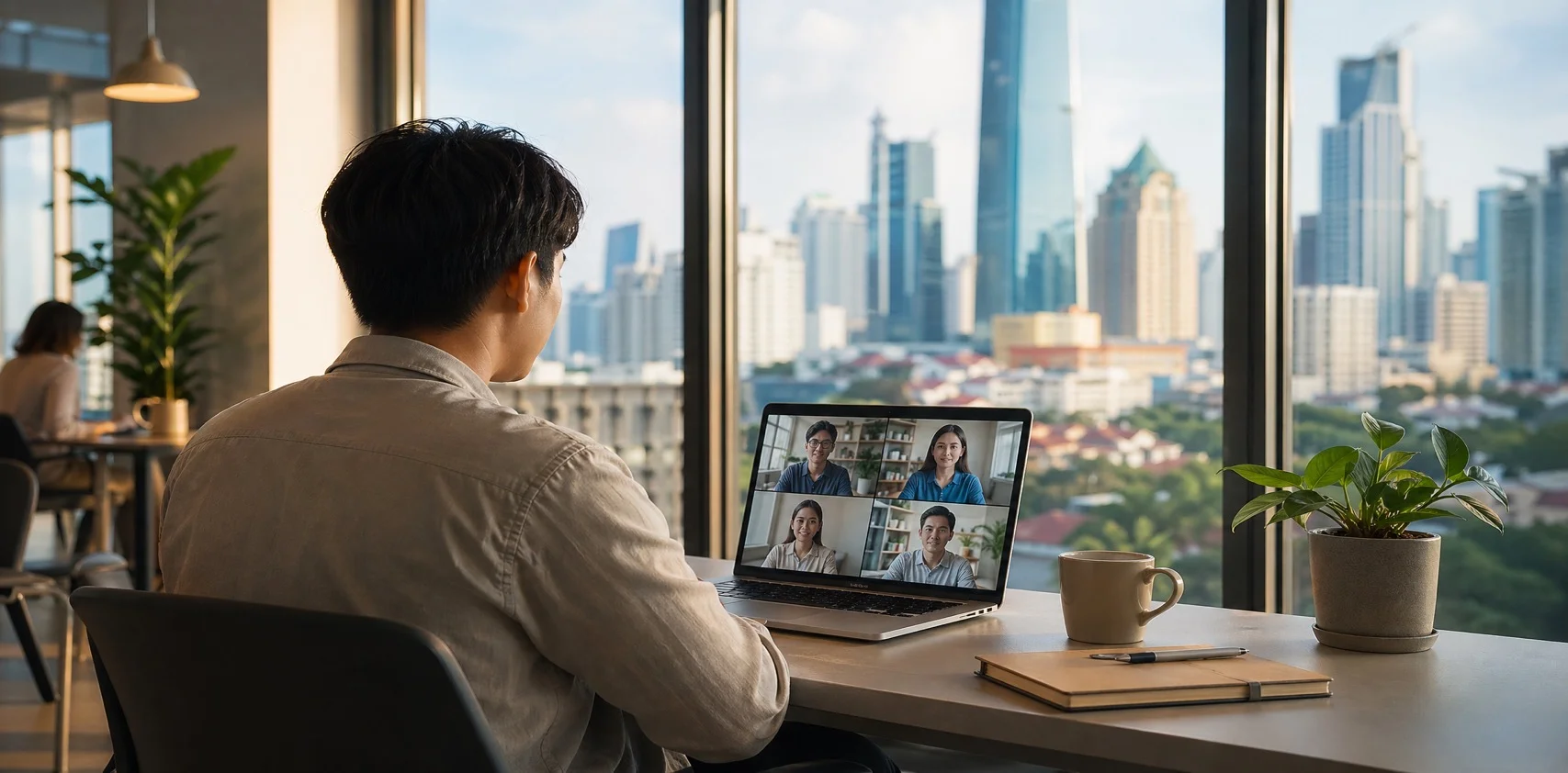
AI Generated - Editorial Use
Remote workers tend to overestimate freedom and underestimate collaboration costs. Information alignment, trust building, ambiguity resolution, and risk sensing that offices handle automatically all require deliberate effort in remote settings. Three layers of cost emerge: compounding communication delays, the precision tax of async communication, and accelerated trust erosion. Freedom and structure are complements, not opposites. Remote workers who develop core project management capabilities can make their freedom genuinely sustainable.
For most people, the appeal of remote work begins and ends with one word: freedom.
No commute. No cubicle. No dress code. No manager hovering near your desk at 4:47 PM wondering if you're really working. Just a laptop, a decent internet connection, and the open road. A café in Chiang Mai, a coworking space in Lisbon, a rented apartment in Tokyo, or simply the couch at home. Your time, your space, your rhythm.
These are real benefits. They are not exaggerated, and they are not trivial. For many people, the ability to choose where and when they work is genuinely life-changing.
But they are only half the story.
The other half tends to reveal itself three to six months into the remote work experience: the freedom you gained came bundled with a sharp increase in collaboration costs. These costs were always there, but in a traditional office, they were absorbed invisibly by physical space, daily routines, and organizational structure. Once the office disappears, every one of those costs surfaces and becomes something you must handle deliberately, every single day.
This article is not about whether remote work is good or bad. It is about a more practical question: why freedom and collaboration costs are so consistently misjudged, and what it takes to recalibrate.
What the Office Was Quietly Handling for You
Before examining the collaboration costs of remote work, it is worth pausing to consider what the office was doing behind the scenes.
Information alignment. In an office, the current status of a project often reaches you without anyone deliberately sharing it. You walk past a colleague's desk and notice she is revising the pitch deck. You bump into another colleague in the break room and learn that the client timeline has slipped. This information flows through the physical environment with zero orchestration.
Trust accumulation. In an office, you see your colleagues every day. You observe when they arrive, how they handle problems, whether they ask for help when stuck. Trust builds through these small, continuous observations without anyone consciously investing in it.
Instant clarification of ambiguity. Much workplace communication is imprecise: "Can you take a look at this?" "Just handle it for now." "Make it roughly right." In an office, the recipient can immediately turn around and ask, "Which version do you mean?" Two seconds, clarified. The manager can walk over an hour later to check that things are on track.
Early conflict resolution. Face-to-face, tone, facial expressions, and body language are all visible. Many potential frictions get resolved before they escalate. A furrowed brow, a quick "everything okay?", and the issue is caught early.
All of the above happen in an office with virtually no conscious effort. They are like oxygen: invisible, taken for granted, essential.
Then remote work removes the office.
The oxygen disappears. Every single one of those functions now requires deliberate effort, active design, and ongoing energy.
That is collaboration cost.
Three Layers of Collaboration Cost That Remote Work Amplifies
Remote collaboration cost is not a single, monolithic thing. It operates on at least three distinct layers, each of which becomes significantly heavier in a remote setting.
Layer One: The Compounding of Communication Delays
In an office, a question can go from "raised" to "resolved" in minutes. Walk to a colleague's desk, ask, get an answer. But in a remote environment, the same question follows a very different path:
You type out the question and send it. You wait for the other person to come online. They see it but are not entirely sure what you mean, so they ask a clarifying question. By the time you see their reply, two hours have passed. You respond, but they are now in another meeting. The next morning, they finally read your answer, but they have lost the thread and need to re-read the entire conversation for context.
A question that would have taken five minutes in an office now takes a full day or longer.
If this happened occasionally, it would be manageable. But in real projects, a dozen such questions are running in parallel at any given time. Each one is waiting, each one is delayed. And the delays are multiplicative, not additive: the answer to Question A depends on Question B, which is blocked by the confirmation of Question C. The entire chain slows down together.
This is why many remote workers find that their actual working hours have not decreased. The workload may not have grown, but waiting and repeated clarification now consume a significant portion of each day.
Layer Two: The Precision Tax of Asynchronous Communication
Remote work almost inevitably moves toward asynchronous communication. When team members are spread across time zones, you cannot wait for everyone to be online simultaneously. Slack messages, emails, and comments in project management tools become the primary channels.
The benefits of async are well known: people can process information in their own optimal state without being interrupted. But async carries a cost that is frequently overlooked: every message must be significantly more precise, because the recipient will read it at an unknown time and cannot ask for immediate clarification.
In an office, you can say, "There's something off with the report; can you check?" because the other person can immediately ask, "Which report? What's off?" In an async environment, the same message needs to be: "Page three of the Q2 revenue report shows a 12% discrepancy between North American figures and the CRM data. I cross-referenced against the March 15 snapshot. Could you confirm whether this is a scope difference or a counting gap?"
The second version is far more precise, but it also requires the sender to spend considerably more time organizing their thoughts, verifying facts, and providing sufficient context.
This is the "precision tax": every act of communication demands more cognitive effort than its in-person equivalent. A handful of such messages per day is fine. But when you are writing thirty or fifty high-quality async messages daily, the cognitive load becomes genuinely exhausting.
Many remote workers end their days feeling drained without being able to point to any single major accomplishment. The reason is often here: a large share of their mental energy went into ensuring communication quality rather than doing the work itself.
Layer Three: The Erosion of Trust
This is the most easily overlooked layer, and potentially the most consequential.
In an office, trust accumulates continuously. Daily face-to-face interaction, even without deliberate effort, steadily builds interpersonal confidence. But in a remote environment, there is no passive trust-building mechanism.
Worse, trust erodes in a remote setting far faster than it builds.
A colleague takes two days to reply to your message. You do not know whether they were dealing with a time zone gap, a family emergency, a more urgent project, or whether they simply did not care. In an office, you would see them the next day and probably learn that they had been buried in a deadline. In a remote setting, all you see is a chat window that has been silent for 48 hours.
The human brain, when faced with insufficient information, defaults to negative interpretations. "Are they ignoring me?" "Do they think my request is unimportant?" "Are they not committed to this project?" These thoughts arise without any factual basis.
In an office, such thoughts are naturally dissolved by the next day's interaction. In a remote setting, they accumulate, ferment, and eventually become genuine interpersonal problems.
This explains a paradox common in remote teams: on the surface, everyone is polite and professional in their messages, but the underlying trust level is often lower than in co-located teams. Trust simply cannot build as fast as it erodes.
Time Zones: More Than a Scheduling Problem
If all remote workers operated in the same time zone, the issues above would still exist but would at least be mitigated by overlapping working hours. The reality of digital nomad life, however, is often different: one person in Taipei, a collaborator in Berlin, a client in New York. Three time zones, a few hours of overlap at best.
Decision delays. In an office, a decision requiring two or three people's agreement can be made in a fifteen-minute huddle. Across three time zones, the same decision requires each person to see the message, think, and respond during their own working hours. One round of communication takes 24 hours. If someone raises an objection, another round. A straightforward decision can take three to five days. During that time, all work that depends on the decision is stalled.
Handling urgencies. Your "urgent" might be someone else's 3 AM. You cannot call them. Even if you leave a message, it will not be seen until their workday begins. This forces remote workers to redefine urgency: many things that are "urgent" in an office must be downgraded to "important but can wait" in a cross-timezone setup.
Social isolation by time zone. When your working hours overlap with the team by less than two or three hours, you are not just working at a different time. You exist in a different social dimension. You miss spontaneous online gatherings, you are always the last to respond in channels, you are absent from every real-time discussion. Gradually, you shift from "team member" to "that person in the other time zone."
Freedom Does Not Mean Less Management
Many people leave the office carrying an implicit assumption: remote work means less management, fewer processes, fewer rules. That assumption is part of what makes "freedom" so appealing.
The reality is the opposite.
Remote work does not need less management. It needs more deliberate, more conscious, more carefully designed management. The difference is that this management is no longer provided automatically by the organization. Each individual must supply it themselves.
Reporting cadence. In an office, reporting happens organically. The manager walks past your desk and roughly knows what you are working on. Monday morning standup, two minutes per person. These mechanisms are lightweight and almost effortless.
In a remote setting, if no one proactively reports, no one knows what you are doing. From your perspective, you may have spent the entire day productively solving problems. From everyone else's perspective, you simply vanished for a day. No one knows whether you were busy, resting, or stuck.
This is the single most common trigger for trust crises in remote work. Not because people are not working, but because no one can see that they are.
Reporting is also about early risk detection. In an office, if someone is stuck for a full day, the manager probably notices by afternoon. In a remote setting, the same situation might not surface for three days, during which all dependent work quietly falls behind.
Risk anticipation. Experienced project managers know that the key to risk management is not handling problems after they occur but identifying them before they happen: assess impact, prepare responses. In an office, risk signals emerge naturally through daily interaction: a colleague looks stressed, another department seems overloaded, a vendor's email responses are getting slower. You pick up on these cues without any formal process.
Remote work severs all of these signal channels. You cannot see facial expressions. You do not know what other teams are dealing with. You miss the subtle early warnings. By the time a problem becomes visible in text messages, it is usually already serious.
This means that in remote environments, risk identification must shift from passive sensing to active mechanisms: scheduled risk reviews, structured status updates, explicit escalation paths. These practices might seem overly formal in an office. In a remote setting, they are survival essentials.
Expectation alignment. The biggest invisible threat in remote work is "everyone assumes expectations are aligned when they are not."
In an office, misaligned expectations are caught quickly. You submit a report, the manager flips through two pages, frowns slightly, and you know on the spot that something is off. Adjustment happens immediately. In a remote setting, you submit a report, the other person reads it three days later, spends a day writing feedback, and you see it a week after submission. In that week, you may have already built further work on top of the original direction.
The later a directional error is discovered, the higher the correction cost. Remote work inherently stretches the discovery lag.
Therefore, remote workers must make expectation alignment an active, deliberate practice. Before starting, write down your understanding of goals, scope, and delivery standards, and confirm agreement. During execution, set regular checkpoints so deviations are caught early. After delivery, proactively seek feedback rather than waiting for it.
The Freelancer's Compounded Challenge
The dynamics described above are already demanding in remote teams with organizational support. For remote freelancers, the challenge compounds further.
Freelancers typically serve multiple clients simultaneously. Each client has different communication preferences, different reporting expectations, different tool ecosystems. Client A uses Slack, Client B uses Teams, Client C insists on email. Client A wants daily updates, Client B is fine with weekly, Client C mostly does not check in but occasionally demands a sudden progress review.
The freelancer must switch between these frameworks constantly, with no one to help integrate them. You are your own project manager, your own communication coordinator, your own risk officer.
The additional difficulty is that freelancers have no "colleague buffer." In a team, if you momentarily miss something, a teammate might catch it or remind you. As a freelancer, you face every client alone. When a ball drops, it truly drops.
Many freelancers go through a painful learning curve in their first year or two of remote work: from "I'm finally free" to "Why am I spending more time on communication and coordination than on actual work?"
This shift is not because freedom is bad. It is because freedom inherently includes the reality that you must now absorb every cost that organizations used to handle.
Tools Are Not the Solution
When confronted with remote collaboration challenges, the instinctive response is to adopt tools. Slack for real-time messaging, Notion for documentation, Asana for project tracking, Loom for async video, Zoom for meetings.
These tools are useful. But tools solve the "channel" problem, not the "method" problem.
If a team does not know when, how often, or in what format to report progress, no amount of tooling will help. Slack channels become information junkyards. Notion pages become unupdated ruins. Asana boards become forgotten to-do lists.
Tools are the vehicle. Method is the engine. An effective remote collaboration method should answer: Who needs to know what? How frequently? In what format? Who confirms that information was received? What is the escalation path when things go wrong? What severity level requires immediate attention, and what can wait until the next business day?
If these questions are not answered, even the best tools merely move the chaos online.
Interestingly, these questions are not unique to remote work. They are, at their core, project management questions. In an office, they were masked by the physical environment and never felt urgent. Remote work strips away that mask and turns them into non-negotiable fundamentals.
Rethinking Freedom
At this point, it may be useful to reframe what "freedom" actually means in the context of remote work.
The freedom remote work provides is genuine: location independence, time flexibility, no commute, the ability to design your own workspace. These advantages are real and valuable.
But freedom is not free. Its price is that you must now personally handle everything that used to be absorbed automatically by office structure, organizational processes, and physical proximity.
This is not a bad trade. But it is a trade that needs to be clearly understood.
People who overestimate freedom assume that remote work simply removes constraints while everything else stays the same. People who underestimate collaboration costs assume that Wi-Fi and a laptop are sufficient for work to flow as smoothly as it did in an office.
Those who thrive in remote work long-term have usually undergone a cognitive shift: they recognize that freedom and structure are not opposites but complements. Better structure supports greater freedom. A remote worker with a clear reporting rhythm, explicit expectation alignment, and effective risk management actually enjoys more genuine freedom than the one who "doesn't want to deal with any of that." Because their freedom is built on a controllable foundation, not on luck.
From a Technical Problem to a Capability Problem
The challenges of remote collaboration look, on the surface, like technical issues: which tools to use, how to configure processes, how to schedule meetings across time zones. But at a deeper level, they are capability issues.
Specifically, remote workers need the core skills of project management. Not the certification-and-framework variety, but the practical kind: how to keep things moving, how to keep collaborators confident, how to deliver results in environments full of uncertainty.
This capability includes several dimensions:
The ability to break ambiguous goals into clear, actionable tasks. Remote environments do not tolerate "let's just start and see." The cost of course correction is too high. Goals, scope, and expectations must be clarified before work begins.
The ability to design effective reporting and communication mechanisms. When to report proactively, in what format, at what level of detail, under what circumstances to escalate. These are not optional administrative tasks. They are survival skills for remote work.
The ability to proactively identify and manage risks. In an office, you can afford to wait for problems to surface. In a remote setting, you must actively look for them. By the time they surface on their own, they are usually already large.
The ability to build and maintain trust without face-to-face interaction. This means being highly predictable: delivering on promises, meeting deadlines, communicating proactively, and never leaving the other party guessing about your status.
These capabilities are neither innate nor automatically developed through experience. They need to be systematically understood and practiced.
Final Thoughts
The real challenge of remote work has never been "Can you manage yourself?" Most people who choose remote work have no problem with self-discipline.
The real challenge lies in the things that are harder than self-discipline: How do you keep a project moving forward when you cannot see each other? How do you make decisions when time zones do not overlap? How do you maintain trust, align expectations, and manage risks through text-only communication?
If you are currently working remotely, or about to start, consider shifting your attention from "how to get more freedom" to "how to handle the collaboration costs that come with freedom." This is not a discouraging shift. Quite the opposite: when you have the capability to handle those costs, your freedom becomes genuinely solid.
And if you find that the hardest part of remote work is not self-discipline but cross-timezone collaboration, reporting rhythms, project progression, and risk management, it might be worth investing one day to systematically close that gap. The 101 Project Management Intensive by Da Ren Xue is built for exactly this: not textbook frameworks or certification prep, but the practical skills for keeping things moving and keeping your team confident in chaotic environments, so you can enjoy freedom while also being equipped to bear its invisible weight.
This content is protected by copyright. Please respect the author's work and do not copy or distribute without permission.
數位遊牧編輯群 Digital Nomad Editor Group
Digital Nomad is a knowledge sharing platform specially designed for “those who dream to become digital nomads.” We share the latest news and industry trends related to digital nomadism, as well as introduce essential skills and knowledge needed for freelancers, remote workers, etc. Our goal is to help you connect with fellow digital nomads!
