


Second-Generation Nomads: How Do Kids Who Grow Up in Airbnbs Define "Home"?
June 9, 2026
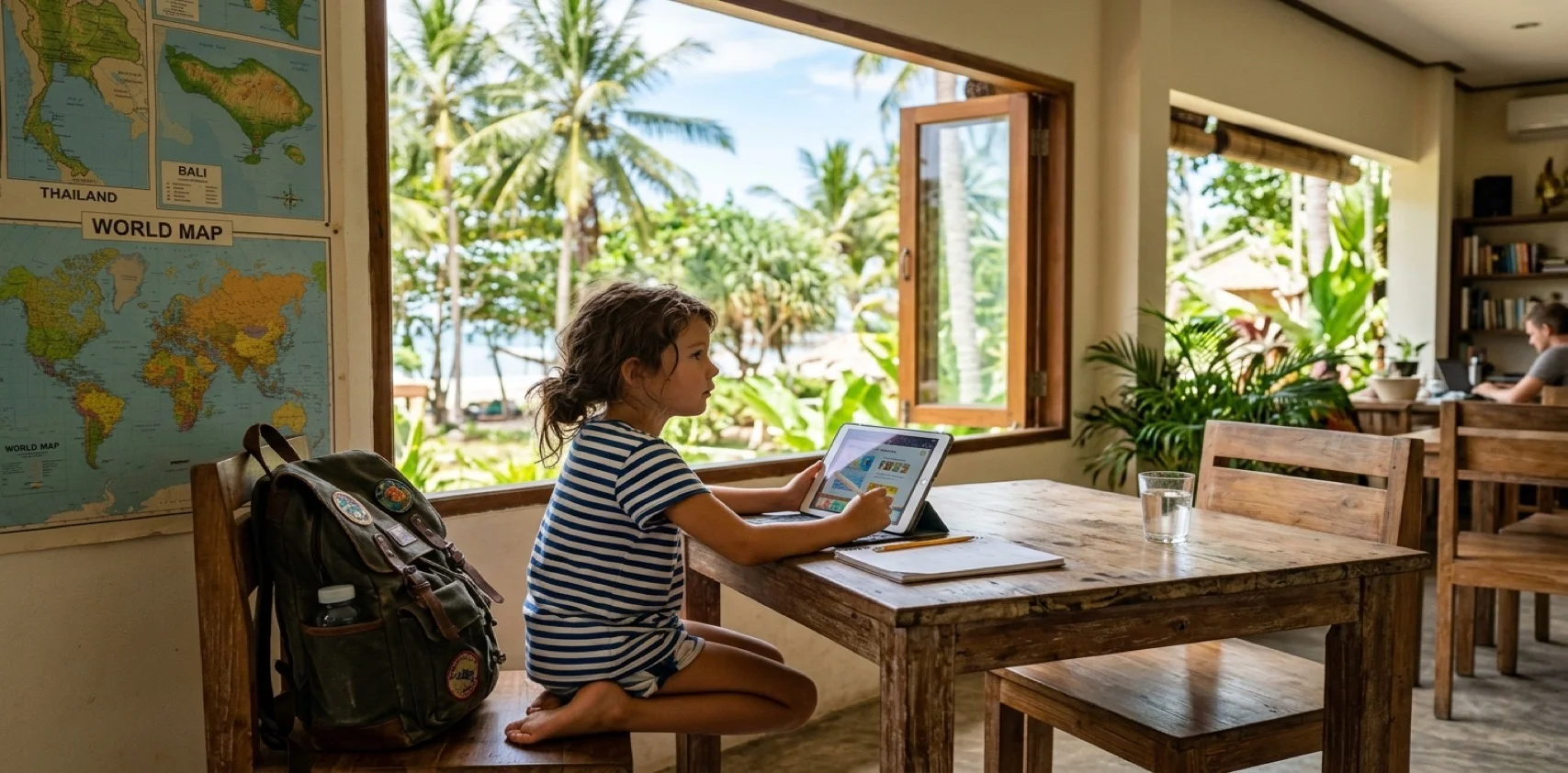
AI Generated - Editorial Use
The global worldschooling movement has surged from 5,000 families in 2018 to over 45,000 in 2025. Research shows nomadic childhoods can boost cognitive flexibility and multilingual ability, but may also compromise attachment security and deep friendship development. A Utrecht University study tracking 312 high-mobility families found nearly one in four young children exhibited clinical separation anxiety. This article examines nomad kids through academic research, firsthand accounts, age-specific developmental needs, legal gray areas, and economic realities.
In the living room of a month-to-month apartment in Chiang Mai, eight-year-old Liam sits cross-legged on the floor, working through fraction exercises on Khan Academy. From the next room comes the sound of his mother typing. His father has ridden a motorbike to a coworking space two blocks away. Outside, the afternoon monsoon hammers the tin awning with its usual punctuality.
This is the fourth city Liam has lived in this year. Lisbon, Mexico City, Bali, and now Chiang Mai. He has learned to check his phone for the time zone every morning upon waking. He has learned to use Google Translate to decode Thai menus into English. He has also learned not to get too attached to any particular bed.
Ask him where home is, and he tilts his head for a few seconds before answering: "Wherever Mom is."
It is a charming answer. But the fact that an eight-year-old needs to substitute a person for a place when answering that question is, in itself, worth pausing to think about.
From Fringe Experiment to Family Movement
Raising children on the road was, five years ago, the province of a small and adventurous minority. Today it is rapidly entering the mainstream, at a scale that can no longer be dismissed as niche.
Data from the Worldschooler Foundation traces a steep growth curve: the number of self-identified worldschooling families worldwide grew from roughly 5,000 in 2018 to over 45,000 in 2025, a ninefold increase in seven years. COVID-19 was the force that kicked the door open. Once remote work stopped being a Silicon Valley perk and became a global labor-market standard, solo nomads began starting families on the road, and established families packed up their settled lives to join them.
The largest worldschooling community on Facebook, "Worldschoolers," has more than 150,000 members. On Reddit's r/digitalnomad, discussions about nomading with children surged from around 30 posts per month in 2020 to over 200 per month in 2025. These numbers point not merely to a trend but to an emerging family structure.
The question that keeps parents awake, regardless of where they fall on the spectrum, remains stubbornly the same: Is this actually good for the kids?
The Case in Favor
Parents who advocate for worldschooling are not operating on faith alone. They have research to cite.
The cognitive advantages of multicultural exposure have empirical support. Research by UCLA developmental psychologist Patricia Greenfield found that children regularly exposed to different cultural environments scored 15 to 20 percent higher on cognitive flexibility tests than peers raised in monocultural settings. Cognitive flexibility is the ability to switch thinking modes across different contexts. In a world of compounding complexity and accelerating change, it amounts to a survival advantage.
Language acquisition outcomes are similarly well-documented. A 2023 longitudinal study from Cambridge University found that children who lived in three or more countries between the ages of 6 and 12 were fluent in an average of 2.3 languages. More strikingly, their reaction times in language-switching tests were roughly 200 milliseconds faster than those of monolingual peers. No after-school language program can replicate that result.
The real world as classroom is another compelling argument. An eight-year-old converting Thai baht to US dollars at a market stall in Chiang Mai likely develops a more intuitive grasp of arithmetic than a peer memorizing formulas in a classroom. Worldschooling families widely adopt some form of self-directed learning, allowing children to find motivation in real-world contexts. When math stops being an abstraction on a test paper and becomes a currency-exchange problem that needs solving right now, intrinsic motivation ignites on its own.
The forging of adaptability is also frequently cited. Rebuilding a social life in an unfamiliar city every few months either produces a child with exceptional social skills or crushes one. Advocates believe the former is the norm.
These arguments have solid foundations. The problem is that they tell only the first half of the story.
What the Research Also Shows
The evidence assembled by researchers paints a considerably more complex picture.
Attachment is the first piece of the puzzle to examine. A 2022 position paper from the British Psychological Society (BPS) stated explicitly that for children under six, a stable physical environment is one of the important conditions for the formation of secure attachment. In John Bowlby's foundational framework for developmental psychology, a core concept is the "secure base": the place from which a child ventures out to explore the world and runs back to when frightened. When the base itself shifts every few months, where does that instinct to run back lead?
A substantial 2024 study from Utrecht University in the Netherlands tracked 312 families that had relocated more than five times over a three-year period. It found that approximately 23 percent of children aged 4 to 8 in those families exhibited clinically significant symptoms of separation anxiety, double the rate in the general population. The same study, however, identified an important buffer: when at least one parent provided two or more hours of focused, one-on-one time per day, the rate of separation anxiety dropped significantly to around 12 percent. The quality of parent-child interaction can partially offset the instability introduced by frequent moves. But the operative word is "partially," not "fully."
The depth of friendship is the second issue that tends to be underestimated. Nomad children typically get faster at making friends over time, and no one disputes this. But speed and depth have never been the same thing. Child development scholar William Corsaro, who has spent decades studying children's peer cultures, identifies ages 7 to 12 as the critical window for developing deep friendships. These relationships require extended shared time and the full cycle of conflict, cold shoulders, reconciliation, and renewed play. A life rhythm that changes cities every three months can almost never provide those conditions.
Sarah Pura, a nomad mother who runs the "World School Family" blog, has been candid about this: "My kids can make friends anywhere, but they don't really know how to maintain a long-term friendship. That's something we're still working on."
Academic achievement data conceals a statistical trap that is easy to overlook. Advocates like to cite the strong performance of worldschooled children on standardized tests, but these data carry serious selection bias. Families that can afford to travel the world with their children already possess higher socioeconomic status, higher educational attainment, and more time and money to invest in their children's education. Are the good test scores a product of nomadism itself, or of the kind of family that was already positioned to educate their children well?
In 2024, the National Home Education Research Institute (NHERI) in the United States conducted a more rigorous analysis. After controlling for household income and parental education level, it found no statistically significant difference in academic achievement between worldschooled children and those receiving traditional homeschooling. This result points to an uncomfortable possibility: the variable that actually matters may not be travel itself but parents' willingness to invest heavily in their children's education.
What the Kids Themselves Say
In the adults' debate, the voices most easily drowned out are those of the people who actually lived through this kind of childhood.
"Grown Unschoolers" is an online community of several hundred adults who were raised in nontraditional educational environments. Some of their childhood experiences closely resemble what we now call worldschooling, and their feedback forms a picture that resists easy categorization.
Mika (a pseudonym), 27, lived in 19 countries between the ages of 5 and 14. "People always say how lucky I am. But they don't know how many years it took me to figure out where I'm actually from. My passport is American, I was born in Japan, and the longest I stayed anywhere was Portugal. Whenever someone asks, 'Where are you from?' I still freeze up."
Mika is equally open about the gains: "I'm comfortable anywhere. I can talk to anyone. I'm not afraid of change. In the workplace, those are enormous assets."
Tom, 24, tells a very different story. His parents took him and his younger sister on the road starting when he was 8 and only settled in Berlin when he was 15. "My parents thought they were giving me the best education possible, and in some ways they were. But what I really wanted was a permanent room, a permanent bed, and friends who would still be there three months later." He paused before continuing: "The first time I had my own bookshelf, at 15, was one of the happiest moments of my life."
A bookshelf. Most children never notice how precious one is, because it has always been there. For Tom, it was the first object in seven years that would not be packed into a suitcase.
These lived experiences reveal something that ideological debates tend to obscure: for children, "home" is often not an abstract concept but an intensely concrete, intensely material reality. The stickers on a bedroom door. The fixed arrangement of books on a shelf. The tree in the nearby park that has been climbed a hundred times. Adults see these as trivial details, easily left behind. In a child's world, they are the bricks and mortar of security.
Age Changes Everything
Any assessment of how nomadic life affects children must contend with age as the central variable. Children at different developmental stages have vastly different needs for environmental stability.
Zero to three: relatively low impact. Infants and toddlers derive their sense of security primarily from the consistent presence and responsive behavior of their caregivers, not from the physical environment itself. As long as the primary caregiver remains constant and responsive, the disruption of relocation is manageable. Many nomad families choose to set out during this window precisely because of this flexibility.
Four to seven: entering sensitive territory. Children at this stage begin to develop a "sense of place," and their attachment extends from caregivers to physical spaces. They know the route home. They remember where the toy box sits in the corner of their room. They care whether the drawings on the wall come along in the move. If nomadic life is to continue through this phase, staying at each location for at least three to six months is a safer approach.
Eight to twelve: the golden window for friendship. Deep friendships take root during this period. Children need sustained time with the same group of peers to complete the full arc from acquaintance through conflict, reconciliation, and trust. Longer stays of six months to a year are advisable during this stage, or at the very least, children should have a stable online social circle that serves as a relational anchor.
Thirteen and above: autonomy becomes the central issue. Teenagers need not just stability but a sense of control over their own lives. If nomadism is the parents' decision rather than the child's choice, pushback is nearly guaranteed. Multiple nomad parents report that their children, upon entering adolescence, express an intense desire to "stay put." Ignoring that signal tends to cost more than adults expect.
What Successful Families Look Like
Not all nomad families face the same degree of difficulty. Some manage to maintain a sense of stability for their children within a life of movement. Their approaches share several identifiable patterns.
They choose slow nomadism over fast travel. Successful cases typically stay at each location for at least three months, sometimes six months or a full year. The critical distinction is that they are not "traveling" but "living in different places." Three months is enough time for a child to establish a daily rhythm, learn the surrounding streets, and befriend the neighbor's kids.
They build a portable sense of home. Some families carry a handful of objects their child is most attached to and reconstruct a miniature familiar environment at each new residence. One nomad mother's rule: no matter where they move, the same nightlight sits on the bedside table and the same stuffed rabbit rests beside the pillow. It sounds trivial. For a young child's sense of security, it has disproportionately large effects.
They deliberately maintain social connections that survive relocation. In many successful cases, children participate in regular online classes or nomad-kid communities, ensuring a set of stable friendships that transcend geography. Some families intentionally return to the same city each year for a few weeks, reconnecting their children with old friends.
They create stability in the dimension of time. Spaces may change, but daily rhythms stay consistent: a fixed wake-up time, a fixed study block, a fixed window of free play. When physical surroundings keep shifting, temporal regularity becomes the most important psychological anchor a child has.
And the most critical common thread: they listen to their children. When a child says, "I don't want to leave," they do not override that feeling with "This is good for your development." They treat their child as a stakeholder in this lifestyle, not a passive passenger along for the ride.
An Emerging Support Ecosystem
The growing scale of nomad families has spawned support systems designed specifically for them.
Boundless Life is one of the largest nomad-family communities currently operating, with hubs in Portugal, Greece, and Italy. It offers an integrated package of coworking spaces, children's education programs, and community activities. Family monthly fees range from roughly 2,000 to 3,000 euros, covering housing, children's classes, and social events. This model directly targets the biggest pain point for nomad families: giving children a stable social circle.
Worldschooler Hubs represent another expanding model. In nomad-heavy cities like Chiang Mai, Mexico City, and Medellín, a growing number of informal learning centers cater specifically to nomad families' children, providing group learning and socializing several days a week. Most are organized by nomad parents themselves, with monthly fees of roughly 200 to 500 US dollars, though quality varies considerably.
Online schools such as Sora Schools, Prisma, and Synthesis offer education options untethered from geography. Built around project-based learning and small-group interaction, they charge annual fees ranging from 5,000 to 15,000 US dollars. For families that need formal academic credentials, these online schools may represent the most pragmatic middle path currently available.
Law and Bureaucracy: The Gray Zone Nobody Wants to Discuss
Behind the appealing narrative of nomad family life, legal compliance is an issue that is systematically avoided.
Most countries' compulsory education laws require school-age children to receive some form of formal education. But when confronted with the scenario of "homeschooling abroad," legal frameworks in many jurisdictions are vague at best. Germany, for example, has an effective ban on homeschooling. A German family nomading with children in Thailand could theoretically be in violation of their home country's compulsory education laws, even if enforcement is practically impossible from overseas.
More immediate, day-to-day concerns include cross-border continuity of health insurance, international management of vaccination records, and language barriers during medical emergencies. One nomad father recalls that when his child developed a persistent high fever in Vietnam, it took three hours to find a hospital that could communicate in English. He says it was the closest he ever came to giving up the nomad life.
The Cold Water of Economic Reality
The nomad family lifestyle is often packaged as a money-saving proposition: lower cost of living in Southeast Asia, no sky-high rent, no school-district premiums. This narrative conveniently omits several important line items.
Education costs do not vanish with nomadism; they simply change form. Online school tuition, learning materials, and tutoring can run between 5,000 and 20,000 US dollars per year. Joining a community like Boundless Life adds several thousand euros per month for bundled housing and education.
Travel expenses themselves are easily underestimated. Airfare for a family of three or four, visa fees, insurance premiums, and the productivity dip that follows each relocation often push actual annual spending 30 to 50 percent above expectations.
The deepest economic issue is opportunity cost. Nomad life typically requires at least one parent to significantly reduce working hours in order to manage the child's education and daily care. In a formerly dual-income household, this amounts to giving up an entire salary. Factor that in, and the claim that nomadism is "cheaper than settling down" begins to wobble.
Back to the Fundamental Question
This article has no intention of persuading anyone to embrace or abandon nomad family life. The honest truth is that the same lifestyle can be a key that opens the world for some children and a source of lasting damage for others. The decisive factor is not nomadism itself but whether the adults making the decision have genuinely placed their child's needs ahead of their own aspirations.
A few questions worth answering honestly:
What is driving the decision to go nomad? If the primary motivation is the adults' desire for freedom and the child is simply a passenger brought along for the ride, the decision deserves more rigorous self-examination.
How old is the child? The needs of a four-year-old and a fourteen-year-old exist on entirely different planes. There is no one-size-fits-all approach.
Are you willing to change the pace for your child? If your child makes an important friend in a particular city, are you prepared to extend a planned two-month stay to six months? When your child says they want a permanent home, will you take that statement seriously?
Is there an exit plan? If nomad life produces observable negative effects on the child, do you have the resources and the willingness to return to a settled life?
Reimagining "Home"
The existence of nomad families may offer an opportunity for everyone to reexamine what the word "home" actually carries.
In the traditional understanding, home is an address, a building, a physical space wrapped in neighborhood relationships. But nomad children are rewriting that definition through their own lived experience. For them, home might be a person (wherever Mom is), a feeling (the confirmation of being loved and safe), or a set of objects that fit in a suitcase (that nightlight, that stuffed rabbit, that blanket they have slept under for three years).
This fluid interpretation of "home" is neither more advanced nor more backward than the traditional one. But in an era of ever-increasing global mobility, the ability to build a sense of belonging in unfamiliar places is becoming an increasingly scarce resource.
Before celebrating that flexibility, however, one thing is worth clarifying: whose decision was it to go nomad in the first place, the adults' or the child's?
The children who grow up in Airbnbs will eventually become adults. They will carry their own memories back to their childhoods and reassess those years with the understanding that comes with maturity. When that time arrives, their verdict will be the only one that truly counts.
Until that verdict comes in, all the adults who made this choice can do is pause now and then on the road to freedom, look down at the small hand they are holding, and make sure they are holding it tight enough.
This content is protected by copyright. Please respect the author's work and do not copy or distribute without permission.
