


The Rise of Nomad Forex Traders: From Meme to Market Force
June 8, 2026
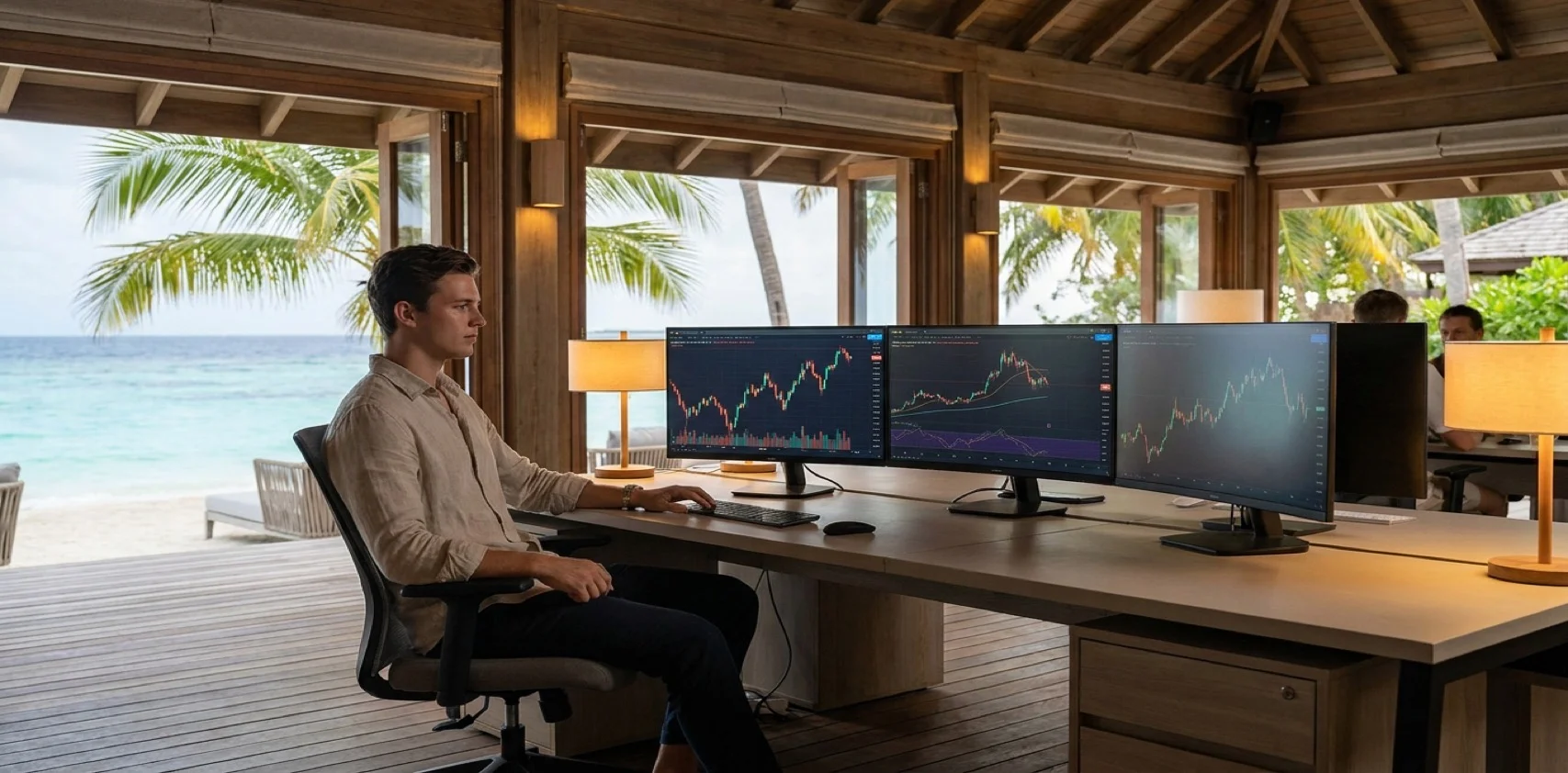
AI Generated - Editorial Use
Trading forex from a laptop on a Bali beach used to be a punchline. In 2026, it's a statistic. Digital nomad forex traders have evolved from a social media meme into a real and growing segment of the global retail forex market. Low-latency mobile tools, the prop firm model enabling zero-capital entry, and nomad visas providing legal residence created a perfect storm. But the survival rate remains brutal — over 70% of retail traders lose money. This article profiles the emerging tribe, their business models, and why most end up spending their savings in exotic locations.
In a coworking space in Chiang Mai, a 27-year-old trader watches a MetaTrader 5 chart on his phone, waiting for the London session to open. His laptop displays a multi-pane TradingView layout beside a Telegram channel where 3,000 members are dissecting the day's cable setup. He has no finance degree and has never worked at a bank. But he manages a $200,000 account funded by a proprietary trading firm.
This scene barely existed in 2020. By 2026, it has become one of the most visible — and most contested — new archetypes in the digital nomad world.
From Joke to Job
The "laptop trader" image circulated on social media for years, mostly as a punchline: beachside screenshots, exaggerated profit displays, "freedom lifestyle" captions. Over the past three years, several converging forces turned the meme into something real.
The first force was the explosive growth of proprietary trading firms — prop firms — operating on a challenge-based model. Platforms like FTMO fundamentally rewired how retail traders access capital. Instead of risking personal savings, a trader pays a challenge fee (typically $100 to $500), passes a performance evaluation on a simulated account, and receives a funded account ranging from $10,000 to $400,000. Profits are split between the trader and the firm, usually at ratios of 70/30 to 90/10 in the trader's favor.
In 2025, the prop firm industry crossed a threshold of institutional legitimacy. FTMO acquired OANDA, one of the world's most recognized retail forex brokers, backed by a $250 million credit facility from a consortium of Czech banks. By March 2026, OANDA had formally migrated its prop trading clients to FTMO's infrastructure. Traditional brokers began launching their own prop brands at an accelerating pace, and the line between prop firm and broker started to blur.
The second force was the maturation of mobile trading technology. TradingView's mobile app now delivers near-desktop-grade charting. MetaTrader 5's mobile client has significantly improved in stability and execution speed. Combined with expanding global 4G and 5G coverage, executing trades from a café in Bali or a coworking desk in Lisbon is no longer a technical compromise — it is functionally equivalent to trading from a home office.
The third force was the normalization of nomadic work itself. As remote employment shifted from fringe to mainstream, the idea of earning a living from a laptop anywhere in the world became culturally unremarkable. Forex — a 24-hour, fully digital, location-agnostic market — was a natural fit.
Portrait of the Nomad Trader
The reality of nomad forex traders diverges substantially from the social media stereotype.
They tend to cluster between ages 25 and 35. Many hold university degrees, though not necessarily in finance — former software engineers, data analysts, and even teachers-turned-traders are common profiles.
Most are not full-time traders, at least not initially. A significant proportion maintain parallel income streams: freelance development, online teaching, content creation. Forex trading functions as an additional revenue layer built on top of an existing nomad lifestyle, rather than the sole source of income.
FTMO remains the dominant platform, but The5ers, FundedNext, and TopStep (focused on futures) hold meaningful market share. Challenge fees range from tens to hundreds of dollars. The pass rate — the critical number in the entire model — is estimated at roughly 10 to 15 percent across platforms based on available public and private data. The percentage of traders who sustain consistent payouts after passing is lower still.
Geographically, Southeast Asia remains the preferred base. Chiang Mai, Canggu in Bali, Bangkok, and Kuala Lumpur offer the optimal combination of low living costs, reliable internet, and time zone coverage spanning the Asian and European sessions. Lisbon, Tenerife, and Mexico City host growing nomad trader communities as well.
Time Zone Arbitrage: The Structural Edge
The forex market operates across three major sessions — Asian, European, and American — each with distinct liquidity and volatility characteristics. The nomad's geographic flexibility provides an advantage that office-bound traders cannot easily replicate: time zone arbitrage.
A trader based in Europe can trade Asian-session yen pairs in the early morning hours (lower volatility, suited to range strategies), then shift to European-session euro and sterling trades during the highest-liquidity window of the day. The same trader, relocated to Southeast Asia, can trade the New York session in the evening — positioning around U.S. economic data releases and their associated volatility spikes.
This ability to align biological rhythm with market rhythm by choosing where to live is a genuine structural advantage. The nomadic lifestyle minimizes the mismatch between the trader's waking hours and the market's most productive hours.
Prop Firm Economics: Can You Actually Make Money?
The business model at the heart of prop firms is not primarily about the profits generated by successful traders. It is about challenge fees.
A typical scenario: a trader pays $300 to enter a challenge requiring 8 to 10 percent profit within 30 days on a simulated account, with a maximum drawdown limit of 5 to 10 percent. Upon passing, the trader receives a $100,000 funded account — still simulated, but with real payouts based on performance — and profits are split 80/20.
In the ideal case, a trader generating a consistent 3 percent monthly return on a $100,000 account earns $3,000 per month in gross profit. At an 80 percent split, that is $2,400 in take-home income. In Chiang Mai or Canggu, this is a comfortable monthly income.
Reality is considerably less forgiving.
Data mandated by the European Securities and Markets Authority (ESMA) shows that 75 to 80 percent of retail forex traders lose money. Within the prop firm model, the picture may be worse. Traders who fail challenges lose not only their fee but often retry multiple times, compounding their total expenditure. Industry estimates suggest that most traders spend well beyond their initial challenge fee before eventually quitting.
For prop firms, challenge fees are a significant component of revenue. Failed traders' fees subsidize the payouts to successful traders. The economic structure is analogous to a poker tournament — a small number of winners funded by a large pool of entry fees.
The Tax Optimization Motive
Beyond lifestyle appeal, tax considerations are a powerful and often understated driver of the nomad trading phenomenon.
Tax treatment of forex profits varies enormously by jurisdiction. In the United States, forex income may be taxed at ordinary income rates up to 37 percent. In the United Kingdom, CFD trading profits are classified as gambling income and are tax-free — provided trading is not the individual's primary income source. Under Portugal's Non-Habitual Resident (NHR) regime, foreign-source investment income can qualify for exemption or reduced rates under specific conditions.
By selecting their country of residence, nomad traders can legally optimize their tax burden. Holding Portuguese NHR status, establishing Dubai tax residency, or using jurisdictions that do not tax foreign-source income (Panama, Georgia) are widely discussed strategies in trading communities.
However, the boundary between tax optimization and tax evasion is not always sharp. Many countries have complex rules for determining tax residency, and the nomadic lifestyle's frequent relocations can trigger simultaneous tax obligations in multiple jurisdictions. Without professional cross-border tax planning, what begins as "optimization" can become legal exposure.
Survivorship Bias on Display
Search "forex trader lifestyle" on Instagram or TikTok. The results are uniformly aspirational: luxury apartments, profit screenshots, laptops on beaches. This picture suffers from acute survivorship bias.
The traders who consistently produce social media content are, by definition, the small minority who have succeeded. Those who lost money do not film their failures. Those who quit do not return to share lessons. The result is a profoundly distorted representation of actual success rates.
More concerning is the revenue model behind many high-visibility "traders." Their real income often derives not from trading itself but from selling courses, signal services, or earning prop firm referral commissions. This creates a self-reinforcing cycle: the image of success attracts students and followers, and the tuition and referral income far exceeds actual trading profits.
Not all trading education is fraudulent — genuinely skilled educators exist. But consumers should understand that the correlation between a trader's social media influence and their actual trading performance is far weaker than intuition suggests.
Why Most Will Fail
The high failure rate in forex trading is not accidental. It is structural.
Leverage is a force multiplier in both directions. Retail forex typically employs leverage of 10:1 to 100:1. A 1 percent price movement at 100:1 leverage equals a 100 percent swing on capital. Leverage amplifies profits but amplifies losses far more lethally — especially for traders without rigorous risk management discipline.
Market efficiency does not favor retail participants. The major players in forex — central banks, investment banks, and large hedge funds — possess informational advantages, execution speeds, and analytical resources that retail traders cannot match. In this ecosystem, the retail trader is the weakest participant.
Psychological destruction is underestimated. The greatest enemy in trading is often not the market but the trader's own emotions. Fear triggers premature profit-taking. Greed prevents timely loss-cutting. The isolation and lack of structured social support inherent in nomadic life can amplify these psychological traps.
Prop firm rules are themselves a stress factor. Maximum drawdown limits, time constraints, and profit targets force decision-making under pressure — and pressure is the primary catalyst for irrational trading behavior.
What Comes Next
Despite the risks, nomad forex traders as a cohort are moving from the periphery toward the mainstream. FTMO's acquisition of OANDA signals that the prop firm model has earned a measure of institutional acceptance. Advances in mobile trading technology continue to lower infrastructure barriers. The emergence of AI-assisted trading tools — from automated technical analysis to sentiment-parsing algorithms — is creating new possibilities for technically skilled nomad traders.
But the core reality will not change: forex trading is a negative-sum game after spreads and commissions, and the majority of participants will lose money. The geographic freedom and tax flexibility that nomadic life provides are genuine advantages, but they cannot substitute for trading skill itself.
For digital nomads considering this path, the most honest advice may be this: validate your edge with minimal capital over the longest possible time horizon before treating trading as an income pillar. Until then, maintain other stable income sources. Because in the world of nomad forex trading, the vast majority of those enviable profit screenshots on social media are missing the most important image of all — the cumulative loss statement that preceded them.
This content is protected by copyright. Please respect the author's work and do not copy or distribute without permission.

數位遊牧編輯群 Digital Nomad Editor Group
Digital Nomad is a knowledge sharing platform specially designed for “those who dream to become digital nomads.” We share the latest news and industry trends related to digital nomadism, as well as introduce essential skills and knowledge needed for freelancers, remote workers, etc. Our goal is to help you connect with fellow digital nomads!
