


Taiwan Has Everything Digital Nomads Want. It Just Hasn't Figured Out How to Say It.
June 2, 2026
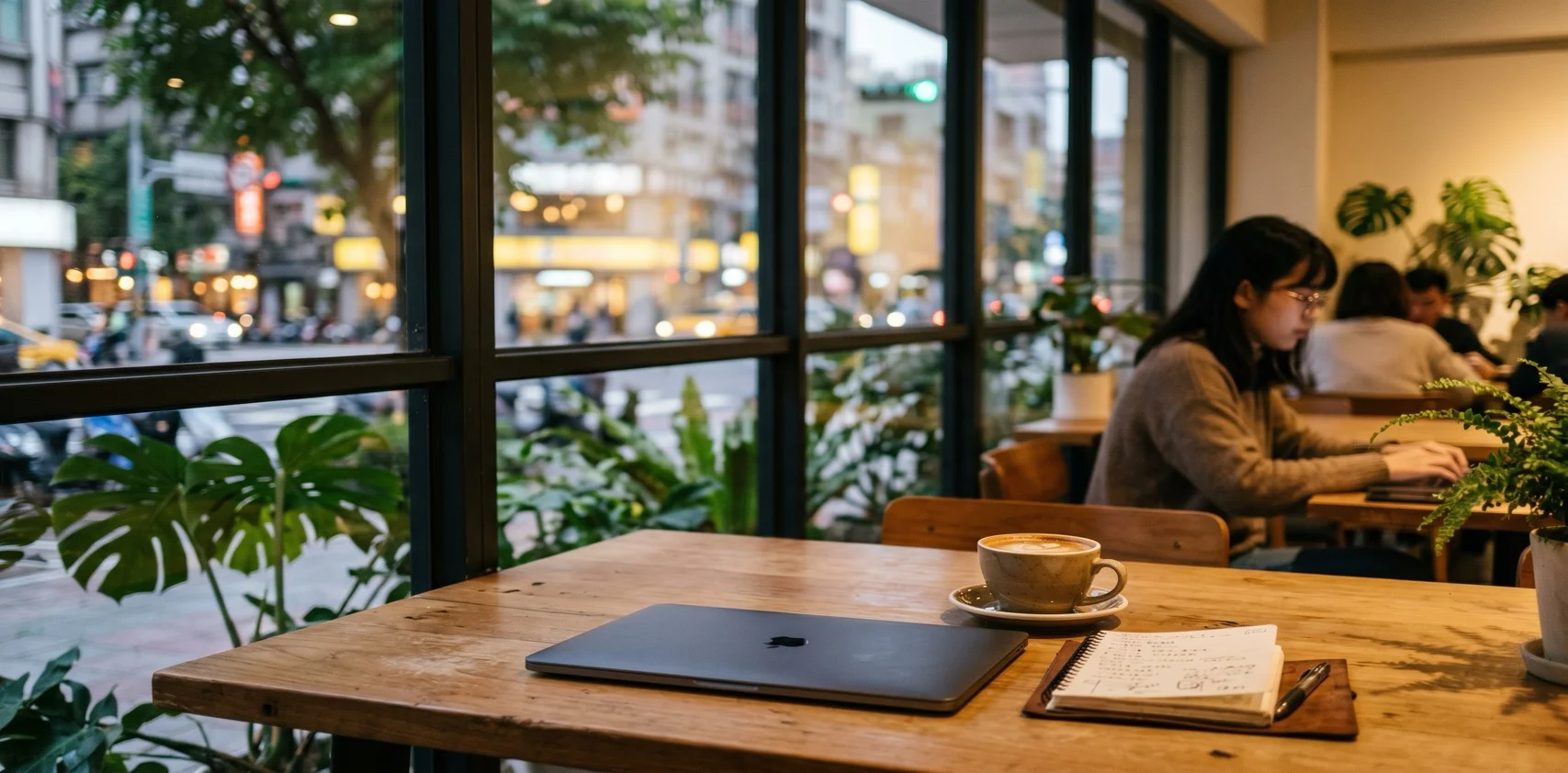
AI Generated - Editorial Use
Taiwan ranks near the top on almost every metric nomads care about: safety, healthcare, internet, transit, food, and convenience. Yet it barely registers on the global nomad radar. The problem isn't the product; it's the pitch. Taiwan has never packaged its strengths into a clear narrative for international remote workers. This piece unpacks what Taiwan actually offers and asks who should finally tell that story.
Open any digital nomad forum and the same destinations cycle through like a greatest-hits playlist: Bali, Chiang Mai, Lisbon, Medellín, Mexico City. Each comes with a fully formed narrative, a mental postcard that lets prospective nomads picture their life there before booking a flight. Bali is rice paddies and surf breaks between Zoom calls. Lisbon is European sunshine at a fraction of London prices. Chiang Mai is the place where a thousand dollars a month buys a surprisingly comfortable life.
Taiwan? Most nomads couldn't tell you what life there looks like. Not because the experience is lacking, but because almost nobody has bothered to describe it.
Search "Taiwan" on r/digitalnomad and you'll find scattered threads, a handful of people noting that Taipei is "underrated," a few replies agreeing, and then silence. No sustained community discussion, no comprehensive city guides updated season after season, no critical mass of experience reports feeding the algorithm. For a place that checks nearly every box on the nomad wish list, Taiwan's absence from the conversation is genuinely strange.
Because the fundamentals are not just adequate. They are, on many dimensions, best-in-class.
The Product Is There. The Pitch Isn't.
Think of Taiwan as a kitchen stocked with premium ingredients, professional-grade equipment, and plenty of counter space. What's missing is a menu that the people walking past can read.
In digital nomad terms, a "menu" is a coherent information package: what daily life looks like, how much it costs, what the visa situation is, what problems you'll run into, and what your routine will feel like after three months, six months, a year. Bali has had this package for nearly a decade, refined through waves of blogger testimonials, coworking brand marketing, NomadList reviews, and YouTube vlogs. The information pipeline is mature and self-sustaining.
Taiwan has almost none of it.
The tourism bureau promotes Sun Moon Lake, night markets, and Jiufen. Investment promotion targets semiconductor supply chains and corporate relocation. The Employment Gold Card program speaks to high-end professionals in the language of talent recruitment, not lifestyle design. And the recently introduced digital nomad visa, while a welcome policy signal, hasn't yet been wrapped in the kind of storytelling that makes someone actually want to apply.
Nobody is telling international nomads: "Here's what six months in Taiwan actually looks like, and here's why it might be exactly what you need."
Safety You Stop Thinking About
People who live in Taiwan rarely mention personal safety as a selling point. It's too obvious, like praising oxygen for being breathable. But for nomads who have spent years rotating through destinations where situational awareness is a constant background process, Taiwan's safety is not obvious at all. It is extraordinary.
The nomad community has an unspoken understanding that many popular destinations come with real security trade-offs. Mexico City has pickpocketing and mugging risks in certain neighborhoods after dark. Medellín, though far safer than its reputation suggests, still requires knowing which streets to avoid. Lisbon has seen a rise in tourist-targeted theft. Bali's motorbike bag-snatching is a perennial complaint.
None of this makes those cities unlivable. But when you stay somewhere long enough, safety stops being an abstract statistic and starts shaping your daily behavior. You route-plan around sketchy blocks, keep valuables hidden, maintain awareness of your surroundings in a way that drains mental energy even when nothing happens.
In Taiwan, that calculation essentially disappears.
Walking home alone at two in the morning is unremarkable. Leaving a laptop on a café table while visiting the restroom is routine. A phone left on a restaurant counter stays exactly where you put it. These sound like small things, and they are, individually. But accumulated over weeks and months, the absence of low-grade vigilance produces a quality of life that nomads who have experienced it consistently describe as one of Taiwan's most compelling features.
Taiwan's safety isn't fragile or accidental. It rests on structural factors: dense networks of convenience stores and street lighting creating natural surveillance, high social trust, and relatively equitable income distribution that reduces the economic desperation driving street crime in many other countries. These conditions won't evaporate because more foreigners show up.
Healthcare That Removes Fear
If safety means nomads don't have to watch their backs, Taiwan's healthcare system means they don't have to dread getting sick.
Most long-term nomads carry travel insurance from providers like SafetyWing or World Nomads. These policies handle basic doctor visits and emergencies, but anything moderately complex becomes a bureaucratic ordeal, and the claims process can be genuinely maddening. In many popular nomad cities, language barriers turn a routine medical visit into a guessing game.
Taiwan's clinic and hospital density is remarkably high. In Taipei, Taichung, and Kaohsiung, a clinic is almost always within a fifteen-minute walk. The system moves fast: same-day registration, same-day consultation, same-day medication pickup. The entire process often takes under an hour. For anyone accustomed to European or North American wait times (weeks for a specialist appointment is normal in many countries), the speed is startling.
Costs are low even without National Health Insurance enrollment (which requires six months of continuous residence). A standard outpatient visit including medication runs roughly NT$600 to 1,500 (about US$20 to 50). Dental cleanings, eye exams, dermatology consultations: all fall in the same range. After NHI enrollment, the monthly premium is around NT$800 to 1,500 (US$25 to 50), and copays drop to near-negligible levels.
Language is manageable. Taiwanese physicians generally communicate in English, particularly at larger hospitals. Not every nurse or receptionist will be fluent, but the clinical core of a medical visit, diagnosis and treatment explanation, usually works in English. Compared to seeking medical care in Thailand or Indonesia, where translation apps or interpreters are frequently necessary, Taiwan is significantly more accessible.
What this adds up to: illness in Taiwan is an inconvenience, not a crisis. You walk to the nearest clinic, see a doctor, pick up medication, go home. No frantic Googling of hospital reviews, no anxiety about the bill, no phone battles with insurance adjusters. For nomads who have spent years treating every health issue as a logistical emergency, this kind of normalcy is almost disorienting.
A City That Fits
City scale matters more than most nomads realize when choosing a base.
Mega-cities like Tokyo, New York, or London make even casual errands feel like expeditions. Small towns like Ubud or suburban Chiang Mai offer calm at the cost of limited options. The sweet spot is a city large enough to keep things interesting but compact enough that getting anywhere feels effortless.
Taipei sits squarely in that sweet spot.
It has the full inventory of a major international city: diverse dining, cultural programming, nightlife, retail. But it's small enough that the MRT can get you virtually anywhere within thirty minutes. More importantly, Taipei's districts each carry distinct personalities. Da'an is quiet and bookish. Xinyi is glossy and commercial. Wanhua is loud and local. Tianmu has an expat-neighborhood ease. Minsheng feels like a small town hiding inside a metropolis. You can shift your daily scenery without changing your address.
This compression of diversity into a walkable, transit-friendly footprint is genuinely rare among nomad-popular cities. Bangkok is diverse but sprawling and traffic-choked. Lisbon is compact but limited in neighborhood variety. Chiang Mai is pleasant but small. Taipei's balance is hard to match.
And Taiwan offers more than Taipei.
Taichung has emerged as a high-quality, lower-cost alternative with its own café culture, arts districts, and a sunnier climate. Tainan delivers slow-paced living, extraordinary food, and deep history. Kaohsiung, once dismissed as an industrial port city, is mid-transformation with major public architecture (the National Kaohsiung Center for the Arts, the Kaohsiung Music Center), a growing light rail network, and living costs roughly 60 to 70 percent of Taipei's.
Four distinct cities on one island, all connected by a high-speed rail network that puts any two of them within two hours of each other. This means you can change your environment without leaving the country, a powerful antidote to the restlessness that eventually hits every long-term nomad.
The Café Layer
For digital nomads, cafés aren't just places to drink coffee. They are alternative offices, social anchors, and daily rhythm-setters. A city's café culture directly determines nomad quality of life.
Taipei's independent café density rivals any city in Asia. These aren't cookie-cutter chain outlets but individually designed spaces with distinct identities: some focused on specialty beans and pour-over technique, others on atmosphere and interior design, still others deliberately optimized for long working sessions with ample outlets and stable Wi-Fi.
The cultural attitude matters as much as the physical space. Taiwanese café culture has an implicit tolerance for lingering. During off-peak hours, ordering a single latte and working for three hours draws no dirty looks from staff. Contrast this with Paris (many cafés don't offer Wi-Fi) or Amsterdam (where "no laptops" signs are increasingly common), and the difference is palpable.
Coworking spaces exist too. Taipei's CLBC, Impact Hub Taipei, and Changee have operated for years with stable facilities. Pricing runs around NT$5,000 to 8,000 per month (roughly US$160 to 260) for a fixed desk, significantly cheaper than international brands like WeWork.
But here's where the narrative gap reappears. Bali's Dojo Bali and Outpost became famous not just for their spaces but for their community-building: nomad meetups, visa assistance, consistent social media content, positioning themselves as the first stop for anyone arriving on the island. Taiwan's coworking spaces serve their existing members well but rarely speak outward to the international nomad community. Good product, quiet marketing.
Infrastructure That Just Works
Taiwan's public transportation deserves mention not because it rivals Japan's rail network (it doesn't, in scale or punctuality obsession) but because it hits a pragmatic sweet spot of simplicity and coverage.
A single EasyCard handles the MRT, buses, YouBike (the ubiquitous public bike-share), trains, and convenience store payments. No juggling multiple fare systems. Taipei's MRT map is clean and intuitive, station signage includes English, announcements are multilingual, and transfer navigation is clear enough that getting lost requires genuine effort.
The high-speed rail compresses Taiwan's west coast into a single corridor: Taipei to Taichung in 47 minutes, Taipei to Kaohsiung in about 90. Day trips between cities are trivially easy. The entire island functionally operates as one extended metro area.
Taxis start at NT$85 (about US$2.70), and short urban trips rarely exceed NT$200. Uber operates but many residents (and nomads who've been around a while) find that flagging a street taxi is faster and simpler. Ride costs that would barely cover the base fare in New York or London get you across town in Taipei.
Internet connectivity barely warrants discussion because there's nothing to complain about. Taiwan consistently ranks in the global top ten for fixed broadband speed. Mobile coverage exceeds 99 percent for 4G, with 5G expanding rapidly. A prepaid SIM card runs NT$500 to 1,000 per month (US$16 to 32) for reliable high-speed data. Free Wi-Fi in convenience stores, cafés, and MRT stations is standard.
Food as Daily Infrastructure
Few places on earth can compete with Taiwan on food, and this isn't a subjective claim about taste. It's an observation about the food ecosystem's objective characteristics.
Diversity: within a five-kilometer radius of central Taipei, you can find virtually every major cuisine. Taiwanese staples, Japanese, Italian, Indian, Korean, Thai, Mexican, Middle Eastern. Many international kitchens operate at genuinely high levels, supported by Taiwan's sizable expat population and notoriously discerning local palate.
Price range: a roadside bowl of dry noodles costs NT$50. A Michelin-recommended dinner runs NT$3,000. Between those poles, in the NT$100 to 300 range (roughly US$3 to 10), the quality and variety available is difficult for most countries to match at equivalent price points.
Accessibility: small eateries, lunch-box shops, and breakfast joints operate in virtually every neighborhood from early morning to late night. Convenience stores supplement with fresh-food options, microwaveable meals, and ready-to-eat selections. Running out of food options in Taiwan requires extraordinary effort.
For nomads, food is not a minor quality-of-life detail. It is one of daily life's greatest pleasures and the most immediate gateway to local culture. In Taiwan, you don't schedule a special outing to "experience local food." Every single meal is the experience.
The Convenience Store Civilization
If one symbol captures Taiwan's daily convenience, it is the convenience store.
Taiwan has the world's second-highest convenience store density (behind South Korea), roughly one per two thousand residents. And Taiwanese convenience stores do far more than sell snacks: utility bill payments, package pickup and drop-off, document printing, high-speed rail ticket purchases, transit card top-ups, even certain government service reservations.
For nomads, many errands that require dedicated trips and queue-waiting in other countries can be handled at the nearest 7-Eleven, typically within a three-minute walk. This ultra-low friction daily experience becomes almost addictive. Foreigners who leave Taiwan frequently cite convenience stores, not night markets or scenery, as what they miss most.
Combined with mature food delivery (Uber Eats and foodpanda operate extensively) and efficient e-commerce logistics (next-day delivery is standard on many platforms), daily life in Taiwan can approach zero friction.
Language: A Real But Manageable Barrier
Mandarin is Taiwan's primary language, and that's a genuine consideration for nomads who don't speak it. But the barrier is lower than it might appear.
In Taipei, most daily interactions (ordering food, navigating transit, shopping, medical visits) can be managed with basic English, gesture, and translation apps. Younger Taiwanese generally have functional English skills, not at the level of Singapore or Hong Kong where English is an official language, but sufficient for daily life. Google Maps, MRT signage, and major road signs include English. Complete linguistic helplessness is unlikely.
For nomads interested in learning Mandarin, Taiwan offers near-ideal conditions: world-renowned language programs (National Taiwan Normal University's Mandarin Training Center is globally recognized), abundant real-world practice opportunities, and a cultural attitude that encourages rather than mocks foreign attempts at Chinese.
For nomads who already speak Mandarin, particularly those with Chinese heritage, Taiwan's advantages become overwhelming. It is one of the few places worldwide that uses traditional Chinese characters, combines Chinese cultural foundations with a distinct local identity, and operates within a democratic, open society. For anyone seeking deep Chinese-language cultural immersion without certain political frameworks, Taiwan is essentially the only option.
The Tech Undercurrent
Taiwan is the global epicenter of semiconductor manufacturing. TSMC alone produces more than half of the world's advanced-process chips. What does this mean for digital nomads?
The direct implication is that Taiwanese society is fluent in technology, digital tools, and remote work as concepts. This is not a place where you need to explain that your job happens on a laptop and doesn't require an office. Taipei's tech and startup ecosystem, while smaller than Silicon Valley's, is dense. Meetups, tech communities, and hackathons are active, many conducted bilingually in Mandarin and English.
This gives Taiwan a distinctive character. Unlike pure lifestyle destinations where the nomad population skews toward content creators, coaches, and wellness practitioners, Taiwan naturally attracts (or has the potential to attract) engineers, designers, product managers, and other technically oriented remote workers. Different population, different needs, and Taiwan happens to serve the latter particularly well.
Island Rhythms
Taiwan is an island, and islands have a particular quality of life.
Their boundedness creates a sense of containment that can feel surprisingly grounding. Everything is within reach. From Taipei, a three-hour drive reaches Taroko Gorge's marble cliffs. Two hours gets you to the coast. One hour puts you in a mountain hot spring. Weekend escapes don't require flights; they require an early alarm and a train ticket.
Taiwan's landscape diversity consistently surprises first-time visitors. Many assume the island is essentially urban with some hot springs attached. In reality, it contains more peaks above 3,000 meters than Switzerland, plus subtropical rainforest, coral-reef coastline, temperate conifer forest, and volcanic terrain. The geographic density of distinct landscapes packed into 36,000 square kilometers is globally unusual.
For nomads, this means Taiwan simultaneously serves weekday productivity needs and weekend recharging needs. Work from a Taipei café Monday through Friday, take the train to Yilan's hot springs or Nantou's mountains on Saturday, return Sunday evening. This rhythm is sustainable in a way that pure-urban bases are not. The city's edge always offers nature within arm's reach.
The Honest Downsides
Any serious analysis of a destination that lists only positives is advertising, not assessment.
Taiwan presents several genuine challenges for nomads.
Summer climate. June through September is hot and humid, with perceived temperatures frequently exceeding 38°C (100°F). Typhoon season brings heavy rain and occasional disruption. Nomads from temperate countries may find their first Taiwanese summer punishing. Many experienced Taiwan-based nomads time their stays for October through April, or retreat to higher elevations (Cingjing, Alishan) during the worst months.
Housing. Taiwan's rental market is not foreigner-friendly, not primarily due to discrimination but because the system is opaque. No credible English-language rental platform exists. Most listings appear on 591.com.tw in Chinese only. Lease terms and deposit conventions differ from international norms. Compared to Lisbon (Flatio), Bangkok (abundant English-friendly serviced apartments), or Bali (villa culture that caters effortlessly to foreigners), Taiwan's housing discovery process is a real friction point.
Air quality. Western Taiwan occasionally experiences elevated pollution levels during autumn and winter, driven by cross-border pollutant transport. Taichung and Kaohsiung see more affected days than Taipei. Not a daily issue, but worth monitoring for those with respiratory sensitivities.
International flight connectivity. Taoyuan International Airport's route network and frequency don't match Bangkok, Singapore, or Tokyo. Direct flights to Europe and the Americas are limited. Nomads who fly frequently may find Taiwan's geographic position (eastern edge of Asia) and routing options less convenient than major hub cities.
These are real limitations, but they fall in the "inconvenient" category rather than "deal-breaking." Every nomad destination has a drawback list; Taiwan's is comparatively mild.
What's Missing Isn't a Feature. It's a Story.
Adding everything up, the conclusion is hard to avoid: Taiwan has nearly all the hardware required to function as a top-tier global nomad destination. Safety, healthcare, internet, transit, food, daily convenience: high marks across the board. Add gradually liberalizing visa policy (the Employment Gold Card plus the new digital nomad visa), and institutional barriers are shrinking.
Yet Taiwan remains a fuzzy dot on the global nomad's mental map.
The reason isn't a missing amenity or policy gap. It's a missing narrative.
Consider the stories other destinations have built. Bali: "Code between rice paddies and surf breaks." Lisbon: "Europe's sunniest city at a third of London's price." Chiang Mai: "A thousand dollars buys a king's life." These framings are oversimplified, but they work because they hand prospective nomads a vivid, immediate mental image.
What is Taiwan's story? "Asia's most underrated…" and then what? The framing itself reveals the problem: it defines Taiwan by negation ("underrated" means "you don't know it's good") rather than by an affirmative, image-rich narrative.
Taiwan needs a sentence, or a paragraph, that puts a picture in a nomad's head instantly. Maybe: "A city safe enough for 2 AM walks, with world-class healthcare and a bowl of braised pork rice for a dollar fifty." Maybe: "Asia's tech heartland with an island's pace of life." Maybe: "Close your laptop, and you're standing on a three-thousand-meter peak an hour later."
The exact wording matters less than the act of starting.
Who Tells It?
The government has invested in Gold Card and nomad visa promotion, but government communication defaults to policy explanation, not lifestyle storytelling. An official website listing eligibility requirements and required documents is necessary groundwork, but it won't make a nomad scrolling through their phone in a Chiang Mai café suddenly think, "I should go to Taiwan."
The tourism bureau targets tourists, but nomads are not tourists. The information nomads need (rental channels, coworking reviews, visa nuances, tax implications, community events) barely overlaps with what tourists need (attractions, restaurants, souvenirs). Tourist-framed messaging aimed at nomads is a language mismatch.
Foreign nomads already in Taiwan are arguably the most credible voices, but their numbers are still small and their output is scattered across platforms without forming a coherent narrative current.
Local coworking brands may be the most overlooked leverage point. If Taiwan's spaces learned from Bali's Dojo or Lisbon's Second Home, positioning themselves not just as workspaces but as the international nomad community's gateway to the island, actively producing English-language content, hosting internationally oriented events, building online communities, the narrative could begin to crystallize.
Or perhaps no single institution needs to lead. The most effective nomad-destination narratives have never been top-down campaigns. They emerge organically from people living somewhere, sharing their experience, and drawing others in through genuine word of mouth. What Taiwan needs isn't a "plan." It needs a critical mass of early adopters willing to describe their Taiwanese nomad life consistently, specifically, and honestly.
An Invitation, Not an Advertisement
This article is not trying to convince you to book a flight to Taiwan tomorrow. Needs differ, preferences differ, budgets differ, life stages differ. Taiwan is not for everyone, and pretending otherwise would be dishonest.
But if you are considering an Asian base, or if you've spent enough time in Southeast Asia that the Chiang Mai and Bali nomad bubbles have started to feel like a loop, Taiwan deserves a place on your shortlist. Not because it's the cheapest, the most exotic, or the most Instagram-friendly option, but because it offers a qualitatively different kind of nomad experience: a genuinely high-functioning, high-convenience, high-safety society where you can live a normal life while doing your work.
Taiwan doesn't need to compete with Bali on pool-view aesthetics or with Chiang Mai on rock-bottom costs. It holds its own hand of cards, and it's a strong one.
It just hasn't laid those cards on the table for the world to see.
Maybe it's time.
This content is protected by copyright. Please respect the author's work and do not copy or distribute without permission.

數位遊牧編輯群 Digital Nomad Editor Group
Digital Nomad is a knowledge sharing platform specially designed for “those who dream to become digital nomads.” We share the latest news and industry trends related to digital nomadism, as well as introduce essential skills and knowledge needed for freelancers, remote workers, etc. Our goal is to help you connect with fellow digital nomads!
