


News
20 posts
Sort by Latest
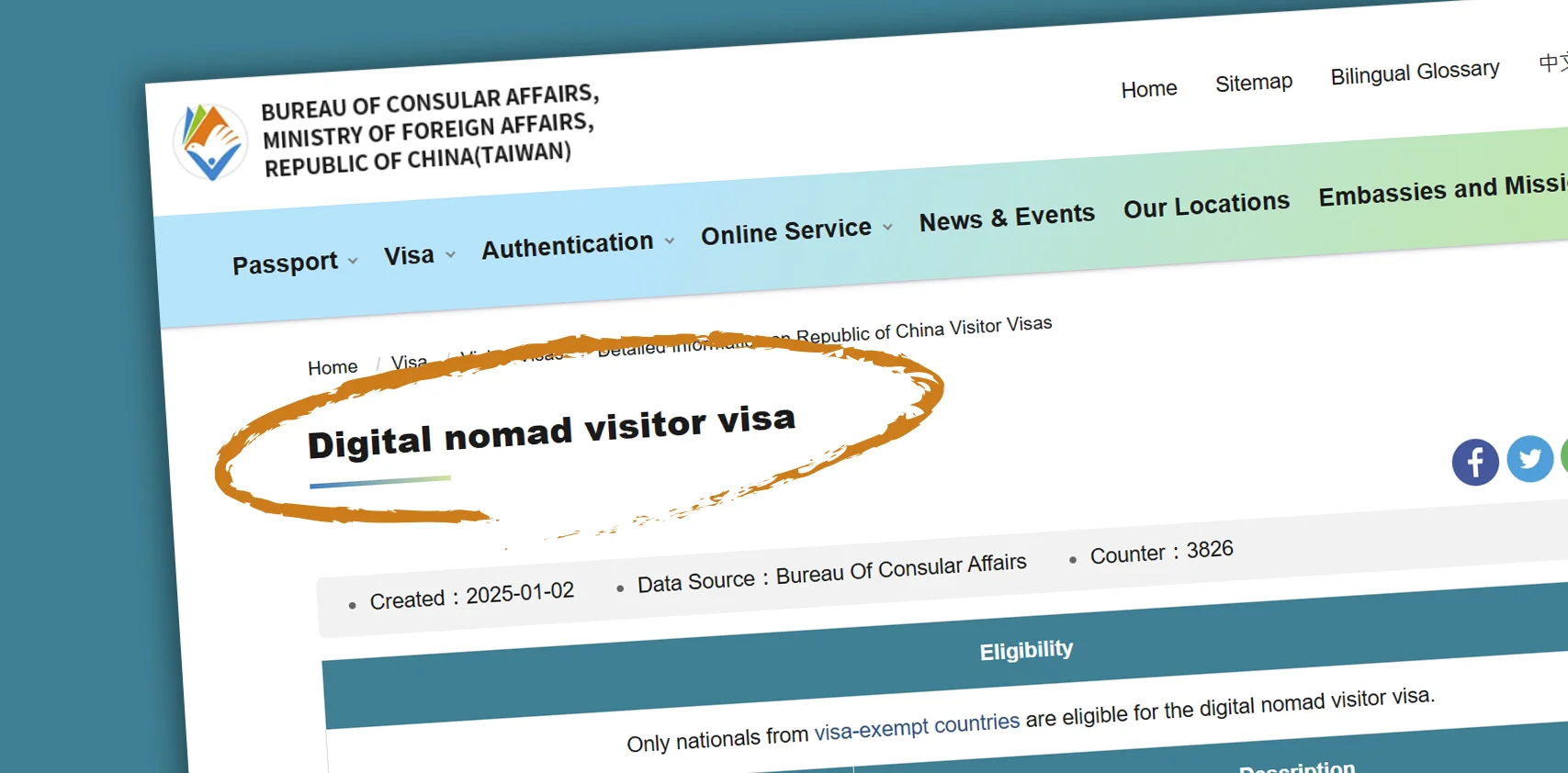
Taiwan Digital Nomad Visa is Here! Application Requirements and Required Documents All in One View!
Taiwan Digital Nomad Visa Officially Launched in January 2025! In the past, foreign digital nomads entering Taiwan under visa-free entry could only stay for up to 90 days. Now, with the Digital Nomad Visa, the maximum stay is extended to six months. Whether you are a freelancer or a remote worker employed by a foreign company, as long as you are from a visa-exempt country and meet the required salary, age, and work conditions, you can apply. According to the "Application Guidelines for Foreigners Applying for a Digital Nomad Stay Visa" published by the Bureau of Consular Affairs, Ministry of Foreign Affairs, here are the details for applying for the Digital Nomad Visa: Taiwan Digital Nomad Visa|Eligible Applicants Applicants must be citizens of a country that enjoys visa exemption status with the Republic of China(Taiwan). Taiwan Digital Nomad Visa|Required Documents Visa application form Two 2-inch color passport photos taken within the last six months (white background) Original passport and a photocopy (valid for at least six months) Proof of remote work(Personal resume and portfolio、Work contract、Completed Description of Intended Activities form) Additional supporting documents choose one of the following: (1)Previously issued Digital Nomad Visa from another country (2)Aged 30 or above, with an annual income of at least USD 40,000 in any of the past two years (3)Aged 20-30, with an annual income of at least USD 20,000 in any of the past two years Proof of regular bank deposits for the past six months, with an average monthly balance of at least USD 10,000 International health insurance certificate Other documents as required on a case-by-case basis Taiwan Digital Nomad Visa|How to Apply If you have not yet entered Taiwan, submit your application to an R.O.C. (Taiwan) overseas mission. If you are already in Taiwan, you can apply at the Bureau of Consular Affairs or one of the Central, Southwestern, Southern, or Eastern Taiwan Offices of the Ministry of Foreign Affairs (MOFA) at least 10 working days before your current stay expires. For detailed information, please refer to the "Application Guidelines for Foreigners Applying for a Digital Nomad Stay Visa" For more information on digital nomad life in Taiwan, check out: Taiwan Digital Nomad Guide | Visa, Currency Exchange, Weather, Internet All in One View
February 13, 2025

Taiwan to Introduce 6 - Month Digital Nomad Visas
Taiwan is also set to launch a digital nomad visa! To attract international talent, Japan, South Korea, and Thailand have all introduced digital nomad visas. Recently, Taiwan government mentioned that Taiwan also plans to introduce a "Digital Nomad Visa" in the future, allowing international talent to come to Taiwan with the opportunity to stay longer. In the past, digital nomads usually came to Taiwan with a tourist visa or visa exemption, which allowed them to stay for up to 3 months. With the introduction of the "Digital Nomad Visa," digital nomads will be able to stay in Taiwan for up to 6 months. More details are still being worked out. Since the "Digital Nomad Visa" does not require legislative amendments, it can be quickly implemented after coordination with the Ministry of Foreign Affairs. The proposal is expected to be submitted in the next legislative session. In the past, Taiwan also introduced the "Employment Gold Card" policy for high-level foreign talent. The Employment Gold Card is a document that consolidates work permits, residence visas, foreign resident certificates, and re-entry permits into one, providing eligible foreign talents the flexibility to freely seek employment, work, and change jobs during its validity. The Employment Gold Card is valid for 1 to 3 years, depending on the applicant's preference, with the option to reapply upon expiration. The future introduction of the Digital Nomad Visa will further open the door, attracting more international talent to Taiwan.
August 15, 2024

Targeting High-Tech Talent! Canada Plans to Introduce Digital Nomad Visas in 2024
Thinking of experiencing the digital nomad life in Canada with its distinct four seasons? According to the latest announcement from the Government of Canada, this dream might have a chance to come true as early as 2024! According to the latest statements from the Government of Canada, the country plans to officially launch a digital nomad visa program in 2024, inviting global digital nomads, especially those in the tech industry, to settle and live in Canada. Previously, digital nomads wishing to live in Canada mostly relied on tourist visas, with a maximum stay of 6 months each time. However, with the introduction of the digital nomad visa, holders may stay in Canada for up to 3 years. Based on current information, individuals interested in applying for this visa may need to prepare insurance certificates, financial proof, and a list of family members accompanying them for the application to the Government of Canada. Targeting High-Tech Talent! Experience First, Settle Later Sean Fraser, the Minister of Immigration for Canada, pointed out that the Government of Canada hopes this program will attract the favor of tech talents and address the local tech industry's workforce shortage. In an interview, Fraser stated, "For those who are interested in trying to live in Canada, our digital nomad visa program will be an excellent opportunity. If they want to stay after the visa expires, we also welcome them with open arms." Open Government Attitude, but Will Talent Come? However, despite the open attitude of the Government of Canada, is Canada equipped enough, both in terms of software and hardware conditions, to attract digital nomads to settle? In the minds of many digital nomads, Canada, with its beautiful natural landscapes and thriving urban centers, has always been one of the ideal destinations. In 2022, a report from the UK ranked Canada as the best country globally for digital nomads to settle, considering factors such as internet speed, cost of living, and remote job opportunities. Hold Off on Packing for Now If you have already started planning your trip to Canada, you might need to hold off for a bit. Currently, the details of the plan are limited, and some disclosed information has raised concerns in the community. One concern is that the government's prioritization of high-tech talents may significantly limit the number of successful applications. After all, digital nomads are not solely composed of tech professionals; there are also those in marketing, media, and online tutoring. Furthermore, even if high-tech talents are willing to consider Canada as a destination, the salary gap might lead them to choose the United States over Canada. According to data from the job site Randstad Canada, the average annual income for Canadian tech talents is around $74,000 (approximately 2.3 million TWD), while in major U.S. cities like New York and San Francisco, their average annual income can be as high as $130,000 (approximately 4.04 million TWD), highlighting the existing salary gap. Additionally, tax and social welfare mechanisms applicable to digital nomads are also aspects that require waiting for more details from the Canadian government. Digital Nomad Visa Launch ≠ Immediate Departure Masha Sutherlin, Director of Service at HR software provider Deel, also reminds that even if the Canadian digital nomad visa program officially launches in the future, digital nomads should not expect to depart immediately. "Just because a country announces a visa program for digital nomads doesn't mean the government has the ability to process all applications promptly," Sutherlin pointed out. "This is a very novel visa type, and many countries have underestimated the resources required to handle a large number of applications." Sutherlin also added that some countries, like the UAE, have the ability to respond to applications within a few weeks, while others, like Portugal, have longer processing times, "possibly ranging from 3 months to 1 year." Stay Patient, Use Time to Reflect on Personal Needs The Government of Canada states that they will reveal more details in the coming months. While waiting, Sutherlin also advises digital nomads intending to go to Canada to be patient and take the time to reflect on what their ideal lifestyle is. "After all, not every country is like Canada, proposing a digital nomad visa program with a comprehensive plan to help those who want to stay obtain permanent residency." References: A Guide to Canada’s Digital Nomad Visa Canada just launched a new digital nomad program—here’s what you need to know Canada’s digital nomad program could attract tech talent – but would they settle down? -- Responsible Editor/Samuel Follow the Digital Nomad Facebook fan page and stay updated with more recent articles on Instagram (@digital.nomad.press)!
January 29, 2024

Remote Work New Trend - "Digital Snowmads" Find Paradise in Ski Resorts!
When we think of digital nomads, the first image that often comes to mind is people leisurely sipping coffee in beautiful cafes, or working on their computers while lying on hammocks beside gorgeous beaches. However, these scenes are mostly fantasies of tropical islands or temperate countries. Have you ever thought about those nomads who love winter? With the popularity of remote work, winter-loving digital nomads are actively seeking new ways to integrate work and leisure. Ski resorts have become their preferred destinations, giving rise to the term "Digital Snowmads." These individuals break away from the traditional office setup, opting for the fresh mountain air and choosing ski resorts as their temporary remote work bases. During the snow season, they explore different countries, working remotely during peak times at ski resorts, and then enjoying skiing when the slopes are quieter in the evenings or after tourists have left. In the past, executing the Digital Snowmads lifestyle faced a significant challenge - the high and hard-to-find long-term accommodation costs in ski resorts. Many resorts required payment of the entire season's rent upfront, which, even with some savings, posed a considerable burden. However, many hoteliers have now recognized this opportunity and are offering facilities suitable for long-term stays. For example, Swiss Escape Hotel in Grimentz, Switzerland, has specifically designed long-term stay options for digital nomads. Apart from Grimentz, Bansko in Bulgaria is recognized as one of the most economically affordable ski resorts in Europe. Several digital skiers also share their experiences, such as choosing ski resorts near the Pyrenees mountains in France, which can be more cost-effective than the Alps. In South America, Chile and Argentina are suggested as bases for Digital Snowmads, offering affordable options such as staying in budget hostels near the ski resorts and reducing costs by purchasing daily tickets. This way of working and living in ski resorts not only provides a fun winter experience but also opens up new possibilities for digital nomads seeking to blend work and leisure. From the thrilling skiing on slopes to the serene working hours in cafes, this lifestyle showcases the charm and diversity of remote work. With the advancement of technology and changes in work patterns, we can anticipate that this way of achieving a balance between work and leisure in the beauty of nature will attract an increasing number of participants. -- Responsible Editor/Jeremy Lee Follow the Digital Nomad Facebook fan page and stay updated with more recent articles on Instagram (@digital.nomad.press)!
January 19, 2024

South Korea Plans to Introduce "Digital Nomad Visa" in 2024
In an effort to boost the domestic economy, the government of South Korea has implemented several policies, including granting visa-free entry with the electronic travel authorization (K-ETA) for visitors from countries like Taiwan and Japan. Additionally, they have announced the launch of the "Digital Nomad Visa" in 2024, which is expected to allow holders to reside in South Korea for one to two years, aiming to attract foreign talents to stay in the country. South Korea has been a popular choice for digital nomads due to its popular culture, high standard of living, and stable network quality. Cities such as Seoul, Busan, and Jeju Island are among the preferred destinations. Previously, digital nomads seeking to stay in South Korea would often hold a B-1 visa (visa-free) or a C-3 visa (short-term visit), but these options only allowed a 90-day stay, which was inconvenient for those wanting a longer stay. In recent years, the government of South Korean has introduced working holiday visas, allowing foreigners to work and travel in the country for up to one year. However, this may not fully meet the needs of digital nomads. The South Korean government has recently announced plans to introduce the Digital Nomad Visa specifically for high-income and high-asset foreign nationals, enabling remote workers to reside in South Korea for one to two years. Additionally, in response to the global popularity of K-POP and Korean TV and film, South Korea will also launch the K-Culture Training Visa to attract a younger demographic to visit and learn about the local culture. -- Responsible Editor/Amanda Chiu Follow the Digital Nomad Facebook fan page and stay updated with more recent articles on Instagram (@digital.nomad.press)!
January 8, 2024

2024 Rankings: The Best Countries for Digital Nomads - Portugal 6th, Argentina 2nd, Who Takes the Top Spot?
According to Forbes statistics, as of the end of 2022, over 40 countries globally have introduced "digital nomad visas," welcoming digital nomads to visit. If you aspire to embark on a digital nomad journey, working with a laptop while exploring various corners of the world, and you are unsure about the best destination, VisaGuide.World has evaluated countries based on visa regulations, internet speed, tax systems, cost of living, and tourist popularity, etc. The top 10 countries globally that are the best for digital nomads in 2024: Spain Argentina Romania United Arab Emirates Croatia Portugal Uruguay Malta Norway Andorra NO.1 Spain Spain has consistently been a popular choice for digital nomads. Besides its pleasant weather, fast internet, and lower cost of living compared to other Western European countries, non-EU citizens applying for a digital nomad visa can reside in Spain for one year, potentially bringing their family along under certain conditions. After one year, the visa can be extended up to five years. Digital nomad visa holders also enjoy some tax incentives. NO.2 Argentina Located in South America, Argentina is loved by digital nomads for its low cost of living and beautiful scenery. Holding an Argentine digital nomad visa allows for a six-month stay, with the option to extend, and no requirement to pay local income tax. NO.3 Romania Romania, situated in the Balkan Peninsula in Europe, allows non-EU citizens to apply for a digital nomad visa, enabling them to live in the country for one year, extendable for another year. With a very low cost of living in European terms and no need to pay local income tax, Romania is a major attraction for digital nomads. NO.4 United Arab Emirates The United Arab Emirates, located on the Arabian Peninsula and consisting of seven emirates, including Abu Dhabi and Dubai. Dubai has recently introduced a digital nomad visa. Foreign digital nomads can live in Dubai for one year without having to pay income tax. Exceptional healthcare services and a high standard of living also draw many foreign talents. NO.5 Croatia Croatia, situated in Southeastern Europe with its breathtaking Mediterranean landscapes, is a sought-after destination for many digital nomads. Non-EU citizens can apply for a digital nomad visa, allowing them to stay in the country for up to one year, with a low cost of living and no requirement to pay local income tax. If you dream of Mediterranean living, Croatia is undoubtedly an excellent choice. The sixth to tenth positions, in order, are Portugal, Uruguay, Malta, Norway, and Andorra. If you are interested in information about digital nomadism in these countries, you can visit VisaGuide.World or use the website Nomad List. Nomad List provides information on living costs, climate, network quality, safety, and more for cities worldwide, serving as a reference for choosing your digital nomad destination. -- Responsible Editor/Amanda Chiu Follow the Digital Nomad Facebook fan page and stay updated with more recent articles on Instagram (@digital.nomad.press)!
January 5, 2024

Greece End In-Country Digital Nomad Visa Applications from 2024
Greece is often considered a dream destination for many digital nomads. However, if you are planning to apply for Greece's Digital Nomad Visa (DNV) to work in the country, you may need to prepare in advance. According to the latest regulations from the Greek government, starting from January 1, 2024, anyone intending to enter Greece with a Digital Nomad Visa must apply first at the Greek embassy or consulate in their home country, obtain the visa, and then enter Greece through this channel. This also means that the previously used "enter first, then apply" process, allowing individuals to enter Greece with a tourist visa and later apply for the Digital Nomad Visa, will no longer be applicable from 2024. Following the global trend, Greece introduced the Digital Nomad Visa in 2021 to attract digital nomads and remote workers worldwide, even implementing incentives like the "enter first, then apply" mechanism to encourage foreign workers to choose Greece. With the stunning backdrop of the Aegean Sea as a workplace, this friendly policy immediately proved effective. In 2022, the number of applications for the Digital Nomad Visa increased by 50 times compared to the previous year. Many media outlets and bloggers listed Greece as the top destination for digital nomads in 2023. Now, with the new regulations set to take effect in 2024, if you plan to embark on a digital nomad journey in the new year, you can refer to the following simplified strategy for applying for the Digital Nomad Visa in Greece: 1. Who is eligible for the Digital Nomad Visa? Citizens from non-European Union countries. 2. What conditions must be met to apply for the Digital Nomad Visa? Applicants must prove that they are not working for a company registered in Greece (and are prohibited from being employed by a company registered in Greece after obtaining the visa). Demonstrate the ability to work remotely. Prove a monthly income exceeding €3,500 (approximately NT$120,000). Before applying, you can contact personnel at Greek embassies or consulates worldwide to inquire about the latest rules and the proof required for remote work, income, and financial capacity to increase the chances of visa approval. 3. How long is the validity of the Greece Digital Nomad Visa? 1 year, with the possibility of extending upon expiry. 4. What fees do I need to pay? Application fee of €75 (approximately NT$2,573). 5. How long does it take to receive the visa after applying? Typically, results are obtained 2-4 weeks after submitting the application. References: Greece Digital Nomad Visa - Visa Requirements For Remote Work In Greece In New Rules For Digital Nomads, Greece Ends In-Country Visa Applications From 2024 Greece Digital Nomad Visa Greece Will Require Digital Nomads to Apply from Home Countries -- Responsible Editor/Samuel
December 27, 2023

Remote Work in Japan! Japan Plans to Launch the "Digital Nomad Visa'" in March 2024
With the easing of the pandemic and the depreciation of the yen, many tourists are drawn to Japan for sightseeing, including many digital nomads who work while traveling. In response to the growing trend of digital nomads, the government of Japan is considering the introduction of a Digital Nomad Visa, which is expected to be implemented as early as the end of March 2024. The aim is to address visa issues for digital nomads and attract more talent to Japan. According to statistics from the Japan National Tourism Organization, in October of this year, the number of foreign tourists visiting Japan exceeded 2.5 million, more than double the pre-pandemic levels in 2019, indicating a gradual return of foreign tourists to Japan's pre-pandemic levels. Among these visitors, not only are there tourists for leisure purposes, but also many digital nomads making a pilgrimage to Japan. Unlike typical tourists, digital nomads only need a laptop and a stable internet connection to work remotely while traveling. This group includes individuals with high skills and incomes. Japan's widespread internet access and low crime rates make it an attractive destination for them. Coupled with the continuous depreciation of the yen, making the cost of living in Japan softer compared to other countries, this has become an essential factor attracting them. However, Japan has not specifically introduced visas for digital nomads. If digital nomads use a regular tourist visa, the stay is only up to 90 days. Those who wish to reside in Japan for an extended period may need to apply for student or work visas. However, the eligibility criteria for these visas may not necessarily align with the situations of digital nomads. In response, the government of Japan has announced that, targeting these groups, it will introduce a special visa allowing a maximum stay of up to six months, aiming to attract highly skilled individuals to reside in Japan and stimulate consumption and tourism. Applicants for the new visa must have an annual income of at least 10 million Japanese yen (approximately 2.13 million NTD), be citizens of one of the 50 countries with visa exemption agreements with Japan, and must also have private health insurance coverage. Spouses and children are also eligible to apply together. Introducing the Digital Nomad Visa could significantly attract digital nomads to Japan. -- Responsible Editor/Jeremy Lee
December 25, 2023