


All Posts
132 posts
Sort by Latest

Without a Stable Address, Nomads Lose Financial Capability Before They Lose Freedom
Most new digital nomads spend their first year discovering a strange contradiction. They can book flights, sort out visas, land clients, and move between cities with surprising ease. Then one morning they log into their bank app and get a message asking them to "update proof of residential address" with a recent utility bill or government letter dated within the last three months. That is the moment they realize the entire financial infrastructure they took for granted was built on one silent assumption: that they live somewhere fixed, somewhere that can receive letters, somewhere that can be verified. Once that assumption breaks, what nomads lose is not freedom. They lose financial capability. They cannot receive payments, replace cards, pass renewed KYC checks, open new accounts, or even keep existing accounts in good standing. These issues rarely surface in week one abroad. They cluster around month six or month ten, during scheduled compliance reviews, arriving as late-night emails in a timezone that makes the deadline nearly impossible to meet. This piece unpacks the financial infrastructure nomads actually need. Multi-currency accounts are only the surface layer. Underneath sit proof of address, tax residency, compliance reviews, payment processors, invoice identity, card delivery, backup accounts, and cash flow resilience. Without deliberate planning, this stack tends to fail together at the worst possible moment. Multi-Currency Accounts Are an Entry Ticket, Not a Solution Over the last few years, tools like Wise, Revolut, and Payoneer have convinced many nomads that banking is a solved problem. Hold multiple currencies, convert at near-interbank rates, receive USD or EUR, and swipe a physical card almost anywhere. Compared to the wire-transfer world of a decade ago, this is real progress. But these tools are, at their core, cross-border payment and money-movement infrastructure. They are not a replacement for having a financial identity in a specific country. They still require you to declare a residence, a tax status, and a phone number. When large flows, unclear sources, or risk models get triggered, they will ask for documents, interviews, or freeze funds while they investigate. That is when nomads discover multi-currency accounts have not eliminated the compliance burden. They have simply deferred it. The mental shift is to treat these accounts as an operational layer for daily flows and to keep one or two sovereign bank accounts as a foundation for large, long-term, legal, credit, and investment purposes. The neobank layer does not survive on its own. Proof of Address: The Asset Nomads Undervalue In most jurisdictions, banks, brokerages, crypto exchanges, and payment processors all require proof of address. Standard documents include utility bills, telecom invoices, government letters, lease agreements, and bank statements. The nomad problem is that these documents either do not exist, are not in their name, or show a short-term rental address that reviewers routinely reject. A common solution is to anchor a home country address. This might be a parent's home, a long-term lease, jointly owned property, or a trusted friend willing to receive mail. The address does not have to be where you physically live, but it has to reliably receive mail, produce plausible documentation, and match the tax residency you declare. For many nomads this address becomes the root of the entire financial stack. When it wobbles, every account tied to it wobbles too. The alternative is a mail forwarding or virtual address service. These providers can scan mail, receive parcels, and forward items to a current location. But not every bank accepts virtual addresses, and some platforms explicitly flag PO boxes or coworking addresses as high risk. Check the policies of your key financial partners before you rely on such a service. You do not want to find out during a compliance review that the address on file does not count. Tax Residency Is Stickier Than People Expect The other half of financial compliance is tax residency. Most banks require CRS or FATCA forms at onboarding and during annual reviews. You declare where you are a tax resident and provide relevant tax identification numbers. Those declarations are automatically exchanged with tax authorities in the relevant countries. A common mistake is assuming that spending fewer than 183 days in any single country automatically means you are a tax resident of nowhere. In practice, tax residency uses a broader test that considers your permanent home, family ties, economic center of interest, and nationality. Some countries continue to treat you as a resident after you leave until you can prove residency elsewhere. This stateless-for-tax posture looks liberating, but it makes banks nervous. Accounts flagged as ambiguous end up in the high-risk pile. The stable approach is to work with a cross-border tax advisor before starting nomad life. Decide where your tax residency should land, gather the supporting documents such as tax certificates, past filings, and residence proofs, and be ready to present them repeatedly. This question does not get asked once. It gets asked every time a bank, broker, or payment processor updates its files. Compliance Reviews Are Routine, Not Exceptional The first real financial scare many nomads experience is a message like this: submit proof of address, source of income, and explanations for recent transactions within X days or your account will be restricted. The instinct is to assume you did something wrong. In reality, this is a scheduled periodic review. As cross-border flows increase and anti-money-laundering standards tighten, banks are required to periodically re-verify customer information. Frequent international transfers, income from multiple payment platforms, sudden large flows, and shifting source countries all raise review frequency. Nomads should assume they will hit these reviews regularly. To reduce disruption, keep contracts, invoices, and statements for all significant income sources so you can produce them instantly. Make transaction descriptions readable by asking clients to reference project names and invoice numbers. Avoid mixing personal and business flows in the same account so a reviewer can parse activity quickly. When a request arrives, prioritize it. Timezone gaps and email delays eat most of the buffer built into the deadline. Payment Processors Are a Second Fragile Node For freelancers and small business nomads, payment processors like Stripe, PayPal, Wise Business, and local e-payment providers are the frontline of cash collection. These platforms have their own address, identity, and tax requirements, and their review logic is often faster and more automated than a bank's. Typical failure modes include a persistent mismatch between the country on file and your IP address, a registered business location that does not match the payee address, large deposits that trigger risk models, and elevated refund or dispute rates. The common outcome is temporary freezes lasting anywhere from 30 to 180 days. For an individual practice with thin cash reserves, that timeline is close to fatal. The practical response is to avoid concentrating all revenue in a single processor. Maintain two or three, spread across different clients, currencies, and geographies. If one platform enters review, the others keep the business alive. Keep verification data current on the primary platform, especially address, identification, and tax details. Do not wait to be asked. Invoice Identity: Who Are Clients Actually Paying? This layer is underestimated. When you work with clients in multiple countries, whose name is on the invoice? What address? What tax number? This is not a paperwork detail. Invoice identity determines whether a client's accounting system can expense the payment, whether their country applies withholding tax, how you declare the income in your tax residency, and whether it counts as personal income or business revenue. Three common setups appear. The first is issuing receipts or simple invoices as an individual freelancer under a local self-employed regime. This works for some clients but often feels informal to larger enterprises. The second is invoicing through a home country entity. This is the most stable arrangement, but it requires actively maintaining that entity, filing accounts, and paying local obligations. The third is using a digital residency scheme such as Estonia's e-Residency, which digitizes the process but still depends on your personal tax residency for the final tax treatment. No single setup is always best. The important thing is alignment. Invoice identity, receiving account, and tax residency should agree with each other. When these three drift apart, tax filings and bank reviews become chronic sources of stress. Card Delivery and Physical Constraints A detail that sounds trivial but matters enormously: how does a physical card reach you? Most banks and fintechs still ship physical cards for new accounts, expiring cards, lost card replacements, and identity verification steps. For someone constantly moving, this creates three pain points. First, the shipping address does not match the current location. Cards arrive in the home country and rely on family to hold, photograph, and forward them, with customs, loss, and time-sensitive activation windows along the way. Second, some cards are only shipped domestically. Requests from abroad get rejected, forcing a wait until the next trip home. Third, emergencies reveal the problem. The main card is frozen, local cash is short, and the backup card is thousands of kilometers away. The unglamorous answer is redundancy. Apply for two or three physical cards across different countries, banks, and networks. Distribute them across your person, your luggage, and a trusted person back home. It looks excessive until the main card fails, at which point the backups are the difference between continuing and being stranded. Backup Accounts Should Be Alive, Not Dormant A common mistake is to concentrate all financial activity in one or two favorite platforms. When those platforms hit a review or outage, some nomads discover they cannot even buy a flight out of the current city. The right way to think about backup accounts is not as a rainy day store, but as something that gets used occasionally as part of normal life. Accounts that go months without activity get flagged as dormant, require re-verification, or get closed automatically. A backup that only exists on paper is not really a backup. It needs a quarterly rhythm of small deposits, spending, and logins. A reasonable configuration might include one primary home country account for large transactions, credit, and legal documents; one or two multi-currency tools for daily flows and conversions; one or two local accounts if a specific country becomes a longer base; a credit card ecosystem as an emergency credit source; and a modest cash reserve because in most cities cash is still the final fallback. The point is not complexity. The point is independence between nodes. When any single platform enters a compliance loop, the other nodes should be able to run without it. Cash Flow Resilience: Timing Beats Totals The final and most overlooked layer is the time structure of cash flow. Spending patterns for nomads differ sharply from settled life. Rent often means short-term deposits plus monthly payments, requiring larger lump sums up front. Flights, visas, insurance, medical checks, and emergency care cluster around moving points. Equipment refreshes for laptops, phones, and backup hardware are infrequent but expensive when they happen. These outflows are lumpy and can produce the frustrating situation of having money on paper but not being able to access it right now. Cash flow resilience for a nomad is not measured by total assets. It is measured by how much can be mobilized in what timeframe. A useful mental model has four layers: funds available within 24 hours through cards or transfers; funds available within a week from investment accounts; funds recoverable within a month from post-tax income; and an emergency reserve covering three months or more. These layers must live in different accounts, different tools, and different countries so that no single event can freeze them together. For anyone building a long-term nomad life, this structure is not conservatism. It is the requirement for sustainability. Real freedom is not the absence of constraints. It is having enough buffer that when external systems misbehave temporarily, you can still make calm decisions. Financial infrastructure ultimately protects that calm, not the assets themselves.
October 19, 2026

Family Nomadism Is Not Just Packing More Suitcases
A single nomad moves to a new city with a laptop, a visa, and a short lease, and can usually start working within a day. The overstuffed suitcase is a personal problem. But once the household includes a partner, children, or ageing parents, the entire operation shifts from a personal travel decision into a small family project. What now moves is not only luggage but school enrollment, medical continuity, visa status, a partner's career, a child's social stability, and every mundane routine that quietly holds daily life together. Recent industry data on remote workers consistently points to the same demographic shift. The single adventurer is no longer the default portrait. More than half of digital nomads are married or living with a partner, and the share of families travelling with children has been rising each year. That shift matters because it moves nomadism from a youth subculture toward a longer term family arrangement that needs actual infrastructure. And infrastructure is exactly what most first-time family nomads underestimate. The Real Cost Structure Is Not Linear The most common budgeting mistake is to take a single-person nomad budget and multiply by household size. Real life breaks that number quickly. Housing does not scale linearly. A studio works for one person. Two adults can compress into a one bedroom. Add a child and you need at least a proper sleeping room plus a living area. Add a second child and the requirement jumps to two bedrooms. In popular nomad cities that shift can move monthly rent from around twelve hundred dollars to three or four thousand, and even then the supply is narrow. Food costs are not linear either. Children tolerate restaurant food for a few days before their stomachs, moods, or both revolt. Family nomadism almost always requires kitchens, which pushes housing back up. Transport costs grow from one ticket to four, and toddler-age children require car seats, strollers, and slow logistics that add hours to every transfer day. Then there is the least discussed line item: the contingency fund. Families have far lower tolerance for surprises than single travellers. A sick child, a partner who must fly home for a parent, a school placement that does not work out, any of these can trigger unplanned flights and rebookings. That reserve is not optional. It is the shock absorber that allows the family to keep moving without every incident becoming a crisis. School Is Not a Building. It Is a Rhythm The single hardest variable in family nomadism is the child's education. It is not only curriculum. It is a whole structure of time, peers, and identity. One path is full homeschooling or online school. It gives the family maximum mobility because the schedule follows the household rather than a local bell. The trade-off is heavy parental involvement. Even with online schools, an adult usually has to enforce discipline, maintain the internet, and manage social gaps. The second path is local enrollment, typically international schools or private local schools. This gives children a stable peer environment, but tuition is high, seats are limited, and admissions timelines rarely align with a family's arrival date. The deeper cost is temporal. Enrollment binds the family to an academic year, which effectively caps the mobility that motivated the whole arrangement in the first place. Every school transfer also spends real social capital that children have to rebuild from scratch. A third path, which many families settle on after trying the extremes, is a base city where they live eight to ten months of the year, with shorter trips during breaks. The child keeps a stable school, stable friends, and predictable weekly routine. Parents accept that flexibility now looks like one long anchor plus short excursions rather than constant motion. This is not a failure of the nomad ideal. It is what sustained family mobility actually looks like once children are involved. The right choice depends on what the child needs at that age: language exposure, close friendships, academic pacing, or broad worldview. Parents should pick the rhythm first, then choose the schooling method that fits. Healthcare Is Access, Not Insurance A single nomad can buy one international health insurance policy and largely be covered. Families cannot. Children and older relatives generate more frequent, more varied medical needs than young adults do. The first reality is routine care. Children need vaccinations on schedule, developmental check-ins, dental care, vision checks. These are not emergencies and do not sit in travel insurance policies. They require a family doctor who can track a medical history over time. Constant movement breaks that thread. Some families consolidate a full medical sweep once a year in their home country. Others keep a paediatrician in their base city and only travel around scheduled visits. The second reality is acute events. A child with a fever at 2 a.m. or a toddler with an allergic reaction does not need a phone number for an insurer's international call centre. That family needs a paediatric emergency room within twenty minutes. This means the first week in a new city should include mapping the nearest emergency room, twenty-four-hour pharmacy, paediatric clinic, and dentist. Not when it becomes urgent. The third reality is pre-existing conditions. International health insurance treats these strictly. A partner or parent who takes long-term medication needs to verify drug availability, prescription rules, and whether the policy reimburses locally sourced substitutes before the family moves, not after. The fourth reality is dental and vision. Most policies only cover the basics. Braces, glasses, cleanings, and orthodontics are usually out of pocket. Some families deliberately anchor in cities with strong medical tourism value and use the stay to bundle these expenses for the whole household. That is a practical budget strategy, not a luxury. Visas for Families Are a Different Species When countries market digital nomad visas, the headlines focus on the main applicant's income threshold and remote work proof. Bring dependents and the fine print starts to matter enormously. Definitions of dependents vary. Spouses are usually eligible, but same-sex partners, unmarried partners, and common-law arrangements are not universally recognised. Some countries require notarised and apostilled marriage certificates, adding weeks to preparation. Child age caps differ. Most visas cover minors, but the definition ranges from eighteen to twenty-one, and some require proof of enrollment or additional financial evidence. Adult children in university may need their own application. Income thresholds stack. A single applicant threshold of three thousand dollars per month typically adds five hundred to a thousand for a spouse and a few hundred per child. A family of four might need documented monthly income of five to six thousand dollars, with verifiable and consistent sourcing. Freelancers with lumpy income often stall at this checkpoint. Work rights for dependents are the most overlooked issue. Many nomad visas restrict the main applicant to foreign-source income and give dependents no work rights at all, or only under narrow conditions. If the partner is already fully remote, this is manageable. If the partner had a location-bound career or expected to work locally, the constraint reshapes the family's entire plan. Renewals are the last trap. Most nomad visas last one or two years, and renewal usually requires the whole family to still meet the criteria. Losing one dependent's eligibility can disrupt a child's school year mid-stream. The Partner's Career Cannot Be the Sacrifice The most common fracture in family nomadism is not children's schooling. It is career asymmetry between partners. The typical pattern: one person has a fully remote job with stable income and drives the decision to travel. The other had a location-bound role, or a remote role in a rising career phase. After the move, the first partner's work rhythm barely changes. The second partner faces broken time zones with existing clients, no legal right to work locally, and slow erosion of the professional network that took years to build. A year in, the career gap becomes visible. The partner who stayed rooted often accumulates promotions, higher-paid roles, and expanding influence. The partner who followed shows a fuzzy gap on the resume or accepts downgraded work to preserve flexibility. That gap becomes a recurring source of tension. Practical safeguards exist. Set the priority of both careers explicitly before leaving, rather than assuming both can travel along equally. Preserve windows for the trailing partner to return home for concentrated work or study, for example three months a year on independent travel. Do not concentrate household income in one person; treat the smaller income as a household asset rather than a variable to sacrifice. Share the decision authority for where to move next, so the higher-earning partner does not unilaterally set the calendar. The quality of the partnership tends to determine sustainability more than the destination does. Children Need Predictability, Not a Fixed Address A comforting myth says children are fine anywhere as long as parents are present. That holds during infancy. Past age three, and certainly once school starts, children develop strong needs around peers, environment, and predictable daily rhythm. The core of security is not location. It is predictability. What time do we wake up, eat, bathe. What happens on weekends. Who visits. When do we leave this city. These small rhythms hold up a child's inner sense of safety. Constant movement does not automatically destroy that safety, provided parents make the rhythm itself the stable frame rather than the address. Concrete practices help. Discuss the next city with children before every move, including housing, school, and how to say goodbye to current friends. Do not schedule anything for the first three days after arrival; use that time only to orient. Travel with the same sheets, toys, and books, so the objects of home persist even when the walls change. Keep family rituals like Sunday breakfast or bedtime stories intact across moves. Children's social lives need active maintenance too. Video calls with friends back home have to be scheduled, not hoped for. Local activities in the new city have to be researched and joined, not stumbled into. Contact with other nomad families needs to be sustained across cities. Children will not organise this themselves. Family Nomadism Needs a Community, Not Just Wi-Fi Single nomads maintain social life through coworking spaces, online communities, and chance encounters. Families need something structurally different. What a family with children actually needs is not fast coffee shop internet. It is another family, nearby, with children of similar age, willing to trade pickups, watch each other's kids, and share on-the-ground information. That kind of relationship is nearly impossible to build in a two-week stay. It requires time, repeated meetings, and letting the children form their own friendships first. This is why family nomads tend to cluster in a small number of cities: Lisbon, Chiang Mai, Ubud, Mexico City, Medellin. It is not just cost or visa friendliness. These places already have a working family nomad community. A new family plugs into an existing network within weeks rather than months, children find peers, and parents find people who understand the specific mix of logistics and doubt that comes with the lifestyle. Alongside local community, families need a rearguard. Parents, siblings, and old friends back home play a bigger role than expected. A grandparent on video call when a child is sick, a sibling handling paperwork back home, an old friend willing to listen when one partner is quietly exhausted, these long-distance relationships have to be maintained deliberately, not called upon only in emergencies. Write the Exit Into the Plan The last principle, and the one romantic narratives most often obscure: family nomadism does not have to be forever. Many families frame it as a final destination in itself. When a child struggles to adapt, a partner hits a career ceiling, or a parent's health changes, they interpret returning home as failure. The healthier frame treats family nomadism as a phased choice, reassessed every six to twelve months. Should we continue, adjust the rhythm, or anchor somewhere for a while? Reassessment works best with concrete indicators, not vague feelings. Ask about the child's sleep, learning, and mood in recent weeks. Ask about each partner's work satisfaction, social life, and physical health. Look at the remaining months of financial runway. Ask whether the next major medical or educational decision can actually be served by the current location. If several answers trend negative, it is time for a real conversation. Writing the exit into the plan is not weakness. It is responsibility. It converts family nomadism from an all-or-nothing bet into a long experiment with adjustable dials, and it prevents families from postponing changes until relationships or children have already been damaged. The centre of family nomadism was never the movement. It is the family itself. Location is background. Relationships are the subject. When that order is right, nomadism becomes not a lifestyle brand but a genuine phase, one that can be sustained, corrected, paused, or restarted as the family needs.
October 15, 2026

Remote Work Can Cross Borders. Employment Still Has Boundaries
Most conversations about digital nomad life focus on cities, coworking spaces, and visa availability. Those questions matter, but they usually skip the layer that decides whether a cross border arrangement can actually last: the employment relationship sitting underneath. The IBA Global Employment Institute report on digital nomads, published in March 2026, made this point in unusually direct language. Nomad work should be examined through employment law, tax and social security, and immigration law at the same time. Treating it as only a lifestyle choice creates blind spots that eventually reach the person or the employer. The MBO Partners 2025 report added a striking number to the picture. About one third of traditionally employed American nomads are operating through informal or hidden arrangements. In practice this means employees who moved abroad without telling their employer, or employees whose employers know but prefer not to look. Short term, this can feel efficient. Longer term, when tax authorities or labor regulators start asking questions, the exposure lands on both sides of the relationship. This article walks through what sits inside the legal wrapper of remote work. Why EOR services appeared. Where the line between contractor and employee actually is. How permanent establishment risk gets triggered by a single person. And what a serious conversation with an employer should cover before someone books the flight. The Location of Work Is Not a Detail A common assumption is that if the job description, manager, and paycheck stay the same, then the place of login does not matter. This is the most widespread misreading of cross border employment. Legally, the location where employment is deemed to occur depends on several factors: where the work is physically performed, whether the employer has any presence there, which law the contract selects, and which local rules apply regardless of what the contract says. When an employee based in New York moves to Portugal for six months, both parties may quietly agree that nothing has changed. Portuguese authorities may see it differently. Most European jurisdictions look at where the work is actually performed rather than what the contract states. Once that threshold is crossed, the employer can face obligations around income tax withholding, local social security contributions, working time rules, termination protections, and possibly permanent establishment assessment. None of these are abstract concerns. They translate into tax bills, filing requirements, and legal risk that no one budgeted for. The Line Between Contractor and Employee Some workers try to sidestep the problem by switching to a contractor arrangement and invoicing their former employer. For small volumes or short periods this can hold up. When the actual working pattern does not change and only the paperwork does, tax authorities in many countries will look straight through the structure and reclassify the relationship as employment. The tests differ by jurisdiction, but the factors are consistent. Are hours fixed? Does the worker take direction on how the work is done? Is there effectively a single client? Is the equipment and software provided by the client? Does the person participate in internal team activities and reporting? When most answers point toward employment, an invoice does not change the underlying reality. Back taxes, penalties, and retroactive social contributions can follow. For nomads this line is often blurred. An engineer might have one anchor client, a couple of side projects, and an advisory role. On paper this looks like independent work. If the anchor client accounts for ninety percent of income and dictates the schedule, the distance to employment is very short. Why EOR Became the Default Answer Employer of Record services have grown quickly for a reason. The model places a locally registered third party company as the legal employer in the country where the worker actually lives. That entity handles payroll, tax withholding, social security, and a locally compliant employment contract. The client company keeps day to day management authority: work assignments, performance reviews, promotion decisions, project scope. This resolves several structural problems at once. The client does not need to incorporate a subsidiary in every country where an employee might want to live. The worker gets a locally recognized status with access to healthcare, pension contributions, and unemployment coverage. Tax and social security compliance sits with a specialist provider that already understands the local rules. EOR is not a universal answer. Fees typically run between ten and twenty percent of monthly salary, which is meaningful for smaller employers or individual contributors. Some countries restrict or prohibit EOR arrangements, especially where staff leasing rules are tight. Provider quality varies. Buyers should confirm whether the EOR actually holds the local employer license itself or subcontracts to a local partner, since liability behavior differs in each case. Permanent Establishment: One Person Can Be Enough Permanent establishment is one of the most consequential concepts in international tax and one of the least understood outside tax teams. In simple terms, if a foreign company has a fixed place of business or a habitual contract signer in a country, that country may claim taxing rights over the related profits. Historically this concept targeted offices, branches, and warehouses. Remote work stretched it in new directions. A senior employee working from another country for an extended period, particularly one with authority to sign contracts or develop business, can trigger permanent establishment analysis on their own. The OECD updated the commentary to its Model Tax Convention in 2025 to address home office scenarios that became common after the pandemic. The general direction is that occasional, employee driven remote work from another country usually does not create permanent establishment, especially when the employer neither requires nor provides the location. Long term, regular use of a home office that becomes an integral part of the employer's operations is a different matter and can meet the threshold. The assessment is fact specific. For employees, the practical consequence is that personal mobility can create employer tax exposure. When employers realize this, the most common reaction is to restrict cross border work by number of days and by country. That is why many written policies now list allowed destinations explicitly. The Hidden Nomad Employee The MBO Partners finding that around one third of traditionally employed nomads operate informally would concern any compliance team. These arrangements look different in practice. Some employees continue to use their home country address for records while living abroad for most of the year. Some use VPNs to keep IP addresses in the home country. Some simply choose not to mention it. In the short term the setup works. Cross border compliance never gets triggered because no one processes it. Daily operations feel identical to office based work. Risk accumulates in three places. First, tax residency shifts. Most countries treat 183 days of presence in a year as a residency threshold. Once crossed, that country can tax worldwide income even when the payer is located elsewhere. When enforcement catches up, back taxes with interest and penalties can consume years of savings. Second, labor protection collapses into a gap. When an employee gets injured, becomes ill, or is dismissed while abroad, home country protections may not fully apply because the work was performed elsewhere. Local protections may not apply either because the contract is foreign. The worker ends up caught between systems. Third, trust with the employer breaks. Even without legal consequences, an employer who discovers a long hidden relocation rarely returns to full trust. Many employment contracts also treat unauthorized overseas work as a contractual breach. Visas Are Entry Passes, Not Work Solutions Digital nomad visas are often marketed as one stop solutions. In reality they solve only the residency question and do not automatically address the employment or tax questions. The OECD policy brief on digital nomad visa schemes noted that eligibility, duration, access to social benefits, and treatment for tax residency vary widely across countries. Most nomad visas allow the holder to work for foreign employers or foreign clients but not for local companies or the local market. The calculation for host countries is deliberate. They want inbound foreign currency without competition for domestic jobs. The tax residency treatment tends to be ambiguous. Some countries offer explicit tax relief or a favorable regime for a limited period. Others apply their normal rules, which means a nomad who crosses the presence threshold becomes a tax resident regardless of visa category. The residency permission does not automatically eliminate withholding obligations for the foreign employer, and it does not shield the employee from local taxation. The safer practical approach is to treat immigration, employment contract, and tax planning as three separate exercises. A weakness in any one of them undermines the other two. Social Security Deserves More Attention Tax gets most of the airtime in cross border work discussions. Social security tends to be treated as a technicality. That underestimates its long term effect on pensions, healthcare access, and unemployment coverage. Within the European Union, coordination rules and the A1 certificate allow short term postings to keep contributions in the home country. Outside the EU, or between countries without a bilateral social security agreement, the situation is more fractured. Where an agreement exists, it may allow contributions to remain in one country for a defined period. Where none exists, workers can face double contribution, or worse, gaps where neither system credits the years. The consequences show up decades later. A nomad may not notice the issue at thirty five. At fifty five, looking at a pension projection, missing ten or fifteen years of contribution history can push retirement benefits below the minimum threshold in several jurisdictions. Preparing the Conversation With an Employer For someone who still wants to build cross border flexibility, the conversation with the employer needs to go further than a request to relocate for a few months. A few points are worth preparing. Be specific about destination and duration. A general wish to spend time in Europe is much harder for an employer to evaluate than a plan to spend four months in Portugal followed by two months at home. The more precise the plan, the easier it is to find a compliant solution. Understand the role's exposure. Positions without signing authority or client facing sales responsibility carry lower permanent establishment risk. Roles that represent the company externally require more careful structuring. Come with a cost sharing proposal. EOR fees, tax advice, and possible double social security contributions add up. Employers may resist absorbing all of it. A proactive suggestion on splitting these costs tends to work better than waiting for the employer to calculate them and refuse. Have a fallback. If the full plan is not feasible, is there a version that works? Shorter periods, business trip framing, only countries with clear agreements, or a shift toward a contractor relationship. Keeping the conversation open is worth more than a single decisive attempt. Treat the Legal Wrapper as Infrastructure The romantic story of digital nomad life easily obscures a plain fact. Every cross border work arrangement rests on some legal structure. It might be traditional employment, contractor work, an EOR arrangement, or a personally owned company invoicing clients. None of them is universally right. But something has to be selected, and it needs to match the actual pattern of work, residence, and tax exposure. For individuals, the question worth asking before booking flights is whether the current employment structure can carry the intended movement. If not, is there willingness to invest in adjusting it? If the employer will not support the change, is there a viable second path? These are unglamorous questions. They also decide whether nomad life continues for five or ten years or ends abruptly two years in when a tax notice arrives. For employers and HR teams, the reactive posture rarely helps. Waiting until someone has already relocated to figure out compliance produces worse outcomes than setting clear policy in advance. A written framework covering approved countries, maximum durations, request procedures, and role exclusions does not kill remote flexibility. It gives organizations that want to operate distributed teams for the long term a stable base to work from. Freedom is not the absence of structure. It is the clarity of knowing which structure supports the choice. When the structure is understood, designed, and chosen deliberately, cross border work stops being a slow motion compliance gamble.
October 13, 2026

Internet Access Is Not Enough: Why Your Phone Number Becomes Nomad Infrastructure
For most people planning a long stint of remote work abroad, the first worry is bandwidth. Which eSIM plan, whether to grab a local SIM at the airport, how reliable the apartment Wi-Fi will be, whether a pocket router is worth the extra weight. These questions are not hard to solve anymore. The market for connectivity has matured, prices keep sliding, and coverage is broadly acceptable in most cities that attract remote workers. Yet the people who have actually spent three, six, or twelve months away from their home country tend to report that the thing which tripped them up was not the internet at all. It was the phone number. A phone number is no longer just a way to make calls. Over the past decade it has quietly become an identity credential. Banks, tax authorities, brokerages, cloud services, social platforms, crypto exchanges, government portals, even the login flow for an app someone has not opened in a year, all tend to fall back on the same sentence: please enter the code we just sent to your phone. That code goes only to the number originally on file. When that number becomes unreachable because of travel, a swapped SIM, a lapsed prepaid plan, or a lost handset, the person on the road suddenly cannot prove who they are in the digital world. Data Connectivity and Identity Connectivity Are Different Layers eSIM providers solve data connectivity. They give a device a way to reach the internet. This layer is in good shape now. Activation happens at the gate, pricing is transparent, and switching between countries takes minutes. But most eSIM plans do not include a stable local number capable of receiving SMS from a home country bank or a government portal. Even when a local number is bundled, it is usually short lived, region locked, and unreliable for the kinds of verification messages that matter. The gap becomes obvious in a way that flat monthly data plans hide. A traveler can hold a smooth video call from a Lisbon co-working space and, at the exact same moment, fail to receive a one time passcode from a bank back home. Bandwidth is present. Identity is not. In the first two or three weeks abroad the problem stays invisible, because most accounts are still within their session windows and most platforms still trust the device. The seam only tears open at the first cross border wire, the first re-login to a brokerage app, the first attempt to file a tax form, the first request to raise a credit limit for foreign purchases. The Home Number Is the Real Anchor A common and painful mistake is to cancel the home number on departure and rely entirely on local SIMs abroad. In most countries the home mobile number sits inside the financial and administrative stack as a nearly irreplaceable anchor. Online banking, national health apps, tax filing, brokerage logins, mobile payment bindings, they default to the original number as the fallback verification channel. Removing that number does not simply mean buying a new plan later. Restoring it often requires physical presence in the home country, an in person visit to a bank branch, and a full re-verification process. A more resilient approach is to treat the home number as infrastructure rather than as a phone service. Its job is not to place calls. Its job is to receive verification codes. That means keeping it in an SMS reachable state even while the owner is on the other side of the world. Options include a minimum tier prepaid plan with regular top ups, leaving the SIM in a spare handset at a relative's home, arranging for a family member to forward incoming messages, or using an operator provided SMS to email service. Every option has a cost. The point is that the choice needs to be made deliberately in advance, not improvised the night before a flight. Local Numbers Have a Real But Different Role Anchoring the home number does not mean local numbers are optional. Staying in a city for more than two or three weeks quickly generates a need for one. Ride hailing apps want to verify. Delivery platforms want to verify. Landlords communicate through the country's dominant messaging app. Local bank accounts require a local contact number. Even topping up the SIM itself often needs a working local number. The role of a local number is completely different from the role of a home number. The home number is an identity anchor. The local number is a life interface. The first must not lapse. The second can be discarded when the traveler leaves the country. Trouble begins when nomads mix them, binding important accounts to a local SIM that expires two months later, effectively locking themselves out of their own financial life. A clean rule of thumb helps. Anything tied to money, legal identity, taxation, or long term contracts, bind only to the home number. Anything tied to daily life in the current city, bind to the local number. When this line stays clear, moving cities becomes far less destructive. Multi Factor Authentication Raises the Stakes Over the last decade MFA moved from a security team recommendation to a default setting on most platforms. This is good for security, but it also concentrates enormous weight on the phone number. When an account uses SMS verification, an authenticator app, and email verification together, any broken link in the chain can lock the owner out of their own data. Nomads face a specific risk. These verification channels can fail at the same time. A stolen phone takes both the SIM and the authenticator app with it. A dead SIM cuts off SMS. If the recovery email account itself is protected by the same phone number, the whole recovery path collapses in a single event. The practical response is layered. Authenticator apps should be backed up, and the backup should live on a device that travels separately from the primary handset. Recovery email addresses should be long lived and stable, not a soon to be closed employer domain or a self hosted address that could go offline. Every critical account should have offline recovery codes generated in advance, printed on paper, and stored inside the same folder that holds the passport. These steps look tedious. They are trivial compared to the cost of being locked out in a foreign country with no local support number to call. SIM Swap Moments Are the Most Fragile Most travelers underestimate how vulnerable the moment of swapping a SIM actually is. When a new physical SIM slides in, or a new eSIM activates, there is a short window of minutes to hours where the old number is already deactivated and the new one is still registering. During this gap any platform that fires a verification message will send it into a void. A worse scenario appears when a home number is recycled by the carrier after prolonged inactivity. That number can be reissued to a new subscriber who then, entirely innocently, begins receiving bank codes, social notifications, and login attempts for someone else's accounts. The security community has a name for this attack surface, SIM recycling, and it is not hypothetical. The mitigation is singular. Before leaving, before any SIM change, before any extended absence from a familiar environment, convert the second factor of critical accounts from SMS to an authenticator app or a hardware security key. SMS should become the backup channel, never the primary one. Hardware Security Keys Are the Overlooked Layer A hardware security key is a small device that plugs into USB or communicates over NFC, acting as a second factor for login. Prices range from roughly twenty to eighty US dollars, and a single purchase lasts years. For someone living abroad long term, the value dwarfs the cost. The advantage is complete independence from the phone and the number. Even if the SIM dies, the phone gets stolen, and the authenticator app was never backed up, the key still works. The catch is that one is not enough. Two is the minimum, one carried on the person and one stored somewhere geographically separated, whether with a trusted family member or in a bank safe deposit box. Relying on a single physical object for identity access defeats the point. Most major platforms now support the FIDO2 or WebAuthn standards, including Google, Apple, Microsoft, mainstream password managers, and a growing number of banks and brokerages. A single weekend spent enrolling security keys on the most important accounts builds a defensive layer entirely independent of the mobile network. The Case for a Backup Device A second phone sounds indulgent, but for anyone living out of a suitcase it is one of the cheapest insurance policies available. It does not need to be new or premium. A two or three year old midrange handset is enough. Its jobs are narrow. Keep the home SIM alive and receiving codes. Hold a backup of the authenticator app. Step in when the primary phone breaks or gets stolen. This backup device does not need to be powered on every day, but it should be charged periodically, connected to the internet occasionally for updates, and checked to confirm the SIM is still active. It belongs in a different bag from the primary phone, ideally in the suitcase rather than the daypack, so that a single theft does not remove both devices at once. Some travelers try to use a tablet in this role. That can work partially, but tablets often cannot receive SMS on cellular networks unless a SIM is installed. As an authenticator host, a tablet is fine. As a phone number backup, it needs additional planning. Number Portability and Retention Strategy Rules on number portability differ by country. Some regulators require carriers to release a number to any competing provider on request, letting the customer move to a minimal prepaid plan while keeping the digits. Others enforce aggressive reclamation policies, releasing numbers that go six months without use. The practical move for long term travelers is to shift the home number from an expensive monthly contract to the cheapest available retention plan, preserving the number without paying for services that will not be used. Beyond that, a more thoughtful plan asks a longer question. If the traveler eventually decides not to return to the home country, who inherits responsibility for that number? Who is authorized to forward messages, handle carrier disputes, or visit a branch office if needed? Discussing this with family before departure is worth more than most people expect. Put Number Management on the Pre Departure Checklist The typical pre departure list covers luggage, visas, tickets, accommodation, and insurance. Number management rarely appears, yet it deserves priority over most items on that list. A useful standard sequence looks like this. Audit which phone number is currently bound to each important account. List every second factor method already active, and confirm at least one backup channel exists for each. Back up the authenticator app to the cloud or export it to a spare device. Generate offline recovery codes for every critical account, print them, and store them physically. Decide how the home number will remain reachable during the trip, and make sure a family member or friend knows their role. Prepare a backup phone, install the SIM in advance, and test that it actually receives messages. Purchase a hardware security key, or ideally two, and enroll them before flying out. The whole sequence takes about a weekend. Once done it becomes infrastructure, not something to repeat before every trip. Like a visa or an insurance policy, it is a one time investment that pays off across many journeys. Treat the Phone Number as an Asset, Not a Utility The shift in mindset that makes everything else easier is simple. A phone number is not a line item on a mobile bill. It is an asset. It carries financial access, government access, social connections, and platform identities. All of these are real property in the digital world, and real property deserves protection, backup, and inheritance planning. Once nomads start treating their numbers this way, the right decisions become obvious. They stop cancelling the home number to save a few dollars a month. They stop binding brokerage accounts to a local SIM that will expire. They stop discovering that the authenticator app was never backed up only after the phone falls into the ocean. They stop trusting a single device with the keys to their entire financial life. Internet access is the ticket that gets a remote worker into the building. The phone number is the pass that lets them stay inside once the door closes. Thinking clearly about that distinction removes a surprising amount of friction from nomad life before it ever has a chance to appear.
October 8, 2026
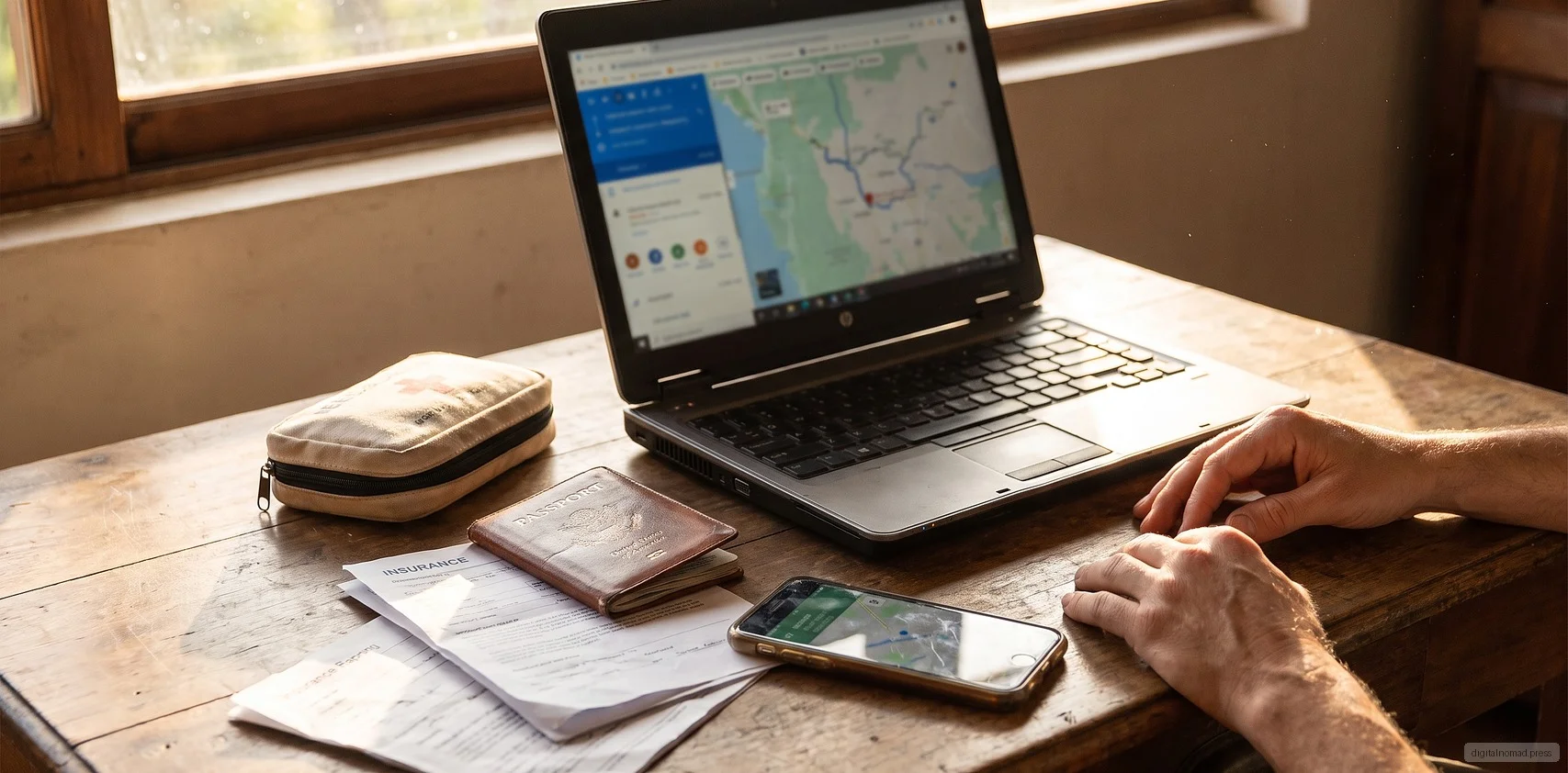
Travel Insurance Is Not a Safety Net: The Real Coverage Gap for Digital Nomads
Most people buy their first cross-border insurance policy the same way they buy an airline meal upgrade: as a five minute checkbox before payment. Pick the dates, tick the region, add a couple of riders, receive a PDF by email, and move on. The convenience creates a side effect. It suggests the traveler is now covered, that any medical, financial, luggage, or work related mishap abroad has a policy waiting behind it. Anyone who actually lives across borders for months at a time discovers quickly that this PDF covers almost none of the risks that matter. Travel insurance was designed for short trips, not for people who work, see dentists, renew visas, and replace laptops in a rotating set of cities. This article does not try to scare anyone into buying more products. It maps the real coverage gap into distinct layers and shows which type of product belongs at each layer. One: See the Edges of Travel Insurance Clearly Standard travel insurance combines two products. The first handles accidental death and disability during the trip. The second handles trip inconvenience such as delayed flights, lost luggage, and cancellations. An optional rider often covers emergency medical treatment abroad, but with strict caps, day limits, pre-existing condition exclusions, and a reimbursement model that expects the traveler to pay first and file claims later. That structure fits a business trip. It does not fit someone spending three months in Lisbon and then two months in Bali. Travel policies typically cap coverage at 180 days per trip, which forces reissuance and reassessment of pre-existing conditions. The emergency medical clause usually excludes chronic conditions, ongoing treatment, dental, mental health, and any preventive care. And the word travel itself becomes contested. Some insurers interpret extended stays as residence, and residence changes what they will pay. Travel insurance handles accidents. It does not handle life. Relying on it during a long stay abroad quietly bets the entire healthcare picture on the assumption that nothing goes wrong. Two: International Health Insurance Is Not an Upgraded Travel Policy The second layer is international health insurance. These annual policies come from global carriers and reinsurance groups and were originally built for expatriates, international school teachers, corporate assignees, and long term overseas residents. The important difference from travel insurance is not price. It is the coverage logic. International health insurance is written on an annual basis and covers a real continuum of care: inpatient, outpatient, chronic condition management, agreed dental, maternity, and mental health. Nomads tend to underrate this layer because the premium looks harsh. A healthy person in their thirties on a worldwide excluding United States plan will often pay between one thousand five hundred and three thousand US dollars a year. Adding the United States roughly doubles that. Compared to a travel policy the numbers feel disproportionate. But the comparison is misleading. The right question is not price per year but claims logic and renewal stability. A proper international policy typically settles directly with hospitals rather than forcing the patient to front large sums. As long as coverage is continuous, pre-existing conditions declared at the start remain covered, which becomes decisive as the insured moves into their late thirties and forties. Four criteria matter when choosing: whether the geographic zone includes the actual destinations, whether outpatient and chronic care are included, whether mental health is included, and whether renewal terms explicitly forbid re-underwriting based on individual claims history. Three: Emergency Medical Evacuation Is a Separate Product Medical evacuation is routinely confused with either travel insurance or health insurance. In practice, most travel policies only cover repatriation of remains, and even health policies often cap evacuation at transport to the nearest adequate facility. True emergency evacuation, meaning transfer by medical aircraft from a remote area to a city that can actually treat the condition, or repatriation across borders to the home country, can cost anywhere from tens of thousands to hundreds of thousands of US dollars. This layer matters most for people diving in Southeast Asian islands, hiking in Central and South America, moving overland across parts of Africa, or living long term in regions where local hospital capacity varies sharply by city. Dedicated evacuation membership services exist in the several hundred dollars per year range and use a simple claims logic: if the condition meets defined criteria, the evacuation is triggered regardless of whether the local hospital has beds. The test is a personal question. If a serious accident happened in the current city today, does the traveler trust the local healthcare system to provide treatment comparable to what would be available at home? If the answer wavers, evacuation is not a luxury. It is a base layer. Four: Routine Care Belongs in Cash Flow, Not Insurance Something nomads consistently underestimate: over a year abroad, the recurring expense is not major medical events. It is dental cleanings, eye checks, dermatology, gynecology, blood work, and vaccinations. Travel insurance almost never touches these. Most international health policies require an added outpatient module before they do. A more grounded approach is to plan routine care as a cash flow item rather than an insurance item. In cities with reasonable pricing such as Bangkok, Kuala Lumpur, Mexico City, or Lisbon, paying out of pocket at a private clinic can be cheaper and faster than filing a claim through a home country insurer. Budgeting several hundred to a thousand dollars a year for out of pocket healthcare abroad, dedicated to check ups, cleanings, and standby medications, treats routine care as maintenance rather than an insurance event. Insurance handles the risks that hurt when they break. Cash flow handles the maintenance that will not kill anyone but should not be skipped. Mixing the two leads to buying the wrong product for the wrong problem. Five: Pre-existing Conditions, Chronic Illness, and Mental Health This is the layer sales scripts glide over the fastest. The pre-existing exclusion inside a travel policy is interpreted far more broadly than most buyers realize. A brief history of blood pressure medication, a few therapy sessions in the past, or a mildly abnormal thyroid reading can all be classified as pre-existing during a claim review, leaving the related treatment entirely unpaid. International health insurance handles this better, but in two distinct ways. Conditions disclosed at application are assessed and either loaded, excluded, or accepted at standard terms. Conditions that arise after coverage begins are treated normally after the waiting period. Two behaviors are decisive. Do not hide anything at application. Do not let coverage lapse. A lapse followed by reapplication resets everything previously known into the pre-existing category. Mental health is the other underrated section. The MBO Partners 2025 report highlights loneliness, time zone fatigue, and family distance as recurring nomad challenges. That means remote therapy and psychiatric support are not edge cases. They are common needs. When choosing a health policy, verify explicitly that psychiatric consultations and counseling are within scope, and that telehealth delivery is supported. Six: Equipment, Liability, and Work Interruption Insurance conversations usually stop at the human body and forget that for a nomad the ability to work equals a laptop and a small set of peripherals. Equipment and liability coverage form the fifth layer of gaps. Equipment insurance handles loss, theft, and accidental damage of laptops, cameras, lenses, microphones, and drives while abroad. Two structures are common. A home contents policy can be extended with an away from home clause, which is affordable but capped low. A dedicated professional gear policy for photographers, journalists, or content creators can insure high value items but requires an itemized schedule. Liability insurance addresses situations where the insured causes harm to others: flooding a rental apartment through negligence, injuring a pedestrian on a scooter, spilling coffee on someone else's laptop in a coworking space. Travel policies sometimes bundle a small personal liability rider, but the limits are usually too low to matter in a real cross-border legal dispute. The financial risk of not being able to work is harder to insure. Business interruption products largely require a registered corporate entity and rarely fit solo operators. The realistic substitute is a personal reserve fund covering three to six months of expenses, treating downtime as a risk absorbed through cash rather than through a policy. Seven: Visa, Residence, and the Fine Print Many digital nomad visas require applicants to hold health insurance covering local care, with minimum sums insured (often starting around thirty thousand euros) and defined categories such as emergency treatment, inpatient care, and repatriation of remains. Insurance is not only a personal risk management tool at this point. It is part of immigration compliance. A policy that appears to meet the requirements on paper may still be rejected locally. Some countries require the policy to be issued in the local language, some require the insurer to have a local office, and some refuse to accept purely online travel policies. Before applying, aligning the policy wording with the visa requirements word by word saves time. If needed, request an English confirmation letter from the insurer that explicitly references the visa criteria. Renewals deserve the same attention. If a short term travel policy was accepted at first application, the second year immigration officer may demand an annual health insurance certificate instead. Handling this one to two months before the renewal window is far safer than discovering the mismatch at the counter. Eight: Treat Insurance as a Portfolio, Not a Policy Return to the opening question. Why is travel insurance not a safety net? Because it was never designed for long term life abroad. A real insurance approach assigns different risks to different products. Accidents and short trips go to travel accident and inconvenience policies. Long term healthcare and chronic conditions go to international health insurance. Remote locations and major incidents go to a dedicated evacuation membership. Routine dental, eye, and vaccination needs go to cash flow and local private clinics. Mental health goes either into a health policy that explicitly covers it or into a self funded telehealth arrangement. Equipment and liability go to specialist gear coverage or dedicated liability riders. Visa requirements go to an annual policy that satisfies the specific immigration wording. Once broken out this way, the total cost is often lower than expected, and the coverage becomes coherent rather than accidental. More importantly, when something actually happens, there is no black hole between what was assumed and what is actually paid. The IBA Global Employment Institute noted in its March 2026 report that digital nomad issues should be understood through employment law, tax and social security, and immigration law together. Insurance cuts across all three and is the first layer that stabilizes a person's legal and financial identity while living across borders. A safety net is a feeling. Insurance is a portfolio of contracts that needs to be reviewed every year. The freedom to move between cities does not depend on the PDF in the inbox. It depends on whether someone has already arranged who catches which kind of fall.
October 5, 2026

Cheap Rent Is Not Enough: Nomad Cities Now Compete on Infrastructure
For most of the last decade, digital nomads picked cities using a fairly simple checklist. Cheap rent. Fast Wi-Fi. Good weather. A decent café scene. That logic put Chiang Mai, Bali, Lisbon, Medellín, Budapest, and Tbilisi on the global map, one after another. Rankings shifted every year, but the underlying metrics rarely changed: monthly rent, number of coworking spaces, internet speed, and cost of living index. By 2026, that scorecard is no longer enough. The reason is not that those factors have become irrelevant. It is that they have become table stakes. A city without a working internet backbone, without a handful of usable coworking spaces, without a cost of living clearly below North America or Western Europe, is not even part of the conversation. The real competition is happening one layer deeper: banking, healthcare, visa renewal, English-language administration, coworking reliability, community quality, family friendliness, safety, and digital public services. This piece is written for nomads currently choosing a city, or thinking about where to stay longer than a season. It is not a ranking. It is a case that once the market matures, the way people choose cities has to mature with it. Cheap Is a Ticket, Not a Moat Start with a market reality: cheap cities are multiplying, but cheapness itself is losing durability. Cities once famous for value, including Lisbon, Mexico City, Medellín, and Ubud in Bali, have all gone through visible rent increases after nomad inflows. Locals have started to push back. Local governments have tightened short-term rental rules. The center of town has lost its price advantage quickly. Cheapness was the core promise of these cities, but cheapness alone cannot stop the next set of even cheaper cities from pulling nomads away. That makes low cost a cyclical advantage rather than a structural one. What actually keeps nomads in a place is not eight hundred dollars a month rent. It is the absence of daily friction after they move in. Watch the behavior of experienced nomads and the decision order has clearly shifted. The first filter is still internet, climate, safety, visa. But what decides whether they stay for three months, six months, or a year is the layer of infrastructure that used to be invisible. Banking and Money Flow The first serious maturity signal is money flow. For a nomad, a bank account is not a status symbol. It is a work foundation. Income has to come in. Payments have to go out. Taxes have to be paid. Local spending has to work on a card. Break any link in that chain and the whole rhythm of work is disrupted. Several things tell you whether a city is mature on this front. First, how hard is it for a foreigner to open a local account. Some cities say they allow it but demand proof of local address, tax IDs, and employment documents that a nomad visa holder cannot produce. Second, how widely are international cards accepted. A city can look modern while its small shops, restaurants, and taxis run on cash or a local payment app that outsiders cannot use. Third, how expensive is cross-border money movement. Some countries look open on paper but impose currency controls, outbound limits, and reporting requirements that make daily life awkward. Portugal, Estonia, Spain, Singapore, Japan, and Taiwan are relatively friendly on money flow. Some newer nomad hotspots offer cheap living but demand large amounts of time and side costs to handle taxes, accounts, and remittance. Once a nomad reaches the stage of stable clients, multi-currency income, invoicing, and tax filing, money flow becomes the most practical filter for choosing a city. Healthcare That Actually Works for Foreigners The second signal is healthcare. Young nomads tend to ignore healthcare because they almost never use it. But stay in one place longer than six months, start thinking about bringing family in, or simply get older, and healthcare shifts from a background variable to a daily decision. A city's healthcare maturity has several layers. First, the quality and price of private care. Many popular nomad cities have excellent private hospitals at prices well below North American levels. That is a plus. But the more important question is whether patients can communicate in English, whether international insurance is accepted, whether English-language medical records are available, and whether long-term prescription needs can be handled. Second, the insurance ecosystem. International health plans have deep direct-billing networks in some cities and almost none in others. In the second case, nomads pay out of pocket and spend weeks on claims. That gap in user experience is enormous. Third, mental health support. This has been badly underweighted. Long stretches abroad, time zones, isolation, weakened relationships, and work pressure all accumulate into real psychological cost. Whether a city offers affordable English-language therapy is becoming an invisible line item on the mature nomad's checklist. Visa Renewal Experience The third signal is what happens after the visa is granted. Digital nomad visas have proliferated in the last two years. EY's global immigration index tracks dozens of jurisdictions offering remote worker or digital nomad routes. Taiwan launched a digital nomad visitor visa in 2025. Japan runs a high-income remote work pathway. Thailand's DTV came online. The Philippines authorized its digital nomad visa framework through Executive Order 86 in April 2025. But receiving a visa is only the beginning. What actually determines a city's usability is the renewal experience. Some countries grant only six months or a year and require the entire process to be re-run, sometimes with an exit and re-entry. Some allow in-country renewal but demand fresh submission of every document, including income proof, insurance, and criminal record checks. Some have very short renewal windows and no forgiveness for missed deadlines. For long-term nomads, every renewal is essentially a project. Documents have to be prepared in advance. Work schedules have to bend. Translations and notarizations have to be coordinated. Immigration office visits have to be planned. Buffer time has to be reserved in case of document requests. The maturity of a city here is not measured by how permissive the visa looks on paper. It is measured by how predictable, digital, English-capable, and low-rejection the renewal process actually is. Estonia, Portugal, and Taiwan score well on transparency. Some other jurisdictions with attractive-looking rules turn into bureaucratic slogs at renewal time. Administration in English The fourth signal is how much of the administrative layer works in English. This has been underrated in nomad discussions for years. People often ask whether locals speak English. What actually matters is whether the government, banks, hospitals, telecom companies, landlords, and tax systems operate in English. A nomad may never chat with a taxi driver, but will absolutely have to deal with banks, telcos, landlords, and immigration. If those institutions only offer forms, websites, and phone support in the local language, then no amount of personal English or local friends removes the daily friction. Administrative English does not require converting an entire country into an English-speaking one. It requires that critical services offer usable English interfaces. Estonia's e-Residency is an extreme example, where the digital government can be operated end to end in English. Singapore, Hong Kong, parts of Malaysia, the Philippines, and Rwanda are relatively friendly on this axis. Japan has moved fast on tourist-facing English, but its administrative layer still runs mostly in Japanese, which long-term residents should be prepared for. Taiwan is improving here. Some central government digital services now provide English interfaces, though local government offices, banks, telcos, and landlords lag behind. This is not unique to Taiwan. It is the shared challenge of every non-English nomad hub. Coworking Reliability The fifth signal is not the number of coworking spaces but their reliability. The count of coworking venues is no longer a differentiator. Every popular nomad city has dozens. What separates cities now is whether those spaces can be relied on for months at a time. ActivTrak's 2026 State of the Workplace shows that remote-only workers accumulate more productive focus time than hybrid split-day workers, whose days stretch long while their focused output shrinks. That effect is amplified in nomad life. If cafés change daily, if a coworking space suddenly shuts down, if the internet drops multiple times a week, if meeting rooms are always booked, real output erodes fast. A city's coworking maturity can be read on several dimensions. Spaces that have operated for more than three years under local operators, not pop-up investors. Membership plans designed for long-term residents, not tourist drop-ins. Redundant internet setups, including dual lines, backup mobile connectivity, and UPS. Enough meeting rooms, phone booths, and focus zones to match actual demand. And genuine community programming rather than marketing-driven events. Lisbon, Chiang Mai, Canggu, El Poblado in Medellín, and Roma or Condesa in Mexico City all host mature operators. Some newer cities have quantity but not stability, and their networks, community, and infrastructure are still finding their footing. Community Quality The sixth signal is community quality, which is often mistaken for community size. Community is the soul of a nomad city, and also the most easily misread variable. Busy does not mean healthy. Many people does not mean real connection. Early nomad communities were idealistic. People helped each other, shared information openly, and mixed across professions. Once a city becomes a touristified nomad hub, community splits. One layer becomes short-term socializing, party culture, and social media content. Another layer settles into long-term residents, cross-industry collaboration, and real friendship and business relationships. Mature nomads look explicitly for the second layer. Signals include recurring non-event gatherings such as industry meetups, book clubs, language exchanges, and sports groups. Local participants alongside foreigners, rather than an expat-only bubble. Members who have been in the city for three or more years and are still active. Organizations that connect nomads to local entrepreneurship and culture rather than sitting apart from it. The most direct effect of community quality is how lonely a nomad feels in a city. Loneliness, in turn, is one of the most honest reasons long-term nomads eventually leave. Family Friendliness The seventh signal is family friendliness. MBO Partners estimates in its 2025 Digital Nomads report that 18.5 million American workers self-identified as digital nomads in 2025, up 2.2% from 2024 and 153% from 2019. This is no longer only a twenty-something freelancer segment. A growing share are in their thirties and forties, moving with partners, children, sometimes parents. Whether a city can host family nomads is a completely different question from whether it can host solo ones. International school options and prices matter. Pediatric care, vaccines, and family doctor access matter. Housing markets need multi-bedroom long-term rentals, not just one-bedroom short-term apartments. Weekend and after-school activities, parks, and green space matter. And the partner's career continuity matters, including local community, remote-friendly collaboration culture, and part-time opportunities. This is a new layer of competition. Lisbon, Valencia, Taipei, Osaka, Chiang Mai, and Ubud score reasonably well here, but with wide variation. Some cities are paradise for a solo nomad and a friction zone for a family. The reverse is also true. The share of family nomads will keep rising. Over the next decade, city competition will shift from a lifestyle-driven solo economy toward a multi-generational family economy. That will reshuffle the rankings. Safety Is Multi-Layered The eighth signal is safety, which is often flattened into a single word and loses precision. For a mature nomad, safety is a stack. The first layer is personal safety, which is what most people mean when they say safe. That is baseline. The second layer is property safety, including housing security, device theft, and fraud exposure. The third layer is information security, including the overall risk profile of public Wi-Fi, mobile networks, and coworking connections. The fourth layer is legal safety, including contract enforceability, consumer protection, and dispute resolution for labor and tax. The fifth layer is political and institutional stability, including exchange rate volatility, capital controls, and sudden policy shifts. Some popular nomad cities perform well on the first layer but carry hidden risk on the fourth and fifth. A two-month visitor never sees those. Someone who decides to live for a year or two, open a company, buy property, or bring children, will run into them. The mature question is not whether a place is safe but which kinds of safety a nomad can tolerate and which they cannot. Digital Public Services The last signal, and the one that will separate cities the most over the next decade, is digital public services. Estonia demonstrated with e-Residency that government itself can be a form of infrastructure. When filing taxes, registering a company, signing contracts, updating addresses, requesting certificates, and paying fees can all be done online, a nomad's administrative overhead drops by an order of magnitude. Taiwan, Singapore, South Korea, Japan, and parts of Europe are each progressing here. Some places have very high digitalization but only serve citizens. Others are foreigner-friendly but not deeply digital. The cities that win the next wave of nomad competition will be those that combine both. This layer is hard to see because it does not lend itself to a headline number the way rent or internet speed do. But it decides whether a nomad spends two days a month on paperwork or ten minutes. From Being Touristed to Being Chosen For the last decade, nomads have been touristified by cities. Cities treated them as a new species of tourist and sold them coffee, coworking, and lifestyle. For the next decade, nomads will choose cities more deliberately. The question will not only be whether a city is fun or cheap. It will be whether a city can carry someone's work, family, health, visa, money flow, and information security. This is a heavier question, and a harder one. It pushes cities to upgrade, governments to invest in infrastructure, coworking to professionalize, and communities to become real. The winners of the next round will not be the cheapest cities or the fastest-internet cities. They will be the cities willing to treat foreigners as long-term residents rather than tourists. There are not many of those yet. But the moment one emerges, it pulls ahead quickly. For anyone currently choosing a city, the measuring stick has to upgrade too. Rent is only the ticket. The questions worth asking are the ones laid out in each section above.
October 2, 2026

Your Laptop Is the Office: Cybersecurity Is Now Part of Nomad Infrastructure
For a decade, most conversations about remote work have focused on productivity, time zones, and lifestyle. The topic that gets glossed over is security. When an engineer moves from an apartment in Taipei to a coworking space in Chiang Mai and then to a cafe in Lisbon, the laptop on her shoulder is effectively a miniature version of her employer. Client data, source code, financial credentials, signing keys, and identity tokens all live inside it. What used to sit behind a corporate firewall and a badge reader now travels through airport security in a 1.4 kilogram aluminum shell and connects to whichever open Wi-Fi is available. This is not paranoia. A 2025 study on the VPN security landscape published on ScienceDirect noted that as remote work expanded between 2020 and 2022, attacks targeting VPN services themselves rose sharply. Tools that were supposed to be the solution became the entry point. The structural shift is clear: security is no longer something a corporate IT team can own on its own. It rides along in the nomad's backpack and has quietly become part of personal infrastructure. Why "That Is IT's Problem" No Longer Holds Inside a traditional office, an employee's security responsibility mostly ends at "do not click strange links." Everything else is handled by the company. The network belongs to the company, the machine is issued by the company, backups are run by IT, and certificates are managed by the security team. The nomad situation inverts that model completely. When the workplace changes from an office to a cafe, a coworking space, a short-term rental, or a hotel lobby, the network trust model collapses instantly. The user cannot verify who actually operates the equipment behind a given SSID, cannot confirm whether the upstream ISP is inspecting traffic, and cannot know whether the coworking router has already been compromised. The phrase "corporate IT will handle it" becomes hollow, because corporate IT has no visibility into these segments. Identity is even more critical. In a remote environment, the company can no longer rely on IP addresses, physical location, or device ownership to answer the simple question of whether a given login is really the employee. The entire defensive perimeter now compresses onto accounts, passwords, multi-factor prompts, and device certificates. If the nomad does not take those layers seriously, no amount of policy at headquarters can compensate. The Real Risk of Public Wi-Fi Is Duller and More Dangerous Than People Think Public Wi-Fi debates tend to swing between two extremes. One camp insists that HTTPS is enough and there is nothing to worry about. The other insists that connecting to public networks is essentially handing over your data. Neither position holds up in practice. Modern websites almost universally use TLS, so the era of sniffing plaintext packets is largely over. That does not mean public networks are safe. The real risks are less dramatic. DNS hijacking can redirect users to convincing fake login pages. Certificate injection at the router layer can make phishing pages look authentic. Captive portals routinely nudge users into disabling protection. And any compromised device on a coworking network can scan its neighbors for exposed services. The reasonable posture is not "never use public Wi-Fi." It is "assume every public network is hostile." That means running sensitive operations, such as banking, tax portals, and admin consoles, over a phone hotspot rather than the cafe network. It means keeping the local firewall on and blocking inbound connections. It means turning off broadcast sharing and AirDrop on shared segments. And it means never doing a first-time login to a critical service on an unfamiliar network. VPN Is Not a Silver Bullet, Just an Encrypted Tunnel Many nomads treat their VPN subscription as the core of their security posture. That is an oversimplification. A VPN provides an encrypted tunnel from your device to the VPN server. It does not make your accounts harder to steal, does not stop phishing, and does not prevent malware from being installed on your machine. The ScienceDirect study cited above also raised another concern. VPN services have themselves become attack targets. Enterprise VPN gateways have shipped critical zero-day vulnerabilities, and consumer VPN vendors have leaked user data. Trusting a VPN provider is essentially outsourcing trust for all of your traffic to a company whose operations, jurisdiction, and logging policies may not be transparent. The pragmatic view is that a corporate VPN is a compliance requirement for reaching internal systems, and a commercial VPN is a tool for bypassing geographic restrictions or adding a modest layer on hostile networks. Neither should be treated as a magic shield. Identity and the device itself carry far more of the load. MFA: From Doing It to Doing It Right Almost every remote work security guide mentions multi-factor authentication. The problem is that many people implement the weakest possible version and then check the box. Consider SMS-based codes. They are the most common form of MFA and also the most easily bypassed. SIM swap attacks have become almost industrialized in some markets. Once an attacker takes over a phone number, SMS MFA is finished. Nomads change eSIMs, roam across networks, and pick up local numbers far more often than average users, so the risk that a home country number is suspended, ported, or fraudulently transferred is elevated. A more defensible layering looks like this. Use a physical security key such as a YubiKey, or a platform passkey, as the primary MFA. Use an authenticator app as backup. Reserve SMS only for accounts that offer nothing else. Disable SMS completely on the accounts that matter most: primary email, corporate SSO, banking, and the password manager itself. Store backup codes offline, not in a cloud note on the same laptop. The Device Itself: Encryption, Loss, Theft, and Border Checks The physical risk to a nomad's device is dramatically higher than in an office. Hotel rooms, rideshares, airport lounges, and coworking lockers are all high-loss environments. Once a device leaves your line of sight, the threat model must assume it could fall into someone else's hands. Three things are non-negotiable. Full disk encryption, using FileVault, BitLocker, or LUKS, must be on so that a powered-down machine is meaningfully protected. Login and system passwords should not be identical, so that a single shoulder-surfed credential does not unlock everything. Idle auto-lock should be measured in minutes, not hours. Beyond that, remote wipe capabilities through Find My, Intune, or an MDM must be tested before departure, not discovered to be disabled the day the laptop disappears. Border inspections are another frequently overlooked scenario. Customs authorities in some countries have the power to compel device unlocks. For nomads carrying sensitive client data, the practical response is to sign out of sensitive accounts before entering, clear active browser sessions, push non-essential files to the cloud rather than keeping them local, and consider a separate clean travel device for higher-risk routes. This is not paranoia. It is baseline respect for client data. Cloud and Identity Are the Real Attack Surface Once most work runs on SaaS, attackers stopped aiming at the laptop's hard drive years ago. They aim at cloud accounts. Email, Google Drive, Notion, GitHub, Figma, Stripe, corporate SSO. The value of taking over these accounts vastly exceeds the value of a stolen physical laptop. The mental model a nomad needs is that accounts are assets, and they are mobile assets. Several things follow. The primary account, typically email, must be the most heavily protected identity in the entire system. A password manager is no longer optional. It is the minimum floor, and never reusing passwords is the minimum bar. Login notifications should be on for every important service. Active sessions and OAuth grants should be reviewed regularly, with unused third-party integrations revoked. Corporate and personal accounts must remain strictly separated. Do not tie a personal Gmail to a client project, and do not sign in to personal services with the company SSO. Backups follow the same logic. The primary inbox needs a recovery email and offline recovery codes. The password manager should have an emergency contact or inheritance mechanism. If the corporate SSO account is disabled, the individual should not simultaneously lose access to every work-related file. These designs feel invisible in normal times. In the first hour after a device loss or account compromise, they determine how bad the damage becomes. Client Data: The Contract Says More Than You Think Freelance nomads often overlook that client contracts frequently include explicit data handling requirements. GDPR, HIPAA, financial services regulations, and enterprise vendor security assessments all specify data storage locations, encryption standards, access controls, and incident notification timelines. These clauses do not quietly stop applying just because the vendor is a single freelancer working from a beach town. A practical response is to treat client data handling as its own workspace. Dedicated encrypted folders, separate password manager vaults, dedicated cloud directories with verified server regions that match the contract, and defined destruction procedures at the end of an engagement. It sounds like enterprise overhead, but as nomads move upmarket toward larger clients, these obligations start showing up directly in contracts. Ignoring them is not carelessness. It is breach. Building a Personal Security Baseline Beats Chasing Perfection The most common failure mode in security is doing nothing because doing everything feels impossible. A more useful stance for nomads is to build a baseline that can be executed daily and then extend it over time. A workable baseline looks something like this. Every device runs full disk encryption, has short idle auto-lock, and keeps operating systems and browsers on automatic updates. Primary accounts use hardware key or passkey MFA. A password manager covers every service, and backup codes are stored offline. Work and personal accounts are separated. Sensitive operations happen off untrusted Wi-Fi. Cloud authorizations and active sessions are reviewed on a regular cadence. Devices are physically verified before leaving a coworking space or hotel room. The list is not long, but a nomad who actually executes it consistently is already ahead of the majority of independent workers in the market. On top of that baseline sit conditional defenses. Dedicated devices for sensitive projects. Data cleanup before entering jurisdictions with more aggressive border inspection. Professional liability insurance for financial or medical clients. This is layered thinking, not an all-or-nothing posture. Security Is the Invisible Resume of a Nomad Career For a mature nomad, security is not a burden. It is a part of the professional profile. A worker who can walk into a contract negotiation and articulate exactly how client data is handled, describe the encryption and backup posture in concrete terms, and commit to a specific incident notification window is bringing leverage to the table. Conversely, a nomad who stores client files on a shared computer, reuses a single password across every service, and connects to admin consoles from open hotel lobby Wi-Fi is one incident away from erasing years of reputation. The laptop is the nomad's office and also the nomad's business card. Offices are locked, backed up, and have visitor policies. That is common sense in a city. It does not become less important once the office fits under an airline seat. It only becomes harder to enforce. Recognizing that is the first step toward growing up as a nomad.
September 29, 2026

Mature Digital Nomads Do Not Just Book Flights. They Manage Risk
On social platforms, the digital nomad aesthetic is almost identical everywhere: ocean-view balcony, latte art, a laptop screen with a video call in progress. The images are not wrong, but they only show the most photogenic side of the lifestyle. What actually determines whether someone can sustain remote work abroad over the long run is not whether they can book flights or pack a suitcase. It is whether they can manage a dozen interlocking risk lines at the same time. Over the past several years, digital nomadism has shifted from a subculture to a recognized way of working. MBO Partners estimated in its 2025 report that roughly 18.5 million American workers self-identified as digital nomads in 2025, up 153 percent from 2019 and about 12 percent of the U.S. workforce. Behind that number is a simple point: this is no longer a lifestyle experiment run by a handful of bloggers. It is a mature working population that needs to be managed with real discipline. The first lesson of that discipline is accepting that nomad life is fundamentally a set of projects, not a long vacation. 1. Booking Flights Is the Easy Part Measured by time, booking flights, finding accommodation, and packing bags probably accounts for less than five percent of the effort in a full nomad cycle. The other ninety-five percent is the material that never gets photographed: anxiety while waiting on a visa decision, reconciliation work during tax season, schedule pressure caused by clients rescheduling last minute, backup plans when a landlord stops replying, cash flow gaps when a local card gets locked, and the judgment call about whether to interrupt a trip when a family member gets sick. These items share a common trait. They rarely happen, but when any one of them happens, it can wreck a month of work rhythm. That is essentially the definition of risk management. It handles not the normal case, but the shock when reality deviates from the normal case. Booking flights is execution. Managing risk is planning. The former can be outsourced to any booking site. The latter has to be internalized as a habit. 2. Nomad Life Is a Project Portfolio If a mature nomad writes down every ongoing concern, the list quickly turns into what project management textbooks call a portfolio: multiple projects that are related, share resources, and must move forward in parallel. A typical portfolio contains a visa and residence project, with each country as its own sub-project, a tax filing project across the home country and current jurisdiction, a health and insurance project, a housing and connectivity project, a client delivery project, a cash flow and multi-currency project, a device and data backup project, and a family and relationship maintenance project. Each of these has its own deadlines, its own risks, and its own key people. Framing life as a portfolio forces one honest admission: resources are finite, and attention is the scarcest resource. When a nomad is simultaneously dealing with a visa renewal, a client delivery, a change of accommodation, and a cross-time-zone meeting, they are effectively rebalancing an investment portfolio. They are not, contrary to travel-blog imagery, focusing on one destination at a time. 3. Visas: The Hardest Timeline in the Portfolio EY's Global Immigration Index update in March 2026 notes that a growing number of jurisdictions offer digital nomad or remote worker visas, while a meaningful share of those programs still carry high income requirements, strict insurance conditions, ambiguous rules, or periods of suspended enforcement. In other words, more visas exist, but not every program is actually usable in a stable way. From a risk-management view, the visa project has the hardest timeline in the portfolio. It has fixed expiry dates, fixed document requirements, fixed local conditions. It also drives many downstream decisions: whether a local bank account can be opened, whether a long-term lease can be signed, whether local health insurance is accessible, whether tax filing can be done as a resident, and whether the next flight should be booked now or later. Mature nomads work visa timelines in reverse. Starting from the expiry date, they work backward to preparation time, processing time, buffer, and a plan B destination. They do not wait until two weeks before expiry to start reading requirements, and they do not assume that renewal will simply happen. Every renewal is treated as a fresh application. 4. Tax and Income Structure: The Invisible Cost of Cross-Border Work Tax is the most consistently underestimated risk. Many nomads budget for flights, accommodation, and food, but not for cross-border tax advice, international wire fees, potential double taxation exposure, or the risk of losing home-country residency status. In reality, these costs can exceed accommodation. A single unreported foreign income episode, a residency threshold triggered by cumulative days of stay, or an employer audit prompted by a worker sitting in an undeclared jurisdiction can produce losses that are not only monetary but also reputational with employers and clients. The risk-management move is simple. Before departure, build a tax map. List the home country, all countries where the nomad may spend more than a certain number of days, and the actual sources of income. For each jurisdiction, note the thresholds that might trigger tax residency and reporting duties. The map does not need to be perfect on day one, but it should be reviewed at least every six months, and there should be a self-alert when accumulated days in any jurisdiction approach a threshold. 5. Insurance and Health: Low Probability, High Impact Insurance is a textbook low-probability, high-impact risk. It sits unused most of the time and, when triggered, can wipe out a year of financial planning. International travel insurance, local medical insurance, cross-border medical evacuation cover, device insurance, liability cover, and the minimum medical coverage that some visa programs require together form the nomad's insurance portfolio. An important detail: each policy has different triggers and exclusions. Some travel policies do not cover long stays. Some health plans only apply within specific jurisdictions. Some employer-provided policies may quietly become invalid when an employee works from an undeclared country. These details are not what an insurance agent volunteers upfront. The nomad has to read them line by line. Beyond insurance itself, health is infrastructure. Cross-time-zone work, changing diet, changing climate, and social isolation are all chronic stressors. Over years, health risk does not surface as an emergency room bill. It surfaces as declining productivity, worse judgment, and slipping deliveries. That is more likely to end a nomad career than any visa issue. 6. Housing and Connectivity: The Front Line of Delivery Risk For a nomad, housing and connectivity are not comfort questions. They are client delivery risk questions. A dropped connection during a meeting, a broken air conditioner that ruins sleep, a landlord who cancels a booking last minute, local power rationing, or a typhoon-season outage may look like small inconveniences, but they show up directly in delivery quality. A mature response operates on several layers. First, when choosing accommodation, look at measured bandwidth, power stability, and backup power rather than only the photos. Second, always have a local fallback in mind: the nearest coworking space, a paid hotel lobby with reliable Wi-Fi, a hotel with an on-site office that can be rented by the day. Third, carry a mobile connectivity plan such as an eSIM or a portable hotspot as an immediate backup when the primary network fails. Accommodation choice is no longer purely price-driven. The more mature the nomad, the more willing they are to pay a premium for predictability. The savings from a cheaper unit are almost always smaller than the trust damage from a missed deliverable. 7. Delivery and Cash Flow: Client-Side Project Management Nomad income tends to be more complex than the typical employee's. There may be a full-time employer, several long-term clients, a few short-term projects, some passive income, and investment positions in parallel. The upside is diversification. The downside is that each stream needs to be managed independently. The core project management issue here is the mismatch between milestones and cash flow. One client may pay on a sixty-day cycle, another monthly, another only at project completion. If those gaps are not drawn onto a single cash flow curve, the classic problem emerges: significant receivables on paper, and not enough real balance to cover next month's rent. The mature move is to treat every client as a project and maintain, for each, at least four basic fields: deliverable, next milestone, expected payment date, and risk rating. Review these at least every two weeks. This is not about turning life into a spreadsheet. It is about reducing the probability of losing a client because a deadline slipped through the cracks of cross-time-zone chaos. 8. Devices, Backups, and Data: Operational Resilience A stolen laptop, a failed drive, a locked cloud account, or a country-level block on a critical service are all business-interruption events for a nomad. Unlike office-based workers, nomads have no IT department to call and no spare machine waiting in a locker. There are three baseline requirements. First, always have a second usable device, even if it is a lightweight tablet with a Bluetooth keyboard. Second, keep important data in both local and cloud backups, and split the cloud copies across at least two providers. Third, enable multi-factor authentication on important accounts, and make sure that the recovery methods, whether backup phone numbers, backup email accounts, or physical security keys, still function when the primary device is lost abroad. These preparations look excessive in normal times. But after a single incident, a laptop stolen on an overnight bus, or a cloud account locked for seventy-two hours after a flagged login from a new country, that "excess" preparation becomes the difference between continuing to work and pausing revenue. 9. Time Zones and Relationships: The Invisible Drain Time zones are the most quietly damaging risk in nomad life because they never explode. They accumulate. Working out of alignment with core stakeholders for months chops up sleep, compounds decision fatigue, and slowly frays important relationships. Willpower does not fix this. It has to be designed for at the itinerary stage. A practical approach is to first identify the non-movable time zone commitments: recurring weekly meetings, family call windows, and the working hours of key clients. These are anchors. Only then should the next destination be chosen. When a location implies daily 3 a.m. calls, "getting used to it" is not a plan. It is denial. Relationship risk works the same way. Extended absences require active maintenance of family, partner, and deep friendship ties. The nomads who last are usually not the ones best at finding cheap flights. They are the ones best at budgeting time for the people they care about. 10. Putting the Mess on One Table When a single person has to manage a dozen risk lines at once, visa, tax, insurance, housing, clients, cash flow, devices, time zones, relationships, the real enemy is not any individual line. It is the cognitive load of holding too much in the head at once without ever seeing the full landscape. That load is what wears nomads down over time. Many frameworks and workshops address the same problem: externalizing the noise in the head so the decision maker can see the terrain. One Taiwanese adult education brand, Da Ren Xue, mentions a tool called Big Table in its 101 series, which is essentially the practice of laying every open decision, every ongoing project, every risk, and every deadline onto one large sheet, so the individual can see the whole picture rather than being pulled around by whichever item is loudest at the moment. Whether that specific method is worth studying depends on personal taste. The point here is not the tool. It is the underlying principle. Any worry that keeps looping in the head without landing on paper is drawing real decision energy. Consolidating visa expiries, tax thresholds, policy expiration dates, client payment days, family dates, and device backup cycles into one visible view is the first step in turning chaos into a project. 11. Mature Nomadism Is Not Romantic. It Is Sustainable. The high-traffic nomad narrative is still about freedom, scenery, and low cost of living. But nomads who reach year three, year five, or year ten talk about very boring things: compliance, backups, retrospectives, renewals, tax filings, health checkups, emergency contact lists. That boredom is exactly the evidence of sustainability. The broader environment in 2026 supports this reading. Gallup's May 2026 hybrid work indicator shows that among U.S. remote-capable employees, 52 percent work hybrid, 26 percent fully remote, and 22 percent fully on-site. ActivTrak's 2026 State of the Workplace report finds that remote-first companies are increasingly common, that fully remote workers log high productive time, and that hybrid split-day workers stretch out longer days with lower focus. The signal is the same: those who last in remote and nomadic work are the ones who can self-manage, not those coasting on environmental novelty. For digital nomads, the message is clear. Booking cheap flights is table stakes. Building an itinerary is the entry ticket. The differentiating capability is treating life as a project portfolio. As visas grow more complex, tax rules more transparent, employers pickier, and clients more mature, "manages risk well" replaces "knows where to go" as the core competency. The nomads who stay in the game will not necessarily be the best travelers. They will be the ones who require no one else to clean up their mess. They prepare in advance, keep redundancies, are honest about their limits, and rely on systems rather than willpower to fight entropy. That kind of person is an asset in any working model. They just happen to have chosen the model that most rewards self-governance. Scenery still matters. But the invisible project table behind the scenery is what determines whether the next view is ever reached at all.
September 25, 2026

AI Will Not Make Nomad Work Effortless. It Turns You Into a One-Person Project Manager
Around 2024, most conversations about AI tools revolved around fairly narrow use cases: draft this email, summarize this meeting, generate a rough image. By 2026, the frame has shifted. Generative models keep improving, but the more interesting movement is on the agentic side. Systems can now take a goal, plan sub-tasks, call multiple tools, read and write files, verify intermediate outputs, and report back to a human. For solo operators, freelancers, and digital nomads, this looks like an obvious win: one person can now do the work that used to require a small team. Talk to people actually running AI-augmented practices in 2026, however, and a different picture emerges. AI has not made them lighter on their feet. It has turned them into full-time project managers who happen to also do the delivery work. They now ship faster, but they also spend more time designing workflows, verifying outputs, managing permissions, tracing errors, reassuring clients, and absorbing accountability when something goes wrong. This piece tries to describe that shift honestly. It is not another take on whether AI will replace anyone. It is about a more practical question: for a digital nomad, AI does not deliver free time. It delivers a new layer of management work. Whether you can carry that layer will decide whether you become one of the operators whose output truly doubled in 2026, or one of the operators who ended up more tethered to their laptop than before. From Tools to Agents: What Actually Changed The most consequential change of the last two years is not raw model intelligence. It is the shift from single-turn tools to persistent, tool-using agents. Recent research on generative AI in IT project management and software project management frames these systems as assistant-level or junior project manager roles: they handle scheduling, status roll-ups, risk flags, document syncing, and other repetitive but time-consuming work. Humans stay accountable for orchestration, judgment, trust, and governance. For a solo remote worker, this means two things happen at once. First, you can take on work you previously could not, because parts of the process that used to require outsourcing or overnight effort can now be delegated to an agent. Second, you have to start thinking like a real project manager: how to break down goals, assign execution, verify results, monitor risks, and track schedules. The difference is that the executors are often AI agents, and the project manager is always you. Productivity Gains Are Real, But Not Free A lot of AI marketing frames productivity gains as switch-flip easy. In practice, they are not. Getting real leverage from AI typically comes with three hidden costs. The first is process design. You have to decompose your own work into pieces small and clean enough that an agent can act on them. That forces you to understand your own workflow in a way many freelancers never had to. If you cannot describe how you do the work, you cannot delegate it to anything, human or otherwise. The second is prompt and context maintenance. An agent that operates across multiple clients needs different reference material, style examples, preferences, and terminology per client. None of that maintains itself. Someone has to keep it current, and that someone is you. The third is verification. AI output must be checked, especially when it touches client data, financial figures, legal language, or code behavior. A single hallucinated citation or a wrong number can end a client relationship. The higher your leverage, the more disciplined your verification must be. In other words, AI gives you access to more capacity, but it also drops a new role on your desk: workflow manager. If you refuse the role, you find yourself firefighting through every AI-augmented deliverable and losing the time savings you thought you had. The Layer Nomads Most Often Miss: Judgment and Accountability Agentic systems can do a lot of things, but they cannot absorb responsibility on your behalf. That matters especially for remote independents. When you are working from Lisbon, Chiang Mai, or Tokyo, and your client sits in New York, Taipei, or Berlin, the client does not have a conversation with your AI when something breaks. They come to you. That means your workflow must include explicit judgment points: which steps an agent can run end to end, and which steps require a human eye before anything leaves your machine. Recent academic work on agentic systems keeps returning to the same idea: the human role moves from execution to orchestration, trust, and governance. Orchestration decides who does what and when. Trust judges whether an output is releasable. Governance defines what happens when something goes wrong. For a nomad, all three layers are harder than in an office. You are moving. Your time zone shifts. Your bandwidth varies. You may be juggling clients across three time zones on the same day. That environment demands a stricter, not looser, approach to process design, because when things break you might be on a flight or in a valley with no signal. The Job Portfolio of a One-Person PM Break down a typical day for a 2026 nomad running AI-augmented delivery and you find several overlapping roles. There is still an executor role, doing content, code, design, or analytical work. That role now has AI assistance, so execution time is shorter but verification time is longer. There is a process designer role, deciding which tasks flow through which tools and agents. This role never rests, because models change, APIs update, and client requirements evolve. There is a quality auditor role, checking factual accuracy, style consistency, correct citations, absence of hallucinations, and absence of accidental data leakage. There is a client communication and expectation management role. This one is easy to underestimate. When AI dramatically shortens your delivery time, clients quickly recalibrate. Yesterday's fast turnaround becomes today's baseline. You have to actively manage that baseline or you get eaten by the efficiency you created. There is also a risk and security role, which deserves its own separate discussion. Each role is small individually. Combined, they add up to a serious ongoing management load that most freelancers underestimate when they first bolt AI onto their practice. Why "Passive Income from AI" Is Mostly Misleading A large part of the online conversation still pushes the fantasy of stacking AI-generated assets and collecting money while you travel. In any serious, client-bearing, quality-sensitive line of work, this is not how AI actually behaves. AI does not make good work passive. It makes it more active. The reason is simple. When the marginal cost of production drops, market supply of content and services surges. Clients, drowning in options, spend more effort filtering for people they can trust to catch mistakes and stand behind the output. Cheap output becomes commoditized. Judgment becomes more valuable, not less. That is good news and bad news for nomads. Good news, because your judgment, taste, contextual understanding of the client, and risk instincts become your primary income drivers. Bad news, because none of those can be handed to an agent while you nap on a beach. Serious AI-augmented work rewards presence of mind, not absence. Time Zones, Networks, Moods: The Real Working Conditions Most agentic AI research happens in stable, well-connected settings. Nomad conditions are messier. Network stability is the first variable. Agents that maintain long connections and call external APIs frequently will fail more often on flaky bandwidth. You have to design retries, resumable steps, and offline-safe fallbacks. The nicer the coworking space in your city, the fewer of these problems bite you, but eventually one of them will. Time zones are the second variable. When an agent runs in the cloud while you sleep half a world away, deciding when to wake you up becomes an engineering problem. Every agent needs escalation rules: which events can wait, which events must ping you immediately, and which events must halt the workflow and wait for human input. Mood and energy are the third variable, and the one people rarely admit. Sustained cross-time-zone work, frequent relocation, and unstable social ties erode judgment. AI output verification specifically requires stable human judgment. There is a structural tension here: the more you rely on AI, the more your personal stability matters, because the entire quality chain runs through your attention. A tired human plus a confident agent is a bad combination. How to Upgrade Yourself Into an Orchestrator If you want to make AI actually work for you in 2026, a few practical moves matter. First, write down your workflow. Documents, checklists, and templates for how you take on work, how you deliver, and how you track progress form the base layer of any automation. Without this step, AI can only help you in fragments; it cannot systematically scale you. Second, separate tasks that can go end to end from tasks that require your own eyes. Formatting, first drafts, aggregation, initial translation, boilerplate replies can often run without you. Final decisions, client commitments, legal or financial calls, and anything touching sensitive data should not. Every operator draws this line differently, but every operator has to draw one. Third, embed verification into the workflow rather than treating it as cleanup. Bake checkpoints into the process, each producing a concrete artifact: a checklist, a diff, a test result. This way, even from a train or a cafe, you can quickly judge whether to release the output. Fourth, budget slack for errors. Any AI-augmented pipeline will occasionally fail, and your schedule must have room to respond. Overpacking your calendar is the classic mistake of early AI adopters, because the tools tempt you to promise more. Fifth, keep investing in domain judgment. The more AI can do, the more the human premium concentrates in taste, context, relationships, and the ability to see what actually matters. None of that grows on its own when the tools improve. It requires deliberate practice, reading, feedback, and reflection. A Healthier Relationship With the Machine Return to the original question: does AI make life easier for digital nomads. The honest answer is that for operators who accept the role of project manager, AI raises the income ceiling while also making the work heavier, the responsibility larger, and the complexity to manage greater. For operators who refuse to take on that layer, AI slowly reroutes their work to competitors who orchestrate better, leaving them competing on price. The healthier mental model is not to treat AI as something that works instead of you. It is to treat it as a junior colleague who never tires but never carries responsibility either. You can hand off large volumes of repetitive work, but you must design the rules, the verification, the escalation paths, and you must own the final quality. For nomads, this transition is actually a fit. If you chose this life, you already opted out of clocking hours in a fixed office. You have been building a portable professional identity. In 2026, a portable professional who can also orchestrate AI agents responsibly and stay accountable to clients is a rare combination in the market. Seen this way, AI does not make the nomad life easier. It makes serious nomads more valuable. Whether you become one of them will shape your career over the next several years at least as much as your choice of the next city.
September 21, 2026

Want to Work While Traveling? In 2026, You Need to Negotiate the Rules First
The 2026 workplace is defined by an apparent contradiction. On one side, large American employers have been rolling out return-to-office mandates since 2024, and headlines keep announcing that remote work is dead. On the other, Gallup's May 2026 hybrid work indicator shows that among U.S. remote-capable employees, 52% work hybrid, 26% work fully remote, and only 22% work fully on-site. Employee preferences still lean strongly toward hybrid and remote. MBO Partners' 2025 report estimates that 18.5 million Americans identified as digital nomads in 2025, up 153% from 2019, roughly 12% of the workforce. In short, executives want control back, and workers still hold the flexibility. That tension is the actual starting point for workcation in 2026. The difference is that the people who genuinely manage to work abroad while traveling are less often the ones sneaking out of the country. They are the ones who negotiated the rules with their employer, put them in writing, and operate under predictable terms. Remote Work Did Not Die. It Got Rules. For three years the narrative has swung between extremes. From 2020 to 2022, the story was work from anywhere, and many people boarded flights to Chiang Mai, Lisbon, or Bali with a laptop for the first time. From 2023 to 2025, the pendulum swung back with RTO announcements from Amazon, Google, JPMorgan, and other bellwethers. Many employees concluded that leaving the country to work was over. The operational reality is more nuanced. ActivTrak's 2026 State of the Workplace report shows that remote-first companies are common in its dataset. Fully remote workers log high productive time, while hybrid split-day workers stretch long hours but show lower focus and productivity. Companies have not abandoned remote work. They have stopped allowing it to be unbounded. The more accurate label for 2026 is conditional remote. Employers will let you go abroad for a period. They will let you spend weeks in another city. But they want prior approval, disclosed locations, signed addenda, and defined availability windows. For anyone serious about long-term workcation, this is actually good news. Once you learn how to negotiate, the path becomes more stable. Break Workcation Into Six Negotiable Terms Most employees walk into a manager's office with a vague ask: I want to work from Japan for a month, is that okay? In the manager's head, that single sentence forks into a stack of questions. Does this count as an assignment? What about taxes? What about data compliance? How will we run meetings across time zones? Who is accountable if something goes wrong? That information gap is the main reason proposals get rejected. A more mature approach is to split workcation into six negotiable dimensions: location, duration, data handling, time zone and availability, performance measurement, and emergency return. Each can be negotiated separately or bundled. When the ask is specific, the cost of saying no rises, because the employer now has to explain which particular clause is unacceptable rather than dismiss a fuzzy request. Take location as an example. Saying Southeast Asia is weaker than saying Bangkok or Chiang Mai. Since Thailand opened the Destination Thailand Visa in 2024, the multi-entry path for remote workers has become clearer, and corporate legal teams can find the relevant tax and residency rules more easily. Japan's MOFA digital nomad visa has high income and insurance thresholds, so it fits fewer employees, but for well-paid engineers and consultants it is workable. The more specific you are, the more the employer can actually assess. Location: Not Where You Want, But Where the Company Already Is Even when your employer accepts remote work in principle, location choice still hinges on three things: whether the company or its clients have an entity in that country, whether your stay triggers permanent establishment risk, and whether local data protection rules complicate access to systems. These three items decide whether corporate legal signs off. If the company has a subsidiary in the destination, life is simple, because payroll and tax already have a compliance path. If not, employees who stay beyond certain day thresholds can create a permanent establishment for the employer, which nobody in legal wants to explain to the finance team. Many mature remote policies therefore include an allowed country list, usually mapped to existing entities or clear tax treaties. When drafting your proposal, do the homework first. Read the destination's digital nomad visa page. Understand tax residency definitions and the 183-day rule. Offer a shortlist rather than an open request. This is not flattery; it is a way to lower the decision cost for your manager and legal. Duration: Short Is Easier Than Long, Recurring Is Easier Than One-Off Asking for a year is hard. Asking for two weeks is easy. Workcation duration follows a simple principle: short is easier to approve than long, and recurring cadence is easier to approve than a single long trip. Short typically means under 30 days per trip. That threshold matters because many countries' short-stay rules, corporate travel policies, and health insurance coverage windows quietly assume that boundary. Beyond 30 days, tax, visa, and insurance risk all rise at once. If you can keep each trip between 21 and 28 days, resistance drops noticeably. Recurring means something like once per quarter, two to three weeks each time. This is easier to accept than three consecutive months in Portugal, because it forms a predictable pattern. Managers can plan meetings, deliveries, and coverage around it. For the employee, a cadence also protects home relationships, since long absences erode the local network you eventually return to. Data Handling: The Term Most Likely to Kill Your Proposal Of the six terms, data handling is the one most likely to stall a request. GDPR in the EU, CPRA in California, and tightening personal data rules in Singapore, Japan, and Korea have made companies much more cautious about employees taking devices and access credentials across borders. Client contracts in finance, healthcare, legal, and public sector work often prohibit data leaving specific jurisdictions. Handle three things proactively in your proposal. First, describe the device. Is it a company-issued laptop with full-disk encryption and MDM enrollment? Second, describe the connection. Will you use the corporate VPN, avoid public Wi-Fi, and route through a personal hotspot when needed? Third, describe the data. Will you avoid the most sensitive client work during the trip, or arrange coverage for it? That proactive framing is much stronger than waiting for legal to interrogate you. It shows that you understand yourself as part of the data chain, not just as an employee wanting a change of scenery. A 2025 ScienceDirect study on the VPN security landscape noted that VPN-targeted attacks rose meaningfully between 2020 and 2022 as remote work expanded. Referencing that context briefly in your proposal signals that you take the risk seriously. Time Zones and Availability: Write Down the Window Time zones are the most romanticized and most easily botched variable in remote work. When an employee says I will do my best to be available, the manager hears you can reach me anytime. When the employee actually lands in a location 12 hours off and stops responding at 3 a.m., the manager feels misled. The mature move is to specify the availability window. For example: while I am in Lisbon, I will be online Monday through Friday from 2 p.m. to 8 p.m. local time, which overlaps our headquarters afternoon by six hours; I will keep Wednesday evenings free for the New York morning standup. A written window turns a vague promise into a verifiable clause. Also declare the periods you will not cover and who your backup is. For instance, no responses after 11 p.m. local, non-urgent items handled the next morning, and named colleagues authorized to make judgment calls on urgent issues. These details sound trivial, but they are exactly what your manager needs when asked in a meeting who covers when you are away. Performance: Talk About Deliverables, Not Effort The most fragile point in remote work is a manager's intuitive anxiety about whether the employee is actually doing anything. A large share of the RTO push comes from that anxiety, not from data proving remote lowers output. ActivTrak's numbers actually show fully remote employees are not less productive than office workers, but data rarely overrides a manager's instinct for visibility. What you can do is shift the measurement from input to output. Instead of promising to be online on time, work with your manager to define three to five measurable deliverables for the period. For example, ship the first version of a specific feature, submit two client proposals, complete and publish a process document with internal review sign-off. Once outputs are clear, location matters less. Propose the deliverables yourself. Do not wait to be handed a list. Write a draft, let your manager edit, and land on a written agreement. That artifact becomes the arbiter later if disagreements arise, replacing the subjective dispute over whether you seemed engaged enough. Emergency Return and Insurance: Discuss It Cold, So You Do Not Panic Hot Nobody enjoys talking about what happens when things go wrong, but a serious workcation proposal cannot skip it. Cover at least three scenarios: personal illness or injury, a family emergency at home, and a major incident on the company side. Each needs its own plan. For personal medical events abroad, you need international health coverage or travel medical insurance with limits high enough to cover typical treatment and, if necessary, medical evacuation from that country. Prepare this yourself, and ask HR whether existing employee insurance covers overseas events. For family emergencies, consider whether you can be home in 24 or 48 hours. Flight connectivity therefore feeds back into location choice. Remote islands are appealing but expensive to leave in a hurry. For company incidents, ask yourself whether you could handle a production outage, an urgent client meeting, or a sudden team departure while abroad. Draft a three-tier list before you leave: items I can handle immediately from anywhere, items I will handle with some delay, and items I will hand off to a named colleague. Giving that list to your manager visibly raises their trust. Write It As a One-Page Memo, Not an Improvised Conversation Once the six terms are worked through, the most effective step is not walking into your manager's office to improvise. It is writing a one-page memo covering purpose, location and duration, availability window, data handling, deliverables, emergency return, and any additional responsibilities you voluntarily accept, such as paying your own supplementary insurance, waiving a portion of travel allowance, or committing to check-in milestones. The value of a one-pager is that it converts spoken commitments into written terms your manager can bring to HR, legal, and finance. Without that document, even a supportive manager cannot advocate for you inside the organization, because there is nothing concrete to circulate. With it, even a rejection produces the basis for revision rather than a return to zero. The memo does not need to be long. One A4 page and five to eight tight paragraphs is enough. The point is not polish. The point is specificity, verifiability, and traceability. Once one memo is approved inside a company, the second and third become easier. That is how workcation goes from being a handful of individual exceptions to a documented internal process in companies with mature remote policies. Negotiation Is Not About More Vacation. It Is About Career Infrastructure. One last thing worth stating clearly: this kind of negotiation is not a trick to smuggle in a few weeks of travel. It is a way to build repeatable, predictable, and cumulative remote capability into your career. The people who will retain real flexibility after 2026 are not the ones sneaking abroad hoping no one notices. They are the ones who wrote the rules down and helped their employer grow the system around them. The first group loses everything the moment they get caught. The second group carries a mature negotiation playbook into every future role and can set the terms on day one at the next company. MBO Partners' data shows a 153% rise in the American digital nomad population between 2019 and 2025. That number is unlikely to reverse, because it reflects a structural shift in how work is organized rather than a pandemic-era anomaly. But it also means workcation is no longer a privilege. It is a skill: the ability to manage where you live and how you perform at the same time. Learning to negotiate the terms is where that skill begins.
September 18, 2026

Digital Nomad Visas Are Multiplying, But Usable Destinations Are Getting Scarcer
Skim the immigration news from the first half of 2026 and it is easy to conclude that the world is competing to welcome remote workers. EY's Global Immigration Index update from March 2026 tracks a substantial jump in remote work and digital nomad programs compared with the pre-pandemic baseline. From the Caribbean to Central Europe, from Southeast Asia to East Asia, hardly a quarter goes by without a new scheme or a revision to an existing one. Switch the question from "does a program exist" to "can you actually live there on it," however, and the picture inverts. The set of realistically usable destinations is not expanding. It is contracting. From existence to usability For most of the last five years, the conversation about digital nomad visas was dominated by presence. Which countries have one? Which are next? Estonia, Portugal, Barbados, Croatia, and Dubai showed up in every listicle. By 2026 that question has lost its edge. EY counts dozens of jurisdictions running some flavor of remote worker or nomad permit. Taiwan launched its Digital Nomad Visitor Visa in 2025. Japan opened a short stay pathway with a high income floor. Thailand's Destination Thailand Visa offers a multi-entry route. The Philippines authorized a framework through Executive Order No. 86 in April 2025 for foreigners working remotely for overseas clients or employers, allowing stays of up to a year with possible renewal. The interesting question is now different. It is not where the programs exist. It is whether a given program is actually issued at scale, whether it can be renewed, and whether it is recognized by banks, tax offices, landlords, and insurers once you hold it. That is visa maturity, and it is a much shorter list than the one on immigration marketing pages. EY itself flags this gap in its report. Several programs are described as ambiguous in procedure, with rules that are not yet operational, and a handful have been suspended. For a nomad on the ground, that means a year of waiting, stacks of supporting documents, and unpredictable administrative costs sit between paper openness and lived usability. Paper programs: fast announcements, slow rules The first kind of "visible but unusable" visa is the paper program. The government press release is polished, the legal instrument is signed, but the operating regulations, the online system, and the consular training are still under construction. The Philippines Executive Order No. 86 is a textbook example. The order itself creates a full framework and sets the outer bounds of eligibility and duration. Turning that into a filing window with clear evidentiary standards, applicant queues, and trained overseas posts is another project entirely. Signing an order does not open a counter. Taiwan's program went live in 2025 with a specific design choice. Applicants must come from visa-exempt jurisdictions and must show income. This is a pragmatic and honest scheme: most of the entry logistics ride on the existing visa waiver system, while the nomad visa acts as a stay-extension instrument. For the target audience it is good news. For applicants who fall outside the waiver list, it is not really a new option at all. Paper programs share a common signature. Lots of press coverage. Few issued visas. Almost no public case studies from actual holders. Nomads who stake their planning on such programs often finish assembling a complete file only to be told to wait for further guidance. Income thresholds: the invisible filter The second usability gap is income. Japan's Ministry of Foreign Affairs page for its digital nomad route is refreshingly direct. The applicant must show a high annual income and hold private medical insurance. This is not a program for all remote workers. It is a short residency channel for the well paid. Several long-running European schemes have quietly raised their thresholds over the last two years, citing inflation and housing pressure. Dubai, various Caribbean islands, and Mediterranean states now sit at income levels that most freelancers cannot maintain consistently across a full application cycle. Layer on requirements for several months of bank statements, employer letters, or client contracts, and the population of viable applicants narrows again. MBO Partners estimated in its 2025 report that 18.5 million American workers identified as digital nomads in 2025, up 2.2 percent from 2024 and 153 percent from 2019, about 12 percent of the U.S. workforce. On the surface this looks like a giant addressable market. When the visa gate is calibrated to the top 10 percent of income earners, however, the number of people who can actually pass is a fraction of the number who identify with the lifestyle. Thresholds are not just numbers. They are national positioning statements. Is the scheme meant to attract high-earning technology workers, or is it a general-purpose channel for independent professionals? The answer determines the tax treatment, the residency benefits, and the renewal pathway that surround it. Renewals and residency: the break point in year two The third gap is the easiest to overlook and the most damaging for anyone planning a long stay. Renewal and residency pathways often break at year two. Many digital nomad visas run for an initial year. That sounds generous until you read the fine print. Whether the permit can be renewed, how many times, and whether it can convert into a longer term residence status is often left blank or described as case by case. The Philippines framework allows renewal, but the specific duration and conversion rules await implementing regulations. Thailand's DTV provides multiple entries and comfortably long single stays, but it is designed for defined activities and remote work rather than as a rung on a permanent residence ladder. In other words, many schemes are engineered for people who come, work, and leave. They are not engineered for people who want to stay. Nomads who evaluate a country only by its first-year comfort can find themselves pushed out just as they finish adapting, or forced to convert into a work visa or investment visa with much stricter requirements. A mature destination writes this pathway out explicitly. From nomad visa to long-term residence, to permanent residence, to citizenship, with clear timeframes, tax history requirements, and local ties. That kind of transparency is still the exception rather than the norm. Banking, tax, and insurance: three walls beyond the paper Holding the visa is one thing. Being able to live on it depends on whether a bank will open an account, how a tax authority classifies you, and whether an insurer will cover you. These three walls quietly decide the quality of daily life. Banking is noticeably harder than it was a decade ago. Anti-money-laundering rules and international tax information sharing have made banks cautious about foreigners on short-term status. Without a local account, rent, utilities, mobile plans, and coworking memberships all become clumsy. Digital banks fill some of the gap, but their acceptance varies widely by country. Tax status is the murkiest layer. Digital nomad visas rarely tell you directly whether you become a tax resident. Some countries decide by day count, some by center of vital interests, some by both. Meanwhile, your home country's rules do not disappear simply because you hold a foreign permit. What is actually needed is a side-by-side view of both jurisdictions, not the community folklore that says a particular visa magically exempts you from tax. Insurance is the most concrete gate. Japan, several European programs, and some Caribbean schemes explicitly require private medical insurance with meaningful coverage limits. Global travel insurance and proper medical insurance are not the same product. The first handles short-term accidents. The second handles long treatment and chronic conditions. Many applicants stall at this step, or discover only later that their policy does not cover costs outside the local public system. Documents and time: the underestimated cost The hidden cost of a visa application is documents and time. Police clearance, academic credentials, employer letters, client contracts, bank statements, health certificates, translations and notarizations, consular appointments. Each item takes days or weeks. If your country of residence and your target country lack streamlined mutual recognition, apostille or embassy legalization adds another layer. For nomads already on the road, the paper war is especially painful because the issuing authority is usually not where you currently sit. This is why experienced nomads often recommend spending six months in your home country before a major application to collect and legalize every document you might plausibly need. Trying to gather these while abroad turns a manageable process into a scavenger hunt across time zones. Administrative time is itself a cost. If an application sits with a consulate for three months, you need to know in advance whether you can keep working in your current location during that window, whether you can leave and reenter, and whether your passport will be held. Reading the map differently Stack these filters onto the same map and the truly usable set of destinations in 2026 is significantly smaller than the news implies. That is not bad news. It is an invitation to plan more concretely. A healthier decision framework starts with a few blunt questions. First, what is the program's actual issuance record? Not press releases, but issued volumes, average waiting times, and refusal rates. Second, does the income evidence requirement fit your actual income structure? Employees, freelancers, and business owners document income very differently. Third, is the renewal and residency path spelled out? If the goal is longer than a year, judge the program by its year-two rules, not its year-one incentives. Fourth, how do you plan to clear the banking, tax, and insurance walls? Is there a local accountant, lawyer, and insurance broker you can consult before applying? Fifth, where and when will you prepare documents? Do you need a trip home first? Sixth, what does exit look like if the plan fails? Deposits, leases, moving equipment, family logistics. A mature market asks for mature users The digital nomad visa market in 2026 is transitioning from a marketing phase to a usage phase. The prior phase rewarded whoever announced first and told the best story. The current phase rewards whoever can actually keep people housed, employed, taxed, and healthy. Gallup's May 2026 hybrid work indicator shows that among remote-capable U.S. employees, 26 percent are fully remote, 52 percent hybrid, and 22 percent on-site, with preferences still tilted heavily toward hybrid or remote arrangements. ActivTrak's 2026 State of the Workplace report finds remote-first companies well represented in its data. The demand is real and will not revert to pre-pandemic levels. Where it flows depends on which countries finish the plumbing. For individuals, maturity is not measured by how many nomad visas one has collected. It is measured by the clarity with which one can say: for this year, this stage of work, this family configuration, this specific destination has a visa that is usable, renewable, and affordable. Rather than chasing the newest announcement, ask a simpler question. If I fly there this month, will I still be able to stay three months from now? If the answer is clear, the visa is worth pursuing. If it is not, the paper is only paper.
September 15, 2026

The Philippines Enters the Digital Nomad Visa Game, and Southeast Asia's Map Just Shifted
When a country decides to formally issue visas to remote workers, the meaning rarely stops at "one more travel option." It functions as a signal. The country in question has accepted that remote work is no longer a pandemic-era improvisation, but a durable form of global talent movement worth writing into official immigration and foreign-exchange policy. The Philippines sent that signal in April 2025. On 24 April 2025, President Ferdinand R. Marcos Jr. signed Executive Order No. 86, authorizing the Department of Foreign Affairs (DFA) to issue a Digital Nomad Visa (DNV) to qualifying foreign remote workers. This is significant. The Philippines is Southeast Asia's most populous economy after Indonesia, and one of the very few in ASEAN that combines a widespread English-language environment with a mature outsourcing services base. It has now written the phrase "working for foreign clients while living here" into formal legal language for the first time. This deserves careful attention, not because the Philippines is cheap and not because the beaches are pretty. It deserves attention because this move raises the level of the regional competition. What was previously a race about who has the easiest tourist visa or the lowest cost of living is quietly becoming a race about which country is willing to institutionalize remote work in its formal statutes. What follows is a briefing from the Digital Nomad Editorial Team on the policy context, the practical calculus, and an honest checklist for anyone considering the Philippines as a base. 1. Where the Policy Actually Stands: Signed, Live, Still Being Refined The timeline matters. Otherwise it is easy to over-sell what is genuinely in place. Executive Order No. 86 was signed and published on 24 April 2025. The Order authorizes the DFA to issue a Digital Nomad Visa to non-immigrant foreigners who wish to reside temporarily in the Philippines, work remotely using digital technologies, and whose clients or employers are located outside the Philippines. The program is jointly administered by three agencies: the Department of Foreign Affairs (DFA), the Bureau of Immigration (BI), and the Department of Information and Communications Technology (DICT). The Order instructed agencies to issue implementing guidelines within thirty days and to conduct a pilot implementation within sixty days. In other words, by late June 2025, the Philippines had a clear legal basis and a pilot timeline. As of July 2026, the core framework is in place and the official e-visa portal (evisa.gov.ph) continues to operate, but whether a DNV application can be lodged smoothly from a specific country or through a specific Foreign Service Post still depends on current DFA, BI, and consular guidance. Some elements remain in flux. The final numerical income threshold, the definitive list of eligible countries, and the exact treatment of accompanying dependents are still being clarified through evolving Implementing Rules and Regulations (IRR). Filipino policymaking traditionally moves regulation-first, details-second. Readers should treat any foreign website that quotes an exact "USD 2,000 per month" figure as a working assumption rather than settled policy. The stable core, however, is worth laying out. Baseline eligibility. Applicants must be at least 18, not Filipino citizens, and able to demonstrate remote work performed via digital technology, whether under an employment contract, freelance agreements, or self-employed business documents, where the client or employer sits outside the Philippines. Applicants must show enough foreign-source income to fund their stay. The government has publicly referenced a benchmark of "approximately USD 24,000 per year," but this specific number is not fixed in the Order itself. The final threshold will be set by the IRR. Duration. The DNV is valid for up to one year and renewable once, giving a maximum legal stay of two years. It is a multiple-entry visa, so holders can leave and re-enter the country freely within the validity period. Health and background. Applicants must hold health insurance valid for the entire stay with coverage inside the Philippines, and provide a police clearance or criminal-record certificate from their country of residence, typically apostilled or authenticated by a Philippine Foreign Service Post. Reciprocity. This is the clause that most articles gloss over and that some readers should study first. The Order explicitly requires applicants to be nationals of countries that offer a reciprocal digital nomad visa to Filipinos. If your passport country has not opened a DNV or equivalent long-stay remote-work permit to Filipino citizens, the Philippine DNV is not available to you. This is a hard gate, not a discretionary one. Countries that have opened DNVs to Filipinos and are therefore candidates for early reciprocity include several European jurisdictions (Portugal, Spain, Croatia, Estonia, Hungary, Germany, Malta, Czechia), the United Arab Emirates, Indonesia, South Korea, Mauritius, and select Eastern European states (Albania, Georgia). The list is expected to expand as bilateral talks progress. For Taiwan and mainland Chinese passport holders, the gate is currently closed, since neither jurisdiction offers a Filipino-facing DNV. No local employment. DNV holders cannot be employed by any Philippine-based entity, nor engage in commercial activity where their clients are located inside the Philippines. The intent is clear: the country wants the foreign currency spending and the human capital adjacency, not labor imports. This is also why, at the tax layer, foreign-source income is in principle not subject to Philippine income tax. Tax treatment. Under existing Philippine tax law, non-citizens are taxed only on Philippine-source income, even if a stay exceeds 180 days and the person is classified as a resident alien. Because DNV holders' income by definition comes from foreign employers or clients, it should not attract local income tax. Two caveats belong here. First, this is a general principle, not a guarantee. It remains to be seen how the Bureau of Internal Revenue (BIR) interprets "in-country activity" for the DNV population. Second, host-country tax treatment does not erase home-country obligations. US citizens, tax residents of countries with worldwide taxation, and holders of tax-residence status in Japan or Korea should treat home-country compliance as a separate question. 2. Why the Philippines Wants This: Foreign Currency, Talent Adjacency, Industry Upgrade Reading a visa policy well requires asking not just what a country opens up, but what it is trying to receive in exchange. For the Philippines, three motives stack. The foreign-currency layer. The economy has long depended on remittances from overseas Filipino workers, roughly 8 to 10 percent of GDP. That dependence is both a structural strength and a structural fragility. The DNV inverts the flow. Rather than only sending Filipinos abroad to remit foreign currency home, the country also wants to bring foreigners in to spend foreign currency directly on the ground. DNV holders cannot work locally, but they will rent apartments, eat out, join gyms, pay for coworking, take domestic flights, and use Manila as a hub for onward travel. All of that is measurable service-sector output. The talent-adjacency layer. The second calculation is spillover. The Philippines hosts one of the world's largest Business Process Outsourcing industries, employing hundreds of thousands in Manila, Cebu, Davao, and Clark. This ecosystem serves North American and European clients in English, on Western business hours, in coworking-friendly infrastructure and 24-hour cafés. Foreign remote workers arriving through the DNV route slot naturally into that environment. The government hopes their skills, contacts, and eventual investment capital will feed the domestic BPO and emerging tech ecosystem over time. The industry-upgrade layer. Note that the Order explicitly names DICT as a co-administering agency. That is a deliberate choice. Tourism policy in the Philippines has historically been led by the Department of Tourism. Bringing DICT into a visa program signals that this is being treated as digital-economy policy, not merely tourism policy. That framing matters for the next decade of infrastructure investment: whether fiber build-out, 5G coverage, grid stability, and international flight capacity will be prioritized around remote-work-friendly cities. Put another way, the Philippines is bundling tourism revenue and digital-talent attraction under a single policy framework, following the pattern Thailand set with its 2022 LTR visa, Malaysia with DE Rantau, and Indonesia with the E33G Remote Worker Visa. With the Philippines now on the board, five of the six major ASEAN economies (Singapore excluded, and following its own high-skill visa logic) have some form of formalized digital nomad pathway. 3. What the Philippines Genuinely Offers Remote Workers Policy is only the entry ticket. The reason people actually come and stay is lived conditions. English. The Philippines is one of the few countries in Asia where English functions as an official language. In urban areas, service, healthcare, government administration, and business conversation can be conducted almost entirely in English. For many remote workers moving from North America or Europe, this dissolves the central tension of "Asian life is attractive but the language barrier is high." Time zone. Philippine Standard Time is UTC+8, aligned with Taipei, Singapore, Hong Kong, mainland China, and Malaysia. The position sits between Asian and Western working hours in a productive way. Serving European clients means the day is yours and evenings are for meetings. Serving American clients means mornings are for meetings and afternoons are yours. Serving Asia-Pacific clients means full time-zone overlap. That kind of flexibility is hard to replicate from a South American or African base. BPO spillover. There is a rarely-mentioned asset that follows from the outsourcing industry: because BPO firms operate to Western client standards, urban commercial infrastructure has been quietly built to that standard as well. Cebu IT Park, Manila's BGC, Ortigas, and Makati offer coworking, dining, banking, and logistics environments that are broadly comparable to Tokyo or Singapore, at roughly one-third to one-half the cost. Diversity of cities and islands. With over 7,000 islands, the Philippines allows a single visa cycle to cover several distinct lifestyles. Manila (BGC, Makati, Ortigas) offers the best infrastructure alongside significant traffic and urban pressure. Cebu, the second city, combines an IT Park work base with beach life on Mactan and diving further south. Davao on Mindanao is often described as the country's most orderly city and suits long-stay residents who want quiet. Palawan and Coron in the west are scenic but have weaker connectivity, better suited to weekend disconnection. Bataan and Baguio in the north offer cooler climates for those who dislike tropical heat. Siargao, the surfing hub that boomed in recent years, adds a distinct beach-town option. Cost of living. This is the country's obvious selling point, but it should be understood precisely. A furnished mid-to-upper-range apartment in Manila BGC runs roughly USD 800 to 1,500 per month, slightly below Bangkok's Sukhumvit corridor and comparable to Kuala Lumpur. Equivalents in Cebu run USD 500 to 900. Secondary cities and island towns go lower, but with real infrastructure trade-offs. Local food is significantly cheaper than the Southeast Asian average, though Western restaurant prices track the regional norm. Overall, the Philippines runs at roughly 30 percent of Singapore's cost, 40 percent of Tokyo's, and 60 percent of Taipei's. Flight connectivity. Manila and Cebu offer dense international schedules with direct routes to Taipei, Tokyo, Seoul, Singapore, Hong Kong, Bangkok, Kuala Lumpur, and Jakarta, plus fewer transit hops for onward Western travel than either Indonesia or Vietnam. For nomads who move frequently, this is a genuine advantage. 4. What the Philippines Actually Struggles With Honest reading requires listing the trade-offs. Uneven infrastructure. This is the most consistently underestimated variable. In urban core areas and newly developed districts, internet, power, and roads are reliable. Move a few blocks off those cores and reliability drops sharply. Within the same city, sometimes on the same street, fiber coverage, voltage stability, and mobile signal quality vary. Anyone accustomed to treating "a country" as a homogeneous evaluation unit will misjudge the Philippines. Experienced long-stay residents typically build a three-layer redundancy: a primary fiber connection (Converge, PLDT, or Globe), mobile hotspot backups (SIMs on both Smart and Globe), and Starlink for outlying islands like Siargao. Traffic. Manila traffic ranks among the world's worst. A five-kilometer trip at rush hour can consume ninety minutes. For work commitments that involve physical meetings, this is a real risk. Within cities, Grab (the regional Uber equivalent) and motorcycle taxis (Angkas) are essential but do not solve the underlying congestion. Between cities, flights usually beat road and ferry on time cost. Healthcare. Private hospitals in Manila, Cebu, and Davao operate at a high standard, often with US-trained physicians and modern equipment. But the market is dual-tracked. Public healthcare quality and service lag significantly, and the domestic health insurance scheme is not open to foreigners. The DNV requirement for Philippines-inclusive health insurance is not a formality but a genuine necessity. Applicants with chronic conditions, long-term medication needs, or plans to give birth in-country should study insurance claim boundaries and referral networks well in advance. Safety. Urban safety in most metro areas sits within the normal Southeast Asian range and mainly requires ordinary attention to personal belongings and nighttime awareness. What deserves specific attention is regional variation. Parts of southwestern Mindanao and the Sulu Archipelago still see occasional political and security incidents, and foreign-government travel advisories should be consulted seriously. Business districts, tourist zones, and coworking-adjacent neighborhoods in the major cities are, in practice, quite safe. Typhoons. The Philippines gets more than twenty typhoons per year, primarily between June and November, with some reaching super-typhoon strength. For residency choices this means: the northern and central regions (Luzon, the Visayas) will lose several weeks of normal rhythm annually to weather, while Mindanao (Davao, Cagayan de Oro) is comparatively spared. Small islands like Siargao, Bohol, and Palawan face heightened risk of connectivity and power outages during the season. Internet stability. Speed has improved dramatically in recent years, driven by fiber build-out and 5G rollout. Ookla data shows metro Manila fixed-line averages above 100 Mbps download, roughly comparable to Kuala Lumpur and Jakarta but behind Bangkok and Taipei. The real challenge is not peak speed but consistency. Outages driven by power dips, typhoons, earthquakes, and construction happen more frequently than in developed markets. This is precisely why seasoned remote workers insist on redundancy. Tax and compliance uncertainty. The DNV's current tax treatment is "foreign-source income is in principle not taxed locally." That principle needs time to become settled practice. The Philippine tax system is complex, and how BIR interprets in-country activity for DNV holders will only crystallize as real cases accumulate through 2026 and 2027. Applicants with high incomes, equity compensation, or crypto assets should consult a tax advisor familiar with both the Philippines and their home jurisdiction before committing. 5. Where the Philippines Sits Against Other Asian DNVs The Philippines' role only becomes clear when placed on the regional map. Thailand. The Destination Thailand Visa (DTV), launched in 2024, offers five years of multiple entry with each stay capped at 180 days. The application fee is low (around THB 10,000), and coverage is broad, but the ceiling on each visit is a hard constraint. It is not residency status. By contrast, the Philippine DNV provides continuous one-year residence renewable once. Positioning: Thailand suits nomads who prefer long-cycle rotations, the Philippines suits those who want to commit to one city for a year. Malaysia. The DE Rantau Nomad Pass, running since 2022, requires USD 24,000 annual income, offers 12 months of stay, and is renewable for another 12. The specifications are very close to the Philippine DNV. The real differentiator: Malaysia offers strong English and more stable infrastructure but lacks the archipelagic variety of the Philippines. Manila and Cebu are noisier urban environments than Kuala Lumpur, but slightly cheaper. The two countries now compete head-on for the same segment. Indonesia. The E33G Remote Worker Visa launched in 2024, valid one year and renewable once, with a USD 60,000 income threshold, higher than either the Philippines or Malaysia. Indonesia's core appeal is the polarized choice between Bali and Jakarta, but for anyone prioritizing long-stay life in a genuinely English-speaking environment, Indonesian cities do not match Manila or Cebu. Taiwan. Taiwan does not yet have a formal DNV. Its Employment Gold Card targets specific professional fields with income or achievement thresholds. This means Taiwan currently sits on the conservative side of the digital nomad visa contest, and by extension, Taiwan passport holders are blocked from the Philippine DNV under the reciprocity clause until bilateral arrangements are established. Japan. Japan's digital nomad visa launched in 2024 is valid for six months, non-renewable, with a JPY 10 million (approximately USD 65,000) annual income floor. Higher threshold, shorter duration, and the non-renewability is a hard limitation. Suits short-cycle high-earning nomads who want the "premium experience" rather than genuine long-term residence. South Korea. The Workation Visa (F-1-D), launched in 2024, sets the income floor at roughly KRW 84.96 million (about USD 63,000), with one-year stay and one renewal. Similar to Japan on the higher-threshold end. Attractive for budget-comfortable remote workers who want the Northeast Asian urban experience, but living costs are considerably higher than in the Philippines. Read this map together and the Philippine positioning becomes clear. The country is going after the "English + tropical + mid-range income threshold + reasonable stay duration" cluster. That combination competes directly with Malaysia, Thailand, and Indonesia, and stays clear of Japan and Korea's higher-threshold segment. The Philippines' comparative advantage is English penetration and BPO-adjacent commercial infrastructure. Its comparative weakness is infrastructure reliability. 6. Practical Guidance Before the Policy Fully Settles Between policy announcement and mature implementation, there is typically an 18-to-36-month settling period. Here is an honest playbook. Do the reciprocity check first. Before spending any research energy at all, confirm whether your passport country appears on the Philippine list of reciprocal DNV states. Check the DFA website, the nearest Philippine Foreign Service Post, and official press releases from the past three months. Taiwan and mainland Chinese passport holders are currently outside the list and must wait for bilateral progress. This gate has no workaround. No matter how high the income or how complete the paperwork, if reciprocity fails, the application does not proceed. Ground-truth with a tourist visa first. The Philippines offers 30-day visa-free or visa-on-arrival access to most Western passport holders. Use two to four weeks of on-the-ground time to test the specific district you are considering. Measure actual internet uptime over a full day, note power flicker frequency, time Grab response rates, check supermarket variety, and locate the nearest reliable hospital. These details are hard to verify online. A short scout run is worth more than a hundred blog posts. Start document prep early. Required documents include three months of bank statements, employment or freelance contracts, criminal-record certificates, health insurance proofs, passport, and photos. In most countries, obtaining a criminal-record certificate takes four to twelve weeks, plus another one to two months if apostille or embassy authentication is required. For health insurance, several international carriers cater specifically to nomads (World Nomads, SafetyWing, Cigna Global), and buyers should verify Philippine network coverage before committing. Evaluate cities on three axes. First, work base: does the city have stable, professionally-run coworking? Second, redundancy density: if the primary internet fails, are there at least two cafes or alternate spaces reliable enough for long-term use? Third, daily closed loop: can groceries, medical care, and banking be accessed within a 30-minute radius? A city that clears all three is viable for long stays. By this standard, Manila (BGC, Makati, Ortigas), Cebu (IT Park, Lahug), Davao (Ecoland, Matina), and Clark (Angeles) are currently the four most complete options. Avoid the cheap-country trap. This is the sharpest warning. Life in the Philippines costs less than in most of Asia, and for budget-constrained remote workers, that pull is strong. But cost of living is one variable among several, not the only one. Choosing a location primarily because it is inexpensive, when it has unstable internet, thin healthcare, and harsh weather patterns, tends to produce declining work quality, elevated health risk, and slow mental fatigue. The right calculation is total cost-effectiveness across living cost, output quality, and health maintenance, not a single-dimensional cheapness metric. Plan taxes early and with a specialist. This matters most for anyone with home-country worldwide-taxation obligations (US citizens especially, along with residents of Taiwan, Japan, Korea, and several European jurisdictions). The DNV nominally exempts foreign-source income from local tax, but if the stay exceeds 180 days, tax residency is triggered and home-country rules do not vanish. A cross-border tax advisor is worth the fee. Prepare for the timeline honestly. From decision to actual arrival, plan on four to eight months. Document assembly runs two to three months, consular processing another six to twelve weeks, and once the visa is granted, another one to two months typically covers ticketing, housing search, and closing affairs at home. The timeline is not procrastination. It is respect for a real administrative process. Anyone hoping to "fly out next month" is not a candidate for this route. 7. The Larger Question: What the Philippines Opening Means for Asia The Philippines' move will not remain a Philippine story. First, it completes ASEAN's digital nomad visa map. By the end of 2025, Thailand, Malaysia, Indonesia, and the Philippines, the four largest ASEAN economies, all have DNV frameworks in place. Vietnam is drafting one. Singapore takes a different path with its high-skill visas rather than a dedicated DNV. The region has, in effect, transitioned from being a place where remote workers passed through to being a set of officially sanctioned residence options for them. Second, it may accelerate broader visa reform conversations in Taiwan and Japan. When neighboring economies keep launching DNVs, and doing so with explicit goals of attracting English-capable talent, countries without a formal program face outside pressure. Taiwan in particular carries structural anxiety around talent attraction and demographic aging. Regional policy movement may push local debate forward faster than domestic politics alone would. Third, it reflects a global trend: governments are formalizing cross-border remote work inside official immigration and tax frameworks. This activity previously sat in a gray zone, with many nomads effectively long-staying on tourist visas, sailing close to the regulatory line. The arrival of DNVs converts that gray relationship into a legal one, allowing legitimate residence, tax compliance, and local economic participation. That is a structural push toward normalizing the entire remote work ecosystem. Fourth, the reciprocity clause makes DNV policy relevant to readers who never thought of it as their concern. Whether your passport country has opened a DNV to Filipinos will directly determine whether you can access the Philippine program. Immigration policy is no longer something that only happens in other countries. It becomes a domestic question of whether your own country is playing on this board. Closing: Cheap Is Not the Answer, Institutionalization Is The Philippine DNV deserves attention not because the country is cheap, and not because it is romantic. It deserves attention because it moves Southeast Asia's competition up one level, from a race about affordable places to live to a race about who can institutionalize a landing point for globally mobile talent. For nomads, this means options will keep expanding while decisions get harder. The old questions were: is this place fun, is it affordable, is the internet fast? The new questions are: what kind of legal status does this country offer me, what tax position, what family arrangements, what continuation path? Policy maturity will slowly replace pure cost or scenery as the core variable in long-stay decisions. The value of the Philippines' move is not that it is the perfect destination. Its value is that it formally opens the era of institutionalized remote-work competition in Asia. Over the next three years, watch how Thailand, Malaysia, and Indonesia respond, whether Japan and Korea revise thresholds, and whether Taiwan finally launches its own DNV. Those answers will shape the map of Asian remote work heading into 2030. Before that map settles, having documents ready, doing real homework, and clarifying the residency rhythm you actually want will matter more than chasing whichever option is currently trending. A visa is only the entry ticket. What determines the quality of a life abroad is always the daily trade-offs that come after the entry ticket has been used. (This piece is prepared by the Digital Nomad Editorial Team, based on information current as of July 2026. Implementing rules continue to evolve. Readers weighing a decision should consult the latest guidance from the Philippine Department of Foreign Affairs and their nearest Philippine Foreign Service Post.)
September 10, 2026