


Lifestyle
27 posts
Sort by Most Viewed
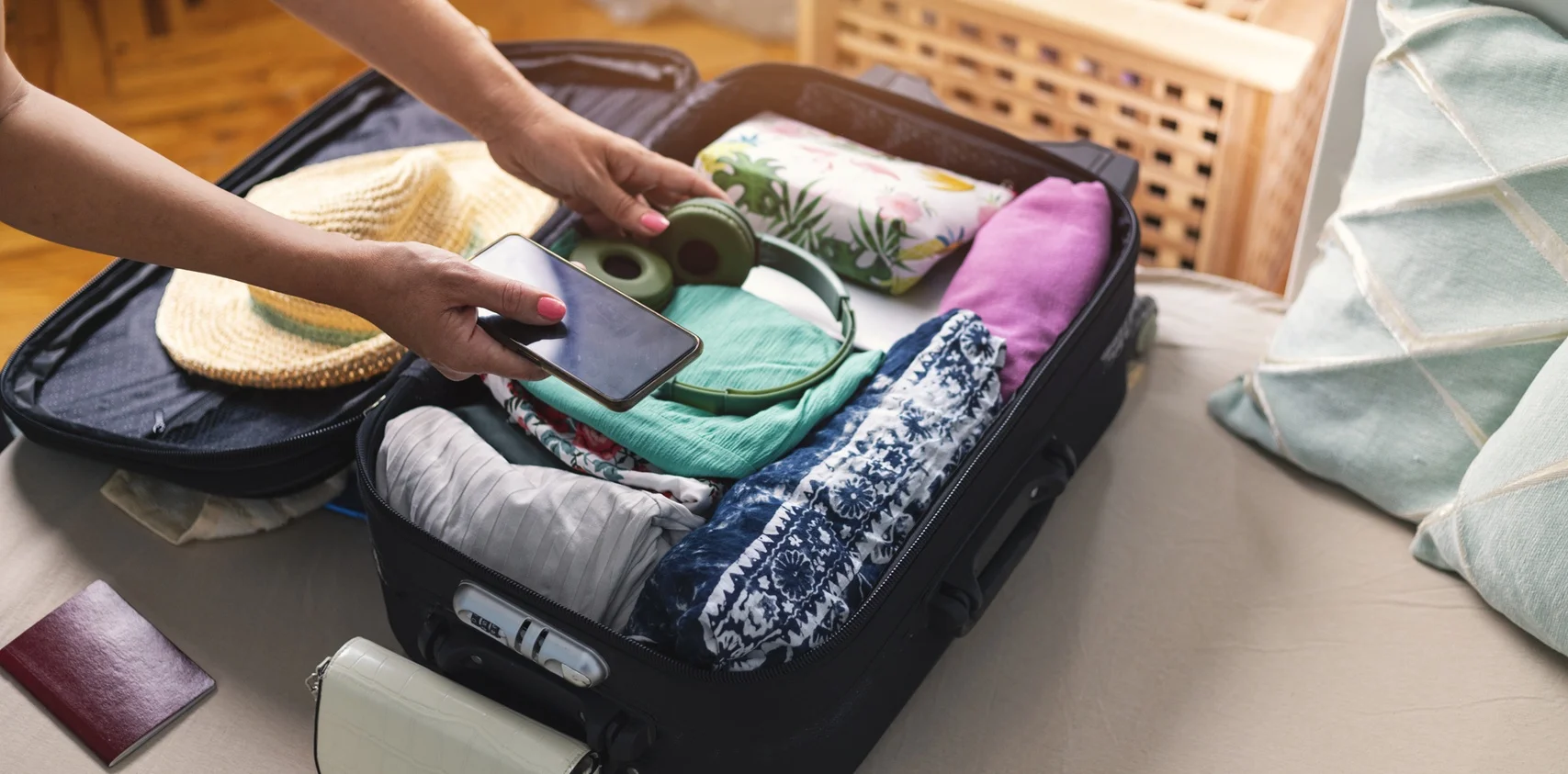
Digital Nomad Pre-Departure Checklist: The Simple Packing Guide
1. Packing Principles : Nomadic Life ≠ Backpacking Trip A digital nomad’s luggage must support both work and daily life. So before packing, remember these three key principles: Lightweight but not careless: You’re not on vacation—you’ll be working remotely for an extended period. Multi-functionality is key: Every item you bring should ideally serve two or more purposes. Backup and flexibility: In case of internet outages, locked cards, or lost items—you need a Plan B. 2. Digital Nomad Gear Checklist (Global Essentials) 1. Remote Work Kit 2. Minimalist Living Kit 3. Safety & Emergency Kit 4. Optional but Helpful Add-ons 3. Commonly Overlooked Essentials These items may seem minor, but many digital nomads regret not bringing them once they’re on the road: Power strip (with USB ports): Many places only offer one outlet—use a strip to charge laptop, phone, and earbuds all at once. Earplugs and sleep mask: In hostels, airplanes, or noisy neighborhoods, good sleep is gold. Backups of passport and key documents: Scan and upload to Google Drive; print a set and hide it deep in your bag. Multiple credit/debit cards: If one gets locked, you’ll have a backup. Understand how insurance claims work: Don’t just buy insurance—know what documents are required and prepare templates in advance. Prescription meds or personal health items: Your go-to brands or specific ingredients might not be available abroad. Feel free to share with us—what are your must-have essentials for digital nomad life? -- Follow the Digital Nomad Facebook fan page and stay updated with more recent articles on Instagram (@digital.nomad.press)!
April 16, 2025
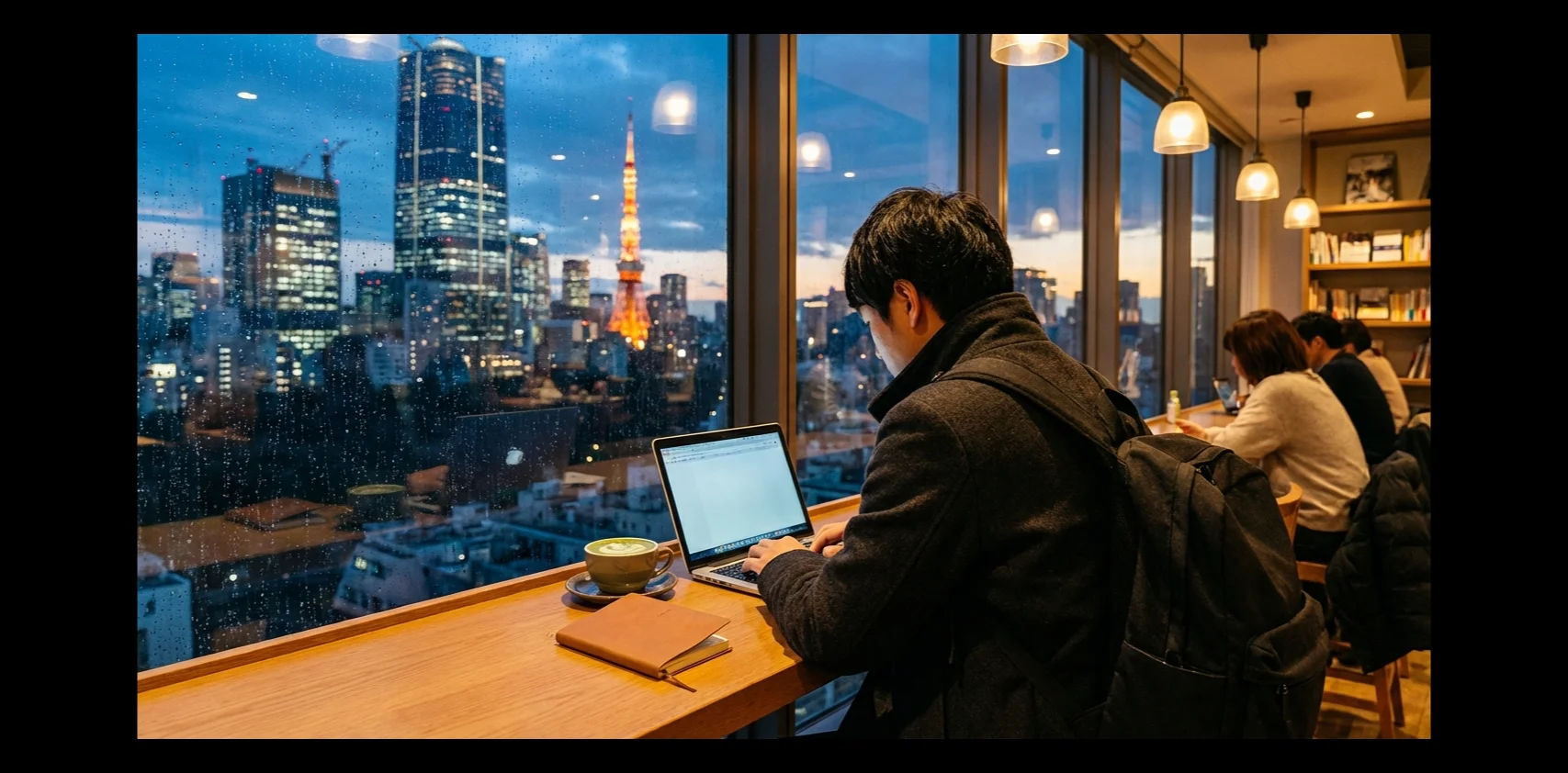
2026 Japan Digital Nomad Complete Guide: Visa, Tax, Living Costs & City Recommendations
We published a Japan digital nomad guide in 2024 covering visa basics, transportation, and accommodation. But two years on, Japan's nomad landscape has fundamentally changed: the Tourism Agency has invested for three consecutive years, local governments are competing to attract nomads, and NomadResort's pilot data proves high-value nomads are willing to invest in Japan. 2026 is a completely different game. This updated guide focuses on tax strategy, detailed cost breakdowns, the latest Tourism Agency policies, 2025 pilot data, and newly emerging nomad cities. For visa application checklists, see our visa details article. 1. Visa Strategy: DN Visa vs Visa-Free — Which Route? Japan's digital nomad visa ("Designated Activities" status) key rules: Duration: Up to 6 months, non-renewable. Must wait 6 months before reapplying Income: ¥10 million/year (~$67,000 USD) Health insurance: ¥10 million coverage required Work restriction: Remote work for overseas clients only No residence card issued; cannot switch visa types But here's what many don't realize: you might not need the DN visa. Practical advice: If your income is below ¥10M or you're staying 2-3 months, visa-free entry while "not taking local Japanese clients" remains the majority choice. But if you need to prove legal work status to clients or employers, the DN visa is the only formal path. 2. Taxes: The 183-Day Rule This is critical and wasn't covered in our 2024 guide. Core rule: Stay under 183 days with all income from outside Japan → generally not considered a Japanese tax resident, no Japanese income tax. Exceed 183 days (including visa-free periods) → potentially classified as tax resident with worldwide income obligations. This is partly why the DN visa caps at 6 months—right at the 183-day boundary. 3. 2026 Tourism Agency: From Tourism to Investment The Tourism Agency launched its third consecutive year of the "Digital Nomad Attraction Program" on March 5, 2026, shifting from exploration to model-setting. 2025 NomadResort Pilot Data: Operated in Okinawa (Nago), Nagano (Hakuba), Nagasaki (Goto), Ishikawa (Noto) Attracted professionals from 27 countries Developed 30+ local experience programs Over 50% of Okinawa participants expressed ¥10-30M investment interest in real estate or business 2026 Priorities: Cross-regional collaboration (city + rural), targeting high-income nomads, and ultra-long stay infrastructure (90+ days). 4. Cost of Living: Five Cities Monthly estimates (single person, moderate lifestyle, JPY): 🏙️ Tokyo: ¥180-310K | 🍜 Osaka: ¥130-240K | 🌊 Fukuoka: ¥100-200K | 🏖️ Okinawa: ¥100-170K | 🏔️ Nagano (Hakuba/Matsumoto): ¥80-160K Cities outside Tokyo save 30-40% with comparable quality of life. Nagano is the newest and most affordable option. 5. City Picks: Five Nomad Styles 🏙️ Tokyo — Everything, but expensive. Endless coworking, perfect transport. Best for short intensive sprints. 🍜 Osaka — Best value major city. 20-30% cheaper than Tokyo, incredible food, Kansai Airport for Asia travel. 🌊 Fukuoka — Japan's most nomad-friendly city. Airport 10 min from downtown, strong startup scene (Fukuoka Growth Next). 🏖️ Okinawa — Tourism Agency's showcase destination. NomadResort 2025 pilot: 50%+ expressed long-term settlement interest. Slowest pace, best beaches, car needed. 🏔️ Nagano (Hakuba/Matsumoto) — Newly emerging 2025 nomad hub. One of four NomadResort pilot regions. Skiing in winter, hiking in summer, lowest costs of all five cities. 90 min by bullet train from Tokyo — the exact "dual-region" model the Tourism Agency is promoting for 2026. 6. Resources Official DN Visa: Immigration Services Agency Tourism Agency 2026 Program: MLIT Coworking Search: Coworker.com NomadResort: Okinawa | Hakuba | Goto | Noto Japan is evolving from a tourism powerhouse into a country where nomads can genuinely settle for months. Compared to 2024, infrastructure is stronger, policies are clearer, and local governments are more proactive. 2026 is the year to seriously consider Japan as your nomad base.
March 12, 2026
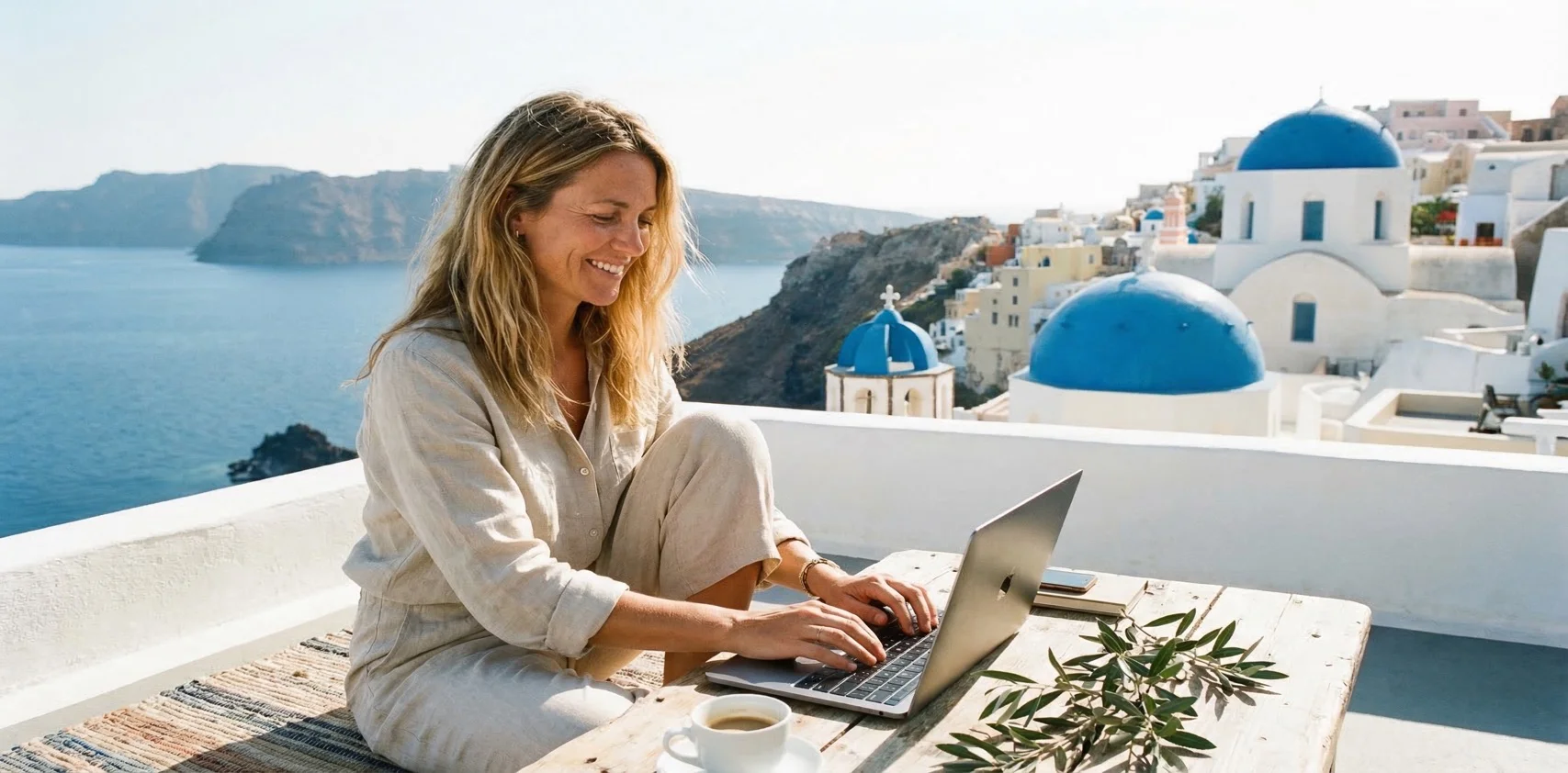
Greece's Digital Nomad Visa Half-Tax Deal, Fully Explained: Work by the Aegean and Pay Half the Income Tax
Among the dozens of digital nomad visa programs now available worldwide, Greece's offering stands apart on one headline feature: a 50% income tax reduction on foreign-source earnings. For remote workers earning above €3,500 per month, this translates to potential annual savings of thousands, or even tens of thousands, of euros. Combined with the completion of the Island Mesh 5G network in 2026 and a cost of living that remains remarkably low by European standards, Greece is evolving from a vacation destination into a serious long-term base for digital nomads. This report breaks down every detail of the Greek digital nomad visa, from eligibility and tax calculations to the actual application process and daily living costs, providing an actionable decision-making guide. Visa Framework Overview Greece's digital nomad visa (formally called the "Digital Nomad Visa" or "Independent Location Work Visa") launched in late 2021. After several revisions, the 2026 version represents a mature system. Core requirements: Applicants must be non-EU/EEA citizens Must work remotely for employers or clients outside Greece Cannot work for Greek employers or conduct business in Greece Minimum monthly income of €3,500 Spouse adds 20% to the threshold (approximately €4,200) Each dependent child adds 15% Duration: Initial visa validity: two years Renewable, with a maximum total residency of five years Permanent residency eligible after five years Greek (EU) citizenship pathway available after permanent residency Application routes: Greek consulates abroad Immigration offices within Greece (for those already legally present) In some cases, tourist visa holders can convert status in-country How the Half-Tax Benefit Works The centerpiece of Greece's nomad visa is the 50% Tax Reduction on Foreign-Source Income. Here's the mechanism. Eligibility conditions: Visa holders must transfer their tax residency to Greece Must not have been a Greek tax resident for at least three of the previous five years Must commit to residing in Greece for at least two years Calculation method: Greece's standard progressive income tax rates: €0 to €10,000: 9% €10,001 to €20,000: 22% €20,001 to €30,000: 28% €30,001 to €40,000: 36% €40,001 and above: 44% The half-tax benefit works straightforwardly: calculate your tax liability using the standard progressive rates above, then pay only 50% of that amount. Worked example at €60,000 annual income: Standard calculation: First €10,000 × 9% = €900 Next €10,000 × 22% = €2,200 Next €10,000 × 28% = €2,800 Next €10,000 × 36% = €3,600 Final €20,000 × 44% = €8,800 Standard tax due: €18,300 (effective rate: 30.5%) With half-tax benefit: Actual tax due: €9,150 (effective rate: 15.25%) Annual savings: €9,150 Worked example at €100,000 annual income: Standard tax due: €35,900 (effective rate: 35.9%) With half-tax: €17,950 (effective rate: 17.95%) Annual savings: €17,950 The higher the income, the greater the absolute savings. For nomads earning above €80,000 annually, the benefit exceeds €14,000 per year. Cross-country comparison: Portugal (revised NHR): 20% flat rate for specific industries, narrower eligibility Italy (Impatriate Regime): Up to 70% reduction, 90% in southern regions Croatia: Zero local income tax during residency (but one-year limit) Spain (Beckham Law): 24% flat rate, plus Autónomo social security costs Estonia: 20% flat personal income tax Italy's southern regions offer the most aggressive tax position for high earners. Croatia's zero-tax approach is attractive but limited by its one-year residency cap. Greece's half-tax program strikes a compelling balance between tax savings and long-term residency potential. Island Mesh: The 5G Game-Changer of 2026 For years, digital nomads wanting to work from Greek islands faced a practical barrier: unreliable internet. Athens and Thessaloniki offered adequate connectivity, but island locations were a bandwidth lottery. That changed fundamentally in 2026. The "Island Mesh" project, a collaboration between the Greek government and telecom operators, completed rollout in early 2026, extending 5G coverage to the vast majority of inhabited islands. Technical details: Millimeter wave and mid-band 5G technology Combined submarine fiber and satellite backhaul Coverage across more than 100 inhabited islands Guaranteed minimum download speeds of 100Mbps, with 300Mbps+ in primary areas Simultaneous upgrade of inter-island submarine fiber links Practical impact: Digital nomads can now work from a cliffside café in Santorini, a beachfront in Mykonos, or a mountain village in Crete with connectivity sufficient for video conferencing and cloud-based work. The longstanding perception that "Greece is great for vacation but not for work" is officially outdated. Note that 5G coverage concentrates in main settlements and tourist areas. Extremely remote locations may still rely on 4G or satellite. Test connectivity before committing to a long-term location. Living Costs: A Detailed Breakdown Greece's cost of living is one of its strongest advantages as a nomad destination. Here are 2026 figures. Athens: City center one-bedroom apartment: €550 to €800/month Suburban one-bedroom: €400 to €600/month Food (mix of cooking and eating out): €350 to €500/month Public transportation pass: €30/month Coworking space: €120 to €200/month Utilities and internet: €100 to €150/month Estimated individual monthly total: €1,200 to €1,800 Islands (off-season): One-bedroom apartment: €400 to €700/month Food: €300 to €450/month Transportation (scooter or car rental typical): €100 to €200/month Coworking (limited options on some islands): €80 to €150/month Utilities and internet: €80 to €130/month Estimated individual monthly total: €1,000 to €1,600 Islands (peak season, June through September): All prices increase 30% to 100% Short-term rentals become especially expensive Long-term lease agreements recommended to lock in rates Comparative context: Athens costs roughly 45% of London, 50% of Paris, 35% of New York Among Southern European peers, Athens is slightly cheaper than Barcelona, comparable to Lisbon, cheaper than Rome Island off-season costs approach Southeast Asian cities like Chiang Mai Step-by-Step Application Process Step 1: Confirm eligibility (2-3 months before application) Verify nationality eligibility Prepare income documentation (six months of bank statements, contracts, or employer letters) Confirm consistent monthly income above €3,500 Calculate adjusted threshold if dependents are included Step 2: Assemble documents Valid passport (at least six months beyond visa period) Income proof Remote work or client contracts Health insurance covering medical costs in Greece Criminal background check Proof of accommodation (lease or hotel booking) Completed application form Certified translations for all non-English, non-Greek documents Step 3: Submit application At a Greek consulate (appointment recommended) Or at a local immigration office if already legally in Greece Pay application fee (approximately €150) Step 4: Wait for processing Typical processing time: 4 to 8 weeks Some consulates may be slower Additional documentation may be requested Step 5: Receive visa and enter Greece Enter Greece on the approved visa Within 30 days of arrival, register at the local tax office (AADE) for a tax number (AFM) Obtain a social insurance number (AMKA) Step 6: Activate tax residency and half-tax benefit Apply to transfer tax residency to Greece Submit the half-tax benefit application (an accountant can handle this) Confirm the benefit's start date Common pitfalls: Greek bureaucracy is slow. Budget more time than expected. Some consulates have specific document format requirements. Verify in advance. Transferring tax residency requires formal notification to your previous country's tax authority. Hiring a local immigration lawyer (€800 to €1,500) and accountant (€500 to €1,000 annually) is strongly recommended. Who Is This Best For? Ideal candidates: Remote workers earning €50,000+ annually (the tax savings become meaningful at this level) People who enjoy Mediterranean climate and lifestyle Those planning extended European stays (Greece as a Schengen base) Those interested in eventual EU permanent residency or citizenship Freelancers or employees with flexible schedules Those who prioritize quality of life over urban convenience Less suitable for: Remote workers earning below €3,500/month (cannot meet the threshold) Those who need a highly urbanized environment with vibrant nightlife (limited options outside Athens) People with low tolerance for bureaucratic inefficiency Those who cannot commit to two years in Greece (required for the tax benefit) Those primarily serving Asia-Pacific clients (time zone challenges) Families requiring top-tier international schools (fewer options than Western Europe) Advanced Tax Considerations Double taxation agreements: Greece has treaties with over 50 countries. Before becoming a Greek tax resident, confirm whether a treaty exists between Greece and your income source country to avoid being taxed by both. Social insurance: Greek tax residents may owe social insurance contributions. For self-employed individuals, this runs approximately 26.95% of income. This cost is separate from the half-tax benefit and must be factored in independently. Exit strategy: The half-tax benefit requires a two-year commitment. Leaving Greece before the two years expire may trigger clawback of previously enjoyed tax reductions. Ensure your plans genuinely support at least two years of residency. Home country obligations: Transferring tax residency to Greece typically ends or reduces obligations in your previous country. However, some countries (notably the United States) impose worldwide taxation on citizens regardless of residency. U.S. citizens need specialized advice. The Bottom Line Greece's digital nomad visa, anchored by its half-tax benefit, occupies a distinctive position in the global nomad visa landscape. It's not the lowest barrier to entry (Argentina and Spain are more accessible). It's not the most aggressive tax deal (Italy's southern regions at 90% reduction and Croatia's zero-tax approach go further). But it achieves an impressive balance across tax optimization, residency flexibility, quality of life, and long-term settlement potential. The 2026 completion of the Island Mesh 5G network addresses what was historically Greece's biggest weakness as a remote work destination. For digital nomads who've fantasized about opening a laptop in a whitewashed house overlooking the Aegean, the fantasy is now an arithmetically sound decision. In the global race to attract digital nomads, Greece has played two powerful cards: half-tax and island 5G. What remains to be seen is whether the execution matches the promise.
April 17, 2026

"Digital Nomad" Reader Submissions|Themes and Methods for Submission Revealed at Once
Are you on the digital nomad journey? Are you trying freelancing, remote work, or entrepreneurship? We sincerely invite you to share your experiences and stories to everyone! I. Submission Themes Feel free to share under themes such as digital nomadism, remote work, freelancing, entrepreneurship, personal branding, media management, overseas work, etc.: 1. Your Work Experience and Skills E.g., freelancing techniques, personal branding strategies, overseas job hunting experiences, etc. 2. Introducing Various Digital Tools Beneficial for Work and Life E.g., effective digital tools for managing remote teams. 3. Methods for Improving Work Efficiency and Time Management E.g., overcoming procrastination, enhancing efficiency in online meetings, etc. 4. Essential Knowledge on Work Visas, Payments, Cross-Border Financial Flow, Contract Signing, etc. 5. Sharing Experiences of Living in Different Places and Local Customs E.g., sharing information about local prices, culture, safety, etc. For more themes and content, please refer to the articles on the Digital Nomad official website. II. Submission Format Please send your submissions to digitalnomad@ftpm.com.tw, with the email subject titled "Digital Nomad Reader Submission: Please Fill in Article Title," and provide "Self-Introduction" and "Submission Article." 1. Self-Introduction To help us understand you better, please provide a self-introduction of about 150 words. 2. Submission Article Word Count: 1000 words. Language: Chinese or English are both acceptable. Submission File: Please provide a Google.doc cloud link with editing permissions enabled. Image Format: If you wish to provide images, please attach them to the email in .jpg format, along with captions and image sources. If there are copyright concerns regarding the images you provide, we will not use them. Contact Information: You can include your blog or social media links at the end of the article. We will create hyperlinks so that readers can get to know you better through these links. Reader submissions are unpaid, and the Digital Nomad editorial team reserves the right to decide whether to publish them. Titles may be adjusted, and content may be edited, with your consent, before publication. Due to the high volume of submissions, we will reply to your email within two weeks. Digital Nomad hopes to be a platform for digital nomads to exchange ideas. Your articles will be featured in Digital Nomad, and we will also promote them through Facebook and Instagram to help you gain visibility and explore more collaboration opportunities. The Digital Nomad team also hopes to use this opportunity to collaborate more deeply with outstanding creators in various aspects. Welcome to submit and share your journey on the digital nomad path. We look forward to the opportunity to exchange and learn together.
April 12, 2024
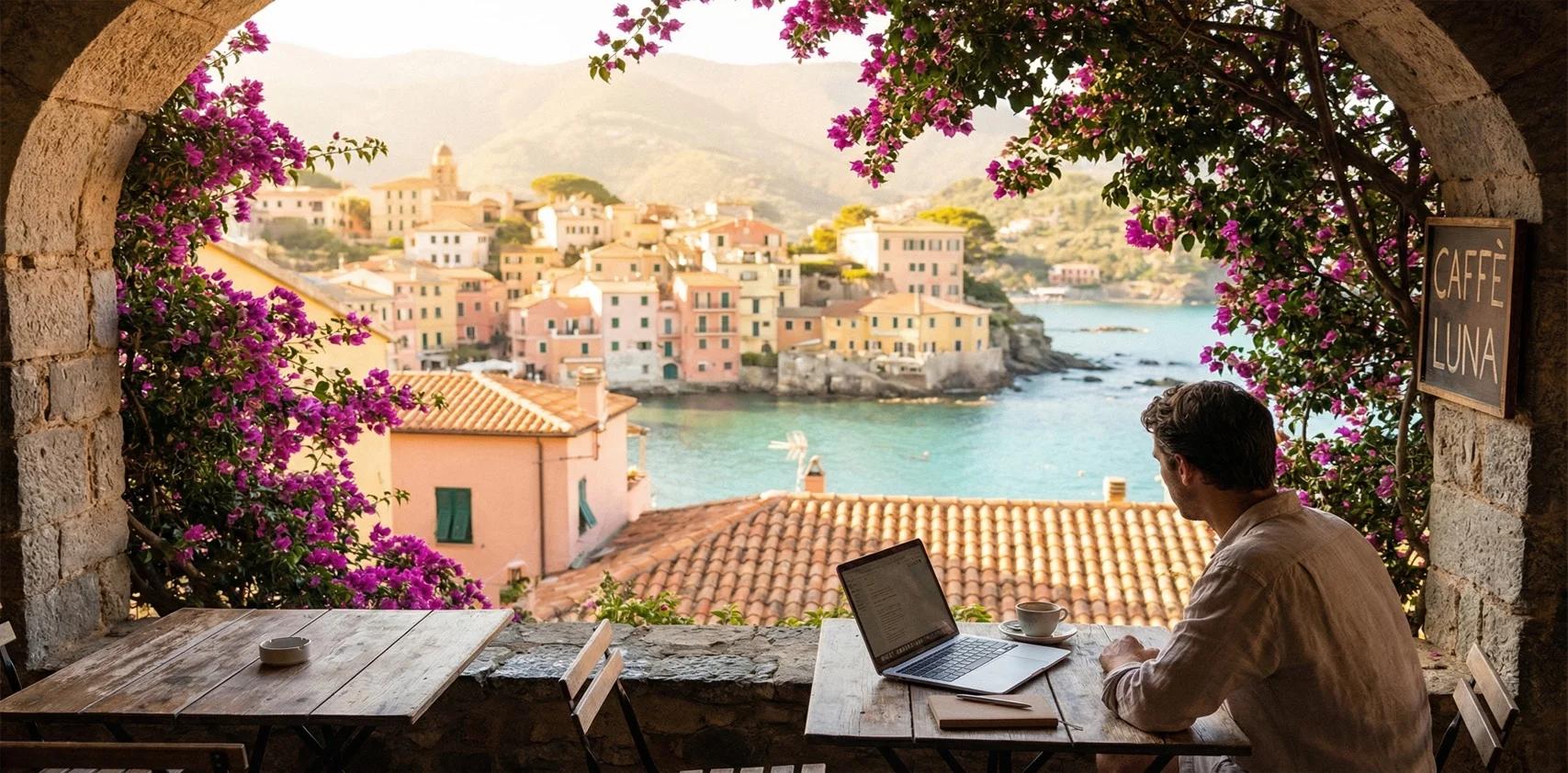
4 Emerging Digital Nomad Cities You Haven't Heard Of (But Should)
Chiang Mai, Bali, Lisbon, Budapest. If you've been in the digital nomad space for more than a year, you've probably heard these names a hundred times. They're great — genuinely. But precisely because everyone knows about them, prices have crept up, visa processes have tightened, and every café is packed with foreigners staring at MacBooks. In 2026, I want to put four rising cities on your radar — places that are gaining momentum but haven't been overrun yet. Over the past eighteen months, I've spent at least three weeks in each. Here's what I found. Kotor, Montenegro: A Secret Base on the Adriatic I first arrived in Kotor last April. It's less than two hours by car from Dubrovnik, but the prices are immediately cut in half. This medieval town, cradled between mountains and a bay, has a quality that's hard to articulate: it has Croatia's scenery without Croatia's crowds. Visa Conditions Montenegro offers visa-free entry for 90 days to most passport holders. For longer stays, the Digital Nomad Visa allows up to two years of residency, renewable. The income threshold is relatively flexible — you just need to demonstrate stable remote income. The visa fee is approximately €25. Montenegro is actively pursuing EU accession, and its legal framework and infrastructure are improving rapidly. Monthly Budget Breakdown Internet Speed Fiber coverage in the city center is solid. Real-world download speeds in Airbnbs averaged 50 to 80 Mbps. Coworking spaces can hit 100 Mbps and above. 4G mobile coverage is stable. It's not Tokyo-tier, but it's more than adequate for standard remote work. Pros and Cons Pros: Stunning scenery (the view from any random café includes the Adriatic Sea), lower costs than Western Europe with comparable quality of life, decent English communication, excellent food (where seafood meets Balkan cuisine), and a strong sense of safety. Cons: Summer months (July-August) bring a tourist surge with rising prices and noise; coworking options are limited; winters are quiet and the social scene shrinks dramatically; few direct flights — you'll usually connect through Dubrovnik or Podgorica. Best for: People who prefer quiet environments, natural beauty, and don't need constant social stimulation. Particularly well-suited for writers, designers, or anyone doing deep-focus work. Avoid peak season in July and August. Medellín, Colombia: The City of Eternal Spring's New Wave Medellín has some name recognition in the nomad community already, but compared to Chiang Mai or Bali, it's still a relatively fresh option. And what sets it apart is this: its infrastructure is far better than most people expect from a South American city. Visa Conditions Colombia offers a dedicated Digital Nomad Visa valid for up to two years. The income threshold is three times the Colombian minimum wage — roughly $1,100 per month as of 2025. The application process is straightforward: submit documents online, and approval typically comes within two to four weeks. Visa fee is about $55. Without the nomad visa, most passport holders can enter visa-free for 90 days, with the option to exit and re-enter to reset. Monthly Budget Breakdown Internet Speed Medellín's internet quality is top-tier for South America. Residential fiber is widespread, with real-world speeds of 50 to 100 Mbps being common. Coworking spaces typically offer 100 to 200 Mbps. 4G/5G mobile coverage is comprehensive. Video calls run without a hitch. Pros and Cons Pros: Perpetual spring weather (average 22°C year-round — no AC, no heating needed), excellent coworking variety (Selina, WeWork, and local brands), active nomad community, diverse cuisine, vibrant nightlife, and a convenient metro system. Cons: Safety requires awareness (El Poblado and Laureles are relatively safe, but some areas aren't great for solo walks at night); Spanish is practically essential (English penetration is lower than Southeast Asia); El Poblado is gentrifying rapidly due to nomad influx; occasional foreigner-pricing. Best for: Social butterflies who enjoy nightlife and can embrace a bit of urban edge. If you speak even basic Spanish, your experience improves dramatically. Best enjoyed over a three-to-six-month deep stay. Penang, Malaysia: Southeast Asia's Underrated Gem In Southeast Asia's nomad landscape, Penang has always lived in the shadow of Bangkok and Chiang Mai. But if you asked me to name one city that delivers low costs, incredible food, fast internet, and Mandarin-friendly communication, Penang is my first answer. Visa Conditions Malaysia offers the DE Rantau Digital Nomad Visa (also called the Nomad Pass), valid for 12 months and renewable. The annual income threshold is $24,000 (about $2,000 per month), and you need to work in a digital field. Application fee is approximately 218 MYR (about $50). Many passport holders can also enter visa-free for 30 to 90 days — sufficient for a trial run. Monthly Budget Breakdown Internet Speed Malaysia's internet infrastructure is genuinely impressive. Fiber broadband in Penang's urban areas regularly tests at 100 to 300 Mbps. Café Wi-Fi typically runs 30 to 50 Mbps. 4G mobile networks are fast and reliable. Pros and Cons Pros: World-class food (Penang's street food is widely considered among the planet's best — char kway teow, laksa, curry mee — you could eat a different breakfast every day for a month and never get bored), extremely low prices (likely the cheapest city on this list), Mandarin and English both widely spoken, culturally diverse and welcoming, and George Town's heritage architecture has a unique charm. Cons: Hot and humid weather (28 to 32°C year-round), public transport is underdeveloped (no metro — you'll rely on Grab or rentals), the nomad community is less mature than Chiang Mai or Bali, and nightlife options are limited. Best for: Budget-conscious nomads who refuse to sacrifice quality of life, food lovers, people comfortable with tropical climates, and anyone looking for an overseas base where Mandarin or English gets you everywhere. Especially recommended for first-time nomads — the cultural adjustment is minimal. Tirana, Albania: Europe's Best-Kept Budget Secret When someone tells me "I want to live in Europe long-term, but I'm on a budget," I point them to Tirana. This city might be the single best value-for-money nomad destination on the European continent. Visa Conditions Albania offers a "Unique Permit" digital nomad visa (Type D). The income threshold is remarkably low — approximately $9,800 per year, one of the lowest in all of Europe. The visa is valid for one year and renewable. Many nationalities can also enter visa-free for extended periods — some for up to a full year, which is extraordinarily rare for a European country. Monthly Budget Breakdown Internet Speed Tirana's internet performance is a genuine surprise. The city has high fiber coverage, and residential connections regularly test between 80 and 250 Mbps. The country's average internet speed ranks in the upper-middle tier for Europe. It's nothing like the "underdeveloped small country" image many people carry. Pros and Cons Pros: Extremely low cost of living (50 to 60% cheaper than Western Europe), surprisingly fast internet, incredibly warm and hospitable locals, rich coffee culture (Italian influence means espresso quality is absurdly good — under $1 per cup), and a city that's rapidly modernizing while retaining genuine character. Cons: English proficiency isn't universal (younger generation is fine, older residents struggle), public infrastructure is still catching up (some roads are rough, waste management needs work), limited international flight connections, and the banking system heavily favors cash (bring plenty). Best for: Budget-sensitive nomads, anyone wanting long-term European residence without breaking the bank, and adventurers who enjoy discovering "off-the-beaten-path" destinations. Tirana is at an interesting inflection point — it's being discovered but hasn't been swamped yet. That window probably won't stay open forever. The Logic Behind Choosing a City Four cities, four personalities. Kotor gives you silence and beauty. Medellín gives you energy and community. Penang gives you value and food. Tirana gives you affordability and surprise. Choosing a digital nomad city isn't just about comparing prices and download speeds. More importantly, it's about understanding what kind of environment you need at this particular stage of your life. Need deep focus? Go to Kotor. Need community and stimulation? Go to Medellín. Need comfort and familiarity? Go to Penang. Need a budget-friendly European base? Go to Tirana. These four cities share one thing: they're all still in the "being discovered" phase. Show up now, and you're the interesting early arrival. Wait two or three years, and you might just be another nomad in the crowd. Timing windows like these don't wait around.
March 25, 2026
Forbes 2026 Nomad City Rankings: Beyond Cheap Rent
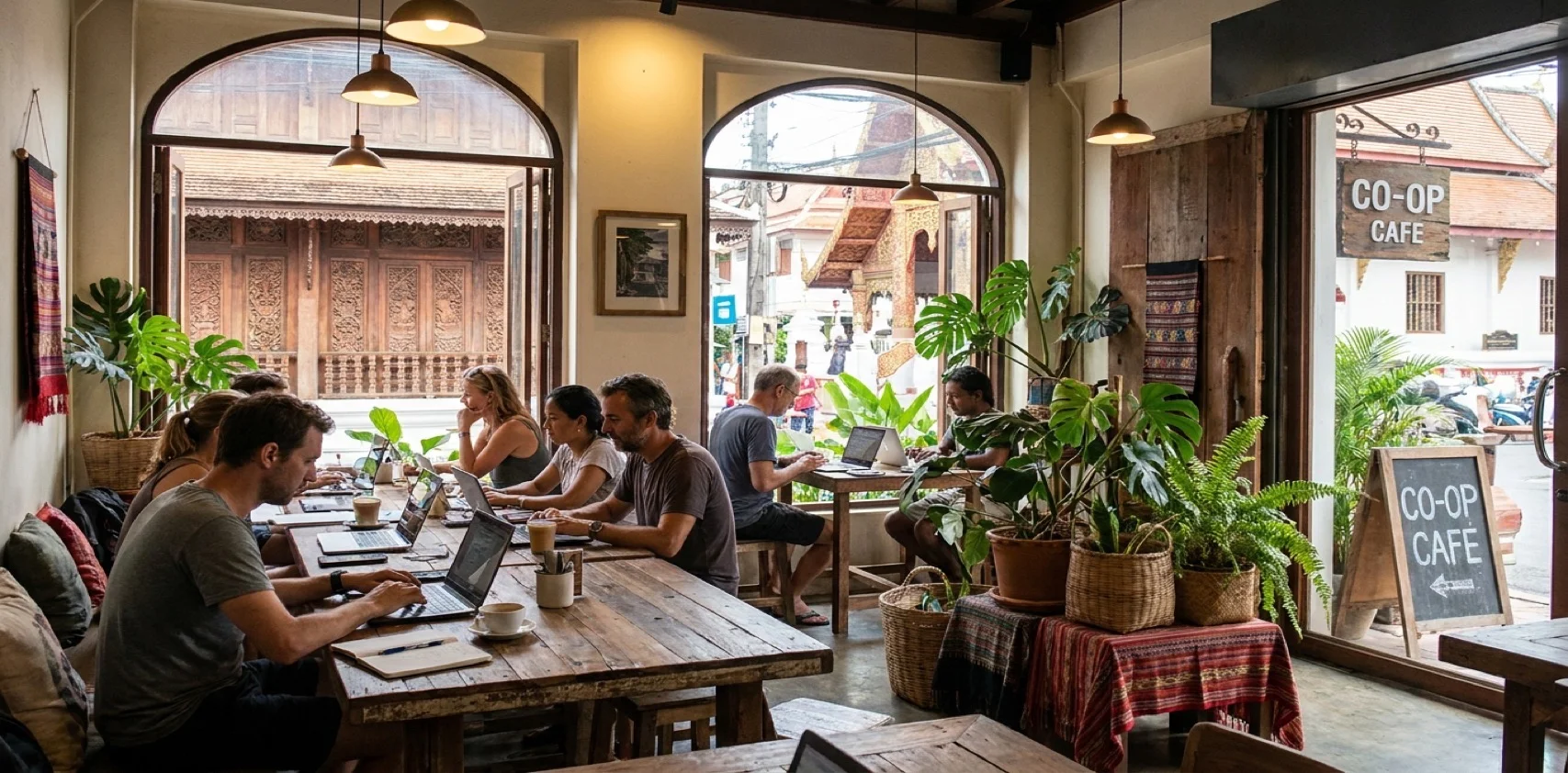
In April 2026, Forbes published its annual list of the best cities for digital nomads and creators. Eight cities made the cut: Lisbon, Medellín, Chiang Mai, Da Nang, Cape Town, Austin, Miami, and Asheville. TimeOut Asia quickly followed up, confirming the two Southeast Asian picks. The list itself was unsurprising. What changed was the logic behind it. For years, nomad city rankings were essentially cost-of-living indexes dressed up with co-working space counts and average Wi-Fi speeds. The implicit question was always the same: where can a remote worker live cheaply while maintaining a decent internet connection? Forbes 2026 flipped the script. The new evaluation criteria center on visa infrastructure, founder ecosystems, healthcare access, co-working density, and banking accessibility. Cost of living still matters, but it has been demoted from the lead criterion to a supporting factor. The smoothie bowl era of digital nomadism is officially over. What Changed in the Ranking Criteria Visa infrastructure over visa-free days. Previous rankings celebrated countries where nomads could stay 90 or 180 days without a visa. The 2026 list cares more about whether a country offers a dedicated digital nomad visa, whether the application process is transparent and digitized, and whether the visa permits opening a local bank account. Over 69 countries now offer some form of remote work visa, but quality varies wildly. The real differentiator is whether a visa provides a stable legal framework for extended stays. Founder ecosystems over café culture. Forbes explicitly used the term "digital entrepreneur" this year, reframing the nomad demographic from laptop-toting freelancers to builders of portable online businesses. A city's appeal is no longer measured by how many cafés let you camp out all day. It's measured by the density of its startup community, the presence of investor networks, cross-industry collaboration in co-working spaces, and the availability of professional services that support scaling a business. Infrastructure completeness as a baseline. Healthcare quality, international schools, banking friendliness toward foreigners, and transportation reliability—factors once treated as nice-to-haves—are now table stakes. A city can offer the cheapest apartments in Southeast Asia, but if a dental appointment requires a three-hour commute, it won't appear on a 2026 list. City-by-City Analysis Lisbon: The Structural Advantage Lisbon has topped nomad city rankings for years, but the rationale has evolved. It's no longer "Europe, but affordable." It's "Europe's startup ecosystem on-ramp." Portugal's D7 visa and digital nomad visa provide clear legal pathways, and the prospect of eventual EU residency adds long-term appeal. The city offers a mature English-speaking startup community, a dense co-working network, and residual momentum from years of hosting Web Summit. The irony: Lisbon's popularity has driven rents up sharply. A one-bedroom apartment now runs €1,200 to €1,800 per month. It remains on the list not because it's cheap, but because its infrastructure is irreplaceable. Chiang Mai: The Original, Evolved Chiang Mai is one of the oldest nodes in the global nomad network, and it retains its core advantages in 2026: an exceptionally dense co-working ecosystem (Punspace, HUB53, Yellow Coworking), a mature long-stay rental market, and a cost structure that supports a comfortable life at around $1,000 per month. But Forbes' emphasis this year isn't on those familiar selling points. Chiang Mai earns its spot because it has evolved from "cheap and livable" to "easy to build a routine in." For entrepreneurs who need stability to run a business, the city offers something that took a decade of community-building to create: a complete nomad infrastructure layer, from visa agents and international hospitals to founder meetups and tax advisory services. Thailand's Long-Term Resident (LTR) visa, introduced in 2025, gives high-income remote workers a more stable residency option, further strengthening Chiang Mai's position. Da Nang: The Window Before Saturation Forbes describes Da Nang as a "fast-growing coastal hub" with reliable internet, an expanding co-working scene (Enouvo Space, Toong), strong café culture, and low barriers to entry. TimeOut also named central Vietnam among Asia's best travel destinations for 2026. The city occupies a delicate position: its co-working ecosystem isn't yet saturated, rents are still approachable, but the international nomad community is gathering fast. Forbes' phrasing—"before the city hits full saturation"—implies a limited window. For nomads scouting their next base, Da Nang's value proposition may be at its peak right now. Medellín, Cape Town, Austin: Different Strengths Medellín offers the density of Latin America's startup community and a gateway to Spanish-language markets. Cape Town provides Africa's rare combination of international-grade infrastructure and English-speaking professional networks. Austin represents a domestic nomad option for those who can't or won't leave the United States—Texas' zero state income tax and active tech scene offer an alternative path. Miami and Asheville round out the list, reflecting an interesting trend: digital nomadism is no longer synonymous with "moving to Southeast Asia." Domestic city-hopping within the U.S. now falls within the nomad definition. Beyond the List: Emerging Cities to Watch Several European cities are building reputations in the nomad community outside Forbes' eight picks. Brno, Czech Republic. Prague's shadow has long obscured this Moravian capital, but Brno is attracting nomads with lower costs, fewer tourists, and a tech industry foundation that rivals Prague's. The Czech freelance license (Živnostenský list) is relatively straightforward, and the city's walkable scale makes daily routine-building easy. Kotor, Montenegro. A medieval town on the Adriatic coast, known for dramatic natural scenery and very low living costs. Montenegro introduced a digital nomad residence permit in 2024. Kotor's international community is small but growing. Its positioning isn't to replace Lisbon or Chiang Mai—it's to serve nomads who need a quiet, low-distraction European option for deep-work periods. Dubrovnik is less than two hours away; Tirana is about three and a half hours. Intra-Balkan travel costs are minimal. Tirana, Albania. Possibly the most underrated nomad city in Europe. Albania's cost of living undercuts even some popular Southeast Asian hubs. The coffee culture is excellent (a dual Italian-Ottoman heritage), and the city is modernizing rapidly. Infrastructure stability and banking internationalization remain challenges, but the early-mover advantage is real. Italy's hidden cities: Lecce, Matera, Orvieto. Italy has long been excluded from nomad recommendations due to high costs and bureaucratic complexity. But an "anti-major-city" trend is emerging: smaller cities in southern and central Italy offer Italian quality of life at rents far below Milan or Rome, attracting nomads willing to accept less international communities. Italy's 2024 digital nomad visa provides the legal foundation. Lecce is called "the Florence of the South," Matera is world-famous for its cave dwellings (and was the 2019 European Capital of Culture), and Orvieto sits on a volcanic plateau in Umbria, just an hour from Rome. A New Decision Framework The real value of the Forbes 2026 list isn't the eight cities it names. It's the decision framework it reveals. The old nomad city logic ran roughly like this: Cost → Weather → Internet speed → Visa-free days → Community. Cheap came first; everything else was a bonus. The 2026 logic runs differently: Visa stability → Business support systems → Life infrastructure → Community quality → Cost. Cost has moved to the back of the line, because the first four factors determine whether someone can stay in a city for longer than three months. This shift reflects the maturation of the nomad demographic itself. When a person evolves from "traveling with a laptop" to "running a business from different cities," the selection criteria naturally pivot from "where can I save the most money" to "where can I be most productive." Whether a city's co-working spaces might connect you with a potential co-founder matters far more than whether its apartments are $200 cheaper per month. For nomads planning their next move, the Forbes list offers a useful self-diagnostic: if the first question in the decision process is still "how much will it cost per month?"—it might be time to reorder priorities. The questions that matter more: How long can this city's visa system support legal residency? Is there a professional community relevant to my industry? Can I access quality healthcare within a reasonable distance? Can I open a bank account? Cheap cities will always exist. But cities that keep both a business and a life running—those are the ones that matter in 2026.
May 27, 2026
The Rise of the Slomad: Why 2026's Nomads Are Staying Put
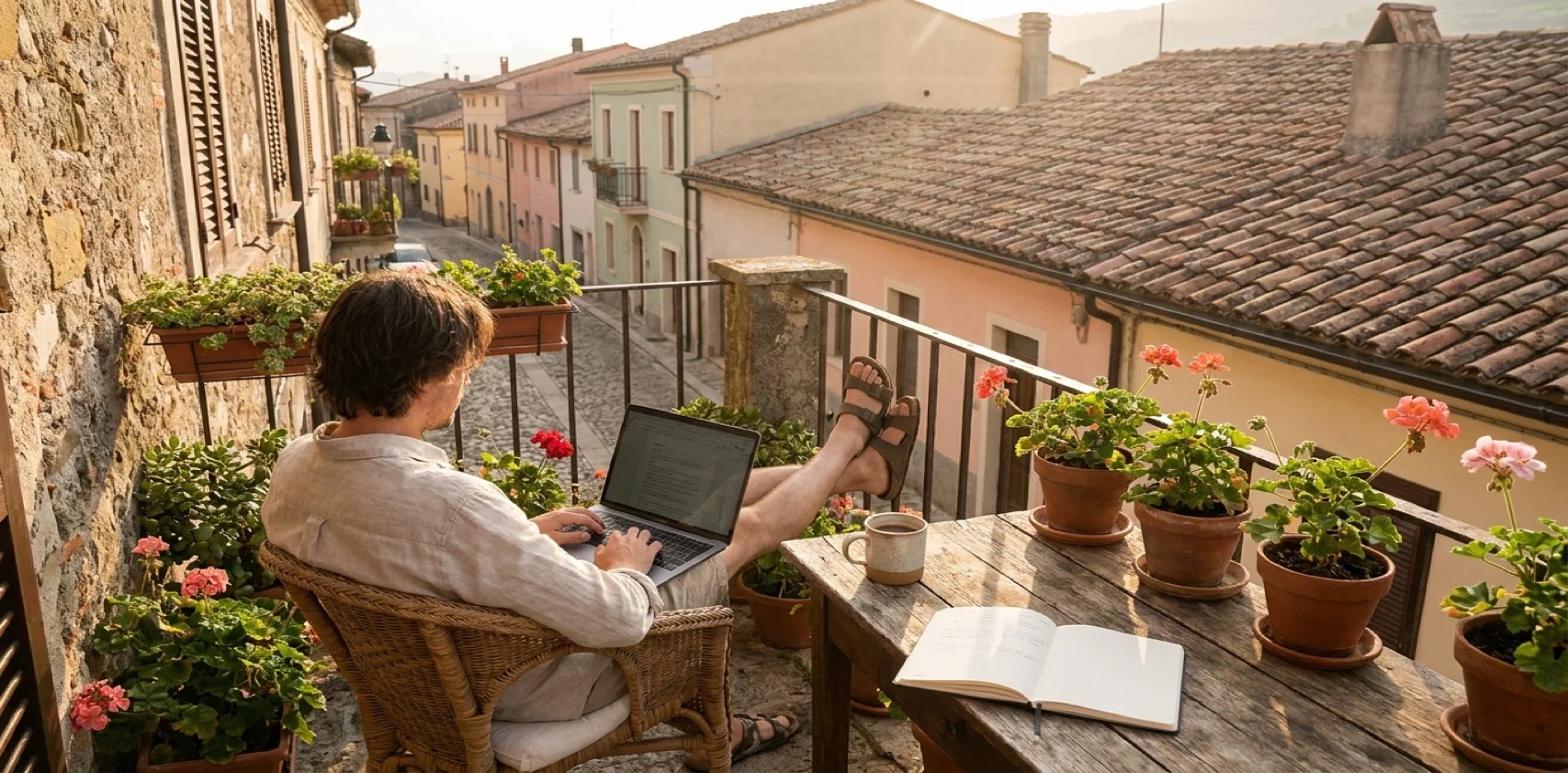
Three years ago, the quintessential digital nomad image looked something like this: a laptop, a carry-on, a new city every three weeks, and an Instagram feed perpetually refreshed with unfamiliar coffee shops and golden-hour sunsets. Movement was the point. The number of countries you'd visited was a proxy for how fully you were living. In 2026, that narrative is being quietly rewritten. A growing share of the world's remote workers aren't chasing the next boarding pass — they're settling into apartments for three months, six months, a year or more. They have a name: slomads. Short for slow nomads. And they're reshaping what it means to live a location-independent life. This isn't the death of digital nomadism. It's its maturation. What the Data Shows MBO Partners' 2025 Digital Nomad Trends Report found that 18.5 million American workers currently identify as digital nomads — a 153% increase since 2019. But the more telling shift isn't in total numbers. It's in how long people are staying. The report explicitly notes that nomads are "opting to stay longer at fewer destinations," a pattern it calls "slomading." A 2025 academic conference paper puts finer numbers on the trend: 58.4% of digital nomads surveyed reported staying in a single destination for one to three months. The remainder — the slomad cohort — opt for significantly longer stays. In February 2026, Drift Travel declared it outright: "2026 is the year of the slow-travel digital nomad." The piece describes nomads who no longer hop cities every few days but instead settle into 30-to-90-day "slowmad residencies" that allow the brain to enter the flow state required for deep, complex work. By April 2026, Euronews reported that approximately 165,000 UK professionals had relocated abroad to work remotely, with the "slomad trend" — favoring longer stays and a slower pace of life — identified as a primary driver. The pattern is unmistakable. Slomading isn't a fringe preference. It's a structural shift in how mainstream nomadism is practiced. Why They're Staying Burnout Is Real The hidden cost of constant relocation is enormous. Every move involves finding accommodation, verifying internet quality, adjusting to a new time zone, rebuilding daily routines, and handling the inevitable logistics failures. When this cycle repeats every three weeks, the cumulative cognitive load erodes both productivity and creative capacity. A Business Insider profile from October 2025 documented one nomad's transition: rather than quitting the lifestyle entirely, she learned to slow down. The article identified one of the most commonly cited contributors to nomad burnout as "the constant challenge of finding reliable internet" — a problem that largely vanishes under the slomad model. When you know you'll be in the same place for three months, you don't spend every Monday morning testing a new Wi-Fi password. Visa Policies Are Catching Up The slomad trend has coincided with a structural upgrade in global digital nomad visa offerings. In the past, most countries offered 90-day visa-free entry or short-term tourist visas, forcing nomads into periodic "visa runs." Now, an increasing number of nations are rolling out year-long or longer permits specifically designed for remote workers. Croatia extended its digital nomad permit to 18 months in 2025 and exempts holders from local income tax, with a minimum monthly income threshold of approximately €3,295. Spain's digital nomad visa enables long-term stays with a €2,700 monthly income requirement and access to a favorable non-resident tax regime. Portugal's D8 visa requires €3,480 per month and grants residence in hubs like Lisbon and Madeira. Estonia offers its e-Residency program with a 22% tax rate and nearly all government services available online. These visas aren't just legal documents. They're signals: these countries are serious about attracting remote workers for the long haul, not just transient tourism spending. Community Can't Be Built in Three Weeks Nomads who move constantly face a paradox: they crave connection but never give themselves enough time to form it. Every new city means finding a coworking space, meeting people, navigating local norms — only to leave before any of it deepens into genuine relationship. MBO Partners' report notes that slomading "fosters a more active social life, deeper learning about local cultures, and reduces the loneliness that is common among digital nomads." This isn't just a psychological benefit. For freelancers and entrepreneurs, local community means potential collaborators, clients, and the kind of trust that can't be replicated over Zoom. Cities like Barcelona, Chiang Mai, and Lisbon became nomad hubs not just because of their weather or cost of living — but because they developed multi-year community ecosystems. You have to stay long enough to become part of the ecosystem, rather than just passing through it. What Slomad Life Actually Looks Like The daily reality of a slomad differs fundamentally from the classic nomad experience. Home isn't a hotel. Slomads typically rent apartments on three-month to one-year leases, not nightly Airbnbs. This means a real kitchen, a dedicated workspace, and the kind of routines — greeting neighbors, knowing the mail carrier — that come with actual residency. Monthly costs are often a third to half of what short-term rentals command. Work rhythms resemble those of settled professionals. Without the need to re-adapt to a new environment every few weeks, continuity and depth of work improve markedly. Many slomads report that their longest, most ambitious projects were completed during extended stays — work they couldn't have sustained while constantly on the move. Travel becomes a weekend activity, not a lifestyle. This is a subtle but important distinction. Slomads still travel — but travel is exploration radiating outward from a fixed base, not an endless migration. A weekend trip to a nearby town, a holiday in a neighboring country — but home is somewhere specific. Local integration goes deeper. After six months in one place, you know which market opens on Wednesdays, which café has the best seats after 3 PM, and the name of the barber three blocks away. These details seem trivial, but they're the difference between inhabiting a place and merely passing through it. Pushing Back on the Instagram Nomad The slomad trend is, in part, a reckoning with the aesthetic that dominated nomad culture for the past decade. Social media constructed an image of the ideal digital nomad as perpetually in motion — always somewhere new, always documenting, always radiating the effortless cool of location independence. That narrative drew millions of young professionals into the lifestyle. It also left many of them feeling hollow after three to six months. The reality is that constant movement doesn't create meaning by itself. The novelty of a new city fades. And the problems you carry with you — career plateaus, relationship difficulties, questions of identity — don't resolve themselves just because you changed time zones. The slomad model proposes a different value equation: freedom isn't measured by how far you can go, but by your ability to build a quality life wherever you are. It's a more mature, more sustainable philosophy of nomadism. How to Transition from Fast to Slow For nomads considering a deceleration, some practical guidance: Start with a one-to-three-month trial stay. There's no need to commit to six months immediately. Pick a city that interests you, find an apartment with reliable internet, and give yourself a month to feel the rhythm. If it clicks, extend. Choose cities with established nomad infrastructure. For a first slomad experience, existing community scaffolding — coworking spaces, regular meetups, online groups — significantly lowers the barrier to integration. Lisbon, Barcelona, Chiang Mai, Medellín, and Budapest are all proven options. Research visa and tax implications. Longer stays introduce more complex regulatory considerations. Understand whether your target country offers a digital nomad visa, whether staying beyond 183 days triggers tax residency, and how your home country treats foreign-sourced income. Systematize your relocation process. Build a reusable moving checklist: accommodation preferences, essential gear packing list, first-three-days task list for each new location. When relocation becomes systematic, transitions are smoother even when they happen less frequently. Leave room for the unplanned. The core of slomad life isn't about doing nothing — it's about having enough slack in your schedule to accommodate the unexpected. A new friend's invitation. A local class you stumble into. A creative idea that needs three consecutive days of focus. Fast-paced nomad life rarely has room for these. Not Stopping — Redefining Movement The deeper significance of the slomad trend isn't that nomads have lost their appetite for travel. It's that their definition of freedom is evolving. The first generation of digital nomads proved their freedom through geographic movement. The second generation — the slomads — is discovering that a more fundamental expression of freedom is the ability to choose to stay, rather than being compelled to move. When a growing share of 18.5 million American nomads opt for slower rhythms, when governments roll out 18-month visas, when academic research and industry reports converge on the same conclusion — this isn't a passing fad. It's digital nomadism growing up. The coolest nomad of 2026 might be the one who's lived in the same apartment for eight months, knows every shopkeeper on the corner, and spends weekends hiking with local friends. Not because they couldn't keep moving. Because they finally found a reason to stay.
May 22, 2026
Why Taiwan Is the Best-Kept Secret for Muslim Digital Nomads
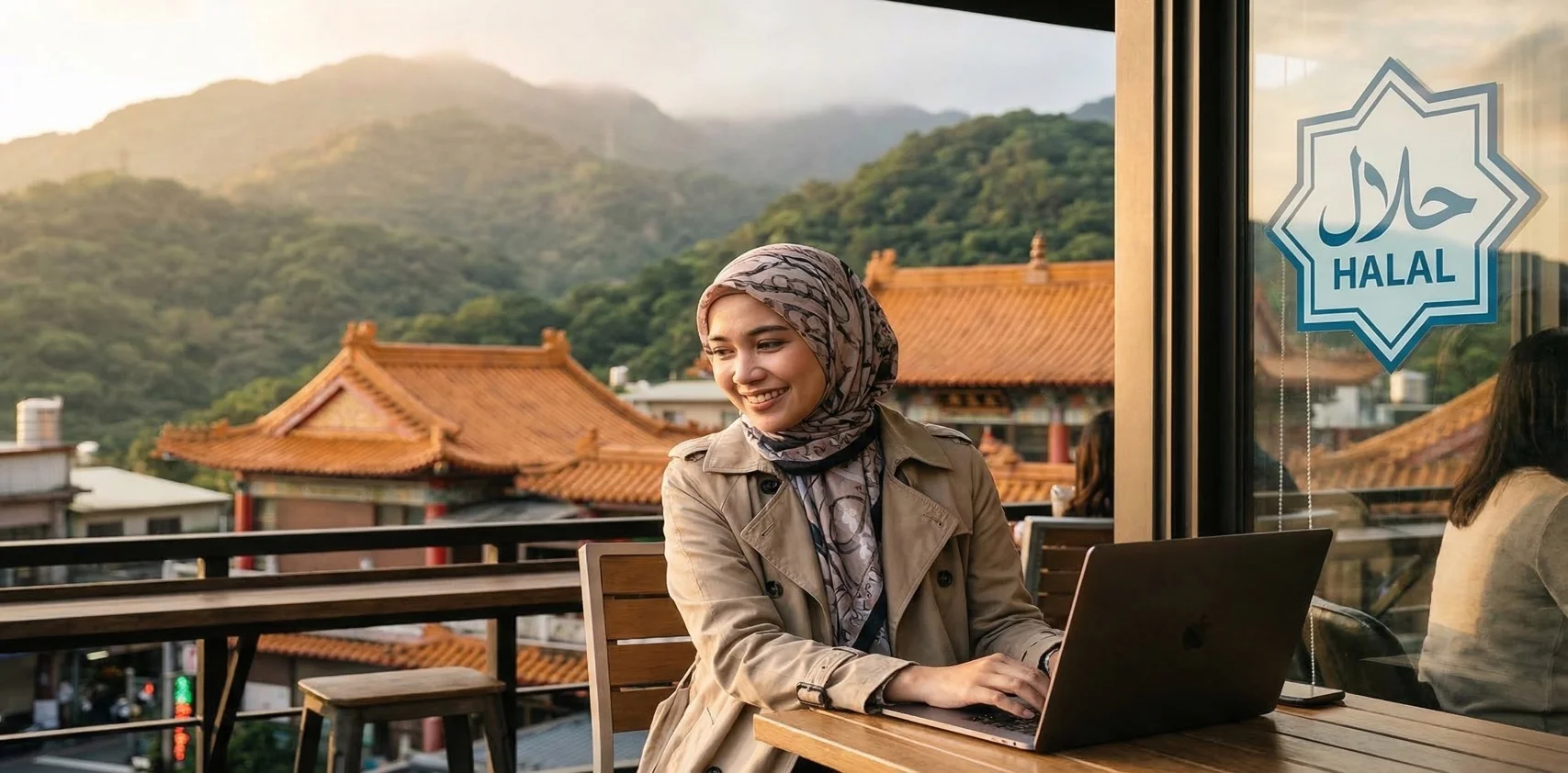
When Muslim digital nomads scout for a base in the Asia-Pacific, the usual suspects dominate the conversation: Bali for its beaches and bargain living costs, Kuala Lumpur for its halal-everything convenience, Bangkok for its affordability and coworking scene. Taiwan rarely makes the shortlist. That may be a mistake. In the Mastercard-CrescentRating Global Muslim Travel Index (GMTI), Taiwan has ranked among the top three non-OIC (Organisation of Islamic Cooperation) destinations for several consecutive years. It placed second in 2022, third in 2023, and maintained a top-tier position in 2024, alongside Singapore and Hong Kong. In 2023, Taipei was awarded "Most Promising Muslim-Friendly City Destination of the Year (non-OIC)" at the Halal in Travel Global Summit organized by CrescentRating. For a place where Muslims account for less than one percent of the population, these rankings are not a fluke. They reflect a deliberate, policy-driven ecosystem that happens to address the exact pain points Muslim digital nomads face when settling in for months at a time: food, prayer, visas, and community. The Infrastructure: Prayer Rooms in Train Stations Taiwan's approach to Muslim-friendly infrastructure is remarkably systematic for a non-Muslim society. Prayer rooms with qibla (direction of Mecca) indicators are available at Taoyuan International Airport, Taipei Main Station, Kaohsiung Station, Hualien Station, and the Taichung High Speed Rail station. Thirteen national scenic areas and multiple highway rest stops across the island also offer prayer spaces. Major department stores in Taipei's Xinyi District provide prayer rooms and wudu (ablution) facilities. Over 30 tourist attractions island-wide have dedicated Muslim-friendly amenities. These are not improvised corners or temporary setups. They are permanent installations embedded in public infrastructure, maintained by local governments. For a nomad who plans to stay for months, the ability to pray at a train station before catching the high-speed rail south is not a luxury. It is daily life made functional. Halal Dining: Certified, Diverse, and Growing Food is the single biggest daily concern for Muslim travelers and residents. In most East Asian countries, maintaining a halal diet requires significant effort, advance planning, and repeated compromises. Taiwan stands apart. The Taiwan Tourism Administration oversees a multi-tiered halal certification system: MFT (Muslim Friendly Tourism), HK (Halal Kitchen), AH (All Halal), and HCI (Halal Counter Inside), among others. These certifications are issued by the Chinese Muslim Association or international halal certification bodies, with actual auditing and standards enforcement. Taipei alone has over 60 Muslim-friendly certified restaurants and hotels. The cuisine options span Taiwanese, Indonesian, Indian, Turkish, and Middle Eastern fare. This diversity matters for long-term residents. Eating the same cuisine every day for months is a fast track to burnout, and Taiwan's halal scene is varied enough to prevent it. Compare this to Tokyo, where halal-certified restaurants exist but are scattered and tourist-oriented, and where everyday Japanese cooking relies heavily on mirin (a rice wine) and non-halal meat. Or Seoul, where fewer than 20 halal-certified restaurants serve the entire city, concentrated almost entirely in the Itaewon district. The area around Taipei Grand Mosque in the Da'an District has organically developed into a small Muslim-friendly neighborhood, with halal restaurants, an Islamic cultural center, and gathering spots for the Indonesian and Malaysian Muslim communities. Accommodation: Rated and Ready CrescentRating has evaluated approximately 90 hotels in Taiwan, with 14 achieving ratings of 6 to 7 on a 7-point scale. Hotels at this level provide in-room qibla indicators, prayer mats, Ramadan-specific services, and halal dining options. For digital nomads, the practical value of this rating system is efficiency. Instead of researching each hotel from scratch, Muslim travelers can filter by CrescentRating score and know exactly what to expect. Options range from five-star properties to budget business hotels. Long-term rental costs offer a significant price advantage. A furnished studio apartment in Taipei runs approximately NT$15,000 to NT$25,000 per month (roughly USD 470 to 780), which is 40 to 60 percent cheaper than equivalent housing in Singapore, and meaningfully below Tokyo and Seoul prices. Moving to New Taipei City or Taichung drops costs by another 30 percent. The Visa Question: Legal Paths to Stay In January 2025, Taiwan launched a dedicated Digital Nomad Visitor Visa for nationals of visa-exempt countries. The visa allows stays of up to six months for the purpose of remote work, with applicants required to show proof of a remote employment contract or freelance income. The Employment Gold Card, which has been running for several years, provides an even more robust option. Targeted at professionals with expertise in technology, economics, education, culture, sports, finance, law, or architecture, the Gold Card grants an open work permit for up to three years. Holders need no employer sponsorship and can freelance, start businesses, or work for multiple clients. An income tax incentive sweetens the deal further. Together, these two pathways offer a clear legal framework for Muslim remote workers to reside in Taiwan. The Digital Nomad Visa suits those testing the waters for a few months. The Gold Card serves professionals ready to commit longer-term. By contrast, Bali's digital nomad visa options have been marked by shifting policies and inconsistent enforcement. Japan has no dedicated digital nomad visa. South Korea's equivalent remains in pilot phase. Malaysia's DE Rantau program exists but is known for slow processing and opaque criteria. Community and Religious Life A concern that Muslim nomads frequently raise about non-Muslim countries is isolation. Infrastructure is one thing. Feeling at home is another. Taiwan's Muslim community is smaller than those in Malaysia or Indonesia, but it is more established and accessible than many outsiders assume. Taipei Grand Mosque is one of the oldest in East Asia, and its weekly Friday prayers (Jumu'ah) draw hundreds of congregants. Additional mosques and Muslim community centers operate in Taichung, Kaohsiung, and Taoyuan. Islam Taiwan (islamtaiwan.com) provides multilingual resources in Arabic, English, Indonesian, and Chinese, covering prayer times, halal restaurant maps, Ramadan events, and community gatherings. It serves as a practical landing page for newly arrived Muslim nomads. Taiwan also has a substantial Indonesian and Malaysian Muslim community, primarily composed of migrant workers and students. Eid al-Fitr and Eid al-Adha celebrations in Taipei and Taoyuan regularly draw thousands of participants. These gatherings provide Muslim nomads with a social anchor and a sense of belonging that pure infrastructure cannot deliver. How Taiwan Compares: The Competitive Landscape To understand Taiwan's positioning, it helps to map it against the alternatives. Bali, Indonesia. Indonesia is the world's most populous Muslim-majority country, but Bali itself is predominantly Hindu. Halal food is available but not as ubiquitous as in Jakarta or KL. The real issue for nomads is infrastructure: unreliable internet (especially outside Ubud and Canggu), motorcycle-dependent transportation, and limited healthcare facilities. Bali's holiday atmosphere can also work against sustained productivity. Kuala Lumpur, Malaysia. KL offers unbeatable halal convenience as a Muslim-majority capital. But chronic traffic congestion, reliance on ride-hailing apps for transportation, street crime concerns (snatch theft), and seasonal haze from agricultural burning are persistent drawbacks for long-term residents. Seoul, South Korea. World-class digital infrastructure meets minimal halal resources. Fewer than 20 halal restaurants citywide, scarce prayer spaces, very few Muslim-friendly hotels, and a language barrier that can feel steeper than in other East Asian capitals. Tokyo, Japan. Japan has been investing in Muslim tourism, and halal restaurant numbers in Tokyo are growing. However, options remain scattered and tourism-focused. The pervasive use of alcohol-based seasonings in Japanese cooking makes daily halal compliance difficult. Tokyo's cost of living is also among the highest in the region. Singapore. Tops the GMTI non-OIC rankings for good reason: multicultural society, abundant halal dining, excellent infrastructure, English as an official language. The catch is cost. Monthly living expenses easily exceed USD 3,000, making it impractical as a long-term nomad base for most budgets. Taiwan's sweet spot. Taiwan is not a Muslim country, but it offers the most comprehensive halal-friendly infrastructure in non-Muslim East Asia. It is not as cheap as Bali, but it delivers far more reliable internet, better public transit, and superior healthcare. Its cost of living undercuts Singapore, Tokyo, and Seoul while providing more halal resources than any of the three. It occupies a rare intersection of Muslim-friendliness and digital nomad readiness that few cities in the region can match. The Numbers: Monthly Cost of Living A single digital nomad maintaining a moderate lifestyle can expect the following approximate monthly costs: Taipei. Housing (furnished studio): USD 470 to 780. Food (including dining out): USD 310 to 470. Transportation (metro pass plus occasional taxi): USD 60 to 95. Coworking space: USD 95 to 250. Total: approximately USD 940 to 1,560. Singapore. Total: approximately USD 3,000 to 4,500, with housing alone consuming USD 1,500 to 2,500. Tokyo. Total: approximately USD 2,200 to 3,500, with limited halal dining adding hidden time costs for self-catering. Kuala Lumpur. Total: approximately USD 1,000 to 1,800, the most budget-friendly option but with the trade-offs noted above. Bali. Total: approximately USD 800 to 1,500, though costs for reliable internet and comfortable housing are rising fast. Taipei lands in the middle of this range, offering a quality-of-life premium over the cheaper destinations without the sticker shock of Singapore or Tokyo. Connectivity and Work Environment Taiwan's average fixed broadband speed ranks in the global top ten. 4G and 5G mobile coverage is extensive, reaching even relatively remote areas like Hualien and Taitung. This stands in sharp contrast to Bali, where a tropical rainstorm can knock out internet for half a day. Taipei's coworking scene includes international brands like WeWork alongside local options such as CLBC and Impact Hub Taipei. Day passes and monthly memberships range from NT$3,000 to NT$8,000 per month. Taiwan's cafe culture is also notably nomad-friendly. Most cafes offer free Wi-Fi and power outlets, and staying for two or three hours with a single drink (typically NT$100 to 150) draws no disapproval. For many nomads, this informal work setup is as important as any formal coworking space. Safety, Healthcare, and Quality of Life Taiwan consistently ranks among the safest places on earth. Walking alone through Taipei at midnight carries virtually no personal safety risk, a factor that matters especially for female Muslim nomads whose sense of security directly affects quality of life and work output. Foreign residents holding an Alien Resident Certificate or Employment Gold Card are eligible for Taiwan's National Health Insurance, with monthly premiums of approximately NT$750 to NT$1,500. This provides comprehensive coverage including outpatient care, hospitalization, and prescription medications. Comparable healthcare access is rare among digital nomad visa programs in the Asia-Pacific. Public transportation in Taipei is clean, punctual, and inexpensive. The high-speed rail connects Taipei to Kaohsiung in about 90 minutes, making the entire western corridor easily accessible for nomads who want to explore different cities. The Honest Caveats No destination is perfect, and Muslim nomads considering Taiwan should be aware of several challenges. Language. Mandarin Chinese is the dominant language. English proficiency is lower than in Singapore or Hong Kong, and communication outside central Taipei can require patience. Translation apps and the general willingness of Taiwanese people to help bridge the gap, but the language barrier is real. Pork is everywhere. Pork is the most commonly used meat in Taiwanese cuisine. From braised pork rice to pork floss, pork products appear in unexpected places. Eating at non-certified restaurants carries a significant risk of inadvertent pork consumption. Muslim nomads need to develop the habit of checking certifications or sticking to known halal establishments, especially early on. Community scale. While Taiwan has an active Muslim community, its size cannot compare to Kuala Lumpur or Jakarta. Nomads seeking deep social integration may need to proactively join Facebook groups, WhatsApp communities, or attend mosque events. Visa nationality restrictions. Taiwan's Digital Nomad Visa is currently limited to nationals of visa-exempt countries. Citizens of some Southeast Asian and Middle Eastern nations are not on the visa-exempt list, meaning they would need to pursue alternative pathways such as the Employment Gold Card or standard work visas. The Bigger Picture What makes Taiwan's proposition distinctive is not any single feature but the sum of its parts. A systematic halal certification framework. Prayer rooms in transit hubs, malls, and tourist sites. Internationally recognized Muslim-friendly ratings. A legal digital nomad visa and a flexible Gold Card program. Reliable high-speed internet. Affordable coworking options. Living costs well below Singapore, Tokyo, and Seoul. World-class public safety and healthcare. An active Muslim community with multilingual information platforms. Taken together, this is not merely tourist-friendly hospitality. It is a functioning ecosystem that allows Muslim digital nomads to live, work, and practice their faith with minimal friction over extended periods. As global Muslim travel is projected to reach 230 million trips annually by 2028, and as the digital nomad population continues to grow within the Muslim world, Taiwan's systematic investment in Muslim-friendly infrastructure positions it as a forward-thinking destination. For Muslim digital nomads assembling their next shortlist, this island in the western Pacific deserves a serious look. Written by the Digital Nomad Press editorial team. Sources include the Mastercard-CrescentRating Global Muslim Travel Index (GMTI), Taiwan Tourism Administration, CrescentRating, Islam Taiwan, and The Traveler.
March 18, 2026
Why Taiwan’s 7-Eleven Is the Nomad’s Best Friend?
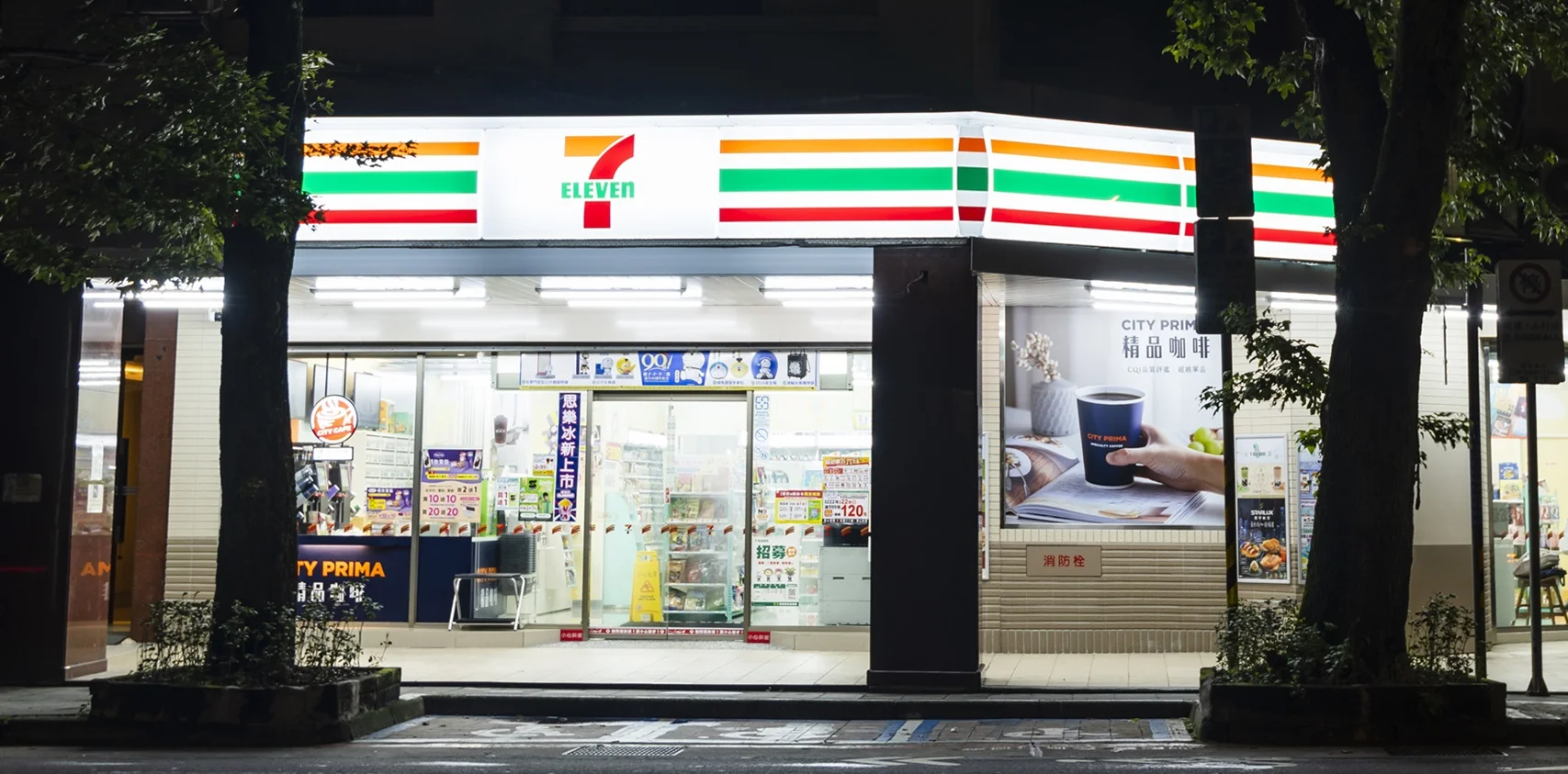
When you think of a convenience store, you probably imagine a place where you grab a bottle of water, maybe a bag of chips, and rush out in under two minutes. But in Taiwan, the experience is completely different. As a digital nomad living here, I can say this with full confidence: 7-Eleven is more than a convenience store—it’s a life hub. Whether you're working remotely, navigating local bureaucracy, or just trying to survive your first typhoon season, 7-Eleven becomes your reliable, all-purpose sidekick. Here’s why every nomad in Taiwan should get to know their neighborhood 7-Eleven (and maybe even become emotionally attached to it). 🧑💻 1. Your Backup Coworking Space Sometimes the coworking space is full, or your Airbnb Wi-Fi goes out right before a Zoom call. No problem—just walk into a nearby 7-Eleven. Many stores have indoor seating, power outlets, and reliable air conditioning. Some even offer free Wi-Fi (especially in urban areas). It's not unusual to see students, freelancers, and office workers typing away in the corner, iced latte in hand. And that latte? Made fresh by a machine that delivers surprisingly decent espresso. Add an egg salad sandwich and you're ready for a productive morning. 🍱 2. Meals, Snacks & Midnight Survival Kits Need a quick lunch between calls? 7-Eleven has you covered with hot bentos (lunchboxes), rice balls, dumplings, pasta, and even vegan options. The food is affordable, filling, and rotates seasonally—yes, there’s a pumpkin-flavored croquette in fall and sweet potato desserts in winter. Late-night hunger pangs? No problem. Most stores are open 24/7, and yes, the staff will microwave your meal, give you utensils, and smile while doing it. 🖨️ 3. Print, Scan, Fax—All Without a Printer One of the biggest struggles for nomads is accessing printing and scanning services. In Taiwan, just walk to 7-Eleven and use the ibon machine. You can: Print documents from your USB or cloud Scan and email files Make photocopies or fax something if needed Even print passport photos or buy resume templates! The interface is available in English, and the process is fast and shockingly cheap. 📦 4. Your Personal Mailroom Online shopping is huge in Taiwan, and 7-Eleven plays a central role in the logistics system. You can: Pick up packages from Shopee, PChome, or other platforms Send local or international parcels Even rent lockers in some branches to receive deliveries while you're out exploring Taroko Gorge No apartment mailbox? No problem. 💡 5. A Swiss Army Knife of Life Services This is where 7-Eleven goes full superpower mode: Pay your rent, electric bill, or even traffic fines Recharge your SIM card, MRT card, or game credits Book train tickets, concerts, or theme parks Use the ATM to withdraw money (many support international cards) Buy tickets for exhibitions, shows, or even a spa reservation All of this is done at the kiosk or counter, often with staff willing to help if you get confused (they’re used to expats and tourists!). 💬 6. The Cultural Warmth You Didn’t Expect Beyond the services, 7-Eleven is a microcosm of Taiwanese hospitality. Store clerks greet you with a “歡迎光臨” (huān yíng guāng lín — welcome) every time. Some will remember your face or your coffee order. You might find yourself chatting with a fellow nomad while waiting for the microwave to finish. It’s the place you go when everything else is closed, when you're slightly lost, or when you just need a quiet corner to collect yourself. It becomes part of your daily rhythm. 🧳 Conclusion: A True Friend on the Road For digital nomads in Taiwan, 7-Eleven isn’t just a convenience—it’s a daily lifeline. It meets practical needs, yes, but also offers a subtle form of companionship in a foreign land. It's your office, your kitchen, your mailbox, your translator, and your guide—all wrapped in one neon-lit, air-conditioned corner of comfort. So next time you're in Taiwan, don't just pass by a 7-Eleven. Step inside, grab a hot latte, and get stuff done. You’ll walk out wondering how you ever lived without it. -- Follow the Digital Nomad Facebook fan page and stay updated with more recent articles on Instagram (@digital.nomad.press)!
June 10, 2025
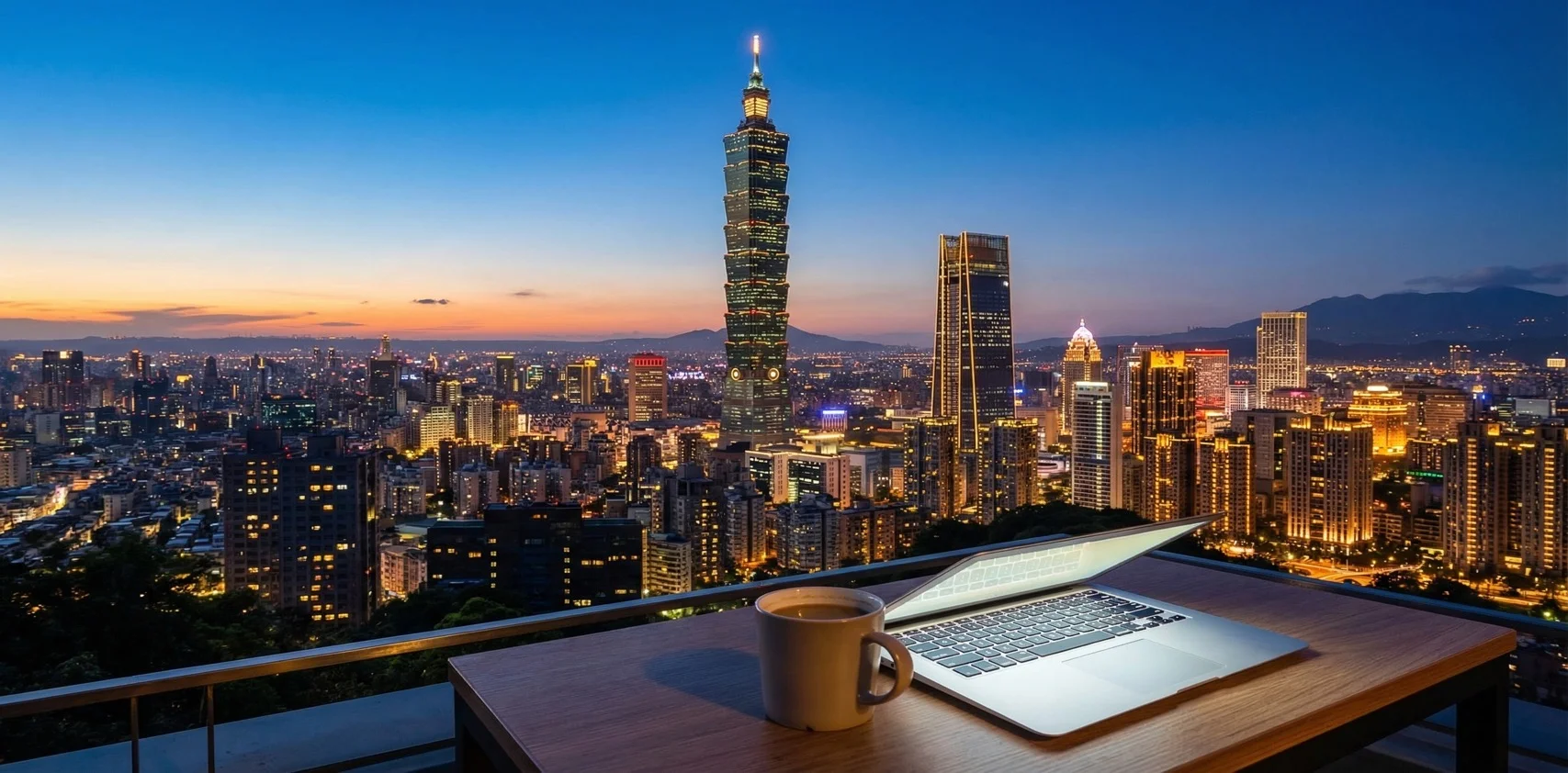
Taiwan: Asia's Most Underrated Digital Nomad Base
Ask a digital nomad to name their top picks in Asia, and you'll hear the usual suspects: Bali for the vibes, Chiang Mai for the value, Bangkok for the energy, Tokyo for the aesthetics. These are fine choices. They've earned their reputations. But there's a place in Asia where the internet is faster than most of Europe, a doctor's visit costs less than a cocktail, the visa system actively welcomes freelancers, and you can walk alone at 3 AM without a second thought — and somehow, it barely registers on the nomad radar. That place is Taiwan. This isn't another "Taiwan digital nomad guide" with bullet points about SIM cards and MRT maps. Those exist already — digitalnomad.press alone has published city guides, visa breakdowns, and starter kits for Taiwan over the past two years. This piece is asking a different question: Why does Taiwan have every ingredient of a world-class nomad destination yet remain chronically overlooked? And what would you actually get if you gave it six months instead of six days? The Reason It's Overlooked Is Exactly Why It's Good Thailand has a mature digital nomad industry. In Chiang Mai or Bali, you step off the plane and immediately enter an ecosystem designed for you — coliving spaces, nomad meetups, visa consultants, Instagram-ready coworking cafés. The whole thing runs like a well-oiled machine. Taiwan doesn't have that. Not in the same polished, packaged way. And that's precisely the point. Taiwan is "underrated" not because it lacks the fundamentals, but because it hasn't commodified them. Its advantages are structural — baked into the fabric of the society itself, not bolted on to attract a specific demographic. What you experience isn't a curated bubble for nomads. It's an actual high-functioning society that happens to be an exceptional place to do remote work. Here's the difference: In Bali, your coliving space has blazing WiFi, but step outside and the connection might drop to nothing. In Taiwan, you walk into a random breakfast shop on a random corner, and the 4G on your phone pulls 50+ Mbps. That's not built for you. That's just what life here is. Visas: Taiwan Is Quietly Rolling Out the Red Carpet For nomads, visa logistics are always the first filter. Taiwan's progress here has been faster than most people realize. The Employment Gold Card might be the single most freelancer-friendly long-term residency document in Asia. It's a four-in-one card combining a work permit, resident visa, re-entry permit, and alien resident certificate. The critical detail: no employer sponsorship required. You don't need a job offer in Taiwan. You need to demonstrate professional qualifications in one of eight fields — science and technology, economics, education, culture and arts, sports, finance, law, or architecture. The card is valid for one to three years and renewable. Application fee: approximately NT$3,500, which works out to about US$110. Read that again. For the price of a moderately nice dinner, you get a card that lets you legally work, freely enter and exit, and enjoy resident-level access in Taiwan. The tax incentive deserves special attention. Gold Card holders earning above NT$3 million annually (roughly US$95,000) receive a 50% tax deduction on the portion exceeding that threshold — for the first five years. This isn't a grey-area tax hack. It's an explicit, codified policy designed to attract international talent. For remote workers with solid incomes, the math is extremely favorable. (For a detailed application walkthrough, see digitalnomad.press article #37, or head to goldcard.nat.gov.tw.) Beyond the Gold Card, Taiwan launched a new digital nomad visa category in February 2025. Compared to the Gold Card's professional bar, this nomad visa is positioned as a lower-threshold option — better suited to those who have stable remote income but may not yet meet the Gold Card's experience requirements. Two distinct pathways, covering different stages of the nomad career arc. What does this mean in practice? It means Taiwan isn't passively relying on 90-day tourist stamps. It's actively building institutional pathways for remote workers. In Asia, that's still rare. National Health Insurance: Taiwan's Hidden Ace If you had to pick one single reason to seriously consider Taiwan — not as a pit stop, but as a place to base yourself for six months — it should be healthcare. Taiwan's National Health Insurance (NHI) covers over 99% of the population. Foreign residents become eligible after six consecutive months of residence, at a monthly premium of approximately NT$800–1,500 — that's US$25–50 per month. Twenty-five to fifty dollars a month. Let that sit for a moment. In the United States, a basic health insurance plan runs $400–600/month with deductibles that can reach thousands. In Europe, even with public systems, foreigners often need supplementary private coverage. Most nomads rely on travel insurance products like SafetyWing or World Nomads — reasonable in price but limited in scope, with claims processes that range from tedious to adversarial. Taiwan's NHI is not travel insurance. It's real medical insurance. A standard outpatient visit costs NT$150–500 (US$5–16), including consultation and basic medication. Specialist visits, imaging, even minor procedures — the costs are so low they feel like errors. And the quality doesn't suffer. Taiwan's healthcare system consistently ranks among the world's best, with wait times so short you might see a doctor, get diagnosed, and pick up medication the same day you book the appointment. For nomads who've been on the road a while, this matters more than it might seem on paper. Health anxiety is one of the least-discussed but most persistent stressors of the nomad lifestyle. That background hum of "what happens if I actually get sick here?" — in Taiwan, it essentially disappears. You don't have to choose between seeing a doctor and watching your budget. Toothache? Go to the dentist. Feeling off? Walk into a clinic. No need to first research whether the local hospitals are trustworthy. The six-month residency requirement looks like a barrier, but flip the frame: if you're planning to stay half a year anyway, NHI enrollment becomes a massive bonus. And during those first six months, out-of-pocket costs for self-pay visits are still remarkably low — a routine consultation might run NT$600–1,000, less than a typical American copay. Cost of Living: Not the Cheapest — the Best Value Let's be upfront: Taiwan is not Southeast Asia. If your sole criterion is minimizing monthly burn, Chiang Mai, Hanoi, or Davao will stretch your dollar further. Taiwan's cost of living sits in Asia's middle tier — significantly cheaper than Japan or Korea, somewhat more expensive than most of Southeast Asia. But cost is never just a number. It's a ratio of what you spend to what you get. In Taipei, a nomad's monthly expenses typically fall between US$1,500 and $2,500, depending on housing and dining preferences. That covers rent (a decent studio runs US$500–800), food (US$300–500/month eating out, which is the default — Taiwan's street food culture makes cooking at home almost economically irrational), transport (MRT plus YouBike, under US$50/month), and incidentals. Take the same budget to Tokyo and you get a smaller room, pricier restaurants, and a more crushing commute. Tokyo's nomad range runs US$2,500–4,000/month, and hitting that lower bound requires meaningful sacrifices. Seoul is similar at US$2,000–3,500, with winter heating bills adding an unwelcome spike. Looking south, Bangkok runs comparable to Taiwan at US$1,000–2,000, but Taiwan pulls clearly ahead on safety, healthcare quality, and infrastructure reliability. Bali occupies a similar price band, but step outside the tourist corridor and gaps in internet stability and transport become the hidden surcharge on that cheap rent. Move beyond Taipei — Taichung or Kaohsiung — and your budget drops to US$1,000–1,800. Taichung has undergone a quality-of-life renaissance in recent years: pleasant climate, manageable pace, increasingly good food and cultural scene. Kaohsiung offers the expansive feel of a harbor city with steadily improving urban planning. Both deliver roughly 80% of Taipei's convenience at roughly 50% of Taipei's rent. Where Taiwan's value really shines is in the things you don't pay extra for. You don't need a water purifier. You don't need to worry about a baseline of food safety (Taiwan's standards are among Asia's strictest). You don't need to budget for living in "the safe neighborhood" — because the entire city is the safe neighborhood. Infrastructure: Things You'll Miss When You Leave Live in Taiwan long enough and you start taking certain things for granted. You only realize what you had when you land at your next destination and it's not there anymore. Internet. Taiwan's average fixed broadband speed exceeds 140 Mbps, ranking in Asia's top three. This isn't a hotel-lobby theoretical figure — it's what you actually get in your apartment, your café, your coworking space. Mobile coverage is equally robust, with 4G/5G reaching effectively everywhere. For remote workers who need reliable upload and download — especially those in video, design, or roles requiring frequent video calls — this is a hard requirement, not a nice-to-have. Convenience stores. This might sound like a strange infrastructure category, but anyone who's lived in Taiwan knows: convenience stores here transcend their label. Taiwan has one of the highest convenience store densities on the planet — 7-Elevens and FamilyMarts appear every block or two. You can pay bills, mail packages, print documents, grab decent coffee and hot meals, and handle minor administrative tasks, all at 3 AM if you want. For nomads, they function as an invisible life-support system. Public transit. The Taiwan High Speed Rail compresses the island's 350 km north-south span into roughly 90 minutes. Taipei's MRT is clean, punctual, cheap, and still expanding. YouBike (public bikeshare) blankets major cities at NT$5 for the first 30 minutes. Kaohsiung has metro and light rail; Taichung offers free bus rides within 10 km. You almost never need a car in Taiwan unless you're chasing mountain trails. Safety. This cannot be overstated. Taiwan consistently ranks among the world's safest countries. Walking alone at night, leaving your laptop on a café table while you use the restroom, riding the last train by yourself — things that require risk calculation in many countries are simply unremarkable here. For solo travelers and especially women nomads, this is foundational. Safety isn't a "nice bonus." It's the substrate on which quality of life is built. Coworking: No Hype, Genuinely Functional Honestly, Taiwan's coworking scene doesn't get the international press that Bali's or Lisbon's does. It doesn't have that Instagram-glow factor. But it has a more practical virtue: these spaces are designed for people who actually need to get work done, not for people who need a backdrop for content. Taipei has the most options. CLBC is a homegrown brand with multiple locations — practical, reasonably priced. Changee offers flexible plans well-suited to short-term nomads. Impact Hub Taipei is part of the global Impact Hub network, pairing workspace with community events and startup resources. WeWork has a Taipei presence for those who prefer global consistency. Taichung's coworking scene has grown rapidly. 好伴 (Howban) is a local institution with strong community ties. Blueprint and Monospace each have distinct character, with Monospace particularly popular among design and creative professionals. Kaohsiung's SpaceBar and Xinbin Station are the better-known options, the latter housed in a renovated historic building with a distinctive atmosphere. Even Hualien and Taitung on the east coast are seeing small independent spaces emerge — limited in selection, but compelling for anyone drawn to the idea of coding with the Pacific Ocean in view. A practical note: Taiwan's café culture is exceptionally developed, and most cafés are remarkably tolerant of laptop campers — far more so than Tokyo or Seoul. Many nomads in Taiwan work a hybrid pattern: café in the morning, coworking space in the afternoon, or cafés exclusively. A pour-over coffee runs NT$120–180 (US$4–6) and buys you hours of seating, air conditioning, and stable WiFi. Quality of Life: Beyond the Spreadsheet Numbers and policies are the skeleton. What actually makes people stay is the texture of daily life. Taiwan's food culture is a luxury for nomads — and a cheap one. Night markets aren't just tourist attractions; they're a living, breathing public dining system. A full night-market dinner runs NT$100–200 (US$3–7), with enough variety that you could eat something different every day for a month straight. Bento shops, street stalls, and breakfast joints form the backbone of daily sustenance for locals and nomads alike. But Taiwan isn't only cheap eats. The spectrum runs wide: specialty coffee roasters, creative fusion restaurants, Japanese-style izakayas, refined Taiwanese cuisine. You can spend NT$80 on a bowl of beef noodle soup that makes you reconsider your life choices, or NT$3,000 on a fine dining experience that redefines what Taiwanese food can be. Nature is another underappreciated dimension. Taiwan is small in area but vertically compressed — subtropical coastline to 3,000-meter peaks, all within a few hours' drive. On a weekend from Taipei, you can surf the north coast, soak in hot springs on Yangmingshan, or wander the hillside streets of Jiufen, all within an hour. With a full weekend, Taroko Gorge in Hualien, sunrise at Alishan, or Kenting's beaches are all within reach. For nomads who work hard during the week and need genuine recharging on weekends, Taiwan's geographic compression is an outsized advantage. Hot springs deserve a specific mention. Situated on the Pacific Ring of Fire, Taiwan has an almost absurd abundance of natural hot springs. Beitou, Wulai, Jiaoxi, Guguan — these aren't fly-to-reach resorts. They're weeknight-after-work destinations. The restorative value of regular hot spring access is something you don't fully appreciate until you have it, and then deeply miss when you don't. Cultural depth runs deeper than outsiders tend to assume. Taiwan is not a monoculture. Indigenous peoples comprise sixteen officially recognized groups, each with distinct languages, music, and festivals. Hakka culture is deeply rooted in certain regions. Hokkien (Minnan) culture is predominant but not the whole picture. Japanese colonial-era architecture and cultural traces are woven throughout the island. This layered cultural texture means you can live here for six months and discover a new dimension every few weeks. Language: An Honest Assessment No sugarcoating: language is Taiwan's most visible barrier for nomads. In Taipei, English functionality is reasonable. MRT signage, major attractions, and most restaurant menus include English. The younger generation's English proficiency is generally solid, and you can navigate daily life in English without major friction. But "manageable" and "comfortable" are different things — if you're accustomed to the near-total English immersion of European cities or Southeast Asian tourist hubs, Taipei will require a slight recalibration of expectations. Move south to Taichung or Kaohsiung and English utility drops noticeably. Young people's English is still decent, but in everyday contexts — traditional markets, local restaurants, government offices — Mandarin is effectively the only operating language. If you speak zero Chinese and plan to stay long-term outside Taipei, Google Translate becomes your constant companion, and you'll inevitably miss nuance. The good news: Taiwanese people are genuinely, disarmingly warm toward foreigners — and it's an earnest warmth, not a transactional one. Even with a complete language gap, most people will go out of their way to help — gesturing, pulling out phone translators, sometimes physically walking you to your destination. This social-level goodwill compensates, at least partially, for the linguistic gap. If you're planning three months or more, investing some time in basic Mandarin pays enormous dividends. You don't need fluency. But "hello," "thank you," "how much," and "no cilantro" will meaningfully upgrade your daily experience — especially the last one. "But What About the Geopolitics?" No article about Taiwan can avoid this question, so let's address it directly. Yes, cross-strait geopolitical tensions are a real and ongoing issue. Yes, international media periodically runs alarming headlines. Yes, if you tell friends you're moving to Taiwan for six months, someone will look concerned. But if you ask people who actually live in Taiwan — locals and expats alike — what percentage of their daily life is spent worrying about this, the answer approaches zero. Taiwanese society demonstrates a distinctive pragmatism on this topic: a clear-eyed acknowledgment that the risk exists, paired with a firm refusal to let it dictate the quality of daily life. On a practical level, Taiwan's political stability is high by Asian standards. Its democracy functions (loudly, sometimes chaotically, but it functions), its rule of law is predictable, and personal freedoms are robustly protected. Your internet isn't censored. You don't need a VPN. Freedom of speech is a default, not something you negotiate for. This article won't pretend the risk is zero — that would be dishonest. But it also won't let a low-probability hypothetical scenario negate a destination that excels on virtually every other dimension. Risk assessment is everyone's personal homework, but it should be informed by reality, not headlines. Why "Six Months"? This piece keeps emphasizing three to six months rather than "a quick visit" or "permanent relocation." That's intentional. Taiwan doesn't reveal its value on a short trip. Two weeks gives you the surface — night markets, Taipei 101, Jiufen — and you leave with a vague "that was nice" impression. Taiwan's real value lives in its deeper structures: NHI enrollment requires six months of residence. The Gold Card's tax benefits require tax residency. Coworking community connections take time to build. The actually-great hole-in-the-wall restaurants are found through word of mouth, not Google Maps. Three to six months is the sweet spot. Long enough to penetrate the tourist layer and start living like a resident. Short enough that you're not making a "moving to Taiwan" commitment. In that window, you can establish an efficient work rhythm, explore multiple cities, experience seasonal shifts (Taiwan's spring and autumn are particularly lovely), and gather enough firsthand data to decide what comes next. Many nomads who've spent six months in Taiwan end up putting it on their permanent rotation — one of those places they return to for a few months each year. That, in itself, is the strongest endorsement. Not the Flashiest. Possibly the Most Livable. The digital nomad community has a tendency to chase the next hot spot. Every few months, a new city gets thrust into the spotlight — maybe a viral YouTube video, maybe a prominent community's recommendation. These places usually have one or two standout strengths (incredibly cheap, incredibly beautiful, incredible community), but they also tend to have equally prominent weaknesses. Taiwan is not the kind of place that goes viral. It doesn't have Bali's visual drama, Lisbon's European romance, or Chiang Mai's "nomad paradise" brand equity. What it has is something rarer: comprehensiveness. Internet speed, healthcare, safety, transit, visa policy, cost of living, food quality, natural environment — Taiwan may not rank #1 in any single category. But add them all up, and it's extraordinarily hard to find another destination that scores this consistently high across this many dimensions. That's what "underrated" actually means. Not that nobody knows Taiwan is good, but that most people haven't grasped how comprehensively good it is. For nomads who've been at this long enough to value "baseline quality of life" over "cheapest and coolest," Taiwan deserves to be at the top of your next-destination list. Not because it's the most glamorous option. But because once you settle in, you'll find remarkably little to complain about. And in the world of digital nomadism, "remarkably little to complain about" might be the highest praise there is.
March 24, 2026
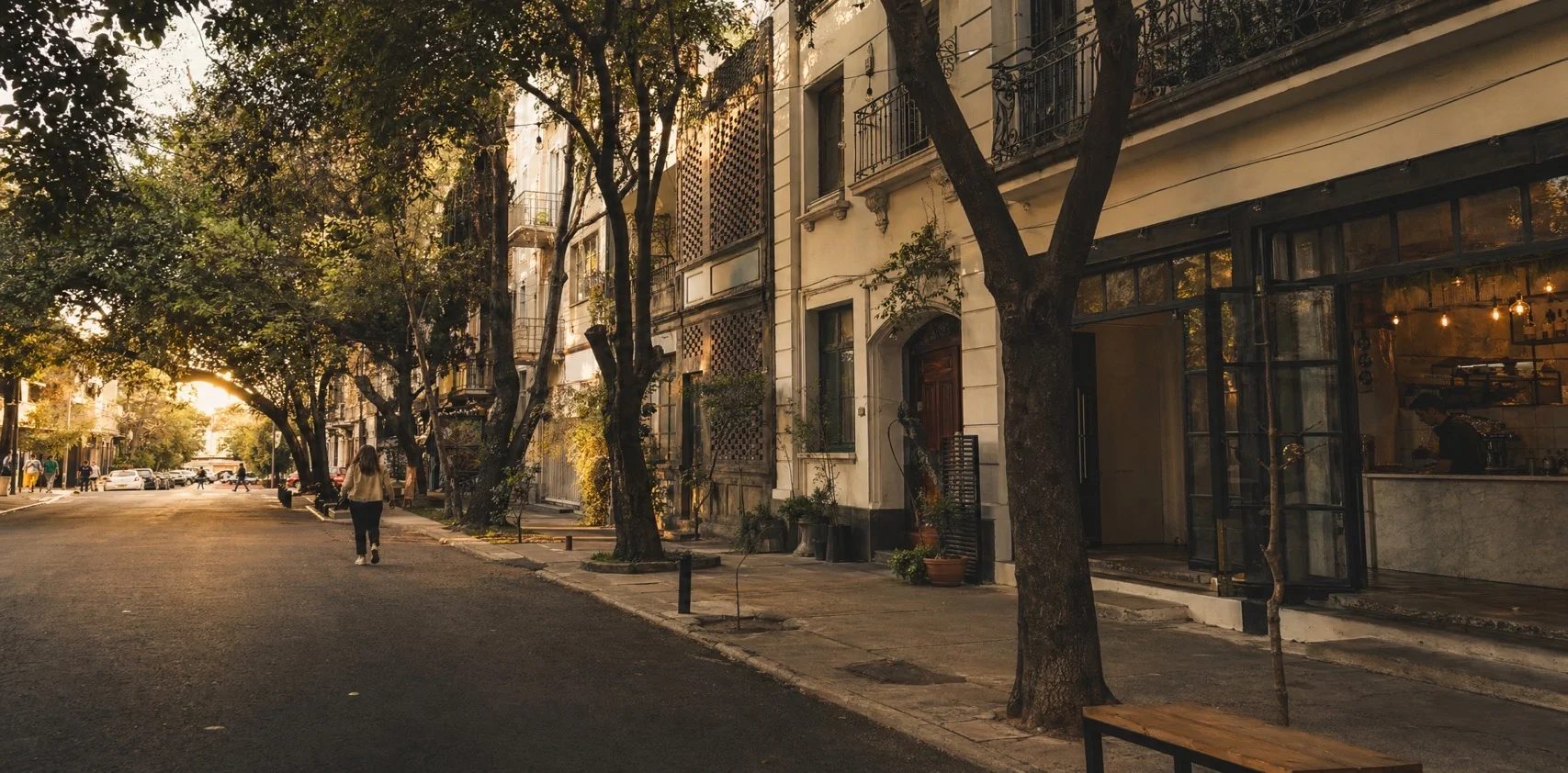
When Paradise Pushes Back: Mexico City's Reckoning with Digital Nomads
In late 2025, someone spray-painted "Gringo go home" on the facade of an apartment building in Roma Norte, one of Mexico City's most coveted neighborhoods. Weeks later, another message appeared on a nearby wall: "Tu Airbnb = mi desalojo" — your Airbnb is my eviction. These weren't the work of a lone vandal. They were the visible edge of a growing social movement, one that has since expanded from graffiti to street protests to legislation. After years of welcoming remote workers with open arms and affordable lattes, Mexico City is now asking a pointed question: at what cost? The Numbers Behind the Rage The simplest way to understand what happened is to follow the money. According to a mid-2025 report by Inmuebles24, Mexico's largest real estate platform, average monthly rents in Roma Norte, Condesa, and Polanco — the three neighborhoods most popular with digital nomads — rose between 60% and 80% since 2020. In Roma Norte specifically, a standard one-bedroom apartment went from roughly 8,000 Mexican pesos (about $400) before the pandemic to 15,000–18,000 pesos ($750–$900) by 2025. For a San Francisco software engineer earning $5,000 a month, $900 in rent is barely noticeable. For a Mexico City resident earning the local median income of around 16,000 pesos per month, that same apartment would consume their entire paycheck. Behind the rent spikes lies the explosive growth of short-term rental platforms. A 2025 survey by the Mexico City government found over 12,000 active Airbnb listings in the Cuauhtémoc borough alone (which encompasses both Roma and Condesa), with more than 70% being entire apartments rather than shared rooms. Each of those units represents a home that was removed from the local rental market and converted into a temporary landing pad for nomads staying three days, five days, or three months. Data from the National Autonomous University of Mexico (UNAM) Housing Research Center sharpened the picture further: in the neighborhoods with the highest nomad density, every 100 new Airbnb listings reduced the available local rental supply by approximately 8%. With supply being steadily eroded and foreign demand pouring in, rents had only one direction to go. This is why "Gringo go home" is not simply xenophobia. It is a protest grounded in economic reality. From Angry Posts to Parliamentary Action Mexico City's anti-nomad sentiment didn't erupt overnight. It escalated through three distinct phases. The first phase was digital. Starting in 2023, Mexican social media filled with criticism targeting foreign remote workers. One viral flashpoint was a video by an American YouTuber titled something along the lines of "How to Live Like a King in Mexico City on $1,000 a Month." The comment sections were merciless: "Our city is not your discount resort." The second phase hit the streets. In October 2025, a grassroots organization called Vecinos en Resistencia (Neighbors in Resistance) organized a march of roughly 3,000 people through Roma Norte. Their demands were specific: restrict foreign purchases of residential property, raise taxes on Airbnb, and channel short-term rental revenue into social housing construction. The marchers included many young families carrying a simple message: "I can't afford rent in my own city." The third phase entered the legislature. In August 2025, Mexico City's congress passed the Short-Term Rental Regulation Act (Ley de Regulación de Alojamientos Temporales), the strictest Airbnb regulation in Latin America to date. Its key provisions covered four areas. Mandatory registration: all short-term rental properties must register with the city government and obtain an operating permit, with fines of up to 500,000 pesos (approximately $25,000) for non-compliance. Annual cap on rental days: each property may be rented short-term for no more than 180 days per year, with a minimum stay of 3 days per booking — effectively eliminating the full-time "professional landlord" model. Community density limits: no more than 25% of units in any residential building may be used for short-term rentals, with buildings that already exceed this threshold given two years to comply. Platform-level tax withholding: Airbnb, Booking.com, and similar platforms are required to withhold and remit accommodation and income taxes totaling roughly 8% to 10% of rental revenue. The law took effect in January 2026. Enforcement remains to be tested, but the signal could not be clearer: Mexico City is done being the world's budget backyard. Nomad Gentrification: Naming the Phenomenon Traditional gentrification describes an intra-national class displacement — wealthier residents move into lower-income neighborhoods, push up prices, and eventually price out the original inhabitants. It has played out for decades in places like Brooklyn and East London. Nomad gentrification is the transnational version. When large numbers of remote workers earning high-income-country salaries flood into a low-income-country city, their purchasing power creates extreme economic fault lines within specific neighborhoods. A 120-peso (roughly $6) specialty pour-over coffee is pocket change for an American engineer earning $5,000 a month. For the Mexican barista who made it, that same price tag might represent close to half a day's wages. As more restaurants and cafés begin pricing for foreign purchasing power, local residents find themselves being "priced out of their own city." Three structural factors explain why Mexico City became the first critical flashpoint for nomad gentrification. Scale. According to Nomad List, the popular community platform, Mexico City ranked number one among global digital nomad destinations from 2023 to 2025, with an estimated 50,000-plus foreign remote workers in the city during that period. That figure is modest relative to a metropolitan area of 21 million, but concentrated in just a few neighborhoods like Roma Norte and Condesa, the density effect became overwhelming. Income gap. The average income of American remote workers is roughly five to eight times that of Mexico City residents. Similar disparities exist in Southeast Asian and Eastern European nomad hotspots, but Mexico City's geographic proximity to the United States and its deep cultural appeal attracted a disproportionate share of North American nomads. Regulatory vacuum. Mexico has long lacked clear rules governing foreign nationals doing remote work within its borders. Nomads on tourist visas occupy a legal gray zone: their employers are abroad, so they are not considered to be "working" in Mexico. No work visa is required. No local income tax is owed. This convenience drew nomads in droves, but it also meant their "contribution" to the local economy was almost entirely limited to consumption, not taxation. The $100 Million Tax Gap The tax issue deserves its own spotlight. Most digital nomads enter Mexico on tourist visas allowing stays of up to 180 days. Legally, they are not considered Mexican tax residents and owe no income tax. Yet they use the same roads, metro system, public healthcare infrastructure, and police services that Mexican taxpayers fund. A 2025 estimate by Mexico City's Finance Ministry put a concrete number on this imbalance: if the city's foreign remote workers paid taxes at local rates, the municipality would gain approximately 2 billion pesos (about $100 million) annually. That sum could build roughly 5,000 units of social housing or seed three new metro lines. This is a theoretical calculation, and the enforcement challenges are enormous. But it exposes a structural inequity: nomads consume all the benefits of urban infrastructure while bearing virtually none of the financial burden. In early 2026, Mexico's federal government began drafting tax proposals targeting foreign remote workers. Details remain under discussion, but the direction is clear: remote workers who stay in Mexico beyond a certain number of days may soon be required to file local income taxes or pay some form of "digital nomad levy." The Cultural Fracture Behind the Coffee Cup Beyond the economics, daily cultural friction is quietly eroding the fabric of affected communities. Social media abounds with stories of nomad behavior that locals find grating. Someone taking a loud English-language video call in a traditional market as if it were their personal office. Someone describing Mexico City on social media as "an insanely cheap New York alternative," instantly provoking collective outrage. Someone occupying a four-person table at an independent Condesa café for an entire workday, having ordered only a single Americano. None of these acts, taken individually, qualify as egregious offenses. But in aggregate, they reflect an attitude that many locals find deeply uncomfortable: treating someone else's hometown as a lifestyle accessory, a place whose value is measured by exchange-rate advantage rather than its own cultural context, rhythm, and collective dignity. A Mexican author who has run an independent bookstore in Roma Norte for over two decades offered a widely quoted remark in an interview with Spain's El País: "They don't come here because they love Mexico City. They come because Mexico City is cheap. When it stops being cheap, they'll leave. And we'll be the ones left to deal with everything they left behind." The Nomad's Dilemma From the nomad perspective, these criticisms are not entirely fair. Many remote workers point out that they spend generously in local businesses, support small vendors, and bring cultural diversity to the neighborhoods where they live. They haven't "taken" anyone's job — their employers and clients are in another country. They are pure consumers, not competitors in the local labor market. These arguments carry weight. But the problem is that when a group's collective behavior generates significant negative externalities, individual goodwill cannot offset structural harm. One nomad checking into a Roma Norte Airbnb has near-zero community impact. But when tens of thousands make the same choice, the effect flips from negligible to catastrophic. This is a textbook tragedy of the commons: each individual acts rationally, yet the collective outcome is destructive. Also worth scrutinizing is the "geoarbitrage" narrative that pervades nomad culture. The concept encourages people to earn high-income-country salaries while living in low-income-country cities — framed as a clever personal finance strategy. But viewed from the other side, it looks like just another form of economic asymmetry, or even a neatly packaged version of economic extraction. To be fair, painting all nomads with the same brush is equally unjust. Many genuinely integrate into their communities, learn Spanish, support local businesses, and even participate in neighborhood affairs. But structural problems demand structural solutions, and individual good intentions can never substitute for institutional reform. The Global Domino Effect Mexico City is not an outlier. It is a harbinger. Lisbon tightened its Golden Visa program in 2023 and imposed stricter limits on short-term rentals in the city center. Barcelona announced in 2024 that it would completely ban tourist short-term rental apartments by 2028. Bali's Canggu began requiring foreign remote workers to obtain dedicated digital nomad visas and pay local taxes starting in 2025. The trajectory across these cities is strikingly similar: first, an enthusiastic embrace of the spending power that foreign visitors bring; then, a rude awakening as housing costs spike and neighborhood character erodes; and finally, regulatory intervention forced by resident pressure. Mexico City's legislation is likely to become a reference template for other Latin American cities. Colombia's Medellín is already discussing similar short-term rental restrictions. Argentina's Buenos Aires, while temporarily relieved of rental pressure due to currency devaluation, is seeing a parallel buildup of anti-nomad resentment. The wave of pushback now rippling across the globe is ultimately asking one fundamental question: whose city is it? When globalization enables people to work from anywhere yet live and spend in only certain places, the residents of those "certain places" have every right to ask: is this arrangement fair to us? If You're Still Planning to Go For remote workers considering Mexico City or any other nomad hotspot, five things are worth thinking through carefully before booking that flight. First, sign a long-term lease and steer clear of Airbnb. Renting directly from a landlord on a six-month-plus contract is typically cheaper and avoids displacing local housing supply. If Airbnb is unavoidable, choose a private room over an entire apartment, and stay away from already-saturated Roma Norte and Condesa. Second, invest real time in learning Spanish. The number of nomads who actually bother to learn the local language is far smaller than one might assume. Language is more than a communication tool — it is the most basic expression of respect. When you can exchange a few words in Spanish with the fruit vendor on the corner, you stop being just another passing consumer and become someone who is at least trying to understand the place. Third, spend your money where it genuinely stays local. The artisanal coffee shops and coworking spaces catering to foreigners are convenient, but they are themselves products of nomad gentrification. Try eating at a traditional fonda (family-run eatery), shopping at neighborhood markets, and using the services that locals use. Fourth, understand and support local regulation. If the city you're in is implementing short-term rental caps or nomad taxes, support those policies rather than trying to circumvent them. These regulations are not designed to expel you — they are designed to ensure your presence does not inflict disproportionate harm on the community. Fifth, confront your economic privilege honestly. "Geoarbitrage" is not a neutral concept. Living a $5,000-a-month lifestyle in a city where the average salary is $800 means participating in a deeply asymmetric economic relationship. Recognizing this is not about guilt. It is about taking responsibility for the consequences of every choice you make. Cheap Paradise, Expensive Consequences Mexico City's story is a mirror reflecting the tension that every city "discovered" by the digital nomad wave will eventually confront. When low prices, pleasant weather, and reliable internet become the only selection criteria, nomads arrive like a rising tide. And when the tide recedes, what remains is often not fertile ground but scars that take years to repair. Digital nomadism itself is not inherently wrong. The freedom to work remotely is a genuine benefit of technological progress, and no one should be morally condemned for exercising it. But freedom has never been free, and its costs should not be borne by those least equipped to absorb them. Mexico City is drawing a line. The rest of the world will follow, sooner or later. For every nomad, the real question is not "where is the next cheap destination?" but "what kind of global citizen do I want to be?" The answer is not in your passport, not in your VPN settings, and not in your currency converter. It lives in every small choice you make, every single day.
May 26, 2026
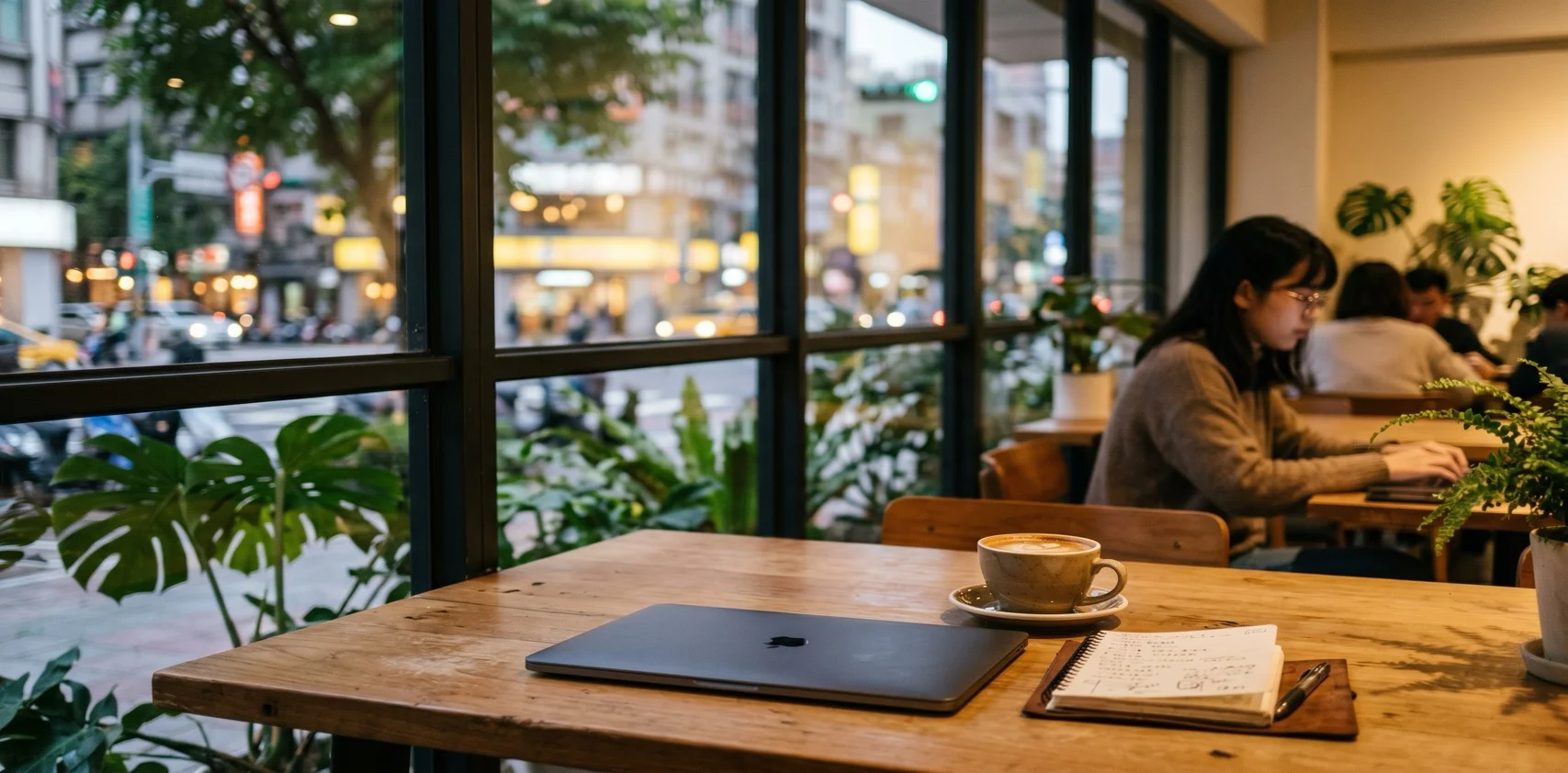
Taiwan Has Everything Digital Nomads Want. It Just Hasn't Figured Out How to Say It.
Open any digital nomad forum and the same destinations cycle through like a greatest-hits playlist: Bali, Chiang Mai, Lisbon, Medellín, Mexico City. Each comes with a fully formed narrative, a mental postcard that lets prospective nomads picture their life there before booking a flight. Bali is rice paddies and surf breaks between Zoom calls. Lisbon is European sunshine at a fraction of London prices. Chiang Mai is the place where a thousand dollars a month buys a surprisingly comfortable life. Taiwan? Most nomads couldn't tell you what life there looks like. Not because the experience is lacking, but because almost nobody has bothered to describe it. Search "Taiwan" on r/digitalnomad and you'll find scattered threads, a handful of people noting that Taipei is "underrated," a few replies agreeing, and then silence. No sustained community discussion, no comprehensive city guides updated season after season, no critical mass of experience reports feeding the algorithm. For a place that checks nearly every box on the nomad wish list, Taiwan's absence from the conversation is genuinely strange. Because the fundamentals are not just adequate. They are, on many dimensions, best-in-class. The Product Is There. The Pitch Isn't. Think of Taiwan as a kitchen stocked with premium ingredients, professional-grade equipment, and plenty of counter space. What's missing is a menu that the people walking past can read. In digital nomad terms, a "menu" is a coherent information package: what daily life looks like, how much it costs, what the visa situation is, what problems you'll run into, and what your routine will feel like after three months, six months, a year. Bali has had this package for nearly a decade, refined through waves of blogger testimonials, coworking brand marketing, NomadList reviews, and YouTube vlogs. The information pipeline is mature and self-sustaining. Taiwan has almost none of it. The tourism bureau promotes Sun Moon Lake, night markets, and Jiufen. Investment promotion targets semiconductor supply chains and corporate relocation. The Employment Gold Card program speaks to high-end professionals in the language of talent recruitment, not lifestyle design. And the recently introduced digital nomad visa, while a welcome policy signal, hasn't yet been wrapped in the kind of storytelling that makes someone actually want to apply. Nobody is telling international nomads: "Here's what six months in Taiwan actually looks like, and here's why it might be exactly what you need." Safety You Stop Thinking About People who live in Taiwan rarely mention personal safety as a selling point. It's too obvious, like praising oxygen for being breathable. But for nomads who have spent years rotating through destinations where situational awareness is a constant background process, Taiwan's safety is not obvious at all. It is extraordinary. The nomad community has an unspoken understanding that many popular destinations come with real security trade-offs. Mexico City has pickpocketing and mugging risks in certain neighborhoods after dark. Medellín, though far safer than its reputation suggests, still requires knowing which streets to avoid. Lisbon has seen a rise in tourist-targeted theft. Bali's motorbike bag-snatching is a perennial complaint. None of this makes those cities unlivable. But when you stay somewhere long enough, safety stops being an abstract statistic and starts shaping your daily behavior. You route-plan around sketchy blocks, keep valuables hidden, maintain awareness of your surroundings in a way that drains mental energy even when nothing happens. In Taiwan, that calculation essentially disappears. Walking home alone at two in the morning is unremarkable. Leaving a laptop on a café table while visiting the restroom is routine. A phone left on a restaurant counter stays exactly where you put it. These sound like small things, and they are, individually. But accumulated over weeks and months, the absence of low-grade vigilance produces a quality of life that nomads who have experienced it consistently describe as one of Taiwan's most compelling features. Taiwan's safety isn't fragile or accidental. It rests on structural factors: dense networks of convenience stores and street lighting creating natural surveillance, high social trust, and relatively equitable income distribution that reduces the economic desperation driving street crime in many other countries. These conditions won't evaporate because more foreigners show up. Healthcare That Removes Fear If safety means nomads don't have to watch their backs, Taiwan's healthcare system means they don't have to dread getting sick. Most long-term nomads carry travel insurance from providers like SafetyWing or World Nomads. These policies handle basic doctor visits and emergencies, but anything moderately complex becomes a bureaucratic ordeal, and the claims process can be genuinely maddening. In many popular nomad cities, language barriers turn a routine medical visit into a guessing game. Taiwan's clinic and hospital density is remarkably high. In Taipei, Taichung, and Kaohsiung, a clinic is almost always within a fifteen-minute walk. The system moves fast: same-day registration, same-day consultation, same-day medication pickup. The entire process often takes under an hour. For anyone accustomed to European or North American wait times (weeks for a specialist appointment is normal in many countries), the speed is startling. Costs are low even without National Health Insurance enrollment (which requires six months of continuous residence). A standard outpatient visit including medication runs roughly NT$600 to 1,500 (about US$20 to 50). Dental cleanings, eye exams, dermatology consultations: all fall in the same range. After NHI enrollment, the monthly premium is around NT$800 to 1,500 (US$25 to 50), and copays drop to near-negligible levels. Language is manageable. Taiwanese physicians generally communicate in English, particularly at larger hospitals. Not every nurse or receptionist will be fluent, but the clinical core of a medical visit, diagnosis and treatment explanation, usually works in English. Compared to seeking medical care in Thailand or Indonesia, where translation apps or interpreters are frequently necessary, Taiwan is significantly more accessible. What this adds up to: illness in Taiwan is an inconvenience, not a crisis. You walk to the nearest clinic, see a doctor, pick up medication, go home. No frantic Googling of hospital reviews, no anxiety about the bill, no phone battles with insurance adjusters. For nomads who have spent years treating every health issue as a logistical emergency, this kind of normalcy is almost disorienting. A City That Fits City scale matters more than most nomads realize when choosing a base. Mega-cities like Tokyo, New York, or London make even casual errands feel like expeditions. Small towns like Ubud or suburban Chiang Mai offer calm at the cost of limited options. The sweet spot is a city large enough to keep things interesting but compact enough that getting anywhere feels effortless. Taipei sits squarely in that sweet spot. It has the full inventory of a major international city: diverse dining, cultural programming, nightlife, retail. But it's small enough that the MRT can get you virtually anywhere within thirty minutes. More importantly, Taipei's districts each carry distinct personalities. Da'an is quiet and bookish. Xinyi is glossy and commercial. Wanhua is loud and local. Tianmu has an expat-neighborhood ease. Minsheng feels like a small town hiding inside a metropolis. You can shift your daily scenery without changing your address. This compression of diversity into a walkable, transit-friendly footprint is genuinely rare among nomad-popular cities. Bangkok is diverse but sprawling and traffic-choked. Lisbon is compact but limited in neighborhood variety. Chiang Mai is pleasant but small. Taipei's balance is hard to match. And Taiwan offers more than Taipei. Taichung has emerged as a high-quality, lower-cost alternative with its own café culture, arts districts, and a sunnier climate. Tainan delivers slow-paced living, extraordinary food, and deep history. Kaohsiung, once dismissed as an industrial port city, is mid-transformation with major public architecture (the National Kaohsiung Center for the Arts, the Kaohsiung Music Center), a growing light rail network, and living costs roughly 60 to 70 percent of Taipei's. Four distinct cities on one island, all connected by a high-speed rail network that puts any two of them within two hours of each other. This means you can change your environment without leaving the country, a powerful antidote to the restlessness that eventually hits every long-term nomad. The Café Layer For digital nomads, cafés aren't just places to drink coffee. They are alternative offices, social anchors, and daily rhythm-setters. A city's café culture directly determines nomad quality of life. Taipei's independent café density rivals any city in Asia. These aren't cookie-cutter chain outlets but individually designed spaces with distinct identities: some focused on specialty beans and pour-over technique, others on atmosphere and interior design, still others deliberately optimized for long working sessions with ample outlets and stable Wi-Fi. The cultural attitude matters as much as the physical space. Taiwanese café culture has an implicit tolerance for lingering. During off-peak hours, ordering a single latte and working for three hours draws no dirty looks from staff. Contrast this with Paris (many cafés don't offer Wi-Fi) or Amsterdam (where "no laptops" signs are increasingly common), and the difference is palpable. Coworking spaces exist too. Taipei's CLBC, Impact Hub Taipei, and Changee have operated for years with stable facilities. Pricing runs around NT$5,000 to 8,000 per month (roughly US$160 to 260) for a fixed desk, significantly cheaper than international brands like WeWork. But here's where the narrative gap reappears. Bali's Dojo Bali and Outpost became famous not just for their spaces but for their community-building: nomad meetups, visa assistance, consistent social media content, positioning themselves as the first stop for anyone arriving on the island. Taiwan's coworking spaces serve their existing members well but rarely speak outward to the international nomad community. Good product, quiet marketing. Infrastructure That Just Works Taiwan's public transportation deserves mention not because it rivals Japan's rail network (it doesn't, in scale or punctuality obsession) but because it hits a pragmatic sweet spot of simplicity and coverage. A single EasyCard handles the MRT, buses, YouBike (the ubiquitous public bike-share), trains, and convenience store payments. No juggling multiple fare systems. Taipei's MRT map is clean and intuitive, station signage includes English, announcements are multilingual, and transfer navigation is clear enough that getting lost requires genuine effort. The high-speed rail compresses Taiwan's west coast into a single corridor: Taipei to Taichung in 47 minutes, Taipei to Kaohsiung in about 90. Day trips between cities are trivially easy. The entire island functionally operates as one extended metro area. Taxis start at NT$85 (about US$2.70), and short urban trips rarely exceed NT$200. Uber operates but many residents (and nomads who've been around a while) find that flagging a street taxi is faster and simpler. Ride costs that would barely cover the base fare in New York or London get you across town in Taipei. Internet connectivity barely warrants discussion because there's nothing to complain about. Taiwan consistently ranks in the global top ten for fixed broadband speed. Mobile coverage exceeds 99 percent for 4G, with 5G expanding rapidly. A prepaid SIM card runs NT$500 to 1,000 per month (US$16 to 32) for reliable high-speed data. Free Wi-Fi in convenience stores, cafés, and MRT stations is standard. Food as Daily Infrastructure Few places on earth can compete with Taiwan on food, and this isn't a subjective claim about taste. It's an observation about the food ecosystem's objective characteristics. Diversity: within a five-kilometer radius of central Taipei, you can find virtually every major cuisine. Taiwanese staples, Japanese, Italian, Indian, Korean, Thai, Mexican, Middle Eastern. Many international kitchens operate at genuinely high levels, supported by Taiwan's sizable expat population and notoriously discerning local palate. Price range: a roadside bowl of dry noodles costs NT$50. A Michelin-recommended dinner runs NT$3,000. Between those poles, in the NT$100 to 300 range (roughly US$3 to 10), the quality and variety available is difficult for most countries to match at equivalent price points. Accessibility: small eateries, lunch-box shops, and breakfast joints operate in virtually every neighborhood from early morning to late night. Convenience stores supplement with fresh-food options, microwaveable meals, and ready-to-eat selections. Running out of food options in Taiwan requires extraordinary effort. For nomads, food is not a minor quality-of-life detail. It is one of daily life's greatest pleasures and the most immediate gateway to local culture. In Taiwan, you don't schedule a special outing to "experience local food." Every single meal is the experience. The Convenience Store Civilization If one symbol captures Taiwan's daily convenience, it is the convenience store. Taiwan has the world's second-highest convenience store density (behind South Korea), roughly one per two thousand residents. And Taiwanese convenience stores do far more than sell snacks: utility bill payments, package pickup and drop-off, document printing, high-speed rail ticket purchases, transit card top-ups, even certain government service reservations. For nomads, many errands that require dedicated trips and queue-waiting in other countries can be handled at the nearest 7-Eleven, typically within a three-minute walk. This ultra-low friction daily experience becomes almost addictive. Foreigners who leave Taiwan frequently cite convenience stores, not night markets or scenery, as what they miss most. Combined with mature food delivery (Uber Eats and foodpanda operate extensively) and efficient e-commerce logistics (next-day delivery is standard on many platforms), daily life in Taiwan can approach zero friction. Language: A Real But Manageable Barrier Mandarin is Taiwan's primary language, and that's a genuine consideration for nomads who don't speak it. But the barrier is lower than it might appear. In Taipei, most daily interactions (ordering food, navigating transit, shopping, medical visits) can be managed with basic English, gesture, and translation apps. Younger Taiwanese generally have functional English skills, not at the level of Singapore or Hong Kong where English is an official language, but sufficient for daily life. Google Maps, MRT signage, and major road signs include English. Complete linguistic helplessness is unlikely. For nomads interested in learning Mandarin, Taiwan offers near-ideal conditions: world-renowned language programs (National Taiwan Normal University's Mandarin Training Center is globally recognized), abundant real-world practice opportunities, and a cultural attitude that encourages rather than mocks foreign attempts at Chinese. For nomads who already speak Mandarin, particularly those with Chinese heritage, Taiwan's advantages become overwhelming. It is one of the few places worldwide that uses traditional Chinese characters, combines Chinese cultural foundations with a distinct local identity, and operates within a democratic, open society. For anyone seeking deep Chinese-language cultural immersion without certain political frameworks, Taiwan is essentially the only option. The Tech Undercurrent Taiwan is the global epicenter of semiconductor manufacturing. TSMC alone produces more than half of the world's advanced-process chips. What does this mean for digital nomads? The direct implication is that Taiwanese society is fluent in technology, digital tools, and remote work as concepts. This is not a place where you need to explain that your job happens on a laptop and doesn't require an office. Taipei's tech and startup ecosystem, while smaller than Silicon Valley's, is dense. Meetups, tech communities, and hackathons are active, many conducted bilingually in Mandarin and English. This gives Taiwan a distinctive character. Unlike pure lifestyle destinations where the nomad population skews toward content creators, coaches, and wellness practitioners, Taiwan naturally attracts (or has the potential to attract) engineers, designers, product managers, and other technically oriented remote workers. Different population, different needs, and Taiwan happens to serve the latter particularly well. Island Rhythms Taiwan is an island, and islands have a particular quality of life. Their boundedness creates a sense of containment that can feel surprisingly grounding. Everything is within reach. From Taipei, a three-hour drive reaches Taroko Gorge's marble cliffs. Two hours gets you to the coast. One hour puts you in a mountain hot spring. Weekend escapes don't require flights; they require an early alarm and a train ticket. Taiwan's landscape diversity consistently surprises first-time visitors. Many assume the island is essentially urban with some hot springs attached. In reality, it contains more peaks above 3,000 meters than Switzerland, plus subtropical rainforest, coral-reef coastline, temperate conifer forest, and volcanic terrain. The geographic density of distinct landscapes packed into 36,000 square kilometers is globally unusual. For nomads, this means Taiwan simultaneously serves weekday productivity needs and weekend recharging needs. Work from a Taipei café Monday through Friday, take the train to Yilan's hot springs or Nantou's mountains on Saturday, return Sunday evening. This rhythm is sustainable in a way that pure-urban bases are not. The city's edge always offers nature within arm's reach. The Honest Downsides Any serious analysis of a destination that lists only positives is advertising, not assessment. Taiwan presents several genuine challenges for nomads. Summer climate. June through September is hot and humid, with perceived temperatures frequently exceeding 38°C (100°F). Typhoon season brings heavy rain and occasional disruption. Nomads from temperate countries may find their first Taiwanese summer punishing. Many experienced Taiwan-based nomads time their stays for October through April, or retreat to higher elevations (Cingjing, Alishan) during the worst months. Housing. Taiwan's rental market is not foreigner-friendly, not primarily due to discrimination but because the system is opaque. No credible English-language rental platform exists. Most listings appear on 591.com.tw in Chinese only. Lease terms and deposit conventions differ from international norms. Compared to Lisbon (Flatio), Bangkok (abundant English-friendly serviced apartments), or Bali (villa culture that caters effortlessly to foreigners), Taiwan's housing discovery process is a real friction point. Air quality. Western Taiwan occasionally experiences elevated pollution levels during autumn and winter, driven by cross-border pollutant transport. Taichung and Kaohsiung see more affected days than Taipei. Not a daily issue, but worth monitoring for those with respiratory sensitivities. International flight connectivity. Taoyuan International Airport's route network and frequency don't match Bangkok, Singapore, or Tokyo. Direct flights to Europe and the Americas are limited. Nomads who fly frequently may find Taiwan's geographic position (eastern edge of Asia) and routing options less convenient than major hub cities. These are real limitations, but they fall in the "inconvenient" category rather than "deal-breaking." Every nomad destination has a drawback list; Taiwan's is comparatively mild. What's Missing Isn't a Feature. It's a Story. Adding everything up, the conclusion is hard to avoid: Taiwan has nearly all the hardware required to function as a top-tier global nomad destination. Safety, healthcare, internet, transit, food, daily convenience: high marks across the board. Add gradually liberalizing visa policy (the Employment Gold Card plus the new digital nomad visa), and institutional barriers are shrinking. Yet Taiwan remains a fuzzy dot on the global nomad's mental map. The reason isn't a missing amenity or policy gap. It's a missing narrative. Consider the stories other destinations have built. Bali: "Code between rice paddies and surf breaks." Lisbon: "Europe's sunniest city at a third of London's price." Chiang Mai: "A thousand dollars buys a king's life." These framings are oversimplified, but they work because they hand prospective nomads a vivid, immediate mental image. What is Taiwan's story? "Asia's most underrated…" and then what? The framing itself reveals the problem: it defines Taiwan by negation ("underrated" means "you don't know it's good") rather than by an affirmative, image-rich narrative. Taiwan needs a sentence, or a paragraph, that puts a picture in a nomad's head instantly. Maybe: "A city safe enough for 2 AM walks, with world-class healthcare and a bowl of braised pork rice for a dollar fifty." Maybe: "Asia's tech heartland with an island's pace of life." Maybe: "Close your laptop, and you're standing on a three-thousand-meter peak an hour later." The exact wording matters less than the act of starting. Who Tells It? The government has invested in Gold Card and nomad visa promotion, but government communication defaults to policy explanation, not lifestyle storytelling. An official website listing eligibility requirements and required documents is necessary groundwork, but it won't make a nomad scrolling through their phone in a Chiang Mai café suddenly think, "I should go to Taiwan." The tourism bureau targets tourists, but nomads are not tourists. The information nomads need (rental channels, coworking reviews, visa nuances, tax implications, community events) barely overlaps with what tourists need (attractions, restaurants, souvenirs). Tourist-framed messaging aimed at nomads is a language mismatch. Foreign nomads already in Taiwan are arguably the most credible voices, but their numbers are still small and their output is scattered across platforms without forming a coherent narrative current. Local coworking brands may be the most overlooked leverage point. If Taiwan's spaces learned from Bali's Dojo or Lisbon's Second Home, positioning themselves not just as workspaces but as the international nomad community's gateway to the island, actively producing English-language content, hosting internationally oriented events, building online communities, the narrative could begin to crystallize. Or perhaps no single institution needs to lead. The most effective nomad-destination narratives have never been top-down campaigns. They emerge organically from people living somewhere, sharing their experience, and drawing others in through genuine word of mouth. What Taiwan needs isn't a "plan." It needs a critical mass of early adopters willing to describe their Taiwanese nomad life consistently, specifically, and honestly. An Invitation, Not an Advertisement This article is not trying to convince you to book a flight to Taiwan tomorrow. Needs differ, preferences differ, budgets differ, life stages differ. Taiwan is not for everyone, and pretending otherwise would be dishonest. But if you are considering an Asian base, or if you've spent enough time in Southeast Asia that the Chiang Mai and Bali nomad bubbles have started to feel like a loop, Taiwan deserves a place on your shortlist. Not because it's the cheapest, the most exotic, or the most Instagram-friendly option, but because it offers a qualitatively different kind of nomad experience: a genuinely high-functioning, high-convenience, high-safety society where you can live a normal life while doing your work. Taiwan doesn't need to compete with Bali on pool-view aesthetics or with Chiang Mai on rock-bottom costs. It holds its own hand of cards, and it's a strong one. It just hasn't laid those cards on the table for the world to see. Maybe it's time.
June 2, 2026