


You Can Change Cities, But You Can't Outrun a Sleep Deficit: A Health Rhythm Guide for Nomads
November 23, 2026
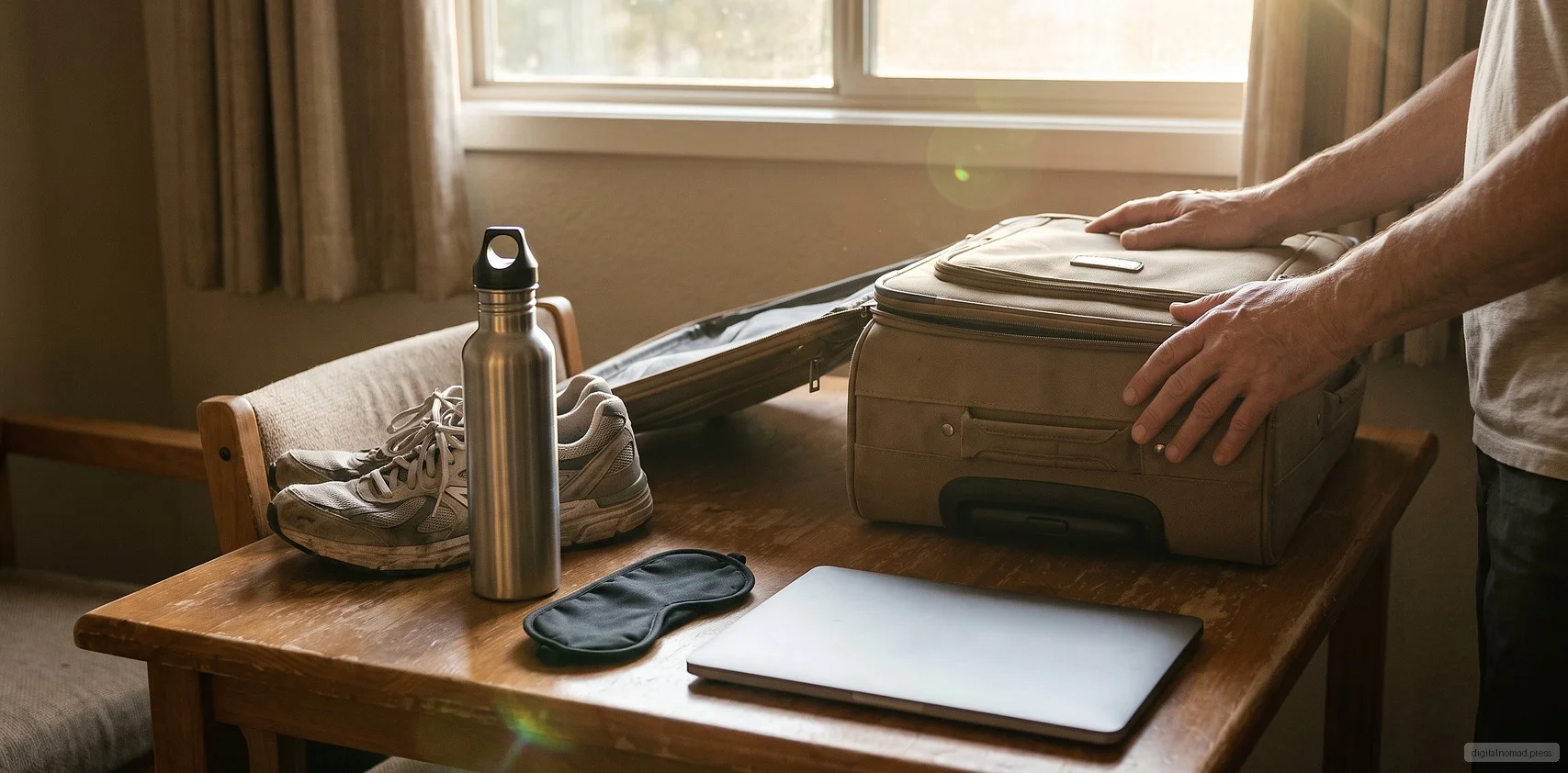
AI Generated - Editorial Use
Digital nomads often misdiagnose persistent fatigue as just another symptom of travel, like jet lag or logistical stress. But the real issue isn't the journey itself; it's the systemic breakdown of your health rhythm. Constant mobility disrupts the core pillars of well-being: consistent sleep, exercise, meals, sunlight exposure, and recovery. This article reframes health rhythm not as a wellness luxury, but as essential professional infrastructure for a sustainable remote career. Building this system is how you maintain high performance and well-being, no matter the city.
You Can Change Cities, But You Can't Outrun a Sleep Deficit: A Health Rhythm Guide for Nomads
The freedom of the digital nomad lifestyle is often romanticized with images of flexible work hours and endless exploration. But behind the scenes, many nomads struggle with a persistent, low-grade fatigue they can't seem to shake. They write it off as an unavoidable cost of constant movement and adaptation, classifying it as a "travel logistics problem." In reality, it's more likely a failure of "health infrastructure." We are treating our body's recovery system like a flexible travel budget, not the core asset it truly is.
Misdiagnosing Fatigue: When Your Body's Alarm Becomes Background Noise
A common mistake among new nomads is confusing the systemic fatigue from a collapsed biological rhythm with simple physical tiredness. The former is chronic, degrading your cognitive function, emotional stability, and decision-making quality. The latter is acute and usually fixed with a good night's sleep. If you find yourself in a multi-week fog of poor focus and low energy, even without a demanding travel schedule, it's not something another cup of coffee can solve. It's an alarm bell: your internal body clock, or circadian rhythm, is in chaos from a lack of consistent signals.
Health Rhythm as Professional Infrastructure
Every remote professional agrees that stable Wi-Fi and a reliable laptop are non-negotiable infrastructure. Yet, we rarely apply this same standard to our own health rhythms. A disrupted body clock is as detrimental to your performance as a spotty internet connection. Your patterns of sleep, meals, exercise, and light exposure form a complex internal operating system. This system dictates your focus, creativity, and resilience. Treating it as an optional "wellness" practice is a critical strategic error. It needs to be managed as core professional infrastructure, just as vital as your technical skills.
The Four Pillars of Your Body Clock
To rebuild your rhythm, you must first understand its components. Your circadian rhythm relies on four primary external cues, known as "zeitgebers," for calibration:
- Sleep Consistency: A regular wake-up and sleep time is the most powerful anchor for your body clock. Your body thrives on predictability.
- Light Exposure: Getting natural sunlight shortly after waking up effectively boots up your internal systems for the day, suppressing melatonin and increasing alertness. Avoiding bright light at night helps prepare the body for sleep.
- Meal Timing: Regular meal times help regulate your metabolic processes. Your body learns to anticipate food and processes it more efficiently at predictable intervals.
- Physical Activity: Consistent exercise not only improves health but also powerfully reinforces your circadian rhythm. It's another strong signal to your body that it's time to be awake and active.
Constant travel assaults all four of these pillars simultaneously, leading to internal desynchronization.
How Nomadism Systematically Breaks Your Rhythm
The very novelty that makes the nomad lifestyle appealing is the enemy of a stable rhythm. Every time you change cities, your established routines are reset. You have to find a new gym, a new grocery store, a new running path, and deal with a bedroom that may have different light and noise levels. Add in time zone changes, new food cultures, and the social pressure to experience nightlife, and establishing a routine becomes immensely challenging. Your body, lost in a sea of unpredictable cues, defaults to a "low power mode",the chronic fatigue you feel.
Strategy 1: Build a Portable Morning Ritual
The most effective way to fight chaos is to create a ritual that is location-independent. The first 60-90 minutes of your day are the most critical for setting your rhythm. Design a simple, repeatable sequence of actions and guard it fiercely. For example:
- Wake up at the same time, regardless of when you went to bed.
- Immediately drink a glass of water to rehydrate.
- Get 10-15 minutes of direct morning sunlight. This could be on a balcony, by a window, or during a short walk.
- Do 10 minutes of light stretching or movement.
This ritual acts as an anchor. Whether you're in a Bangkok condo or a Berlin hotel, it provides a stable, predictable start to your day.
Strategy 2: Time-Block Your Health Like a Client Meeting
Tasks that don't get scheduled often don't get done. Apply this logic to your health. Instead of having a vague intention to "work out later," schedule it directly in your calendar. Block out time for exercise, meal preparation, and even a pre-sleep wind-down period. When you give these activities the same priority as a work appointment, you are far more likely to follow through. This shifts your mindset from passively hoping to be healthy to actively managing your health.
Strategy 3: Engineer Your Sleep Environment, Wherever You Are
Quality sleep is the foundation of recovery, and it's one of the first things nomads sacrifice. While you can't control every aspect of your accommodation, you can significantly improve your sleep environment with a few key tools. A high-quality sleep mask and a good pair of earplugs are the best return-on-investment you can make. Furthermore, a consistent wind-down routine is crucial. An hour before bed, turn off all screens and switch to reading a book or listening to calm music. This ritual signals to your brain that it's time to prepare for rest, facilitating a quicker transition to sleep.
Conclusion: From Surviving to Thriving
Successful, long-term digital nomads are not defined by how many countries they've visited, but by their ability to maintain internal stability amidst external change. Elevating your health rhythm from a personal hobby to a piece of professional infrastructure is the key mindset shift from novice to veteran nomad. This portable system of self-regulation provides a stable core that allows you to adapt to new environments without depleting your physical and mental capital. It's what enables you to not just travel further, but to ensure you are at your best, every step of the way.
This content is protected by copyright. Please respect the author's work and do not copy or distribute without permission.

數位遊牧編輯群 Digital Nomad Editor Group
Digital Nomad is a knowledge sharing platform specially designed for “those who dream to become digital nomads.” We share the latest news and industry trends related to digital nomadism, as well as introduce essential skills and knowledge needed for freelancers, remote workers, etc. Our goal is to help you connect with fellow digital nomads!

Editor Group/CY
C Yo is the editor of "Digital Nomad" and the producer of the "Daren's Small Talk" for Digital Nomad Podcast. Known in the digital world as CY, he has been managing his personal branding in handwritten and calligraphy visual design for many years, and also writing commentaries. He was one of the last editors of "udn Opinion." As an intellectual Omnivore, he enjoys transdisciplinary thinking through perspectives from various fields.
