


How to Be a Good Temporary Resident, Not a Nomad Cities Learn to Resent
November 6, 2026
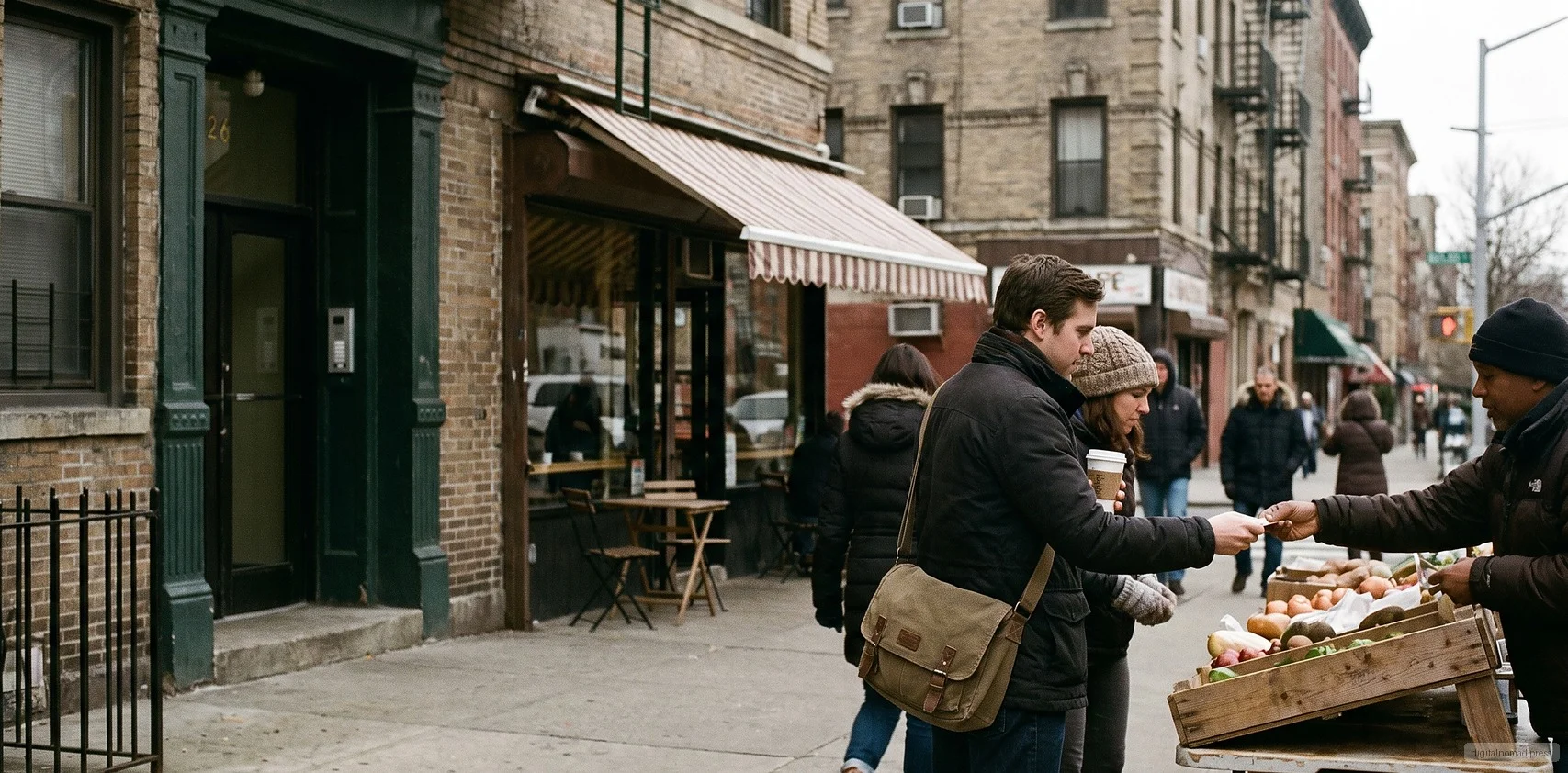
AI Generated - Editorial Use
Cities are not turning against nomads personally. They are turning against a pattern that treats neighborhoods as backdrop. Being welcome again means growing into a serious temporary resident. That covers housing choices, neighborhood manners, where your money actually goes, small language effort, real community participation, clear eyes about housing pressure, and leaving a place better than a tourist would. It is practice, not moral performance.
Over the last few years, cities that once courted digital nomads have grown wary. Lisbon, Barcelona, Mexico City, Chiang Mai, Bali, Tokyo, Seoul appear on nomad recommendation lists, and they also appear in news coverage of local protests over rising rents, over-tourism, and hollowed-out neighborhoods. Some cities are quietly reviewing the rent effects of nomad visas. Some walls carry graffiti telling nomads to leave.
The common nomad response is defensive. I am not a tourist. I spend money here. I pay more tax than locals. I have done nothing wrong. The response is understandable and largely useless. Cities are not annoyed at you personally. They are annoyed at the sum of a behavior pattern. When thousands of people enter a neighborhood in similar ways, short-term rental prices, restaurant menus, cafe crowds, and street languages all shift. You may not have done any single thing wrong. You still participated in the pattern. Admitting this is not moral confession. It is basic situational awareness for a grown-up who lives in other people's cities.
This article is not about guilt or performative virtue. It is about practice. If you plan to stay somewhere for three weeks to six months, what concrete choices can you make so that you burden the neighborhood less, contribute a little more, and end up more anchored yourself? These choices will not turn you into a local. They will not fix structural housing problems. They will change the quality of your relationship with the place.
Know Which Role You Are Playing
Most nomads confuse themselves by wanting the benefits of three identities at once without accepting any of the responsibilities. They want the freedom of a tourist, the local pricing of a resident, and the belonging of an immigrant. In a single neighborhood these three roles rub against each other.
Temporary residency is a real category and deserves to be taken seriously as one. You stay long enough that garbage rules, noise hours, neighbor rhythms, and local holidays matter. You do not stay long enough to carry long term civic weight like voting, long term property tax, or school board involvement. You are in the middle. That middle is legitimate, on the condition that you know you are in the middle and behave accordingly, rather than switching to whichever role is most convenient in the moment.
A useful self-check. If someone asks what you are doing here, can you answer honestly without dressing it up. Not "experiencing the culture" or "living the nomad lifestyle" but "I work remotely, I am here three months, I rent on such and such street, I mostly work from that cafe." When you can describe your situation plainly, you are less likely to slip into treating yourself as marketing material.
Housing Is the Choice That Matters Most
Short-term rental platforms have reshaped housing in many cities. Residents of Lisbon, Barcelona, Osaka, and Kyoto have said clearly and repeatedly that tourist rentals pull inventory out of the long-term market and push families out of neighborhoods their grandparents lived in. Your single choice cannot reverse the structure. You can still avoid being its worst version.
First choice. Can you avoid a tourist short-term rental at all. Many cities now have legal medium-term rentals aimed at foreign workers, student housing, monthly serviced apartments, and local agencies that offer three to six month contracts. These are more annoying than Airbnb. They demand agents, deposits, sometimes guarantors. The friction is the point. It moves you from tourist inventory to long-term inventory, which puts less pressure on the neighborhood.
Second choice. Which neighborhood. The historic center, the old town filmed for social media, the district named in international travel articles are usually the ones where residents are most squeezed. One or two metro stops out, in a residential area with normal services, you will usually pay thirty to forty percent less and live more like a real inhabitant than a visitor next to a souvenir shop.
Third choice. How long in one place. Three months in one apartment is different from three moves of one month each. The former resembles a normal rental. The latter resembles tourist inventory. When your schedule allows, longer stays and fewer moves are themselves a lighter footprint.
Neighborhood Manners Are Not Optional
The most common temporary resident mistake is treating yourself as the person having the experience and forgetting that the people around you are simply living. Neighbors notice this fast, through a few concrete behaviors.
Noise. Apartment buildings in many European and Asian cities have thin walls. Late evening video calls, night music, and early morning suitcase wheels get remembered. A grown-up temporary resident learns the rhythm of the building on day one and adjusts their working timezone to fit it, rather than expecting neighbors to adjust to their jet lag.
Shared spaces. Stairwells, elevators, garbage rooms, courtyards, corridors. Under a tourist mindset these are backgrounds or passageways. Under a resident mindset they are daily functional spaces. Do not linger on long phone calls in stairwells. Do not leave suitcases in hallways. Do not put trash out on the wrong day. These small details are the first evidence neighbors use to decide whether you treat this place as home.
Public volume. In many Asian cities the default volume in public transport, cafes, and restaurants is much lower than in North America. Speaking loudly in your own language, video calls on speaker, occupying a cafe seat all day for free office space. These might be fine in your own culture and read as intrusion here. Watching the volume of the people around you and adjusting requires no language skill, only attention.
Where Your Money Actually Goes
"I contribute to the local economy" is technically true and hides a more important question. Whose pocket does the money reach. If every meal is in an international chain cafe, an English-menu tourist restaurant, or a foreigner-owned health cafe, your spending mostly circulates in an intermediary economy built for foreigners. It rarely reaches the capillaries of the neighborhood.
A conscious temporary resident deliberately assigns some daily spending to local small businesses. The bakery on the corner, the wet market, the family run diner, the neighborhood laundry, the independent bookstore, the local barber. This is not romanticism about local life. It is an acknowledgment that a neighborhood's long term health depends on whether these small businesses survive, and their survival depends on whether ordinary foot traffic keeps arriving. Every visit is a vote.
Also be honest about prices. You can spend three times what locals spend on a meal because you earn in a different economy. That is not a sin. But if you routinely tip far above local norms, accept rents far above local norms without negotiating, or accept driver quotes far above local norms without checking, you help pull local prices up. Reasonable practice is to learn the local baseline, respect it, and not pay above it just because it is easier for you.
Language Effort Is Signal, Not Fluency
Temporary residents do not need to master the local language. They need to show effort. Hello, thank you, please, sorry, how much, I do not speak well, could you say that slowly. These phrases can be learned in any language in the first week. Their value is not communication efficiency. It is a signal that you know you are in someone else's place and do not assume everyone must switch to your language for your convenience.
Many nomads live entirely inside an English-speaking bubble. In the short term this is efficient. Over months it puts a pane of glass between you and the city. You can see it. It is right there. There is no real contact. Willingness to pay in the local language at a bakery, to laugh when you are not understood, to try another phrasing, to point, these small awkward moments are exactly what temporary residency asks of you. They make you approachable rather than a permanent guest inside an English bubble.
If you stay longer than three months, a local language teacher or a language exchange partner is a worthwhile investment. You will not be fluent in three months. You will develop a basic humility of posture, and that posture in turn changes the texture of your whole time in the city.
Community as Participant, Not Customer
Most nomad community activity is nomads talking to nomads. Coworking social nights, foreigner-run fitness groups, English Slack channels, English yoga classes near the Airbnb clusters. These have real value in the first weeks. If after three months your entire social world is still that circle, you live in a parallel city that overlaps geographically with the real one.
Real community participation requires deliberate effort. Local interest groups, photography, running, hiking, book clubs, religious communities, arts scenes. Returning regularly to the same cafe, the same market stall, so you become recognized. Neighborhood cleanup days, festivals, volunteer occasions. Non-commercial contributions in your area of professional skill, such as free workshops or short-term help for a local nonprofit.
Frequency matters more than intensity. One dramatic volunteer day is worth less than showing up in the same place every week. The reason you can even be a temporary resident rather than a tourist is that you can accumulate frequency. Actually spending that capacity is what earns you the temporary resident label.
Clear Eyes About Housing Pressure
Here is an honest fact. Even if you do everything right, you are still part of a structure that pushes housing prices up and changes neighborhood composition. Your individual effort cannot cancel that structure. Pretending the structure does not exist is what makes nomads insufferable.
Clear eyes means, for instance, not marketing a rapidly touristifying neighborhood on social media as an undiscovered gem. That sentence itself is an accelerator. Not publicly posting cheap landlord contacts in nomad forums, which pushes those prices up within weeks. Not replying to local complaints with "but I pay a lot too" because that is not what the complaint is about. Their complaint is about what they are losing, not about you personally.
If you have the ability and the will, you can go further and support local organizations working on housing justice, tenant rights, or neighborhood preservation, even through small donations or sharing information. This is not penance. It is standing on the correct side.
Leaving Well Is Part of the Impression You Leave
One of the biggest differences between temporary residents and tourists is how they leave. Tourists leave and that is the end. Temporary residents leave a few things behind. A clean apartment. A proper thank-you note to the landlord. A goodbye visit to the shops you frequented. Unused items given to neighbors or donated locally. Relationships kept alive so you can return.
Taking the time to do these things when you leave is a way of telling yourself that you did not treat this city as consumable backdrop. This habit changes how you arrive in the next city. You start to treat every stay as a real relationship rather than a disposable experience.
Think of Yourself as Sustainable Presence
A mature temporary resident thinks of their presence in a city as a pattern that can repeat, continue, and stay meaningful for both sides. You want to be able to return in three years, be accepted by the landlord, remembered by the cafe owner, greeted by the neighbors. That hope constrains today's behavior.
Reverse it. If every city is a one-time consumption, your behavior slowly becomes careless. Anywhere is fine to stay. Anywhere is fine to spend. Whether the neighbors remember you does not matter. What you leave behind does not matter. The cost of that mindset is not only that cities resent you. It is that you become a person without ties. You may have visited thirty cities. None of them know you.
Being a good temporary resident is not a moral pose. It is how you stay a person with real relationships to real places while living a mobile life. In a mature phase of nomad life, this is one of the most worthwhile capacities to invest in.
Cities Are Not Stages, They Are Other People's Homes
Back to the start. Cities do not reject you. They reject a pattern of treating cities as backdrop. You can choose not to be part of that pattern. The choice is made every day. Where you live. Where you eat. Which language you try. What you post. How sensitive you are to noise. How patient you are with neighbors. What you leave behind. These choices add up to how others remember you, and to how you remember yourself moving through the world. Being a good temporary resident is, in the end, a gift you give yourself.
This content is protected by copyright. Please respect the author's work and do not copy or distribute without permission.

數位遊牧編輯群 Digital Nomad Editor Group
Digital Nomad is a knowledge sharing platform specially designed for “those who dream to become digital nomads.” We share the latest news and industry trends related to digital nomadism, as well as introduce essential skills and knowledge needed for freelancers, remote workers, etc. Our goal is to help you connect with fellow digital nomads!
