


Is AI Bringing More Freelance Work? Digital Nomads Are Being Handed a New and Exhausting Kind of Job
October 26, 2026
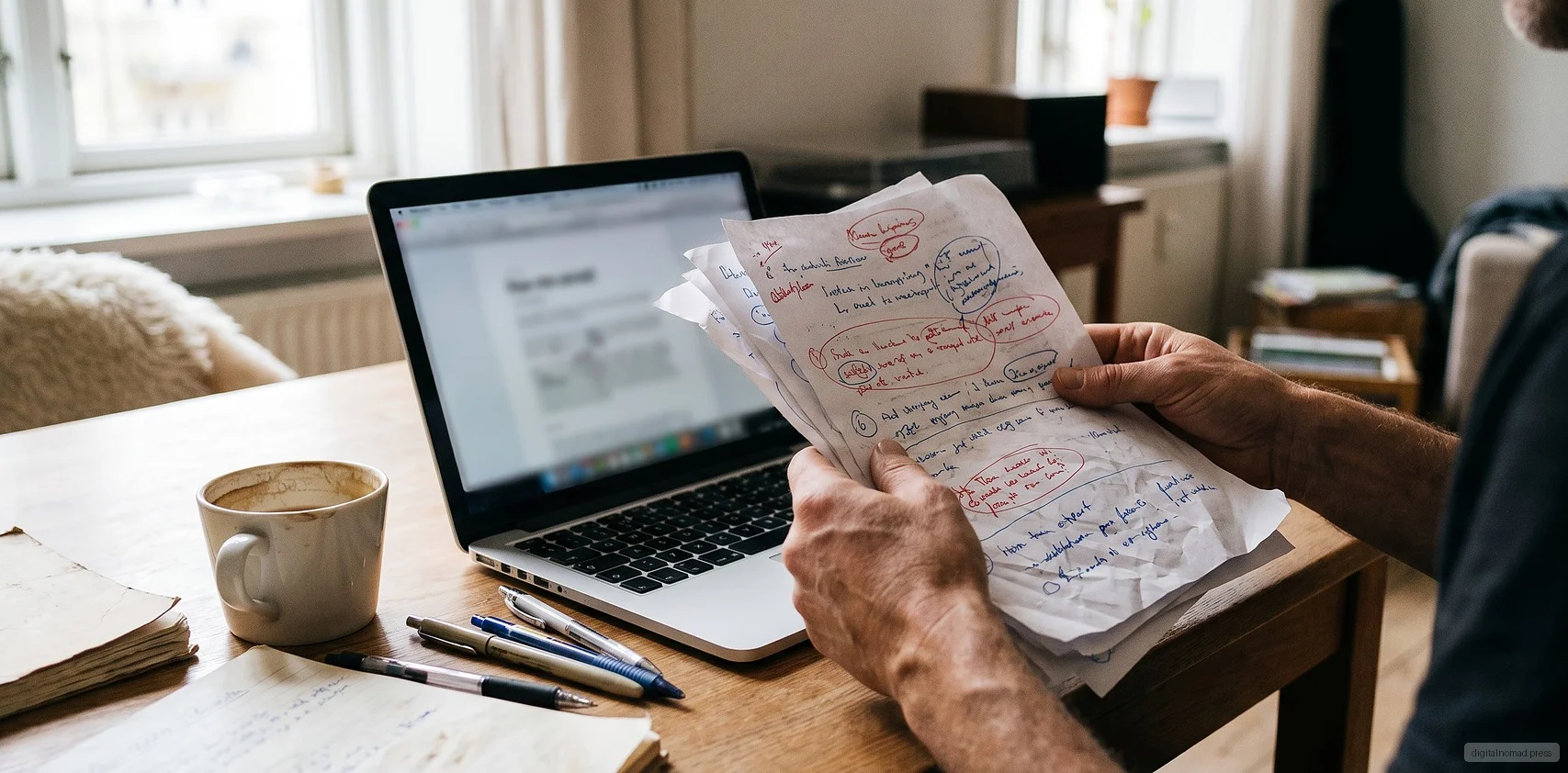
AI Generated - Editorial Use
AI has not made freelance life easier. It has split the work into production, cleanup, and judgment. Nomads pushed into the cleanup layer see rates fall and hours rise until mobility becomes unaffordable. The real opening is to reposition as a judgment worker who sells audits, workflow design, and accountability rather than line-by-line fixes to machine output. Seeing the shift clearly and pricing it properly is the assignment for freelance nomads in late 2026.
If you have spent enough time in freelance communities during late 2026, you have probably noticed something strange. There is more work available. Yet many independent workers feel more tired, less satisfied, and see their effective hourly rate falling. On paper, AI should have made writing, translation, coding, and design faster. In theory, a nomad should be able to take on more clients, earn more, and move between more cities. In practice, a large share of the new commissions flowing through the market is not creative work. It is cleanup.
Several major outlets reported on this pattern through September 2026. Companies are hiring freelancers in growing numbers to fix AI-generated output. Articles that read strangely. Data that does not match its sources. Code that runs sometimes. Designs with the wrong proportions. Translations that sound like a machine. Legal clauses subtly mangled. Buyers who expected AI to replace people are discovering that someone still has to own the last mile, and that last mile is often harder than starting from scratch. For nomads living abroad, working across time zones, and depending on freelance income to fund a mobile life, this shift deserves careful attention.
The market is pushing you from maker to validator
For the past decade, freelance work has been organized around what you can produce. You could write, design, edit video, or ship code, and clients paid for the output. AI is quietly reorganizing that structure. Production is being automated. What remains for humans is judgment, checking, polishing, risk review, fact verification, tone alignment, brand consistency, and legal compliance. Tasks that used to be embedded inside the creative process are now being unbundled and offered as separate commissions.
The problem is that validation is priced far below creation. Clients feel that AI has already done most of the work, so they expect to pay a fraction of the previous rate. Anyone who has actually done this labor knows that fixing AI output is often harder than writing from scratch. You have to read carefully enough to understand why the machine got it wrong, decide what can survive, tear out what cannot, and take responsibility for the final piece. It is high-cognitive-load work that the market is systematically underpricing.
If you do not notice that you have shifted from maker to validator, you will keep quoting like a maker while carrying a validator's workload. The result is more hours, lower effective pay, and a slow erosion of your feeling for the craft.
What AI cleanup work actually looks like
Let me sketch the recognizable shapes of these commissions as they appear in late 2026.
Content cleanup. A company has generated a large volume of blog posts, product descriptions, and newsletters with AI. Traffic drops. Readers bounce. Brand voice fragments. They hire someone to fix everything, piece by piece, at low rates, in high volume, on tight deadlines.
Code repair. A team has shipped features written mostly by an AI assistant. Things pass sometimes and fail other times. Test coverage is thin. Architecture is inconsistent. A freelance developer is brought in to read it all, patch bugs, add tests, and normalize style.
Data verification. AI-generated tables, summaries, or reports contain hallucinated numbers. Someone must line them up against original sources and correct them.
Post-editing translation. Machine translation now covers routine content, but formal documents, marketing copy, and legal clauses still need a human to check or rewrite.
Design cleanup. AI-generated images have odd proportions, extra fingers, and broken text. Designers get called in to fix or repaint key parts.
Decision gatekeeping. Clients use AI to draft proposals, contracts, and strategy documents but need a human professional to sign off, review, and carry the accountability.
The common thread across all six shapes is the same. You are not creating something original. You are underwriting someone else's AI output.
Why this work drains people so quickly
Experienced freelancers will tell you that fixing someone else's work is always harder than doing it yourself. Fixing AI output adds another layer, for three reasons.
First, AI errors do not resemble human errors. When people make mistakes, there is usually a logic you can trace. AI is wrong in a way that is superficial and confident at the same time. The prose flows but the facts are off. The format looks clean but the argument is hollow. You need a different mode of reading to catch these problems, and the mode switching itself burns cognitive energy.
Second, client expectations have been distorted. They see a first draft that reads reasonably well and assume it is eighty percent done. The remaining twenty percent, they think, is a quick hour of polishing. In reality, that remaining slice often requires demolition and rebuilding. When you try to explain this, clients hear it as price inflation, because they cannot see the cost of judgment.
Third, the work is quietly demoralizing. You spend three days making an AI-generated deliverable barely usable. Your name is not on it. It does not join your portfolio. You know you exercised real professional judgment, but the market remembers only that AI did it.
Over time, this makes you feel less like an independent professional and more like a temporary quality-control worker. That is especially dangerous for nomads, because a mobile life depends on being paid for expertise. Once you get pulled into the low-margin cleanup layer, your hours expand, your rates compress, and mobility becomes a luxury you cannot afford.
Signs that you are being treated as cleanup labor
Not every AI-adjacent commission is a trap. But several signals should make you pause.
Language in the brief such as needing only a light polish, or claiming the AI has already done a first draft that only needs a small fix, or saying no creativity is required, only readability, usually means the client is severely underestimating the work.
Pricing structured around word count, page count, or piece count instead of time or professional judgment tells you the client is treating you as an assembly line worker.
A refusal to provide context, brand guidelines, or original requirements, combined with a request to just make an AI draft work, means the client does not really know what they want. You will be forced to make decisions without being trusted to make them.
High volume, aggressive timelines, low unit price, and an explicit statement that costs are being cut because AI is involved is the textbook cleanup market.
If two or more of these signals appear in a single brief, this is not an opportunity. This is a plan to treat your expertise as a consumable.
Moving from cleanup labor to judgment work
Once you see the structure clearly, the real question becomes whether there is a valuable position for you within this new demand. There is. But it requires repositioning.
Cleanup labor makes things presentable. Judgment work decides what can be used, what must be replaced, and who is accountable. The market values these two roles by an order of magnitude difference.
Concretely, several directions are open.
Audit and review services. Instead of editing line by line, you assess the client's overall AI content pipeline, flag risks, identify recurring failure modes, and recommend structural fixes. You are selling judgment, not labor.
Editorial director role. The client has AI output and junior staff. You set the tone, decide what ships, and own the final version. You become the last authority on the work, not the person patching it.
Workflow design. You help the client redesign the AI plus human process, including prompt standards, review checkpoints, ownership rules, and quality metrics. This is consulting-grade service.
Risk review. Legal, financial, medical, and technical documents especially need a domain expert to endorse or reject AI output. This role resists automation because responsibility must land on someone with credentials or professional reputation.
Named authorship. More and more content needs a real person willing to attach their name and stand behind it publicly. That willingness is itself a scarce, priceable resource.
Rethinking how you quote
If you move toward judgment work, your pricing logic has to move with you.
Stop quoting per article or per image. Start quoting per review, per workflow, or per month of oversight.
Stop spending time explaining individual edits. Deliver a review document that lists what you found, why it matters, the risk level, and your recommendations. That document is itself a professional deliverable.
Stop signing long-term per-piece cleanup contracts. Their structure locks you into the lowest-margin band. Replace them with monthly retainers or quarterly audits.
For cleanup work you must accept, price AI correction above original creation and explain the reason. Judgment costs more than production. Clients will only start to internalize this if you say it out loud repeatedly.
When a client insists on paying cleanup rates for your judgment, you need to be able to walk away. That takes cash flow buffer and confidence in your own work. Neither is built in a day, but the direction matters more than the pace.
Why this matters more for nomads
A mobile life carries structural costs. Cross-border rent, international health coverage, cross-border tax exposure, and reliable connectivity all add up. What a nomad needs is not a heavier stack of billable hours, but a healthy professional margin.
If the market pushes you into the AI cleanup layer, your effective rate falls, your hours climb, and mobility becomes something you can no longer afford. You start choosing the cheapest cities, the weakest networks, and the most crowded rooms just to keep your account from going red. That is not a nomadic life. That is low-wage exile with a laptop.
The other direction is different. Positioned in the judgment layer, you need fewer hours to sustain your life. You can genuinely use time zones, choose cities for reasons other than price, and set your own rhythm. AI is not a binary threat or opportunity for nomads. It is a fork in the road that requires a deliberate choice.
There is one more thing worth naming. Nomads have low visibility. You are not in the client's office. They do not remember your face. Your judgment gets diluted more easily into the generic role of the person who sends deliverables. That means you have to actively present yourself as a judgment worker rather than wait for the market to categorize you correctly.
Practical steps you can take now
If more than half of your current work is AI cleanup, a few small moves can start shifting the shape.
In the next three months, identify one or two clients with real potential and propose restructuring from per-piece editing to monthly review or workflow advisory. Use concrete examples to show why both sides benefit.
Start drafting your own AI content review standards document. List how you assess risk and quality in AI output. This is both a tool and a differentiator you can attach to proposals.
Pick a vertical and go deep. Taking on AI cleanup across every language and topic keeps you in the low-price zone. Focusing on one domain, such as financial compliance documents, medical explainers, technical documentation, or academic translation, builds scarcity faster.
Make your judgment process visible. Write short pieces, do teardowns, share how you catch specific AI failure modes. This positions you as an expert in the eyes of future clients rather than as a repair worker.
Recalibrate your minimum rate. Set a floor. Do not accept work below it, even at short-term cost. That floor is what determines whether you can eventually leave the cleanup layer.
Trade notes with peers. Which platforms, clients, and industries are willing to pay for judgment moves quickly through freelance communities. Nomads especially need this signal to understand where the market is heading.
AI has not made freelance life easier. It has changed the shape of the work. Seeing that shape clearly and deciding whether you want to stand on the side that will keep getting priced down is the assignment for every nomadic freelancer in late 2026. The market will not sort you. Clients will not upgrade your role for you. This is work you have to do yourself.
This content is protected by copyright. Please respect the author's work and do not copy or distribute without permission.

數位遊牧編輯群 Digital Nomad Editor Group
Digital Nomad is a knowledge sharing platform specially designed for “those who dream to become digital nomads.” We share the latest news and industry trends related to digital nomadism, as well as introduce essential skills and knowledge needed for freelancers, remote workers, etc. Our goal is to help you connect with fellow digital nomads!
