


Without a Stable Address, Nomads Lose Financial Capability Before They Lose Freedom
October 19, 2026
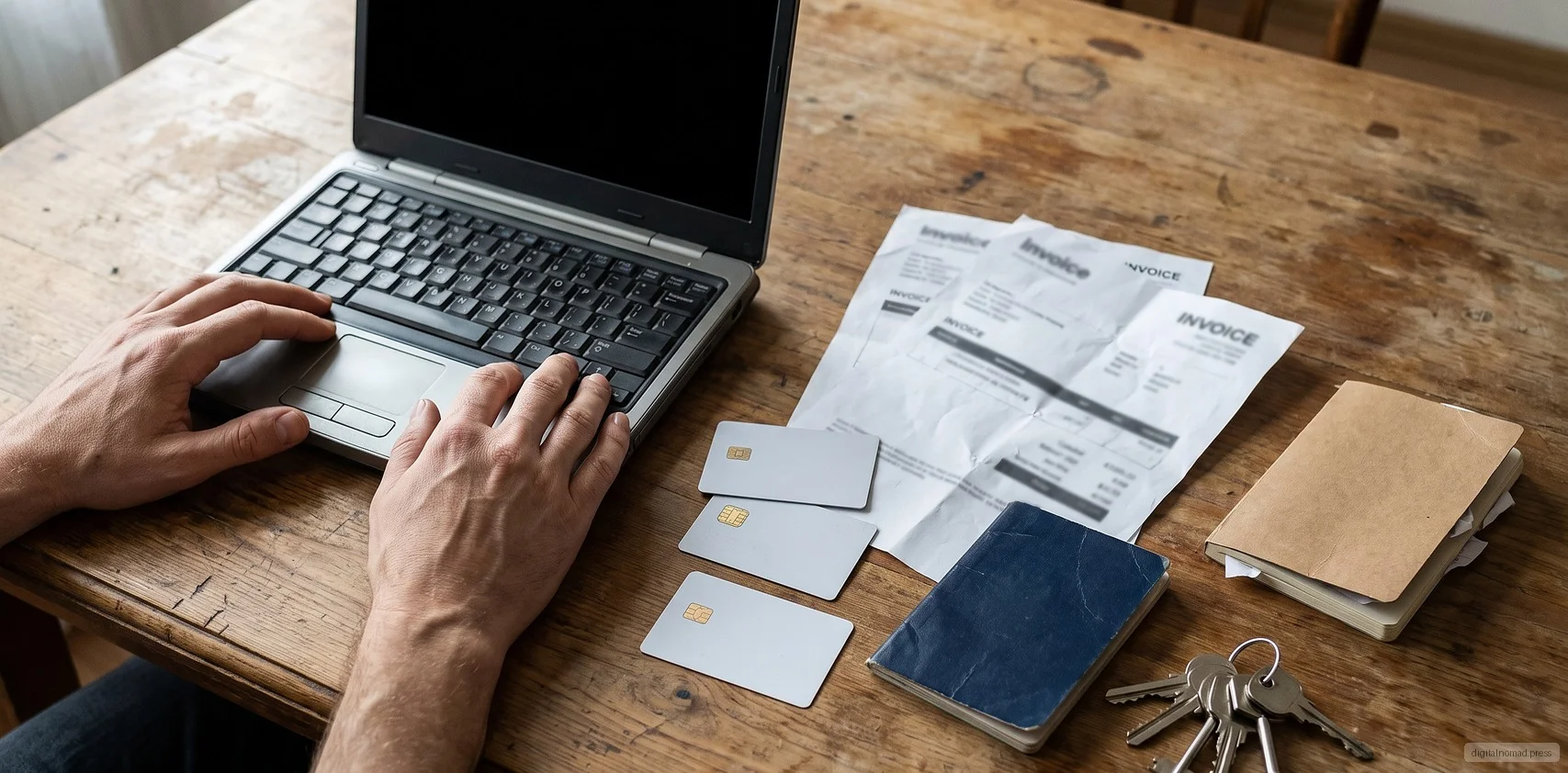
AI Generated - Editorial Use
Nomads often assume multi-currency accounts solve banking, but the real friction sits underneath: proof of address, tax residency, periodic compliance reviews, payment processors, and physical card delivery. When a stable address disappears, what nomads first lose is not freedom but the everyday capability to receive payments, replace cards, and keep accounts in good standing across borders.
Most new digital nomads spend their first year discovering a strange contradiction. They can book flights, sort out visas, land clients, and move between cities with surprising ease. Then one morning they log into their bank app and get a message asking them to "update proof of residential address" with a recent utility bill or government letter dated within the last three months. That is the moment they realize the entire financial infrastructure they took for granted was built on one silent assumption: that they live somewhere fixed, somewhere that can receive letters, somewhere that can be verified.
Once that assumption breaks, what nomads lose is not freedom. They lose financial capability. They cannot receive payments, replace cards, pass renewed KYC checks, open new accounts, or even keep existing accounts in good standing. These issues rarely surface in week one abroad. They cluster around month six or month ten, during scheduled compliance reviews, arriving as late-night emails in a timezone that makes the deadline nearly impossible to meet.
This piece unpacks the financial infrastructure nomads actually need. Multi-currency accounts are only the surface layer. Underneath sit proof of address, tax residency, compliance reviews, payment processors, invoice identity, card delivery, backup accounts, and cash flow resilience. Without deliberate planning, this stack tends to fail together at the worst possible moment.
Multi-Currency Accounts Are an Entry Ticket, Not a Solution
Over the last few years, tools like Wise, Revolut, and Payoneer have convinced many nomads that banking is a solved problem. Hold multiple currencies, convert at near-interbank rates, receive USD or EUR, and swipe a physical card almost anywhere. Compared to the wire-transfer world of a decade ago, this is real progress.
But these tools are, at their core, cross-border payment and money-movement infrastructure. They are not a replacement for having a financial identity in a specific country. They still require you to declare a residence, a tax status, and a phone number. When large flows, unclear sources, or risk models get triggered, they will ask for documents, interviews, or freeze funds while they investigate. That is when nomads discover multi-currency accounts have not eliminated the compliance burden. They have simply deferred it.
The mental shift is to treat these accounts as an operational layer for daily flows and to keep one or two sovereign bank accounts as a foundation for large, long-term, legal, credit, and investment purposes. The neobank layer does not survive on its own.
Proof of Address: The Asset Nomads Undervalue
In most jurisdictions, banks, brokerages, crypto exchanges, and payment processors all require proof of address. Standard documents include utility bills, telecom invoices, government letters, lease agreements, and bank statements. The nomad problem is that these documents either do not exist, are not in their name, or show a short-term rental address that reviewers routinely reject.
A common solution is to anchor a home country address. This might be a parent's home, a long-term lease, jointly owned property, or a trusted friend willing to receive mail. The address does not have to be where you physically live, but it has to reliably receive mail, produce plausible documentation, and match the tax residency you declare. For many nomads this address becomes the root of the entire financial stack. When it wobbles, every account tied to it wobbles too.
The alternative is a mail forwarding or virtual address service. These providers can scan mail, receive parcels, and forward items to a current location. But not every bank accepts virtual addresses, and some platforms explicitly flag PO boxes or coworking addresses as high risk. Check the policies of your key financial partners before you rely on such a service. You do not want to find out during a compliance review that the address on file does not count.
Tax Residency Is Stickier Than People Expect
The other half of financial compliance is tax residency. Most banks require CRS or FATCA forms at onboarding and during annual reviews. You declare where you are a tax resident and provide relevant tax identification numbers. Those declarations are automatically exchanged with tax authorities in the relevant countries.
A common mistake is assuming that spending fewer than 183 days in any single country automatically means you are a tax resident of nowhere. In practice, tax residency uses a broader test that considers your permanent home, family ties, economic center of interest, and nationality. Some countries continue to treat you as a resident after you leave until you can prove residency elsewhere. This stateless-for-tax posture looks liberating, but it makes banks nervous. Accounts flagged as ambiguous end up in the high-risk pile.
The stable approach is to work with a cross-border tax advisor before starting nomad life. Decide where your tax residency should land, gather the supporting documents such as tax certificates, past filings, and residence proofs, and be ready to present them repeatedly. This question does not get asked once. It gets asked every time a bank, broker, or payment processor updates its files.
Compliance Reviews Are Routine, Not Exceptional
The first real financial scare many nomads experience is a message like this: submit proof of address, source of income, and explanations for recent transactions within X days or your account will be restricted. The instinct is to assume you did something wrong. In reality, this is a scheduled periodic review.
As cross-border flows increase and anti-money-laundering standards tighten, banks are required to periodically re-verify customer information. Frequent international transfers, income from multiple payment platforms, sudden large flows, and shifting source countries all raise review frequency. Nomads should assume they will hit these reviews regularly.
To reduce disruption, keep contracts, invoices, and statements for all significant income sources so you can produce them instantly. Make transaction descriptions readable by asking clients to reference project names and invoice numbers. Avoid mixing personal and business flows in the same account so a reviewer can parse activity quickly. When a request arrives, prioritize it. Timezone gaps and email delays eat most of the buffer built into the deadline.
Payment Processors Are a Second Fragile Node
For freelancers and small business nomads, payment processors like Stripe, PayPal, Wise Business, and local e-payment providers are the frontline of cash collection. These platforms have their own address, identity, and tax requirements, and their review logic is often faster and more automated than a bank's.
Typical failure modes include a persistent mismatch between the country on file and your IP address, a registered business location that does not match the payee address, large deposits that trigger risk models, and elevated refund or dispute rates. The common outcome is temporary freezes lasting anywhere from 30 to 180 days. For an individual practice with thin cash reserves, that timeline is close to fatal.
The practical response is to avoid concentrating all revenue in a single processor. Maintain two or three, spread across different clients, currencies, and geographies. If one platform enters review, the others keep the business alive. Keep verification data current on the primary platform, especially address, identification, and tax details. Do not wait to be asked.
Invoice Identity: Who Are Clients Actually Paying?
This layer is underestimated. When you work with clients in multiple countries, whose name is on the invoice? What address? What tax number?
This is not a paperwork detail. Invoice identity determines whether a client's accounting system can expense the payment, whether their country applies withholding tax, how you declare the income in your tax residency, and whether it counts as personal income or business revenue.
Three common setups appear. The first is issuing receipts or simple invoices as an individual freelancer under a local self-employed regime. This works for some clients but often feels informal to larger enterprises. The second is invoicing through a home country entity. This is the most stable arrangement, but it requires actively maintaining that entity, filing accounts, and paying local obligations. The third is using a digital residency scheme such as Estonia's e-Residency, which digitizes the process but still depends on your personal tax residency for the final tax treatment.
No single setup is always best. The important thing is alignment. Invoice identity, receiving account, and tax residency should agree with each other. When these three drift apart, tax filings and bank reviews become chronic sources of stress.
Card Delivery and Physical Constraints
A detail that sounds trivial but matters enormously: how does a physical card reach you?
Most banks and fintechs still ship physical cards for new accounts, expiring cards, lost card replacements, and identity verification steps. For someone constantly moving, this creates three pain points. First, the shipping address does not match the current location. Cards arrive in the home country and rely on family to hold, photograph, and forward them, with customs, loss, and time-sensitive activation windows along the way. Second, some cards are only shipped domestically. Requests from abroad get rejected, forcing a wait until the next trip home. Third, emergencies reveal the problem. The main card is frozen, local cash is short, and the backup card is thousands of kilometers away.
The unglamorous answer is redundancy. Apply for two or three physical cards across different countries, banks, and networks. Distribute them across your person, your luggage, and a trusted person back home. It looks excessive until the main card fails, at which point the backups are the difference between continuing and being stranded.
Backup Accounts Should Be Alive, Not Dormant
A common mistake is to concentrate all financial activity in one or two favorite platforms. When those platforms hit a review or outage, some nomads discover they cannot even buy a flight out of the current city.
The right way to think about backup accounts is not as a rainy day store, but as something that gets used occasionally as part of normal life. Accounts that go months without activity get flagged as dormant, require re-verification, or get closed automatically. A backup that only exists on paper is not really a backup. It needs a quarterly rhythm of small deposits, spending, and logins.
A reasonable configuration might include one primary home country account for large transactions, credit, and legal documents; one or two multi-currency tools for daily flows and conversions; one or two local accounts if a specific country becomes a longer base; a credit card ecosystem as an emergency credit source; and a modest cash reserve because in most cities cash is still the final fallback.
The point is not complexity. The point is independence between nodes. When any single platform enters a compliance loop, the other nodes should be able to run without it.
Cash Flow Resilience: Timing Beats Totals
The final and most overlooked layer is the time structure of cash flow.
Spending patterns for nomads differ sharply from settled life. Rent often means short-term deposits plus monthly payments, requiring larger lump sums up front. Flights, visas, insurance, medical checks, and emergency care cluster around moving points. Equipment refreshes for laptops, phones, and backup hardware are infrequent but expensive when they happen. These outflows are lumpy and can produce the frustrating situation of having money on paper but not being able to access it right now.
Cash flow resilience for a nomad is not measured by total assets. It is measured by how much can be mobilized in what timeframe. A useful mental model has four layers: funds available within 24 hours through cards or transfers; funds available within a week from investment accounts; funds recoverable within a month from post-tax income; and an emergency reserve covering three months or more. These layers must live in different accounts, different tools, and different countries so that no single event can freeze them together.
For anyone building a long-term nomad life, this structure is not conservatism. It is the requirement for sustainability. Real freedom is not the absence of constraints. It is having enough buffer that when external systems misbehave temporarily, you can still make calm decisions. Financial infrastructure ultimately protects that calm, not the assets themselves.
This content is protected by copyright. Please respect the author's work and do not copy or distribute without permission.

數位遊牧編輯群 Digital Nomad Editor Group
Digital Nomad is a knowledge sharing platform specially designed for “those who dream to become digital nomads.” We share the latest news and industry trends related to digital nomadism, as well as introduce essential skills and knowledge needed for freelancers, remote workers, etc. Our goal is to help you connect with fellow digital nomads!
