


Family Nomadism Is Not Just Packing More Suitcases
October 15, 2026
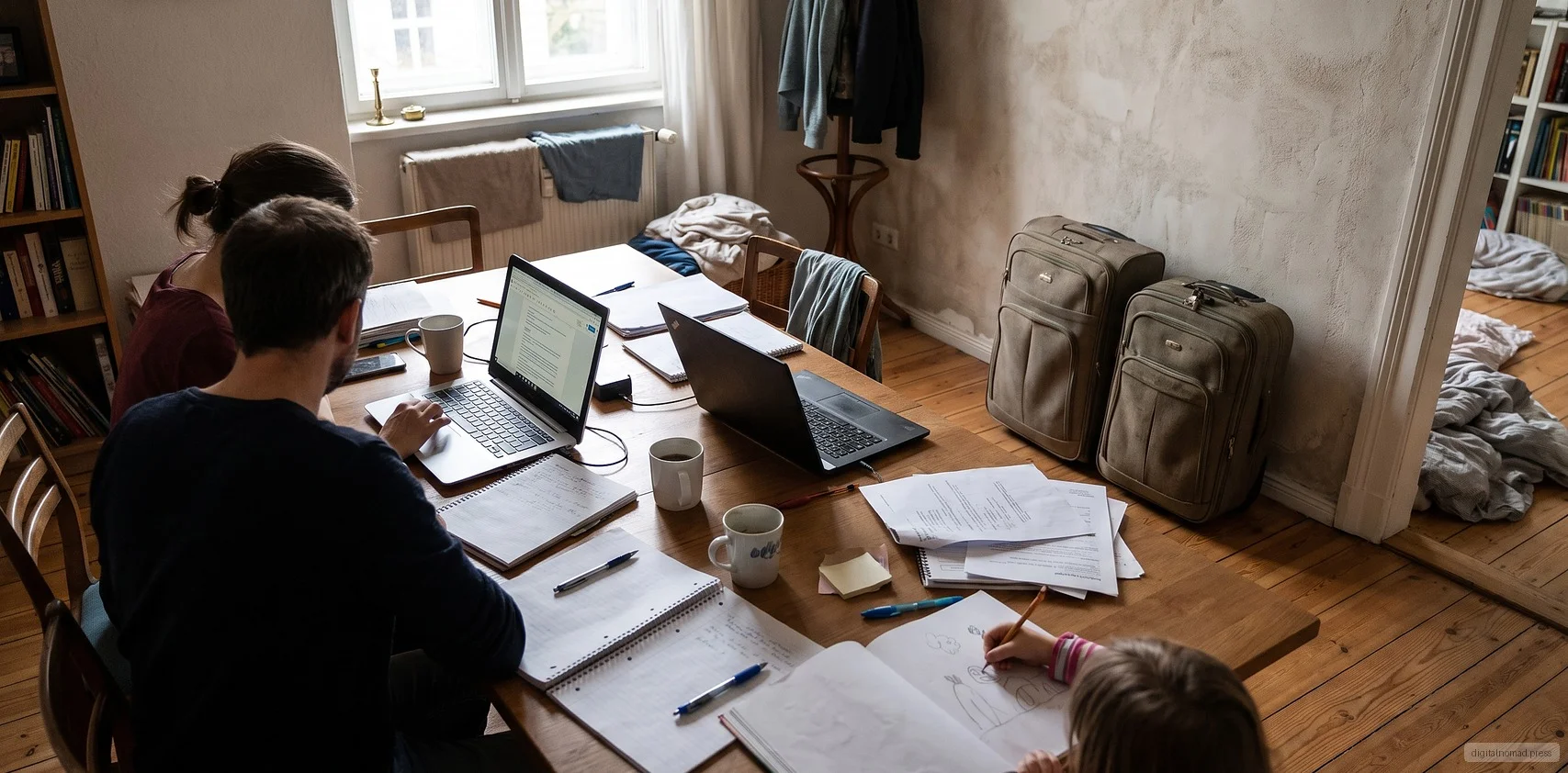
AI Generated - Editorial Use
Traveling as a family reshapes nomadism into a logistical project involving schools, healthcare, dependent visas, partner careers, and children's need for predictability. This article breaks down eight practical layers of family nomad life, from real cost structure to community clustering, and argues for writing a graceful exit into the plan from the start rather than treating return as failure.
A single nomad moves to a new city with a laptop, a visa, and a short lease, and can usually start working within a day. The overstuffed suitcase is a personal problem. But once the household includes a partner, children, or ageing parents, the entire operation shifts from a personal travel decision into a small family project. What now moves is not only luggage but school enrollment, medical continuity, visa status, a partner's career, a child's social stability, and every mundane routine that quietly holds daily life together.
Recent industry data on remote workers consistently points to the same demographic shift. The single adventurer is no longer the default portrait. More than half of digital nomads are married or living with a partner, and the share of families travelling with children has been rising each year. That shift matters because it moves nomadism from a youth subculture toward a longer term family arrangement that needs actual infrastructure. And infrastructure is exactly what most first-time family nomads underestimate.
The Real Cost Structure Is Not Linear
The most common budgeting mistake is to take a single-person nomad budget and multiply by household size. Real life breaks that number quickly.
Housing does not scale linearly. A studio works for one person. Two adults can compress into a one bedroom. Add a child and you need at least a proper sleeping room plus a living area. Add a second child and the requirement jumps to two bedrooms. In popular nomad cities that shift can move monthly rent from around twelve hundred dollars to three or four thousand, and even then the supply is narrow.
Food costs are not linear either. Children tolerate restaurant food for a few days before their stomachs, moods, or both revolt. Family nomadism almost always requires kitchens, which pushes housing back up. Transport costs grow from one ticket to four, and toddler-age children require car seats, strollers, and slow logistics that add hours to every transfer day.
Then there is the least discussed line item: the contingency fund. Families have far lower tolerance for surprises than single travellers. A sick child, a partner who must fly home for a parent, a school placement that does not work out, any of these can trigger unplanned flights and rebookings. That reserve is not optional. It is the shock absorber that allows the family to keep moving without every incident becoming a crisis.
School Is Not a Building. It Is a Rhythm
The single hardest variable in family nomadism is the child's education. It is not only curriculum. It is a whole structure of time, peers, and identity.
One path is full homeschooling or online school. It gives the family maximum mobility because the schedule follows the household rather than a local bell. The trade-off is heavy parental involvement. Even with online schools, an adult usually has to enforce discipline, maintain the internet, and manage social gaps.
The second path is local enrollment, typically international schools or private local schools. This gives children a stable peer environment, but tuition is high, seats are limited, and admissions timelines rarely align with a family's arrival date. The deeper cost is temporal. Enrollment binds the family to an academic year, which effectively caps the mobility that motivated the whole arrangement in the first place. Every school transfer also spends real social capital that children have to rebuild from scratch.
A third path, which many families settle on after trying the extremes, is a base city where they live eight to ten months of the year, with shorter trips during breaks. The child keeps a stable school, stable friends, and predictable weekly routine. Parents accept that flexibility now looks like one long anchor plus short excursions rather than constant motion. This is not a failure of the nomad ideal. It is what sustained family mobility actually looks like once children are involved.
The right choice depends on what the child needs at that age: language exposure, close friendships, academic pacing, or broad worldview. Parents should pick the rhythm first, then choose the schooling method that fits.
Healthcare Is Access, Not Insurance
A single nomad can buy one international health insurance policy and largely be covered. Families cannot. Children and older relatives generate more frequent, more varied medical needs than young adults do.
The first reality is routine care. Children need vaccinations on schedule, developmental check-ins, dental care, vision checks. These are not emergencies and do not sit in travel insurance policies. They require a family doctor who can track a medical history over time. Constant movement breaks that thread. Some families consolidate a full medical sweep once a year in their home country. Others keep a paediatrician in their base city and only travel around scheduled visits.
The second reality is acute events. A child with a fever at 2 a.m. or a toddler with an allergic reaction does not need a phone number for an insurer's international call centre. That family needs a paediatric emergency room within twenty minutes. This means the first week in a new city should include mapping the nearest emergency room, twenty-four-hour pharmacy, paediatric clinic, and dentist. Not when it becomes urgent.
The third reality is pre-existing conditions. International health insurance treats these strictly. A partner or parent who takes long-term medication needs to verify drug availability, prescription rules, and whether the policy reimburses locally sourced substitutes before the family moves, not after.
The fourth reality is dental and vision. Most policies only cover the basics. Braces, glasses, cleanings, and orthodontics are usually out of pocket. Some families deliberately anchor in cities with strong medical tourism value and use the stay to bundle these expenses for the whole household. That is a practical budget strategy, not a luxury.
Visas for Families Are a Different Species
When countries market digital nomad visas, the headlines focus on the main applicant's income threshold and remote work proof. Bring dependents and the fine print starts to matter enormously.
Definitions of dependents vary. Spouses are usually eligible, but same-sex partners, unmarried partners, and common-law arrangements are not universally recognised. Some countries require notarised and apostilled marriage certificates, adding weeks to preparation.
Child age caps differ. Most visas cover minors, but the definition ranges from eighteen to twenty-one, and some require proof of enrollment or additional financial evidence. Adult children in university may need their own application.
Income thresholds stack. A single applicant threshold of three thousand dollars per month typically adds five hundred to a thousand for a spouse and a few hundred per child. A family of four might need documented monthly income of five to six thousand dollars, with verifiable and consistent sourcing. Freelancers with lumpy income often stall at this checkpoint.
Work rights for dependents are the most overlooked issue. Many nomad visas restrict the main applicant to foreign-source income and give dependents no work rights at all, or only under narrow conditions. If the partner is already fully remote, this is manageable. If the partner had a location-bound career or expected to work locally, the constraint reshapes the family's entire plan.
Renewals are the last trap. Most nomad visas last one or two years, and renewal usually requires the whole family to still meet the criteria. Losing one dependent's eligibility can disrupt a child's school year mid-stream.
The Partner's Career Cannot Be the Sacrifice
The most common fracture in family nomadism is not children's schooling. It is career asymmetry between partners.
The typical pattern: one person has a fully remote job with stable income and drives the decision to travel. The other had a location-bound role, or a remote role in a rising career phase. After the move, the first partner's work rhythm barely changes. The second partner faces broken time zones with existing clients, no legal right to work locally, and slow erosion of the professional network that took years to build.
A year in, the career gap becomes visible. The partner who stayed rooted often accumulates promotions, higher-paid roles, and expanding influence. The partner who followed shows a fuzzy gap on the resume or accepts downgraded work to preserve flexibility. That gap becomes a recurring source of tension.
Practical safeguards exist. Set the priority of both careers explicitly before leaving, rather than assuming both can travel along equally. Preserve windows for the trailing partner to return home for concentrated work or study, for example three months a year on independent travel. Do not concentrate household income in one person; treat the smaller income as a household asset rather than a variable to sacrifice. Share the decision authority for where to move next, so the higher-earning partner does not unilaterally set the calendar.
The quality of the partnership tends to determine sustainability more than the destination does.
Children Need Predictability, Not a Fixed Address
A comforting myth says children are fine anywhere as long as parents are present. That holds during infancy. Past age three, and certainly once school starts, children develop strong needs around peers, environment, and predictable daily rhythm.
The core of security is not location. It is predictability. What time do we wake up, eat, bathe. What happens on weekends. Who visits. When do we leave this city. These small rhythms hold up a child's inner sense of safety. Constant movement does not automatically destroy that safety, provided parents make the rhythm itself the stable frame rather than the address.
Concrete practices help. Discuss the next city with children before every move, including housing, school, and how to say goodbye to current friends. Do not schedule anything for the first three days after arrival; use that time only to orient. Travel with the same sheets, toys, and books, so the objects of home persist even when the walls change. Keep family rituals like Sunday breakfast or bedtime stories intact across moves.
Children's social lives need active maintenance too. Video calls with friends back home have to be scheduled, not hoped for. Local activities in the new city have to be researched and joined, not stumbled into. Contact with other nomad families needs to be sustained across cities. Children will not organise this themselves.
Family Nomadism Needs a Community, Not Just Wi-Fi
Single nomads maintain social life through coworking spaces, online communities, and chance encounters. Families need something structurally different.
What a family with children actually needs is not fast coffee shop internet. It is another family, nearby, with children of similar age, willing to trade pickups, watch each other's kids, and share on-the-ground information. That kind of relationship is nearly impossible to build in a two-week stay. It requires time, repeated meetings, and letting the children form their own friendships first.
This is why family nomads tend to cluster in a small number of cities: Lisbon, Chiang Mai, Ubud, Mexico City, Medellin. It is not just cost or visa friendliness. These places already have a working family nomad community. A new family plugs into an existing network within weeks rather than months, children find peers, and parents find people who understand the specific mix of logistics and doubt that comes with the lifestyle.
Alongside local community, families need a rearguard. Parents, siblings, and old friends back home play a bigger role than expected. A grandparent on video call when a child is sick, a sibling handling paperwork back home, an old friend willing to listen when one partner is quietly exhausted, these long-distance relationships have to be maintained deliberately, not called upon only in emergencies.
Write the Exit Into the Plan
The last principle, and the one romantic narratives most often obscure: family nomadism does not have to be forever.
Many families frame it as a final destination in itself. When a child struggles to adapt, a partner hits a career ceiling, or a parent's health changes, they interpret returning home as failure. The healthier frame treats family nomadism as a phased choice, reassessed every six to twelve months. Should we continue, adjust the rhythm, or anchor somewhere for a while?
Reassessment works best with concrete indicators, not vague feelings. Ask about the child's sleep, learning, and mood in recent weeks. Ask about each partner's work satisfaction, social life, and physical health. Look at the remaining months of financial runway. Ask whether the next major medical or educational decision can actually be served by the current location. If several answers trend negative, it is time for a real conversation.
Writing the exit into the plan is not weakness. It is responsibility. It converts family nomadism from an all-or-nothing bet into a long experiment with adjustable dials, and it prevents families from postponing changes until relationships or children have already been damaged.
The centre of family nomadism was never the movement. It is the family itself. Location is background. Relationships are the subject. When that order is right, nomadism becomes not a lifestyle brand but a genuine phase, one that can be sustained, corrected, paused, or restarted as the family needs.
This content is protected by copyright. Please respect the author's work and do not copy or distribute without permission.

數位遊牧編輯群 Digital Nomad Editor Group
Digital Nomad is a knowledge sharing platform specially designed for “those who dream to become digital nomads.” We share the latest news and industry trends related to digital nomadism, as well as introduce essential skills and knowledge needed for freelancers, remote workers, etc. Our goal is to help you connect with fellow digital nomads!
