


Internet Access Is Not Enough: Why Your Phone Number Becomes Nomad Infrastructure
October 8, 2026
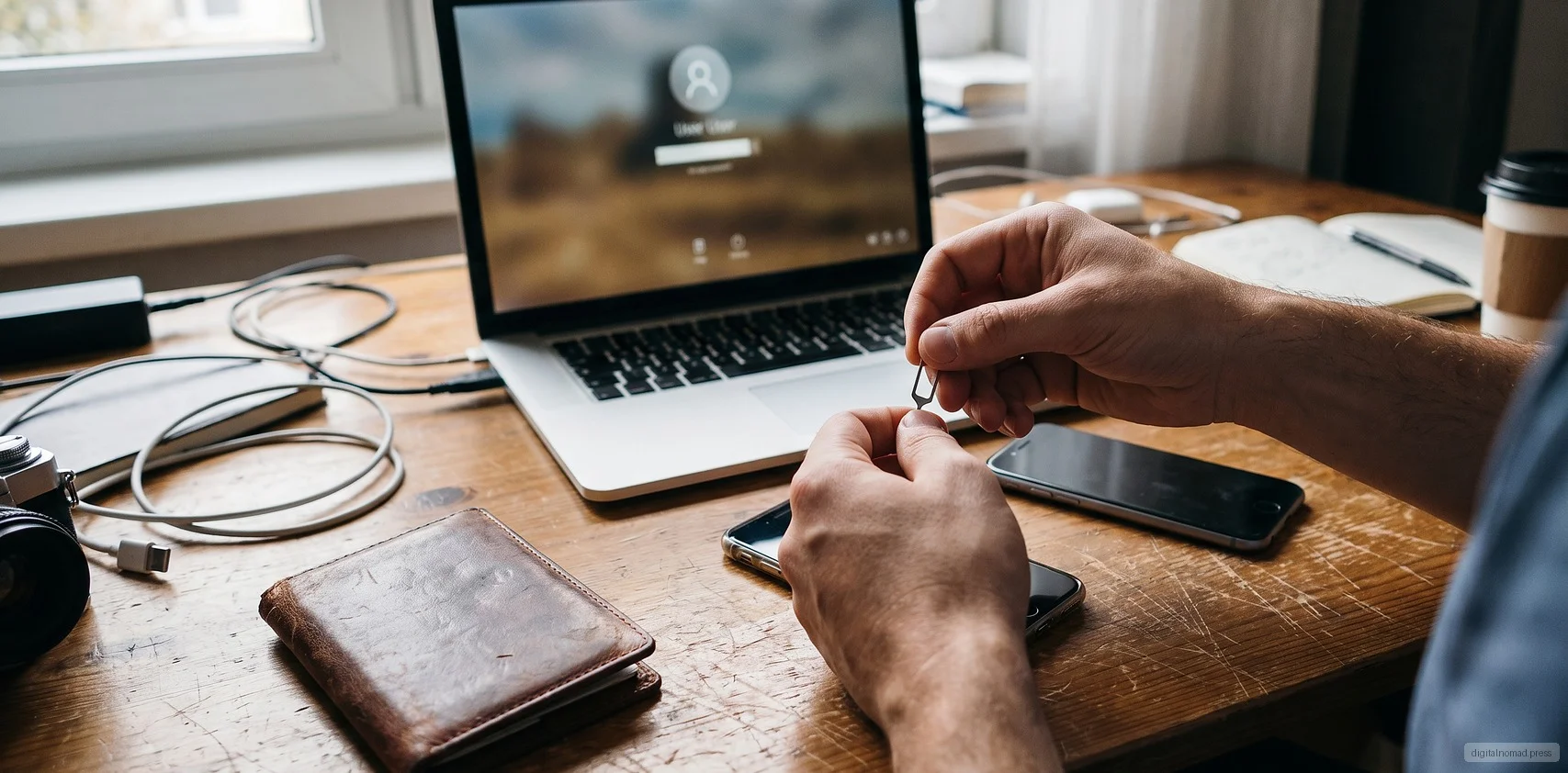
AI Generated - Editorial Use
eSIM plans solve bandwidth, not identity. Banks, tax portals, brokerages, and cloud services still rely on the original home phone number for verification. When that number lapses abroad, access to money and legal identity lapses with it. Treating the home number as long term infrastructure, keeping it reachable, backing up authenticator apps, and adding hardware security keys builds a defensive layer that survives lost SIMs and stolen phones.
For most people planning a long stint of remote work abroad, the first worry is bandwidth. Which eSIM plan, whether to grab a local SIM at the airport, how reliable the apartment Wi-Fi will be, whether a pocket router is worth the extra weight. These questions are not hard to solve anymore. The market for connectivity has matured, prices keep sliding, and coverage is broadly acceptable in most cities that attract remote workers. Yet the people who have actually spent three, six, or twelve months away from their home country tend to report that the thing which tripped them up was not the internet at all. It was the phone number.
A phone number is no longer just a way to make calls. Over the past decade it has quietly become an identity credential. Banks, tax authorities, brokerages, cloud services, social platforms, crypto exchanges, government portals, even the login flow for an app someone has not opened in a year, all tend to fall back on the same sentence: please enter the code we just sent to your phone. That code goes only to the number originally on file. When that number becomes unreachable because of travel, a swapped SIM, a lapsed prepaid plan, or a lost handset, the person on the road suddenly cannot prove who they are in the digital world.
Data Connectivity and Identity Connectivity Are Different Layers
eSIM providers solve data connectivity. They give a device a way to reach the internet. This layer is in good shape now. Activation happens at the gate, pricing is transparent, and switching between countries takes minutes. But most eSIM plans do not include a stable local number capable of receiving SMS from a home country bank or a government portal. Even when a local number is bundled, it is usually short lived, region locked, and unreliable for the kinds of verification messages that matter.
The gap becomes obvious in a way that flat monthly data plans hide. A traveler can hold a smooth video call from a Lisbon co-working space and, at the exact same moment, fail to receive a one time passcode from a bank back home. Bandwidth is present. Identity is not. In the first two or three weeks abroad the problem stays invisible, because most accounts are still within their session windows and most platforms still trust the device. The seam only tears open at the first cross border wire, the first re-login to a brokerage app, the first attempt to file a tax form, the first request to raise a credit limit for foreign purchases.
The Home Number Is the Real Anchor
A common and painful mistake is to cancel the home number on departure and rely entirely on local SIMs abroad. In most countries the home mobile number sits inside the financial and administrative stack as a nearly irreplaceable anchor. Online banking, national health apps, tax filing, brokerage logins, mobile payment bindings, they default to the original number as the fallback verification channel. Removing that number does not simply mean buying a new plan later. Restoring it often requires physical presence in the home country, an in person visit to a bank branch, and a full re-verification process.
A more resilient approach is to treat the home number as infrastructure rather than as a phone service. Its job is not to place calls. Its job is to receive verification codes. That means keeping it in an SMS reachable state even while the owner is on the other side of the world. Options include a minimum tier prepaid plan with regular top ups, leaving the SIM in a spare handset at a relative's home, arranging for a family member to forward incoming messages, or using an operator provided SMS to email service. Every option has a cost. The point is that the choice needs to be made deliberately in advance, not improvised the night before a flight.
Local Numbers Have a Real But Different Role
Anchoring the home number does not mean local numbers are optional. Staying in a city for more than two or three weeks quickly generates a need for one. Ride hailing apps want to verify. Delivery platforms want to verify. Landlords communicate through the country's dominant messaging app. Local bank accounts require a local contact number. Even topping up the SIM itself often needs a working local number.
The role of a local number is completely different from the role of a home number. The home number is an identity anchor. The local number is a life interface. The first must not lapse. The second can be discarded when the traveler leaves the country. Trouble begins when nomads mix them, binding important accounts to a local SIM that expires two months later, effectively locking themselves out of their own financial life.
A clean rule of thumb helps. Anything tied to money, legal identity, taxation, or long term contracts, bind only to the home number. Anything tied to daily life in the current city, bind to the local number. When this line stays clear, moving cities becomes far less destructive.
Multi Factor Authentication Raises the Stakes
Over the last decade MFA moved from a security team recommendation to a default setting on most platforms. This is good for security, but it also concentrates enormous weight on the phone number. When an account uses SMS verification, an authenticator app, and email verification together, any broken link in the chain can lock the owner out of their own data.
Nomads face a specific risk. These verification channels can fail at the same time. A stolen phone takes both the SIM and the authenticator app with it. A dead SIM cuts off SMS. If the recovery email account itself is protected by the same phone number, the whole recovery path collapses in a single event.
The practical response is layered. Authenticator apps should be backed up, and the backup should live on a device that travels separately from the primary handset. Recovery email addresses should be long lived and stable, not a soon to be closed employer domain or a self hosted address that could go offline. Every critical account should have offline recovery codes generated in advance, printed on paper, and stored inside the same folder that holds the passport. These steps look tedious. They are trivial compared to the cost of being locked out in a foreign country with no local support number to call.
SIM Swap Moments Are the Most Fragile
Most travelers underestimate how vulnerable the moment of swapping a SIM actually is. When a new physical SIM slides in, or a new eSIM activates, there is a short window of minutes to hours where the old number is already deactivated and the new one is still registering. During this gap any platform that fires a verification message will send it into a void.
A worse scenario appears when a home number is recycled by the carrier after prolonged inactivity. That number can be reissued to a new subscriber who then, entirely innocently, begins receiving bank codes, social notifications, and login attempts for someone else's accounts. The security community has a name for this attack surface, SIM recycling, and it is not hypothetical.
The mitigation is singular. Before leaving, before any SIM change, before any extended absence from a familiar environment, convert the second factor of critical accounts from SMS to an authenticator app or a hardware security key. SMS should become the backup channel, never the primary one.
Hardware Security Keys Are the Overlooked Layer
A hardware security key is a small device that plugs into USB or communicates over NFC, acting as a second factor for login. Prices range from roughly twenty to eighty US dollars, and a single purchase lasts years. For someone living abroad long term, the value dwarfs the cost.
The advantage is complete independence from the phone and the number. Even if the SIM dies, the phone gets stolen, and the authenticator app was never backed up, the key still works. The catch is that one is not enough. Two is the minimum, one carried on the person and one stored somewhere geographically separated, whether with a trusted family member or in a bank safe deposit box. Relying on a single physical object for identity access defeats the point.
Most major platforms now support the FIDO2 or WebAuthn standards, including Google, Apple, Microsoft, mainstream password managers, and a growing number of banks and brokerages. A single weekend spent enrolling security keys on the most important accounts builds a defensive layer entirely independent of the mobile network.
The Case for a Backup Device
A second phone sounds indulgent, but for anyone living out of a suitcase it is one of the cheapest insurance policies available. It does not need to be new or premium. A two or three year old midrange handset is enough. Its jobs are narrow. Keep the home SIM alive and receiving codes. Hold a backup of the authenticator app. Step in when the primary phone breaks or gets stolen.
This backup device does not need to be powered on every day, but it should be charged periodically, connected to the internet occasionally for updates, and checked to confirm the SIM is still active. It belongs in a different bag from the primary phone, ideally in the suitcase rather than the daypack, so that a single theft does not remove both devices at once.
Some travelers try to use a tablet in this role. That can work partially, but tablets often cannot receive SMS on cellular networks unless a SIM is installed. As an authenticator host, a tablet is fine. As a phone number backup, it needs additional planning.
Number Portability and Retention Strategy
Rules on number portability differ by country. Some regulators require carriers to release a number to any competing provider on request, letting the customer move to a minimal prepaid plan while keeping the digits. Others enforce aggressive reclamation policies, releasing numbers that go six months without use.
The practical move for long term travelers is to shift the home number from an expensive monthly contract to the cheapest available retention plan, preserving the number without paying for services that will not be used. Beyond that, a more thoughtful plan asks a longer question. If the traveler eventually decides not to return to the home country, who inherits responsibility for that number? Who is authorized to forward messages, handle carrier disputes, or visit a branch office if needed? Discussing this with family before departure is worth more than most people expect.
Put Number Management on the Pre Departure Checklist
The typical pre departure list covers luggage, visas, tickets, accommodation, and insurance. Number management rarely appears, yet it deserves priority over most items on that list. A useful standard sequence looks like this.
Audit which phone number is currently bound to each important account. List every second factor method already active, and confirm at least one backup channel exists for each. Back up the authenticator app to the cloud or export it to a spare device. Generate offline recovery codes for every critical account, print them, and store them physically. Decide how the home number will remain reachable during the trip, and make sure a family member or friend knows their role. Prepare a backup phone, install the SIM in advance, and test that it actually receives messages. Purchase a hardware security key, or ideally two, and enroll them before flying out.
The whole sequence takes about a weekend. Once done it becomes infrastructure, not something to repeat before every trip. Like a visa or an insurance policy, it is a one time investment that pays off across many journeys.
Treat the Phone Number as an Asset, Not a Utility
The shift in mindset that makes everything else easier is simple. A phone number is not a line item on a mobile bill. It is an asset. It carries financial access, government access, social connections, and platform identities. All of these are real property in the digital world, and real property deserves protection, backup, and inheritance planning.
Once nomads start treating their numbers this way, the right decisions become obvious. They stop cancelling the home number to save a few dollars a month. They stop binding brokerage accounts to a local SIM that will expire. They stop discovering that the authenticator app was never backed up only after the phone falls into the ocean. They stop trusting a single device with the keys to their entire financial life.
Internet access is the ticket that gets a remote worker into the building. The phone number is the pass that lets them stay inside once the door closes. Thinking clearly about that distinction removes a surprising amount of friction from nomad life before it ever has a chance to appear.
This content is protected by copyright. Please respect the author's work and do not copy or distribute without permission.

數位遊牧編輯群 Digital Nomad Editor Group
Digital Nomad is a knowledge sharing platform specially designed for “those who dream to become digital nomads.” We share the latest news and industry trends related to digital nomadism, as well as introduce essential skills and knowledge needed for freelancers, remote workers, etc. Our goal is to help you connect with fellow digital nomads!
