


Cheap Rent Is Not Enough: Nomad Cities Now Compete on Infrastructure
October 2, 2026
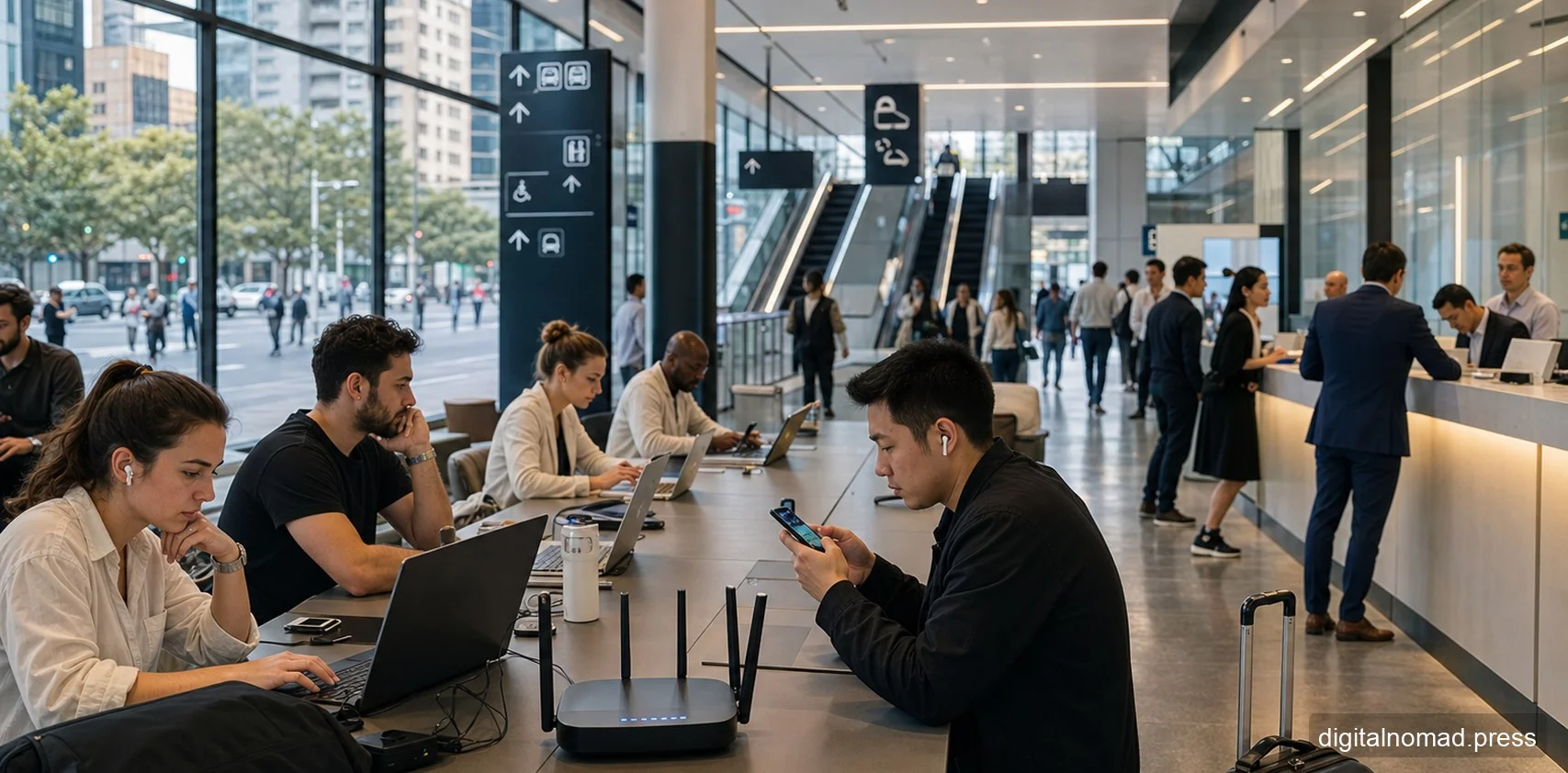
AI Generated - Editorial Use
The next wave of nomad city competition will not be won by cheap rent and pretty cafes alone. Cities that retain remote workers need reliable internet, banking, health care, renewal pathways, English administration, community quality, transportation, safety, and predictable public infrastructure.
For most of the last decade, digital nomads picked cities using a fairly simple checklist. Cheap rent. Fast Wi-Fi. Good weather. A decent café scene. That logic put Chiang Mai, Bali, Lisbon, Medellín, Budapest, and Tbilisi on the global map, one after another. Rankings shifted every year, but the underlying metrics rarely changed: monthly rent, number of coworking spaces, internet speed, and cost of living index.
By 2026, that scorecard is no longer enough.
The reason is not that those factors have become irrelevant. It is that they have become table stakes. A city without a working internet backbone, without a handful of usable coworking spaces, without a cost of living clearly below North America or Western Europe, is not even part of the conversation. The real competition is happening one layer deeper: banking, healthcare, visa renewal, English-language administration, coworking reliability, community quality, family friendliness, safety, and digital public services.
This piece is written for nomads currently choosing a city, or thinking about where to stay longer than a season. It is not a ranking. It is a case that once the market matures, the way people choose cities has to mature with it.
Cheap Is a Ticket, Not a Moat
Start with a market reality: cheap cities are multiplying, but cheapness itself is losing durability.
Cities once famous for value, including Lisbon, Mexico City, Medellín, and Ubud in Bali, have all gone through visible rent increases after nomad inflows. Locals have started to push back. Local governments have tightened short-term rental rules. The center of town has lost its price advantage quickly. Cheapness was the core promise of these cities, but cheapness alone cannot stop the next set of even cheaper cities from pulling nomads away.
That makes low cost a cyclical advantage rather than a structural one. What actually keeps nomads in a place is not eight hundred dollars a month rent. It is the absence of daily friction after they move in.
Watch the behavior of experienced nomads and the decision order has clearly shifted. The first filter is still internet, climate, safety, visa. But what decides whether they stay for three months, six months, or a year is the layer of infrastructure that used to be invisible.
Banking and Money Flow
The first serious maturity signal is money flow.
For a nomad, a bank account is not a status symbol. It is a work foundation. Income has to come in. Payments have to go out. Taxes have to be paid. Local spending has to work on a card. Break any link in that chain and the whole rhythm of work is disrupted.
Several things tell you whether a city is mature on this front. First, how hard is it for a foreigner to open a local account. Some cities say they allow it but demand proof of local address, tax IDs, and employment documents that a nomad visa holder cannot produce. Second, how widely are international cards accepted. A city can look modern while its small shops, restaurants, and taxis run on cash or a local payment app that outsiders cannot use. Third, how expensive is cross-border money movement. Some countries look open on paper but impose currency controls, outbound limits, and reporting requirements that make daily life awkward.
Portugal, Estonia, Spain, Singapore, Japan, and Taiwan are relatively friendly on money flow. Some newer nomad hotspots offer cheap living but demand large amounts of time and side costs to handle taxes, accounts, and remittance.
Once a nomad reaches the stage of stable clients, multi-currency income, invoicing, and tax filing, money flow becomes the most practical filter for choosing a city.
Healthcare That Actually Works for Foreigners
The second signal is healthcare.
Young nomads tend to ignore healthcare because they almost never use it. But stay in one place longer than six months, start thinking about bringing family in, or simply get older, and healthcare shifts from a background variable to a daily decision.
A city's healthcare maturity has several layers. First, the quality and price of private care. Many popular nomad cities have excellent private hospitals at prices well below North American levels. That is a plus. But the more important question is whether patients can communicate in English, whether international insurance is accepted, whether English-language medical records are available, and whether long-term prescription needs can be handled.
Second, the insurance ecosystem. International health plans have deep direct-billing networks in some cities and almost none in others. In the second case, nomads pay out of pocket and spend weeks on claims. That gap in user experience is enormous.
Third, mental health support. This has been badly underweighted. Long stretches abroad, time zones, isolation, weakened relationships, and work pressure all accumulate into real psychological cost. Whether a city offers affordable English-language therapy is becoming an invisible line item on the mature nomad's checklist.
Visa Renewal Experience
The third signal is what happens after the visa is granted.
Digital nomad visas have proliferated in the last two years. EY's global immigration index tracks dozens of jurisdictions offering remote worker or digital nomad routes. Taiwan launched a digital nomad visitor visa in 2025. Japan runs a high-income remote work pathway. Thailand's DTV came online. The Philippines authorized its digital nomad visa framework through Executive Order 86 in April 2025.
But receiving a visa is only the beginning. What actually determines a city's usability is the renewal experience.
Some countries grant only six months or a year and require the entire process to be re-run, sometimes with an exit and re-entry. Some allow in-country renewal but demand fresh submission of every document, including income proof, insurance, and criminal record checks. Some have very short renewal windows and no forgiveness for missed deadlines.
For long-term nomads, every renewal is essentially a project. Documents have to be prepared in advance. Work schedules have to bend. Translations and notarizations have to be coordinated. Immigration office visits have to be planned. Buffer time has to be reserved in case of document requests.
The maturity of a city here is not measured by how permissive the visa looks on paper. It is measured by how predictable, digital, English-capable, and low-rejection the renewal process actually is. Estonia, Portugal, and Taiwan score well on transparency. Some other jurisdictions with attractive-looking rules turn into bureaucratic slogs at renewal time.
Administration in English
The fourth signal is how much of the administrative layer works in English.
This has been underrated in nomad discussions for years. People often ask whether locals speak English. What actually matters is whether the government, banks, hospitals, telecom companies, landlords, and tax systems operate in English.
A nomad may never chat with a taxi driver, but will absolutely have to deal with banks, telcos, landlords, and immigration. If those institutions only offer forms, websites, and phone support in the local language, then no amount of personal English or local friends removes the daily friction.
Administrative English does not require converting an entire country into an English-speaking one. It requires that critical services offer usable English interfaces. Estonia's e-Residency is an extreme example, where the digital government can be operated end to end in English. Singapore, Hong Kong, parts of Malaysia, the Philippines, and Rwanda are relatively friendly on this axis. Japan has moved fast on tourist-facing English, but its administrative layer still runs mostly in Japanese, which long-term residents should be prepared for.
Taiwan is improving here. Some central government digital services now provide English interfaces, though local government offices, banks, telcos, and landlords lag behind. This is not unique to Taiwan. It is the shared challenge of every non-English nomad hub.
Coworking Reliability
The fifth signal is not the number of coworking spaces but their reliability.
The count of coworking venues is no longer a differentiator. Every popular nomad city has dozens. What separates cities now is whether those spaces can be relied on for months at a time.
ActivTrak's 2026 State of the Workplace shows that remote-only workers accumulate more productive focus time than hybrid split-day workers, whose days stretch long while their focused output shrinks. That effect is amplified in nomad life. If cafés change daily, if a coworking space suddenly shuts down, if the internet drops multiple times a week, if meeting rooms are always booked, real output erodes fast.
A city's coworking maturity can be read on several dimensions. Spaces that have operated for more than three years under local operators, not pop-up investors. Membership plans designed for long-term residents, not tourist drop-ins. Redundant internet setups, including dual lines, backup mobile connectivity, and UPS. Enough meeting rooms, phone booths, and focus zones to match actual demand. And genuine community programming rather than marketing-driven events.
Lisbon, Chiang Mai, Canggu, El Poblado in Medellín, and Roma or Condesa in Mexico City all host mature operators. Some newer cities have quantity but not stability, and their networks, community, and infrastructure are still finding their footing.
Community Quality
The sixth signal is community quality, which is often mistaken for community size.
Community is the soul of a nomad city, and also the most easily misread variable. Busy does not mean healthy. Many people does not mean real connection.
Early nomad communities were idealistic. People helped each other, shared information openly, and mixed across professions. Once a city becomes a touristified nomad hub, community splits. One layer becomes short-term socializing, party culture, and social media content. Another layer settles into long-term residents, cross-industry collaboration, and real friendship and business relationships.
Mature nomads look explicitly for the second layer. Signals include recurring non-event gatherings such as industry meetups, book clubs, language exchanges, and sports groups. Local participants alongside foreigners, rather than an expat-only bubble. Members who have been in the city for three or more years and are still active. Organizations that connect nomads to local entrepreneurship and culture rather than sitting apart from it.
The most direct effect of community quality is how lonely a nomad feels in a city. Loneliness, in turn, is one of the most honest reasons long-term nomads eventually leave.
Family Friendliness
The seventh signal is family friendliness.
MBO Partners estimates in its 2025 Digital Nomads report that 18.5 million American workers self-identified as digital nomads in 2025, up 2.2% from 2024 and 153% from 2019. This is no longer only a twenty-something freelancer segment. A growing share are in their thirties and forties, moving with partners, children, sometimes parents.
Whether a city can host family nomads is a completely different question from whether it can host solo ones.
International school options and prices matter. Pediatric care, vaccines, and family doctor access matter. Housing markets need multi-bedroom long-term rentals, not just one-bedroom short-term apartments. Weekend and after-school activities, parks, and green space matter. And the partner's career continuity matters, including local community, remote-friendly collaboration culture, and part-time opportunities.
This is a new layer of competition. Lisbon, Valencia, Taipei, Osaka, Chiang Mai, and Ubud score reasonably well here, but with wide variation. Some cities are paradise for a solo nomad and a friction zone for a family. The reverse is also true.
The share of family nomads will keep rising. Over the next decade, city competition will shift from a lifestyle-driven solo economy toward a multi-generational family economy. That will reshuffle the rankings.
Safety Is Multi-Layered
The eighth signal is safety, which is often flattened into a single word and loses precision.
For a mature nomad, safety is a stack.
The first layer is personal safety, which is what most people mean when they say safe. That is baseline. The second layer is property safety, including housing security, device theft, and fraud exposure. The third layer is information security, including the overall risk profile of public Wi-Fi, mobile networks, and coworking connections. The fourth layer is legal safety, including contract enforceability, consumer protection, and dispute resolution for labor and tax. The fifth layer is political and institutional stability, including exchange rate volatility, capital controls, and sudden policy shifts.
Some popular nomad cities perform well on the first layer but carry hidden risk on the fourth and fifth. A two-month visitor never sees those. Someone who decides to live for a year or two, open a company, buy property, or bring children, will run into them.
The mature question is not whether a place is safe but which kinds of safety a nomad can tolerate and which they cannot.
Digital Public Services
The last signal, and the one that will separate cities the most over the next decade, is digital public services.
Estonia demonstrated with e-Residency that government itself can be a form of infrastructure. When filing taxes, registering a company, signing contracts, updating addresses, requesting certificates, and paying fees can all be done online, a nomad's administrative overhead drops by an order of magnitude.
Taiwan, Singapore, South Korea, Japan, and parts of Europe are each progressing here. Some places have very high digitalization but only serve citizens. Others are foreigner-friendly but not deeply digital. The cities that win the next wave of nomad competition will be those that combine both.
This layer is hard to see because it does not lend itself to a headline number the way rent or internet speed do. But it decides whether a nomad spends two days a month on paperwork or ten minutes.
From Being Touristed to Being Chosen
For the last decade, nomads have been touristified by cities. Cities treated them as a new species of tourist and sold them coffee, coworking, and lifestyle.
For the next decade, nomads will choose cities more deliberately. The question will not only be whether a city is fun or cheap. It will be whether a city can carry someone's work, family, health, visa, money flow, and information security.
This is a heavier question, and a harder one. It pushes cities to upgrade, governments to invest in infrastructure, coworking to professionalize, and communities to become real.
The winners of the next round will not be the cheapest cities or the fastest-internet cities. They will be the cities willing to treat foreigners as long-term residents rather than tourists. There are not many of those yet. But the moment one emerges, it pulls ahead quickly.
For anyone currently choosing a city, the measuring stick has to upgrade too. Rent is only the ticket. The questions worth asking are the ones laid out in each section above.
This content is protected by copyright. Please respect the author's work and do not copy or distribute without permission.

數位遊牧編輯群 Digital Nomad Editor Group
Digital Nomad is a knowledge sharing platform specially designed for “those who dream to become digital nomads.” We share the latest news and industry trends related to digital nomadism, as well as introduce essential skills and knowledge needed for freelancers, remote workers, etc. Our goal is to help you connect with fellow digital nomads!
