


AI Will Not Make Nomad Work Effortless. It Turns You Into a One-Person Project Manager
September 21, 2026
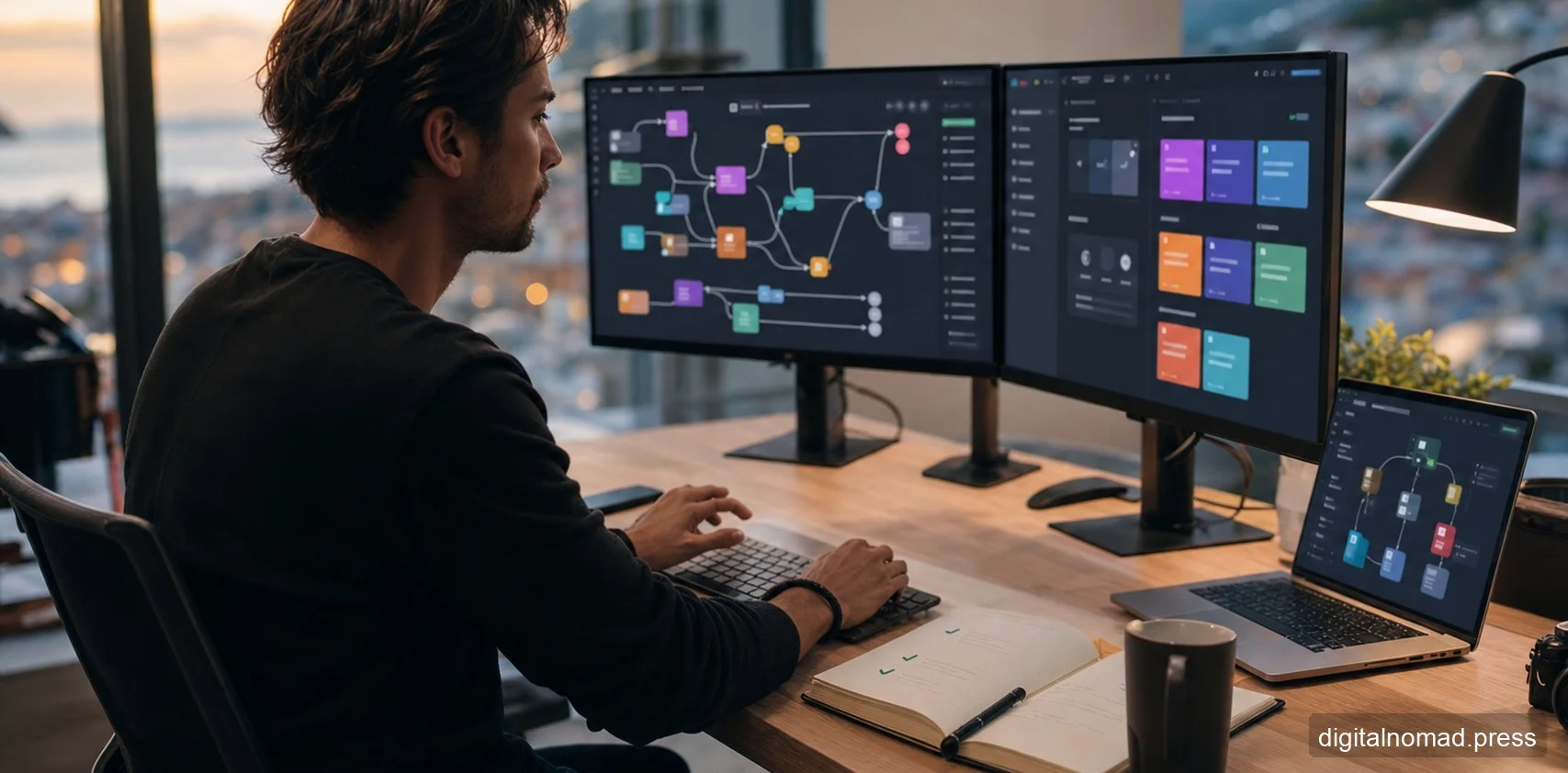
AI Generated - Editorial Use
AI increases a nomad worker’s capacity, but it also turns work into a workflow that must be managed. The real advantage is not tool usage alone, but task decomposition, checkpoints, verification, judgment, accountability, and a deliverable system clients can trust.
Around 2024, most conversations about AI tools revolved around fairly narrow use cases: draft this email, summarize this meeting, generate a rough image. By 2026, the frame has shifted. Generative models keep improving, but the more interesting movement is on the agentic side. Systems can now take a goal, plan sub-tasks, call multiple tools, read and write files, verify intermediate outputs, and report back to a human. For solo operators, freelancers, and digital nomads, this looks like an obvious win: one person can now do the work that used to require a small team.
Talk to people actually running AI-augmented practices in 2026, however, and a different picture emerges. AI has not made them lighter on their feet. It has turned them into full-time project managers who happen to also do the delivery work. They now ship faster, but they also spend more time designing workflows, verifying outputs, managing permissions, tracing errors, reassuring clients, and absorbing accountability when something goes wrong.
This piece tries to describe that shift honestly. It is not another take on whether AI will replace anyone. It is about a more practical question: for a digital nomad, AI does not deliver free time. It delivers a new layer of management work. Whether you can carry that layer will decide whether you become one of the operators whose output truly doubled in 2026, or one of the operators who ended up more tethered to their laptop than before.
From Tools to Agents: What Actually Changed
The most consequential change of the last two years is not raw model intelligence. It is the shift from single-turn tools to persistent, tool-using agents. Recent research on generative AI in IT project management and software project management frames these systems as assistant-level or junior project manager roles: they handle scheduling, status roll-ups, risk flags, document syncing, and other repetitive but time-consuming work. Humans stay accountable for orchestration, judgment, trust, and governance.
For a solo remote worker, this means two things happen at once. First, you can take on work you previously could not, because parts of the process that used to require outsourcing or overnight effort can now be delegated to an agent. Second, you have to start thinking like a real project manager: how to break down goals, assign execution, verify results, monitor risks, and track schedules. The difference is that the executors are often AI agents, and the project manager is always you.
Productivity Gains Are Real, But Not Free
A lot of AI marketing frames productivity gains as switch-flip easy. In practice, they are not. Getting real leverage from AI typically comes with three hidden costs.
The first is process design. You have to decompose your own work into pieces small and clean enough that an agent can act on them. That forces you to understand your own workflow in a way many freelancers never had to. If you cannot describe how you do the work, you cannot delegate it to anything, human or otherwise.
The second is prompt and context maintenance. An agent that operates across multiple clients needs different reference material, style examples, preferences, and terminology per client. None of that maintains itself. Someone has to keep it current, and that someone is you.
The third is verification. AI output must be checked, especially when it touches client data, financial figures, legal language, or code behavior. A single hallucinated citation or a wrong number can end a client relationship. The higher your leverage, the more disciplined your verification must be.
In other words, AI gives you access to more capacity, but it also drops a new role on your desk: workflow manager. If you refuse the role, you find yourself firefighting through every AI-augmented deliverable and losing the time savings you thought you had.
The Layer Nomads Most Often Miss: Judgment and Accountability
Agentic systems can do a lot of things, but they cannot absorb responsibility on your behalf. That matters especially for remote independents. When you are working from Lisbon, Chiang Mai, or Tokyo, and your client sits in New York, Taipei, or Berlin, the client does not have a conversation with your AI when something breaks. They come to you.
That means your workflow must include explicit judgment points: which steps an agent can run end to end, and which steps require a human eye before anything leaves your machine. Recent academic work on agentic systems keeps returning to the same idea: the human role moves from execution to orchestration, trust, and governance. Orchestration decides who does what and when. Trust judges whether an output is releasable. Governance defines what happens when something goes wrong.
For a nomad, all three layers are harder than in an office. You are moving. Your time zone shifts. Your bandwidth varies. You may be juggling clients across three time zones on the same day. That environment demands a stricter, not looser, approach to process design, because when things break you might be on a flight or in a valley with no signal.
The Job Portfolio of a One-Person PM
Break down a typical day for a 2026 nomad running AI-augmented delivery and you find several overlapping roles.
There is still an executor role, doing content, code, design, or analytical work. That role now has AI assistance, so execution time is shorter but verification time is longer.
There is a process designer role, deciding which tasks flow through which tools and agents. This role never rests, because models change, APIs update, and client requirements evolve.
There is a quality auditor role, checking factual accuracy, style consistency, correct citations, absence of hallucinations, and absence of accidental data leakage.
There is a client communication and expectation management role. This one is easy to underestimate. When AI dramatically shortens your delivery time, clients quickly recalibrate. Yesterday's fast turnaround becomes today's baseline. You have to actively manage that baseline or you get eaten by the efficiency you created.
There is also a risk and security role, which deserves its own separate discussion.
Each role is small individually. Combined, they add up to a serious ongoing management load that most freelancers underestimate when they first bolt AI onto their practice.
Why "Passive Income from AI" Is Mostly Misleading
A large part of the online conversation still pushes the fantasy of stacking AI-generated assets and collecting money while you travel. In any serious, client-bearing, quality-sensitive line of work, this is not how AI actually behaves. AI does not make good work passive. It makes it more active.
The reason is simple. When the marginal cost of production drops, market supply of content and services surges. Clients, drowning in options, spend more effort filtering for people they can trust to catch mistakes and stand behind the output. Cheap output becomes commoditized. Judgment becomes more valuable, not less.
That is good news and bad news for nomads. Good news, because your judgment, taste, contextual understanding of the client, and risk instincts become your primary income drivers. Bad news, because none of those can be handed to an agent while you nap on a beach. Serious AI-augmented work rewards presence of mind, not absence.
Time Zones, Networks, Moods: The Real Working Conditions
Most agentic AI research happens in stable, well-connected settings. Nomad conditions are messier.
Network stability is the first variable. Agents that maintain long connections and call external APIs frequently will fail more often on flaky bandwidth. You have to design retries, resumable steps, and offline-safe fallbacks. The nicer the coworking space in your city, the fewer of these problems bite you, but eventually one of them will.
Time zones are the second variable. When an agent runs in the cloud while you sleep half a world away, deciding when to wake you up becomes an engineering problem. Every agent needs escalation rules: which events can wait, which events must ping you immediately, and which events must halt the workflow and wait for human input.
Mood and energy are the third variable, and the one people rarely admit. Sustained cross-time-zone work, frequent relocation, and unstable social ties erode judgment. AI output verification specifically requires stable human judgment. There is a structural tension here: the more you rely on AI, the more your personal stability matters, because the entire quality chain runs through your attention. A tired human plus a confident agent is a bad combination.
How to Upgrade Yourself Into an Orchestrator
If you want to make AI actually work for you in 2026, a few practical moves matter.
First, write down your workflow. Documents, checklists, and templates for how you take on work, how you deliver, and how you track progress form the base layer of any automation. Without this step, AI can only help you in fragments; it cannot systematically scale you.
Second, separate tasks that can go end to end from tasks that require your own eyes. Formatting, first drafts, aggregation, initial translation, boilerplate replies can often run without you. Final decisions, client commitments, legal or financial calls, and anything touching sensitive data should not. Every operator draws this line differently, but every operator has to draw one.
Third, embed verification into the workflow rather than treating it as cleanup. Bake checkpoints into the process, each producing a concrete artifact: a checklist, a diff, a test result. This way, even from a train or a cafe, you can quickly judge whether to release the output.
Fourth, budget slack for errors. Any AI-augmented pipeline will occasionally fail, and your schedule must have room to respond. Overpacking your calendar is the classic mistake of early AI adopters, because the tools tempt you to promise more.
Fifth, keep investing in domain judgment. The more AI can do, the more the human premium concentrates in taste, context, relationships, and the ability to see what actually matters. None of that grows on its own when the tools improve. It requires deliberate practice, reading, feedback, and reflection.
A Healthier Relationship With the Machine
Return to the original question: does AI make life easier for digital nomads. The honest answer is that for operators who accept the role of project manager, AI raises the income ceiling while also making the work heavier, the responsibility larger, and the complexity to manage greater. For operators who refuse to take on that layer, AI slowly reroutes their work to competitors who orchestrate better, leaving them competing on price.
The healthier mental model is not to treat AI as something that works instead of you. It is to treat it as a junior colleague who never tires but never carries responsibility either. You can hand off large volumes of repetitive work, but you must design the rules, the verification, the escalation paths, and you must own the final quality.
For nomads, this transition is actually a fit. If you chose this life, you already opted out of clocking hours in a fixed office. You have been building a portable professional identity. In 2026, a portable professional who can also orchestrate AI agents responsibly and stay accountable to clients is a rare combination in the market.
Seen this way, AI does not make the nomad life easier. It makes serious nomads more valuable. Whether you become one of them will shape your career over the next several years at least as much as your choice of the next city.
This content is protected by copyright. Please respect the author's work and do not copy or distribute without permission.

數位遊牧編輯群 Digital Nomad Editor Group
Digital Nomad is a knowledge sharing platform specially designed for “those who dream to become digital nomads.” We share the latest news and industry trends related to digital nomadism, as well as introduce essential skills and knowledge needed for freelancers, remote workers, etc. Our goal is to help you connect with fellow digital nomads!
