


Your Manager Is Watching Your Screen: The Trust Crisis Behind Remote Monitoring Software
August 17, 2026
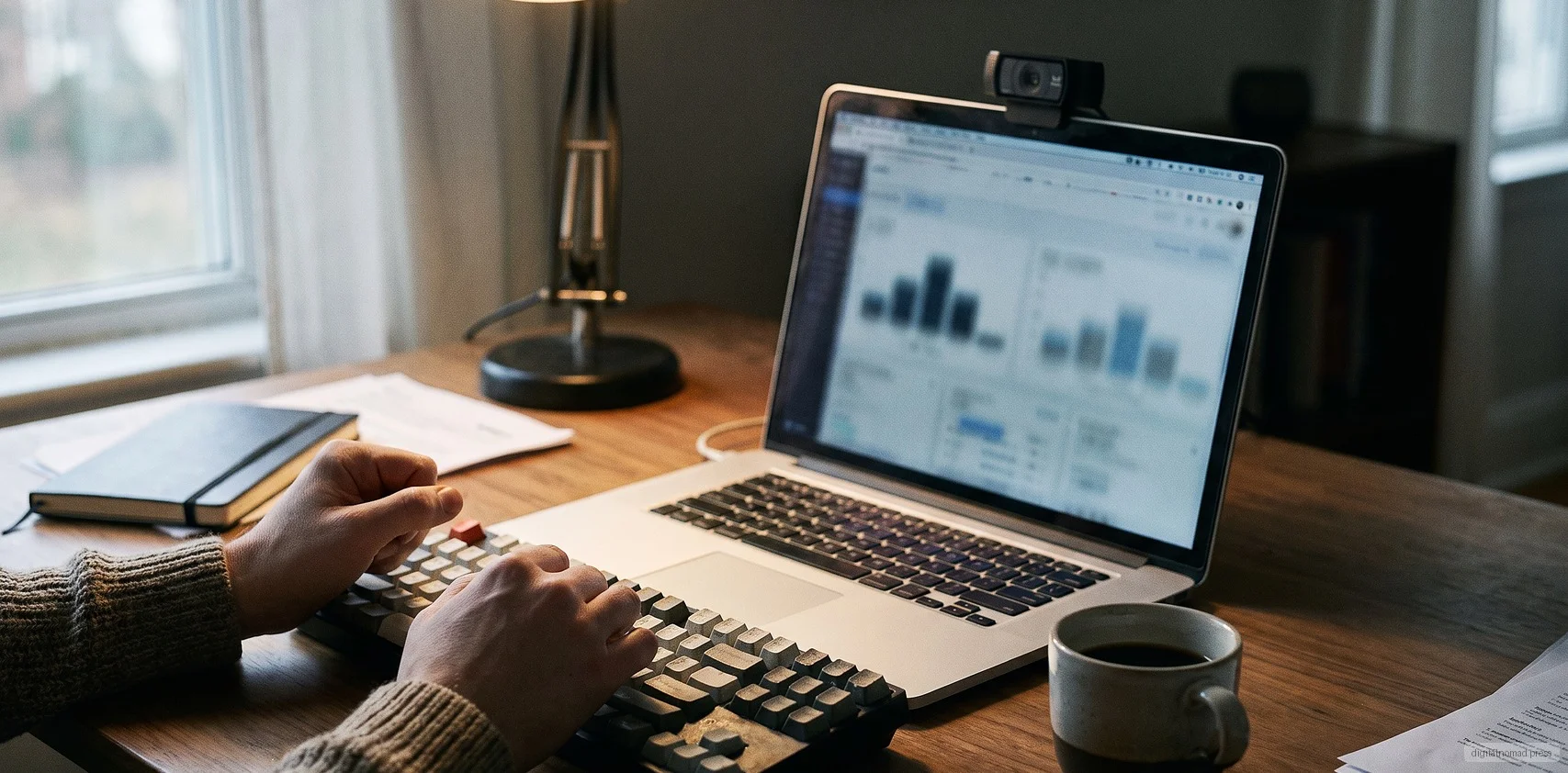
AI Generated - Editorial Use
As remote work becomes standard, many companies are adopting employee monitoring software to track screen activity, keystrokes, and daily focus scores. While these tools, often called bossware, promise better visibility for managers, they frequently trigger a phenomenon known as productivity theater. Instead of doing deep work, employees spend their energy performing for the dashboard to look busy. When organizations choose digital surveillance over outcome based management, they risk breaking team trust and inadvertently pushing away their most talented and autonomous top performers. Understanding this dynamic is crucial for both managers and remote workers navigating modern career choices.
One engineer described his first week at a new company like this. The onboarding email included a technical document instructing him to install a "productivity assistance tool" on his laptop. Once installed, a small icon appeared in the corner of his screen, usually easy to ignore. When he asked IT what the tool actually did, the answer was crisp. Every ten minutes it captured a desktop screenshot, logged which applications he opened, calculated the ratio of keyboard and mouse activity, and rolled everything into a daily "productivity score" that landed on his manager's dashboard.
Sitting at his own desk in his own home, staring at that quiet little icon, he felt the room shrink.
His story is not unusual. Industry data from late 2025 suggests that roughly seven out of ten large employers now use some form of employee monitoring, and adoption is even higher at fully remote companies. The products come with a variety of tasteful names: productivity analytics platform, workforce intelligence suite, engagement analytics. But in the English-speaking tech community they share a blunter nickname, bossware. Software for bosses.
Over the past few years, remote work has evolved from an emergency workaround into a permanent option, and the relationship between companies and workers has shifted along with it. Some organizations have genuinely embraced the change, redesigning performance systems and collaboration workflows to fit distributed teams. Others have taken a different route, layering on more screenshots, more logs, more cameras, trying to reproduce the "visibility" of a physical office inside people's homes. The question worth asking is not whether these tools should exist, but something more fundamental. When a company chooses surveillance over management, what does remote work actually become?
Why Monitoring Software Exploded in the Remote Era
To understand the current landscape, it helps to rewind to 2020. That March, countless organizations were forced to move an entire office into their employees' homes within weeks. Many managers had never led a remote team before. Their previous method of evaluating people was mostly ambient. Walking past a desk and seeing someone typing, noticing whose camera was on in a meeting, observing who was still around after five. These signals were crude, but inside a shared physical space, a manager's brain automatically stitched them into a kind of impression score.
Once those signals disappeared, many managers found themselves in the dark. They could see that tasks were progressing, deliverables were arriving, meetings were happening, and yet a vague anxiety remained. One product vice president at a tech company once admitted in an interview that even though team output had not dropped, he still felt his people might be "goofing off at home." The important part of that sentence is not what the employees were doing. It was that he could no longer be sure.
Monitoring software slid neatly into that psychological gap. In January 2022, purchases of employee monitoring tools jumped by seventy-five percent, the largest single-month increase since the pandemic began. The wave never really receded. As remote and hybrid arrangements became normalized, it slowly seeped into more industries. By 2026, the global market for employee monitoring software is projected to reach roughly 4.59 billion dollars, and the product landscape is evolving quickly. Simple time tracking has expanded into live screen viewing, keystroke logging, application usage analytics, mouse-movement heatmaps, occasional webcam snapshots, and increasingly, AI-driven "focus scores" and "sentiment analysis."
It is worth noting that this trend is not driven purely by bad bosses. Some companies adopt monitoring for genuine security reasons, particularly in finance and heavily regulated industries where auditable activity logs are a compliance requirement. Others adopt it to satisfy client demands, especially agencies whose clients want proof that billable hours were spent on the correct project. Some do it for insurance and legal cover. The motives are rarely single-issue.
But a tool's actual use tends to drift well past the reasons it was purchased. Once a company has spent budget on a system, it becomes very hard for managers not to open the dashboard. Once the dashboard is open, it generates new questions, new suspicions, new comparisons. Monitoring software is not a passive recorder. It reshapes what its users can see, gradually training managers to notice the things that are measurable while missing the things that actually determine outcomes.
A Critical Perception Gap
A widely cited industry survey has revealed a striking asymmetry. Around sixty-eight percent of employers believe that monitoring genuinely improves productivity. At the same time, roughly seventy-two percent of employees say that monitoring either has no positive effect on their work or actively hurts it. This is a deep crack. It is not a disagreement over numbers. It is a collision of two very different definitions of what work is.
From the employer's angle, monitoring systems deliver unprecedented visibility. The dashboard produces neat reports every day. Who typed how many words, who kept the IDE open for how many hours, whose mouse activity is below the team average, whose screenshots contain windows unrelated to work. This data feels objective, precise, and comparable. For senior leaders who are used to managing by numbers, it has an almost irresistible appeal.
The problem is that what these systems measure is not output. It is activity. Between those two, there is a very deep canyon.
A senior engineer might spend two hours staring at a screen without touching the keyboard, mentally simulating how a system architecture would behave under various failure modes. From the monitoring software's perspective, no keys pressed, no mouse moved, no window switches. The system flags him as "not focused." But those two hours might be the most valuable output of his entire week, because during them he made a technical decision that will save the team six months of development. Meanwhile, another employee might spend the day flipping between browser tabs, generating dense keyboard activity that shows up as "highly engaged," while actually doing little more than repeatedly copy-pasting the same data or wandering through search results without progress.
When companies start using activity metrics to drive performance evaluations, compensation, and promotions, employees learn the rules of the new game very quickly. This is what has come to be called productivity theater.
How Productivity Theater Eats Away at the Value of Remote Work
The term productivity theater began circulating in English-language management media around 2023. It refers not to fraud, but to something subtler. Employees investing energy in looking busy rather than producing real results.
In remote environments, this theater takes many forms. Some people run mouse jigglers so the monitoring software keeps registering activity. Some prop an old phone next to the keyboard with a rubber band to keep the screen glowing. Some develop the habit of tapping the Enter key every few minutes to prevent their focus score from sagging. Some make a point of posting in Slack at specific hours to leave a trail of "active presence." Some leave documents scrolling overnight so their screenshots still show work happening after hours.
These behaviors sound absurd, but the pattern they expose is serious. When a monitoring system focuses on activity rather than output, employee attention follows. A person who might have spent eight hours thinking about how to improve a product now spends six of them thinking about how to look like they are improving the product, and two actually improving it. Those missing two hours are not laziness. They are the rational response to a system that trained the person to invest time in impression management.
Research has found that employees in monitored environments report engaging in performative work at significantly higher rates than their unmonitored peers. These are not bad employees. On the contrary, they are often the ones who most want to keep their jobs and earn recognition. They are simply responding rationally to the signal their company keeps sending them. If activity is what you measure, activity is what I will give you.
The cost of productivity theater is that the most precious part of remote work quietly evaporates. The original promise of remote arrangements was that people could produce their best work at whatever rhythm suited them. That deep thinking would no longer be shredded by meetings. That the time saved from commuting could become focus time. Once monitoring dashboards enter the picture, an employee's rhythm has to conform to the software's sampling frequency, not the shape of their own energy curve. The space for deep work is chopped into ten-minute screenshot intervals. The margin for reflection is compressed into a set of activity metrics that must be maintained. Remote work stops being freedom and becomes a more fragmented digital factory.
How Surveillance Precisely Drives Away the People You Most Want to Keep
There is a common assumption in the labor market that surveillance may make employees uncomfortable, but at least it lifts overall output, presenting a trade-off between morale and efficiency. Recent data suggests this assumption may not hold up.
One study tracked the intent to leave among monitored and unmonitored employees. The result was striking. Forty-two percent of monitored employees said they planned to leave their job within a year, compared with just twenty-three percent of their unmonitored counterparts. The gap is nearly double. Another case analysis of a large technology firm found that after monitoring systems were rolled out, average daily working hours rose by about two hours per employee, while overall productivity dropped by eight to nineteen percent. The reason was that teams had to spend more time in meetings, more time writing reports, more time explaining anomalies flagged by the monitoring system. Actual creative work was squeezed to the margins.
There is a rarely discussed mechanism here. The psychological impact of monitoring software is not evenly distributed across the workforce. For less capable employees who need external pressure to maintain their pace, monitoring may indeed raise activity levels, if only by discouraging obvious gaming during work hours. But that group is generally not the core the company wants to retain.
For high-trust, high-autonomy employees who take pride in what they produce, the signal from monitoring is very different. What they read is not "the company is protecting its assets." What they read is "the company does not believe I will do my job unless it watches me." This triggers a very deep psychological reaction. Their professional self-respect is being challenged. These employees are often the technical spine of the team, the senior experts, the people who give a product its soul. They are the ones who might quietly work through two weekends to fix a bug no one else noticed, or spend extra hours mentoring newcomers. These behaviors flow from intrinsic motivation, and once intrinsic motivation is diluted by external surveillance, it rarely returns.
The absurd outcome is that a company spends money installing a system in the hope of raising overall output, and that system ends up filtering out the people who were never a great fit, while precisely pushing away the people who mattered most. What remains is a middle layer of employees who have learned to invest their time in the dashboard. The activity metrics look better than ever. The real output quietly thins.
One venture partner in the tech industry once put it vividly. You can look at how a company treats trust with its remote workforce, he said, and roughly predict whether that company will lose its top technical talent over the next three years. It is not that monitoring itself is uniquely terrifying. It is that monitoring reveals the company's definition of work. Top performers rarely coexist for long with an organization that defines work as screen activity time.
Surveillance Is a Substitute for Failed Management, Not a Solution
Zoom out a bit, and it becomes clear that what monitoring software is really filling in for is something else entirely. Management capability.
A good remote manager does a handful of specific things. First, they slice work into tasks with clear, verifiable outputs, rather than fuzzy responsibilities. Second, they set reasonable rhythms and check-ins so that progress and blockers surface early. Third, they build communication channels of enough trust that people will voluntarily say "I'm stuck" instead of hiding the problem. Fourth, they pay attention to their people's growth and wellbeing, not just at review time. These practices take time, practice, and a certain amount of emotional energy.
The honest truth is that many managers never developed these skills in the physical office either. They relied on the ambient sensing that shared space provided, not on real management technique. When the space disappeared, their management gaps were exposed. At that moment, monitoring software offered an extremely tempting alternative. No need to learn new skills, no need to change mindsets, just open the dashboard and feel a sense of control.
But a sense of control is not the same as actual control. The activity metrics on a dashboard will not tell a manager what real difficulty their team is facing, which opportunities are being missed, or which employee is at a career inflection point that needs support. A manager staring at the dashboard thinks they are managing, but in truth the dashboard is managing them, redirecting their attention toward the signals that are measurable but not particularly important.
There is a sharp but fair way to describe this dynamic. When a company substitutes surveillance for management, it is essentially outsourcing its failure to manage to a software vendor. And the vendor is happy to take the order, because selling dashboards is much easier than selling management consulting. It is a business, not a solution.
Actual answers to the remote management challenge tend to point in the same direction. Outcome orientation. Outcome orientation does not mean "we ignore how employees work and only look at results." It means defining outputs precisely enough that employees and managers can discuss them against a shared standard. It includes several concrete practices. Tasks have clear acceptance criteria. Progress is tracked in a way that is visible to everyone. Blockers have low-friction paths to surface. Performance evaluation logic is agreed in advance. All of this is harder than installing a monitoring system, but it is the only path that lets remote work reach its actual potential.
A Field Guide for Remote Workers
For anyone job hunting for remote roles or already working in one, understanding surveillance is not just an ethical concern. It is a practical career question. Here are a few methods for evaluating a company before, during, and after joining.
Before applying, do a little public research. Search the company on Glassdoor, Blind, Reddit's career forums, and similar platforms. Useful keywords include monitoring, surveillance, screenshots, productivity tracking, bossware. If many employees mention pressure from monitoring, or refer to specific tools by name (Hubstaff, Time Doctor, Teramind, ActivTrak, among others), that is a meaningful signal. It does not automatically mean the company is bad, but it is worth probing during interviews.
During interviews, ask specific questions rather than fishing for abstract "culture" statements. Try questions like: How do you measure the performance of remote employees, and what tools do you use? How does my manager typically know I am working? When I hit a blocker, how are you hoping I communicate that to my manager? These sound simple, but a genuinely healthy company will have clear answers that lean toward outcomes and communication. If the interviewer stumbles or falls back on phrases like "we have a system that..." or "the dashboard shows...", that itself is a signal.
Another direct question is worth asking. If at three in the afternoon I feel mentally exhausted and want to take a one-hour walk before continuing, would that be a problem here? A healthy remote company will treat this as an unremarkable and even desirable rhythm adjustment. An unhealthy one will immediately start explaining "our active hours policy" or "how we define working time."
Around the time of joining, read the employment contract and information security policy carefully, paying attention to monitoring clauses. Many companies leave themselves broad authority, such as "the company may access any activity records on company devices." Sometimes these clauses exist purely for compliance and are not actively used, but you should know what you are signing. If the contract permits practices that make you deeply uncomfortable, and the company will not adjust the wording, take that seriously.
After joining, watch how performance is discussed inside the team. A healthy remote company describes performance in terms of output and impact. Reviews focus on what you delivered, what you changed for the company, and what you want to develop next. An unhealthy company slides toward activity metrics almost unconsciously. Your online hours last quarter were ten percent below average. Your screenshots frequently contain such-and-such application. These details will tell you what this company really thinks you are: a person who brings a brain to work, or an activity-generating machine that requires oversight.
A Short Note for Remote Managers
Most of this piece has been written from the employee's angle, but many readers manage teams. The advice for managers is shorter but no less important.
First, ask yourself honestly what problem you are trying to solve with monitoring software. If the answer is "I don't know whether my people are actually working," then the real problem is not visibility. It is task definition. Investing time in slicing tasks well and writing clear acceptance criteria solves about eighty percent of that anxiety.
Second, if compliance or security reasons genuinely require some form of logging, prefer non-invasive approaches. Some tools produce activity statistics without capturing screenshots, or only trigger recording in specific situations. More transparent tools cause less psychological damage to teams, and employees are more likely to understand and accept them. Whatever you choose, disclose it fully in advance, and clearly specify the purpose, retention period, and access rights of the data.
Third, do not use dashboard data directly for personnel decisions. Monitoring data can be a nudge. If you notice an employee whose activity has been unusual for two weeks, you can reach out to see if they are struggling. But do not jump straight to the conclusion that they are not committed. Real judgment still requires one-on-one conversations, review of actual deliverables, and cross-functional feedback.
Fourth, periodically ask yourself whether you could still manage this team if all monitoring systems were switched off. If the answer is no, the gap you need to close is not more surveillance. It is management.
Closing Thoughts: Trust Is Not a Piece of Management Poetry
Some people treat trust as a nice-sounding but impractical word, arguing that in real business environments trust has to be enforced by systems, checks, and tools. There is truth in that view, but only half of it.
Trust does need institutional support. But the direction of the institution determines whether trust gets cultivated or consumed. An outcome-oriented system, with clear goals and feedback loops, verifies and reinforces trust with every delivery. A system built around activity tracking and screenshots grinds trust down with every dashboard refresh. The problem with monitoring software is not that it violates some abstract right to privacy. It is that it quietly rewrites the contract between company and employee. From "we are pursuing this outcome together" to "I am watching you work, prove yourself to me."
The next decade of remote work will be the main battlefield of this trust crisis. Some companies will double down on surveillance and turn remote arrangements into more refined activity prisons. Others will go through the painful process of learning genuine remote management and transform themselves into organizations fit for a new era. That choice, which today may feel like a small purchasing decision, will show up five years from now in talent structures, product quality, and organizational reputation.
For those currently doing remote work, you do not always have the freedom to choose which company to join, but you can choose to ask questions, choose to observe, and choose to make the next call within the range of what is available to you. At the very least, when you notice that quiet icon in the corner of your screen, you will recognize that it is telling a story about this company, and that you are part of that story too.
The Digital Nomad editorial team believes that the real freedom of remote work is not the freedom to leave the office. It is the freedom to produce meaningful work while being trusted. That path is not easy, not for employees and even less so for managers, but it is the only path that lets remote work grow into its full shape. Your manager can choose to watch your screen. Your manager can also choose to watch your outcomes. That choice determines more than a management style. It determines who they can hire, who they can keep, and what their team will look like five years from now.
This content is protected by copyright. Please respect the author's work and do not copy or distribute without permission.

數位遊牧編輯群 Digital Nomad Editor Group
Digital Nomad is a knowledge sharing platform specially designed for “those who dream to become digital nomads.” We share the latest news and industry trends related to digital nomadism, as well as introduce essential skills and knowledge needed for freelancers, remote workers, etc. Our goal is to help you connect with fellow digital nomads!
