


The Hybrid Nomad: Why the Future of Freedom Is Not Constant Movement, but Moving from a Base
July 30, 2026
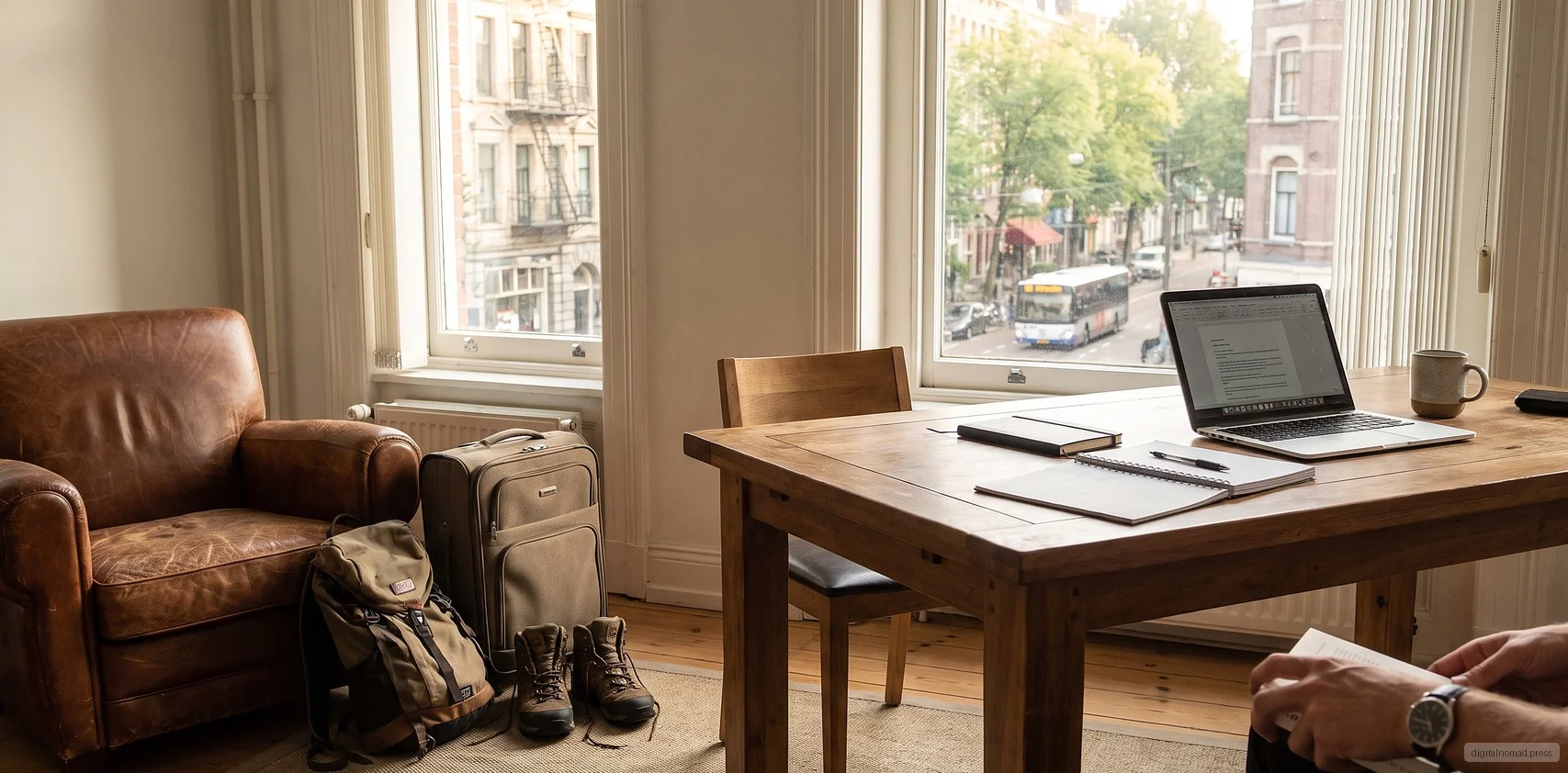
AI Generated - Editorial Use
For years, the ideal digital nomad lifestyle was defined by constant travel and a passport full of stamps. However, veteran remote workers are increasingly experiencing nomad burnout, realizing that perpetual motion often leads to physical exhaustion and social isolation. This has led to the rise of the Hybrid Nomad, a new mainstream approach where individuals maintain a stable home base while taking short remote work trips throughout the year. By securing a long term residence to handle adult responsibilities like healthcare and deep friendships, remote workers can finally find a sustainable balance. This lifestyle acknowledges our human need for both deep roots and geographical freedom, proving that true flexibility does not require you to be constantly on the move.
There is a familiar image that has dominated the digital nomad imagination for most of the past decade. A laptop open on a café table in Lisbon in the morning. Two weeks later, a beachside guesthouse in Bali. A month after that, a rooftop apartment in Mexico City. A suitcase permanently unpacked. A passport thick with stamps. Between 2018 and 2022, this picture defined what freedom meant for a whole generation of remote workers.
That image is quietly fading. Not because the movement has died, but because the people who actually walked that path for three, five, seven years have begun admitting something out loud: constant movement is exhausting, and it does not scale.
Enter the Hybrid Nomad. This is a person who keeps a long-term base in one city, handles the boring but necessary parts of adult life there (visa, taxes, insurance, friendships), and then structures a few one-to-three-month remote work trips into each year. They have more than a full-time nomad, since they have a home. They have more than a typical office worker, since they still get to live in multiple countries every year. It is a shape that acknowledges two truths at once: humans need roots, and humans crave motion.
According to MBO Partners' 2025 Digital Nomads Trends Report, roughly 18.5 million Americans now identify as digital nomads, a 147% increase from 2019. But the more interesting signal is buried underneath that headline. The growth is not driven by people selling all their possessions and hitting the road. It is driven by people who still own houses, still have partners, sometimes have children, but carve out one to three months a year to work remotely from somewhere else. The pure "rootless nomad" has become a minority within the movement.
This piece is about why that shift happened, and what it means for anyone considering stepping onto the remote-work path.
The Golden Age of Extreme Nomadism and What It Cost
To understand why hybrid nomadism is rising, it helps to look at what it is replacing.
Between 2018 and 2022, the "new country every two weeks" version of nomad life dominated Instagram and YouTube. Creators produced beautiful timelapses of café sunrises, infinity pools, and coworking spaces with floor-to-ceiling windows, all set to the promise: you can have all of this. The narrative was enormously effective at pulling a generation of restless remote workers out of their offices.
What the beautiful footage did not show, though, was where most of the actual cost lived.
The first cost is physical fatigue. Every new city means relearning basic logistics: where the supermarket is, which SIM card to buy, where the reliable internet lives, which café has chairs that will not destroy your back. These small tasks look trivial in isolation, but they consume a large chunk of cognitive bandwidth. Attention that should be spent on work or creative output gets shredded across a thousand micro-adaptations.
The second cost is emotional isolation. If a person leaves every two weeks, they are saying goodbye every two weeks to people they just started to know. Over time, many nomads notice themselves becoming socially shallow, less willing to invest in new friendships, because "I am leaving next month anyway." In the short term, this looks like a rich, colorful social life. In the long term, it produces a peculiar kind of loneliness that no amount of Instagram engagement can fill.
The third cost is professional. Frequent movement means unstable internet, shifting time zones, meeting slots that constantly need renegotiation, and clients or employers who start quietly wondering whether this person is reliable. Some nomads compensate by chasing more short-term gigs, avoiding long-term commitments, which then traps them in a cycle of always hunting the next project. The lifestyle stops feeding the career.
The fourth cost is administrative and health-related, and it is often invisible until it hits hard. Visas need renewal every 30 or 90 days. Insurance policies exist on paper but no one is sure how to use them in an unfamiliar country. Tax status is murky year after year. Bank accounts get frozen because the account holder is not physically present in the home country. Any one of these things is manageable. All of them together produce a slow suspicion that maybe this whole thing was just an elegant way to avoid becoming a functioning adult.
Out of this comes a term the community has started using: Nomad Burnout. It is different from ordinary career burnout. The people affected do not hate their work. Many of them love it, and love the lifestyle in principle. They have simply discovered that the fuel cost of this life is much higher than the brochure promised.
What Hybrid Nomadism Actually Is
The core idea of hybrid nomadism is not complicated. A person picks one or two base cities, rents or buys a long-term home there, and handles the parts of life that reward stability (visa status, taxes, healthcare, deep social ties). Then each year, they arrange several remote work trips of one to three months, either to explore new places or to escape unfriendly seasons at the base (winter in Southeast Asia, summer back in Europe, that kind of pattern).
Trend reports coming out of 2025 and 2026 keep pointing at the same thing: the "three to six months abroad, the rest of the year at base" cadence is quickly replacing the sprint-style nomad life. A related term is Slomad, short for slow nomad, referring to someone who stays three to twelve months in a single place. Some observers estimate the global Slomad population reached around 18 million by mid-2026, up from roughly four million just three years earlier. That growth rate outpaces the growth of full-time nomadism itself.
Hybrid Nomad and Slomad overlap, but the emphasis differs. Slomad emphasizes staying longer in one place. Hybrid Nomad emphasizes holding both a base and mobility. The first is a change in tempo. The second is a change in structure. In practice, they often happen together: once someone starts staying longer, that place tends to become a base almost by accident.
A third adjacent term worth knowing is Part-Time Digital Nomad. These are people with a full remote job and a fixed home, who spend one to three months a year working from somewhere else. This is possibly the fastest-growing segment of the whole movement, because the barrier to entry is close to zero. No quitting. No selling furniture. No breaking up with a partner. It turns "digital nomad" from an identity into a lifestyle option.
Together, these three flavors (Hybrid, Slomad, Part-Time) form the mainstream of remote work culture in 2025 to 2026. The boundaries between them are blurry, but the shared spirit is clear: freedom is no longer equated with rootlessness, and stability is no longer equated with being trapped.
Why the Shift Happened
The forces driving this change are more layered than a simple "people got tired and slowed down." Several structural pressures are acting at once.
Visas and Taxes Grew Up
Most tourist visas cap out at 30 or 90 days. That window is long enough to acclimate but too short to build depth. Extending the stay legally means dealing with visa paperwork, and the rules differ everywhere. Spain's digital nomad visa asks for proof of income and company documentation. Portugal's D8 requires an established residence in Portugal. Thailand's long-term options require substantial savings.
Taxes are messier. Staying more than 183 days in a country often triggers tax residency, which means owing income tax there. Not properly severing tax ties in the home country can then produce double taxation. The old trick, "just keep moving so no country ever claims me," has become fragile since the OECD's Common Reporting Standard and other cross-border tax information exchanges matured in the past few years.
Having a clearly defined tax base has flipped from being a constraint to being a strategy. This is why so many experienced nomads gravitate toward Portugal, Spain, Georgia, the UAE, or Mexico as long-term bases. These jurisdictions either offer favorable regimes for foreign residents or provide dedicated nomad visa tracks, letting someone hold a real base legally without inviting a tax disaster.
Healthcare Started to Matter
At 25, cheap travel insurance feels sufficient because most people rarely need it. At 35 or 40, or once a chronic condition appears, or once a family member needs accompanying to a doctor, the calculation shifts.
Living in one country long-term means enrolling in the local health system, finding a family doctor, and building a continuous medical record. These things become non-negotiable in real emergencies. Many veteran nomads only accepted the need for a base after one genuinely serious medical event. A common line: "I can accept work being interrupted. I cannot accept sitting in an unfamiliar hospital in an unfamiliar language listening to an unfamiliar doctor tell me something I did not want to hear."
Belonging Started to Matter
Humans being social animals is a truth nomad life tests repeatedly. Short stays can produce plenty of introductions, but real social networks require repetition. Getting to know the neighbor well enough to receive their package. Getting to know the café owner well enough that they start your usual coffee before you order. Getting to know a friend well enough to call them for last-minute dinner. These relationships are not built in a week. They require staying in one place, showing up over and over, until something crosses a threshold.
Hybrid nomadism preserves the possibility of this depth. A base city gives someone a set of people who have actually known them for years. The annual trips then become chosen variety, not passive drift.
There is an often-repeated observation: on Instagram, anyone can look like they lead a rich life. In the actual moments of loneliness, the number of people who could reasonably answer a phone call is what tells the truth about quality of life. Hybrid nomadism takes that observation seriously and builds a life structure around it.
Fighting Nomad Burnout
The Nomad Burnout mentioned earlier is the most immediate driver of this shift. Constant movement drains something psychologists sometimes call decision fatigue. Every day requires choosing where to eat, where to work, where to go next, how to handle the next visa, whether the exchange rate is favorable this week. These small decisions act like a low-grade tax on attention.
With a base, most of those decisions get automated. No debating the morning café, because it is the one downstairs. No worry about this month's rent, because the bank pulls it automatically. No question about which gym, because the membership already exists. The feeling of "not needing to decide again" gives the brain space for what actually matters: work, creative output, relationships, health.
One long-time remote worker put it well: "Freedom is not being able to choose every day. Freedom is not having to choose everything."
Careers Started Thinking Long-Term
Sprint nomadism suits solo freelancers or people early in their remote-work journey. But someone building a serious career eventually runs into needs that fight the nomad logic: long-term clients who want in-person meetings, a stable address to receive samples, consistent working hours in a specific time zone, sometimes a team to build and manage.
These needs collide with constant movement. Clients hesitate to hand a long project to someone whose location keeps changing. Teams struggle when their lead's time zone drifts. A base solves this by providing the predictability a career benefits from, letting a person hold "career growth" and "life freedom" in the same hand rather than choosing between them.
One number from the MBO Partners report is worth sitting with: 51% of American digital nomads are traditional employees using a hybrid work model. They did not quit. Their employers simply agreed to remote arrangements for parts of the week or year. This segment has been the fastest-growing group in the whole nomad population over the past three years, faster than pure freelancers. It contradicts the older story that digital nomadism means fleeing corporate life. Increasingly, nomads are people who stayed inside companies and quietly redefined where the office lives.
What Hybrid Nomadism Looks Like in Practice
The shape this life takes varies wildly. Here are some of the common rhythms that show up.
Base plus seasonal migration. The classic version. A long-term apartment in Lisbon or Mexico City, then two or three months in Bali, Chiang Mai, or Colombia when the base gets too cold or too hot. The rhythm follows the seasons, which is actually how humans lived for most of history.
Base plus event travel. Better for people whose movement is driven by specific interests or gatherings. The base sits in Taipei or Tokyo, but each year gets shaped by particular music festivals, industry conferences, or family events, producing trips ranging from two weeks to two months. The point is intentional movement, not movement for its own sake.
Two bases. Some people run parallel homes, summer in Lisbon, winter in Bangkok. This tends to work when the finances allow it or when short-term coworking membership makes duplicate infrastructure cheap. The upside is total climate control. The downside is maintaining two social networks, which is more tiring than it sounds.
Seasonal return home. Common among people whose families still form the emotional center of life. Base abroad, but two or three months a year back in the home country, aligned with major holidays and family responsibilities. Many Asian remote workers use this pattern because family maintenance is culturally non-negotiable.
Base plus wild card. A stable work and social life at base, but each year leaves one stretch open for somewhere completely unfamiliar. The purpose is not remote work per se but pure exploration and learning. This suits creators, researchers, and anyone whose work benefits from wide inputs.
None of these are rigid categories, and one person's shape often changes across life stages. The point is not to copy a formula, but to notice that "base" and "movement" are two independent variables that can be tuned separately, and then find the ratio that fits the current season.
How to Choose a Base City
If hybrid nomadism is appealing, the next question is practical: where should the base actually be?
There is no single answer, but there is a useful checklist.
Long-term visa viability. Can a person legally stay for two, three, or ten years? Relying on endless tourist-visa renewals produces chronic stress. Countries with real digital nomad visa tracks or investment residency paths (Portugal, Spain, Georgia, UAE, Mexico) offer far more runway.
Tax structure. Foreign resident tax regimes, bilateral tax treaties, capital gains rules, inheritance rules. This is the one area where consulting a cross-border tax specialist early is worth more than any listicle. Handling this after the fact is always more expensive than setting it up correctly.
Healthcare access and quality. Hospital standards, whether family doctor systems exist, whether public healthcare is open to foreigners, and what private insurance actually costs. Easy to ignore in your twenties, central by your forties.
Community density. Are there enough people in this city who share your interests, profession, or worldview? Not just other nomads, but local professional communities, cultural scenes, hobby groups. The more shared context available, the easier deep friendships get to build.
Infrastructure. Internet speed, power stability, transit, delivery systems. Individually small, but used daily, and the compounding effect on quality of life is significant.
Climate and geography. Can a person live happily in this weather for many years? Extreme summers or brutal winters wear on mood and health over time. Also, how well positioned is the city for the trips a person actually takes? A Lisbon base makes South America and Africa easy. A Taipei base makes Southeast Asia and Northeast Asia trivial. Geography compounds.
Cultural fit. Language, food, social norms, tempo, attitudes toward foreigners. Some places score brilliantly on objective criteria but never feel like home. This is subjective and should be tested with an actual three-month stay before committing, not judged from a two-week vacation.
Cost and net worth math. Long-term rent, groceries, healthcare, tax. If these add up to an unreasonable share of income, no other virtue can compensate for that over time.
Practical advice: do not sign a two-year lease immediately, and do not rush to buy property. Start with a six-month to one-year medium-term rental, experience the seasons, the holidays, the small daily annoyances, and only then decide whether to sink roots deeper. Many people choose bases based on tourist-mode impressions and discover the shadow side of a city only after actually living there.
Hybrid Nomadism Is Not a Compromise, It Is a Maturation
Some purists frame hybrid nomadism as a compromise, a giving-in to reality, a less authentic version of "true" nomad life. That framing carries a certain early-culture romanticism: the more rootless, the freer; the more mobile, the more alive.
Zoomed out, though, hybrid nomadism is not a compromise. It is a more mature version of freedom.
The extreme nomad model often equated freedom with refusal of commitment. Refuse to commit to a city, to a relationship, to a long-term job, to anything that might reduce mobility. After three or five years in that mode, many people realize they have not actually accumulated anything. The friendships stay shallow. The work stays scattered. Health gets deferred. The weight of a life gets diluted by the speed of the movement.
Hybrid nomadism acknowledges one thing: depth requires stillness. Deep friendships, deep expertise, deep community, deep self-knowledge. None of these emerge from two-week stops. They require being in the same place, with the same people, doing the same thing, repeated long enough to cross some invisible threshold.
At the same time, hybrid nomadism acknowledges the opposite: humans also need new inputs and new horizons. Staying only in one place too long produces narrowness. Habits ossify. Assumptions calcify. Regular movement keeps curiosity alive, exposes a person to other cultures, and forces them to question what they used to take for granted.
These two truths do not contradict each other. They just run on different rhythms. Depth is slow. Breadth is fast. The elegance of hybrid nomadism is that it weaves both rhythms into one life structure: the base handles depth, the trips handle breadth.
The definition of freedom shifts accordingly. From "I can leave anytime" to "I have somewhere worth returning to, and I know I can leave whenever I choose." The second version is sturdier and rarer. The first only requires having no attachments. The second requires building attachments and preserving the ability to move at the same time.
For Anyone Considering This Path
If you currently sit in an office and are wondering whether to try remote-work travel, hybrid nomadism is a much lower-risk entry point than the full jump. You do not need to quit. You do not need to sell furniture. You do not need to leave your partner. Combine annual leave with a remote-work window and test one to two weeks of "workation." If it feels right, next year stretch it to two or three months. This gradual approach lets you probe whether the lifestyle suits you without cutting off your safety net.
If you have been a full-time nomad for two or three years and are starting to feel worn down, hybrid nomadism is likely the next stage, not a defeat. Reframe it as evolution, not surrender. Pick a city you keep enjoying more than expected, stay longer, rent a place large enough for actual furniture, and start investing in a local community. You will likely find your energy returning faster, your work quality improving, and your ambition sharpening.
If you are a freelancer whose career is still growing, the biggest gift a base offers is not stability, it is predictability. A predictable address, tax status, and time zone allow you to accept longer, more valuable engagements. A base does not restrict your freedom. It gives your freedom leverage.
If you have a partner or children, hybrid nomadism is probably the only viable long-term shape. Children need schools, friends, and a rhythm. Partners often have career considerations. A base city provides all of that while the annual trips let the whole family keep exploring the world together.
Regardless of the starting point, the important idea to internalize is this: freedom is not a destination, it is a continuously-tuned capacity. This year's ideal ratio between base and travel is not next year's. Career stage, family status, health, and inner needs all shift. The beauty of hybrid nomadism is that it has enough flex to absorb those shifts.
Closing: Movement from a Base Is the Only Sustainable Freedom
The early digital nomad culture taught an entire generation that work does not have to be tied to an office. That was a real contribution. It broke a spatial constraint that had existed since the Industrial Revolution and forced a rethink of how work and life relate.
But the next question is no longer "can I leave." It is "once I have left, how do I sustain this." The answer to sustainability is not found in moving faster. It is found somewhere between deeper anchoring and more intentional movement.
Hybrid nomadism is not the end of the nomad story. It is the version of the story that grew up. When the dream shifts from "everywhere all the time" to "somewhere by choice, elsewhere by design," it represents an upgrade in the very idea of freedom: from escaping a place to being able to live well in any place, from refusing commitment to being willing to invest in a few places while keeping the option to leave.
This version of freedom is less photogenic. It does not need airport-heroic shots of dragging luggage into arrivals. It only needs a bed that sleeps well, a group of friends who know you, and a calendar that already knows where you are going next.
For many who have been through extreme nomadism, this kind of equilibrium is what arriving actually feels like. They finally understand that freedom was never really about fleeing anything. It was about the capacity to choose. And that capacity, it turns out, needs a base to fully express itself.
The future of freedom is not moving constantly. It is moving from a base. The sentence sounds anticlimactic, but for this generation of remote workers, it may be the most important shift in perspective they will make.
Written by the Digital Nomad editorial team.
This content is protected by copyright. Please respect the author's work and do not copy or distribute without permission.
數位遊牧編輯群 Digital Nomad Editor Group
Digital Nomad is a knowledge sharing platform specially designed for “those who dream to become digital nomads.” We share the latest news and industry trends related to digital nomadism, as well as introduce essential skills and knowledge needed for freelancers, remote workers, etc. Our goal is to help you connect with fellow digital nomads!
