


The Next Wave of Nomad Cities Isn't Competing to Attract People—It's Competing to Keep Them
June 19, 2026
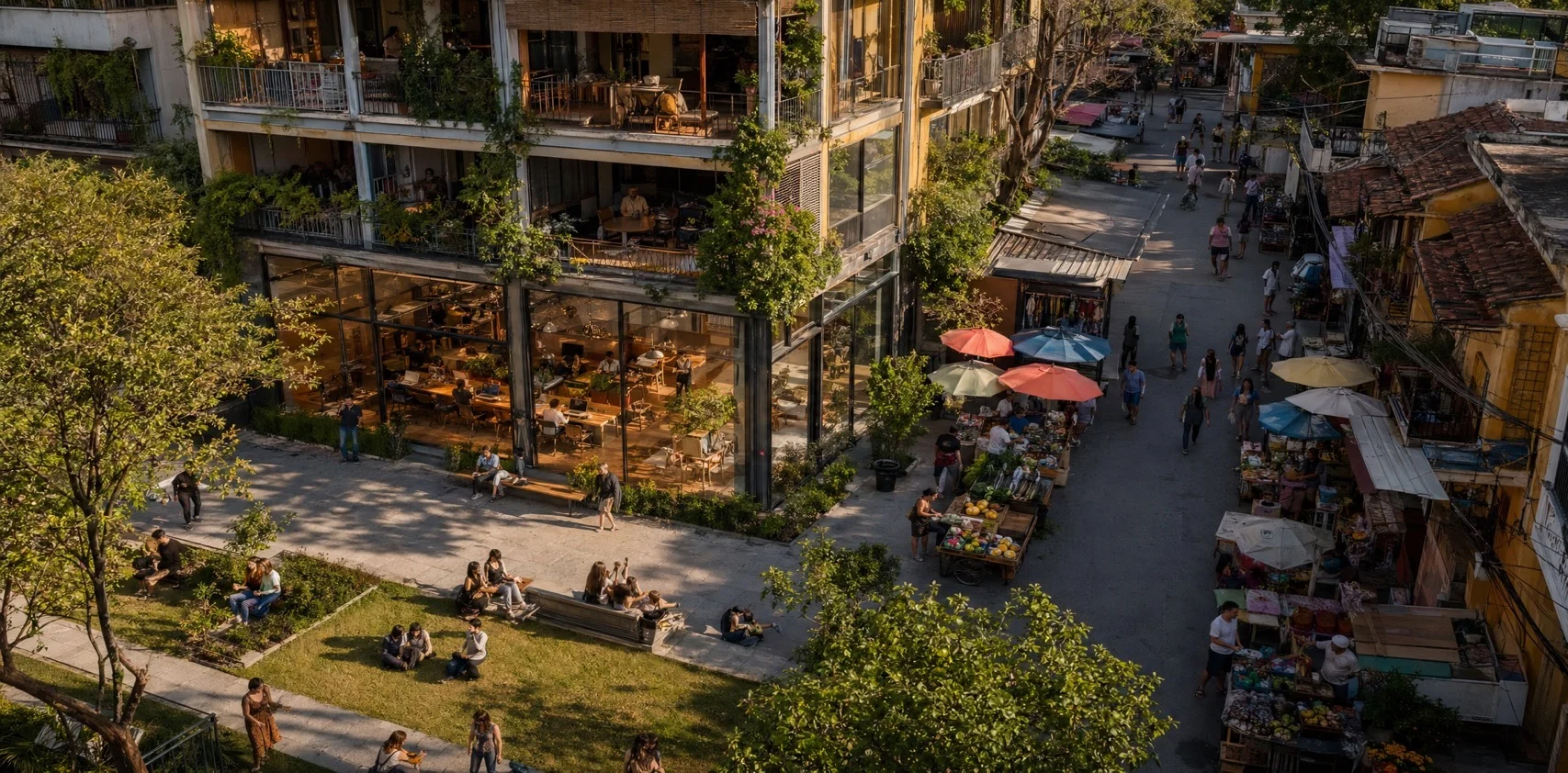
AI Generated - Editorial Use
Over sixty countries now offer digital nomad visas, but the first-wave strategy of just getting people to come is no longer enough. The next wave of city competition shifts toward retention: community infrastructure, healthcare accessibility, education resources, tax transparency, and holistic quality of living. The cities that truly retain people are not the cheapest or most beautiful, but those that turn nomads from visitors into residents.
Over the past few years, more than sixty countries have launched some form of digital nomad visa. From Dubai to Costa Rica, Portugal to Malaysia, governments discovered a seemingly simple economic equation: attract high-income remote workers who spend money locally without competing for local jobs.
In the first wave, it worked. Nomads arrived with foreign currency, rented apartments, patronized cafés and coworking spaces, took yoga classes. Their spending flowed directly into local economies without displacing local workers. For many smaller economies, it was essentially cost-free stimulus.
But as more cities jumped into the competition, the dynamics started shifting.
"Getting people to come" is no longer the challenge. The question now is: how do you get them to stay?
The First Wave Strategy Was Simple: Cheap Plus Visa
If you look back at the nomad visa explosion between 2020 and 2023, the strategies across countries were remarkably similar.
Most set a monthly income threshold—usually between $2,000 and $4,000—offered a one-year residence permit, and said: welcome.
Low barriers, simple paperwork, pleasant climate, affordable living. That was the pitch. Barbados, Croatia, Dubai, Georgia, Ecuador—each had its own natural beauty and cultural appeal, but the core attraction logic was identical: cheap, easy, just show up.
This brought a visible wave of arrivals. Chiang Mai and Bali already had nomad communities; visa programs amplified their draw. Lisbon transformed from an underrated European city into a global nomad hotspot. Mexico City attracted floods of North American remote workers with its extraordinary value proposition.
But problems surfaced quickly.
First, homogenization. When sixty-plus countries are all selling "affordable, good weather, easy visa," nomads have too many options and every city becomes substitutable. Skip Barbados? Try Sri Lanka. Skip Croatia? Try Greece. When every city's pitch sounds the same, no one develops loyalty to any of them.
Then, the retention problem. Nomads arrived, stayed a few months, and left for the next city. That's not surprising—it's literally what "nomad" means. But for cities, it created an awkward reality: you invested administrative resources designing visa programs, building application processes, and marketing campaigns, only to attract people who were mostly passing through.
Their spending concentrated in tourism-adjacent sectors: short-term rentals, cafés, coworking spaces. They didn't buy local property, enroll children in local schools, or participate in community life long-term. When global economic winds shifted or another city launched a more attractive program, they simply moved on.
The first-wave strategy's fundamental problem: it attracted traffic, not stickiness.
The deeper issue was that the "transient economy" model created side effects for cities themselves. Nomads clustered in specific neighborhoods, pushing up rents and prices in those areas, but their spending didn't distribute evenly across the city's broader economy. Café owners and Airbnb hosts profited, but the traditional shop around the corner might have felt nothing.
Second-Wave Cities Started Asking Different Questions
Early movers felt this bottleneck first.
Portugal is a textbook case. D7 visas and digital nomad visas brought waves of international remote workers to Lisbon within just a few years, but rent skyrocketed alongside them. Local young people found themselves priced out of the city center—landlords realized that short-term renting to nomads earning €5,000 a month was far more profitable than long-term leasing to locals earning €1,000.
The Portuguese government eventually adjusted policy, tightening some tax incentives and imposing new restrictions on short-term rentals. But the damage was done. Many locals' attitudes toward nomads shifted from welcoming to hostile.
This story didn't just play out in Lisbon. Bali experienced similar tensions, as did Chiang Mai and Mexico City. Any city experiencing a large influx of high-spending foreigners faces the gentrification problem.
Recognizing this, second-wave cities started thinking about the problem differently. They stopped asking only "how do we get more people to come" and started asking "how do we get the right people to stay—and create positive interactions with local communities."
That sounds like a slogan. But some cities are already doing concrete things.
Five Dimensions of Retention
Cities transitioning from "attracting nomads" to "retaining nomads" typically organize their strategies around five dimensions.
Community infrastructure. Ask nomads why they left their last city, and the most common answer isn't weather, visa expiration, or cost of living—it's loneliness. This might surprise many people, but it appears consistently in research. Working independently in a foreign country, without colleagues, without a stable social circle, without family nearby, creates enormous psychological drain. Many nomads project sunshine on social media while privately struggling with isolation and rootlessness.
Smart cities are investing proactively in community infrastructure. Not government-organized networking events or investor forums, but more organic structures: subsidizing coworking spaces to run mixed events between locals and nomads, supporting local startup communities in welcoming international members, encouraging coliving development.
Dubrovnik, Croatia tried an interesting approach. Beyond issuing visas, they actively matched nomads with local SMEs. You're a UX designer? Here's a local tourism startup looking for design consultants. You're a marketing expert? A local olive oil brand wants to break into international markets. These matches didn't just give nomads something to do—they created genuine connections to the local economy.
Healthcare and insurance accessibility. This is a seriously underestimated factor. Travel insurance works for short trips, but if you're staying in a city for more than six months, healthcare accessibility becomes a real consideration.
Where is healthcare quality good, pricing reasonable, and access easy for foreigners? This question increasingly shapes nomads' city choices. Thailand's private hospitals are known for high-quality care at reasonable prices. Portugal and Spain's public healthcare systems are open to foreigners with legal residence.
Some cities are partnering with insurance companies to offer locally tailored health insurance for digital nomads. International nomad insurance providers like SafetyWing and Genki are already mature, but if a city can offer more localized options—letting nomads walk into a clinic like a local instead of first confirming "does my insurance cover this hospital?"—that's an entirely different level of reassurance.
This seemingly minor detail might retain people better than low tax rates. Because every nomad knows deep down: if I get seriously ill, can I be properly treated here? When the answer is a clear yes, your attachment to a city jumps several levels instantly.
Education resources. This might surprise you, but "nomad families" are a rapidly growing segment. More remote workers aren't solo backpackers—they have partners and children. When you're nomading with kids, education becomes one of the most critical considerations.
International school quality and pricing, homeschooling legality, whether local public schools accept foreign students, language instruction accessibility—these factors are becoming key indicators for nomad families choosing where to settle.
Kuala Lumpur, Bangkok, Chiang Mai, and Lisbon are attracting growing numbers of nomad families thanks to rich international school options. Conversely, cities with rock-bottom living costs but scarce education resources simply don't make the list for parents.
This filter is easy to overlook but devastating in effect. Once a nomad has children, their city shortlist instantly shrinks to a third of what it was. And nomad families tend to be the highest-spending, longest-staying demographic. Cities that attract nomad families will have dramatically better retention rates than those targeting only solo backpackers.
Tax system transparency and reasonableness. Nomads aren't afraid of paying taxes. They're afraid of not knowing where they owe taxes, how much, or whether they might accidentally become tax residents of two countries and face double taxation.
Cities with more transparent and predictable tax systems retain people better. Portugal's NHR (Non-Habitual Resident) regime was enormously attractive in its early years. Spain's Beckham Law offers a flat rate for qualifying foreign workers. The UAE simply doesn't levy personal income tax.
But there's a delicate balance. Overly aggressive tax incentives can trigger local backlash and attract "tax haven" labels internationally. Stable, fair, transparent systems that apply equally to everyone have more long-term pull than short-term super-incentives.
Another pain point nomads frequently mention is tax uncertainty—not whether rates are high, but whether the rules are clear and won't suddenly change. Portugal's NHR regime was significantly modified in 2024, catching many nomads who had relocated specifically for its benefits. This kind of policy instability is serious risk for anyone making long-term plans.
The lesson emerging second-wave cities are learning: rather than luring people with super-deals, retain them with stability, transparency, and predictability.
Holistic quality of living. This is the hardest to quantify but arguably the most important dimension. It encompasses too many things to list exhaustively: public safety, air quality, internet reliability, public transit convenience, food diversity, language friendliness, nighttime safety perception, pet-friendliness, even waste management efficiency.
No city scores perfectly across every dimension. But cities that clear the bar on most dimensions and particularly excel in a few are becoming the retention winners.
An interesting observation: many nomads who eventually settle don't choose the first city they visited. They choose the one they "came back to three or more times." The typical nomad path is: explore widely during the discovery phase, gradually narrow the range, eventually rotate between two or three cities, and then one day realize: this place isn't just "where I'm going this time"—it's "my base." What triggers that shift usually isn't any single factor, but the combined effect of all five dimensions above.
The Competition Between Cities Is Accelerating
By 2026, digital nomad visas are no longer novel. When sixty-plus countries are competing for the same pool of people, simply having a visa program isn't remotely sufficient.
Differentiation is what matters.
Some cities build advantages in specific industries. Estonia's e-Residency program isn't just a visa—it lets you establish an EU company entirely online, which is enormously attractive to entrepreneurs. Dubai positions itself as a fintech and crypto-friendly environment.
Some cities invest deeply in community. Places like Bansko (a small Bulgarian town) and Las Palmas (Canary Islands) aren't the most naturally attractive destinations, but because they've cultivated tight-knit nomad communities over years, they retain people better than many major cities.
Some cities partner with corporations. They invite multinationals to establish remote work stations locally, offering tax incentives and office space subsidies. The advantage: you're not just attracting individual nomads but entire teams. Teams are more stable than individuals because they have organizational reasons to stay.
Regardless of strategy, the core shift is the same: from "attract arrivals" to "create reasons to stay."
From another angle, this inter-city competition is actually doing nomads a favor: it forces every city to continuously improve its "nomad-friendliness." Better visa policies, more transparent tax systems, improved healthcare accessibility, richer community programming, more reasonable rent controls. These improvements don't just benefit nomads—they benefit the cities' own residents too.
In a sense, nomads serve as "mobile auditors." They vote with their feet—gravitating toward cities with good experiences, leaving those with bad ones. This mobility prevents cities from resting on a single visa program and waiting for people to show up. They have to keep investing in the conditions that make people want to stay.
The next phase of nomadism isn't about going to more places. It's about finding a place worth staying.
And the competition between cities is pushing the quality of those places upward, one increment at a time.
For anyone considering digital nomadism, that's good news. Your options are getting better, and they'll keep getting better. But the prerequisite is clarity about what you're really looking for: the next stop, or a place you can call a base?
This content is protected by copyright. Please respect the author's work and do not copy or distribute without permission.

數位遊牧編輯群 Digital Nomad Editor Group
Digital Nomad is a knowledge sharing platform specially designed for “those who dream to become digital nomads.” We share the latest news and industry trends related to digital nomadism, as well as introduce essential skills and knowledge needed for freelancers, remote workers, etc. Our goal is to help you connect with fellow digital nomads!
