


When Paradise Pushes Back: Mexico City's Reckoning with Digital Nomads
May 26, 2026
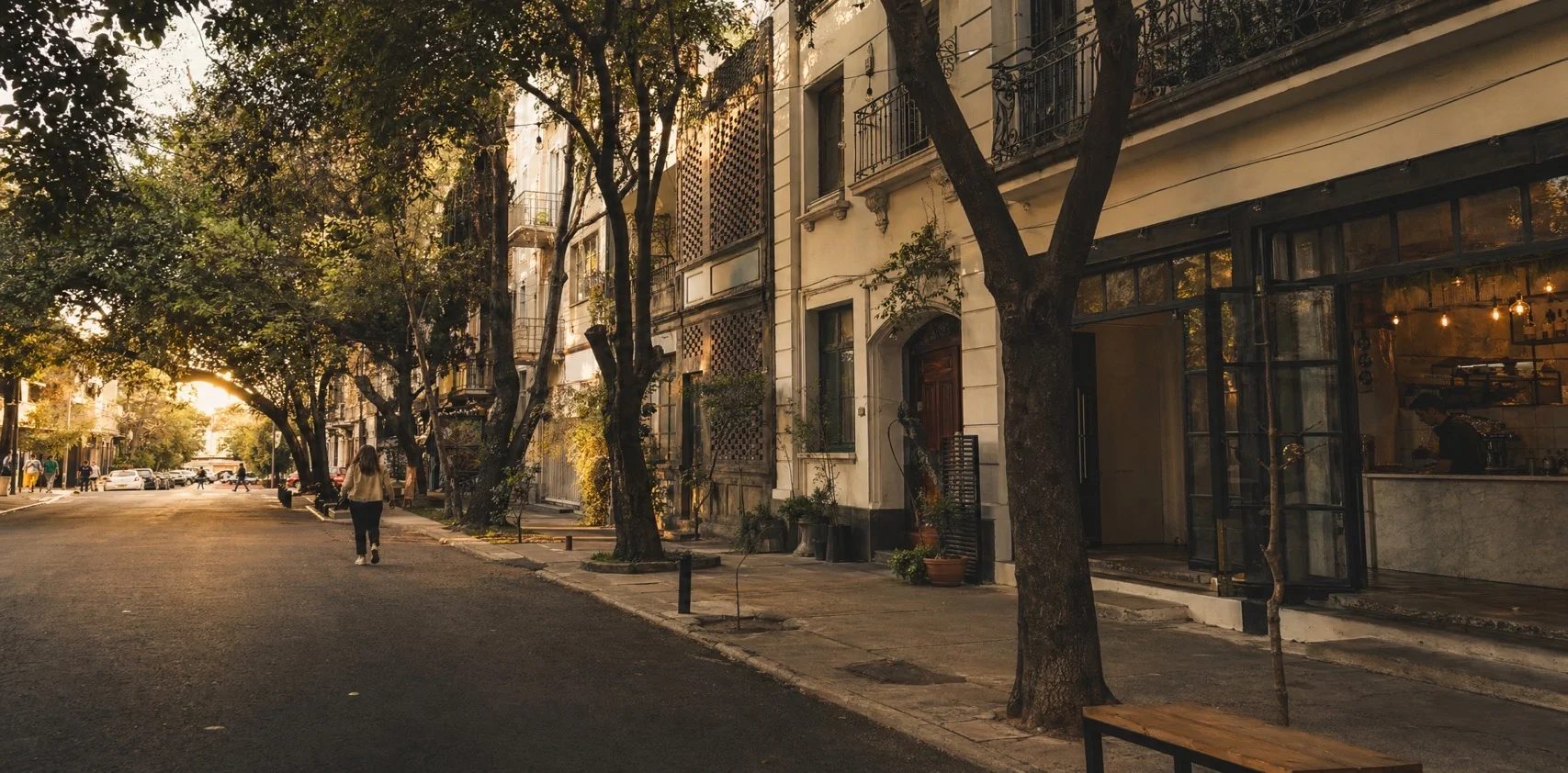
AI Generated - Editorial Use
Mexico City was once the ultimate digital nomad paradise — until soaring rents, cultural clashes, and a growing housing crisis turned locals against remote workers. With rents up 60-80% since 2020 and Latin America's strictest short-term rental law now in effect, the city is drawing a line. This article examines nomad gentrification, a $100 million tax gap, and the global regulatory wave reshaping the future of location-independent work.
In late 2025, someone spray-painted "Gringo go home" on the facade of an apartment building in Roma Norte, one of Mexico City's most coveted neighborhoods. Weeks later, another message appeared on a nearby wall: "Tu Airbnb = mi desalojo" — your Airbnb is my eviction.
These weren't the work of a lone vandal. They were the visible edge of a growing social movement, one that has since expanded from graffiti to street protests to legislation. After years of welcoming remote workers with open arms and affordable lattes, Mexico City is now asking a pointed question: at what cost?
The Numbers Behind the Rage
The simplest way to understand what happened is to follow the money.
According to a mid-2025 report by Inmuebles24, Mexico's largest real estate platform, average monthly rents in Roma Norte, Condesa, and Polanco — the three neighborhoods most popular with digital nomads — rose between 60% and 80% since 2020. In Roma Norte specifically, a standard one-bedroom apartment went from roughly 8,000 Mexican pesos (about $400) before the pandemic to 15,000–18,000 pesos ($750–$900) by 2025.
For a San Francisco software engineer earning $5,000 a month, $900 in rent is barely noticeable. For a Mexico City resident earning the local median income of around 16,000 pesos per month, that same apartment would consume their entire paycheck.
Behind the rent spikes lies the explosive growth of short-term rental platforms. A 2025 survey by the Mexico City government found over 12,000 active Airbnb listings in the Cuauhtémoc borough alone (which encompasses both Roma and Condesa), with more than 70% being entire apartments rather than shared rooms. Each of those units represents a home that was removed from the local rental market and converted into a temporary landing pad for nomads staying three days, five days, or three months.
Data from the National Autonomous University of Mexico (UNAM) Housing Research Center sharpened the picture further: in the neighborhoods with the highest nomad density, every 100 new Airbnb listings reduced the available local rental supply by approximately 8%. With supply being steadily eroded and foreign demand pouring in, rents had only one direction to go.
This is why "Gringo go home" is not simply xenophobia. It is a protest grounded in economic reality.
From Angry Posts to Parliamentary Action
Mexico City's anti-nomad sentiment didn't erupt overnight. It escalated through three distinct phases.
The first phase was digital. Starting in 2023, Mexican social media filled with criticism targeting foreign remote workers. One viral flashpoint was a video by an American YouTuber titled something along the lines of "How to Live Like a King in Mexico City on $1,000 a Month." The comment sections were merciless: "Our city is not your discount resort."
The second phase hit the streets. In October 2025, a grassroots organization called Vecinos en Resistencia (Neighbors in Resistance) organized a march of roughly 3,000 people through Roma Norte. Their demands were specific: restrict foreign purchases of residential property, raise taxes on Airbnb, and channel short-term rental revenue into social housing construction. The marchers included many young families carrying a simple message: "I can't afford rent in my own city."
The third phase entered the legislature. In August 2025, Mexico City's congress passed the Short-Term Rental Regulation Act (Ley de Regulación de Alojamientos Temporales), the strictest Airbnb regulation in Latin America to date. Its key provisions covered four areas.
Mandatory registration: all short-term rental properties must register with the city government and obtain an operating permit, with fines of up to 500,000 pesos (approximately $25,000) for non-compliance.
Annual cap on rental days: each property may be rented short-term for no more than 180 days per year, with a minimum stay of 3 days per booking — effectively eliminating the full-time "professional landlord" model.
Community density limits: no more than 25% of units in any residential building may be used for short-term rentals, with buildings that already exceed this threshold given two years to comply.
Platform-level tax withholding: Airbnb, Booking.com, and similar platforms are required to withhold and remit accommodation and income taxes totaling roughly 8% to 10% of rental revenue.
The law took effect in January 2026. Enforcement remains to be tested, but the signal could not be clearer: Mexico City is done being the world's budget backyard.
Nomad Gentrification: Naming the Phenomenon
Traditional gentrification describes an intra-national class displacement — wealthier residents move into lower-income neighborhoods, push up prices, and eventually price out the original inhabitants. It has played out for decades in places like Brooklyn and East London.
Nomad gentrification is the transnational version. When large numbers of remote workers earning high-income-country salaries flood into a low-income-country city, their purchasing power creates extreme economic fault lines within specific neighborhoods.
A 120-peso (roughly $6) specialty pour-over coffee is pocket change for an American engineer earning $5,000 a month. For the Mexican barista who made it, that same price tag might represent close to half a day's wages. As more restaurants and cafés begin pricing for foreign purchasing power, local residents find themselves being "priced out of their own city."
Three structural factors explain why Mexico City became the first critical flashpoint for nomad gentrification.
Scale. According to Nomad List, the popular community platform, Mexico City ranked number one among global digital nomad destinations from 2023 to 2025, with an estimated 50,000-plus foreign remote workers in the city during that period. That figure is modest relative to a metropolitan area of 21 million, but concentrated in just a few neighborhoods like Roma Norte and Condesa, the density effect became overwhelming.
Income gap. The average income of American remote workers is roughly five to eight times that of Mexico City residents. Similar disparities exist in Southeast Asian and Eastern European nomad hotspots, but Mexico City's geographic proximity to the United States and its deep cultural appeal attracted a disproportionate share of North American nomads.
Regulatory vacuum. Mexico has long lacked clear rules governing foreign nationals doing remote work within its borders. Nomads on tourist visas occupy a legal gray zone: their employers are abroad, so they are not considered to be "working" in Mexico. No work visa is required. No local income tax is owed. This convenience drew nomads in droves, but it also meant their "contribution" to the local economy was almost entirely limited to consumption, not taxation.
The $100 Million Tax Gap
The tax issue deserves its own spotlight.
Most digital nomads enter Mexico on tourist visas allowing stays of up to 180 days. Legally, they are not considered Mexican tax residents and owe no income tax. Yet they use the same roads, metro system, public healthcare infrastructure, and police services that Mexican taxpayers fund.
A 2025 estimate by Mexico City's Finance Ministry put a concrete number on this imbalance: if the city's foreign remote workers paid taxes at local rates, the municipality would gain approximately 2 billion pesos (about $100 million) annually. That sum could build roughly 5,000 units of social housing or seed three new metro lines.
This is a theoretical calculation, and the enforcement challenges are enormous. But it exposes a structural inequity: nomads consume all the benefits of urban infrastructure while bearing virtually none of the financial burden.
In early 2026, Mexico's federal government began drafting tax proposals targeting foreign remote workers. Details remain under discussion, but the direction is clear: remote workers who stay in Mexico beyond a certain number of days may soon be required to file local income taxes or pay some form of "digital nomad levy."
The Cultural Fracture Behind the Coffee Cup
Beyond the economics, daily cultural friction is quietly eroding the fabric of affected communities.
Social media abounds with stories of nomad behavior that locals find grating. Someone taking a loud English-language video call in a traditional market as if it were their personal office. Someone describing Mexico City on social media as "an insanely cheap New York alternative," instantly provoking collective outrage. Someone occupying a four-person table at an independent Condesa café for an entire workday, having ordered only a single Americano.
None of these acts, taken individually, qualify as egregious offenses. But in aggregate, they reflect an attitude that many locals find deeply uncomfortable: treating someone else's hometown as a lifestyle accessory, a place whose value is measured by exchange-rate advantage rather than its own cultural context, rhythm, and collective dignity.
A Mexican author who has run an independent bookstore in Roma Norte for over two decades offered a widely quoted remark in an interview with Spain's El País: "They don't come here because they love Mexico City. They come because Mexico City is cheap. When it stops being cheap, they'll leave. And we'll be the ones left to deal with everything they left behind."
The Nomad's Dilemma
From the nomad perspective, these criticisms are not entirely fair.
Many remote workers point out that they spend generously in local businesses, support small vendors, and bring cultural diversity to the neighborhoods where they live. They haven't "taken" anyone's job — their employers and clients are in another country. They are pure consumers, not competitors in the local labor market.
These arguments carry weight. But the problem is that when a group's collective behavior generates significant negative externalities, individual goodwill cannot offset structural harm. One nomad checking into a Roma Norte Airbnb has near-zero community impact. But when tens of thousands make the same choice, the effect flips from negligible to catastrophic.
This is a textbook tragedy of the commons: each individual acts rationally, yet the collective outcome is destructive.
Also worth scrutinizing is the "geoarbitrage" narrative that pervades nomad culture. The concept encourages people to earn high-income-country salaries while living in low-income-country cities — framed as a clever personal finance strategy. But viewed from the other side, it looks like just another form of economic asymmetry, or even a neatly packaged version of economic extraction.
To be fair, painting all nomads with the same brush is equally unjust. Many genuinely integrate into their communities, learn Spanish, support local businesses, and even participate in neighborhood affairs. But structural problems demand structural solutions, and individual good intentions can never substitute for institutional reform.
The Global Domino Effect
Mexico City is not an outlier. It is a harbinger.
Lisbon tightened its Golden Visa program in 2023 and imposed stricter limits on short-term rentals in the city center. Barcelona announced in 2024 that it would completely ban tourist short-term rental apartments by 2028. Bali's Canggu began requiring foreign remote workers to obtain dedicated digital nomad visas and pay local taxes starting in 2025.
The trajectory across these cities is strikingly similar: first, an enthusiastic embrace of the spending power that foreign visitors bring; then, a rude awakening as housing costs spike and neighborhood character erodes; and finally, regulatory intervention forced by resident pressure.
Mexico City's legislation is likely to become a reference template for other Latin American cities. Colombia's Medellín is already discussing similar short-term rental restrictions. Argentina's Buenos Aires, while temporarily relieved of rental pressure due to currency devaluation, is seeing a parallel buildup of anti-nomad resentment.
The wave of pushback now rippling across the globe is ultimately asking one fundamental question: whose city is it? When globalization enables people to work from anywhere yet live and spend in only certain places, the residents of those "certain places" have every right to ask: is this arrangement fair to us?
If You're Still Planning to Go
For remote workers considering Mexico City or any other nomad hotspot, five things are worth thinking through carefully before booking that flight.
First, sign a long-term lease and steer clear of Airbnb. Renting directly from a landlord on a six-month-plus contract is typically cheaper and avoids displacing local housing supply. If Airbnb is unavoidable, choose a private room over an entire apartment, and stay away from already-saturated Roma Norte and Condesa.
Second, invest real time in learning Spanish. The number of nomads who actually bother to learn the local language is far smaller than one might assume. Language is more than a communication tool — it is the most basic expression of respect. When you can exchange a few words in Spanish with the fruit vendor on the corner, you stop being just another passing consumer and become someone who is at least trying to understand the place.
Third, spend your money where it genuinely stays local. The artisanal coffee shops and coworking spaces catering to foreigners are convenient, but they are themselves products of nomad gentrification. Try eating at a traditional fonda (family-run eatery), shopping at neighborhood markets, and using the services that locals use.
Fourth, understand and support local regulation. If the city you're in is implementing short-term rental caps or nomad taxes, support those policies rather than trying to circumvent them. These regulations are not designed to expel you — they are designed to ensure your presence does not inflict disproportionate harm on the community.
Fifth, confront your economic privilege honestly. "Geoarbitrage" is not a neutral concept. Living a $5,000-a-month lifestyle in a city where the average salary is $800 means participating in a deeply asymmetric economic relationship. Recognizing this is not about guilt. It is about taking responsibility for the consequences of every choice you make.
Cheap Paradise, Expensive Consequences
Mexico City's story is a mirror reflecting the tension that every city "discovered" by the digital nomad wave will eventually confront. When low prices, pleasant weather, and reliable internet become the only selection criteria, nomads arrive like a rising tide. And when the tide recedes, what remains is often not fertile ground but scars that take years to repair.
Digital nomadism itself is not inherently wrong. The freedom to work remotely is a genuine benefit of technological progress, and no one should be morally condemned for exercising it. But freedom has never been free, and its costs should not be borne by those least equipped to absorb them.
Mexico City is drawing a line. The rest of the world will follow, sooner or later. For every nomad, the real question is not "where is the next cheap destination?" but "what kind of global citizen do I want to be?"
The answer is not in your passport, not in your VPN settings, and not in your currency converter. It lives in every small choice you make, every single day.
This content is protected by copyright. Please respect the author's work and do not copy or distribute without permission.
