


Why Taiwan Is the Best-Kept Secret for Muslim Digital Nomads
March 18, 2026
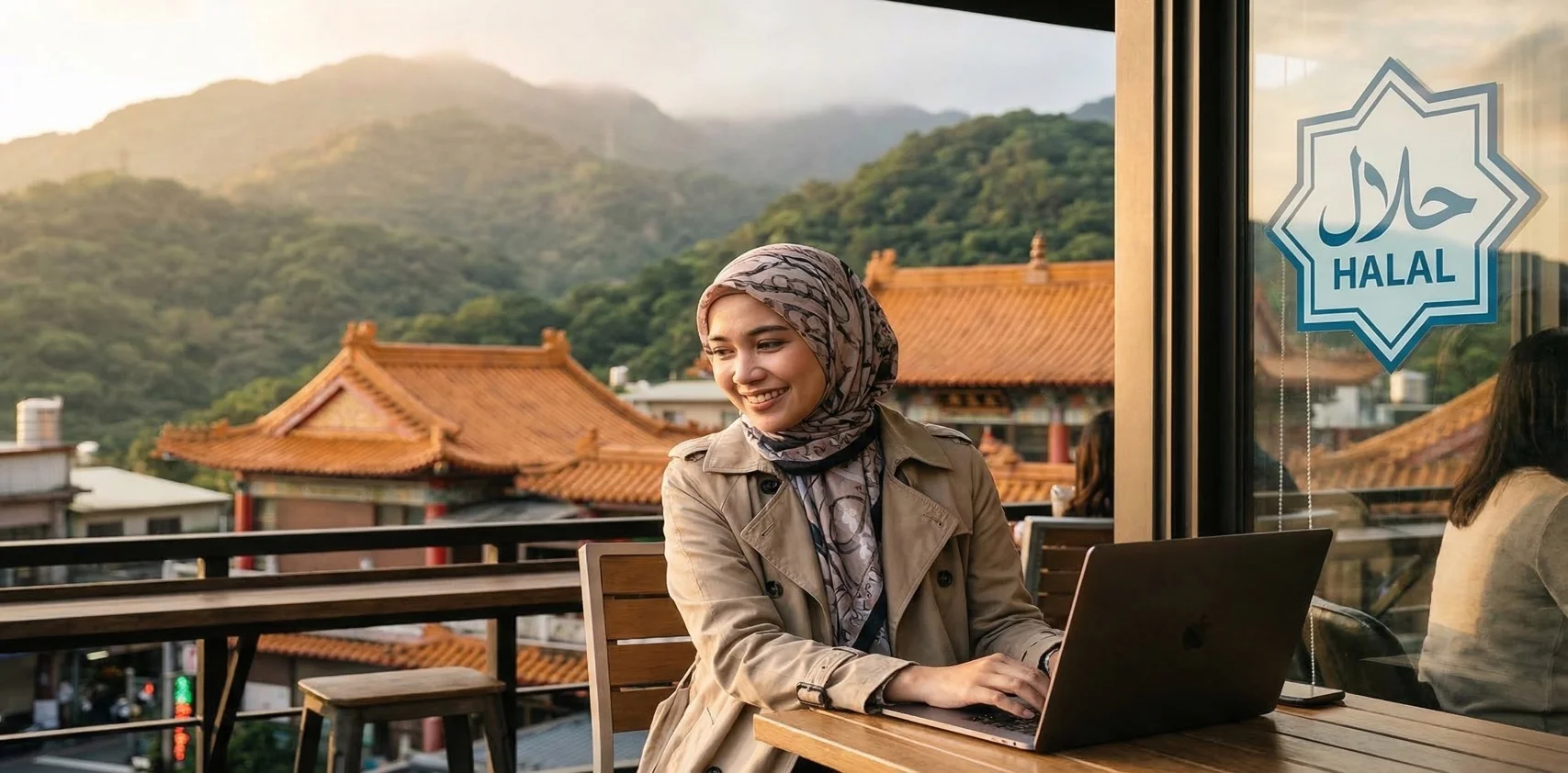
AI Generated - Editorial Use
Taiwan ranks top 3 globally for Muslim-friendly travel among non-OIC nations, with halal dining, prayer rooms island-wide, and a digital nomad visa that lets Muslim remote workers stay long-term.
When Muslim digital nomads scout for a base in the Asia-Pacific, the usual suspects dominate the conversation: Bali for its beaches and bargain living costs, Kuala Lumpur for its halal-everything convenience, Bangkok for its affordability and coworking scene. Taiwan rarely makes the shortlist.
That may be a mistake.
In the Mastercard-CrescentRating Global Muslim Travel Index (GMTI), Taiwan has ranked among the top three non-OIC (Organisation of Islamic Cooperation) destinations for several consecutive years. It placed second in 2022, third in 2023, and maintained a top-tier position in 2024, alongside Singapore and Hong Kong. In 2023, Taipei was awarded "Most Promising Muslim-Friendly City Destination of the Year (non-OIC)" at the Halal in Travel Global Summit organized by CrescentRating.
For a place where Muslims account for less than one percent of the population, these rankings are not a fluke. They reflect a deliberate, policy-driven ecosystem that happens to address the exact pain points Muslim digital nomads face when settling in for months at a time: food, prayer, visas, and community.
The Infrastructure: Prayer Rooms in Train Stations
Taiwan's approach to Muslim-friendly infrastructure is remarkably systematic for a non-Muslim society.
Prayer rooms with qibla (direction of Mecca) indicators are available at Taoyuan International Airport, Taipei Main Station, Kaohsiung Station, Hualien Station, and the Taichung High Speed Rail station. Thirteen national scenic areas and multiple highway rest stops across the island also offer prayer spaces. Major department stores in Taipei's Xinyi District provide prayer rooms and wudu (ablution) facilities. Over 30 tourist attractions island-wide have dedicated Muslim-friendly amenities.
These are not improvised corners or temporary setups. They are permanent installations embedded in public infrastructure, maintained by local governments. For a nomad who plans to stay for months, the ability to pray at a train station before catching the high-speed rail south is not a luxury. It is daily life made functional.
Halal Dining: Certified, Diverse, and Growing
Food is the single biggest daily concern for Muslim travelers and residents. In most East Asian countries, maintaining a halal diet requires significant effort, advance planning, and repeated compromises.
Taiwan stands apart.
The Taiwan Tourism Administration oversees a multi-tiered halal certification system: MFT (Muslim Friendly Tourism), HK (Halal Kitchen), AH (All Halal), and HCI (Halal Counter Inside), among others. These certifications are issued by the Chinese Muslim Association or international halal certification bodies, with actual auditing and standards enforcement.
Taipei alone has over 60 Muslim-friendly certified restaurants and hotels. The cuisine options span Taiwanese, Indonesian, Indian, Turkish, and Middle Eastern fare. This diversity matters for long-term residents. Eating the same cuisine every day for months is a fast track to burnout, and Taiwan's halal scene is varied enough to prevent it.
Compare this to Tokyo, where halal-certified restaurants exist but are scattered and tourist-oriented, and where everyday Japanese cooking relies heavily on mirin (a rice wine) and non-halal meat. Or Seoul, where fewer than 20 halal-certified restaurants serve the entire city, concentrated almost entirely in the Itaewon district.
The area around Taipei Grand Mosque in the Da'an District has organically developed into a small Muslim-friendly neighborhood, with halal restaurants, an Islamic cultural center, and gathering spots for the Indonesian and Malaysian Muslim communities.
Accommodation: Rated and Ready
CrescentRating has evaluated approximately 90 hotels in Taiwan, with 14 achieving ratings of 6 to 7 on a 7-point scale. Hotels at this level provide in-room qibla indicators, prayer mats, Ramadan-specific services, and halal dining options.
For digital nomads, the practical value of this rating system is efficiency. Instead of researching each hotel from scratch, Muslim travelers can filter by CrescentRating score and know exactly what to expect. Options range from five-star properties to budget business hotels.
Long-term rental costs offer a significant price advantage. A furnished studio apartment in Taipei runs approximately NT$15,000 to NT$25,000 per month (roughly USD 470 to 780), which is 40 to 60 percent cheaper than equivalent housing in Singapore, and meaningfully below Tokyo and Seoul prices. Moving to New Taipei City or Taichung drops costs by another 30 percent.
The Visa Question: Legal Paths to Stay
In January 2025, Taiwan launched a dedicated Digital Nomad Visitor Visa for nationals of visa-exempt countries. The visa allows stays of up to six months for the purpose of remote work, with applicants required to show proof of a remote employment contract or freelance income.
The Employment Gold Card, which has been running for several years, provides an even more robust option. Targeted at professionals with expertise in technology, economics, education, culture, sports, finance, law, or architecture, the Gold Card grants an open work permit for up to three years. Holders need no employer sponsorship and can freelance, start businesses, or work for multiple clients. An income tax incentive sweetens the deal further.
Together, these two pathways offer a clear legal framework for Muslim remote workers to reside in Taiwan. The Digital Nomad Visa suits those testing the waters for a few months. The Gold Card serves professionals ready to commit longer-term.
By contrast, Bali's digital nomad visa options have been marked by shifting policies and inconsistent enforcement. Japan has no dedicated digital nomad visa. South Korea's equivalent remains in pilot phase. Malaysia's DE Rantau program exists but is known for slow processing and opaque criteria.
Community and Religious Life
A concern that Muslim nomads frequently raise about non-Muslim countries is isolation. Infrastructure is one thing. Feeling at home is another.
Taiwan's Muslim community is smaller than those in Malaysia or Indonesia, but it is more established and accessible than many outsiders assume.
Taipei Grand Mosque is one of the oldest in East Asia, and its weekly Friday prayers (Jumu'ah) draw hundreds of congregants. Additional mosques and Muslim community centers operate in Taichung, Kaohsiung, and Taoyuan.
Islam Taiwan (islamtaiwan.com) provides multilingual resources in Arabic, English, Indonesian, and Chinese, covering prayer times, halal restaurant maps, Ramadan events, and community gatherings. It serves as a practical landing page for newly arrived Muslim nomads.
Taiwan also has a substantial Indonesian and Malaysian Muslim community, primarily composed of migrant workers and students. Eid al-Fitr and Eid al-Adha celebrations in Taipei and Taoyuan regularly draw thousands of participants. These gatherings provide Muslim nomads with a social anchor and a sense of belonging that pure infrastructure cannot deliver.
How Taiwan Compares: The Competitive Landscape
To understand Taiwan's positioning, it helps to map it against the alternatives.
Bali, Indonesia. Indonesia is the world's most populous Muslim-majority country, but Bali itself is predominantly Hindu. Halal food is available but not as ubiquitous as in Jakarta or KL. The real issue for nomads is infrastructure: unreliable internet (especially outside Ubud and Canggu), motorcycle-dependent transportation, and limited healthcare facilities. Bali's holiday atmosphere can also work against sustained productivity.
Kuala Lumpur, Malaysia. KL offers unbeatable halal convenience as a Muslim-majority capital. But chronic traffic congestion, reliance on ride-hailing apps for transportation, street crime concerns (snatch theft), and seasonal haze from agricultural burning are persistent drawbacks for long-term residents.
Seoul, South Korea. World-class digital infrastructure meets minimal halal resources. Fewer than 20 halal restaurants citywide, scarce prayer spaces, very few Muslim-friendly hotels, and a language barrier that can feel steeper than in other East Asian capitals.
Tokyo, Japan. Japan has been investing in Muslim tourism, and halal restaurant numbers in Tokyo are growing. However, options remain scattered and tourism-focused. The pervasive use of alcohol-based seasonings in Japanese cooking makes daily halal compliance difficult. Tokyo's cost of living is also among the highest in the region.
Singapore. Tops the GMTI non-OIC rankings for good reason: multicultural society, abundant halal dining, excellent infrastructure, English as an official language. The catch is cost. Monthly living expenses easily exceed USD 3,000, making it impractical as a long-term nomad base for most budgets.
Taiwan's sweet spot. Taiwan is not a Muslim country, but it offers the most comprehensive halal-friendly infrastructure in non-Muslim East Asia. It is not as cheap as Bali, but it delivers far more reliable internet, better public transit, and superior healthcare. Its cost of living undercuts Singapore, Tokyo, and Seoul while providing more halal resources than any of the three. It occupies a rare intersection of Muslim-friendliness and digital nomad readiness that few cities in the region can match.
The Numbers: Monthly Cost of Living
A single digital nomad maintaining a moderate lifestyle can expect the following approximate monthly costs:
Taipei. Housing (furnished studio): USD 470 to 780. Food (including dining out): USD 310 to 470. Transportation (metro pass plus occasional taxi): USD 60 to 95. Coworking space: USD 95 to 250. Total: approximately USD 940 to 1,560.
Singapore. Total: approximately USD 3,000 to 4,500, with housing alone consuming USD 1,500 to 2,500.
Tokyo. Total: approximately USD 2,200 to 3,500, with limited halal dining adding hidden time costs for self-catering.
Kuala Lumpur. Total: approximately USD 1,000 to 1,800, the most budget-friendly option but with the trade-offs noted above.
Bali. Total: approximately USD 800 to 1,500, though costs for reliable internet and comfortable housing are rising fast.
Taipei lands in the middle of this range, offering a quality-of-life premium over the cheaper destinations without the sticker shock of Singapore or Tokyo.
Connectivity and Work Environment
Taiwan's average fixed broadband speed ranks in the global top ten. 4G and 5G mobile coverage is extensive, reaching even relatively remote areas like Hualien and Taitung. This stands in sharp contrast to Bali, where a tropical rainstorm can knock out internet for half a day.
Taipei's coworking scene includes international brands like WeWork alongside local options such as CLBC and Impact Hub Taipei. Day passes and monthly memberships range from NT$3,000 to NT$8,000 per month.
Taiwan's cafe culture is also notably nomad-friendly. Most cafes offer free Wi-Fi and power outlets, and staying for two or three hours with a single drink (typically NT$100 to 150) draws no disapproval. For many nomads, this informal work setup is as important as any formal coworking space.
Safety, Healthcare, and Quality of Life
Taiwan consistently ranks among the safest places on earth. Walking alone through Taipei at midnight carries virtually no personal safety risk, a factor that matters especially for female Muslim nomads whose sense of security directly affects quality of life and work output.
Foreign residents holding an Alien Resident Certificate or Employment Gold Card are eligible for Taiwan's National Health Insurance, with monthly premiums of approximately NT$750 to NT$1,500. This provides comprehensive coverage including outpatient care, hospitalization, and prescription medications. Comparable healthcare access is rare among digital nomad visa programs in the Asia-Pacific.
Public transportation in Taipei is clean, punctual, and inexpensive. The high-speed rail connects Taipei to Kaohsiung in about 90 minutes, making the entire western corridor easily accessible for nomads who want to explore different cities.
The Honest Caveats
No destination is perfect, and Muslim nomads considering Taiwan should be aware of several challenges.
Language. Mandarin Chinese is the dominant language. English proficiency is lower than in Singapore or Hong Kong, and communication outside central Taipei can require patience. Translation apps and the general willingness of Taiwanese people to help bridge the gap, but the language barrier is real.
Pork is everywhere. Pork is the most commonly used meat in Taiwanese cuisine. From braised pork rice to pork floss, pork products appear in unexpected places. Eating at non-certified restaurants carries a significant risk of inadvertent pork consumption. Muslim nomads need to develop the habit of checking certifications or sticking to known halal establishments, especially early on.
Community scale. While Taiwan has an active Muslim community, its size cannot compare to Kuala Lumpur or Jakarta. Nomads seeking deep social integration may need to proactively join Facebook groups, WhatsApp communities, or attend mosque events.
Visa nationality restrictions. Taiwan's Digital Nomad Visa is currently limited to nationals of visa-exempt countries. Citizens of some Southeast Asian and Middle Eastern nations are not on the visa-exempt list, meaning they would need to pursue alternative pathways such as the Employment Gold Card or standard work visas.
The Bigger Picture
What makes Taiwan's proposition distinctive is not any single feature but the sum of its parts.
A systematic halal certification framework. Prayer rooms in transit hubs, malls, and tourist sites. Internationally recognized Muslim-friendly ratings. A legal digital nomad visa and a flexible Gold Card program. Reliable high-speed internet. Affordable coworking options. Living costs well below Singapore, Tokyo, and Seoul. World-class public safety and healthcare. An active Muslim community with multilingual information platforms.
Taken together, this is not merely tourist-friendly hospitality. It is a functioning ecosystem that allows Muslim digital nomads to live, work, and practice their faith with minimal friction over extended periods.
As global Muslim travel is projected to reach 230 million trips annually by 2028, and as the digital nomad population continues to grow within the Muslim world, Taiwan's systematic investment in Muslim-friendly infrastructure positions it as a forward-thinking destination.
For Muslim digital nomads assembling their next shortlist, this island in the western Pacific deserves a serious look.
Written by the Digital Nomad Press editorial team. Sources include the Mastercard-CrescentRating Global Muslim Travel Index (GMTI), Taiwan Tourism Administration, CrescentRating, Islam Taiwan, and The Traveler.
This content is protected by copyright. Please respect the author's work and do not copy or distribute without permission.

數位遊牧編輯群 Digital Nomad Editor Group
Digital Nomad is a knowledge sharing platform specially designed for “those who dream to become digital nomads.” We share the latest news and industry trends related to digital nomadism, as well as introduce essential skills and knowledge needed for freelancers, remote workers, etc. Our goal is to help you connect with fellow digital nomads!
