


Bhutan's Mindfulness Visa: When Everyone Else Is Competing on Price, This Country Chose Restriction
March 19, 2026
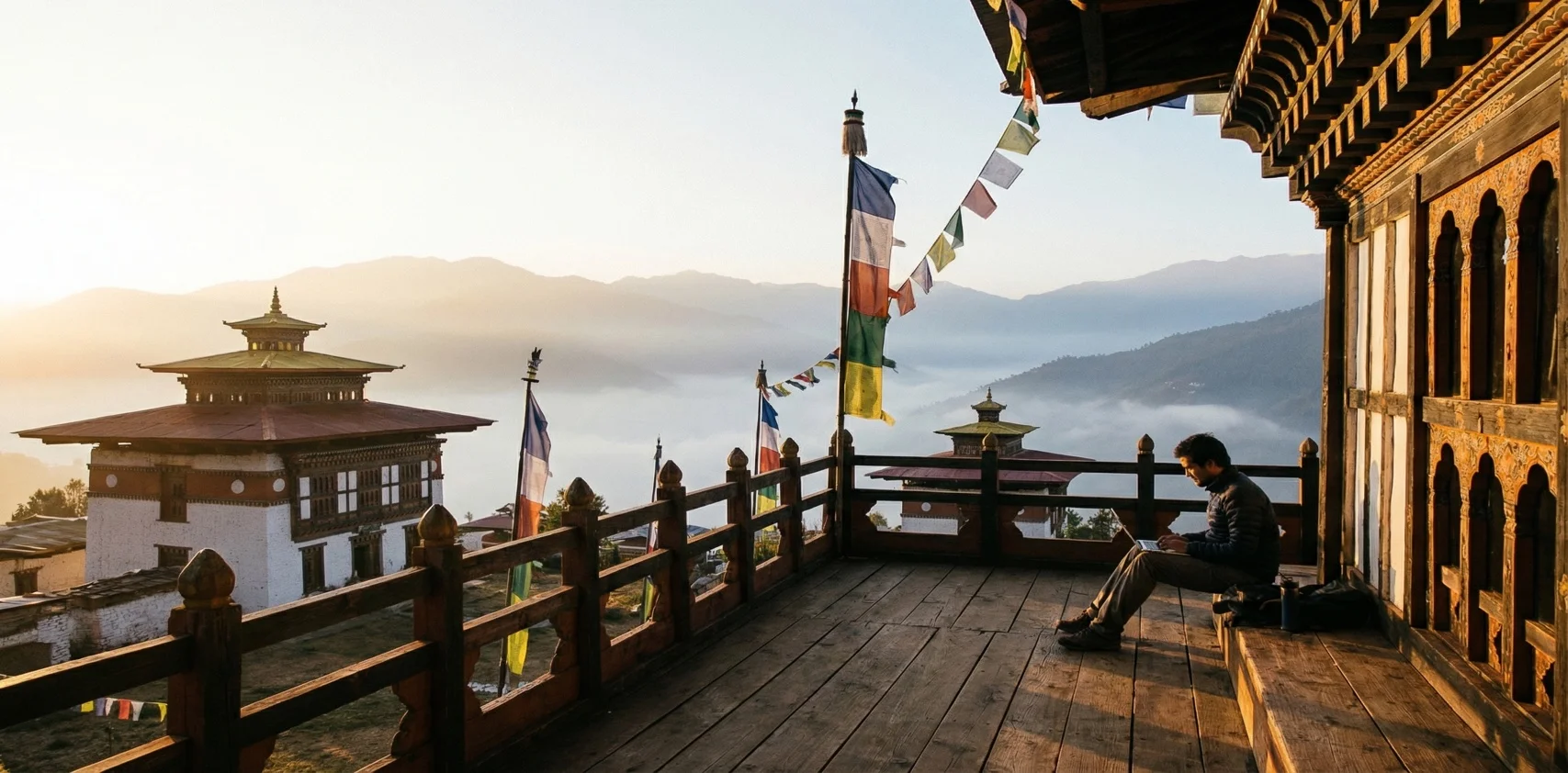
AI Generated - Editorial Use
Bhutan launched the world's first blockchain-backed mindfulness nomad visa: $10,000 refundable deposit, $2,800 annual fee. Not a gimmick — a small nation's strategy of creating value through restriction.
In late February 2026, Bhutan dropped a bombshell on the digital nomad world: the launch of the world's first blockchain-backed "Mindfulness Digital Nomad Visa." Administered by the Gelephu Mindfulness City special administrative region and developed in partnership with NomadClub, the visa requires applicants to purchase $10,000 worth of TER — a gold-backed token built on the Solana blockchain — as a refundable deposit, plus a non-refundable annual fee of $2,800.
When most people see those numbers, the immediate reaction is: "Are you kidding? Thailand's DTV visa costs $260. What makes Bhutan worth forty times more?"
Fair question. But if all you see is the price tag, you're missing what Bhutan is actually doing.
What Does a $10,000 Deposit Actually Buy You?
Let's start with the basics.
Applicants purchase $10,000 in TER tokens through DK Bank, Bhutan's regulated digital bank. The tokens are gold-backed and built on Solana. Critically, this is a deposit — you get it back when you leave. The $2,800 annual fee is non-refundable and functions as your permission cost for living in Bhutan.
The visa is valid for up to 36 months. There's no mandatory minimum stay, and you can move freely within the country. No income proof is required, which sets it apart from most digital nomad visas globally.
For context, here's how other popular nomad visas compare:
Portugal's D8 visa requires a minimum monthly income of €3,510 (roughly $3,800), with an application fee of about €180 — but you'll face lengthy processing times and complex tax obligations. Colombia's nomad visa has a much lower bar: about $1,100 monthly income, with virtually no application fee. Thailand's DTV is a five-year visa for around $260, but requires an embassy interview.
Bhutan's barrier to entry is clearly higher than most. But that's not accidental.
The Strategy of Creating Value Through Restriction
Bhutan's approach to tourism has always been "high value, low volume." Before 2023, every visitor had to pay a daily Sustainable Development Fee of $200 to $250. Even after it was reduced to $100, the core logic remained: Bhutan doesn't want mass tourism. It wants travelers willing to pay a premium and respect local culture and environment.
The Mindfulness Visa extends this philosophy. The $10,000 deposit isn't about extracting your money (it's refundable, after all). It's about filtering who gets in. Someone willing to lock up $10,000 to live in Bhutan is a fundamentally different person from someone who books a flight because they saw a $49 fare.
It's the same logic luxury brands operate on. Hermès doesn't charge what it charges because the leather is uniquely expensive. It charges that price because "not everyone can easily have one" is part of the value proposition itself. Bhutan isn't just selling beautiful scenery (though it absolutely delivers on that front). It's selling a deliberately scarce experience.
And the blockchain-and-token approach isn't just trend-chasing. Bhutan is a small nation without massive financial infrastructure. Processing international fund flows through digital banking and blockchain might actually be more efficient than traditional systems. It's also a live experiment for the Gelephu Mindfulness City's fintech ecosystem.
What Nomad Life in Bhutan Actually Looks Like
Let's be practical: is Bhutan actually a good place for digital nomads?
The positives first. The natural environment speaks for itself — the air quality and landscapes at the foot of the Himalayas are world-class. Crime is virtually nonexistent. Culturally, Bhutan's Gross National Happiness index isn't just a political slogan; you genuinely feel a sense of ease and goodwill in daily interactions.
The lack of a minimum stay requirement is a huge plus. You could spend three months in Bhutan, fly home for two months, then return. The 36-month validity offers serious flexibility.
Now the challenges. Internet infrastructure is still developing. Connectivity in Thimphu is decent, and major towns have 4G coverage, but don't expect Seoul or Tokyo-level speeds. If your work depends on stable video calls or heavy cloud computing, this is something to verify before committing.
Cost of living isn't cheap, either. It's not Geneva or New York territory, but it's higher than most of Southeast Asia. Expect to spend between $800 and $1,500 per month on accommodation, food, and transportation, depending on lifestyle. Factor in the annualized $2,800 fee, and your monthly fixed costs run about 30 to 40 percent higher than Chiang Mai.
Coworking options are extremely limited. Thimphu has a handful of emerging spaces, but the selection and quality can't compare to mature nomad hubs like Bali or Bangkok. You'll likely be working from hotel cafés or your own accommodation.
Who It's For — And Who It's Not
The Bhutan Mindfulness Visa works best for:
People who've outgrown "beginner nomad" destinations. If you've done Chiang Mai, Bali, and Lisbon, and you want something fundamentally different, Bhutan offers what most nomad destinations can't — genuine stillness and a deep connection with nature.
People whose work doesn't require real-time responsiveness. Writers, designers, strategy consultants, investors. If your work accommodates asynchronous communication, Bhutan's pace becomes an asset rather than a limitation.
People who aren't fazed by crypto. The entire visa process involves purchasing tokens and using a digital bank. If you don't know what MetaMask is, the application alone might be a headache.
People with financial cushion. The $10,000 deposit is refundable, but it does need to be locked up for a while. If that amount represents significant financial strain, this probably isn't the right time.
It's probably not ideal for: livestreamers or video creators who need high-speed, stable internet; people who thrive on nightlife and social scenes; or budget backpackers trying to minimize expenses.
A Small Country's Big Play
Step back, and Bhutan's move is actually quite shrewd.
Over 50 countries now offer digital nomad visas. While most compete on having the lowest threshold, the cheapest fees, and the longest stays, Bhutan went the opposite direction: high barrier, small numbers, but higher value per person.
For a nation of fewer than 800,000 people, this makes sense. Bhutan doesn't have the infrastructure to host large numbers of nomads, and it doesn't want to. What it wants is a small cohort of people willing to integrate into local life and contribute positively to the community.
And don't overlook this: even though the $10,000 in TER tokens is eventually refunded, during the holding period it provides liquidity for Bhutan's sovereign financial infrastructure. This isn't traditional taxation. It's a new kind of "nation as platform" thinking.
The Bhutan Mindfulness Visa probably won't become the mainstream choice in digital nomadism. But it doesn't need to be. It just needs to attract the right people and create a one-of-a-kind ecosystem.
In an era where everyone is chasing "more," choosing "less but better" is itself a powerful strategy.
This content is protected by copyright. Please respect the author's work and do not copy or distribute without permission.
數位遊牧編輯群 Digital Nomad Editor Group
Digital Nomad is a knowledge sharing platform specially designed for “those who dream to become digital nomads.” We share the latest news and industry trends related to digital nomadism, as well as introduce essential skills and knowledge needed for freelancers, remote workers, etc. Our goal is to help you connect with fellow digital nomads!
