


Labor and Health Insurance for Freelancers in Taiwan: Professional Unions, National Pension, and Other Options
May 13, 2024

Photo from Freepik
Freelancing in Taiwan means handling your own social insurance. This guide explains employer enrollment, occupational unions, National Pension, health insurance, retirement gaps, and the questions to ask before choosing an option.
Labor and Health Insurance for Freelancers in Taiwan: Professional Unions, National Pension, and Other Options
When you work for a company in Taiwan, your employer usually handles Labor Insurance and National Health Insurance for you. Once you become a freelancer, independent contractor, or self-employed professional, however, you need to understand how these systems work and decide how to maintain your own coverage.
First, let us clarify the two systems:
- Labor Insurance is a social insurance program designed primarily for workers. It provides benefits for occupational injury, disability, old age, death, and other covered events.
- National Health Insurance (NHI) is Taiwan's compulsory health insurance system. Eligible residents must remain enrolled even when they are not employed by a company.
Health insurance coverage must continue, but freelancers often wonder whether they should also maintain Labor Insurance. The main reasons are straightforward:
- No one can predict whether an accident or disability will interrupt their ability to work. Labor Insurance may provide financial protection when a covered event occurs.
- Labor Insurance can also provide old-age benefits after the insured person reaches the applicable retirement age and meets the eligibility requirements.
In short, insurance is a way to reduce the financial impact of risks that may be difficult to absorb alone.
1. Four Ways Freelancers Can Handle Labor and Health Insurance
Option 1: Enroll through an employer
If you are genuinely employed by a company, the company should enroll you in the applicable insurance programs. The premium is normally shared among the insured person, the employer, and the government according to the relevant rules.
Some freelancers ask a relative's or friend's company to enroll them even though no real employment relationship exists. This can create legal and eligibility risks. If the arrangement is not based on genuine employment, a future claim may be questioned, and the company may still ask the freelancer to cover the employer's share of the premium.
Therefore, company-based enrollment should be used only when there is an actual employment relationship.

Option 2: Establish your own business or company
Another possibility is to register a business or company and become an insurance registration unit when the legal requirements are met.
This route may make sense if you already need a formal business entity for contracts, invoicing, hiring, accounting, or tax planning. It is usually not efficient to establish a company solely for insurance because incorporation and ongoing administration involve additional costs, bookkeeping, filings, and compliance obligations.
Business owners should also note that the rules for the responsible person of a company are not identical to those for an ordinary employee. Before making a decision, confirm the latest requirements with the Bureau of Labor Insurance, the National Health Insurance Administration, or a qualified accountant.
Option 3: Join an occupational union
Taiwan's Labor Union Act recognizes several types of labor unions. An occupational union is generally formed by workers in the same occupation within the same area. One of the services offered by many occupational unions is helping eligible members enroll in Labor Insurance and National Health Insurance.
This is why many freelancers join an occupational union related to their actual work.
However, an occupational union is not your employer. It does not have an employer-employee relationship with you and does not pay premiums in the same way an employer would. Members normally bear the required member share and union-related fees.

Not everyone is eligible to enroll through an occupational union. Your work must generally match the union's occupational scope, and you must meet the statutory requirements. Examples may include:
- A person who regularly works for two or more employers that are not compulsory Labor Insurance registration units within a three-month period.
- A self-employed worker who independently performs labor or skilled work for compensation and does not hire paid workers to assist with that work.
Eligibility should never be treated as a formality. If your actual occupation does not match the union's scope, your insured status or a future benefit claim may be challenged.
Another important difference is the Labor Pension system. A regular employer generally contributes at least 6 percent of an employee's monthly wage to the employee's individual labor pension account. Occupational-union enrollment does not create an employer contribution. Freelancers therefore need a separate retirement savings plan.
Option 4: Do not enroll in Labor Insurance and remain covered by National Pension
Taiwan's National Pension Insurance is intended to provide basic social protection for eligible people who are not covered by Labor Insurance, Farmer Health Insurance, Government Employee and School Staff Insurance, or Military Personnel Insurance.
In general, an eligible person aged 25 to under 65 who has household registration in Taiwan and is not covered by another qualifying social insurance program may be automatically enrolled in National Pension Insurance. Health insurance must still be handled separately, such as through dependent enrollment or the appropriate local administrative office when applicable.
National Pension Insurance and Labor Insurance both provide certain old-age, disability, and survivor benefits, but their contribution methods, benefit calculations, and coverage are different. Choosing between them should not be based only on the monthly premium.
2. How to Choose an Occupational Union
If occupational-union enrollment is suitable for you, consider the following points before joining.
1. The union must match your actual occupation
This is the most important requirement. Choose a union whose occupational category genuinely reflects the work you perform. Joining an unrelated union simply because enrollment is convenient or inexpensive may lead to problems during an eligibility review or benefit claim.
Geographic requirements may also apply, so confirm whether the union covers the area where you live or work.
2. Check the union's history and financial administration
Before joining, look into how long the union has operated, whether its records and premium payments are properly managed, and how it handles member inquiries. You can also ask current members about the quality and reliability of its administration.
Delayed or mishandled premium payments may affect members, so administrative stability matters more than promotional offers.
3. Compare fees and member services
In addition to insurance-related work, unions may charge admission fees, recurring membership fees, or other administrative charges. Some also offer training, consultations, events, grants, or other member services.
Ask for a complete fee schedule and make sure you understand what is included before applying.
3. Finding a Suitable Occupational Union
You can consult the Ministry of Labor's labor union information and then contact unions related to your profession directly.
When comparing unions, ask these questions:
- Does my actual work fall within your membership scope?
- What documents are required to prove my occupation?
- What are the admission, membership, and insurance-related fees?
- How is my insured salary determined and adjusted?
- How are premiums collected, and how can I verify that payments have been made?
- What should I do if I later become an employee, establish a company, hire workers, or stop freelancing?
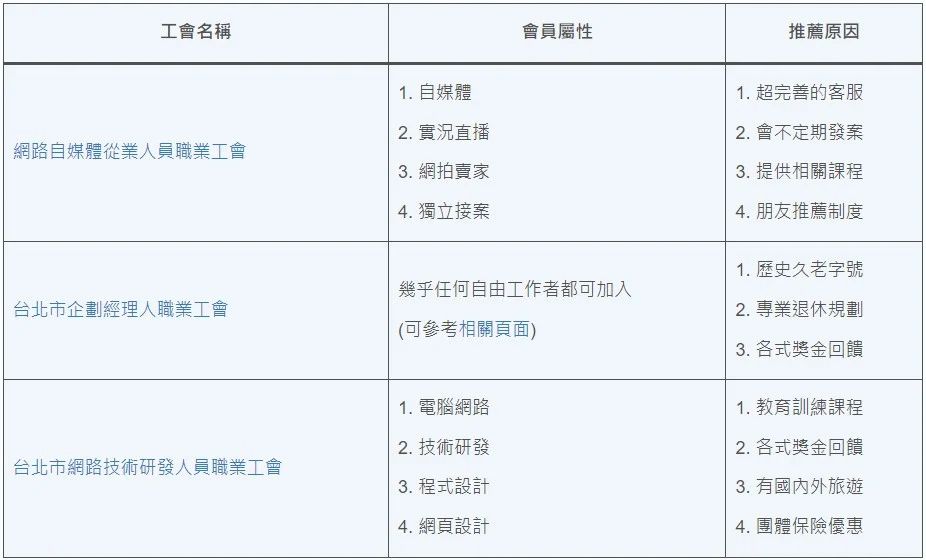
The original author of this article joined the Occupational Union of Online Media Workers because its membership scope matched the author's work, its customer service was responsive, and it offered a referral program. This is a personal experience rather than a universal recommendation. Your choice should be based on your own occupation, location, eligibility, fees, and the union's administrative quality.
4. Labor Insurance or National Pension: How Should You Choose?
Comparing the two systems
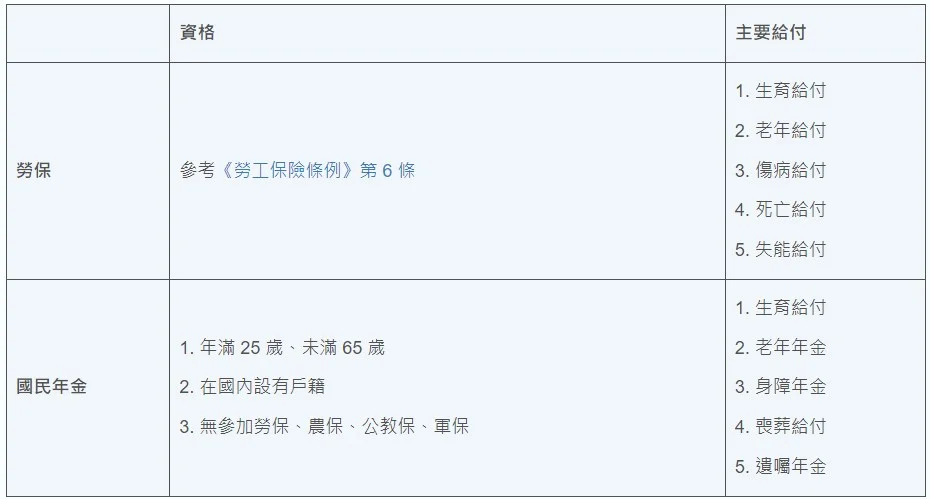
Labor Insurance and National Pension Insurance are separate systems. Labor Insurance is connected to employment or eligible occupational-union participation, while National Pension Insurance mainly covers eligible people who are not enrolled in other major social insurance programs.
Benefit calculations are different
Labor Insurance benefits are generally related to the insured salary and the insured period, subject to statutory formulas and limits. National Pension Insurance uses its own monthly insured amount and benefit formulas.
This means that the system with the lower immediate premium is not necessarily the one that provides the protection you need. Consider disability, survivor, maternity, occupational injury, and old-age benefits as a whole.
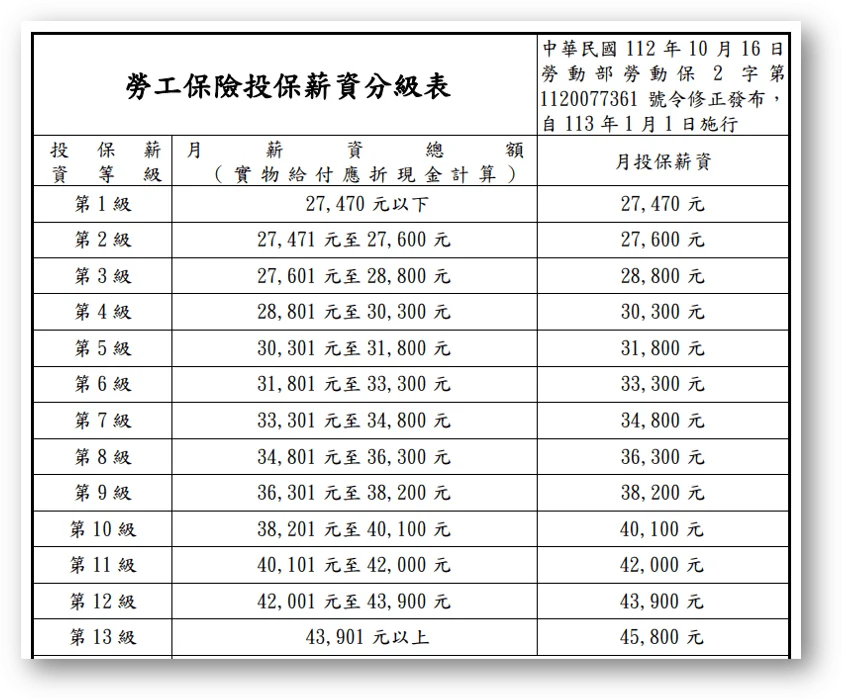
For an estimate, use the official calculators and guidance provided by Taiwan's Bureau of Labor Insurance. Because contribution brackets, premiums, and benefit formulas can change, confirm the current rules before making a long-term decision.
Do not overlook retirement savings
Labor Insurance old-age benefits and the Labor Pension are not the same thing. Employees may receive employer contributions to an individual Labor Pension account, but freelancers enrolled through an occupational union do not receive an employer's 6 percent contribution.
If you are self-employed, you should create a separate retirement plan through regular saving and long-term investing appropriate to your risk tolerance. Social insurance should be treated as one layer of protection, not your entire retirement strategy.
5. Frequently Asked Questions
Q1: How do I enroll through an occupational union?
The exact process differs by union, but it usually includes the following steps:
- Contact a union related to your actual occupation.
- Submit identification and documents showing the nature of your work.
- Select or confirm the appropriate insured salary according to the rules.
- Review the insurance coverage, fees, and payment schedule.
- Pay the required admission, membership, and insurance fees.
- Ask the union when enrollment becomes effective and how to verify it.
Some unions accept online applications, while others require an in-person visit.
Q2: What insured salary should a freelancer choose?
Freelance income may fluctuate, but your insured salary should reflect your actual monthly earnings under the applicable reporting rules. Do not deliberately report an unrealistically low amount simply to reduce premiums. An incorrect declaration may be adjusted after review and may affect contributions or benefits.
If your income varies substantially, keep contracts, invoices, payment records, and other evidence of earnings. Ask the union or the Bureau of Labor Insurance how the current rules apply to your situation.
Q3: Can I move from National Pension Insurance to Labor Insurance?
Yes. If you later become eligible for Labor Insurance, you may enroll in Labor Insurance, and National Pension enrollment for the overlapping period will normally be handled according to the applicable rules.
The insured periods under the two systems are recorded separately. In some circumstances, periods under both systems may be considered when determining eligibility for old-age benefits, while benefits are still calculated under each system's rules. Because the details depend on age, insured periods, and claim timing, consult the Bureau of Labor Insurance for an individual calculation.
Q4: Can I enroll in National Health Insurance as a dependent?
Possibly. If you meet the legal definition of a dependent and do not have a higher-priority enrollment status, you may be able to enroll through an eligible spouse or close family member. It is not a general-purpose option for every freelancer. The National Health Insurance Administration determines the correct enrollment category according to statutory priority rules.
Q5: Should I establish a company just to obtain insurance?
Usually not. A company may be appropriate when your business needs contracts, invoicing, employees, liability separation, or a formal operating structure. Establishing one only for insurance can create disproportionate accounting, tax, and compliance costs.
6. Conclusion
Freelancers in Taiwan do not all have the same best option. The right arrangement depends on whether you have genuine employment, whether your work qualifies for occupational-union enrollment, whether you can enroll as a dependent for health insurance, whether National Pension Insurance applies to you, and whether your business already requires a registered entity.
The most important principles are:
- Keep National Health Insurance enrollment continuous under the correct category.
- Use employer-based Labor Insurance only when a genuine employment relationship exists.
- Join an occupational union only when your actual work meets its membership scope.
- Remember that occupational-union enrollment does not include an employer Labor Pension contribution.
- Verify current contribution rates, insured salary brackets, and benefit rules with the relevant government agency.
If you decide that Labor Insurance is appropriate and you are eligible, do not delay unnecessarily. Insurance periods accumulate over time, and gaps can affect future protection.
Further Reading
If you are deciding among occupational-union enrollment, dependent health-insurance enrollment, National Pension Insurance, and establishing a company, continue with How Do Freelancers Handle Labor and Health Insurance? Your Options When No Company Has Your Back. It compares the major routes, who each option is suitable for, the protection provided, and the main limitations.
This article was republished from DR.DEAN (original Chinese article: How Should Freelancers Handle Labor and Health Insurance? Details for One-Person Businesses).
Follow Digital Nomad Press on Facebook and Instagram for more articles and updates.
This content is protected by copyright. Please respect the author's work and do not copy or distribute without permission.
